
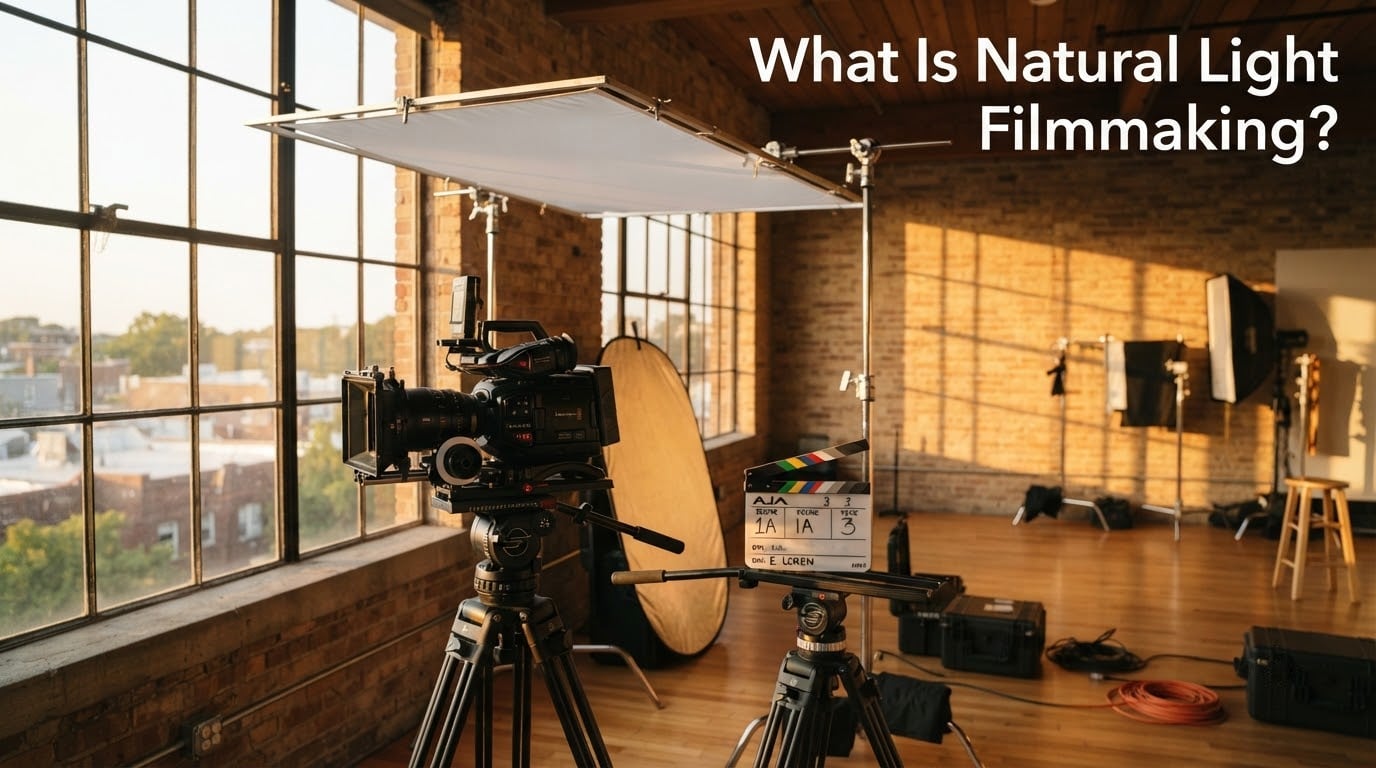
Walk onto almost any indie film set today and you will see the same thing: a small crew, a single camera, and the sun doing most of the work. Natural light filmmaking has quietly become the default for short films, documentaries, and a surprising number of Hollywood features. It is faster, cheaper, and often more emotionally true than any lighting kit you can rent.
In this guide I will walk you through what natural light filmmaking actually means, how it differs from working with studio lights, the techniques professionals use to make sunlight look cinematic, and the moments when you absolutely should not rely on it. I have spent the last few years shooting short films almost exclusively under daylight and ambient sources, and I will share what has worked, what has not, and what I would tell a first-time filmmaker starting tomorrow.
Table of Contents
- What Is Natural Light Filmmaking?
- Why Filmmakers Choose Natural Light
- Types of Natural Light in Cinematography
- Natural Light vs Artificial Light: Key Differences
- Practical Techniques for Shooting Indoors With Natural Light
- Practical Techniques for Shooting Outdoors With Natural Light
- Equipment for Shaping and Controlling Natural Light
- When NOT to Use Natural Light
- Famous Films Shot With Natural Light
- Frequently Asked Questions
- Final Thoughts on Natural Light Filmmaking
What Is Natural Light Filmmaking?
Natural light filmmaking is the practice of shooting a film or video using only the light that already exists in a location – primarily sunlight, but also moonlight, window light, and ambient environmental light – without adding artificial studio lighting. Filmmakers plan their schedules, locations, and camera setups around the position, quality, and color of that available light.
The term is often confused with available light, and the difference matters. Available light technically includes any light source already at the location, including practical lamps, streetlights, and neon signs. Natural light refers more strictly to sunlight and the ambient light that comes from the sky – the kind you cannot turn on or off. For most short film shoots, the two phrases are used interchangeably, but when you read older cinematography books, available light is the broader term.
Filmmakers who work this way treat the sun as their key light, the sky as their softbox, and weather as their gaffer. The job is to plan around what nature gives you and use simple tools like reflectors and diffusion to shape it.
Why Filmmakers Choose Natural Light
There are practical reasons, financial reasons, and creative reasons – and the best cinematographers understand all three.
The first is realism. Our eyes evolved under natural light, so footage shot under daylight feels instinctively true. Skin tones look healthier, landscapes feel deeper, and interiors feel lived-in. When you match the light on screen to the light your audience is sitting under while they watch, the image disappears and the story takes over.
The second is speed and budget. A full lighting rig on a short film can mean a generator truck, two electricians, and an extra hour of setup per setup. Shooting natural cuts that down to a reflector, a diffusion frame, and one crew member. For a short film with a four-day schedule and a tiny budget, that gap is the difference between finishing the shoot or running out of time.
The third is creative freedom for actors. Jean-Marc Vallée shot Dallas Buyers Club almost entirely with natural light so his actors never had to hit marks for lamp positions. They could move, breathe, and find the scene. Watch the film and you can feel it.
There is also a sustainability angle. No generator, no power runs, no heat on set, fewer trucks on the road. Smaller indie productions are starting to advertise this as a feature, not just a compromise.
Types of Natural Light in Cinematography
Not all daylight is created equal. Cinematographers talk about natural light in a handful of specific ways, and learning the vocabulary helps you plan a shoot.
Direct sunlight is unfiltered, hard, and casts sharp shadows. It is the noon sun on a cloudless day, and it is the most unforgiving kind of light for faces. Shoot into it for dramatic silhouettes or backlight; turn subjects away from it and use fill for portraits.
Indirect sunlight is sunlight that has bounced off clouds, walls, snow, or ground before reaching your subject. Overcast skies turn the entire sky into a giant softbox, which is why cinematographers quietly celebrate cloudy days. The light is even, flattering, and consistent for hours at a time.
Window light is sunlight that has traveled through glass. It is usually softer than direct sun and creates beautiful directional gradients on faces. This is the workhorse of indoor natural light filmmaking and the entire basis of classic Hollywood close-ups.
Ambient light is everything else – the glow from a streetlamp, the bounce off a white ceiling, the blue tint from an overcast sky. Indoors without windows, ambient is often the only natural light you have, and it shapes the mood as much as any lamp would.
Moonlight and starlight are technically natural light too, though they are usually too dim to expose for without high ISO. Real moonlit scenes in cinema are almost always lit with HMIs or LED panels balanced to around 4000K to look like the moon.
Color temperature shifts with each type. Direct noon sun sits around 5600K, golden hour drops to about 3200K, blue hour cools down to 8000K or higher, and overcast skies tend to land near 6500K. Setting your white balance correctly is what separates amateur-looking natural light footage from cinematic natural light footage.
Natural Light vs Artificial Light: Key Differences
Natural light and artificial light both light a scene, but they behave very differently on set.
Natural light is free, constantly changing, and impossible to fully control. You can shape it, bounce it, and block it, but you cannot dim the sun or reposition clouds in the middle of a take. It is also directional in a way that feels organic to viewers because it matches the real world.
Artificial light gives you total control over intensity, direction, color temperature, and shadow quality. You can match the look across multiple setups, shoot at any hour of the day, and repeat the same exposure on day fifty of a multi-month shoot. The cost is gear, power, crew, and time.
The choice between them usually comes down to three questions: what is the budget, how many shoot days do you have, and what mood are you trying to create. Big-budget features lean on artificial light for consistency. Short films and documentaries lean on natural light for flexibility. Many modern productions blend both – shooting natural for the wide shots and adding subtle artificial light for close-ups and night scenes.
The three-point lighting system you may have read about – key light, fill light, and backlight – is fundamentally an artificial-light framework. Under daylight, those roles are filled by the sun, a bounce or negative fill, and whatever the sky or a window is doing behind your subject.
Practical Techniques for Shooting Indoors With Natural Light
Indoor natural light filmmaking comes down to one question: where is the window, and where is the sun relative to it.
Start by picking the room with the biggest windows and the highest ceilings. Top-floor apartments and loft spaces usually have light coming in from multiple angles, which gives you flexibility. Basements and interior rooms without windows are almost impossible to light naturally and are usually a sign to switch to HMIs or LED panels.
Position your subject so the window is at a 30 to 45 degree angle to their face. This gives you a soft key light, a natural shadow on the opposite cheek, and a clean gradient across the face. Shooting straight into the window creates a silhouette; shooting with the window directly behind the camera flattens the face and removes dimension.
Use a white wall or a 12×12 bounce on the shadow side to lift the fill. If the shadow side is too bright, use negative fill – a black flag, a Duvatine, or even a dark bedsheet – to deepen it and add shape. Most natural-light beginners skip negative fill and end up with flat, even lighting that lacks dimension.
Diffusion is your friend on bright days. A 6×6 silk or scrim over the window turns harsh midday sun into the soft, directional light you usually only get on overcast days. If you do not own a frame, a sheer white curtain hung over the window does the same job.
Watch for time of day. A window that is perfect at 10 a.m. may be useless by 3 p.m. when the sun moves behind a tree or shifts across the building. Plan your coverage carefully and shoot the wide angles first, when the room is at its most flexible.
For movement blocking, remember that actors walking through a room create their own light transition. Walk them from shadow into a window and back into shadow to write the lighting into the scene itself.
Practical Techniques for Shooting Outdoors With Natural Light
Outdoor natural light filmmaking is mostly a planning exercise. Once the sun is up, you are reacting to it, so the schedule matters more than the gear.
Golden hour is the hour after sunrise and the hour before sunset. The sun is low, the light is warm (around 3200K), shadows are long, and skin tones glow. It is the most popular natural light for narrative work for good reason. The catch is that it only lasts about 60 minutes and you have to be set up before it starts.
Blue hour sits just before sunrise and just after sunset. The sun is below the horizon, the sky is saturated blue, and artificial lights in the scene start to take over. It is ideal for night-for-night scenes that need to feel real.
Overcast days are the most underrated. The whole sky becomes a 180-degree softbox, faces look great without bounce or diffusion, and you can shoot from 9 a.m. to 4 p.m. with consistent quality. Build your key shooting days around cloudy weather when the script allows.
Use a sun tracker app (Sun Surveyor, PhotoPills, or Helios) to plan exact sun positions for every scene. Block your locations with the GPS coordinates and the date and the app will show you where the sun will be at any hour. This lets you walk a location the day before and know which corners will be lit, which will be in shadow, and where the sun pops behind a tree or rooftop.
For camera settings, you will usually want to keep ISO low for clean shadows, set white balance manually for the color temperature of the moment, and use ND filters to control aperture. Shutter speed should match the angle you want – 180 degrees for natural motion blur. A variable ND lets you ride exposure as the sun moves behind a cloud and back.
Weather calls are part of the cinematographer’s job. If the script needs rain or sun, you have to decide in advance whether to postpone, swap coverage, or commit to an overcast look. A backup interior plan is non-negotiable.
Equipment for Shaping and Controlling Natural Light
The toolkit for natural light filmmaking is small, but every piece earns its place.
Reflectors are the single most-used tool. A 5-in-1 collapsible reflector gives you white, silver, gold, black, and translucent diffusion in one package. Silver punches light into shadows, gold warms skin tones, white gives a softer fill, and black gives you negative fill. For a closer look at options, our guide to the best reflectors for natural-light filmmaking breaks down what is worth buying.
Diffusion frames come in silk and solid versions. A 6×6 silk softens a window or a backlit subject; a solid diffusion breaks up harsh sun without softening too much. Frames are heavy and need stands, sandbags, and a grip to set them up.
Scrims are large diffusion panels rigged between the sun and your subject. They turn direct sun into overcast-quality light without moving the shoot indoors. Sizes range from 6×6 to 20×20, with 12×12 being the most common single-source frame.
Flags are solid black frames (or any black material on a stand) used to block light from hitting part of the frame or to deepen shadows. Negative fill on a face is just a flag held close to the shadow side.
ND filters and ND gel reduce the amount of light hitting the sensor without changing the color. Solid variable NDs in matte boxes are the standard for outdoor work; ND gel cut into squares can be taped to windows.
Bounce boards are larger reflectors – usually 4×4 or larger – used to redirect sun onto a subject as a soft key. Mirror boards do the same thing with a harder, more focused beam. Duvatine is the workhorse black fabric for negative fill.
For handheld or run-and-gun shoots, smaller accessories matter too – a folding reflector slips into a backpack, and a battery-powered LED panel is your safety net for the moments when daylight fails you. Our best mobile filmmaking accessories roundup covers the everyday kit. Choosing lenses that handle low light well is also critical for natural light work; see our picks for best lenses for filmmaking in low light.
When NOT to Use Natural Light
Natural light is not always the right answer, and pretending otherwise will burn you on set. Knowing when to switch to artificial light is part of being good at natural light filmmaking.
If your location has no windows or very small ones, you are usually better off adding LED panels than fighting the ambient. Indoor daylight through a tiny window will leave you underexposed, color-shifted, and reliant on high ISO noise.
If you are shooting a multi-day sequence that needs to cut together seamlessly, natural light is risky. The sun moves every minute, clouds come and go, and yesterday’s 4 p.m. setup will not match today’s 4 p.m. setup. Artificial light with matched gels gives you the consistency.
If your schedule forces you to shoot during the worst hours – high noon, in the dead of winter, on a permanently overcast coast – natural light will fight you. Either adjust the schedule, change the location, or supplement with diffusion and bounce until the light is usable.
Night exterior scenes are another limit. A real full moon only provides about 0.05 lux, which is far below exposure for any modern camera without heavy noise. Films that look like they were shot under moonlight are usually using HMI lights cooled to around 4000K.
The honest answer is that natural light filmmaking works best when the script, schedule, and location all cooperate. When any of those three fight you, bring light in.
Famous Films Shot With Natural Light
Some of the most celebrated cinematography in film history was done with daylight – or with daylight as the base and minimal shaping for the close-ups.
Days of Heaven (1978) – Terrence Malick and Néstor Almendros shot almost entirely during the golden hour, often racing to wrap setups before the light ran out. The result is the warm, painterly look that won Almendros the Oscar.
Barry Lyndon (1975) – Stanley Kubrick famously used only candlelight for many interior scenes, lit by a special 50mm Zeiss lens developed for NASA. Asked why he preferred natural light, Kubrick reportedly answered, “Because that’s the way we see things.”
The Revenant (2015) – Emmanuel Lubezki shot the entire film using only available light. The production was delayed almost a year when the planned snow did not fall in Alaska and the crew had to relocate to Argentina.
The Tree of Life (2011) – Another Lubezki and Malick collaboration, shot almost entirely outdoors with available light. Lubezki has said the rule on set was “we may get something, we may not.”
Moonlight (2016) – James Laxton shot on a tight budget using natural light and carefully chosen locations. The look became inseparable from the film’s identity.
Lawrence of Arabia (1962) – Freddie Young shot the desert scenes during a four-month window when the conditions matched the story. The 70mm prints still look like nothing else ever filmed.
Dallas Buyers Club (2013) – Jean-Marc Vallée and Yves Bélanger used natural light to give actors freedom to move. The film went on to win Oscars for Best Picture and Best Actor.
Beasts of the Southern Wild (2012) – Ben Richardson shot on 16mm with mostly natural light, partly out of budget necessity and partly by choice. The image quality and intimacy are part of why the film felt so alive.
Frequently Asked Questions
What’s the difference between natural light and studio light?
Natural light is any sunlight or ambient daylight already at the location – you cannot move, dim, or turn it off. Studio light is artificial lighting you set up on set, giving you total control over intensity, direction, color, and shadow quality. Natural light is free, changeable, and matches what your viewers see in real life. Studio light is repeatable, predictable, and required when you need consistency across many setups or shots that have to match across multiple shoot days.
What are some examples of films shot with natural light?
Days of Heaven, The Tree of Life, The Revenant, Moonlight, Dallas Buyers Club, Beasts of the Southern Wild, and Lawrence of Arabia all used natural light as the primary or only source. Emmanuel Lubezki shot The Tree of Life and The Revenant with natural light on location. Terrence Malick’s films in particular are known for shooting almost entirely during golden hour with available daylight.
How do filmmakers use natural light?
Filmmakers use natural light by planning their shooting schedule around it – choosing locations and shoot times when the daylight is right, positioning subjects and cameras to make the most of that light, and using shaping tools like reflectors, diffusion frames, scrims, and negative fill to control its quality. They also set white balance manually, ride exposure as the sun moves, and watch weather forecasts closely because clouds and rain change everything.
Why do filmmakers use natural light?
Filmmakers use natural light for realism, lower cost, faster setup, smaller crews, and creative freedom for actors. Natural light matches the world the audience lives in, which makes the image feel more honest. It also removes the need for generators, lamp operators, and long setup times – critical advantages for short films and documentaries with tight schedules. Stanley Kubrick once summed it up by saying he preferred natural light because that is the way we see things.
Final Thoughts on Natural Light Filmmaking
Natural light filmmaking is not a workaround for a small budget – it is a creative choice with a long pedigree. From Kubrick’s candlelit interiors to Lubezki’s golden-hour epics, the most celebrated cinematography in film history has often been the work of someone who planned around the sun instead of fighting it.
If you are starting a short film this week, pick your three biggest exterior scenes around golden hour, pick your interiors based on where the window faces in the morning, and budget for a reflector and a 6×6 silk before you rent any lights. You will move faster, spend less, and probably end up with a look that feels more like a film than a setup.