
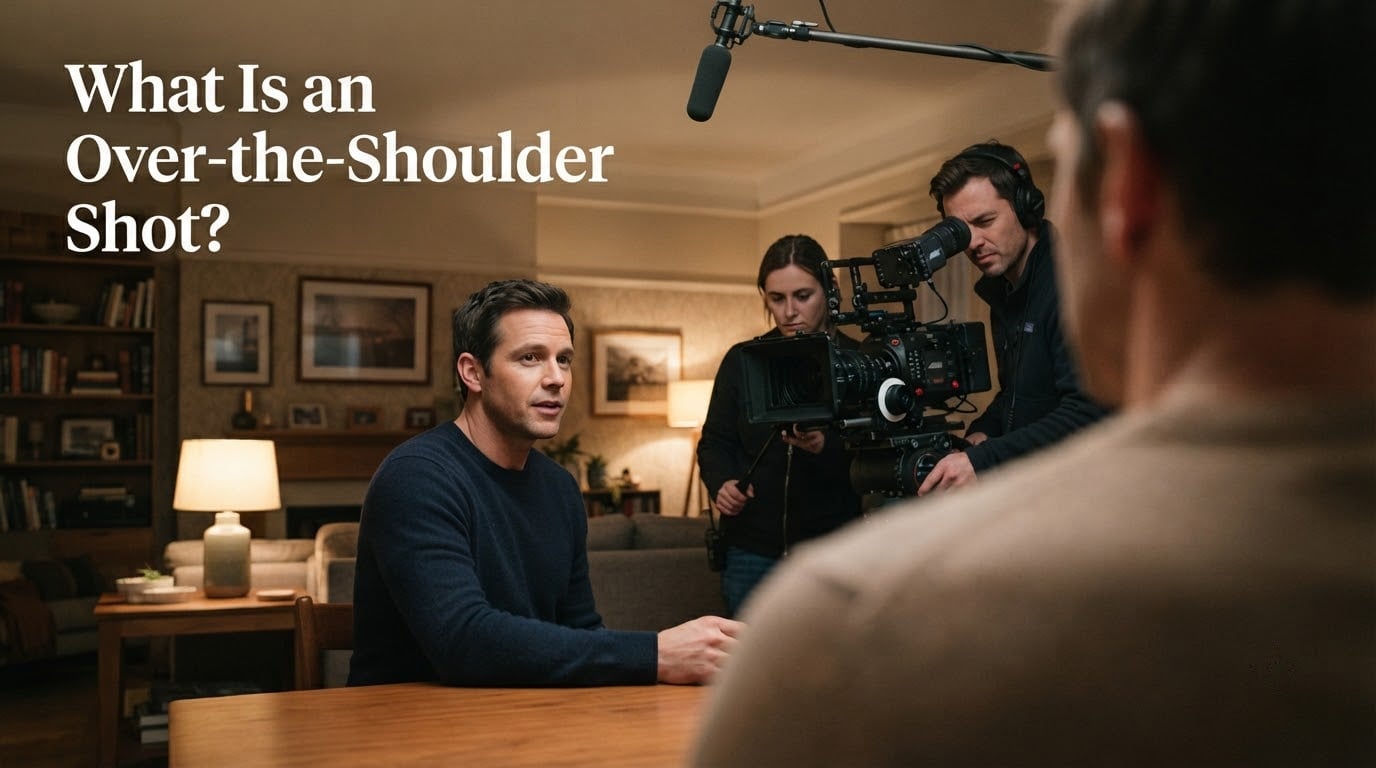
If you have ever watched a conversation unfold on screen and felt instantly placed inside the room, you have experienced the over-the-shoulder shot at work. An over-the-shoulder shot (often called OTS or a third-person shot) is a camera angle placed just behind and slightly to the side of one character so the back of their shoulder and head occupies the foreground while another character is framed across from them.
OTS shots are the silent backbone of nearly every dialogue scene in film and television. In this guide, we will break down what an over-the-shoulder shot is, why directors reach for it again and again, the main variations you will see on screen, and how to film one yourself. By the end, you will be able to spot an OTS in the first second of any scene and know exactly why the director chose it.
Table of Contents
- What Is an Over-the-Shoulder Shot?
- Why Filmmakers Use Over-the-Shoulder Shots
- Types of Over-the-Shoulder Shots
- Over-the-Shoulder Shot vs Single Shot vs Two-Shot vs POV
- How to Film an Over-the-Shoulder Shot
- The 180-Degree Rule and Eye Line Matching
- Famous Over-the-Shoulder Shot Examples in Film
- Common Mistakes to Avoid
- Frequently Asked Questions
- What is an over-the-shoulder shot in cinematography?
- Why would a director use an over-the-shoulder shot?
- What is the effect of taking an over-the-shoulder shot?
- What is a dirty over-the-shoulder shot?
- What is the 180 rule in videography and how is it used?
- Can you provide some examples of over-the-shoulder shots?
- What are the four types of shots?
- Why do directors use over-the-shoulder shots?
- Final Thoughts on the Over-the-Shoulder Shot
What Is an Over-the-Shoulder Shot?
An over-the-shoulder shot is a camera angle in film and television where the camera is placed above the back of the shoulder and head of one character, looking past them toward another character in the scene. The character whose shoulder we see from behind is called the off-screen actor. The character facing the camera is called the on-screen actor. Together, the two angles form one side of a conversation before the edit cuts to the reverse for the other side.
How the Camera Is Positioned
The camera sits roughly 30 to 60 centimeters behind and to the side of the off-screen actor’s head. It aims forward, across the axis of action, so the on-screen actor’s face lands on the far side of the frame. The off-screen actor stays slightly out of focus, creating a soft foreground shape that frames the shot without competing for attention.
Key Parts of the Frame
- Foreground: The blurred shoulder, neck, or back of the off-screen actor.
- Midground: The on-screen actor, usually framed from the chest up.
- Background: Set dressing, depth, and any other characters in the scene.
- Eye line: The imaginary line from the on-screen actor’s eyes to a point just past the camera, where the off-screen actor would be standing.
The result is a frame that feels inhabited. You are not watching a character speak from across a void; you are sitting next to someone, listening in.
Why Filmmakers Use Over-the-Shoulder Shots
Directors reach for the over-the-shoulder shot because it does five jobs at once. It anchors the viewer in physical space, signals whose turn it is to speak, builds intimacy between two characters, controls the emotional rhythm of the scene, and lets the editor cut back and forth without breaking the 180-degree rule.
- Orient the viewer: The shoulder tells you exactly where you are in the room and who else is present.
- Suggest intimacy: Sitting behind a shoulder feels like standing close to someone in real life.
- Show power dynamics: A lower shoulder can make the on-screen actor feel larger or more dominant; a higher shoulder can make them feel small.
- Drive the edit: OTS shots naturally pair into shot-reverse-shot pairs that carry dialogue rhythm.
- Hide the cut: Movement in the foreground shoulder masks the edit point, making the conversation feel seamless.
In our experience breaking down scenes for shot lists, we have noticed that OTS shots do the heaviest lifting in first meetings, interrogations, and confessions. The shoulder acts as a kind of barrier the audience can lean against, watching the conversation happen just beyond it.
Types of Over-the-Shoulder Shots
Not every OTS is the same. Editors and cinematographers use a small family of variations, each with a different feel. Here are the most common types you will see on screen and on set.
Dirty Single
A dirty single (or dirty over) shows part of the off-screen actor’s head, hair, or shoulder in the foreground, often blurry, while the on-screen actor is in sharp focus. It is the most common OTS variation and the workhorse of dialogue coverage. Reviewers on r/cinematography note that beginners tend to frame too much of the foreground head, which pulls focus away from the speaker.
Clean Over
A clean over is an over-the-shoulder shot where the off-screen actor is essentially absent from the frame. The camera is still positioned from behind the shoulder, but only the on-screen actor and the surrounding environment are visible. Clean overs feel less crowded and are useful when the foreground character would distract from the moment.
Wide OTS
A wide OTS pulls the camera further back so both characters are fully visible from the waist up, with one shoulder still anchoring the foreground. This variation carries more blocking information and is common in Westerns, office scenes, and any place where body language matters as much as dialogue.
Shot-Reverse Shot
Shot-reverse shot is the editing pattern, not a single shot, that uses two matched OTS angles. The first OTS shows character A from behind B’s shoulder; the editor cuts to the reverse OTS showing character B from behind A’s shoulder. This back-and-forth is the standard rhythm of nearly every dialogue scene in modern cinema.
Over the Hip
An over-the-hip variation frames the off-screen actor from the hip down rather than the shoulder. Filmmakers use it for more dynamic blocking, dance-like movement, or scenes where the characters are moving through space rather than standing still.
Over-the-Shoulder Shot vs Single Shot vs Two-Shot vs POV
OTS shots sit alongside three other foundational coverage shots. Knowing the difference helps you choose the right tool for each beat of a scene.
| Shot Type | What It Shows | Best Used For | Emotional Feel |
|---|---|---|---|
| Over-the-shoulder (OTS) | One character from behind another’s shoulder | Dialogue, conversation, exchanges | Intimate, shared, balanced |
| Single shot | One character alone in the frame | Reaction beats, emotional isolation | Focused, vulnerable, intense |
| Two-shot | Two characters side by side in the same frame | Establishing relationships, group moments | Connected, observational, neutral |
| POV shot | Exactly what a character sees | Subjective moments, suspense reveals | Personal, immersive, disorienting |
Most dialogue scenes mix OTS shots with singles and two-shots rather than relying on OTS alone. Mixing reads as more professional and lets the editor shape the emotional temperature of each beat.
How to Film an Over-the-Shoulder Shot
Filming a clean OTS is simpler than it looks, but every step matters. Follow this five-step process the next time you block a dialogue scene.
Step 1: Block the Characters
Mark the actors’ positions on the floor with tape. The two characters should stand roughly 1 to 2 meters apart and face each other directly. Make sure they can see each other’s eyes without tilting their heads. Blocking first lets the camera fall into the right place later.
Step 2: Choose the Camera Side
Pick which side of the line the camera will sit on. Once you decide, every other shot in the scene must respect that side, or you will break the 180-degree rule and confuse the audience about spatial geography.
Step 3: Set the Lens and Focus
Use a 35mm to 50mm lens for most OTS work. A longer lens flatters the face and softens the foreground shoulder; a wider lens keeps more of the room in the frame. Pull focus so the on-screen actor is sharp and the foreground shoulder falls slightly soft.
Step 4: Match the Eye Line
Place a small piece of tape on the off-screen actor’s cheek or ask them to hold a finger next to their face. The on-screen actor should look just past the camera, toward that mark. Matching eye lines on both sides of the conversation keeps the geometry of the scene believable.
Step 5: Shoot the Reverse and Get Coverage
Once you have the first OTS, walk around the actors and shoot the reverse OTS from the opposite shoulder. Then capture a wide two-shot, a single on each actor, and any inserts you might need. Coverage gives the editor options and protects you against performance choices you cannot predict.
The 180-Degree Rule and Eye Line Matching
The 180-degree rule is the invisible line drawn between two characters facing each other. The camera must stay on one side of that line for the entire scene, or the actors will appear to swap places on screen. OTS shots live and die by this rule; break it, and the conversation feels broken even if the audience cannot name why.
Eye line matching is the matching pattern. When character A looks slightly to screen-right in their OTS, character B must look slightly to screen-left in their reverse OTS. The two eye lines should converge on the same imaginary point in space, even though the camera has moved. Many filmmakers on r/Filmmakers describe continuity in eye line as more important than exact shoulder framing; a slightly off shoulder reads fine, but a swapped eye line reads as a continuity error.
If you want to break the 180-degree rule on purpose, you usually signal it with a wide shot, a deliberate cut to a new angle, or a moment where the character physically crosses the line. Otherwise, stay on your side.
Famous Over-the-Shoulder Shot Examples in Film
Studying great scenes is one of the fastest ways to internalize the technique. Here are five iconic over-the-shoulder shot examples and what makes each one work.
- The Godfather (1972): The door-close with Kay Corleone uses a slow OTS push-in across Michael’s shoulder, building dread as the camera inches toward his face.
- Casablanca (1942): The airport goodbye between Rick and Ilsa is built almost entirely from OTS shots that keep the two characters in constant visual conversation.
- Pulp Fiction (1994): Tarantino stacks OTS on OTS in the Jack Rabbit Slim’s booth scene, breaking convention to keep the audience slightly off-balance.
- No Country for Old Men (2007): The coin-toss motel scene uses sparse, careful OTS coverage that lets silence carry more weight than dialogue.
- Westworld (2016): Modern prestige television leans hard on OTS pairs in conversation scenes to make dialogue feel theatrical.
Watch any of these scenes with the sound off and you can still follow the emotional arc purely from the camera placement. That is the mark of a well-designed OTS sequence.
Common Mistakes to Avoid
Even experienced crews fall into the same handful of traps. Here are the mistakes we see most often and how to fix them.
- Framing too much foreground. If the off-screen actor’s full head and nose are in focus, the eye gets pulled to them. Crop the shoulder and hairline and let the foreground fall soft.
- Breaking the 180-degree rule by accident. A handheld move, a quick re-stage, or a second camera on the wrong side can flip the line. Choose your side, mark it, and protect it.
- Stacking OTS on OTS. If every line of dialogue is covered with a back-and-forth OTS, the scene flattens. Drop in singles or a wide two-shot to give the editor rhythm.
- Ignoring the background. A distracting exit sign, a crooked picture, or a bright window behind the on-screen actor can pull focus from the performance. Always check the background before rolling.
- Forgetting the foreground actor’s movement. A tiny shift in head position can completely change the framing. Give the foreground actor small, natural beats to play rather than asking them to freeze.
Aim for variety. The best dialogue coverage mixes OTS shots with singles, two-shots, and the occasional wide, so the scene has places to breathe.
Frequently Asked Questions
What is an over-the-shoulder shot in cinematography?
An over-the-shoulder shot in cinematography is a camera angle positioned just behind and slightly to the side of one character so the back of their shoulder and head appears in the foreground while another character is framed across from them. It is one of the most common coverage shots used in dialogue scenes.
Why would a director use an over-the-shoulder shot?
Directors use over-the-shoulder shots to orient the viewer in physical space, build intimacy between two characters, signal whose turn it is to speak, control the emotional rhythm of a scene, and create a clean shot-reverse-shot editing pattern. The technique is the backbone of nearly every dialogue scene in film and television.
What is the effect of taking an over-the-shoulder shot?
The effect of an over-the-shoulder shot is to place the viewer behind one character, looking at another, which creates a sense of shared presence and emotional closeness. It hides the cut between angles, carries the 180-degree rule naturally, and lets the audience read micro-expressions on the on-screen actor’s face.
What is a dirty over-the-shoulder shot?
A dirty over-the-shoulder shot is a variation where part of the off-screen actor’s head, hair, or shoulder is visible in the foreground, usually slightly out of focus, while the on-screen actor is in sharp focus. It is the most common OTS style and the workhorse of dialogue coverage in modern filmmaking.
What is the 180 rule in videography and how is it used?
The 180-degree rule in videography is the rule that the camera must stay on one side of an imaginary line drawn between two characters who are facing each other. As long as every shot in the scene stays on the same side of that line, screen-left and screen-right stay consistent. It is used in over-the-shoulder shots so that two characters in a conversation never appear to flip positions on screen.
Can you provide some examples of over-the-shoulder shots?
Classic examples of over-the-shoulder shots include the door-close scene in The Godfather, the airport goodbye in Casablanca, the booth conversation in Pulp Fiction, the motel scenes in No Country for Old Men, and most dialogue scenes in Westworld. Each of these scenes relies on OTS pairs to carry the emotional rhythm of the conversation.
What are the four types of shots?
The four foundational types of shots in film are the close-up, medium shot, wide shot, and over-the-shoulder shot. Close-ups show emotion, medium shots show dialogue and gesture, wide shots establish geography, and over-the-shoulder shots place the viewer behind one character looking at another.
Why do directors use over-the-shoulder shots?
Directors use over-the-shoulder shots because the angle does five jobs at once. It anchors the viewer in space, signals whose turn it is to speak, builds intimacy, controls scene rhythm, and lets the editor cut cleanly between angles without breaking the 180-degree rule.
Final Thoughts on the Over-the-Shoulder Shot
The over-the-shoulder shot is the small, repeatable unit that holds most of cinema together. Once you can read it, you can read almost any dialogue scene in any film you watch this year. We recommend pulling up one of your favorite conversation scenes, muting the audio, and sketching out which shots are OTS, which are singles, and which are wide. The pattern becomes obvious fast.
When you are ready to plan your next shoot, build your own one-shot short film, or set up the right support gear for handheld work, explore our shot list software guide and our shoulder rig recommendations. The over-the-shoulder shot is one of the oldest tools in film, and it is still one of the most powerful.