
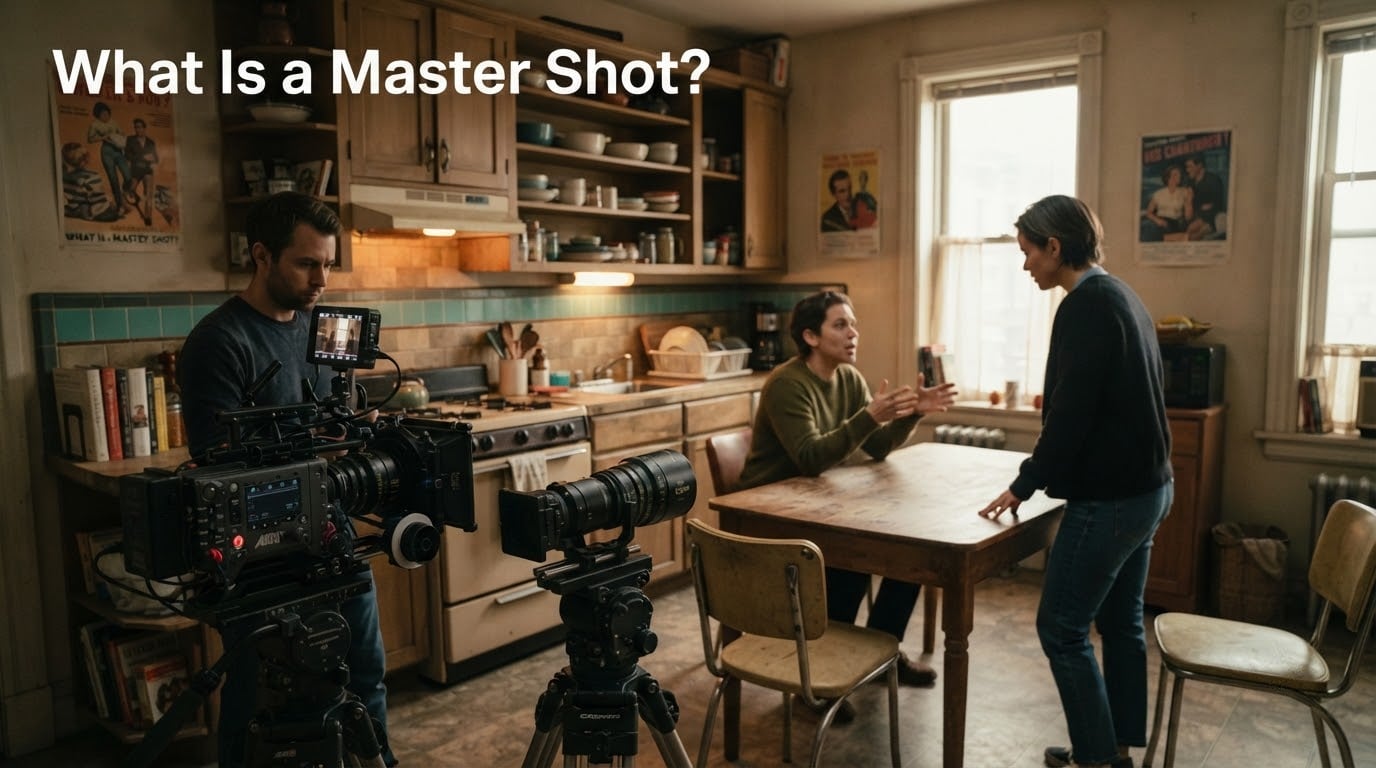
If you have ever wondered what is a master shot, here is the short answer: it is one continuous take that records an entire scene from start to finish, keeping every player in view from a wide angle so editors can build the rest of the scene around it.
We have spent the last few months watching master shots, breaking them down scene by scene, and trying them on our own short film sets. In this guide, we will walk you through the definition, the purpose, the two main flavors (standard and complex), and the practical steps our team uses to plan, shoot, and edit a master shot on a short film budget. By the end, you will know exactly when to use one, when to skip it, and how to make it work even with a three-person crew.
Table of Contents
- What Is a Master Shot in Film? Definition and Core Idea
- Why Master Shots Matter: The Safety Net and Creative Anchor
- Standard Master Shot vs Complex Master Shot
- Master Shot vs Establishing Shot vs Wide Shot
- How to Plan and Shoot a Master Shot: 6 Steps
- How Long Should a Master Shot Last?
- Famous Master Shot Examples in Film
- Master Shots in Short Films: A Practical Angle for Indie Filmmakers
- Common Master Shot Mistakes to Avoid
- When NOT to Use a Master Shot
- Frequently Asked Questions
- Final Thoughts on the Master Shot
What Is a Master Shot in Film? Definition and Core Idea
A master shot is a single continuous take that captures an entire dramatized scene from beginning to end, keeping all of the characters, their actions, and the surrounding environment in frame. The camera typically starts wide enough to see the whole playing space and may stay put or move through a choreographed path while the scene plays out.
The technique goes back to the earliest days of narrative cinema, when directors had no way to cut between cameras and simply rolled on the whole scene from a respectful distance. Today, the master shot still serves that same purpose: it gives you one complete record of the scene that you can always fall back on. Modern directors treat it as the backbone of their coverage – the master shot establishes scene geography, locks down continuity, and provides the reference point that every closer angle gets cut against.
You will also hear the master shot called a “wide master,” a “cover shot,” or simply “the master” on set. It is not a single framing choice, but rather a filming approach defined by completeness and continuity.
Why Master Shots Matter: The Safety Net and Creative Anchor
The master shot exists for two reasons, and most filmmakers only ever think about the first one. The practical reason is insurance. When you shoot a master first, you are guaranteed at least one usable take of the entire scene. If a focus pull misses, an actor forgets a line, or a lighting cue goes wrong on a closer shot, the master is still there in the edit bay. Beginners often skip it to save time and live to regret it during post-production when their coverage does not match up.
The creative reason is more interesting. A great master shot anchors the whole scene. It establishes where the characters are in relation to each other and to the room, and it lets the audience feel the full weight of the moment before you push in for emotion. Long takes by directors like Martin Scorsese, Stanley Kubrick, and Alfonso Cuarón use the master format as a creative tool to build tension, reveal information slowly, and put the viewer inside the scene instead of watching it from the outside.
For short film crews specifically, the master shot often pulls double duty. It saves time you cannot afford to waste on coverage, and it lets a small location carry a scene through performance and movement rather than through cuts. We have used it on short drama sets where there were simply not enough hours to light three angles.
Standard Master Shot vs Complex Master Shot
Most of the guides out there lump every master shot together, but there are really two distinct approaches. They look similar on screen, but they require very different planning.
Standard Master Shot
A standard master shot is a static or minimally moving wide take that simply records the scene. The camera sits on a tripod, the actors perform the scene from start to finish, and you cut to closer coverage afterward. This is the kind of master shot you will see in most dialogue scenes in television and indie features. It is fast to set up, easy to light, and reliable as coverage insurance.
Complex Master Shot
A complex master shot is choreographed. The camera moves through the scene on a dolly, slider, or Steadicam. The actors hit precise marks, the blocking is rehearsed, and the whole sequence is designed to play in one continuous take without a cut. Think of the Copacabana tracking shot in Goodfellas, the hallway swings in The Shining, or the battle sequence in Children of Men.
Complex masters are riskier to shoot but they pay off emotionally. They feel immersive in a way that edited coverage rarely does. The trade-off is time: a complex master can eat half a day on a short film set, so it should be reserved for scenes where the long take itself carries the meaning.
| Aspect | Standard Master Shot | Complex Master Shot |
|---|---|---|
| Camera movement | Static or simple move | Choreographed dolly, slider, or Steadicam path |
| Setup time | 15 to 45 minutes | 1 to 4 hours |
| Rehearsal needed | Minimal | Extensive blocking rehearsal |
| Best for | Dialogue scenes, safety coverage | Scenes where the take itself carries meaning |
| Risk of failure | Low | High (focus pulls, marks, performance) |
Master Shot vs Establishing Shot vs Wide Shot
Three terms get thrown around as if they mean the same thing, and they do not. People ask us all the time about the difference between a master shot and an establishing shot, and almost as often whether a master shot is just a wide shot. Here is the clean breakdown.
An establishing shot is a brief opening shot that tells the audience where the next scene is taking place. It usually shows the exterior of a building or a wide view of a landscape, and it runs only a few seconds before you cut into the scene. The establishing shot exists to orient the viewer, not to cover the scene.
A wide shot is a framing choice. It refers to a camera position far enough back to show a character’s full body and the surrounding space. Wide shots can be part of a master shot, but they can also be a single line of dialogue, an insert, or any shot the cinematographer chooses to frame wide.
A master shot is a complete record of the whole scene. It uses a wide framing by convention, but the defining feature is duration and coverage, not framing. You could in theory shoot a master shot as a medium on a long lens in a tiny room, as long as the camera rolls continuously through the entire scene.
| Term | What it is | How long | Purpose |
|---|---|---|---|
| Master shot | Continuous take of the whole scene | 30 seconds to several minutes | Coverage backbone for the edit |
| Establishing shot | Brief location-setting opener | 2 to 10 seconds | Tell the audience where the scene is |
| Wide shot | A framing choice | Any duration | Show the full body and environment |
How to Plan and Shoot a Master Shot: 6 Steps
Here is the six-step process our team runs through before we roll on any master shot. It works on a short film set with a skeleton crew just as well as it does on a larger production.
Step 1: Break Down the Scene
Read the scene like a script supervisor, not a reader. List every action, every prop the actors touch, every door they open, every line of dialogue, and any practical effects that need to happen. The breakdown tells you what the master shot actually has to capture, which is usually more than you think on first read.
Step 2: Build a Shot List and Storyboard
Translate the breakdown into a shot list that includes the master shot at the top, followed by all of the closer coverage you will need. For the master itself, sketch a quick storyboard or use a shot list app. If you want a starting point for the software side, our shot list and scheduling software roundup covers the tools we have tested on real sets.
Step 3: Block the Actors and Camera
Walk the scene with your actors and find the marks. Mark them with tape. Walk the camera path yourself, even if it is just a slight push-in. If you are planning a complex master with movement, rehearse the timing until everyone can do it three times in a row without thinking. This is where most master shots succeed or fail.
Step 4: Choose Your Framing
Pick the framing that gives you everything you need without making the actors feel miles away. A wide shot works for big physical scenes. A long shot frames the full body tighter and works well for two-person dialogue. A full shot (head to feet, but closer in) can double as a master in a small room. If you want to add subtle motion to a static master, a slider is often the cheapest way to do it – we rounded up our favorites in our cinematic camera slider guide.
Step 5: Shoot the Master First
Roll on the master before you shoot any coverage. Treat it as your safety net. Once you have a clean master in the can, you can experiment with closer angles knowing the scene is locked down. Reddit’s r/Filmmakers community hammers this point again and again: indie directors who skip the master shot first end up with mismatched coverage and lost scenes in the edit.
Step 6: Capture Coverage Around the Master
Now shoot your close-ups, over-the-shoulders, and inserts using the master as your reference for screen direction, eyelines, and timing. The master will tell you where to cut back to whenever a closer angle breaks continuity, which is a frequent problem for short film editors working with limited footage.
How Long Should a Master Shot Last?
There is no fixed rule, but the answer most working directors give is between 30 seconds and 3 minutes for a standard master shot, and anywhere from 3 to 10 minutes for a complex one. The duration is set by the scene itself. A two-page dialogue scene will give you a master shot in the 60 to 180 second range. A simple wide master of a single character entering a room might be 20 to 40 seconds. A complex long take like the Copacabara opener in Goodfellas runs over three minutes.
As a rule of thumb, do not make a master shot longer than the scene needs. If the scene is two minutes of dialogue, your master should be two minutes, not five. Long takes only earn their length when the camera movement or the blocking is doing meaningful work. If nothing changes for the viewer in the second half of the take, you can cut to coverage sooner and lose nothing.
Famous Master Shot Examples in Film
Examples help more than any abstract explanation. Here are five master shots our team comes back to when we teach the technique on short film sets.
- Touch of Evil (1958) – Orson Welles. The three-minute opening crane shot is the most famous master shot in film history. It follows a couple across a border town, introduces two ticking bombs, and sets up the whole murder plot in one unbroken take.
- Goodfellas (1990) – Martin Scorsese. The Copacabana tracking shot follows Henry Hill and his date from the street, through the back entrance, past the kitchen, and into the VIP table in a single take that introduces the world of the mob.
- The Shining (1980) – Stanley Kubrick. The Steadicam follows Danny Torrance on his tricycle through the Overlook Hotel’s hallways, building dread through continuous movement. It is a complex master shot in its purest form.
- Children of Men (2006) – Alfonso Cuarón. The car ambush and the refugee camp escape are shot almost entirely as long masters, putting the audience in the middle of a chaotic future.
- Birdman (2014) – Alejandro G. Iñárritu. The whole film is designed to look like one master shot, stitching many complex takes together to hide the cuts. It is the most ambitious modern use of the technique.
Master Shots in Short Films: A Practical Angle for Indie Filmmakers
Most guides on master shots assume you have a feature-sized schedule and a union crew. That is not our world, and it is probably not yours either. Here is how we adapt the master shot for short film production specifically.
Short films tend to live in one or two locations with small casts. That is actually a gift when it comes to master shots, because the technique shines when the whole scene happens in one continuous space. A ten-minute drama with a kitchen and two actors can be shot almost entirely as a master plus a few closer pickups, and the result can feel more cinematic than a coverage-heavy cut that looks like a soap opera.
If you want to push the technique further, a one-shot short film takes the master shot to its logical limit. Our complete guide to one-shot short films walks through how crews of three to ten people actually pull off a 10 to 20 minute single take, including blocking, rehearsal, and the gear that makes it possible.
For exterior work, drones have quietly become the cheapest way to get a sweeping master shot. A single FPV drone flight can cover a location in one take for a fraction of what a crane would cost. If you want to see what is out there, our FPV drone roundup and our cinematic landscape drone guide compare the models we have actually flown on short film sets.
Common Master Shot Mistakes to Avoid
Master shots fail in predictable ways. Here are the four we see most often on short film sets, plus how to avoid them.
- The security camera framing. A static wide master with no camera movement reads as surveillance footage. Even a slow push-in or a slight pan keeps the shot alive and signals intent to the viewer.
- Skipping the master to save time. Skipping the master almost always costs more time later. Shoot it first, even if you are sure you will not use it. You will thank yourself in the edit.
- Flat blocking. If the actors stand in a line and deliver lines without moving through the space, the master shot becomes a stage play. Choreograph movement so that the geography of the scene changes during the take.
- Unrehearsed focus pulls. A complex master that loses focus at the two-minute mark is unusable. Rehearse the focus pulls as many times as the actors rehearse their marks.
When NOT to Use a Master Shot
The master shot is a tool, not a rule. There are scenes where it actively works against you, and a good director knows when to skip it.
If your scene cuts between two or more locations, a single master shot cannot cover it without a process shot or a forced transition. Better to design the scene as cross-cut coverage from the start. Similarly, a montage or a music-heavy sequence usually gains nothing from a master shot and loses the rhythm that cuts provide. If the scene is a stylized comedy with reaction shots every line, the master shot will slow the pacing and dilute the jokes.
Director Neil Oseman has written thoughtfully about this trade-off, and his argument is worth considering even if you love master shots. Use them when the technique serves the story. Skip them when the story is better served by faster cutting or by coverage that holds attention through editing rhythm rather than continuous takes.
Frequently Asked Questions
What is a master shot in filmmaking?
A master shot in filmmaking is a single continuous take that records an entire dramatized scene from start to finish, with the camera positioned wide enough to keep all of the characters and the surrounding environment in view. It serves as the backbone of the scene’s coverage and the safety net for the editor.
How long should a master shot last?
A standard master shot usually runs between 30 seconds and 3 minutes, depending on the length and pacing of the scene. A complex master shot with choreographed camera movement can run anywhere from 3 to 10 minutes or more. The shot should be exactly as long as the scene itself, and not a frame longer.
Is a master shot the same as a wide shot?
No, a master shot and a wide shot are not the same thing. A master shot is defined by duration and coverage – it captures the whole scene in one take. A wide shot is a framing choice that can be used anywhere in a scene, including inside the master shot itself.
What is the difference between a master shot and an establishing shot?
An establishing shot is a brief opening shot, usually 2 to 10 seconds long, that tells the audience where the next scene takes place. A master shot is a complete record of the entire scene from beginning to end. The establishing shot orients the viewer; the master shot covers the scene.
Can you give me an example of a master shot in a movie?
A great example is the opening of Touch of Evil (1958) directed by Orson Welles, where a single three-minute crane shot follows a couple across a border town and introduces the murder plot in one unbroken take. Other classic examples include the Copacabana tracking shot in Goodfellas and the Steadicam hallway sequence in The Shining.
Final Thoughts on the Master Shot
So, what is a master shot? It is one continuous take that covers your whole scene from a wide enough angle to keep the geography intact, and it is the single most useful tool a short film director has for getting home with a clean edit. Shoot the master first, build your coverage around it, and use complex masters only when the scene itself calls for a long take.
If you are starting your first short film this season, try shooting one scene as a master shot and another as standard coverage, then compare them in the edit. You will learn more from that experiment than from any amount of theory. And if you want to keep going, our guide to one-shot short films takes the same ideas and pushes them as far as a small crew can take them.