
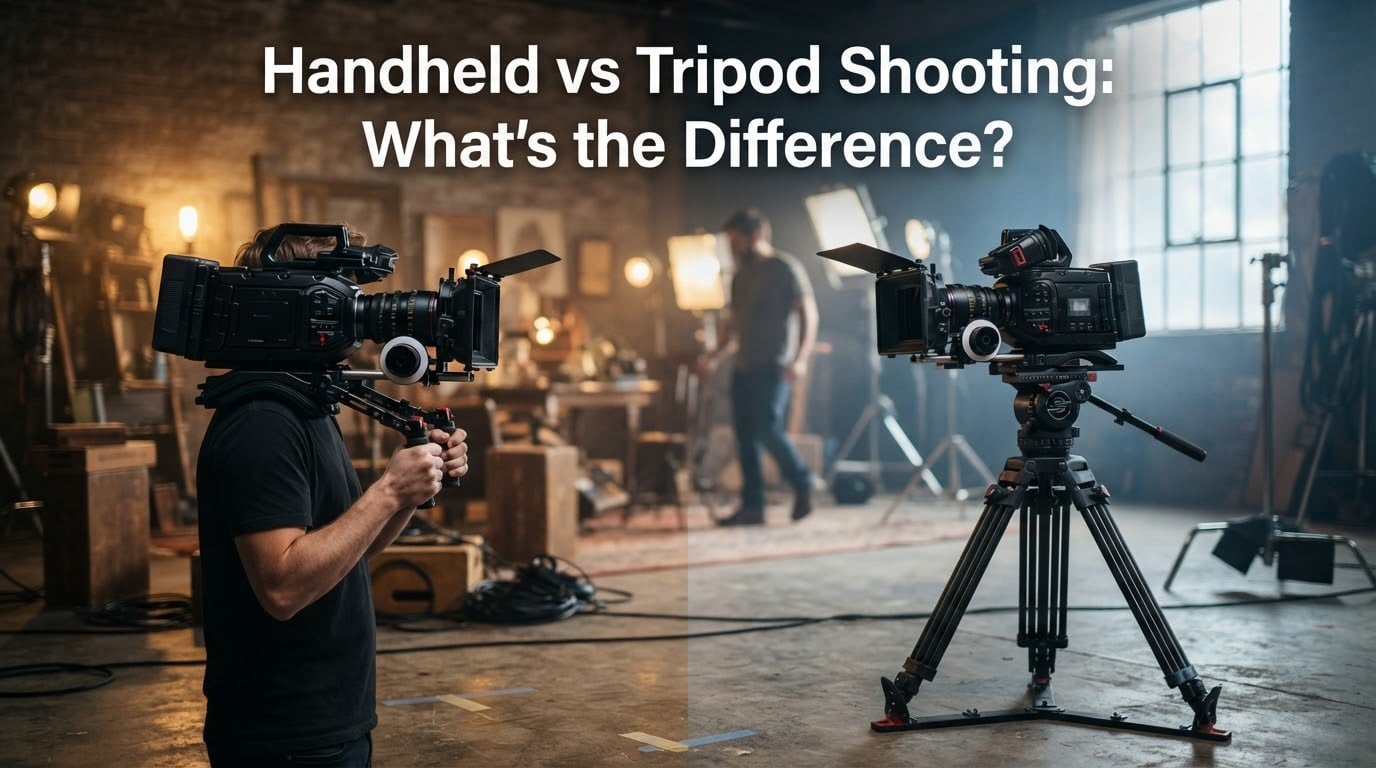
Handheld vs tripod shooting comes down to what you want the audience to feel. In handheld shooting, the camera operator holds the camera (often on a shoulder or support rig), so the frame carries the natural movement of the human body. In tripod shooting, the camera locks onto a three-legged stand, so the frame stays still, composed, and observational.
Both are valid tools. Most working filmmakers treat the choice as a spectrum, not a binary, and pick per scene, per beat, and per emotional intent. Our team has talked through this question with dozens of short-film directors and DPs over the years, and the answer is almost always the same: the best choice is the one that serves the story.
This guide walks through what handheld and tripod actually do on screen, the pros and cons of each, when to use which, and how to mix them inside a single short film. If you are choosing camera support for a festival-bound short, an interview shoot, or your first narrative film, this is the breakdown we wish we had on day one.
Table of Contents
- What Is Handheld Shooting?
- What Is a Tripod and What Is a Lock-Off Shot?
- Side-by-Side: Handheld vs Tripod at a Glance
- Pros of Handheld Shooting
- Cons of Handheld Shooting
- Pros of Tripod Shooting
- Cons of Tripod Shooting
- When to Use Handheld vs When to Use a Tripod
- Hybrid Shooting: Mixing Handheld and Tripod in One Film
- Famous Examples of Handheld and Tripod in Cinema
- Practical Tips for Shooting Handheld
- Practical Tips for Shooting on a Tripod
- Frequently Asked Questions
- What is the main difference between handheld and tripod shooting?
- Is handheld better than tripod?
- When is a tripod essential?
- What are the challenges of handheld shooting with a professional camera?
- What is a lock-off shot?
- Can you mix handheld and tripod in the same film?
- Which is better for video recording, a monopod or a tripod?
- Final Thoughts on Handheld vs Tripod Shooting
What Is Handheld Shooting?
Handheld shooting means the camera operator holds the camera directly with their body, with or without a shoulder rig, easy rig, or gimbal. The footage carries the operator’s breathing, footsteps, and micro-movements, which is why the look reads as immediate and alive.
Handheld is a spectrum. On one end you have aggressive, shaky cam that puts the audience inside chaos (think the D-Day landing in Saving Private Ryan). On the other end you have a subtle, breathing cam where the shake is so soft the audience does not consciously register it, but the frame still feels alive. A cined.com article summed it up well: a handheld camera in a film can make an image feel all shaky, as if the earth beneath it trembles. Or it can be so subtle that you will barely see it.
Handheld is not new. Direct cinema and cinéma vérité documentary crews in the 1960s used it to escape the formality of studio setups, and the French New Wave used handheld and available light to put viewers on the street. Today it shows up in war films, found-footage horror, music videos, run-and-gun documentary, and intimate dialogue scenes.
What Is a Tripod and What Is a Lock-Off Shot?
A tripod is a three-legged stand with a head on top that holds the camera steady. The most common heads are fluid heads (smooth pan and tilt, common in narrative filmmaking), ball heads (fast to reposition, common in photo and video), and geared heads (precise, used in studio and architectural work). When you lock the tripod head so the camera does not move at all during the take, the result is a lock-off shot.
A lock-off is the most composed, most stable frame in cinema. There is no body motion, only the motion inside the frame. Stanley Kubrick built compositions on it. David Fincher built entire films on it. Wes Anderson, Roger Deakins, and many commercial and documentary shooters use lock-offs as a default starting point.
If you want a deeper dive into the gear side, our guide to tripod systems for broadcast video and our roundup of tripod fluid heads for cinema rigs are good next reads.
Side-by-Side: Handheld vs Tripod at a Glance
Before we get into pros and cons, here is the difference between handheld and tripod shooting at a glance. This table is the one our team wishes existed when we started shooting, because none of the long-form guides we read used one.
| Factor | Handheld | Tripod (Lock-Off) |
|---|---|---|
| Look and feel | Alive, breathing, organic motion | Composed, stable, observational |
| Setup time per shot | Seconds (just grab and go) | Minutes (level, lock, frame) |
| Operator skill required | High (grip, breathing, framing on the move) | Moderate (leveling, fluid-head control) |
| Audience signal | Intimacy, urgency, tension, realism | Composure, distance, intent, peace |
| Cost and crew | Low (one operator, minimal gear) | Low to moderate (gear + setup time) |
| Focus difficulty | High (subject distance changes constantly) | Low (fixed distance, easier to pull focus) |
| Low-light / telephoto | Harder (shake compounds) | Easier (stability lets you stop down or zoom) |
| Ideal scenes | Dialogue, action, chase, documentary, chaos | Interviews, establishing, composed drama, VFX plates |
| Famous examples | Saving Private Ryan, The Bourne Identity | Kubrick films, Fincher films, The Grand Budapest Hotel |
If you only remember one thing from this article, make it this: handheld says you are inside the scene, tripod says you are watching the scene.
Pros of Handheld Shooting
Handheld has earned its place on professional sets for good reasons. When used deliberately, it gives you things a tripod simply cannot.
Speed and agility. You can grab a shot in seconds. If your blocking changes between takes, you just move. For run-and-gun documentary, event coverage, and short shoots on tight schedules, that speed is the difference between getting the moment and missing it.
Intimacy and realism. The audience reads body motion as presence. A handheld frame feels like the camera is a person in the room, breathing with the actors. A Dvxuser poster put it bluntly: handheld shots are more intimate and draw the audience in more. Handheld equals tension and tripod equals peace.
Improvisation-friendly. When actors find new beats between takes, handheld lets you follow without rebuilding a composition. This is a huge advantage for rehearsal-heavy or naturalistic shoots.
Lower gear and crew cost. One operator with a camera and a shoulder rig can do the work of a tripod setup plus a grip plus a focus puller. For low-budget short films and festival entries, that is real money and real time saved.
Emotional intensity. Handheld raises the audience’s heart rate. That is why it shows up in war films, found-footage horror, and documentary-style drama. It is a craft choice, not a default born out of laziness.
Cons of Handheld Shooting
Handheld is not free. Here is what handheld shooting costs you, especially when you shoot with a professional cinema camera.
Operator fatigue. A camera on your shoulder for a 10-hour day gets heavy. Fatigue shows up in the frame late in the day: sloppy reframing, missed focus, sloppy horizon. Build rest breaks into the schedule.
Focus is harder. Subject distance changes with every micro-movement. If you are not pulling focus constantly, autofocus on modern mirrorless bodies helps, but cinema workflows still lean on manual. For long lenses, this is a serious problem.
Telephoto shake compounds. Past roughly 75mm focal length, handheld shake becomes distracting. There is a rough rule of thumb that the slowest safe handheld shutter speed is around 1/(focal length). Use wider lenses handheld, save the long glass for sticks.
VFX tracking is harder. If you plan to do screen replacements, set extensions, or extensive cleanup, a locked-off plate tracks far more cleanly than a handheld plate. Cinematic VFX houses will charge more for a shaky plate.
Easy to abuse. Unmotivated movement, hunting for framing, constant micro-tilts: these read as nervous or amateur. As cinematographer Brendan McGinty wrote, the audience registers handheld as invisible when it is motivated, and as a distraction when it is not.
Pros of Tripod Shooting
Tripod shooting is not the absence of style. It is a deliberate, composed choice with its own strengths.
Total stability. A locked-off tripod frame does not shake. That stability lets you stop down the lens for deeper depth of field, shoot at lower shutter speeds in low light, and use telephoto focal lengths without distracting wobble.
Composed framing. On a tripod, you have time to set the frame, check the edges, level the horizon, and lock it. The shot looks considered. That is why interview setups, dialogue scenes, and architectural shots almost always start on sticks.
Audience peace and distance. A locked-off shot says, this is a painting; look at it. For quiet drama, comedy, and period work, that calmness is the whole point. A dvxuser forum participant nailed the contrast: handheld equals tension and tripod equals peace.
Easier focus pulling. With the camera locked off and the subject moving through a known plane, a focus puller can mark distance, ride the focus, and nail the rack. Handheld makes this nearly impossible.
VFX-friendly plates. Locked-off frames track cleanly in Nuke, After Effects, and DaVinci Fusion. If your short has heavy compositing, a tripod plate saves time and money in post.
Iconic credibility. Kubrick built 2001: A Space Odyssey, The Shining, and Eyes Wide Shut around steady, composed camera work. Fincher’s Zodiac and The Social Network are deliberate, locked-off landmarks. Locked-off is not the boring choice. It is a creative statement.
Cons of Tripod Shooting
Tripod has real downsides too, especially on small crews and tight schedules.
Setup time. Leveling a tripod, setting leg height, balancing a fluid head, locking off the frame, and marking the floor takes minutes per shot. Across a day of coverage, that adds up. A cinematography.com user summed it up: tripods are great in the right situations, but they slow down taking the shot, and make it harder to change composition quickly.
Can feel static. A poorly motivated lock-off reads as a default, not a choice. Festival juries and test audiences sometimes flag all-tripod shorts as boring, even when the framing is beautiful.
Ties up operator attention. A locked-off shot requires the operator to hold framing and the focus puller to stay locked. You need more crew concentration per shot than handheld, which means more crew.
Less improvisation room. Once you lock the frame, you cannot follow a new beat easily. Rehearsal and blocking need to be tighter before you call action.
When to Use Handheld vs When to Use a Tripod
This is the practical decision most filmmakers are actually asking. Here is the decision flow our team uses, scene by scene.
Interviews and talking-head pieces: tripod. Stability and clean audio frames are the standard. The audience expects to sit across from the subject. Handheld on an interview feels unstable and unprofessional.
Dialogue scenes between actors: handheld or tripod, depending on tone. A tense argument feels right handheld (the camera is a participant). A quiet conversation across a table can feel more composed on sticks. Test both setups if your schedule allows.
Action, chase, and fight scenes: handheld (or stabilizer). The audience expects the energy. Steadicam, gimbal, and easy rig give you handheld’s feel with less operator strain.
Establishing shots, architectural frames, and symmetrical compositions: tripod. This is where Wes Anderson-style locked-off framing lives. It says look at the space.
Documentary and vérité: handheld. Presence, speed, and the ability to follow real moments is the whole reason this style exists.
VFX-heavy plates: tripod. Save your budget by giving your compositor a clean locked-off plate to track.
Long lenses (75mm+): tripod. Handheld shake compounds fast past mid-tele focal lengths. Use sticks.
Quick note on monopods: a monopod gives you partial stability without full tripod setup, and it lets you pan and follow action faster than a tripod. It is a useful middle tool for event coverage and ENG-style work, but it does not give you a true lock-off. If you want the lock-off look, you need a tripod.
Hybrid Shooting: Mixing Handheld and Tripod in One Film
Most festival shorts and many features mix both. Oppenheimer cuts between IMAX tripod compositions and 65mm handheld sequences to shift the audience’s emotional state. A Ghost Story locks off long, static frames for the static time-passing scenes and uses slow, motivated handheld elsewhere. Sicario uses tripod for composed tension and handheld for chaotic sequences.
The trick is motivation. The audience reads the change in camera feel as a change in emotional register. When you cut from a stable tripod frame to a handheld frame, you are saying, something just shifted. When you cut back to sticks, you are saying, we are safe again. That is a storytelling tool, not a mistake.
For your short, a simple hybrid pattern works: tripod for setup and exposition, handheld for the central conflict, tripod for the resolution. Or invert it for a more unsettling effect.
Famous Examples of Handheld and Tripod in Cinema
Working examples help. Here are films our team returns to when teaching this topic, on both sides of the question.
Handheld references:
- Saving Private Ryan (1998) – Spielberg and Janusz Kamiński used handheld and reduced shutter speed for the D-Day landing. Audiences reported elevated heart rate and stress during the sequence.
- The Bourne Identity (2002) – Paul Greengrass’s signature shaky handheld style became the action template for the next decade.
- The Blair Witch Project (1999) – Found-footage handheld for horror, completely diegetic camera.
- The Wrestler (2008) – Maryse Alberti shot handheld in the wrestling venues to put the audience inside the ring.
Tripod / locked-off references:
- Stanley Kubrick’s 2001: A Space Odyssey and The Shining – One-point perspective compositions, locked-off framing, perfectly symmetrical blocking.
- David Fincher’s Zodiac and The Social Network – Locked-off framing throughout, with very slow push-ins to add motion without losing stability.
- Wes Anderson’s The Grand Budapest Hotel – Locked-off, dead-center compositions as a signature.
- Roger Deakins on No Country for Old Men and Sicario – Composed tripod framing paired with controlled camera movement for tension.
Both lists are credible. Both styles have made cinema history. The question is never which is better, it is which serves this scene.
Practical Tips for Shooting Handheld
If you are picking up a camera for handheld work, these tips from working operators save you a lot of bad takes.
Commit to a movement. Don’t drift. Decide where the camera is going before you call action, and follow that path with confidence. Hunting reads as nervous.
Use your body, not just your arms. Breathe from the diaphragm, soften your knees, keep the camera close to your center of gravity. This is why shoulder rigs and easy rigs exist: they put the camera at chest height so your legs and core absorb movement.
Eye level matters. For most narrative work, the camera belongs at the actor’s eye line, not at yours. A shoulder rig gets you close.
Use the wider end of your lens kit. Stay near the wide end of zooms or use primes in the 18mm to 35mm range. Handheld shake compounds fast past 50mm.
Mind your shutter speed. The classic 1/(focal length) rule is a safe starting point. Modern IBIS and lens stabilization help, but they do not eliminate fatigue and body sway.
Practical Tips for Shooting on a Tripod
If you are setting up a tripod, a few habits separate a working professional from an amateur.
Level twice. Level the tripod base, then level the head. A perfectly level base with a tilted head gives you a horizon drift on pans.
Lock the pan and tilt friction. Most fluid heads let you tune resistance. Set it so a pan at arm’s length feels smooth but not floppy.
Mark the floor. Tape the tripod feet once you have the framing you want. If you bump the legs, you can restore the exact setup in seconds. This is also how you replicate a setup on a reshoot day.
Sandbag the center column if you can. A hanging weight (a camera bag in a pinch) adds stability on tall setups and prevents tip-over on uneven ground. Mind the wind outdoors.
Use a fluid head for narrative. Ball heads are fine for photo and fast repositioning. For pans and tilts that feel like cinema, a fluid head is the standard. If you are buying one, our guide to fluid heads for cinema rigs breaks down the options. And if you travel with your kit, our roundup of travel tripod bags for filmmakers will save your gear.
Frequently Asked Questions
What is the main difference between handheld and tripod shooting?
Handheld shooting has the operator hold the camera directly, so the frame carries the natural motion of the human body. Tripod shooting locks the camera to a stable stand, so the frame stays still and composed. Handheld reads as intimate and immediate; tripod reads as composed and observational.
Is handheld better than tripod?
Neither is better. They are different tools for different goals. Handheld is best for dialogue intimacy, action, and documentary speed. Tripod is best for interviews, composed drama, low-light, VFX plates, and long-lens work. Most productions use both, choosing per scene.
When is a tripod essential?
A tripod is essential for any long-lens work past about 75mm, any low-light situation where you cannot keep shutter speed up, interview setups, VFX plates that need to track cleanly, and any composition you want to hold perfectly still across multiple takes.
What are the challenges of handheld shooting with a professional camera?
The main challenges are operator fatigue over a long day, focus pulling on a moving camera, shake compounding on telephoto lenses, harder VFX tracking in post, and the risk of unmotivated movement that reads as nervous rather than intentional.
What is a lock-off shot?
A lock-off shot is a frame where the camera does not move at all during the take. The tripod head is fully locked, and the only motion in the image is the motion of the subject inside the frame. Kubrick and Fincher use lock-offs as a signature.
Can you mix handheld and tripod in the same film?
Yes, and most features and shorts do. Films like Oppenheimer, A Ghost Story, and Sicario cut between tripod and handheld within a single scene. The audience reads the change as an emotional shift, which is a useful storytelling tool when motivated.
Which is better for video recording, a monopod or a tripod?
A tripod gives you a true lock-off with no movement. A monopod gives you partial stability and faster repositioning, which is great for event coverage and ENG-style work, but it cannot lock off the way a tripod can. For stable interview and VFX plates, use a tripod.
Final Thoughts on Handheld vs Tripod Shooting
The best handheld vs tripod shooting decision is the one that serves the scene. Handheld gives you intimacy, urgency, and speed. Tripod gives you composure, stability, and clean plates. Both are credible, both are award-winning, and the strongest filmmakers use both.
Pick your technique per scene, not per film. Test both setups on your first shoot day if you have the time. Trust the rehearsal. And remember that the camera’s job is to put the audience exactly where the story needs them to be, whether that is inside the chaos or across the table from a quiet conversation.
If you want to dig into score and sound design as you shape the emotional register of your next short, our guide on score vs soundtrack covers the audio side of the same conversation.