
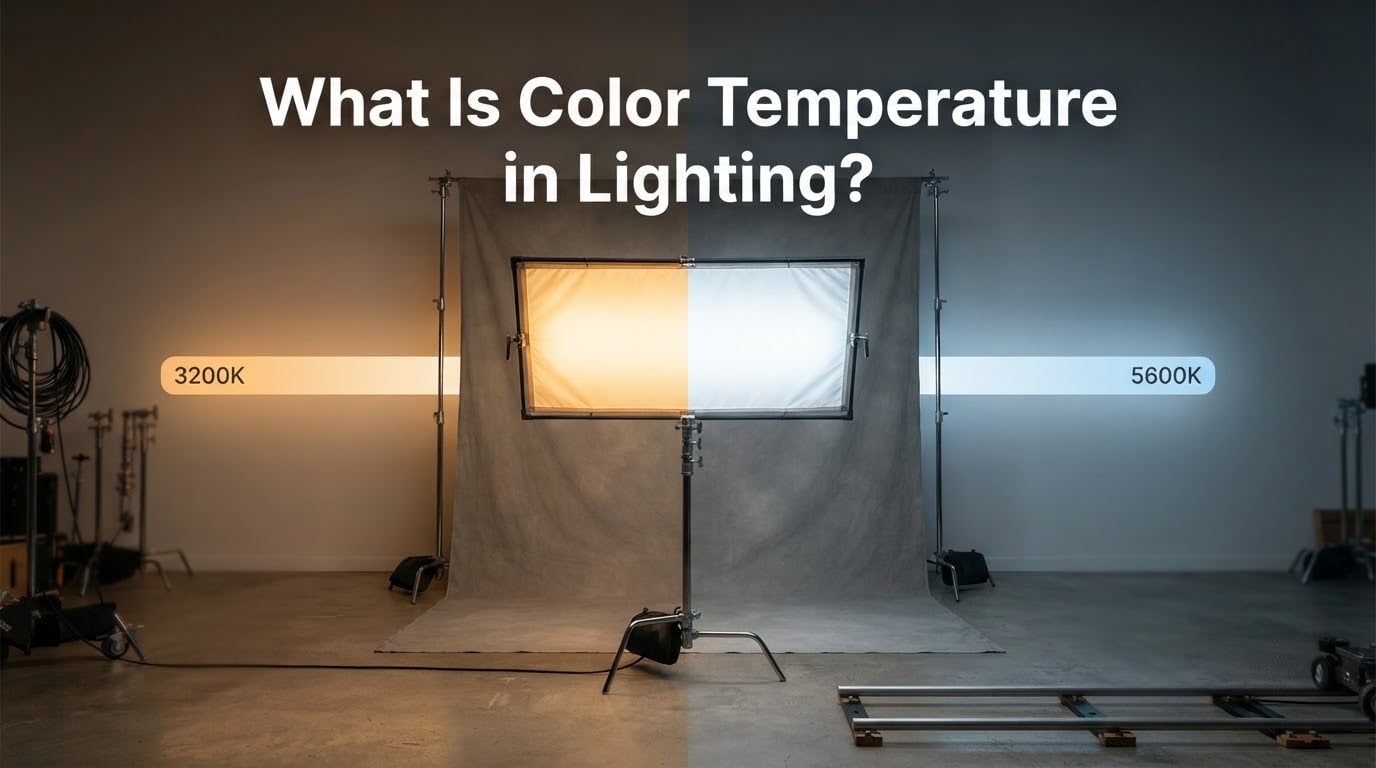
Color temperature in lighting is a way to describe whether a light source looks warm (yellowish) or cool (bluish), measured in units called Kelvin (K) on a scale that compares the light to an idealized glowing object called a black body. We use color temperature every time we pick a light bulb, set up an LED panel, or white-balance a camera.
On our lighting tests, the same room can feel like a cozy cafe under a 2700K bulb or a sterile office under a 5000K bulb, even when both produce the same measured brightness in lumens. This guide walks through how color temperature works, what the Kelvin numbers really mean, and how to choose the right one for your home, your office, or your film set.
Table of Contents
- What Is Color Temperature at a Glance
- How Color Temperature Works: The Black-Body Science
- The Kelvin Color Temperature Chart: Warm, Neutral, and Cool Bands
- Warm Light vs Cool Light: Why the Naming Is Backwards
- Correlated Color Temperature (CCT) and Modern LEDs
- Color Temperature in Filmmaking: 3200K vs 5600K On-Set
- How to Choose the Right Color Temperature by Room and Setting
- Pairing CCT, CRI, and Lumens: A Practical Buying Checklist
- Color Temperature and Your Circadian Rhythm
- Frequently Asked Questions
- What is the best color temperature for lighting?
- What is brighter, 3000K or 5000K?
- What is 4000K color temperature?
- Is 3000K LED light warm or cool?
- Which is whiter, 4000K or 6000K?
- Can you explain the Kelvin color temperature of a light bulb?
- Is 3000 Kelvin considered warm light?
- Do 10,000 Kelvin lights exist?
- Conclusion
What Is Color Temperature at a Glance
If you only remember one thing, remember this: color temperature is measured in Kelvin, and lower Kelvin means warmer-looking light.
- 2000K to 3000K (Warm white): Candlelight, sunset, incandescent bulbs. Cozy, relaxing, flattering to skin tones.
- 3100K to 4500K (Neutral white): Morning sunlight, halogen, some office fluorescents. Clean, balanced, slightly cool.
- 4600K to 5500K (Cool white / Daylight): Midday sun, electronic flash. Crisp, energizing, slightly blue.
- 5600K to 6500K (Daylight): Overcast sky, standard video “daylight” white balance, D65 reference white.
- 6500K to 10000K (Cool daylight / Blue sky): Blue sky, deep shade, computer monitor white point.
Now let’s unpack why that scale exists, why it feels backwards, and how to put it to work.
How Color Temperature Works: The Black-Body Science
Color temperature compares the color of any light source to the color an idealized black-body radiator would produce at a given absolute temperature, measured in Kelvin.
A black body is a theoretical object that absorbs all incoming light and re-emits it purely as thermal radiation. As you heat this object from absolute zero, it first glows dull red, then orange, then yellow-white, then white, then blue-white. Each color corresponds to a specific temperature in Kelvin.
Why Higher Kelvin Looks Cooler Instead of Hotter
A candle flame sits near 1850K and glows warm orange. A standard incandescent bulb at 2700K glows warm white. Noon daylight sits around 5500K and looks white. An overcast sky at 6500K looks slightly blue. Higher Kelvin numbers refer to physically hotter black bodies, yet the light looks cooler to our eyes.
The reversal comes from human color perception. Our eyes evolved to associate red and orange with fire and warmth, and blue with ice, water, and shadow. The black-body curve follows physics, but our brains read “warm color” and “cool color” through cultural and biological shorthand. So when lighting engineers say a bulb is “warm,” they mean warm-looking, not hot-running.
What Is Correlated Color Temperature (CCT)
Most real light sources (LEDs, fluorescents, screens) are not true black bodies, so we use correlated color temperature (CCT) to describe them. CCT finds the point on the black-body curve that most closely matches the color appearance of the source, then labels it with that Kelvin value. This is why an LED labeled “3000K” looks almost identical to a halogen bulb at 3000K, even though their spectral power distributions differ.
The Kelvin Color Temperature Chart: Warm, Neutral, and Cool Bands
The Kelvin color temperature scale runs from about 1000K to 10000K for everyday lighting, and each band maps to a recognizable light source.
- 1000K to 2000K: Candle flame, very low-pressure sodium lamps. Deep orange-red light.
- 2000K to 3000K: Sunset, sunrise, incandescent and warm LED bulbs. The classic “soft white” range.
- 3000K to 4000K: Halogen, warm white LEDs, tungsten film lights. Warm-to-neutral transition.
- 4000K to 5000K: Cool white fluorescents, some office LEDs. Neutral, crisp, slightly cool.
- 5000K to 5500K: Electronic flash, direct noon sunlight, D55 standard illuminant.
- 5500K to 6500K: Average daylight, overcast sky, D65 standard illuminant, video “daylight” white balance.
- 6500K to 10000K: Deep shade, blue sky, computer monitor white point, “cool daylight” LEDs.
You will see bulb packages in home stores labeled Soft White (2700K), Warm White (3000K), Bright White (3500K-4100K), Cool White (5000K), and Daylight (6500K). These names are retailer-friendly shortcuts for the same scale.
Warm Light vs Cool Light: Why the Naming Is Backwards
Warm light sits at the low end of the Kelvin scale, and cool light sits at the high end. The words “warm” and “cool” describe the color appearance, not the physical temperature of the bulb.
A 2700K incandescent bulb runs much hotter to the touch than a 5000K LED bulb of the same brightness. Yet the 2700K bulb looks warm and yellow, and the 5000K LED looks cool and white. Higher Kelvin does not mean a hotter-running bulb. It means a light that more closely matches a hotter theoretical black body, which our eyes perceive as bluer.
Myth vs Fact: Higher Kelvin Is Not Brighter
Kelvin measures color, not brightness. Brightness is measured in lumens. A 2700K bulb can easily produce more lumens than a 5000K bulb of the same wattage. If two bulbs have the same lumen rating, the higher-Kelvin one does not appear brighter; it just appears cooler in color. Many users confuse these two specs, so always check lumens for brightness and Kelvin for color appearance separately.
Correlated Color Temperature (CCT) and Modern LEDs
LEDs do not emit thermal black-body radiation. They emit light from a phosphor coating excited by a blue or violet pump diode. Their spectrum is a spike plus a phosphor hump, not a smooth Planckian curve.
Because the spectrum differs from a true black body, we describe LEDs using correlated color temperature (CCT). CCT finds the closest-matching point on the Planckian locus (the black-body color curve) and labels the LED with that Kelvin value. Two 3000K LEDs from different brands may look subtly different because their spectral curves approach the same point from different angles, which is why LED “binning” (factory sorting) matters for color consistency.
Tunable-White and Color-Tunable LEDs
Tunable-white LEDs let you dial CCT up or down, usually from about 2700K to 6500K, using a wall control, app, or DMX. Color-tunable LEDs add full RGB control for hue and saturation. Both are common on modern film sets, photo studios, and smart-home installations. For a filmmaker, a tunable LED is a single fixture that can play 3200K tungsten interior light and 5600K daylight exterior light on the same shoot.
Color Temperature in Filmmaking: 3200K vs 5600K On-Set
Color temperature sits at the heart of how we light a scene, expose a sensor, and grade footage. On a film set, two anchor values rule: 3200K (tungsten) for interiors lit by practical lamps, and 5600K (daylight) for exterior sunlight, HMIs, and most LED panels.
When a DP calls for a 3200K interior, every fixture on that set is dialed or gelled to 3200K so the white balance matches and skin tones read true. Switch to a daylight exterior, and the team switches to 5600K (or sets a 5600K white balance on the camera). Mixing 3200K and 5600K sources in the same frame without gels produces color casts that are painful to correct in post.
For screen and grading work, monitor calibration targets D65 (6504K) as the reference white point, and the Rec. 709 broadcast standard assumes a D65 white. When you grade or color correct footage, the entire pipeline assumes your monitor and your lights are both anchored to a known Kelvin value, which is why consistent color temperature is not optional in post.
On-set white balance gets tricky when practical lamps (often 2700K-3000K) and daylight (5600K) mix through windows. Crews solve this with full CTB (color temperature blue) or CTO (color temperature orange) gels, daylight-balanced HMIs, or modern bi-color LEDs that swing between 3200K and 5600K on demand. For accurate skin tones under mixed sources, a high-CRI fixture (CRI 95+) and a calibrated monitor with proper color-grading displays save hours in the grade. When the mixed lighting is too complex to fix in-camera, a handheld color meter for cinematographers gives the DPs team a real Kelvin reading from the actual scene instead of guessing from the eyepiece.
How to Choose the Right Color Temperature by Room and Setting
The best color temperature for lighting depends on the room, the time of day you use it, and the mood you want. Here is the framework our team uses when picking fixtures for clients and our own spaces.
Recommended Kelvin by Room
- Living room: 2700K to 3000K. Warm white feels inviting and flattering for evenings.
- Bedroom: 2700K. Soft warm white promotes relaxation; many sleep experts recommend avoiding 4000K and above after sunset.
- Kitchen: 3000K to 4000K. A touch cooler helps with food prep visibility while staying flattering.
- Bathroom: 3000K to 4000K. Cool enough for grooming accuracy, warm enough to flatter skin.
- Home office: 4000K to 5000K. Cool white supports focus and alertness during the workday.
- Retail and galleries: 3000K to 4000K for warm atmosphere, 5000K for high-accuracy color display.
- Photography and film studio: 3200K (tungsten) or 5600K (daylight), matched to your white balance.
- Outdoor security: 4000K to 5000K. Cool white improves facial recognition at night without harsh blue cast.
- Hospital and clinical: 5000K. Cool daylight supports accurate medical color assessment.
Two Questions to Ask Before You Buy
- What mood do I want? Cozy and warm, clean and neutral, or crisp and energizing? Pick Kelvin to match.
- What existing light is in the room? Mismatch windows, lamps, and overheads and the room will look patchy. Aim to keep all fixtures within 500K of each other unless you want deliberate contrast.
Why Mocking Up Matters
Kelvin ratings on a box do not tell you how the light will actually feel in your room. Bulb brightness, wall color, and existing daylight all change how a given Kelvin reads. Regency Supply and several lighting designers recommend mocking up one or two candidate bulbs in your actual space for at least an evening before committing.
Pairing CCT, CRI, and Lumens: A Practical Buying Checklist
Color temperature alone does not tell you whether a light is good. Two other specs matter just as much: Color Rendering Index (CRI) and lumen output.
What Is CRI (Color Rendering Index)
CRI scores how accurately a light source renders colors compared to a reference illuminant (often a black body or daylight source). CRI runs from 0 to 100. A CRI of 80 is acceptable for most home use, while CRI 90+ is recommended for photography, film, art studios, retail, and anywhere color accuracy matters.
Two LEDs at the same 3000K CCT can render skin and fabric differently because CRI measures how faithfully the spectrum reproduces colors across the visible range. High-CRI LEDs cost a bit more but save you from a greenish or washed-out look, especially on skin tones.
The CCT + CRI + Lumens Checklist
When you choose a bulb or fixture, check three numbers together, not in isolation:
- CCT (Kelvin): Decides color appearance and mood.
- CRI (Ra): Decides color accuracy. Target 80+ for general use, 90+ for film, photography, and art.
- Lumens: Decides actual brightness. A 60W incandescent equivalent needs about 800 lumens; a 100W equivalent needs about 1600 lumens.
If a fixture only lists wattage and Kelvin, ask for the CRI before you commit. Reviewers on r/Lighting have flagged this gap on many cheap LED brands.
Color Temperature and Your Circadian Rhythm
The color temperature of the light around you affects your circadian rhythm, the internal clock that regulates sleep and alertness. Blue-rich light at night suppresses melatonin and can delay sleep onset, while warm low-Kelvin light in the evening supports the natural wind-down.
The American Medical Association and several sleep researchers recommend limiting blue-rich exposure (5000K and above) in the two to three hours before bed. Practical steps include using 2700K bulbs in bedrooms and living rooms, switching overhead lights to warm white after sunset, and enabling night-shift or warm-filter modes on screens. Daytime, on the other hand, benefits from brighter, cooler light (5000K+) to support alertness.
Filmmakers and night-shift workers should know that high-Kelvin LED panels used as work lights at night can interfere with sleep patterns long after the shoot ends. Warm bi-color LEDs (2700K-3200K) and high-CRI output reduce this effect.
Frequently Asked Questions
What is the best color temperature for lighting?
The best color temperature for lighting depends on the room and the mood. For living rooms and bedrooms, 2700K to 3000K feels warm and relaxing. For kitchens, bathrooms, and home offices, 3000K to 4000K strikes a clean, balanced look. For task-heavy or clinical spaces, 4000K to 5000K provides crisp daylight-like visibility. Match your bulbs to how the room is actually used.
What is brighter, 3000K or 5000K?
Brightness is measured in lumens, not Kelvin, so 3000K and 5000K do not have a fixed brightness difference. A 3000K bulb and a 5000K bulb with the same lumen rating will look equally bright, but the 5000K bulb will appear cooler and whiter. To choose a brighter light, compare lumens, not color temperature.
What is 4000K color temperature?
4000K sits in the neutral-to-cool white range on the Kelvin scale. It is cooler than a typical home bulb but warmer than noon daylight. 4000K is common in kitchens, bathrooms, offices, garages, and retail spaces where users want crisp visibility without a clinical feel. Many people describe 4000K as slightly cool white or bright white.
Is 3000K LED light warm or cool?
3000K LED light is considered warm white. It sits just above the classic incandescent 2700K and reads as a soft, slightly amber white. 3000K is popular for homes, hospitality, and film interiors because it flatters skin tones and feels comfortable in the evening.
Which is whiter, 4000K or 6000K?
6000K appears whiter and slightly bluer than 4000K. Both sit in the cool-to-daylight band, but 6000K is closer to the D65 reference white used in video and monitor calibration, while 4000K reads as a clean neutral white with a faint warmth. For most residential rooms, 4000K looks closer to natural white, while 6000K starts to feel bluish indoors.
Can you explain the Kelvin color temperature of a light bulb?
The Kelvin color temperature of a light bulb is a measurement, in degrees Kelvin, of the color appearance of the light it produces. Lower Kelvin numbers mean warmer, yellower light, and higher Kelvin numbers mean cooler, bluer light. A 2700K bulb looks like a traditional incandescent, while a 5000K bulb looks like midday sunlight. Kelvin describes color, not heat or brightness.
Is 3000 Kelvin considered warm light?
Yes, 3000 Kelvin is considered warm white light. It is just above the warmest common residential setting of 2700K, which mimics classic incandescent bulbs. 3000K reads as a soft, slightly amber white and is widely used in homes, restaurants, hotels, and film interiors where a cozy atmosphere is the goal.
Do 10,000 Kelvin lights exist?
Yes, 10,000K lights exist, but they are specialty products. The 6500K to 10,000K range sits in deep blue daylight territory, used in aquarium lighting, some plant-growth fixtures, forensic and specialty inspection lamps, and certain photographic special effects. For homes, offices, and film sets, 2700K to 6500K covers nearly every practical need.
Conclusion
Color temperature in lighting is one of the simplest specs to learn and one of the easiest to get wrong. Pick your Kelvin to match the mood and the function of the room, pair it with a CRI of 80 or higher (90+ for film and photography), and use lumens to dial actual brightness.
For our readers at Short Film Central, color temperature also sets the foundation for clean footage, accurate white balance, and faster color grading with the right reference tools. Once the Kelvin on set is locked in, the rest of the post pipeline gets easier, whether you grade on a calibrated laptop for color grading or a reference monitor.