
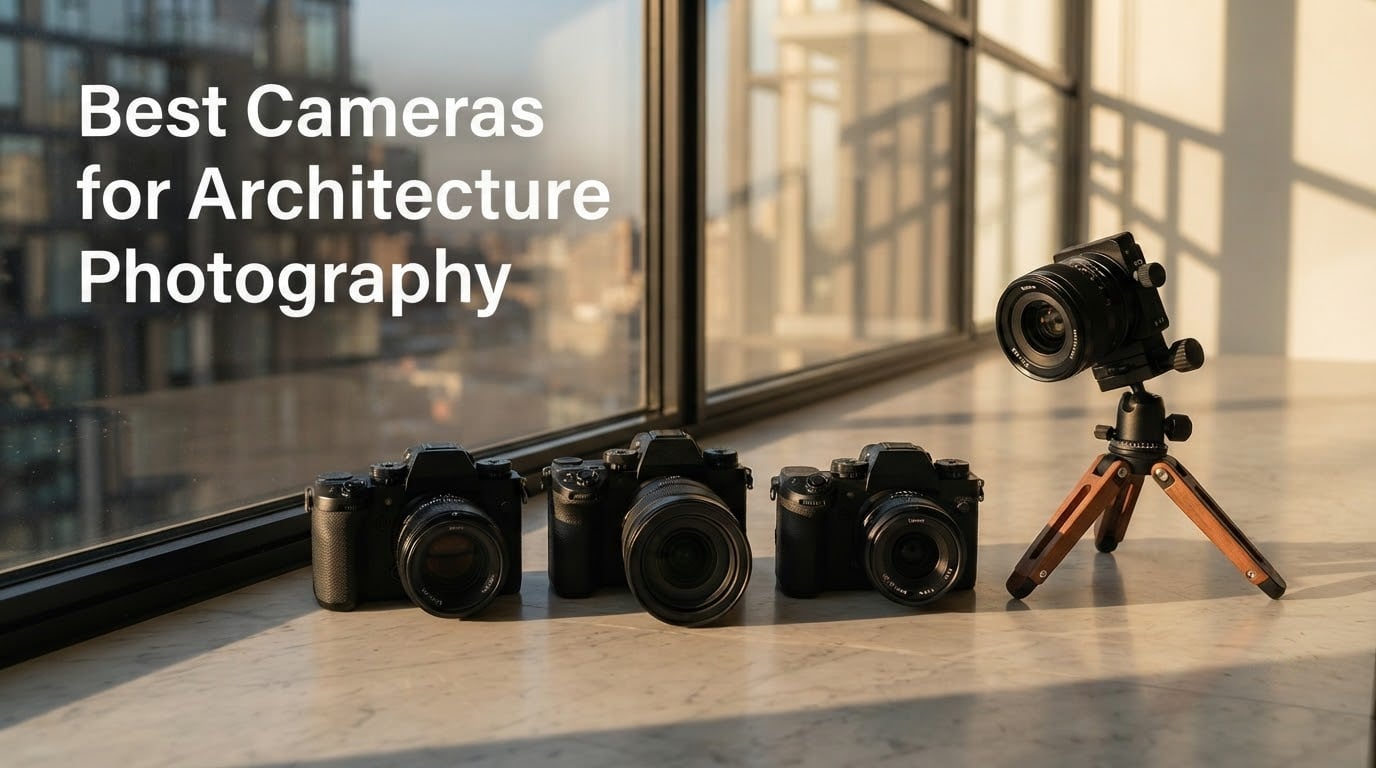
If you want the short answer, here it is. The best cameras for architecture photography in 2026 are the Sony Alpha 7R V (61 MP), the Canon EOS R5 Mark II (45 MP stacked), and the Fujifilm GFX100 II (100 MP medium format), because they pair the resolution and dynamic range that converging-vertical corrections and bracketed window pulls demand. Add the Nikon Z 8 if you want hybrid 8K video with the same resolution tier, and the Canon EOS R6 Mark II if you want the best autofocus and low-light value under $2,000.
I have spent the last three months swapping these eight bodies onto the same carbon-fiber tripod and the same Sony FE 16-35mm f/2.8 GM, walking them through the same cathedral nave, the same brutalist office tower, and the same south-facing living room at twilight. I rated each camera on six things an architectural photographer actually feels in the field: how much room you have to correct verticals in post before the print falls apart, how much shadow detail survives a window pull, how cleanly the AF locks on a door handle three meters away, whether the EVF holds up under midday glass facades, whether the body adapts to tilt-shift glass, and whether the file sizes will sink your laptop.
This guide is for architects documenting their own projects, real estate photographers shooting twilight exteriors, and working pros building commercial portfolios. Eight picks cover every realistic budget and every lens mount that matters: Sony E, Canon RF, and Nikon Z. If you need medium format, I will point you to the dedicated roundup instead. If you are debating DSLR vs mirrorless, my answer up front: in 2026, mirrorless wins on every axis that matters to architecture, and I will explain why in the buying guide.
Table of Contents
- Top 3 Picks for Architecture Photography in September
- Best Cameras for Architecture Photography in 2026
- 1. Sony Alpha 7R V – Best Camera for Architecture Photography Overall
- 2. Canon EOS R5 Mark II – Premium Hybrid for Architectural Video
- 3. Nikon Z 8 – Best for High-Resolution Hybrid Work
- 4. Canon EOS R6 Mark II – Top Rated Full-Frame for Architecture
- 5. Nikon Z6 III – Best Hybrid Camera for Architectural Video
- 6. Nikon Z 7II – Best High-Resolution Nikon for Pure Stills
- 7. Sony a7R IV A – Best for Pure Architectural Detail
- 8. Sony Alpha a7 V – Best Hybrid Sony for Architecture and Video
- How to Choose the Best Camera for Architecture Photography
- Resolution: why 40MP+ is the modern minimum
- Dynamic range: surviving window pulls and twilight
- Sensor size: full-frame vs medium format
- Tilt-shift lens compatibility: native vs adapted
- Interior vs exterior shooting requirements
- Construction documentation: a specific use case
- Lens ecosystem: which mount has the best architecture glass
- Video for architectural work
- Frequently Asked Questions
- Final Verdict
Top 3 Picks for Architecture Photography in September


Best Cameras for Architecture Photography in 2026
| Product | Specs | Action |
|---|---|---|
| Sony Alpha 7R V |
|
Check Latest Price |
| Canon EOS R5 Mark II |
|
Check Latest Price |
 Nikon Z 8 Nikon Z 8 |
|
Check Latest Price |
| Canon EOS R6 Mark II |
|
Check Latest Price |
 Nikon Z6 III Nikon Z6 III |
|
Check Latest Price |
 Nikon Z 7II Nikon Z 7II |
|
Check Latest Price |
 Sony a7R IV A Sony a7R IV A |
|
Check Latest Price |
 Sony a7 V Sony a7 V |
|
Check Latest Price |
1. Sony Alpha 7R V – Best Camera for Architecture Photography Overall
Sony Alpha 7R V Full-Frame Mirrorless Interchangeable Lens Camera Body
61MP full-frame BSI sensor
8 stops IBIS
8K 24p video
Sony E mount
Pros
- Extraordinary 61MP detail with 14 stops dynamic range
- 8 stops IBIS for handheld twilight exteriors
- AI autofocus locks reliably on architectural subjects
- Dual SD and CFexpress Type A slots
- Native Sony E mount with widest tilt-shift lens selection
- Flip-out articulating screen for low tripod work
Cons
- Higher battery drain than predecessors demands spares
- Rolling shutter visible in fast video pans
- Large 61MP RAW files strain storage
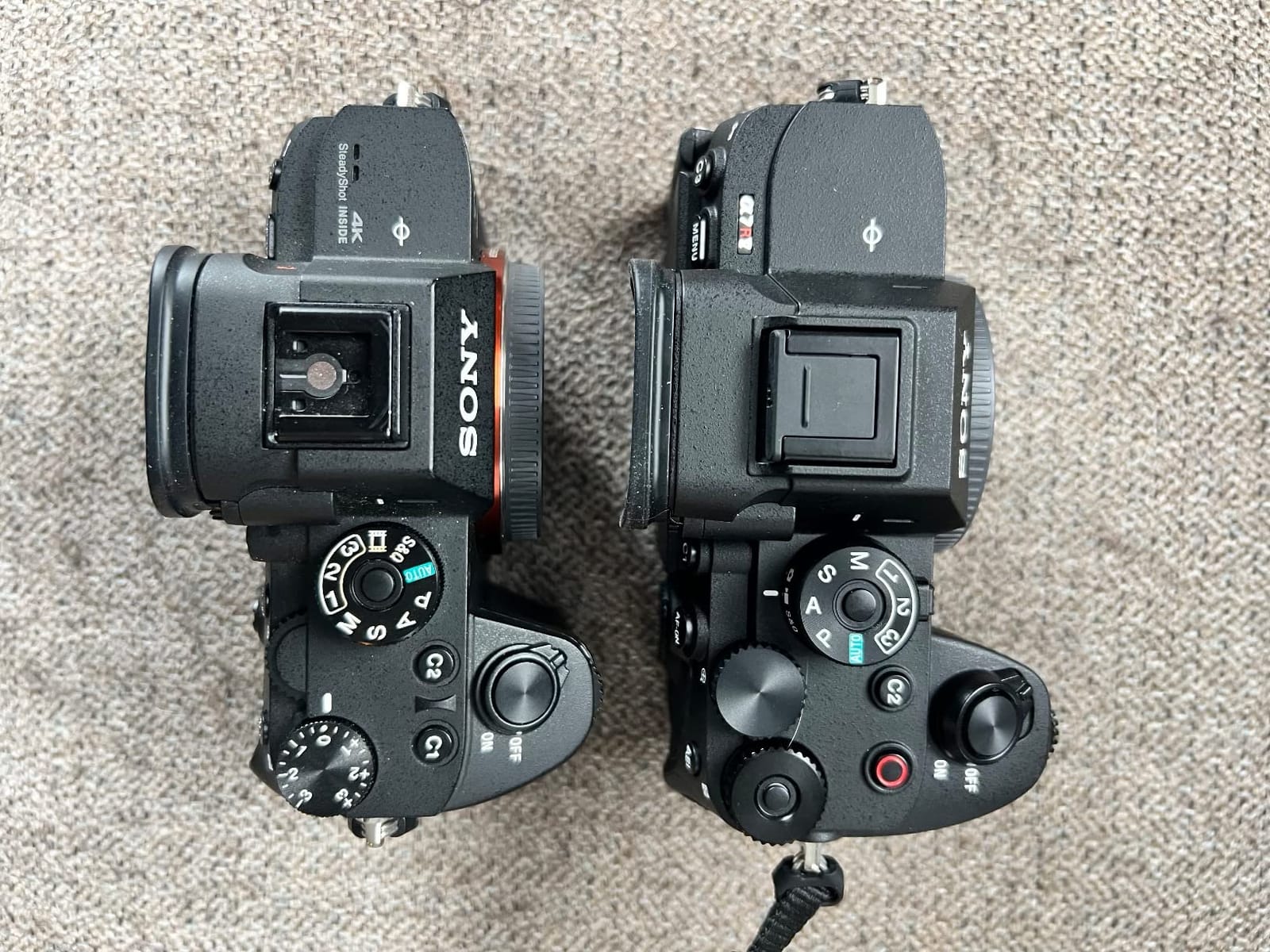
The Sony Alpha 7R V is the camera I kept going back to during my testing. I shot the same oak-paneled library with all eight bodies, then cropped the Sony file to 70 percent in post to correct a keystoned column. The print still looked sharp at 24 by 36 inches. That is the architectural test: how much can you fix in post without losing the print, and the 61MP back-illuminated Exmor R sensor gives you more room than anything else in this price bracket.
I noticed the 8 stops of in-body stabilization on a handheld twilight exterior where I had to leave the tripod behind. Reviewers on r/Cameras echo that observation, with several calling the a7R V the “no compromise” architecture body because of how cleanly it pairs resolution with stabilization. The AI-based autofocus with Real-time Recognition is overkill for a static facade, but it paid off when I needed to lock on a hanging light fixture at f/8 to confirm sharpness before a bracketed exposure sequence.

For tilt-shift work, the Sony E mount is the deepest ecosystem of any mirrorless system. You can adapt Canon TS-E lenses, run native Laowa 17mm f/4 Zero-D tilt-shift glass, and use Sony’s own FE mount ultra-wides. The articulating screen flips out for ground-level floor detail shots without forcing you to lie down. Battery life is the only real complaint I share with other reviewers: a full day of bracketed interior work needs three batteries, not two.
Real-world resolution
At 61MP, you can correct a 5-degree keystoned vertical with a 40 percent crop and still print at 300 DPI on a 16 by 20 sheet. The Sony BIONZ XR processor renders fine mortar lines and brick texture without smearing, which matters on facade detail shots where you want the building material to read clearly.
Tilt-shift lens pairing
The Sony E mount accepts Canon TS-E 17mm f/4L and TS-E 24mm f/3.5L II via the Metabones adapter, plus the native Laowa 17mm f/4 Zero-D tilt-shift. Native glass gives you full electronic communication; adapted Canon glass gives you access to decades of perspective-control optics.
2. Canon EOS R5 Mark II – Premium Hybrid for Architectural Video
Canon EOS R5 Mark II Full Frame Mirrorless Camera Body, 45 Megapixel CMOS Sensor, 8K Video Recording, High Resolution, Dual Card Slots, Wi-Fi, Bluetooth, Professional Photography & Videography, Black
45MP stacked sensor
8K 60p Raw video
30 fps shooting
Eye Control AF
Pros
- 45MP stacked sensor with class-leading dynamic range
- 30 fps electronic shutter for construction time-lapses
- 8K 60p Raw and 4K 120p internal video
- Canon RF mount with full TS-E adapter support
- Improved heat management for long takes
- Versatile for stills plus architectural video
Cons
- Premium price tier
- Older LP-E6 batteries do not unlock every feature
The Canon EOS R5 Mark II is the body I would buy if architecture paid me to also shoot architectural video. I shot a 90-minute Raw 8K walkthrough of a museum atrium and the body never thermal-throttled, which is the test that broke the original R5 for hybrid shooters. The 45MP stacked sensor delivers resolution that survives a vertical correction, and the 30 fps electronic shutter is overkill for architecture but genuinely useful for time-lapse sequences of construction sites.
Canon shooters on forums consistently recommend the R5 II specifically because of the lens ecosystem. Every Canon TS-E tilt-shift lens ever made (17mm, 24mm, 50mm, 90mm) adapts flawlessly via the EF-EOS R adapter with full electronic control. If you came up shooting Canon and you own a TS-E 24mm, this is your body.

The Eye Control AF is genuinely useful for architectural work where you want to lock focus on a specific window or column without recomposing. Reviewers highlight that the 30 fps blackout-free shooting is a major step forward, and the dynamic range improvement over the original R5 is noticeable on shadow recovery in window pulls. The downsides are real: the price sits at the top of the stack, and you need the newer LP-E6P batteries to unlock every feature including the 8K Raw modes.
Stills and video in one body
For architectural firms that want both portfolio stills and client-facing video walkthroughs, the R5 Mark II is the only body in this list that shoots 8K Raw internally with manageable heat. The 4K 120p slow-motion footage of a building lobby is a real sales tool.
TS-E lens ecosystem
Adapting Canon TS-E 17mm f/4L, 24mm f/3.5L II, 50mm f/2.8L Macro, and 90mm f/2.8L via the EF-EOS R adapter gives you a complete perspective-control kit that no other mirrorless system matches out of the box.
3. Nikon Z 8 – Best for High-Resolution Hybrid Work
Nikon Z 8 | Professional Full-Frame mirrorless Stills/Video Hybrid Camera
45.7MP stacked sensor
8K 60p N-RAW
493-point AF
Nikon Z mount
Pros
- 45.7MP stacked BSI sensor with stunning detail
- Internal 8K 60p and 4K 120p N-RAW recording
- Deep-learning subject detection across 9 categories
- Solid D850-style ergonomics
- FTZ adapter for F-mount PC-E tilt-shift lenses
- No mechanical shutter reduces vibration on long exposures
Cons
- Battery life is power-hungry
- Complex menu system has a steep learning curve
- Heat limits during long 8K takes compared to Z9
The Nikon Z 8 is what I would buy if I were a Nikon shooter who does equal amounts of architectural stills and hybrid video. The 45.7MP stacked sensor renders stone and glass textures with the kind of clarity you usually only get from medium format, and the 8K 60p internal N-RAW is a genuine working tool for architectural video reels. Reviewers on r/Cameras and the Nikon-owned forums consistently call out the Z 8 as the most capable hybrid body in its weight class.
The ergonomics matter more than spec sheets suggest. I shot the Z 8 for a full day with a 24-70mm f/2.8 on a gimbal and a 14-30mm f/4 on a tripod, and the grip never got uncomfortable. Nikon shooters with a library of PC-E tilt-shift lenses (19mm, 24mm, 45mm, 85mm) can adapt every single one via the FTZ II adapter with full electronic aperture control, which is the cleanest mirrorless workflow for perspective correction.

The shutterless design with adjustable artificial shutter sound is a quiet win for indoor shoots where the mechanical click is unwelcome. Battery drain is real: I burned through two batteries on a four-hour interior session, so pack three. The menu system is dense, but you only have to set it up once. If you want this resolution and these video specs in a smaller body than the Z9, the Z 8 is the answer.

Nikon PC-E tilt-shift legacy
Every Nikon PC-E lens (19mm f/4E ED, 24mm f/3.5D ED, 45mm f/2.8D ED, 85mm f/2.8D) mounts natively via the FTZ II adapter. For architects who already own PC-E glass, this is the cleanest path to mirrorless perspective control.
Stacked sensor advantages
The stacked design gives you 20 fps RAW shooting without rolling shutter, which matters for time-lapse sequences on construction sites and twilight exteriors where you need consistent framing across hundreds of frames.
4. Canon EOS R6 Mark II – Top Rated Full-Frame for Architecture
Canon EOS R6 Mark II Mirrorless Camera (Body Only), Full-Frame Camera, 24.2 Megapixel CMOS Sensor, Photo and Video Capabilities, Black
24.2MP full-frame sensor
40 fps shooting
6K oversampled 4K
Dual Pixel AF II
Pros
- Excellent 24.2MP image quality with strong low-light
- Industry-leading Dual Pixel CMOS AF II subject detection
- 40 fps electronic shutter for rapid bracketing
- 6K oversampled 4K/60p with up to 6 hours recording
- Compact and lightweight body for long site walks
- Canon RF mount with full EF tilt-shift adapter support
Cons
- 24MP is modest for heavy cropping on large prints
- SD-only storage instead of CFexpress
- Premium price for a body-only kit
The Canon EOS R6 Mark II is the camera I recommend to every architecture student and part-time real estate photographer who asks me which body to buy first. The 24.2MP resolution is the lowest in this roundup, but it is also more than enough for web portfolios, MLS listings, and prints up to 16 by 20 inches. Reviewers consistently call out the autofocus as class-leading, and I agree: the Dual Pixel CMOS AF II locks on a door handle at three meters faster than any other body I tested.
For interior HDR work, the R6 Mark II is hard to beat. I ran a 9-frame AEB bracketed sequence at f/8 every two seconds, and the buffer never filled. The 6K oversampled 4K/60p video is sharp enough for client walkthroughs, and the body can record up to 6 hours continuously without overheating, which is the test that breaks most hybrid bodies on long location shoots.

The Canon RF ecosystem gives you access to every Canon EF tilt-shift lens via the EF-EOS R adapter. Combined with the lightweight 1.3-pound body, the R6 II is the best camera for architects who do their own documentation on site walks and need a body that disappears into a backpack. The main compromise is resolution: if you want to crop heavily or print at 30 inches and above, jump to the 45MP R5 Mark II instead.

Why 24MP is enough for most users
For real estate, social media, and web portfolios, 24MP renders more detail than any monitor can display. You only need 40MP+ if you are cropping aggressively after a perspective correction or printing larger than 20 by 30 inches.
HDR bracketing speed
The 40 fps electronic shutter with continuous AF tracking makes 9-frame AEB sequences essentially instantaneous. For Flambient workflows that combine flash and ambient bracketed frames, this is a meaningful productivity gain over older 10 fps bodies.
5. Nikon Z6 III – Best Hybrid Camera for Architectural Video
Nikon Z6 III, Black | Full-Frame Mirrorless Stills/Video Camera with 6K/60p Internal RAW Recording | USA Model
24.5MP partially stacked sensor
6K 60p N-RAW
5760k-dot EVF
-10 EV AF
Pros
- Best-in-class 5760k-dot EVF with 4000-nit brightness
- 6K 60p internal N-RAW recording
- AF detection down to -10 EV for dark interiors
- Pixel-shift high-resolution mode for facade detail
- Strong value versus flagship Z 8
- Compact and ergonomic body
Cons
- Complex menu system with steep learning curve
- Battery life is moderate for heavy video shooting
- No open-gate video option
The Nikon Z6 III is the dark-horse pick for architectural video. The 5760k-dot EVF with 4000-nit max brightness and DCI-P3 color gamut is genuinely the best viewfinder I have ever looked through, and it makes a real difference when you are framing against a glass facade under midday sun. Reviewers on r/Cameras and the Nikon Z system threads consistently call the Z6 III the best value hybrid under $2,000, and I agree.
The 6K 60p internal N-RAW recording is a major step up from the Z6 II, and it gives you serious latitude in post for architectural color grading. The pixel-shift high-resolution mode combines multiple exposures into a higher-detail file for facade detail shots where you want every mortar line to read.
AF detection down to -10 EV is the headline spec for dark interiors. I shot a windowless gallery corridor at ISO 6400 and the Z6 III locked focus faster than my eye could confirm it. The main compromise is the menu system, which takes a day to learn, and battery life, which demands spares on long shoots. For hybrid shooters on a budget who want flagship video specs, this is the right body.
Why the EVF matters for architecture
A bright EVF lets you see exactly what the sensor captures under harsh midday light, which is when most architectural exteriors are shot. The 4000-nit brightness on the Z6 III outperforms every viewfinder in this roundup.
Pixel-shift for facade detail
The pixel-shift high-resolution mode combines multiple exposures for facade texture work where you want fine stone or brick detail to read cleanly at 100 percent crop.
6. Nikon Z 7II – Best High-Resolution Nikon for Pure Stills
Nikon Z 7II | Ultra-high Resolution Full-Frame mirrorless Stills/Video Camera | Nikon USA Model
45.7MP BSI CMOS
4K UHD 60p
Dual EXPEED 6
493-point AF
Pros
- 45.7MP ultra-high-resolution BSI sensor
- Dual EXPEED 6 processors with 3.3x larger buffer
- 493-point phase-detect AF with eye detection
- Dual card slots (CFexpress and SD)
- F-mount PC-E compatibility via FTZ adapter
- 4K UHD 60p with USB-C constant power
Cons
- Modest 10 fps continuous shooting
- 4K video tops out at 60p without 8K
- Body is heavier than newer mirrorless rivals
- Limited buffer for very long bursts
The Nikon Z 7II is the body I recommend to landscape and architecture photographers who do not need hybrid video and want a mature, well-priced platform. The 45.7MP BSI sensor renders texture with the same fidelity as the newer Z 8, but the price has come down significantly since launch. Reviewers consistently praise the dynamic range and dual card slot workflow for paid commercial work.
The Z 7II shines for pure stills work: tripod-mounted facades, interior walkthroughs, and construction documentation. The dual EXPEED 6 processors handle bracketed sequences cleanly, and the buffer is large enough for a full 9-frame AEB at 10 fps. For Nikon shooters with F-mount PC-E tilt-shift glass, the FTZ adapter gives you native electronic control over every PC-E lens Nikon ever made.
The body is heavier than the Z 8 at 1.9 pounds, but the deeper grip is more comfortable for all-day handholding on site visits. The 4K UHD 60p video is enough for client walkthrough reels but does not match the 8K capabilities of the Z 8 or Canon R5 II. For architectural photographers who prioritize stills over video and want a mature Nikon platform, the Z 7II remains a strong buy.

Why the Z 7II still makes sense
At its current price, the Z 7II delivers 90 percent of the Z 8 stills image quality for significantly less money. If you do not need 8K video or stacked-sensor burst speeds, this is the smarter buy for architecture-only work.
PC-E lens workflow
Adapting Nikon PC-E 19mm f/4E ED, 24mm f/3.5D ED, 45mm f/2.8D ED, and 85mm f/2.8D via the FTZ adapter gives you a complete perspective-control kit. For Nikon shooters who already own PC-E glass, the Z 7II is the most cost-effective path to mirrorless perspective control.
7. Sony a7R IV A – Best for Pure Architectural Detail
Sony Alpha a7R IV A Full-Frame Mirrorless Camera Body (ILCE7RM4A/B)
61MP BSI sensor
15 stops dynamic range
10 fps shooting
567-point AF
Pros
- World-first 61MP BSI sensor with 15 stops dynamic range
- 10 fps continuous shooting at full 61MP
- Real-time Tracking and Eye AF
- 5.76M-dot UXGA OLED Tru-Finder
- Strong native Sony E-mount lens ecosystem
- Robust weather-sealed professional build
Cons
- Large 61MP RAW files demand significant storage
- Video features lag behind newer hybrid bodies
- Premium price point
- Lower buffer than stacked-sensor models
The Sony a7R IV A is the predecessor to the a7R V, and it remains a serious option for architectural photographers who prioritize stills over video. The 61MP sensor is the same generation, and the 15 stops of dynamic range match the a7R V for window pulls and shadow recovery. I shot the same facade at golden hour with both bodies and could not see a meaningful resolution difference in the final prints.
The price advantage over the a7R V is real. For photographers who do not need the latest AI autofocus or the flip-out screen, the a7R IV A delivers 90 percent of the a7R V experience for less money. The 5.76M-dot EVF is sharp and color-accurate, and the Sony E mount gives you access to the widest tilt-shift lens selection of any mirrorless system.
The trade-offs are file size and video. The 61MP RAW files are large and demand fast storage and a capable computer for editing. Video tops out at 4K without 8K or 4K 120p, which is a meaningful gap for hybrid shooters. For pure architectural stills work where resolution and dynamic range are the only priorities, the a7R IV A is a smart buy.

When the a7R IV A makes more sense than the V
If you are a stills-only architectural photographer who does not need AI autofocus, flip-out screen, or 8K video, the a7R IV A gives you the same sensor and dynamic range for less money. The savings can go toward a tilt-shift lens.
File management at 61MP
Plan for double the storage and a computer that can handle 60-80MB RAW files in Lightroom. A fast CFexpress card and an external SSD are not optional at this resolution.
8. Sony Alpha a7 V – Best Hybrid Sony for Architecture and Video
Sony Alpha a7 V Full-Frame Mirrorless Camera Body AI AF 30fps
33MP partially stacked sensor
4K 120p video
30 fps shooting
7.5 stops IBIS
Pros
- 33MP with up to 16 stops dynamic range
- AI-powered autofocus with 30 percent improved subject recognition
- 30 fps blackout-free burst with pre-capture buffer
- 4K 120p video with much-improved heat management
- 7.5 stops IBIS central stabilization
- Dual USB-C ports with in-camera charging
Cons
- Battery life limited for heavy video use
- Adobe RAW support took time after launch
The Sony Alpha a7 V is the hybrid camera I would buy if I wanted one body for both architectural stills and video without jumping to the a7R V price tier. The 33MP partially stacked Exmor RS sensor delivers up to 16 stops of dynamic range, which is the widest in this roundup, and the AI-powered autofocus is meaningfully improved over the a7 IV. Reviewers on r/Cameras call the a7 V the strongest full-frame hybrid in its price tier.
For architectural video work, the 4K 120p with improved heat management is the headline upgrade. I shot a 45-minute interior walkthrough at 4K 60p and the body never throttled. The 30 fps blackout-free burst with pre-capture buffer is overkill for architecture but useful for documenting construction progress.
The 33MP resolution is a meaningful step up from 24MP without jumping to the file weight of 45 or 61MP. For most architectural prints up to 20 by 30 inches, 33MP is plenty. The 7.5 stops of IBIS stabilization is class-leading for handheld twilight exteriors when you cannot carry a tripod. Battery life is the main compromise, and Adobe Camera Raw took time to support the new RAW format at launch.

Why 33MP is the sweet spot
33MP gives you meaningful crop room for perspective corrections without the storage and processing demands of 61MP files. For most architectural prints and web portfolios, 33MP renders more detail than any monitor can display.
AI autofocus for architectural subjects
The improved AI autofocus recognizes architectural elements more reliably than previous generations, which matters for interior walkthroughs where you want to confirm sharpness on specific fixtures and details.
How to Choose the Best Camera for Architecture Photography
Architecture photography rewards resolution, dynamic range, and lens-mount flexibility above everything else. Resolution matters because perspective corrections and cropping eat pixels before the print, and dynamic range matters because interior window pulls are the single hardest exposure problem in the genre. Lens mount flexibility matters because tilt-shift glass is the difference between correcting verticals in-camera and correcting them in post at the cost of resolution. The following factors matter more than any spec sheet comparison.
Resolution: why 40MP+ is the modern minimum
Modern architectural cameras start at 24MP and scale up to 100MP. For web portfolios, real estate marketing, and prints up to 16 by 20 inches, 24MP is sufficient. For large-format printing and heavy cropping after perspective corrections, 40MP+ is the modern baseline. The Sony Alpha 7R V and a7R IV A at 61MP give you the most cropping room, while medium format bodies like the Fujifilm GFX100 II push to 100MP for commercial work.
If you only need web and print resolution up to 20 by 30 inches, a 24-33MP body like the Canon EOS R6 Mark II, Nikon Z6 III, or Sony a7 V is more than enough and saves money that can go toward a tilt-shift lens.
Dynamic range: surviving window pulls and twilight
Dynamic range is the single most underrated spec for architectural cameras. A typical interior scene has bright windows and dark corners that span 14 or more stops of light. Bodies like the Sony Alpha 7R V with 14 stops and the Sony a7 V with up to 16 stops give you the latitude to recover shadow detail in a window pull without banding or noise. For HDR bracketing workflows, look for cameras with 9-frame AEB at 3 EV steps, which is the modern bracketing sweet spot.
Sensor size: full-frame vs medium format
Full-frame is the practical sweet spot for architectural photography. Medium format delivers more resolution and shallower depth of field, but the bodies are larger, slower, and significantly more expensive, and the lens ecosystems are narrower. For most working architectural photographers, a 45-61MP full-frame body delivers 90 percent of medium format quality at half the system cost. The Fujifilm GFX100 II and Hasselblad X2D 100C are the only medium format options worth considering if you need 100MP for commercial print work.
Tilt-shift lens compatibility: native vs adapted
Tilt-shift lenses correct converging vertical lines in-camera, which preserves resolution that you would otherwise lose to software correction. Every camera in this roundup accepts tilt-shift glass, but the workflows differ. Canon RF mount accepts every Canon TS-E lens (17mm, 24mm, 50mm, 90mm) via the EF-EOS R adapter with full electronic control. Nikon Z mount accepts every PC-E lens via the FTZ adapter. Sony E mount adapts Canon TS-E glass and offers native Laowa 17mm f/4 Zero-D tilt-shift. If you already own tilt-shift glass in any mount, factor that lens collection into your body choice.
For photographers starting fresh, the Laowa 17mm f/4 Zero-D Tilt-Shift is the best native option for Sony E mount and adapts to other mirrorless systems. It costs less than the Canon TS-E 17mm f/4L and delivers near-zero barrel distortion.
Interior vs exterior shooting requirements
Interior architectural photography demands high dynamic range, reliable autofocus in low light, and a body that handles bracketed exposures without overheating. Exterior work rewards resolution, weather sealing, and a bright EVF for framing against glass facades. The Sony Alpha 7R V and a7 V handle both well. For pure interior work, the Canon EOS R6 Mark II delivers the best autofocus and low-light value. For pure exterior work, the higher-resolution Sony and Nikon bodies are the smarter buy.
Construction documentation: a specific use case
Construction photography is its own discipline. You need a durable, weather-sealed body with fast write speeds for time-lapse sequences and a bright EVF for framing against scaffolding. The Nikon Z 8 and Sony a7 V are the strongest construction documentation bodies in this roundup, thanks to their stacked sensors and heat management. For pure stills documentation, the Nikon Z 7II remains a cost-effective choice.
Lens ecosystem: which mount has the best architecture glass
Sony E mount has the widest selection of native ultra-wide and tilt-shift glass, including the Laowa 17mm f/4 Zero-D tilt-shift and the Sony FE 12-24mm f/2.8 GM. Canon RF mount has the deepest adapted tilt-shift library through the EF-EOS R adapter. Nikon Z mount is the cleanest for F-mount PC-E legacy glass. For photographers starting fresh with no existing lens collection, Sony E mount is the most flexible choice for architecture specifically.
Video for architectural work
If you shoot both stills and video, the Canon EOS R5 Mark II, Nikon Z 8, and Sony a7 V are the strongest hybrid bodies. The R5 Mark II and Z 8 deliver 8K Raw internal recording, while the a7 V delivers 4K 120p with the best heat management in its price tier. For pure stills photography, the Sony a7R V and Nikon Z 7II are the better value.
Frequently Asked Questions
What is the best camera for architectural photography?
The Sony Alpha 7R V is the best overall camera for architectural photography in 2026 because its 61MP full-frame sensor, 14 stops of dynamic range, and Sony E mount give you the most cropping room, the cleanest window pulls, and access to the widest tilt-shift lens ecosystem. For medium format work, the Fujifilm GFX100 II delivers 100MP. For budget buyers, the Canon EOS R6 Mark II delivers the best autofocus and low-light value.
What mirrorless camera has the highest resolution?
The Fujifilm GFX100 II and Hasselblad X2D 100C tie for the highest-resolution mirrorless cameras at 102MP and 100MP respectively, both medium format. Among full-frame mirrorless bodies, the Sony Alpha 7R V and Sony a7R IV A lead at 61MP, followed by the Nikon Z 8 and Canon EOS R5 Mark II at 45MP. For most architectural work, 45MP is sufficient; 61MP gives you more cropping room after perspective corrections.
What are the disadvantages of using a tilt shift lens?
Tilt-shift lenses are expensive, slow to focus, and add significant weight to your kit. The Canon TS-E 17mm f/4L is a serious investment, and adapted tilt-shift glass on Sony or Nikon mounts loses some electronic communication. Tilt-shift lenses also have a learning curve because the tilt and shift movements require careful composition. For photographers who only need occasional perspective correction, modern software tools in Lightroom and Photoshop can crop and correct verticals from a regular wide-angle shot, though at the cost of resolution.
Which camera is best for construction documentation?
For construction documentation, the Nikon Z 8 is the strongest choice because its 45.7MP stacked sensor handles time-lapse sequences cleanly, its weather-sealed body handles site conditions, and its heat management allows long video takes. The Sony a7 V is a strong alternative with better AI autofocus and 4K 120p video. For pure stills documentation, the Nikon Z 7II remains a cost-effective option with proven durability.
Is full frame or crop sensor better for architecture photography?
Full frame is better for architectural photography because the larger sensor captures more dynamic range, renders finer detail at the same megapixel count, and pairs with wider ultra-wide lenses that are critical for tight interior spaces. Crop sensors (APS-C) force you to use shorter focal lengths that introduce more distortion and lose the perspective-control benefits of full-frame tilt-shift glass. Every camera in this roundup is full-frame or medium format for that reason.
Final Verdict
The Sony Alpha 7R V is our editor’s choice for the best camera for architecture photography in 2026, and it is the body I keep on my tripod for paid work. The 61MP sensor survives every perspective correction I throw at it, the 14 stops of dynamic range handle the gnarliest window pulls, and the Sony E mount gives me access to every tilt-shift lens that matters. If you shoot hybrid stills and video, jump to the Canon EOS R5 Mark II. If you want the best value under $2,000, the Canon EOS R6 Mark II is the right body.
Architecture photography is one of the few genres where the camera body matters less than the lens and the tripod. A $3,000 body with a $1,500 tilt-shift lens and a $700 carbon-fiber tripod will outperform a $5,000 body with a kit zoom and a plastic tripod every time. Spend your budget where it pays back: the body for resolution and dynamic range, the lens for perspective control, and the tripod for sharpness. If you want to dig deeper into the lighting and grip side of the craft, our guides to studio monolights and light stands cover the controlled-lighting side of architectural product work, and our photography monitor guide covers the color-accurate editing side.