
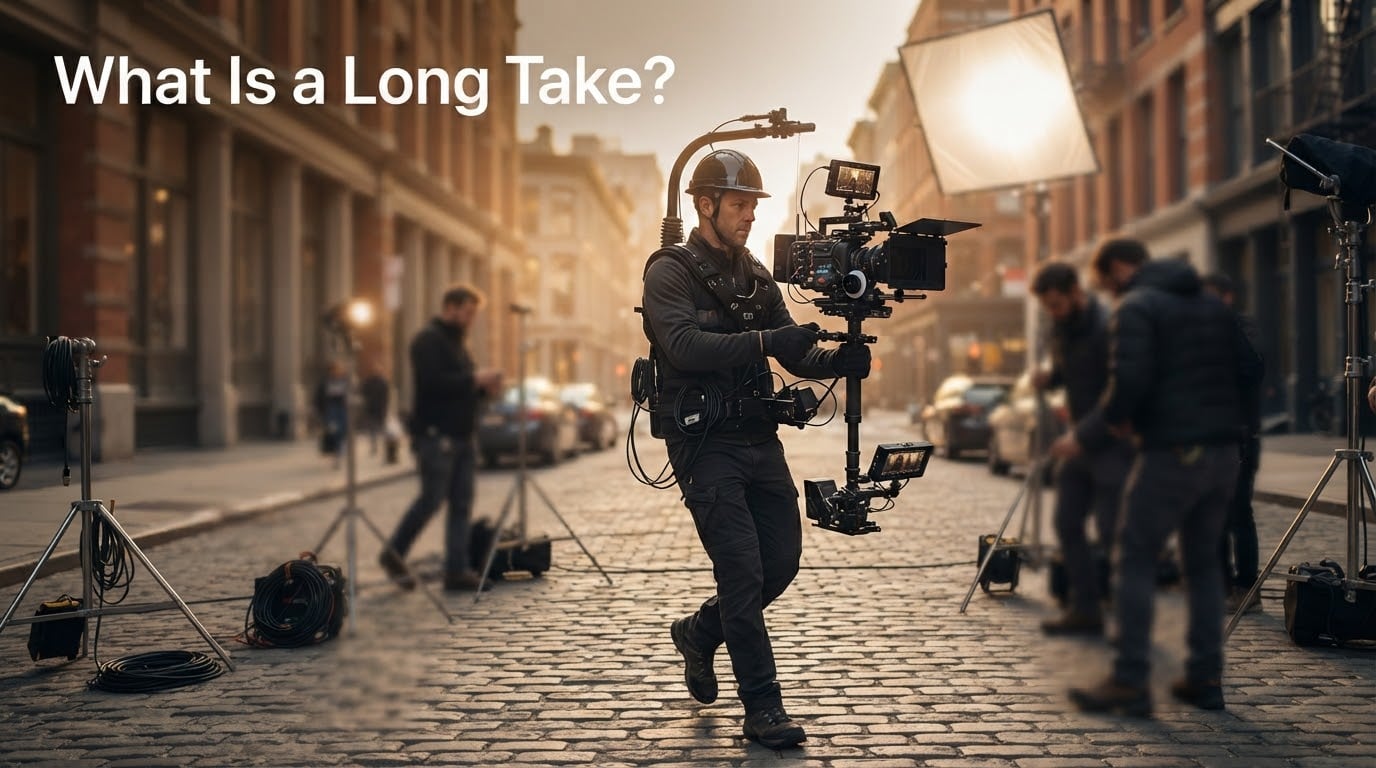
A long take – also called a continuous take, continuous shot, or oner – is a single, uninterrupted shot that runs much longer than the conventional editing pace of a film. It can last anywhere from half a minute to an entire feature, and it usually involves elaborate camera movement and precisely choreographed actor blocking. Filmmakers reach for the long take when they want the audience to feel trapped inside a moment, swept along in real time rather than guided through it by cuts.
If you’ve ever wondered why some films feel like you are breathing alongside the characters, while others feel like flipping through a photo album, the long take is usually the answer. In this guide, our team walks you through the definition, the history, the most famous examples, and the practical craft behind pulling one off – whether you’re a film student, a Short Film Central filmmaker, or just a curious cinephile.
Table of Contents
- What Is a Long Take? Definition and Alternate Names
- Long Take vs Long Shot: Clearing Up the Most Common Confusion
- A Brief History of the Long Take in Cinema
- Why Directors Use Long Takes
- Famous Long Take Examples in Cinema
- Touch of Evil (1958) – The Opening
- Goodfellas (1990) – Copacabana
- Atonement (2007) – The Dunkirk Beach
- Boogie Nights (1997) – The Disco Lingerie
- The Player (1992) – The Opening
- Children of Men (2006) – The Car Ambush
- True Detective Season 1 (2014) – The Raid
- Birdman (2014) – The Stairwell
- 1917 (2019) – The Whole Film
- Gravity (2013) – The Opening
- One-Take Feature Films: When the Whole Movie Is the Take
- Hidden Cuts and Digital Stitching: How They Fake It
- How Long Takes Are Made: Planning, Equipment, and Execution
- Long Takes in TV and Modern Cinema
- Directors Known for Long Takes
- Long Takes in Short Films and Indie Cinema
- When Long Takes Don’t Work: Criticism and Overuse
- Frequently Asked Questions
- Final Thoughts on the Long Take
What Is a Long Take? Definition and Alternate Names
A long take is a shot whose runtime runs significantly longer than the conventional editing pace of the film it appears in – or longer than the editing pace of cinema in general. Where a typical Hollywood shot might hold for two to four seconds before a cut, a long take can hold for thirty seconds, three minutes, or, in the case of single-take features, well over an hour.
The term has a thicket of aliases, and almost every article on the subject opens by untangling them. Here is the working glossary our team uses:
- Long take – The umbrella term. Any single shot whose duration stretches well beyond the editing norm.
- Continuous take or continuous shot – The most literal synonym; emphasizes that the camera never stops rolling.
- Oner – Industry slang, derived from “one-er,” referring to a take intended to play as a single shot in the final cut.
- Sequence shot – A long take that covers an entire dramatic sequence (a heist, a battle, a conversation). French filmmakers call this a plan-séquence.
- One-shot film – A feature film or short edited to look like one continuous shot, though hidden cuts are usually involved.
The first 50 words of this article deliver the canonical definition for a reason – the Wikipedia-style snippet is what search engines surface as the featured answer. But the term is more than a dictionary entry. The long take is a creative choice, and the rest of this guide is about how, why, and when it works.
Long Take vs Long Shot: Clearing Up the Most Common Confusion
This is the confusion we hear most often from readers, and it is the one that keeps showing up in the People Also Ask box. A long take refers to duration. A long shot refers to framing. The two terms are unrelated, and mixing them up is one of the surest signs of a casual viewer.
| Term | Refers to | Example |
|---|---|---|
| Long take | Duration of a single, uninterrupted shot | The 3-minute Copacabana tracking shot in Goodfellas (1990) |
| Long shot | Camera-to-subject distance / focal length | An establishing shot of a city skyline filmed with a long lens |
| Sequence shot | A long take that covers a full dramatic sequence | The Odessa Steps sequence in Battleship Potemkin (1925) |
| Wide shot | A framing choice showing full bodies and surroundings | Two characters seen head-to-toe in a kitchen |
Why does the confusion stick? Because the words sound interchangeable, and because a long take is often (but not always) a long shot in the framing sense. A filmmaker can shoot a long take as a tight close-up on a face, and a long shot can last only two seconds before the editor cuts away. The duration-vs-distance split is the cleanest way to keep them apart.
If you want to test yourself, the next time someone calls a long take a “long shot,” ask them how long the shot lasts. If the answer is in seconds rather than feet, they’re talking about the wrong thing.
A Brief History of the Long Take in Cinema
The long take is older than the language we use to describe it. In the earliest days of cinema, every shot was a long take – there was no editing grammar yet, and cameras had fixed magazines that limited how much film you could expose. The technique became a deliberate artistic choice once editors learned to cut.
Two early landmarks set the template:
- The Stranger (1946) by Orson Welles – often cited as the first feature-length film to use long takes as a stylistic signature, with shots lasting up to nine minutes.
- Rope (1948) by Alfred Hitchcock – staged to look like one continuous shot, though it was actually stitched from 10-minute reels spliced together. Hitchcock’s experiment is the ancestor of every “fake” one-take film since.
By the late 1950s the long take had become a marker of auteur ambition. Orson Welles’s Touch of Evil (1958) opens with a celebrated 3-minute-30-second crane shot that follows a couple through a border-town street, building dread without a single cut. The studio nearly trimmed it; today it is taught in every film school.
The 1960s and 1970s saw the long take evolve into a political and philosophical tool. Andrei Tarkovsky used long takes to slow time and force contemplation in films like Andrei Rublev (1966) and Stalker (1979). Martin Scorsese deployed long takes for kinetic, immersive energy – the Copacabana tracking shot in Goodfellas (1990) is the most-cited example in modern American cinema.
By the 2010s, digital tools made the long take easier to fake convincingly. Alejandro González Iñárritu’s Birdman (2014) won Best Picture using long takes that hide joins in shadow, while Sam Mendes’s 1917 (2019) used digital stitching to make a war film feel like one continuous journey. Both films reignited mainstream interest in a technique that had been quietly waiting for its close-up.
Why Directors Use Long Takes
A long take is never free – it costs rehearsal time, performance stamina, and the risk that one fumbled line blows the whole shot. When filmmakers reach for it, they are usually reaching for one of the following effects.
Immersion and Realism
Editing stitches time back together; the audience is never supposed to notice the seams. A long take removes the seams entirely. The result is a sense that you are watching real time unfold, which is why long takes are the language of choice for documentary-influenced drama (think of the beach landing in Saving Private Ryan or the car ambush in Children of Men).
Mounting Tension
Cuts release pressure. Without them, pressure builds. A long take traps the audience in a scene the way a horror film traps a character in a room. The famous corridor shootout in Oldboy (2003) is a textbook example – you can feel the protagonist’s exhaustion because the camera never lets you look away.
Performance and Character
An actor performing a long take cannot reset between cuts. Every twitch, every breath, every micro-expression survives into the final film. Long takes are a gift to actors playing emotional arcs – the unbroken audition scene in Begin Again, or the stairwell monologue in Birdman.
Spatial Geography
A long take lets the audience learn a space by living in it. The opening of Touch of Evil teaches you the geography of a border town in a single sweep. Boogie Nights (1997) does the same for a 1970s disco. By the time the scene ends, you know where every door is.
Subjective Camera
When the camera is locked to a character’s eye line, a long take becomes the cinematic equivalent of first-person thought. The opening of The Player (1992) by Robert Altman is an eight-minute celebrity cameo parade that puts you inside a Hollywood executive’s morning. You read the room as he reads it.
World-Building and Scope
The reverse trick works too: an objective long take can establish a world so vast and detailed that the audience believes in it. Alfonso Cuarón’s Children of Men (2006) uses long takes to make a dystopian Britain feel observed rather than scripted.
Showing Off – For Better or Worse
We’d be lying if we said the show-off factor didn’t exist. Long takes are visibly hard, and audiences know it. The risk is that the technique starts calling attention to itself, which is exactly the criticism we’ll get to in a later section.
Famous Long Take Examples in Cinema
Below are the scenes our team keeps returning to when we talk about what a long take can do. Each one earns its place for a different reason.
Touch of Evil (1958) – The Opening
Orson Welles opens the film with a 3-minute-30-second crane shot that follows a couple through a Mexican border town while a bomb ticks in the trunk of their car. The studio cut it down for the original release; the restored version is now considered one of the great openings in cinema.
Goodfellas (1990) – Copacabana
Martin Scorsese’s steadicam glides through the back entrance of a nightclub, up an elevator, past the kitchen, and into the VIP table – all in one unbroken move. It is the long take that everyone copies and nobody matches.
Atonement (2007) – The Dunkirk Beach
Joe Wright uses a 5-minute steadicam shot to track Robbie through the chaotic Dunkirk evacuation. The single-take effect mirrors the panic and futility of the moment.
Boogie Nights (1997) – The Disco Lingerie
Paul Thomas Anderson opens the film with a slow, gliding tour of a 1970s San Fernando Valley disco. The camera does not stop introducing characters until the song does.
The Player (1992) – The Opening
Robert Altman’s eight-minute celebrity cameo opener is a masterclass in subjective camera. The long take is mostly famous for the stars who saunter through frame.
Children of Men (2006) – The Car Ambush
Alfonso Cuarón’s film reportedly contains 32 minutes of shots longer than 45 seconds – roughly a quarter of its runtime. The car ambush is the most famous, a 4-minute handheld blast through a besieged city street.
True Detective Season 1 (2014) – The Raid
Cary Joji Fukunaga’s six-minute steadicam shot in episode four is the single most-discussed long take in modern television. It is a logistical miracle: night exterior, multiple locations, dozens of extras, and a planned Steadicam arc that ends in a flaming church.
Birdman (2014) – The Stairwell
Emmanuel Lubezki’s cinematography hides joins in shadow and doorways, letting the long takes appear seamless. The stairwell sequence in particular uses the technique to externalize a character’s psychological unraveling.
1917 (2019) – The Whole Film
Sam Mendes’s World War I drama is sold as “one shot,” though in practice it is hundreds of takes digitally stitched together. The technique immerses viewers in real-time urgency as two soldiers race across enemy territory.
Gravity (2013) – The Opening
Alfonso Cuarón opens Gravity with a 13-minute unbroken sequence that drifts from a serene Earth view into catastrophic destruction. The long take sets up the entire emotional arc of the film in one go.
One-Take Feature Films: When the Whole Movie Is the Take
Some filmmakers take the technique to its logical extreme: a feature film that runs as a single continuous shot. Hidden cuts almost always lurk somewhere in the edit, but the illusion is the point.
| Film | Year | Runtime | Director | Language |
|---|---|---|---|---|
| Empire | 1964 | 8 hours 5 min | Andy Warhol | Silent |
| Timecode | 2000 | 97 min | Mike Figgis | English |
| Russian Ark | 2002 | 96 min | Alexander Sokurov | Russian |
| PVC-1 | 2007 | 85 min | Spiros Stathoulopoulos | Spanish |
| Victoria | 2015 | 138 min | Sebastian Schipper | German |
| Boiling Point | 2021 | 92 min | Philip Barantini | English |
Each of these films is a logistical feat. Victoria reportedly required the entire 138-minute film to be rehearsed in three long weekends before the single 3-hour take was captured in one night. Boiling Point was shot in a single long take that allowed Stephen Graham to improvise his performance as the kitchen fell apart around him.
Hidden Cuts and Digital Stitching: How They Fake It
This is the question that keeps showing up in the People Also Ask box: how do directors fake a long take? The honest answer is that most “long takes” longer than a few minutes are actually several takes joined together so the seams cannot be seen.
The technique is called a hidden cut (sometimes invisible cut) or, when applied across an entire film, digital stitching. The seams are usually hidden in:
- Dark transitions – passing through a dim hallway, a shadow, or a doorway where the brightness can be matched across the cut.
- Movement blur – the camera whips past a wall or object, obscuring the join.
- Body occlusion – a character crosses in front of the lens and the editor cuts mid-occlusion.
- Post-production digital stitching – 3D camera tracking and CG environment matching, as used in 1917.
Sam Mendes’s team on 1917 reportedly rehearsed and shot the film over eight weeks but the final cut was stitched from roughly 65 individual long takes, joined at points chosen for visual continuity. Lubezki’s work on Birdman used similar tricks but leaned harder on practical lighting and shadow blocking.
The reveal can be a letdown for cinephiles who spot the joins – the r/cinematography thread on the topic regularly calls out specific seams in 1917 and Birdman. Whether that ruins the illusion depends on the viewer. Most audiences never notice, which is the entire point.
How Long Takes Are Made: Planning, Equipment, and Execution
Pulling off a long take is one of the most demanding exercises in filmmaking. Our team has watched short film crews attempt them on micro-budgets, and the lessons are the same as the ones taught on big productions: planning is everything.
Pre-Production: The Choreography
A long take starts with a shot list, a storyboard, and a block-by-block rehearsal schedule. Every actor move, every extra’s position, every lighting cue, every camera operator’s path has to be plotted and timed. Studios like StudioBinder walk through this in detail; the short version is that a long take is built before a single frame is exposed.
Rehearsals are non-negotiable. By the time cameras roll, the cast and crew have run the sequence dozens of times. On Victoria, the cast reportedly walked through the script for 12 hours a day across several weeks before the final take.
Equipment: What the Camera Sits On
Long takes demand camera support that can move smoothly through space. The common options:
- Steadicam – the workhorse of modern long takes. Worn by the operator, it isolates the camera from the operator’s footsteps. Used for Goodfellas, Atonement, True Detective.
- Dolly and tracks – the original long-take platform. Smooth, repeatable, but limited to a fixed path.
- Crane or jib – essential for vertical movement, like the opening of Touch of Evil.
- Wireless video transmission – lets the director and focus puller follow the action at a distance without cables snagging.
- Drone and gimbal – the modern extension of the crane, used for exterior long takes where a crane would be impractical.
If you are shooting a short film and wondering what gear to start with, our guide to the best cinema cameras for long interview takes walks through the rigs most accessible to indie crews.
On Set: Rehearsal, Rehearsal, Rehearsal
The single biggest variable in a long take is human error. A line is missed, a prop is in the wrong place, a stray shadow crosses the frame. Rehearsal is the only insurance. On a film like 1917, the production reportedly budgeted more time for rehearsal than for shooting.
Post-Production: Stitching and Sound
Once the footage is captured, the editor finds the joins that best preserve the illusion of continuity. Sound design fills in any audio seams; foley and ambient tracks smooth the cut. The visual effects team handles any CG stitching required.
It is brutal, exhausting work, and it is the reason many long takes look effortless on screen but cost hundreds of hours behind the scenes.
Long Takes in TV and Modern Cinema
Long takes did not stop at cinema. Television has been quietly catching up, and the 2020s have brought a wave of single-episode or single-take experiments.
- True Detective Season 1, Episode 4 (2014) – the raid sequence we covered above is still the benchmark.
- Mr. Robot – Sam Esmail built season finales around long takes that mirror the dissociative state of the protagonist.
- Adolescence (2025) – the British limited series experimented with single-take episodes that followed characters in real time.
- The Studio (2025) – Seth Rogen’s Hollywood satire opens with a long-take dream sequence that sets the show’s manic tone.
The trend reflects two things: digital cameras now match the latitude and runtime of film, and streaming platforms reward technically ambitious moments that audiences share on social media. Long takes have become a marketing asset as much as a storytelling one.
Are long takes still popular today? Yes, but they have evolved. The “show off” single-shot scene has been joined by longer-form experiments – limited series with one-take episodes, VR films designed to be experienced in a single unbroken gaze, and AI-assisted stitching that hides cuts even more invisibly.
Directors Known for Long Takes
A compact glossary of the directors our team most often associates with the technique:
- Alfred Hitchcock – pioneered the stitched long take with Rope (1948).
- Orson Welles – used long takes as a political and stylistic signature from The Stranger (1946) to Touch of Evil (1958).
- Andrei Tarkovsky – the philosopher of the technique; every shot in Stalker feels like a long take.
- Martin Scorsese – the kinetic American master, from Goodfellas to The Wolf of Wall Street.
- Robert Altman – the ensemble long take of The Player set the template for Hollywood satire.
- Alfonso Cuarón – pushed the technique into blockbuster territory with Children of Men and Gravity.
- Alejandro González Iñárritu – reinvented the hidden cut with Birdman (2014).
- Sam Mendes – extended the technique to a whole film with 1917 (2019).
- Cary Joji Fukunaga – delivered TV’s most-discussed long take on True Detective.
- Paul Thomas Anderson – the slow, gliding long take in Boogie Nights and the swirling steadicam work in There Will Be Blood.
Long Takes in Short Films and Indie Cinema
The long take is not only a Hollywood game. Short film and indie filmmakers have made it their own, often out of necessity as much as style. A single unbroken shot can carry an entire short film without the budget or production design of a feature.
On the indie side, the technique has produced some of the most memorable one-take features of recent years: Victoria (2015) was shot for a small budget over a few weeks in Berlin; Boiling Point (2021) was staged in a single London restaurant kitchen with a handful of extras and minimal crew movement. Both films lean on the technique because the technique does the storytelling work.
For short film makers, the long take is a particularly useful constraint. Without time for multiple setups or a large cast, a single unbroken shot becomes a structural argument: you have one chance, so the choreography must be airtight. Short film festivals regularly program long-take shorts because they reward rehearsal discipline in a way that mirrors the work of the form’s master practitioners.
If you are planning a short and want inspiration, our related guides cover how long it takes to make an animated short and the best footrests for long editing sessions – useful for the long hours you’ll spend planning your shot list.
When Long Takes Don’t Work: Criticism and Overuse
No honest guide to the long take is complete without the backlash, and our team has spent enough time on film forums to know it is real. A long-running r/TrueFilm thread titled “Anyone else a bit tired of the obsession with long takes?” captures the mood: viewers feel that some filmmakers reach for the technique as a shortcut to being labelled “artful” or “serious.”
The criticism usually falls into three buckets:
- Unmotivated technique – the long take exists because the director wanted to prove they could shoot one, not because the scene needed it.
- Audience fatigue – extended single takes without dramatic justification can feel like watching someone hold a note they cannot reach.
- Hidden cuts that break immersion – cinephiles who spot a hidden cut can be pulled out of the film entirely, especially when the technique is being sold as “real.”
The counterargument is that the same criticism could be levelled at any technique deployed without motivation – jump cuts, slow motion, shaky cam. The long take is just the current favorite shorthand for “prestige.” When used in service of character, story, or emotion, it remains one of the most powerful tools in cinema. When used as a stunt, it shows.
The honest craft lesson is that a long take has to earn its duration. If a scene would play better with three cuts, cut it. If the unbroken shot makes the audience feel something the cut version could not, hold it.
Frequently Asked Questions
What is a long take in cinematography?
A long take is a single, uninterrupted shot that runs much longer than the conventional editing pace of a film. Also called a continuous take, continuous shot, or oner, it usually involves elaborate camera movement and precisely choreographed actor blocking.
What is the difference between a long take and a long shot?
A long take refers to a shot’s duration (how long it runs). A long shot refers to framing (camera-to-subject distance, often using a long lens). The two terms are unrelated, even though a long take is sometimes also a long shot in the framing sense.
How do directors fake a long take?
Directors fake long takes with hidden cuts – joins hidden in darkness, behind objects, during whip pans, or behind a passing character. Films like 1917 and Birdman stitch together many shorter long takes using digital tools and 3D camera tracking so the seams are invisible.
What is the longest long take in a movie?
Andy Warhol’s Empire (1964) holds the record at roughly 8 hours and 5 minutes of continuous footage of the Empire State Building. Among narrative feature films, Russian Ark (2002) at 96 minutes and Victoria (2015) at 138 minutes are the most-cited single-take features.
Why do directors use long takes?
Directors use long takes to build immersion, real-time tension, performance continuity, spatial geography, subjective camera, and emotional weight. The technique removes the seams of editing and forces the audience to inhabit a scene rather than observe it.
Are long takes still popular today?
Yes. Long takes are common in prestige cinema (1917, Birdman), television (True Detective, Adolescence), and one-take features like Victoria and Boiling Point. Digital cameras, wireless transmission, and AI-assisted stitching have made the technique more accessible in the 2020s.
Final Thoughts on the Long Take
A long take is more than a technical stunt. It is a creative choice that asks the audience to breathe at the same pace as the characters on screen. From Hitchcock’s stitched reels in Rope to the digital seams of 1917, the technique has reinvented itself with every generation of cinema.
Our team hopes this guide answers the question “what is a long take” with enough depth to plan your next shot, score your next film class paper, or settle the next debate about whether the Copacabana tracking shot beats the True Detective raid. If you are a Short Film Central filmmaker looking to try one yourself, start with the short film and indie section above, plan your shot list twice, and rehearse until you dream about it.
That is the long take in 2026: one shot, one chance, one chance to make it count.