
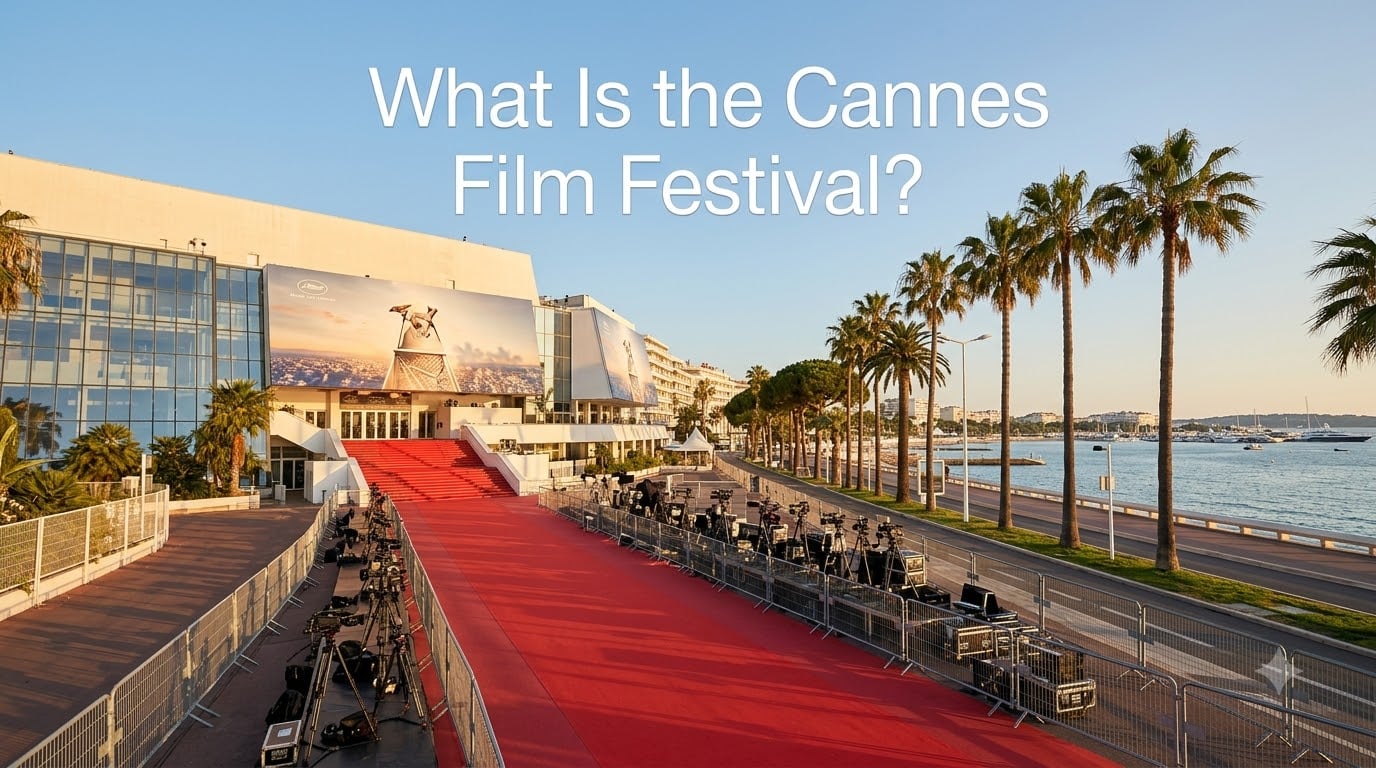
The Cannes Film Festival is the world’s most prestigious international film festival, held annually in May in Cannes, France, on the French Riviera. Founded in 1946, it previews new films from across the globe, awards the coveted Palme d’Or, and serves as the single most important annual gathering for the international film industry. Every spring, thousands of filmmakers, critics, distributors, and cinephiles descend on this small Mediterranean city to celebrate cinema at its highest artistic level.
If you have ever wondered what happens behind the red carpet, why a Palme d’Or win matters more than almost any other film prize, or whether you can actually buy a ticket and attend, this guide is for you. Our team has followed Cannes for years, watched dozens of premieres, and pulled together everything you need to understand the festival that defines world cinema.
Table of Contents
- What Is the Cannes Film Festival?
- The History and Origins of the Cannes Film Festival
- Where Is the Cannes Film Festival Held?
- How Does the Cannes Film Festival Work?
- The Palme d’Or and Other Major Awards
- Why Is the Cannes Film Festival So Important?
- The Marche du Film and the Business of Cinema
- Short Films at Cannes: The Cinéfondation and Short Film Palme d’Or
- How to Attend the Cannes Film Festival?
- Frequently Asked Questions
- Final Thoughts
What Is the Cannes Film Festival?
The Cannes Film Festival (French: Festival de Cannes) is an annual international film festival that takes place over roughly twelve days each May in the city of Cannes on France’s Côte d’Azur. It previews new films of every genre, length, and country of origin, then awards prizes to the best in competition. Run by the French nonprofit Association Française du Festival International du Film, it is officially classified as a competitive feature film festival and is accredited by the FIAPF (the International Federation of Film Producers Associations).
The Festival at a Glance
Founded: 1946 (originally planned for 1939)
Location: Cannes, France, on the French Riviera
Main venue: Palais des Festivals et des Congrès
Top prize: The Palme d’Or (Golden Palm)
Length: Around 12 days each May
Next edition: The 80th edition runs May 11 to 22, 2027
Industry side: The Marché du Film, the largest film market in the world
Think of Cannes as three things in one. First, a competitive showcase where the year’s strongest films compete for the Palme d’Or. Second, a film market where studios buy and sell distribution rights to thousands of titles. Third, a cultural spectacle whose red-carpet premieres set the tone for the entire year’s film conversation.
The History and Origins of the Cannes Film Festival
Cannes was born out of a specific moment in history, and its origins tell you a lot about what the festival was designed to be. The story begins in the late 1930s, when France wanted a free, international alternative to the Venice Film Festival, which by then had fallen under fascist Italian government influence.
Why Cannes Was Born in 1939 (and Launched in 1946)
The idea took shape in 1938, when Philippe Erlanger and a small group of French officials, including the then-Minister of Education Jean Zay, began lobbying for a French rival to Venice. The plan was ambitious: an independent festival where films would be judged purely on artistic merit, free of political pressure.
Originally set to debut in September 1939, the festival’s inaugural edition was cancelled at the very last moment when Nazi Germany invaded Poland and World War II erupted across Europe. Posters and invitations had already been printed. The first true Cannes Film Festival finally opened on September 20, 1946, in the old Casino Municipal of Cannes. It featured sixteen films from across Europe and the United States, and it announced something the cinematic world had not really seen before: a global festival that put art above politics.
Milestones Through the Decades
After 1946, Cannes grew quickly into its current role. In 1951, the festival moved into a dedicated venue, and in 1955 the top prize was renamed the Palme d’Or (it had previously been called the Grand Prix). The festival survived the political turmoil of 1968, when screenings were cancelled in solidarity with the May 1968 protests, and it expanded its programming over subsequent decades to include sections like Directors’ Fortnight, Critics’ Week, and the Cinéfondation, the last of which is especially relevant for short filmmakers.
By the 2026s, Cannes had firmly established itself as the most prestigious film festival on Earth, a position it has held consistently for over half a century.
Where Is the Cannes Film Festival Held?
The Cannes Film Festival takes place entirely in the city of Cannes, a resort town of about 75,000 people on the French Riviera (Côte d’Azur) in southeastern France. This is the same stretch of coastline that runs through Nice, Antibes, and Monaco. Cannes itself is small enough that most of the festival action happens within walking distance of the city’s famous Croisette waterfront boulevard.
The Palais des Festivals et des Congrès
Most of the festival’s public-facing events are staged inside the Palais des Festivals et des Congrès, a sprawling modernist building on the western end of the Croisette. The current Palais opened in 1982 after the original 1949 building was demolished. Inside, you will find the Grand Théâtre Lumière, the festival’s main 1,000-plus seat screening hall where Competition and Out of Competition premieres happen, plus Debussy Theater, Buñuel Theater, and a labyrinth of press rooms, interview booths, and red-carpet entrances.
The famous 24 steps of the red-carpet staircase sit right at the Palais entrance. Almost every major premiere photo you have ever seen from Cannes was shot on those steps.
How Does the Cannes Film Festival Work?
Cannes runs for about twelve days each May. The schedule is packed from morning to night: press and industry screenings in the morning, photo-calls and junkets in the afternoon, official premieres in the evening, and after-parties that often run until dawn. Our team has spent several editions on the ground, and the rhythm is intense even compared to other major festivals.
Festival Sections and Categories
Films at Cannes are organized into several official and parallel sections, each with its own purpose and jury.
In Competition: Around 18 to 23 feature films competing for the Palme d’Or, judged by the Main Competition Jury.
Out of Competition: High-profile premieres not eligible for prizes, often gala premieres of major studio films.
Un Certain Regard: A competition section focused on films with unique styles or visions.
Cannes Première: A section for films that have already played elsewhere but deserve a major Cannes platform.
Special Screenings: Documentaries, restored classics, and tributes.
Midnight Screenings: Genre films, often horror, action, or cult-style titles.
Two long-running parallel sections run alongside the official selection:
Directors’ Fortnight (Quinzaine des Cinéastes): Founded in 1969 by the French Directors’ Guild after the 1968 upheaval, it focuses on independent and auteur cinema.
Critics’ Week (Semaine de la Critique): The oldest parallel section, founded in 1962, dedicated to first and second feature films.
The Selection Committee and Jury
The official selection is curated by the festival’s General Delegate and a committee of programmers who watch thousands of submissions each year. Films are not submitted by the public in the traditional sense. Studios and producers send screeners, but the final call rests with the festival. There is no fee to enter, and there is no application portal like some festivals use. It is invitation-driven, which is part of why a Cannes slot is so rare.
Once selected, films in Competition are judged by the Main Jury, a rotating panel of roughly nine filmmakers, actors, and cultural figures chaired by a different President each year. Past jury presidents have included Martin Scorsese, Jane Campion, Greta Gerwig, Spike Lee, and Isabelle Huppert. The jury watches every Competition film, then deliberates and announces the winners at the Closing Ceremony on the final Saturday.
The Palme d’Or and Other Major Awards
Cannes hands out around twenty prizes each year across its various sections. The Palme d’Or is the headline award, but several other prizes carry serious weight in the industry.
What Is the Palme d’Or?
The Palme d’Or (Golden Palm) is the highest prize awarded at the Cannes Film Festival, given to the director of the best film in the official Competition. It takes the form of a golden palm leaf, designed in 1955 and inspired by the coat of arms of the city of Cannes. Winning the Palme d’Or is widely considered the single highest honor in world cinema, often ranked above even the Academy Award for Best Picture in terms of pure artistic prestige.
Recent Palme d’Or winners include Sean Baker’s Anora in 2024, Justine Triet’s Anatomy of a Fall in 2023, and Ruben Östlund’s Triangle of Sadness in 2022. Past legends of the prize include Francis Ford Coppola, Martin Scorsese, Quentin Tarantino, the Coen Brothers, Lars von Trier, Michael Haneke, and Bong Joon-ho. Bong’s 2019 win for Parasite later paved the way for its Best Picture Oscar, illustrating the unique two-track path between Cannes glory and Hollywood success.
Other Cannes Awards
The Competition jury also awards several companion prizes each year:
Grand Prix: The runner-up prize, second only to the Palme d’Or.
Jury Prize: Awarded to a third standout Competition film.
Best Director: Recognizes directorial achievement specifically.
Best Screenplay: Awarded for outstanding writing.
Best Actor / Best Actress: Given to standout performances.
Short Film Palme d’Or: The top prize for short films (more on this below).
Camera d’Or: Best first feature across all sections, judged by a separate jury.
Why Is the Cannes Film Festival So Important?
Cannes matters because it sits at the very top of the prestige hierarchy in film. The festival was designed from day one to evaluate films on artistic merit rather than box office, and that mission has shaped the global cinema landscape for nearly eighty years. A Palme d’Or win can transform a small independent film into an international sensation overnight. A Cannes premiere, even without a prize, often triggers distribution deals worth millions of dollars.
Beyond the business side, Cannes sets the cultural agenda for the rest of the year. Every fall film season and awards campaign is influenced, in some way, by what Cannes celebrated or ignored the previous May. Critics travel from over 90 countries to attend. The press coverage generated during the twelve-day festival reaches roughly half a billion viewers worldwide.
Cannes vs the Oscars: What’s the Difference?
This is one of the most common questions we get from readers. Cannes and the Oscars are both incredibly important, but they reward different things.
Cannes rewards artistic merit. There is no box-office consideration, no campaign spending, no lobbying. The jury selects what they consider the strongest films from a curated competition.
The Oscars reward industry success. Academy members vote based partly on craft, partly on personal taste, and partly on the year-long PR campaigns studios run to support their contenders.
Cannes happens before release. Most Cannes Competition films have not yet been released theatrically. The Oscars mostly consider films already in wide release.
Cannes is global. Films in Competition come from every continent. The Oscars are voted on by an American academy and tend to favor Hollywood productions.
For filmmakers, winning at Cannes is often considered the harder and more meaningful prize. For actors and audiences, an Oscar typically has more name recognition.
The Marche du Film and the Business of Cinema
Running alongside the festival is the Marché du Film, the largest film market in the world. Held at the same time in Cannes, the Marché turns the city into a global bazaar where producers, distributors, sales agents, and buyers negotiate deals on roughly 4,000 films and projects each year.
More than 12,000 industry professionals from over 120 countries attend the Marché annually. If you walk past the Palais during the festival and see lines of suited executives clutching iPads and coffee cups, you are most likely looking at Marché business in progress. This is the commercial engine of Cannes, and it is what keeps the festival financially self-sustaining.
The Marché is also where emerging producers connect with financiers, where festival programmers scout for their next season’s lineups, and where smaller national film agencies set up pavilions to promote their country’s cinema.
Short Films at Cannes: The Cinéfondation and Short Film Palme d’Or
If you are a short film maker or a short film fan, Cannes has a section specifically for you. Two dedicated programs place shorts at the heart of the festival.
The first is the Cinéfondation, launched in 1998 to support the next generation of filmmakers. Each year, the Cinéfondation selects around 15 to 20 student films from film schools around the world and screens them in Cannes. The top three Cinéfondation films receive prizes that fund the directors’ next feature projects.
The second is the Short Film Competition, which screens roughly 10 to 12 shorts in official selection each year. From this pool, the Short Film Palme d’Or is awarded to the best short, judged by a jury dedicated entirely to the short film competition. Past Short Film Palme d’Or winners have included work by filmmakers who later went on to direct major features. The short film circuit at Cannes is, in many ways, a launching pad for the next generation of world cinema.
For our audience at Short Film Central, this is where Cannes is most directly relevant. We follow the Short Film Competition closely each year and report on the winners as soon as the awards are announced.
How to Attend the Cannes Film Festival?
Yes, you can attend, but your access depends on who you are. The festival is open to the public, but screenings and access are tiered.
If you are a film professional (director, producer, distributor, journalist, festival programmer), you can apply for an accreditation through the festival’s official website. Industry accreditation gives you access to the Marché, the official screenings, and most press conferences.
If you are a film student, you can apply for the Cinéfondation Residence program or, in some cases, a student pass that grants limited access.
If you are a member of the general public, you can still attend. Limited public tickets go on sale for evening screenings, and the festival’s outdoor cinema screens films for free on the beach every night. You can also stand along the Croisette to watch celebrities arrive for premieres, though you will not get into the actual screenings without a pass.
For the 2027 edition running May 11 to 22, accreditation applications typically open in early 2026 of the preceding year. Tickets for the public screenings usually sell out quickly.
Frequently Asked Questions
What is the purpose of the Cannes Film Festival?
The Cannes Film Festival exists to celebrate and reward artistic excellence in world cinema. It provides a global stage for new films of every genre and country, awards the Palme d’Or to the strongest entry in its official Competition, and operates the Marché du Film as the world’s largest film market. Beyond prizes and deals, the festival serves as the annual meeting point for the international film industry, where artistic merit is prioritized over commercial success.
Can anybody go to the Cannes Film Festival?
Yes, members of the public can attend limited parts of the festival. Outdoor beach screenings are free every night, and a small number of tickets for evening Competition and special screenings go on sale to the general public. However, full access to red-carpet premieres, the Marché du Film, and most screenings requires industry accreditation, which is reserved for film professionals, journalists, and students who apply through the official festival website.
Which is more prestigious, the Cannes or the Oscar?
Within the global filmmaking community, the Cannes Film Festival is generally considered the more artistically prestigious prize, especially for international filmmakers. The Palme d’Or is selected by a small expert jury and rewards purely artistic merit, with no campaigns or commercial factors. The Oscar for Best Picture carries wider public recognition and global TV viewership, but it is voted on by a large American academy and is heavily influenced by year-long studio campaigns. For most directors and international filmmakers, a Palme d’Or outranks an Oscar in artistic prestige.
What is the Palme d’Or?
The Palme d’Or, or Golden Palm, is the highest prize awarded at the Cannes Film Festival. Given each year to the director of the best film in the official Competition, it takes the form of a golden palm leaf and was first awarded under that name in 1955. Past winners include Francis Ford Coppola, Quentin Tarantino, the Coen Brothers, Lars von Trier, Michael Haneke, and Bong Joon-ho. A Palme d’Or win is widely considered the single highest honor in world cinema.
When is the Cannes Film Festival held each year?
The Cannes Film Festival takes place annually in May, typically running for about twelve days from the middle to the end of the month. The 80th edition is scheduled for May 11 to 22, 2027. Dates shift slightly each year to align with the French public holiday calendar, but the festival consistently falls in the second half of May.
Final Thoughts
The Cannes Film Festival is far more than a glamorous May vacation on the French Riviera. It is the annual heartbeat of world cinema, the place where the strongest films of the year are revealed, where the Palme d’Or is awarded, and where the industry meets to decide what gets made, sold, and seen in the year ahead.
For filmmakers, especially those working in short film, Cannes offers a stage that no other festival can match. We will keep covering the Short Film Competition, the Cinéfondation, and the broader Cannes slate every spring so you can follow along with the films and filmmakers shaping the next era of cinema.