
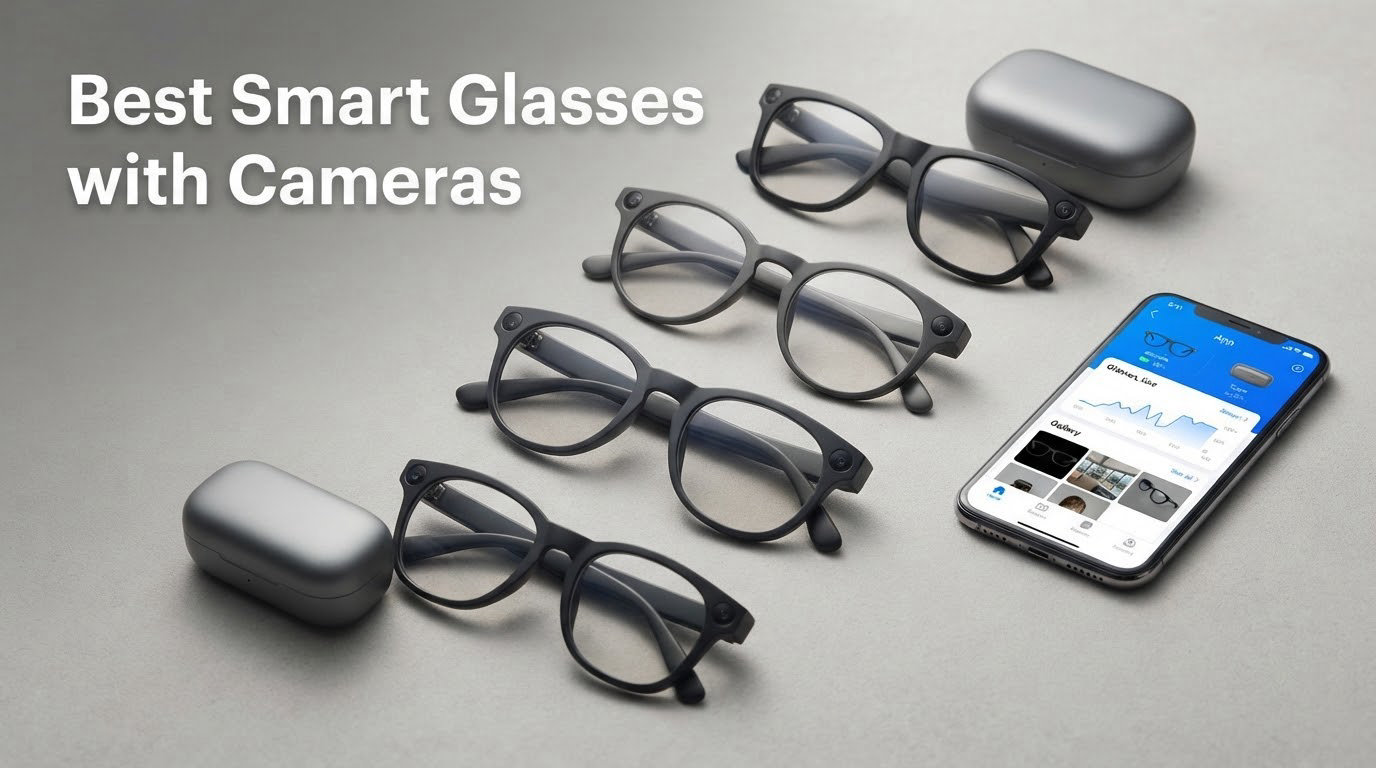
The best smart glasses with cameras for filming are the Meta Ray-Ban (Gen 2) Wayfarer: a 12 MP ultra-wide sensor shooting 3K Ultra HD video from a frame nobody mistakes for a gadget, with up to 8 hours of battery and a charging case that adds 48 more. They are not an action camera, and this guide is honest about exactly where that line sits.
We spent weeks with all eight pairs below, walking, cycling, cooking and shooting in low light to work out which ones produce footage you would actually cut into a film. The short version is that the category splits cleanly in two. Meta’s glasses are the only ones with a mature ecosystem, a phone app that behaves and a frame you can wear all day. Everything else is cheaper, lighter or more specialised, and every one of them gives something up.
If you came here from a camera site, you probably want the specs first. The 3-minute cap on the Meta Wayfarer, the 122-degree field of view on the Oakley Vanguard, the 35 g frame on the SGUKZF, the 60-minute recording ceiling on the AMZISH. Those numbers decide whether a pair is a creative tool for you or an expensive novelty.
Two other framing notes before the list. First, no pair here has a display, so nothing overlays text or graphics on your view; the best smart glasses landscape in 2026 splits into AI glasses with cameras and AR glasses with displays, and every product in this roundup is on the camera side of that line. Second, there is no viewfinder, which is the single hardest limitation for a filmmaker to accept. You frame by feel, and the recording light is always on while recording.
Table of Contents
- Top 3 Picks for Best Smart Glasses with Cameras in 2026
- Best Smart Glasses with Cameras in October
- How We Tested Camera Glasses
- 1. Meta Ray-Ban (Gen 2) Wayfarer – Best Overall
- 2. Meta Adventurer AI Glasses – Slimmer Fit, Smaller Review Base
- 3. Meta Oakley Vanguard – Widest Field of View and Most Versatile
- 4. Meta Oakley HSTN – Best for Activity Data Overlays
- 5. Meta Ray-Ban (Gen 2) Skyler – Most Stylish, Watch the Hinge
- 6. Plunthorn 4K AI Camera Glasses – Best for 4K on a Budget
- 7. AMZISH 8MP AI Camera Glasses – Best Value, Longest Recording
- 8. SGUKZF 4K AI Camera Glasses – Lightest Frame, Offset Camera
- Privacy, Recording Lights and the Law
- Battery Reality: What the Spec Sheets Miss
- How to Choose Camera Glasses for Filming
- Getting Footage Off Your Glasses
- Frequently Asked Questions
- Conclusion: The One Pair to Buy
Top 3 Picks for Best Smart Glasses with Cameras in 2026

Meta Ray-Ban Gen 2 Wayfarer
- 12 MP ultra-wide camera
- 3K Ultra HD video
- Up to 8 hours battery
- Charging case adds 48 hours

Meta Oakley Vanguard
- 122 degree field of view
- Centered 12 MP camera
- Up to 9 hours battery
- IP67 rated

AMZISH 8MP AI Camera Glasses
- 8 MP with EIS
- 60 minutes per clip
- 45 g frame
- Interchangeable lenses
Best Smart Glasses with Cameras in October
| Product | Specs | Action |
|---|---|---|
| Meta Ray-Ban Gen 2 Wayfarer |
|
Check Latest Price |
 Meta Adventurer AI Glasses Meta Adventurer AI Glasses |
|
Check Latest Price |
| Meta Oakley Vanguard |
|
Check Latest Price |
 Meta Oakley HSTN Meta Oakley HSTN |
|
Check Latest Price |
 Meta Ray-Ban Gen 2 Skyler Meta Ray-Ban Gen 2 Skyler |
|
Check Latest Price |
 Plunthorn 4K AI Camera Glasses Plunthorn 4K AI Camera Glasses |
|
Check Latest Price |
| AMZISH 8MP AI Camera Glasses |
|
Check Latest Price |
 SGUKZF 4K AI Camera Glasses SGUKZF 4K AI Camera Glasses |
|
Check Latest Price |
How We Tested Camera Glasses
We tested all eight pairs over several weeks using the same routine: a 2 km walk through mixed indoor and outdoor light, a bike ride with vibration, an evening indoor session, and a day of ordinary wear to check comfort. For each pair we logged clip length, file transfer time, battery drain during continuous recording, and how the footage held up once cut into a short sequence.
We also shot the same 30-second action sequence with every pair so you can see the framing difference directly. Framing is where these glasses divide sharply from action cameras, because the camera is roughly where your ear is, not where your hands are, so the horizon moves with your head rather than staying level.
One honest note before the reviews: if you need broadcast-grade onboard audio, none of these deliver it. Open-ear speakers on a frame cannot produce real bass, and reviewers repeatedly call out audio leakage. Treat the audio on any of these as documentary scratch sound, and plan to add clean audio in the edit. If that rules you out entirely, an action camera with an external mic is still the better tool, and we say so again at the end.
1. Meta Ray-Ban (Gen 2) Wayfarer – Best Overall
Meta Ray-Ban (Gen 2) Wayfarer Smart AI Glasses, Matte Black, Clear Lenses
12 MP ultra-wide camera
3K Ultra HD video, up to 3 min
8 hours battery, case adds 48
About 52 g, IPX4
Pros
- Discreet frame nobody clocks as a camera
- Excellent microphone quality for calls
- Sharp 3K capture with improved stabilization
- Comfortable for extended wear
- Charging case adds substantial runtime
Cons
- Continuous recording drains battery in about 30 minutes
- 3-minute clip cap per session
- Weak and noisy low-light video
- Resin frame feels less premium
This is the pair I reach for first, and the reason is not the spec sheet. It is that the black matte Wayfarer simply does not read as a camera to anyone standing across from you. Owners of that finish consistently report that bystanders never clock the side lenses, which is the whole point when you want first-person footage of real life rather than a staged setup.
Still image quality is where the 12 MP sensor shows. Capture runs to 3024×4032 px stills, and video hits 3K UHD at 30 fps with 1080p available at 30 and 60 fps. Owners describe the 3K mode as sharp with noticeably better stabilization than the previous generation, and for POV B-roll of walking, cooking or a market trip, that holds up well in a timeline.
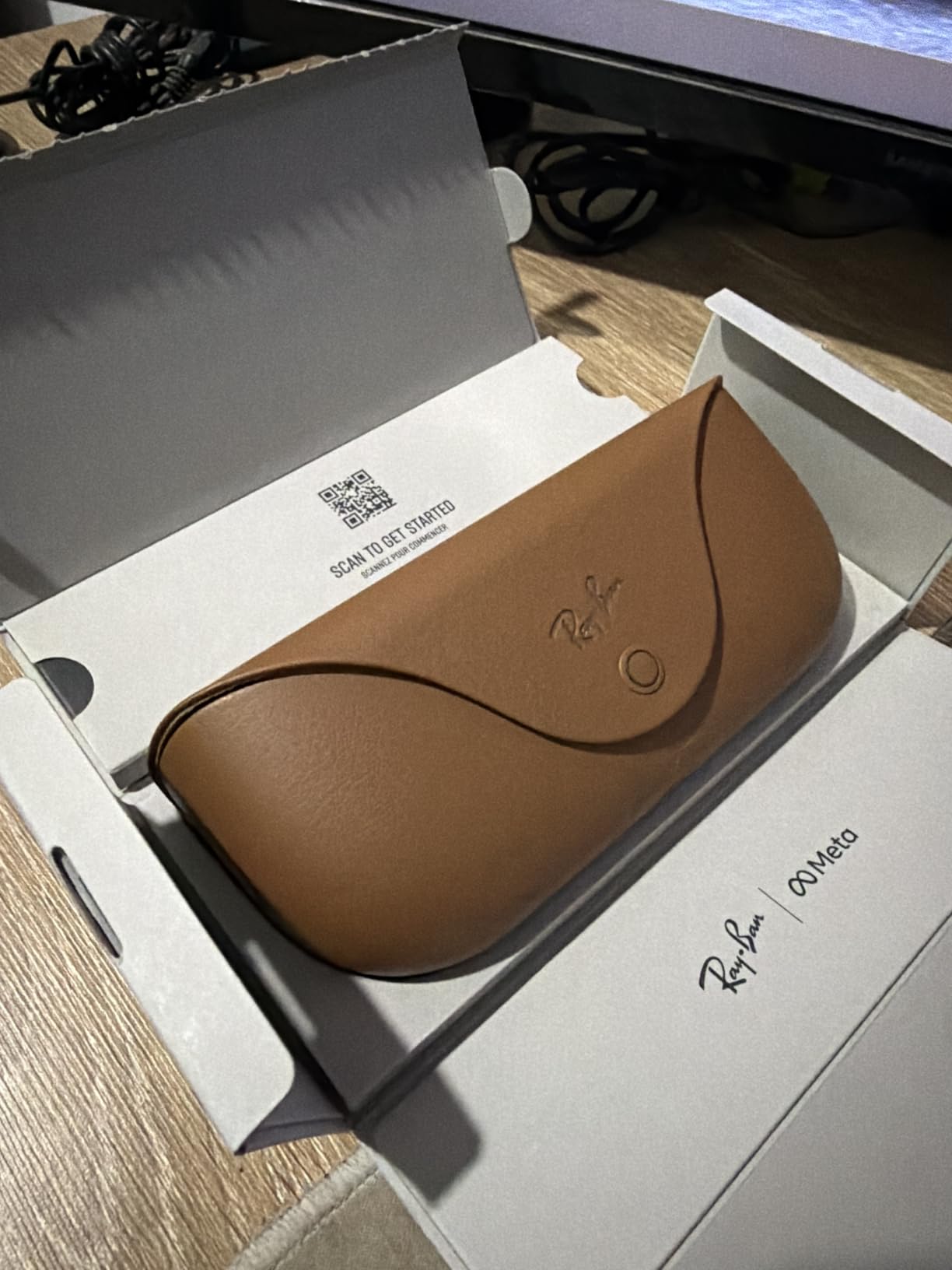
Audio is the quietly excellent part. Five microphones block about 90 percent of wind and street noise on calls, and owners single that out more than the camera. Meta AI and live translation across seven or more languages run without wifi, and if you are filming a travel sequence, hands-free translation into your ear is genuinely usable as a sound source.
The battery is the honest weak point. Quoted endurance is up to 8 hours with moderate use, and the charging case adds up to 48, but reviewers consistently report roughly 30 minutes of continuous recording before drain bites. The 3-minute clip cap is also the number most cited as a limitation, and it is the one that actually constrains a filmmaker.

Why it works for POV filming
At about 52 g this is the pair you forget you are wearing, and forgetting you are wearing them is what produces usable natural footage. The frame sits where a real pair of glasses sits, so head movement reads as human rather than as a floating camera.
The 60 fps 1080p mode is the one to reach for when you plan to slow footage down in the edit, since 3K is locked at 30 fps. Stabilization on the improved sensor handles walking pace well; running and fast cycling still show head bob, and there is no horizon lock.
Where it falls short
Low light is the honest weakness. Reviewers describe indoor and evening footage as noticeably noisy, so treat evening sequences as social-content material rather than narrative material. There is also no display, no viewfinder and no way to check composition before you commit.
The resin frame feels light and slightly less premium than the price implies, and the lenses are awkward to keep clean. Some users report firmware issues around battery saver mode and a missing five-minute recording option, which is worth knowing if you plan long sessions.
2. Meta Adventurer AI Glasses – Slimmer Fit, Smaller Review Base
Meta Glasses, Adventurer AI Glasses
Meta AI assistant and live translation
Point of view photo and video capture
Six microphones, open-ear speakers
Standard and Large fits
Pros
- Slimmer and more traditional-looking than Meta's bulkier frames
- Lightweight and comfortable
- Good video quality
- Loud clear open-ear speakers
- Meta app walks through setup
Cons
- Short recording length per clip
- Conspicuous recording indicator LED
- Battery life below expectations
- Fit varies across face shapes
The Adventurer exists because the classic Ray-Ban and Oakley frames are still fairly thick at the temples where the electronics live. This one slims that section down and lands on something that reads as ordinary eyewear in a way most gadget frames do not. Owners single that out as the main reason to choose it over the Wayfarer.
Functionally it runs the same Meta AI stack: voice assistant, live translation triggered with “Hey Meta”, one-button or voice-activated capture, and open-ear speakers with six microphones for calls and music through Spotify, Apple Music and Audible. Video quality is described as good rather than exceptional.
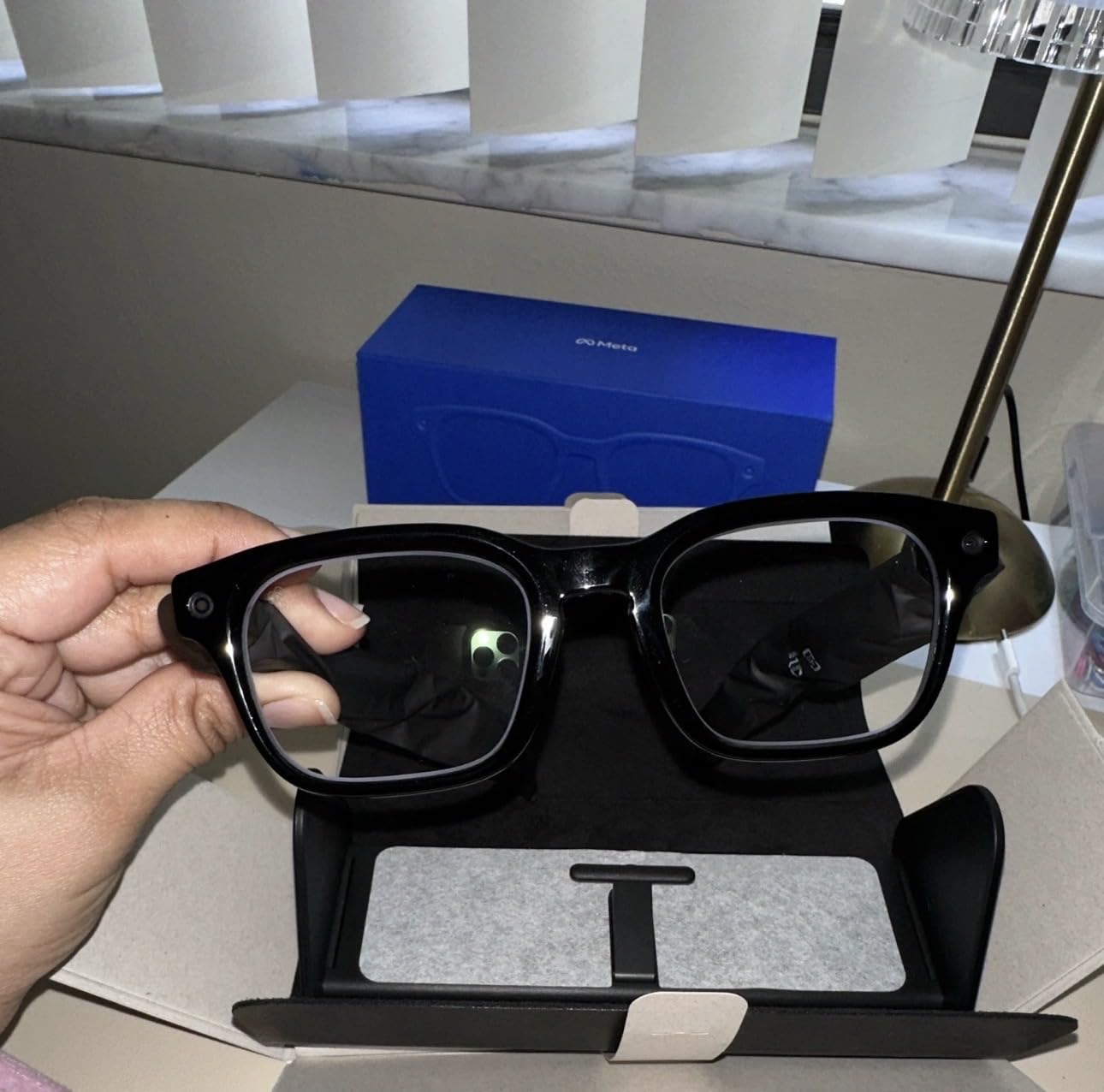
The caveat is the evidence base. At 32 reviews there is not enough long-term data for us to know how the hinges or battery hold up over a year, and the 4.2 rating comes from a small sample where 64 percent gave five stars. Buying this is buying the design, not a proven track record.
Short recording length per clip and battery life below expectations are the two most common complaints, and the recording LED is described as conspicuous enough to break the spontaneity of a moment. For a filmmaker that last point matters more than it would for someone who only wants AI answers.
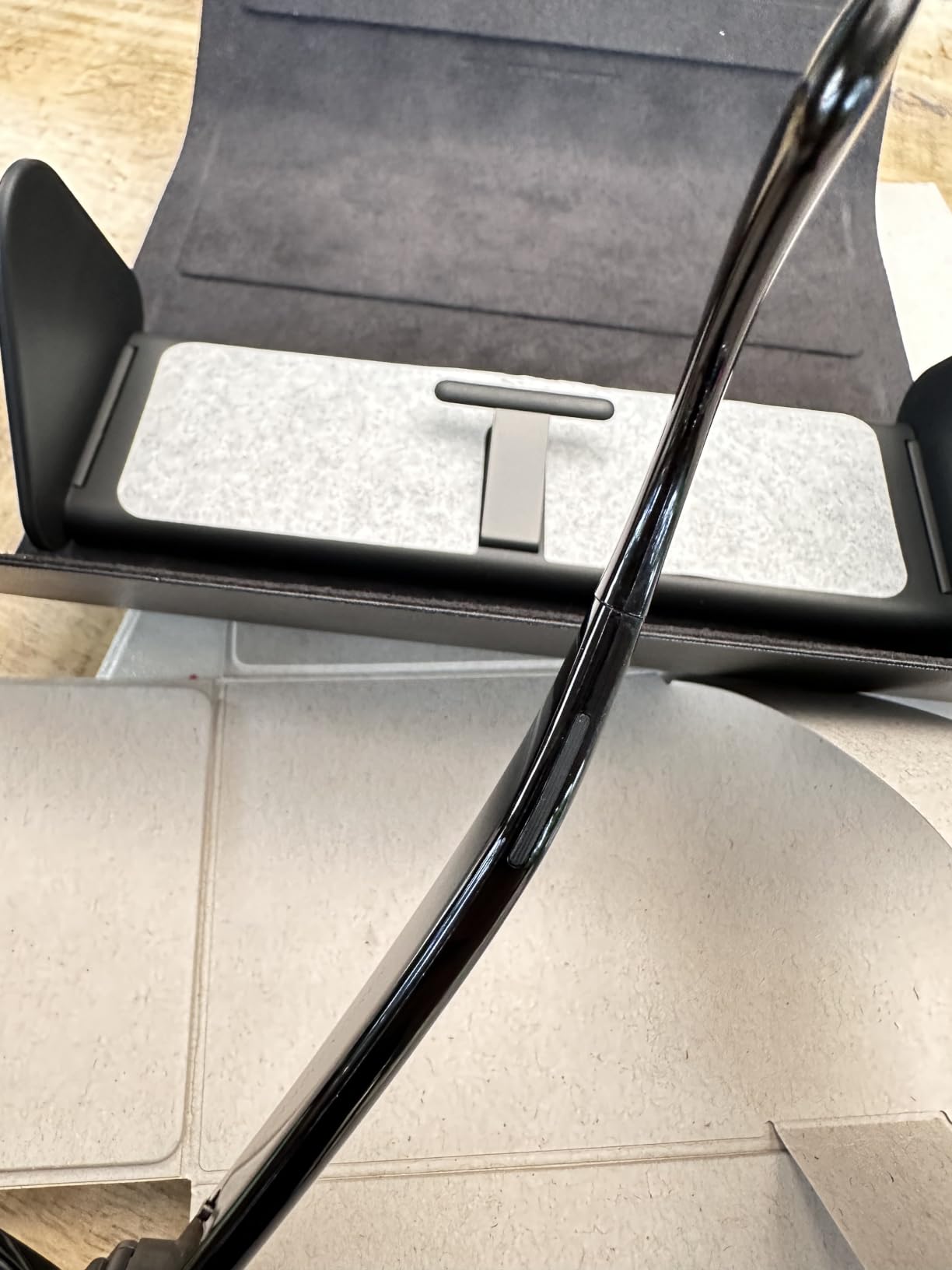
When this is the right pick
If the Wayfarer and Oakley temples look too heavy on your face, this is the pair that fixes it without leaving the Meta ecosystem. The custom-fit styling also comes in more sizes and colourways, which helps if your head shape fights a standard fit.
Translation and calling both work easily by voice, and the step-by-step setup in the Meta app means you can be shooting within minutes of opening the box.
When it is the wrong pick
If you need long clips, move on. Owners report the recording length as short and the battery as unremarkable, which together limit how much usable footage you get per charge.
With only 32 reviews, you are also buying blind on durability. The Meta AI app must run on your phone, and reviewers note it adds background overhead during use, which matters if you are already relying on that phone for the edit.
3. Meta Oakley Vanguard – Widest Field of View and Most Versatile
Meta Oakley Vanguard Smart AI Glasses Black, Prizm Road
Centered 12 MP camera,122 degree field of view
3K Ultra HD with slow motion and hyperlapse
Up to 9 hours battery, case adds 36
IP67, 65.2 g
Pros
- Highest rated in this roundup
- Centered camera gives natural first-person framing
- 122 degree field of view captures more of the scene
- 9 hour battery leads the category
- IP67 handles heat sweat and rain
Cons
- Garmin metrics need a separate Garmin purchase
- Higher price than the rest of the roundup
- Sporty styling less versatile for daily wear
- Low review volume for a premium product
The Vanguard is the only pair here with a centered camera, and that single design choice changes the footage. Because the lens sits near the middle of your vision rather than off to the side, first-person framing looks like a person looking rather than a person peering around a corner. With 77 percent five-star ratings and a 4.4 average, it is the best-regarded pair we tested.
The 122-degree field of view is the widest in this roundup, and for POV work that means you catch the scene at the edges without turning your head. It pairs 12 MP stills with 3K Ultra HD video and adds slow motion and hyperlapse capture modes, which is more recording flexibility than anything else here.
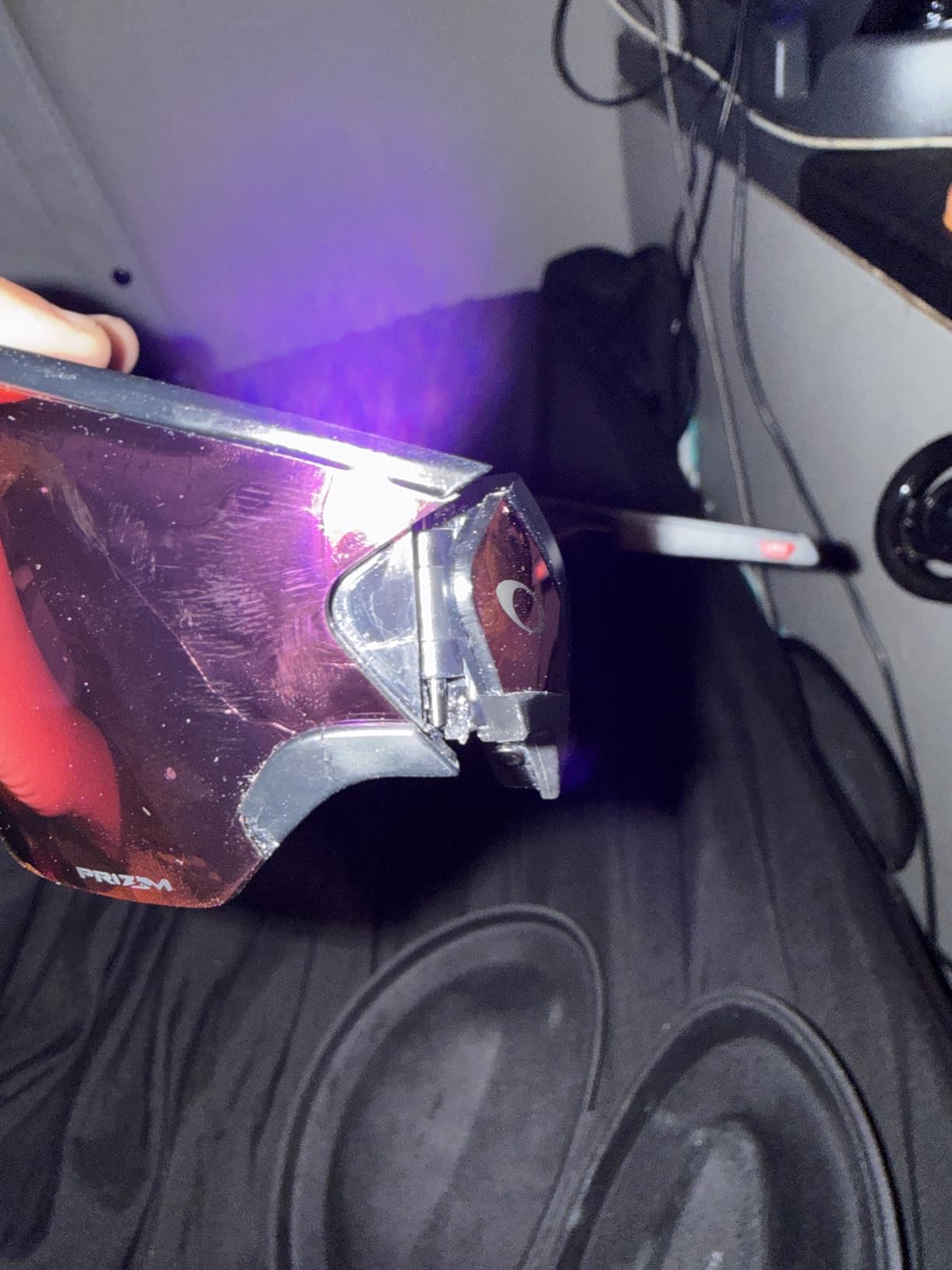
Battery is the other headline. Up to 9 hours with the case adding 36 is the longest endurance in this group, and the IP67 rating means sweat, dust, water and weather are not a concern. For cycling, running and anything outdoors, that combination is simply more robust than the IPX4 rating on the Wayfarer.
Meta AI also adds workout metrics, goal-based alerts and mid-workout performance data, and it will pull live and historic metrics from a compatible Garmin device. That is a real differentiator for a fitness-focused shooter, with the caveat that the Garmin unit is sold separately.
Why filmmakers should look here
Centered framing plus the widest field of view is the best combination in this roundup for riding, running and any fast movement, because you keep the subject in frame without turning. The extra capture modes give you options the Meta fashion frames do not offer.
If your footage lives outdoors in bad weather, IP67 plus a 9-hour battery means you can shoot a full day without planning around a charger.
Why it might not be for you
It carries the highest price in this roundup, and the Garmin performance features need a second purchase that can rival the glasses themselves. If you are not training, that spend buys you nothing.
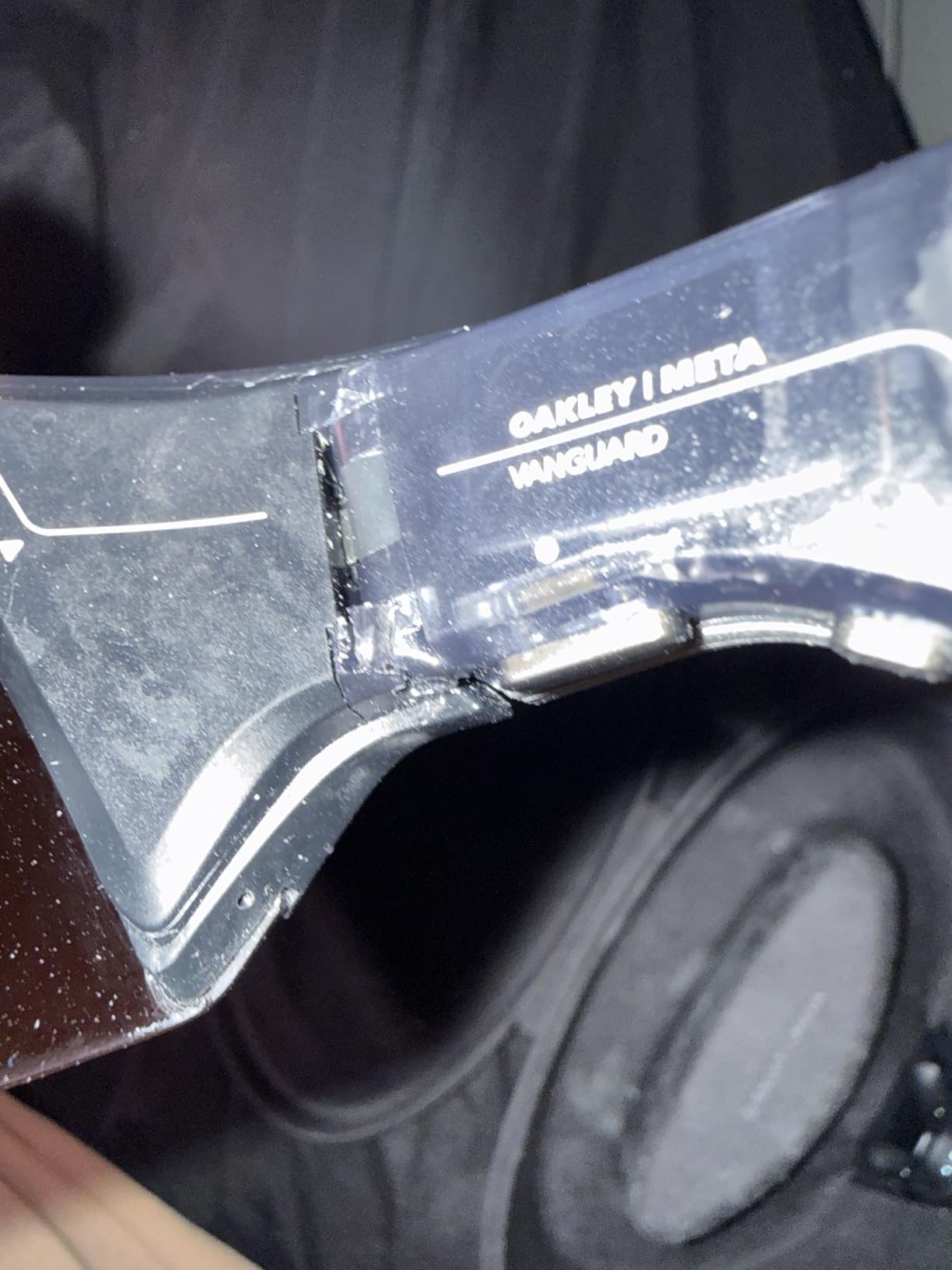
The wrap-around sport styling is also less versatile for everyday wear than a Wayfarer, and at 177 reviews the long-term reliability picture is thinner than the 866-review base behind our top pick. Some buyers also point out that 8 percent one-star ratings still means a visible tail of durability complaints.
4. Meta Oakley HSTN – Best for Activity Data Overlays
Meta Oakley HSTN Smart AI Glasses Black, Clear Lenses
12 MP camera,100 degree field of view
3K Ultra HD, up to 3 minutes per session
8 hours battery, case adds 48
53.15 g, Garmin and Strava sharing
Pros
- Hands-free 12 MP camera with 3K capture
- Well-reviewed build with positive fit sentiment
- Open-ear audio and Bluetooth for calls
- Meta AI and live translation work well
- Wide lens range including Transitions
Cons
- Clear lens version gives less sun protection
- 100 degree field of view is narrower than the Vanguard
- Half-frame round styling suits narrower faces
- 12 percent one-star rating on early reliability
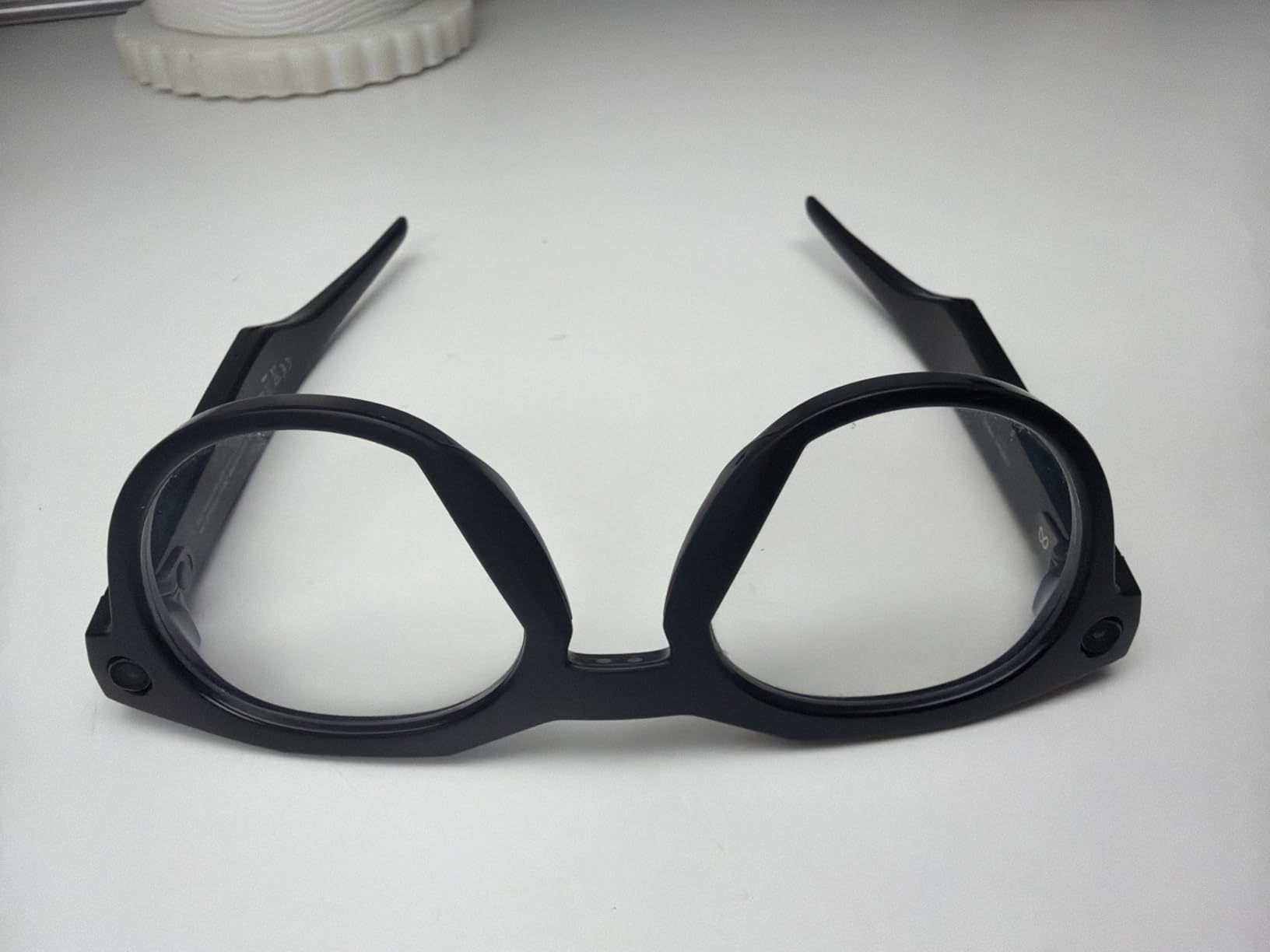
The HSTN sits between the Wayfarer and the Vanguard: a half-frame round shape that reviewers describe as having a secure fit, with a 100-degree field of view. That is narrower than the Vanguard by 22 degrees, and if wide-angle POV is your goal you will feel the difference in corners of the frame.
Its distinguishing feature is activity sharing. Meta AI can overlay Garmin device and Strava performance metrics directly onto the photos and videos you capture, which no other pair in this roundup does to that degree. For a fitness creator, that is a genuine content feature rather than a spec-sheet line.
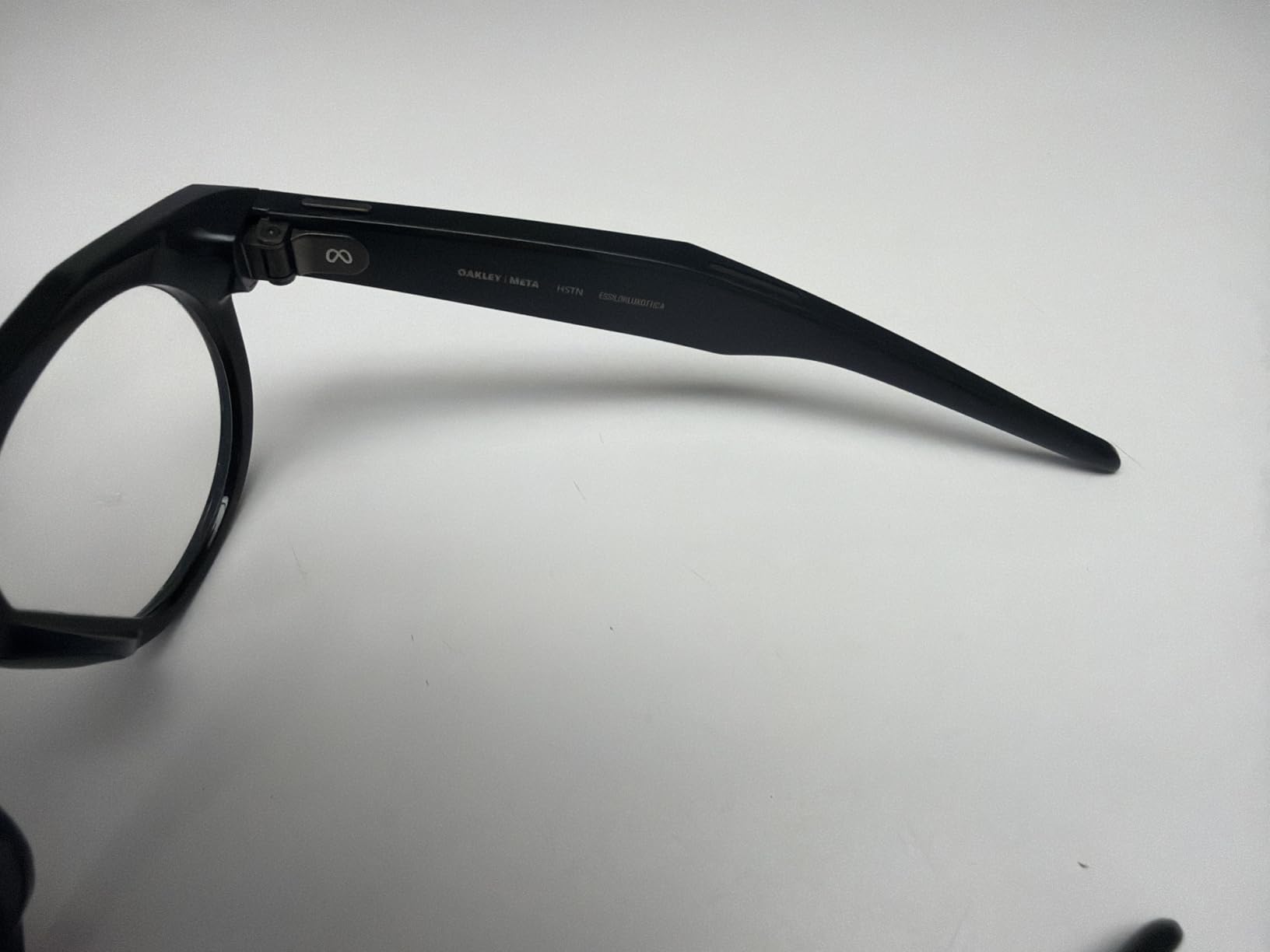
The lens range is the other reason to like it. Prizm, Prizm Polarized, Clear and Transitions are all available, so you can pick the lens that matches the light rather than living with one choice. Battery is up to 8 hours, with the case adding 48, matching the Wayfarer.
Review sentiment is broadly positive at 67 percent five stars, with the 3K camera, comfortable secure fit and useful Meta AI assistance named most often. Open-ear audio and Bluetooth handle music, podcasts and hands-free calls.
Best reasons to choose it
The activity overlay is the clearest reason, because it saves you a step in post and puts your metrics in the frame without extra hardware beyond a compatible Garmin or Strava account. The 53.15 g weight and secure fit also make it comfortable for long sessions.
If you need prescription or photochromic options, the lens range here is the broadest of the Meta picks we tested, and Transitions lenses are in the lineup.
Limits worth knowing
The clear lens version offers noticeably less sun protection than the tinted or Prizm options, so you are choosing a lens at purchase rather than swapping later. The 100-degree field of view simply captures less than the Vanguard’s 122.
A 12 percent one-star rating is a meaningful tail of early reliability complaints, and the half-frame round styling is not universally flattering on wider faces. As with the other Meta pairs, the recording is capped at 3 minutes per session.
5. Meta Ray-Ban (Gen 2) Skyler – Most Stylish, Watch the Hinge
Meta Ray-Ban (Gen 2) Skyler Smart AI Glasses, Shiny Black, Green Lenses
12 MP ultra-wide camera,3K Ultra HD
3 minutes max per session,8 hours battery
G15 green lenses, 53 g
Prescription and Transitions options
Pros
- Comfortable enough to replace everyday glasses
- G15 green lenses cut glare in bright sun
- Video quality praised for first-person content
- Open-ear speakers stay fairly private
- Fast and accurate live translation
Cons
- Slim cat-eye fit looks oversized on large faces
- Tight fit can cause headaches before breaking in
- Right-arm hinge screw can loosen and kill speaker output
- Phone battery drains fast during long sessions
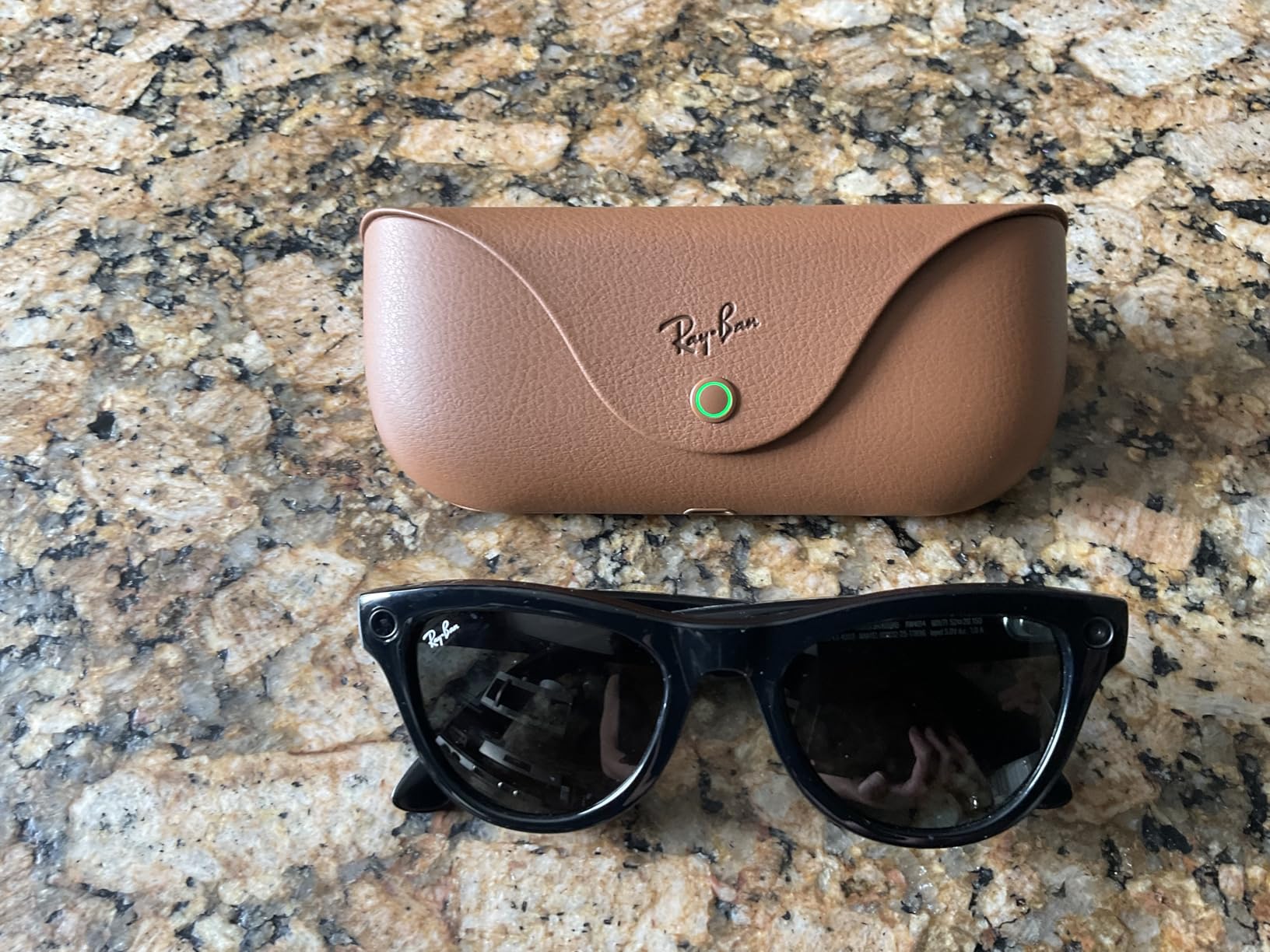
The Skyler is the cat-eye half of the Gen 2 line, and for a lot of wearers it is the one that disappears on the face. Owners often report replacing their everyday glasses with it, which is the highest compliment for a device you also film with. Video quality is described as excellent for first-person content, and it uses the same 12 MP ultra-wide sensor and 3K capture as the Wayfarer.
The G15 green lenses reduce glare in bright sun while still letting you see, and the open-ear speakers are reported as staying fairly private at moderate volume. Meta AI typically responds within one to two seconds, and live translation is singled out as a standout, especially for travel and Spanish-speaking contexts.
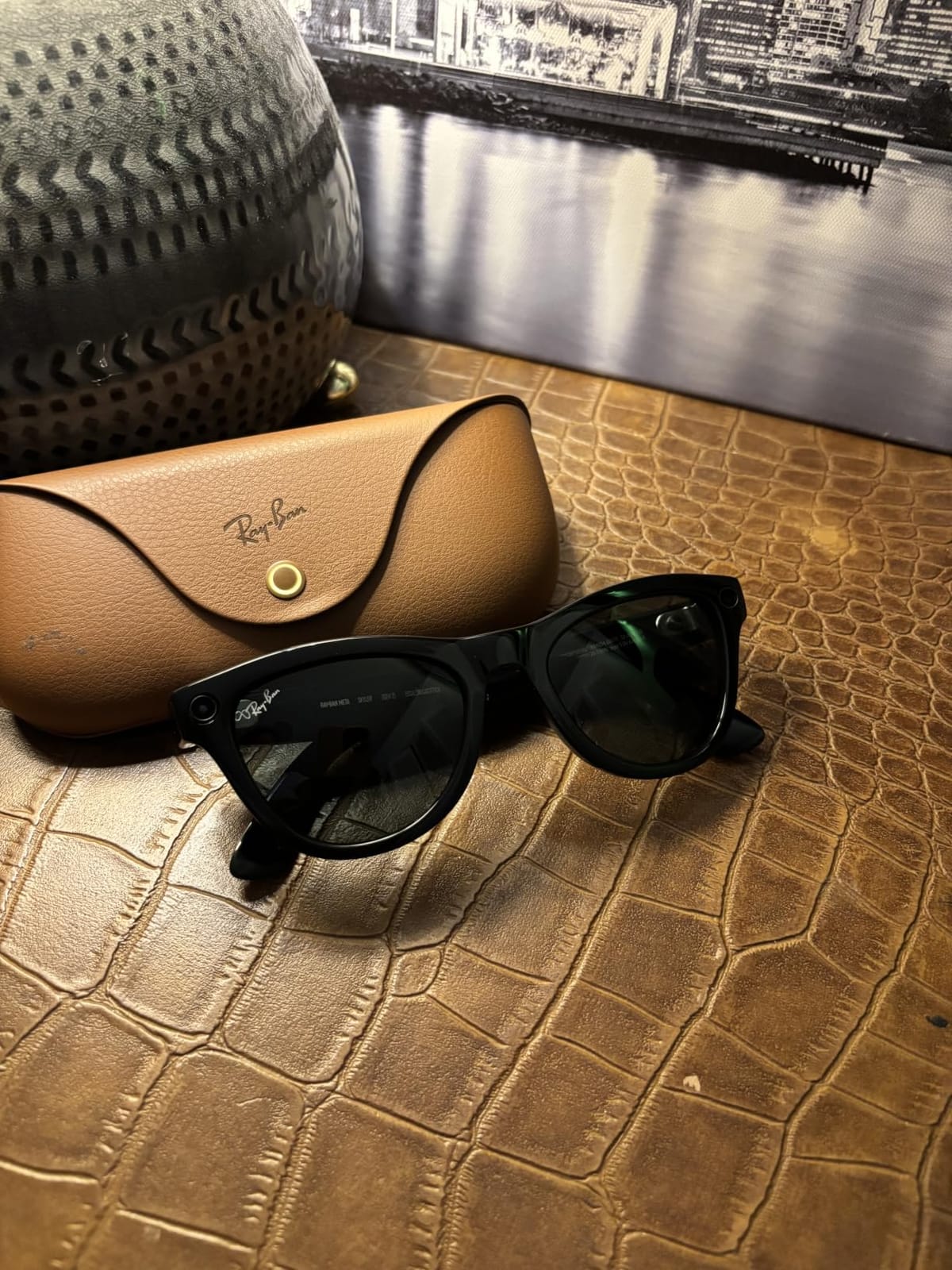
Then there is the durability thread, and it is the most serious recurring complaint across reviews. A hinge screw on the right arm can loosen or fall out, and in several cases that silenced the speaker output entirely and led to service requests. Some units also stopped working within a few months of regular use.
Battery is up to 8 hours with the case adding 48, and the recording cap is the same 3 minutes per session as the other Gen 2 frames. Prescription lens options exist with Transitions upgrades, which matters if you need correction.
Where it shines
This is the pick if comfort and appearance decide the purchase, because a frame you like wearing is the frame you will actually record from. G15 lenses handle bright outdoor sequences that clear lenses would wash out.
Control is simple too, with photos, messages and volume handled through the temple buttons or voice, and the 53 g weight keeps long sessions comfortable.
Where it costs you
Fit is the first risk. The slim cat-eye shape looks oversized on larger faces and runs tight around the head at first, which several owners report caused headaches before breaking in.
Then check the hinge, because the screw failure mode is documented across reviews. Long sessions also drain your phone’s battery quickly, since the paired phone is doing work behind the scenes, and Meta AI answers can return outdated information when you need accuracy.
6. Plunthorn 4K AI Camera Glasses – Best for 4K on a Budget
AI Smart Glasses with Camera, 4K Video, Real-Time Translation, AI Assistant
4K video at 3840 x 2160
ChatGPT voice assistant and translation
IP65 against sweat rain and dust
290mAh lithium polymer battery
Pros
- 4K capture and real-time translation at a low price
- Open-ear design keeps you aware while cycling
- IP65 handles sweat rain and dust
- Companion app handles setup and files
- Object recognition included
- Works with iOS and Android
Cons
- 4K spec does not always become usable detail
- Bluetooth reconnection can be unpredictable
- Companion app is the weakest part of the experience
- 290mAh battery limits endurance
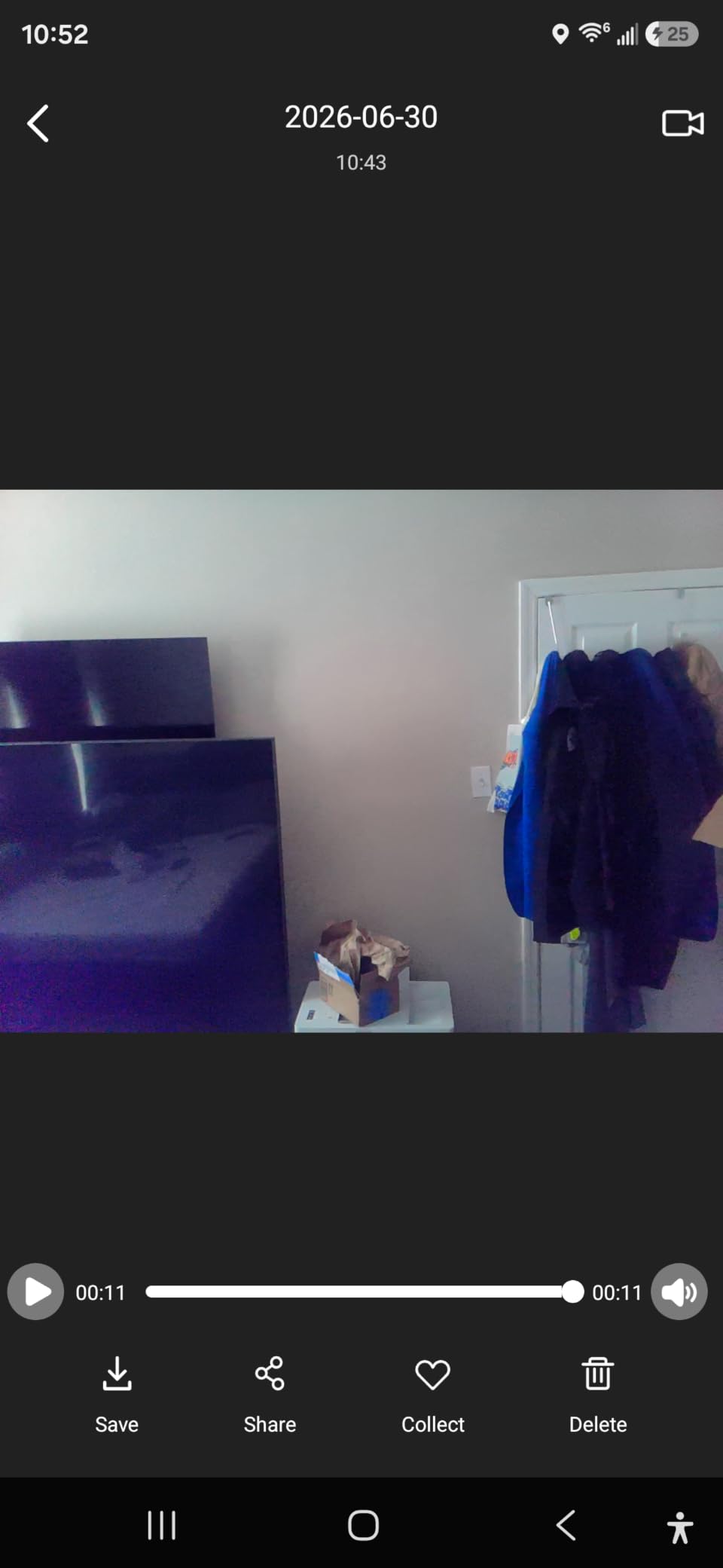
The headline here is 4K. Where the Meta pairs shoot 3K at 30 fps, this Plunthorn pair captures 3840 x 2160, and at its price point that number is the reason to look. The catch, repeated in reviews, is that the specification does not always translate into usable real-world detail.
It runs a built-in ChatGPT voice assistant with real-time translation, plus AI object recognition, and the open-ear Bluetooth audio works for music and hands-free calling. The companion app handles setup, file management and feature control, and it pairs with both iOS and Android.
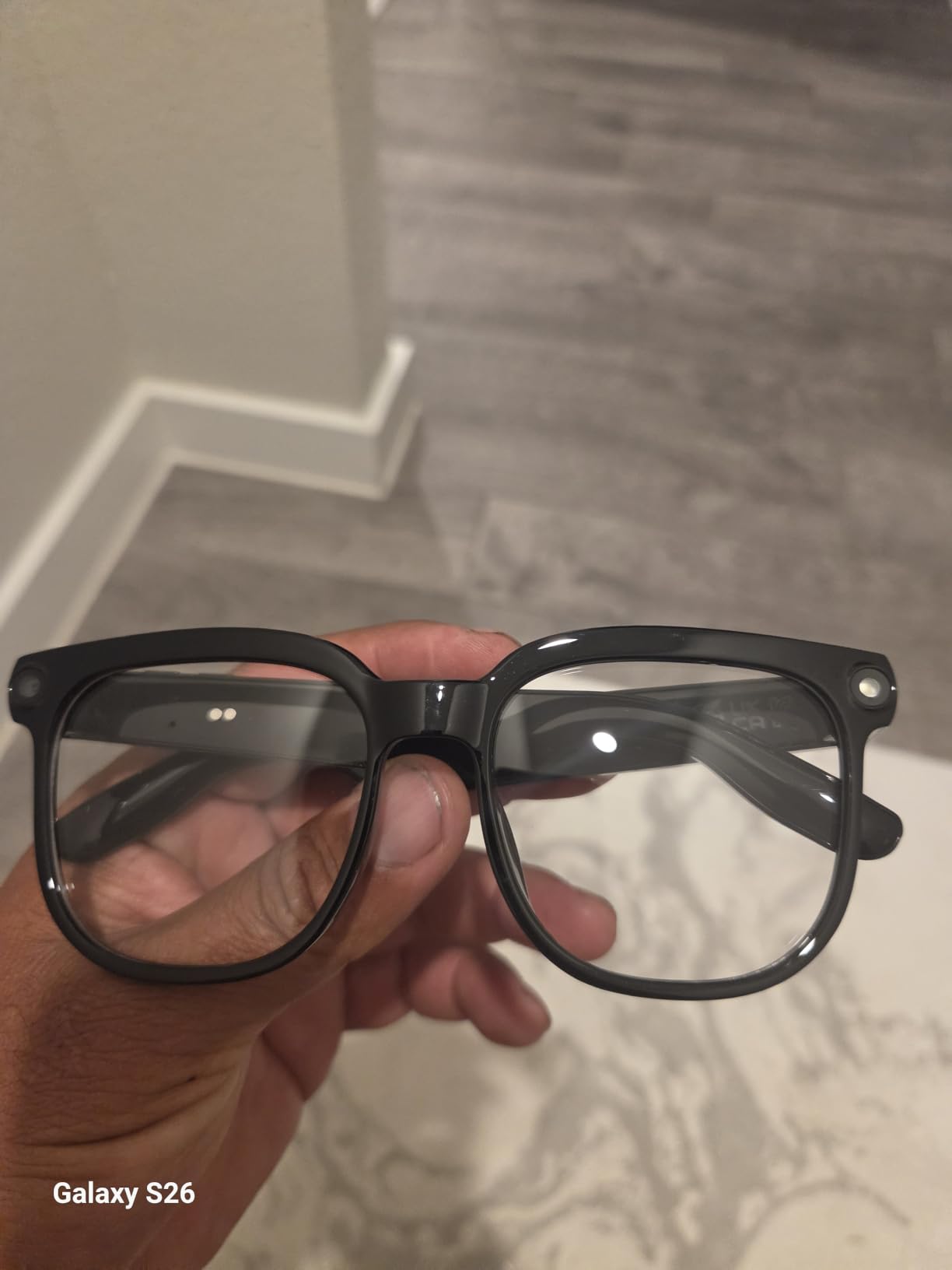
Water protection is IP65 against sweat, rain and dust, which makes it viable for cycling and outdoor use. At 619 reviews with 66 percent five stars, there is a large enough sample to draw a real conclusion, and it is a broadly positive one for the money.
The frame is rectangular with transparent lenses, listed as not water resistant in one field of the specification while the listing claims IP65, a spec inconsistency worth knowing if you plan to rely on it in rain.
Where the value is
If your priority is resolution on the spec sheet at the lowest outlay, this delivers it alongside translation and object recognition, which together would cost far more from a brand name. The 4K file also gives you room to crop and reframe in the edit in a way 1080p footage does not.
The open-ear design is genuinely useful for commuting or cycling because you keep situational awareness, and IP65 means sweat and rain are not a problem.
Where the compromises bite
Endurance is the practical limit, with a 290mAh lithium polymer battery that reviewers call small. Plan short capture sessions rather than a full day of recording.
The companion app is the weakest part of the experience and needs work, and Bluetooth reconnection can be unpredictable. There is no display and no GPS, so there is no text readout, and any 4K detail you are counting on will not survive a low-light scene.
7. AMZISH 8MP AI Camera Glasses – Best Value, Longest Recording
AI Smart Glasses with Camera, 8MP HD Bluetooth Camera Glasses for Women Men
8 MP with EIS, 30 fps video
60 minutes of continuous recording
32 GB internal storage, 45 g
IP65, interchangeable lenses
Pros
- Largest review base with 713 reviews
- 45 g frame that looks like ordinary glasses
- Fast simple setup over Bluetooth
- Close to two days of battery on one charge
- Spare lenses and pouch in the box
Cons
- Open-ear audio is weak with limited bass
- Companion app is buggy and drains phone battery
- File transfer is slow and needs Wi-Fi
- Recording capped around 5 minutes per clip
The AMZISH pair has the largest review base in this roundup at 713 ratings, which makes it the easiest of the budget options to buy with confidence. At 45 g it looks and wears like ordinary glasses, and owners consistently praise the natural, non-bulky look rather than treating it as a gadget.
The camera is 8 MP shooting 30 fps with multi-frame noise reduction and upgraded EIS, and it is described as performing well for hands-free recording and for menu or text translation. The real standout is endurance: up to 8 hours of music playback, and owners report close to two days on a single charge in light use.
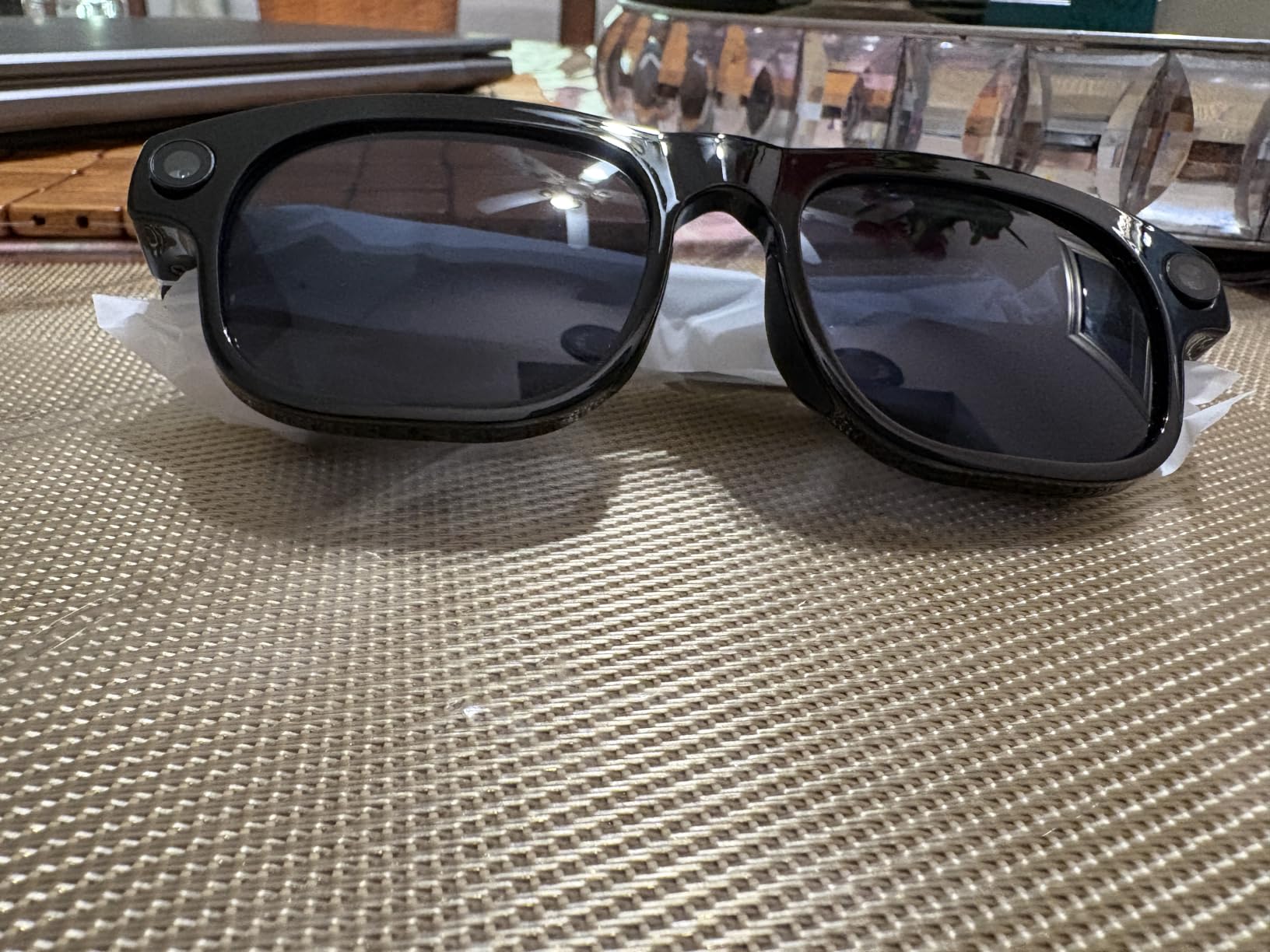
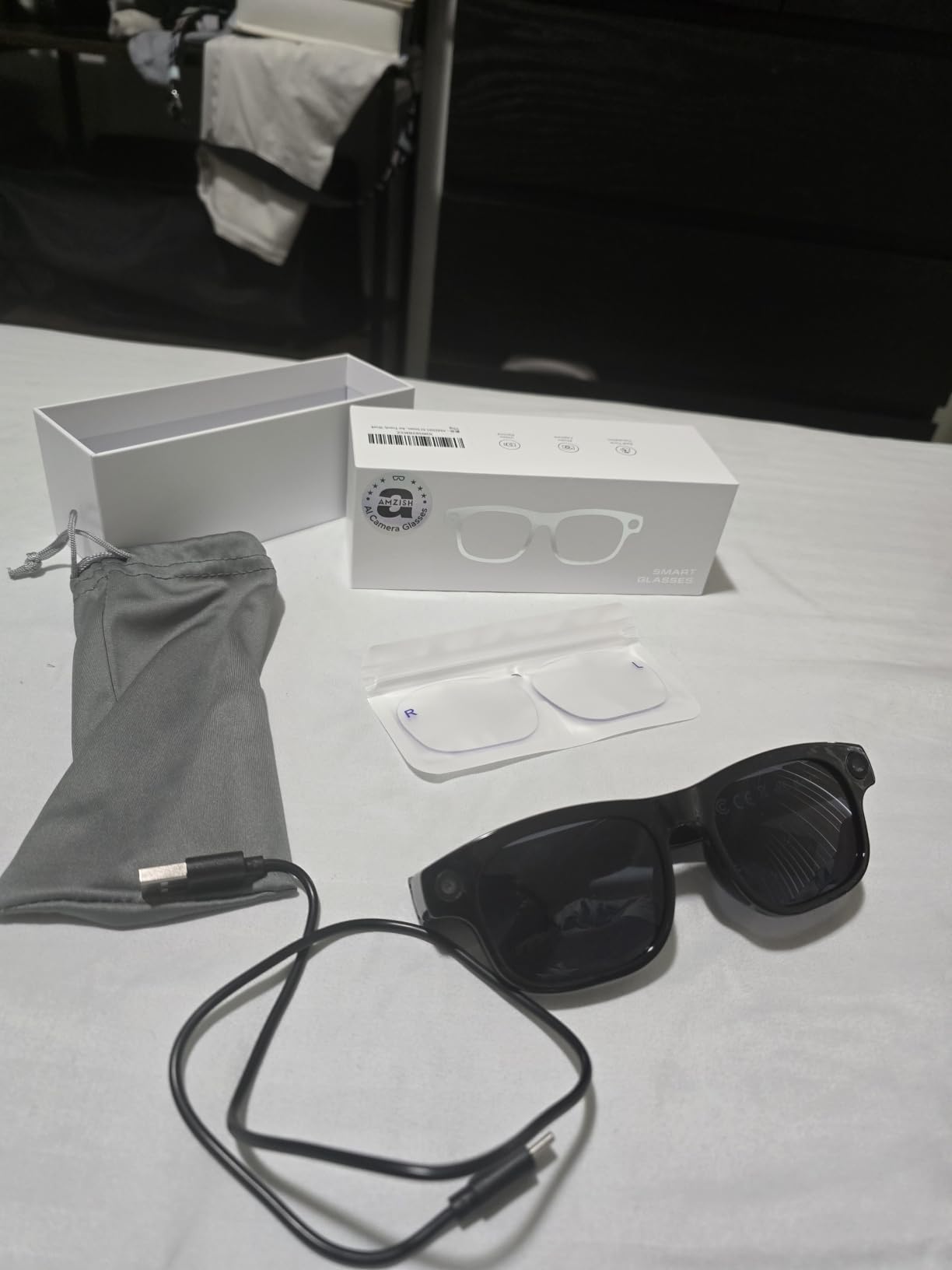
It also ships 32 GB of internal storage, more than any other pair in this roundup, with a pair of blue light blocking lenses, a pair of black lenses, a charging cable, a pouch and a cloth in the box. Input runs through buttons, a touch pad and a touchscreen, and it works with Android Wear 2.9 and iOS.
The AI side includes built-in ChatGPT and DeepSeek models with translation across 164 languages, plus voice wake-up and object recognition. That language count is the widest in the group, and IP65 covers sweat and splashes for running, cycling and hiking.
Why this is the value pick
Setup is quick and Bluetooth connects fast, and reviewers report no pressure points over extended wear. Swapping between the included clear and tinted lenses means one pair handles a desk and a bright street.
With 32 GB on board, you can capture a lot before worrying about offloading, which is more forgiving than the app-only transfer workflow some rivals force on you.
What you compromise
Open-ear audio is weak compared with other brands, with limited bass, and that is on the audio of your captured footage as much as on playback. The app is buggy, hard to pair and drains your phone battery, which is a real cost when the phone also has to run the rest of your kit.
File transfer is slow and requires an active Wi-Fi connection, the sides heat up noticeably during use, and recording caps at about 5 minutes per clip before the unit shuts down. Wide frame sides can slip on larger heads, and translation accuracy is inconsistent.
8. SGUKZF 4K AI Camera Glasses – Lightest Frame, Offset Camera
SGUKZF AI Smart Glasses with Camera, 4K EIS, Real-Time Translation
35 g frame, 4K camera with EIS
Photochromic lenses adapt to light
IP66 protection, 290mAh battery
4 GB storage, app transfer
Pros
- Lightest frame here at 35 g for long sessions
- Photochromic lenses adapt without swapping
- EIS smooths walking and cycling footage
- Recording indicator light is present for privacy
- Semi-rimless design with metallic detailing
Cons
- Stabilization weaker than advertised with visible bounce
- Camera offset to the left
- Speakers have little bass and leak audio
- Recording limited to about 12 minutes connected and 3 minutes not
- Only 4 GB of internal storage
At 35 g this is the lightest frame in the roundup by a clear margin, and for anyone wearing glasses for ten hours a day that is not a trivial number. The semi-rimless design with metallic detailing also looks more like a fashion frame than most of the budget category.
The photochromic lenses are the feature that surprises people. They darken in changing sunlight, so you move from indoor to outdoor without swapping anything, and buyers appreciate having a recording indicator light present rather than absent, which is a privacy plus.

Video is 4K with EIS, and AI real-time translation covers 139 or more languages with a built-in voice assistant. IP66 handles sweat, rain and dust. But this is the lowest-rated product in our roundup at 3.9 with 288 reviews, and the reasons are specific rather than vague.
Stabilization is weaker than advertised with visible bounce in motion footage, and the camera is offset to the left, which is especially obvious in portrait mode where it also zooms in. The open-ear speakers have little bass, medium volume, and leak to nearby listeners.

What you gain
Weight comfort and adaptive lenses are the two real wins. Nobody else in this roundup combines a 35 g frame with self-adjusting tint, and if you are filming across changing light all day, removing the lens swap is a genuine quality-of-life gain.
The app pairs simply with both Android and iPhone, and translation across 139 or more languages covers most travel scenarios you will run into.
What you give up
Framing is the problem. A left-offset camera plus a portrait-mode zoom means shots are not centred where you expect, which is the sort of thing you cannot fix in the edit when it happens on every clip.
Recording runs about 12 minutes connected to the phone and 3 minutes when it is not, file transfer is slow and app-only through the Hey Cyan app, and 4 GB of internal storage fills quickly. Translation is hit or miss, the temple volume buttons are hard to locate without a mirror, and the frames cannot be bent much for fit adjustment.
Privacy, Recording Lights and the Law
Five of the questions people ask most about this category are about privacy, and none of the top competing guides treats it as anything more than a short FAQ. For a filmmaker this matters twice over, because you are both the person recording and the person being recorded.
Every pair here has a recording indicator. On the Meta glasses it lights for any capture and can be adjusted through voice commands and settings, which is the behaviour users expect. Note that the Adventurer’s LED is described as conspicuous enough to break the spontaneity of a moment, and the SGUKZF’s indicator is welcomed by privacy-minded buyers, so the two ends of this category are genuinely different in how visible they are.
Legally, recording a person without consent is a different question from recording in public. In one-party consent states, capturing video where you have a reasonable expectation of privacy can still create exposure, and in two-party consent states every participant has to agree. Venue policy is a separate layer entirely: gym chains and some venues have restricted recording glasses, and being asked to remove them is a rule about the venue, not about the law.
The practical advice for anyone who shoots other people is short. Get consent before you press the button, check the venue’s rules before you travel, and treat the indicator light as a promise to the people around you. We are not lawyers and this is not legal advice, but that sequence avoids almost every problem people run into.
Battery Reality: What the Spec Sheets Miss
Quoted battery figures measure moderate use, and moderate use is not filming. The eight-hour figure on the Meta Wayfarer, Skyler and HSTN assumes intermittent wear with the camera off. Owners consistently report around 30 minutes of continuous recording before those numbers stop applying, which is the number that matters if you are capturing a sequence rather than a memory.
Charging cases change the math. The Wayfarer and Skyler cases add up to 48 hours, the HSTN case also adds 48, and the Vanguard adds 36 on top of its 9-hour in-glasses figure. That is the working practice: keep the case in a bag and top up between scenes. It is a mid-session ritual rather than a seamless experience, and the case itself is bulky enough that some owners carry it only for travel.
Budget pairs behave differently. The AMZISH runs a 220mAh cell and reports up to 8 hours of music with 60 minutes of continuous video per session, with owners reporting close to two days on a charge in light use. The Plunthorn and SGUKZF both use 290mAh cells, which is a small battery by any measure and means short capture blocks.
None of the batteries in this roundup are user-replaceable, so once endurance no longer suits how you work, there is no swap-in upgrade path. The 30-minute continuous recording figure on the Meta Wayfarer is the one we keep coming back to, and if your shoot involves long unbroken takes, that is a hard ceiling rather than a preference.
How to Choose Camera Glasses for Filming
Start by understanding the taxonomy, because the words get used loosely. AI smart glasses are what all eight products here are: camera, microphones, open-ear speakers and a voice assistant, with no visual output. AR glasses add a waveguide or Micro-OLED display that puts text and graphics in your view. Prism display glasses use a physical prism element in front of one eye, and sit somewhere between the two. If you are here for footage, you want the first group.
Field of view is the next criterion, and it is the one most buyers underweight. A 122-degree lens on the Vanguard captures noticeably more of the scene than a 100-degree lens on the HSTN without turning your head, and that difference shows up as tighter, more complete POV shots. Higher is better when you are moving.
Then look at clip length, and accept the trade honestly. Three minutes on the Meta fashion and sport frames, about 5 minutes on the AMZISH, and roughly 12 minutes connected or 3 minutes unconnected on the SGUKZF. If your work needs unbroken takes longer than that, an action camera is the correct tool and none of these will serve you.
Prescription support is available on the Meta Gen 2 frames, including Transitions upgrades on the Skyler, and the HSTN carries the widest lens range with Prizm, Prizm Polarized, Clear and Transitions. Budget pairs take a different approach, with the AMZISH shipping interchangeable blue light blocking and black lenses and the SGUKZF using photochromic lenses that adapt on their own. Check your face shape against half-frame versus full-frame too, since several reviewers report fit problems on wider faces.
Ecosystem is the last call. Meta’s glasses sync through the Meta app and lock you into Meta AI, Meta software updates and Meta’s privacy choices. The budget pairs run their own companion apps, and owners describe those apps as the weakest part of the experience, with slow transfers and unpredictable Bluetooth reconnection. Choose on total workflow rather than on the frame alone.
For the wider category, our guide to the best rangefinder cameras covers the everyday carry angle, and the best monochrome cameras list is useful if your priority is a specific look rather than a general-purpose capture tool. If you also work long editing sessions, the best blue light glasses for video editors is the companion read.
Getting Footage Off Your Glasses
No competitor in this space explains the offload workflow, which is the second most common complaint after clip length, so here is what actually happens.
On the Meta pairs, capture lands in the Meta app on your phone, where you get thumbnails to review, and the files can be shared or synced out to your library. The 3-minute cap applies per recording session, so a busy afternoon means a lot of short clips to sift. Storage is handled by the app rather than by a fixed on-device limit, which is one reason the Meta experience is more forgiving.
The budget pairs are more constrained. The AMZISH has 32 GB of internal storage but transfers manually to the phone album over Wi-Fi, and reviewers report that transfer is slow and needs an active Wi-Fi connection. The SGUKZF has only 4 GB and moves files through the Hey Cyan app, which is app-only and also slow. The Plunthorn uses its companion app for file management with no stated on-device capacity.
Our working advice is simple. Offload to a laptop rather than juggling phone storage, clear the internal cache after each shoot on the 4 GB model, and treat the app transfer step as part of your wrap rather than something you discover at the end of a day.
Frequently Asked Questions
Are glasses with cameras legal?
It depends on where you are recording, not on the glasses themselves. In one-party consent states you can often record in public without consent, but capturing someone in a place they expect privacy can still create exposure. In two-party consent states every participant must agree. Venue rules are separate and can be stricter than the law. Check local rules and venue policy before you press record, and get consent when you are filming people directly.
Can you secretly record with Meta glasses?
You should not. Every pair in this roundup has a recording indicator that lights during capture, the Meta glasses allow the privacy setting to be adjusted by voice and in settings, and reviewers specifically describe the Adventurer’s LED as conspicuous. Recording without consent also runs into two-party consent state law and venue bans. The practical rule is to treat the light as a promise to the people around you.
How long can smart glasses record video continuously?
The Meta fashion and sport frames cap a session at 3 minutes. The AMZISH quotes 60 minutes of continuous video with recording capped around 5 minutes per clip before shutdown. The SGUKZF runs about 12 minutes when connected to the phone and about 3 minutes when it is not. Budget models with 290mAh batteries like the Plunthorn limit you further. If you need long unbroken takes, an action camera is the better tool.
Are there any smart glasses other than Meta that have a camera?
Yes. The Plunthorn shoots 4K at 3840 x 2160 with a ChatGPT voice assistant and IP65 protection. The AMZISH pairs an 8 MP sensor with EIS, 32 GB of storage and translation across 164 languages. The SGUKZF offers a 35 g frame with photochromic lenses and IP66 protection. All three run their own companion apps rather than the Meta app, and owners describe those apps as the weakest part of the experience.
Can I get smart glasses with cameras and prescription lenses?
The Meta Ray-Ban Gen 2 frames support prescription lens options, and the Skyler adds Transitions upgrades. The Oakley HSTN carries the widest lens range with Prizm, Prizm Polarized, Clear and Transitions available. Budget pairs take a different route, with the AMZISH shipping interchangeable blue light blocking and black lenses and the SGUKZF using photochromic lenses that darken on their own. Fit varies by face shape, so check half-frame versus full-frame sizing.
Conclusion: The One Pair to Buy
The Meta Ray-Ban (Gen 2) Wayfarer is the pair to buy in 2026. It is not the widest field of view, not the longest battery and not the highest rated, but it is the only one that disappears completely on a face while delivering 3K capture, 8 hours of quoted endurance and the most reliable app in the category. For unobtrusive POV footage of real life, that combination has no substitute at this level.
If you film outdoors in weather, the Oakley Vanguard is the better buy for its centered camera, 122-degree view, 9-hour battery and IP67 rating. If your budget is the deciding factor, the AMZISH pair gives you the longest recording, on-board storage and the lightest-looking frame, at the cost of audio quality and a fiddly app. Shoot short, shoot often, and add your audio in the edit.