
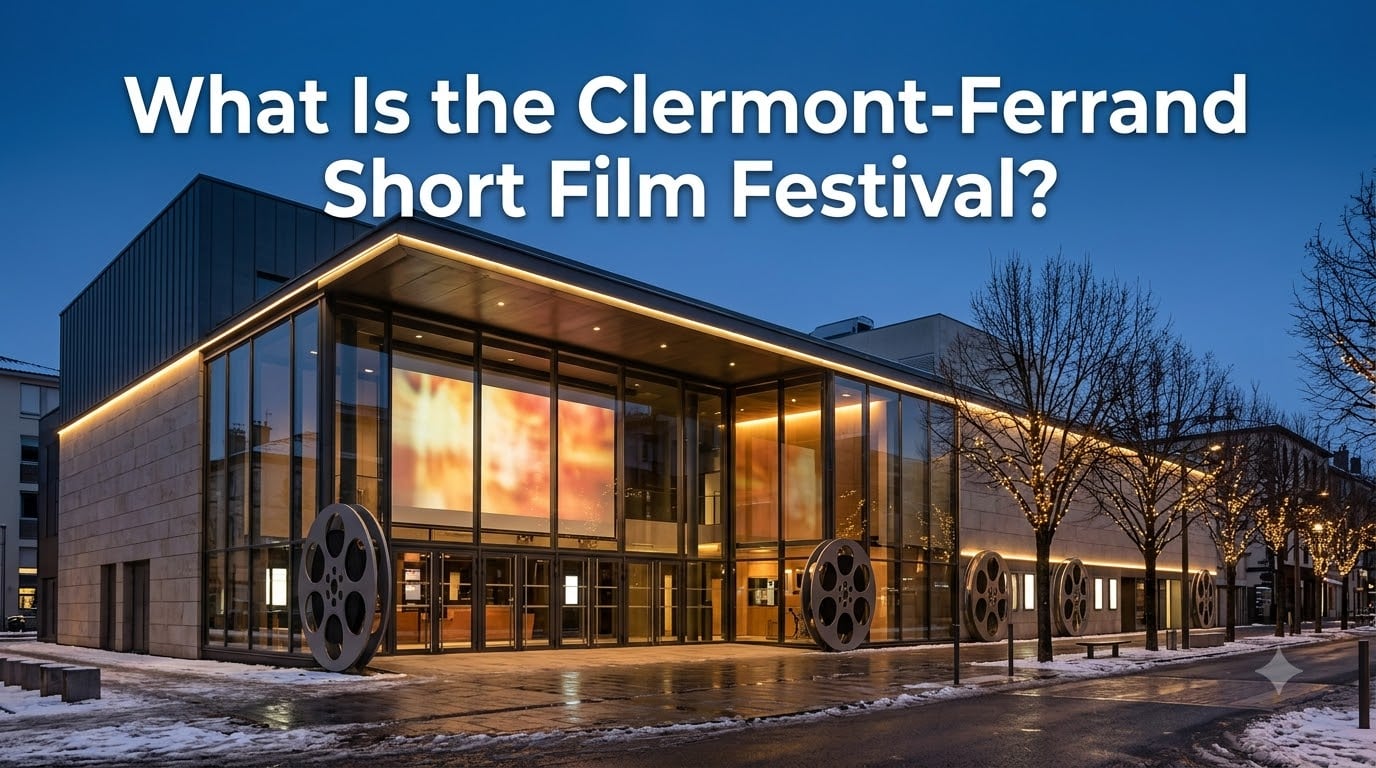
Every January, a university city in central France transforms into the short film capital of the world. Over 170,000 people flood into Clermont-Ferrand for nine days of screenings, deal-making, and career-defining moments. If you make short films, distribute them, or simply love them, this is the one festival you need on your radar.
In this guide, I’ll walk you through everything you need to know about the Clermont-Ferrand Short Film Festival. We’ll cover its history, how the competitions work, what the Short Film Market is, how to submit your film, and what to expect if you attend for the first time.
Whether you’re a filmmaker planning your first submission or an industry professional looking for the biggest short film event on the planet, you’ll find the answers here.
Table of Contents
- What Is the Clermont-Ferrand Short Film Festival?
- A Brief History of the Festival
- Competition Sections: International, National, and Lab
- Key Statistics: Why It Matters in the Film World
- The Short Film Market: What It Is and Why It’s a Big Deal
- Famous Filmmakers Discovered at Clermont-Ferrand
- How to Submit Your Short Film to Clermont-Ferrand?
- What to Expect as a First-Time Attendee?
- How Clermont-Ferrand Compares to Other Major Short Film Festivals?
- FAQs
- Is Clermont-Ferrand a good film festival?
- What is the largest short film festival in the world?
- Where is the Clermont-Ferrand film festival held?
- What are the most prestigious short film festivals in the world?
- How do I submit a film to Clermont-Ferrand?
- When is the Clermont-Ferrand Short Film Festival 2027?
- Why Clermont-Ferrand Remains the Short Film Capital
What Is the Clermont-Ferrand Short Film Festival?
The Clermont-Ferrand International Short Film Festival is the world’s leading film festival dedicated entirely to short films, held annually in Clermont-Ferrand, France. Founded in 1979, it has grown into the largest short film festival on the planet and the second-largest film festival in France overall, trailing only Cannes.
The festival is organized by an association called Sauve qui peut le court métrage, which roughly translates to “Save the short film.” In 2026, the event operates under the brand name Le Court, reflecting its ongoing effort to modernize its identity while keeping its decades-long mission intact.
Each edition screens hundreds of short films across competitive and non-competitive sections. Running concurrently is the Short Film Market, the largest industry event of its kind, which attracts around 5,000 film professionals from buyers and distributors to festival programmers and sales agents.
A Brief History of the Festival
The festival began in 1979 as a modest gathering organized by a group of passionate film students and cultural advocates in Clermont-Ferrand. What started as a small regional event with a handful of screenings quickly gained a reputation for programming quality that rivaled bigger, feature-focused festivals.
By the 1990s, the festival had established its three main competition sections: International, National (French), and Lab. This structure allowed it to showcase both mainstream and experimental short filmmaking from around the world. The addition of the Short Film Market in 1986 turned the event into a professional hub, not just a screening series.
Over the decades, the festival has expanded its programming to include XR and Extended Reality experiences, young audience programs, educational workshops through The Atelier and Les Petits Ateliers, and industry forums like Euro Connection and Talents Connexion.
Today, the festival generates an estimated €11 million per year for the local Auvergne region. It employs hundreds of staff and volunteers during festival week and has become a cultural institution that the city builds its entire winter season around.
Competition Sections: International, National, and Lab
The festival organizes its competitive programming into three distinct sections, each with its own selection process and jury. Understanding the difference matters if you’re planning a submission or trying to navigate the program as an attendee.
International Competition
The International Competition is the festival’s flagship section. It screens short films from dozens of countries, typically selecting 60 to 80 films from thousands of submissions worldwide. Films compete for the Grand Prix, which carries significant cash prize money and prestige. Winning here can launch a filmmaker onto the international stage and often serves as a stepping stone to Academy Award consideration.
National Competition
The National Competition focuses on French short films. This section highlights the depth of French filmmaking talent and often serves as a launchpad for directors who go on to make feature films. It draws heavy attention from French distributors, producers, and broadcasters looking for the next wave of domestic talent.
Lab Competition
The Lab Competition is dedicated to experimental, non-conventional, and boundary-pushing short films. If your work doesn’t fit neatly into traditional narrative or documentary categories, this is where it belongs. The Lab section celebrates formal innovation and has built a loyal following among filmmakers and audiences who want to see something genuinely different.
XR and Special Programs
In recent years, the festival has added XR (Extended Reality) programming, showcasing immersive and interactive works that push the boundaries of what a short film can be. Special thematic programs, retrospectives, and young audience screenings round out the schedule.
Key Statistics: Why It Matters in the Film World
The numbers tell the story of just how massive this event has become. Here are the figures that define the Clermont-Ferrand Short Film Festival:
170,000+ admissions each edition, making it one of the most attended film festivals anywhere
5,000 industry professionals accredited annually, including buyers, distributors, programmers, and sales agents
Over €71,500 in cash prizes awarded across competition categories
Second largest film festival in France after Cannes by attendance
€11 million annual economic impact on the Auvergne region
For context, most short film festivals draw a few thousand attendees. Clermont-Ferrand operates on a completely different scale. When Reddit users on r/FilmFestivals describe the festival as “legit” and “prestigious with decades of history,” these are the numbers backing up that reputation.
It’s worth noting that being second to Cannes in France is no small distinction. Cannes focuses on features and industry prestige for established filmmakers. Clermont-Ferrand owns the short film space entirely, with a public audience turnout that many feature festivals would envy.
The Short Film Market: What It Is and Why It’s a Big Deal
The Short Film Market runs concurrently with the festival, typically over four days, and it is the largest professional short film market in the world. While the festival is for audiences, the Market is for business.
Here’s where the confusion often starts for newcomers: the festival and the Market are two separate things happening at the same time. The festival screens films for the public and juries. The Market is where industry professionals buy, sell, distribute, and program short films for the coming year.
The Video Library
At the heart of the Market is the video library, a digital catalog containing thousands of short films available for on-demand screening by accredited professionals. Even if your film doesn’t make the official competition selection, it can still be included in the video library through a Market submission. This gives buyers and festival programmers from around the world a chance to discover and acquire it.
Industry Events and Networking
The Market hosts several major industry forums. Euro Connection is a co-production meeting that pairs short film projects with potential producers and funders across Europe. Talents Connexion is a networking event designed to connect emerging filmmakers with established industry figures. There are also pitch sessions, panel discussions, and one-on-one meeting programs.
For an Australian filmmaker on Reddit who recently received a Market Pick designation, the value was immediate. Even without an official competition slot, being highlighted in the Market gave their film visibility among exactly the right professionals. That’s the kind of career boost the Market is designed to deliver.
Famous Filmmakers Discovered at Clermont-Ferrand
One of the strongest indicators of a festival’s prestige is the talent it helps launch. Clermont-Ferrand has an extraordinary track record in this regard, having served as an early platform for filmmakers who went on to international acclaim and, in some cases, Academy Awards.
Cédric Klapisch screened early short work at the festival before directing features like L’Auberge Espagnole. Jean-Pierre Jeunet, the visionary behind Amélie, has roots connected to the festival’s community. Jan Kounen gained early attention at Clermont-Ferrand before moving into feature filmmaking.
Erick Zonca built momentum at the festival before his feature debut with The Dreamlife of Angels won at Cannes. Shawn Christensen won the Grand Prix at Clermont-Ferrand for his short Curfew, which then went on to win the Academy Award for Best Live Action Short Film.
This Oscar connection is not a coincidence. The festival is an Academy Award-qualifying festival, meaning that winning its top prize automatically makes a short film eligible for Oscar consideration. For many filmmakers, Clermont-Ferrand is the first stop on a path that could end at the Dolby Theatre.
How to Submit Your Short Film to Clermont-Ferrand?
If you’re a filmmaker, here’s the practical information you actually need. The submission process is straightforward but competitive, and understanding the requirements before you start will save you time and frustration.
Basic Requirements
Your film must have a maximum runtime of 40 minutes. This is a hard limit that applies across all competition sections. There is no minimum length, so everything from a one-minute animation to a 39-minute drama qualifies.
Films must have been completed within a specific timeframe relative to the festival edition. Check the official guidelines each year, but generally, films completed in the 12 to 18 months before the upcoming edition are eligible.
Where to Submit
Submissions are handled through Short Film Depot, the official submission platform for the festival. You create an account, upload your film, select your competition category, and pay any applicable submission fee. The platform also manages the video library inclusion for Market submissions separately.
Submission Deadline
The submission deadline typically falls in early to mid-October each year. For the upcoming edition running January 29 to February 6, 2027, you should plan to have your film submitted by October 2026 at the latest. I always recommend submitting at least two weeks before the deadline to avoid last-minute technical issues.
Market Pick and Non-Selected Films
Even if your film is not selected for the official competition, it can still be designated as a Market Pick. This means it will be included in the Short Film Market’s video library, where industry professionals can screen it during the Market. For many filmmakers, this is where the real opportunity lies, since buyers and programmers actively search the library for acquisitions.
What to Expect as a First-Time Attendee?
Heading to Clermont-Ferrand for the first time? No competitor guide covers this, so let me fill the gap based on what attendees and filmmakers actually experience.
The festival takes place over nine days in late January to early February. The 2027 edition is scheduled for January 29 through February 6. The Market runs for four days within that period, from February 1 to February 4. Plan your trip dates around whether you’re there for the festival experience, the Market, or both.
The Venues
Screenings take place across multiple venues in Clermont-Ferrand, including the Maison de la Culture, the Grande Halle, and several smaller theaters. The festival provides an interactive map and a mobile app to help you navigate. Venues are spread across the city center, which is compact and walkable.
The Catalog Overwhelm
Be prepared for the program catalog to be enormous. One Reddit user described it as “ginormous,” and they’re not exaggerating. With hundreds of films across competitions, special programs, and retrospectives, you cannot see everything. My advice: identify your priorities before arrival. Decide which competition sections matter most to you, read the synopses in advance, and build a daily schedule.
Accreditation
There are different accreditation types depending on your role. Industry professionals, filmmakers with selected films, press, and students each have specific badge categories. Industry accreditation gives you access to the Market, the video library, and networking events that general festival attendees cannot enter. Apply for accreditation early through the official website.
The Atmosphere
Clermont-Ferrand is a university town, which means the atmosphere during festival week is energetic and young. The city fully embraces the event. Cafes, bars, and restaurants fill with filmmakers and industry people every evening. The networking that happens after screenings is often just as valuable as the films themselves.
How Clermont-Ferrand Compares to Other Major Short Film Festivals?
If you’re choosing where to submit or attend, it helps to understand how Clermont-Ferrand stacks up against other major short film festivals.
vs. Cannes: Cannes is the most prestigious overall film festival in France, but it centers on features. Its short film competition is small by comparison. Clermont-Ferrand dwarfs Cannes in short film programming volume and short film industry activity.
vs. Sundance: Sundance has a broader focus across independent features and shorts, with a distinctly American lens. Clermont-Ferrand is more international in its short film selection and has a much larger dedicated short film market.
vs. Tampere Film Festival: Tampere in Finland is another major short film festival with a strong international reputation. It is smaller in scale but respected for its programming quality. Clermont-Ferrand offers significantly more industry infrastructure.
vs. Palm Springs ShortFest: Palm Springs is the largest short film festival in North America and also an Oscar-qualifying festival. It competes in prestige, though Clermont-Ferrand maintains the edge in market size and European industry access.
The short version: if you can only submit to or attend one short film festival worldwide, Clermont-Ferrand gives you the largest audience, the biggest industry presence, and the strongest career-boosting track record.
FAQs
Is Clermont-Ferrand a good film festival?
Yes. Clermont-Ferrand is widely considered the most important short film festival in the world. It draws over 170,000 attendees and 5,000 industry professionals annually, offers over €71,500 in cash prizes, and is an Academy Award-qualifying festival. Its decades-long history and track record of launching Oscar-winning filmmakers make it one of the most prestigious short film events you can attend or submit to.
What is the largest short film festival in the world?
The Clermont-Ferrand International Short Film Festival is the largest short film festival in the world by attendance and industry participation. With over 170,000 admissions and approximately 5,000 accredited professionals each year, it also hosts the world’s largest short film market, making it the biggest event dedicated exclusively to short films globally.
Where is the Clermont-Ferrand film festival held?
The festival is held in Clermont-Ferrand, a city in the Auvergne region of central France. Screenings take place across multiple venues in the city center, including the Maison de la Culture and the Grande Halle. The city is accessible by train from Paris in about three and a half hours.
What are the most prestigious short film festivals in the world?
The most prestigious short film festivals include the Clermont-Ferrand International Short Film Festival (France), Palm Springs ShortFest (USA), Tampere Film Festival (Finland), and the short film competitions at Cannes and Sundance. Among these, Clermont-Ferrand is generally regarded as the leading festival dedicated exclusively to short films.
How do I submit a film to Clermont-Ferrand?
Submissions are made through Short Film Depot, the festival’s official submission platform. Your film must be 40 minutes or shorter, completed within the eligible timeframe, and submitted before the deadline, which typically falls in early to mid-October. You select your competition category (International, National, or Lab) during the submission process. Non-selected films can still be included in the Short Film Market video library as a Market Pick.
When is the Clermont-Ferrand Short Film Festival 2027?
The 2027 edition of the Clermont-Ferrand Short Film Festival is scheduled for January 29 to February 6, 2027. The Short Film Market runs concurrently from February 1 to February 4, 2027. Submission deadlines are typically in October of the preceding year.
Why Clermont-Ferrand Remains the Short Film Capital
The Clermont-Ferrand Short Film Festival has earned its place as the world’s most important event dedicated to short filmmaking. With 170,000+ attendees, 5,000 industry professionals, over €71,500 in prizes, and a history of launching Oscar-winning careers, no other short film festival matches its scale and influence.
If you’re a filmmaker, your next step is simple: head to Short Film Depot, check the submission deadline for the upcoming edition, and prepare your film. The 2027 festival runs January 29 through February 6, with submissions typically due in October 2026. Whether you land in the official competition or earn a Market Pick designation, Clermont-Ferrand is where short film careers take off.