
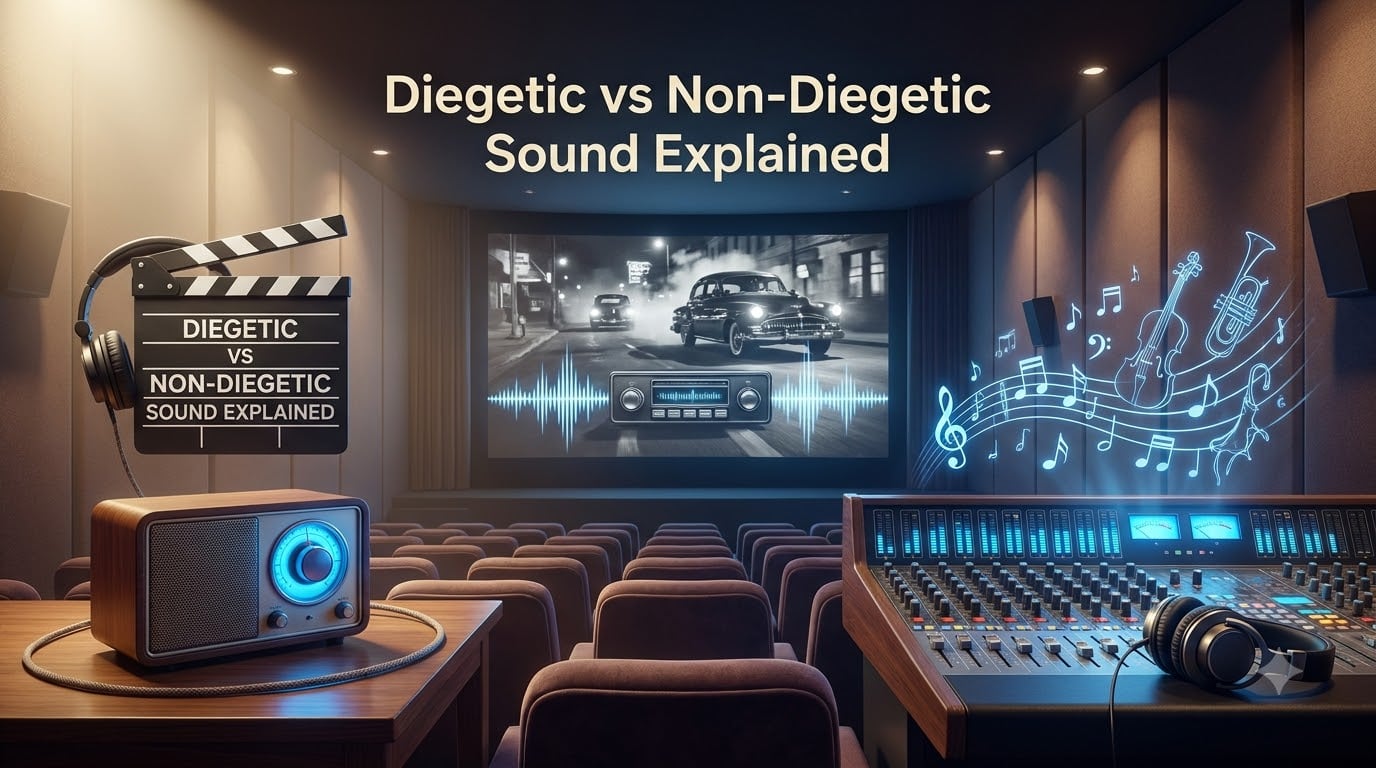
Watch any great short film and you will notice something invisible but powerful: the way sound shapes every scene. A creaking floorboard tells you someone is hiding. A swelling violin score tells you something terrible is coming. Both sounds serve the story, but they come from entirely different places in the filmmaking process. That difference is what we call diegetic vs non-diegetic sound.
Understanding diegetic vs non-diegetic sound is one of the first concepts every film student, indie filmmaker, and content creator needs to master. It changes how you plan your shoots, how you approach post-production audio, and how you control what your audience feels. The good news is the concept itself is straightforward once you see it in action.
In this guide, we break down both categories with clear definitions, recognizable film examples, and practical techniques you can apply to your own short films. We also tackle the gray areas that confuse most beginners, including trans-diegetic transitions and where voiceover narration actually fits.
Table of Contents
- What Is Diegetic Sound?
- Diegetic Sound Examples in Film
- What Is Non-Diegetic Sound?
- Non-Diegetic Sound Examples in Film
- Diegetic vs Non-Diegetic Sound: Side-by-Side Comparison
- Trans-Diegetic Sound: When Sound Crosses the Boundary
- Is Voiceover Diegetic or Non-Diegetic?
- How to Use Diegetic and Non-Diegetic Sound in Short Films
- How to Remember the Difference
- FAQs
- Conclusion
What Is Diegetic Sound?
Diegetic sound is any audio that originates from within the world of the film. The characters on screen can hear it, and it has a source that exists within the story. Dialogue between two characters, a song playing on a radio in the room, footsteps on a wooden floor, and the hum of traffic outside a window are all diegetic.
The term comes from the Greek word “diegesis,” which refers to the narrated world or the fictional reality of a story. In film theory, the diegesis is everything that exists inside the story world. So diegetic sound is simply sound that belongs to that world.
Not all diegetic sound comes from something visible on screen. If a phone rings off-camera or a dog barks in the next room, that is still diegetic because the source exists within the story space. The key test is whether the characters could theoretically hear it.
Filmmakers also distinguish between internal and external diegetic sound. External diegetic sound is heard by everyone in the scene. Internal diegetic sound comes from inside a character’s mind, like a heartbeat or a thought they hear but no one else can. This distinction matters when you are making deliberate choices about what information to share with your audience versus your characters.
Diegetic Sound Examples in Film
The easiest way to understand diegetic sound is to look at specific examples across different categories.
Dialogue: Every line of spoken conversation in a film is diegetic. When two characters argue in a kitchen, their words exist in the story world. Even whispered secrets or off-screen shouts count.
Source music: This is music that plays from a source within the scene. A character puts on a vinyl record, a band performs at a party, or a busker plays guitar on a street corner. Tarantino is famous for using source music. In “Pulp Fiction,” the dance scene at Jack Rabbit Slims uses music from the restaurant’s speakers, making it fully diegetic.
Sound effects with visible sources: A door slamming, glass breaking, a car engine starting, or keys jingling. If the object making the sound exists in the scene, the effect is diegetic. In “Mad Max: Fury Road,” the revving engines and metal crashes are diegetic because they come from vehicles and weapons on screen.
Ambient sound and room tone: The background noise of a location is diegetic. Wind in trees, distant traffic, a clock ticking, or the murmur of a crowd at a cafe. Indie filmmakers often overlook ambient sound, but it adds enormous realism to a scene. Recording clean room tone on set is one of the simplest ways to make your short film feel professional.
Short film example: Imagine a two-minute short where a student sits alone in a classroom. The fluorescent light buzzing above, the muffled sounds of a hallway through the door, and the scratch of a pencil on paper are all diegetic. These sounds ground the audience in the space without needing a single word of dialogue.
What Is Non-Diegetic Sound?
Non-diegetic sound is audio that exists outside the world of the film. Characters cannot hear it. It is added for the audience only, typically during post-production, to create mood, build tension, or provide information the characters do not have access to.
Think of it this way: if you were standing in the room where the scene takes place, non-diegetic sound is what you would not hear. The sweeping orchestral score that plays when two lovers finally kiss does not exist in their world. The dramatic sting when a killer appears is purely for the audience.
Non-diegetic sound is one of the most powerful tools a filmmaker has for controlling emotion. Music, in particular, can tell your audience exactly how to feel before a single word is spoken. A scene that feels neutral on set can become heartbreaking, terrifying, or thrilling depending on the score you layer underneath it.
While diegetic sound grounds the audience in reality, non-diegetic sound gives you direct access to their emotions. The best films use both deliberately, creating a balance between immersion and emotional manipulation.
Non-Diegetic Sound Examples in Film
Here are the most common categories of non-diegetic sound you will encounter.
Film score: The composed music that plays underneath a scene is the most recognizable form of non-diegetic sound. John Williams’ “Jaws” theme, Hans Zimmer’s “Inception” brass, and the haunting strings in Hitchcock’s “Psycho” are all non-diegetic. The characters never hear these sounds. In short films, even a simple piano motif or ambient drone track added in post counts as non-diegetic score.
Voiceover narration: When a narrator speaks directly to the audience but is not part of the on-screen action, that is non-diegetic. Think of the opening narration in “The Big Lebowski” or Morgan Freeman’s reflections in “The Shawshank Redemption.” The characters in the scene do not hear the narrator.
Sound effects for dramatic emphasis: Sometimes a sound effect is added purely for audience impact, with no source in the scene. A deep bass boom during a slow-motion shot, a whoosh during a whip-pan, or an exaggerated heartbeat during a tense moment. These sounds serve the audience experience but do not exist in the story world.
Title cards and stingers: The dramatic sound that accompanies a studio logo or a title card is non-diegetic. It sets the tone before the story even begins.
Short film example: Picture a short film about a cyclist riding home at night. The bicycle clicks, the wind, and passing cars are diegetic. But the eerie synth drone building underneath, the heartbeat-like pulse that quickens as she notices someone following her, and the final emotional piano chord at the end are all non-diegetic. That contrast is what makes the short feel like a finished film rather than a home video.
Diegetic vs Non-Diegetic Sound: Side-by-Side Comparison
Here is a quick reference to help you tell the two apart at a glance.
| Aspect | Diegetic Sound | Non-Diegetic Sound |
|---|---|---|
| Can characters hear it? | Yes | No |
| Source | Within the story world | Outside the story world |
| Primary purpose | Ground the scene in reality | Set mood and guide audience emotion |
| Common examples | Dialogue, source music, ambient sound, visible sound effects | Film score, voiceover narration, dramatic stingers, title music |
| When it is added | Recorded on set or sourced for the scene | Added in post-production |
| Filmmaker’s tool | Realism and immersion | Emotional direction and atmosphere |
Print this table out or bookmark it. When you are storyboarding your short film, run every audio element through this filter to decide where it belongs.
Trans-Diegetic Sound: When Sound Crosses the Boundary
Trans-diegetic sound is what happens when audio moves between the diegetic and non-diegetic worlds within a single scene. It is one of the most effective and least understood techniques in sound design. Once you learn to spot it, you start seeing it everywhere.
Here is a classic example. A character turns on a radio and starts humming along to a song. That is diegetic because the music comes from the radio and the character can hear it. Then the song swells, the radio sound fades, and the same melody is picked up by a full orchestra. The music has crossed from diegetic to non-diegetic. The characters can no longer hear it, but the audience now experiences it as a cinematic score.
This transition can go the other direction too. A non-diegetic score can bleed into the diegetic world. Imagine a scene where ominous music plays as a character walks down a hallway. The music grows louder and louder until we realize the sound is actually coming from a speaker in the scene. What felt like a score was diegetic all along, and the character can hear it too.
Filmmakers love this technique because it creates a jolt of surprise or emotional connection. It plays with the audience’s expectations about what belongs to the story world versus what is editorial commentary. For learners, recognizing a trans-diegetic transition is often a breakthrough moment where the concept suddenly clicks.
In short films, trans-diegetic transitions are especially effective because they feel sophisticated without requiring a big budget. A single melody performed on piano by a character on screen can transform into a layered arrangement for the emotional climax, all from the same musical idea.
Edgar Wright uses trans-diegetic sound constantly. In “Baby Driver,” the main character constantly listens to music on earbuds, making most of the soundtrack diegetic. But that same music frequently expands into a full non-diegetic score that shapes the rhythm of the entire film. The boundary dissolves so smoothly that the audience stops noticing where one world ends and the other begins.
Is Voiceover Diegetic or Non-Diegetic?
This is one of the most common questions in film sound education, and it trips up a lot of beginners. The short answer: voiceover narration is almost always non-diegetic. The narrator speaks to the audience from outside the story world, and the characters on screen cannot hear them.
However, there are exceptions that create interesting gray areas. If a character delivers a monologue that the audience hears but that represents their internal thoughts, and no one else in the scene can hear those thoughts, this is sometimes called internal diegetic sound. The voice comes from within the character’s mind, which is still part of the diegesis, but only that character experiences it.
Documentary narration is typically non-diegetic. The narrator is describing events for the audience and is not part of the scene being filmed. The same applies to most voiceover in fiction shorts, where a narrator provides context or emotional framing that the characters are unaware of.
The confusion often comes from films where a character narrates their own story. Even though the narrator is a character, the voiceover itself exists outside the timeline of the scene. The character speaking the narration is doing so retrospectively, which places the audio outside the immediate diegetic world.
How to Use Diegetic and Non-Diegetic Sound in Short Films
Knowing the theory is one thing. Applying it on a tight budget is where most indie filmmakers struggle. Here are practical techniques you can use on your next short film.
Record clean production audio on set. Your diegetic sound starts with what you capture during the shoot. Invest in a decent shotgun mic or lavalier system. Dialogue, footsteps, and environmental sounds recorded on set form the backbone of your diegetic audio. Even a $100 lavalier kit will outperform relying entirely on your camera’s built-in mic.
Capture room tone everywhere you shoot. Before you wrap each location, record 30 to 60 seconds of silence. This gives you clean ambient sound that you can layer under dialogue and effects in post. Room tone is the invisible ingredient that makes diegetic scenes feel real.
Use source music strategically. You do not need an expensive composer to create powerful diegetic music. A character playing guitar, a phone ringing with a custom ringtone, or music from a laptop speaker all count as source music. Just make sure you have the rights to any song you use. Royalty-free music libraries offer tracks that work well as diegetic source music.
Layer a simple score for emotional impact. Non-diegetic music does not require a full orchestra. A single piano track, a drone synth pad, or even a free ambient loop can transform a scene’s emotional tone. The key is restraint. Choose one or two musical ideas and use them consistently so they become associated with specific characters or emotions.
Try a trans-diegetic trick. Have a character play a simple melody on an instrument in one scene. Then bring that same melody back as a non-diegetic score during a later emotional moment. This creates a musical through-line that connects scenes without any additional budget.
Use ADR when dialogue is unusable. Automated Dialogue Replacement, or ADR, is the process of re-recording dialogue in post-production when on-set audio is compromised by noise. While the re-recorded line is still diegetic because the character is speaking it within the scene, many beginners do not realize how common ADR is. Even well-funded productions re-record significant portions of dialogue.
Build your sound design in layers. Start with your diegetic foundation: dialogue, ambient sound, and visible effects. Then add non-diegetic elements: score, dramatic effects, and any narration. Mixing these layers with proper volume balance is what separates amateur shorts from professional ones.
How to Remember the Difference
If you struggle to keep these terms straight, here are a few memory tricks that work.
The character test: Ask yourself, can the characters in the scene hear this sound? If yes, it is diegetic. If no, it is non-diegetic. This single question resolves 90 percent of classification questions.
The “D” trick: Diegetic starts with D, and so does “detected.” If a sound can be detected by characters in the story, it is diegetic.
The source test: Does the sound have a physical source within the scene? A radio, a guitar, a slamming door, a person talking. If the source exists in the story world, the sound is diegetic. If the sound floats over the scene with no visible origin, it is non-diegetic.
The audience test: Is this sound purely for the audience’s benefit? If the characters gain nothing from hearing it and it exists only to make the audience feel something, it is non-diegetic.
FAQs
What is an example of diegetic sound?
Diegetic sound is any audio that characters in a film can hear because it originates from within the story world. Examples include dialogue between characters, music playing from a radio on screen, footsteps, a doorbell ringing, a dog barking off-camera, or the ambient noise of a busy street.
What is an example of non-diegetic sound?
Non-diegetic sound is audio added for the audience that characters cannot hear. Examples include an orchestral film score playing under a scene, a narrator providing voiceover commentary, a dramatic bass boom during a slow-motion shot, or the music that accompanies a film’s opening title card.
Is voice-over diegetic or non-diegetic?
Voiceover narration is almost always non-diegetic because the narrator speaks from outside the story world and the characters on screen cannot hear them. The rare exception is internal diegetic sound, where a character’s thoughts are audible to the audience but exist within that character’s mind rather than the external scene.
How to remember diegetic vs non-diegetic?
Use the character test: if the characters in the scene can hear the sound, it is diegetic. If only the audience hears it, it is non-diegetic. You can also remember that diegetic starts with D, just like detected, because characters can detect diegetic sounds.
What is trans-diegetic sound?
Trans-diegetic sound occurs when audio crosses the boundary between diegetic and non-diegetic within a single scene. For example, a character hums a melody that is diegetic, and then that same melody swells into a full orchestral score that only the audience hears, transforming from diegetic to non-diegetic.
Conclusion
Mastering diegetic vs non-diegetic sound gives you control over one of the most powerful dimensions of filmmaking. Diegetic sound grounds your audience in the reality of your story. Non-diegetic sound lets you speak directly to their emotions. And trans-diegetic transitions let you blur the line for dramatic effect.
The best way to internalize these concepts is to start listening critically. Pick a short film you admire and identify every sound as diegetic or non-diegetic. Then apply that same awareness to your own work, layering your audio deliberately from the ground up. Your next short film will sound more intentional, more immersive, and more professional from day one.