
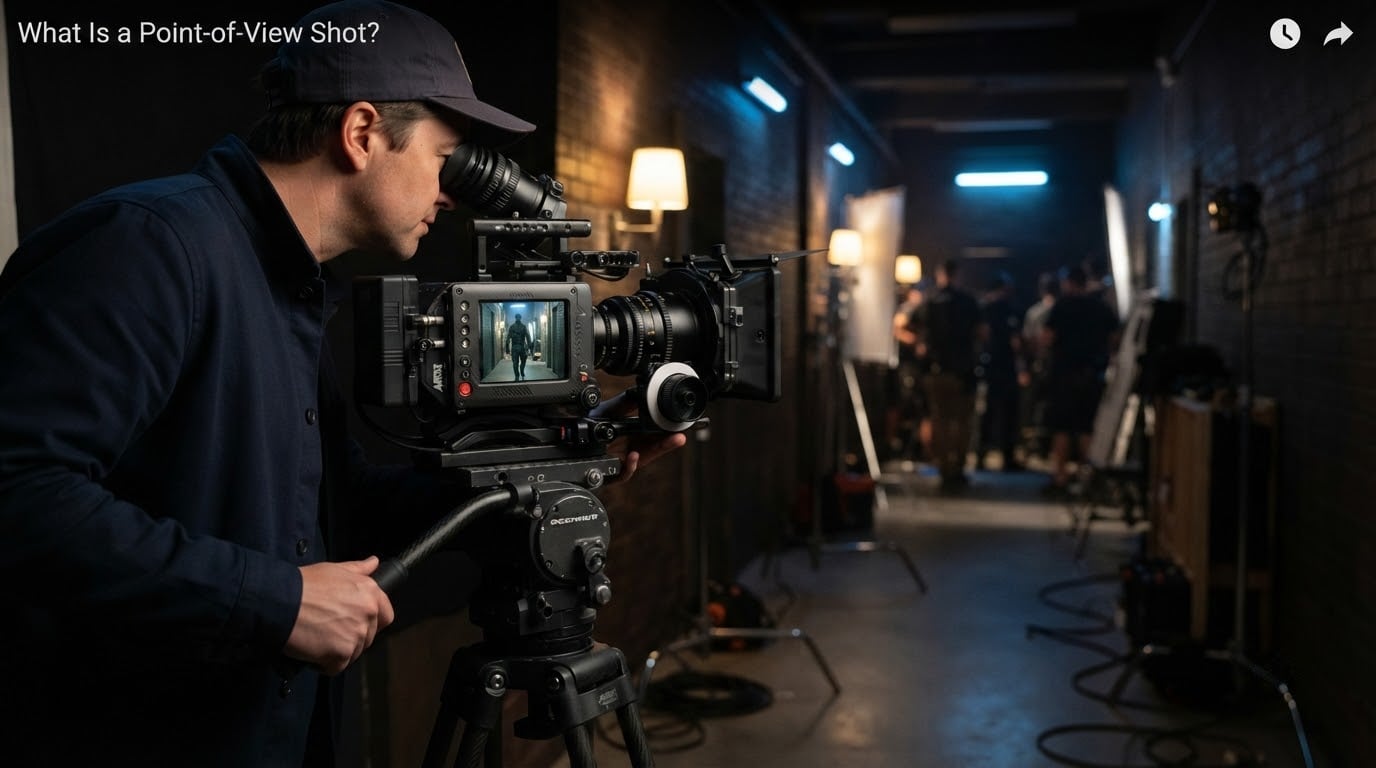
A point-of-view shot, also known as a POV shot, first-person shot, or subjective camera, is a film technique where the camera is positioned to show what a certain character is seeing from their perspective. In other words, the camera acts as the character’s eyes – the audience sees only what the character sees, framed at their eye level, from their physical position in the scene.
I’ve spent years breaking down scenes frame by frame with student filmmakers, and the POV shot is one of the few techniques that completely flips who the audience “is” in a story. Done well, it pulls viewers inside a character’s mind. Done poorly, it makes a movie feel like a found-footage horror short nobody asked for. This guide walks you through the full picture: what a POV shot actually is, how the classic three-shot sequence works, why directors reach for it, every type you can use, the gear that makes it possible, and how to shoot your own without shaky-cam nausea.
If you’re planning a short film or just want to understand the films you watch better, you’ll find practical shot-listing advice here too. We also link to our guides on one-shot short films and shot list software to help you plan your own POV project.
Table of Contents
- What Is a Point-of-View Shot? Definition and Alternative Names
- How Does a POV Shot Work? The Classic Three-Shot Sequence
- Why Filmmakers Use Point-of-View Shots
- Types of POV Shots: First, Second, Third-Person Limited, Omniscient, and Peripheral
- POV vs Subjective vs Objective Shots: What’s the Difference?
- Iconic POV Shots in Famous Films
- Whole-Movie POV Films: When the Entire Story Is First Person
- POV in Short Films and Animation: A Practical Angle for Independent Filmmakers
- POV Technology and Rigs: How to Shoot a POV Shot on Any Budget
- Practical Tips for Shooting Your First POV Shot
- Frequently Asked Questions
- Conclusion
What Is a Point-of-View Shot? Definition and Alternative Names
A point-of-view shot is a camera angle that places the viewer inside a character’s head. The lens sits where the character’s eyes would be – same height, same direction – and shows exactly what they see. The technique is also called a POV shot, a first-person shot, or a subjective camera, and the four terms are interchangeable in most film textbooks and on most sets.
Joseph V. Mascelli’s classic reference The Five C’s of Cinematography describes the technique as putting the camera in the subject’s position to capture “the exact viewpoint of the subject.” That phrasing is why so many filmmakers prefer the term “subjective camera” – it’s more descriptive than a label like “POV,” which can also refer to narrative perspective in writing.
The phrase “point-of-view shot” was popularized by the New Hollywood generation in the late 1960s and 1970s. Directors like Martin Scorsese, Brian De Palma, and Steven Spielberg leaned on POV shots to put audiences inside the heads of their characters, and the vocabulary stuck. Today you’ll hear all four terms on set without anyone blinking.
How It Works: A Quick Reference
- Subjective view – the camera literally stands in for the character’s eyes, so the audience sees only what that character sees.
- The setup – most POV shots are part of a three-shot sequence: character looking, what they see, and their reaction.
- Alternative names – the technique is also called a POV shot, first-person shot, subjective camera, or first-person camera.
- Eye line – the POV shot must match the character’s height, head position, and direction of gaze to feel believable.
How Does a POV Shot Work? The Classic Three-Shot Sequence
Almost every POV shot on screen is part of a three-shot pattern called a POV sequence. First, you cut to the character looking at something off-screen. Then you cut to what they’re looking at, framed from their eye line. Finally, you cut back to the character’s face for a reaction. That triangle – look, what they see, reaction – is the grammar of subjective camera work.
The look establishes whose eyes we are borrowing. The middle shot pays off the anticipation. The reaction shot sells the emotion. Cut any one of those three and the sequence loses power. That is why filmmakers obsess over matching eye lines, lens heights, and head turns between shots.
You can absolutely break the pattern. Hardcore Henry (2015) runs nearly its entire runtime as one continuous first-person POV with no reaction shots at all – the audience never sees the protagonist’s face. But for traditional storytelling, the look-POV-reaction triangle is the safest, cleanest way to drop viewers into a character’s mind.
Key Elements That Make the Sequence Work
- Eye-line match – the character’s gaze in shot one must align with the framed subject in shot two. Even a small misalignment breaks immersion.
- Lens height – place the camera where the character’s eyes actually sit. A POV from above or below reads as a different character.
- Head turn continuity – if the character turns their head, the POV should begin or end mid-motion to hide the cut.
- Reaction close-up – a tight reaction shot at the end sells the subjective experience more than any wide shot can.
Why Filmmakers Use Point-of-View Shots
The short answer is empathy. A POV shot pulls the viewer into a character’s sensory experience, and that direct access to what someone sees, hears, and feels creates an emotional shortcut no other shot type can match. Filmmakers reach for POV shots when they want the audience to feel what the character feels – fear, desire, confusion, disorientation, joy.
Horror directors use POV shots to make the audience complicit in violence – we see through the killer’s eyes in Halloween (1978), and that identification makes the killing feel closer, more uncomfortable. Spielberg uses a child’s-eye POV in E.T. to make us feel the wonder and smallness of a kid meeting an alien. War filmmakers like Spielberg (again) and the makers of 1917 use them so we feel the danger of being under fire, the way every doorway could hide an enemy.
POV shots also let filmmakers hide information. The thriller Rear Window (1954) spends most of its running time as a POV shot from wheelchair-bound photographer L.B. Jefferies – we see what he sees through his binoculars. That single decision is what allows Hitchcock to withhold the killer’s face until the climax while keeping us riveted. Want a deeper dive on how POV drives suspense? Our breakdown of 3-point lighting setups shows how cinematographers shape the world the POV character sees.
Types of POV Shots: First, Second, Third-Person Limited, Omniscient, and Peripheral
Filmmakers borrow the term “point of view” from literature, where it has been used for centuries to describe who is telling a story. That history is why there are several flavors of POV in cinema, not just one. Each one changes the audience’s relationship to the story.
First-Person POV
The camera is the character’s eyes. We see what they see and almost never see their face. This is the most immersive option, and it is what most people mean when they say “POV shot.” Hardcore Henry, Enter the Void (2009), and the killer shots in Halloween all use first-person POV.
Second-Person POV (Breaking the Fourth Wall)
The character looks directly into the camera and addresses the audience as “you.” This breaks the fourth wall and pulls the viewer into the scene as a participant rather than a witness. Fight Club, House of Cards, and Ferris Bueller’s Day Off use second-person POV sparingly but memorably.
Third-Person Limited POV
The camera follows one character closely – their eyeline, their reactions, their perspective – but we still see them on screen. Most dramas use third-person limited POV. It is the default mode of conventional filmmaking.
Third-Person Omniscient POV
The camera can be anywhere, with any character, and we may even know things none of the characters know. A voice-over or narrator often signals this. The Shawshank Redemption uses omniscient narration by Red, even though the camera work stays mostly objective.
Peripheral POV
The camera takes the perspective of someone – or something – at the edge of the action. A child hiding behind furniture, a bystander glimpsing a robbery, or the trunk-of-a-car viewpoint Quentin Tarantino popularized in Pulp Fiction. The “trunk shot” is a peripheral POV.
| POV Type | What the Camera Shows | Example |
|---|---|---|
| First-person | Only what the character sees; no face visible | Hardcore Henry opening sequence |
| Second-person | Character addresses camera, audience is “you” | Ferris Bueller’s fourth-wall breaks |
| Third-person limited | Follows one character closely, including their face | Most dramas and thrillers |
| Third-person omniscient | Anywhere, knows more than characters, often narrated | The Shawshank Redemption |
| Peripheral | A bystander or object’s perspective at the edge of action | Tarantino’s trunk shots in Pulp Fiction |
POV vs Subjective vs Objective Shots: What’s the Difference?
Filmmakers often use these three terms as if they were synonyms, but they are not. A POV shot is a specific kind of subjective shot, and a subjective shot is a specific kind of shot in general. Getting the distinction right will sharpen your shot list and your understanding of what you are watching.
| Term | Definition | When to Use |
|---|---|---|
| POV shot | Camera shows exactly what a specific character sees, from their eye line and position. | Horror killers, immersive first-person storytelling, hiding the protagonist’s face. |
| Subjective shot | Any shot that conveys a character’s inner experience – POV, blurred vision, disorientation, altered mental state. | Dreams, intoxication, panic, flashback distortions. |
| Objective shot | The camera is invisible and uninvolved. The audience watches from outside the action. | Most conventional coverage – masters, two-shots, neutral coverage. |
In short: every POV shot is a subjective shot, but not every subjective shot is a POV shot. A blurred, fish-eye view of a character stumbling drunk is subjective but is not strictly a POV shot unless the camera is where their eyes would be.
Iconic POV Shots in Famous Films
The best way to understand POV shots is to watch them in the wild. Here are six famous examples every film student should know, with the technique each one uses.
Halloween (1978) – The Killer’s POV
John Carpenter’s Halloween uses the killer Michael Myers’s POV to make the audience complicit in his stalking of Laurie Strode. The look-POV-reaction triangle is reversed: we see through Michael’s eyes, then cut to his mask, then back to his view. It is the single most copied POV setup in horror history, used in Scream, Friday the 13th, and dozens of slasher films since.
Rear Window (1954) – The Voyeur’s POV
Almost the entire film is a POV shot from wheelchair-bound photographer L.B. Jefferies. The camera stands in for his binoculars, panning across the courtyard to follow the neighbor he suspects of murder. Hitchcock withholds Jefferies’s face so we cannot look away from what he sees.
Kill Bill Vol. 1 (2003) – The Trunk Shot
Tarantino’s signature trunk POV shot in Kill Bill places the camera inside the trunk of a car as a wounded character is loaded in. It is a peripheral POV – we are seeing through the eyes of no one in particular, but the low, confined angle creates claustrophobia and dread.
Saving Private Ryan (1998) – The Soldier’s POV
Spielberg shoots the Omaha Beach landing in Saving Private Ryan with a mix of objective shaky-cam coverage and brief POV cuts from the soldiers. The handheld shake, the slow-motion impact hits, and the fragmented POV all combine to make the audience feel the chaos rather than just watch it.
E.T. the Extra-Terrestrial (1982) – The Child’s POV
Several key moments in E.T. are framed from a child’s eye level, including the famous flying-bicycle sequence. By keeping the camera low, Spielberg makes adults in the film feel towering and the world feel huge, exactly as it does to a child.
Lady in the Lake (1947) – The First Whole-Movie POV
Robert Montgomery’s 1947 film noir Lady in the Lake is widely cited as the first feature shot entirely in first-person POV. The camera is private detective Philip Marlowe for almost the entire running time. Audiences in 1947 found the experiment disorienting, and the film flopped, but it remains a landmark.
Whole-Movie POV Films: When the Entire Story Is First Person
Some filmmakers commit to first-person POV for an entire feature. The results are usually polarizing – audiences either love the immersion or feel exhausted by an hour and a half of never seeing the protagonist’s face. The films that work tend to use the constraint as part of their meaning.
Modern Whole-Movie POV Features
- The Blair Witch Project (1999) – found-footage horror that helped revive the format for a generation of low-budget filmmakers.
- Cloverfield (2008) – a monster attack as seen through one character’s camcorder.
- Hardcore Henry (2015) – an entire action movie shot in continuous first-person POV, like a first-person shooter video game.
- Enter the Void (2009) – Gaspar Noe’s psychedelic drama that floats between first-person POV and death-state visions.
- Diving Bell and the Butterfly (2007) – shot largely from the locked-in syndrome patient’s POV, with eye-blink interface framing.
- I Didn’t See You There (2022) – documentary POV from a wheelchair user, exploring disability and visibility.
Filmmakers love the format because it is low-budget-friendly: one actor, one camera operator, no coverage. Indie producers hate it because it can be alienating for general audiences. The sweet spot is usually a 5-15 minute section rather than a full feature.
POV in Short Films and Animation: A Practical Angle for Independent Filmmakers
POV shots are an underused tool in short films. The format suits them: a short film has time to commit to a single perspective, and indie budgets make the constraints of first-person POV a feature rather than a bug. Student film BLINK, for example, was shot entirely in POV using a custom helmet rig and a 24mm lens – proof that an entire short film works in first person.
Animation is another natural home for POV shots. Because animators control the camera completely, they can simulate POV effects more cheaply than live action – no helmet rig, no stabilization, no eye-line headaches. Spike Jonze’s short film I’m Here and Pixar’s work in Wall-E both use first-person framing to amplify intimacy. Animated shorts in particular can use POV shots to put the viewer inside a non-human character – a robot, an insect, an inanimate object – without the uncanny-valley cost of prosthetics.
For Short Film Central readers, POV is a low-cost storytelling shortcut. One actor, one operator, one or two locations, and you have a complete short film. No wonder festival programmers love them – they are tight, immersive, and visually distinct from the typical two-character drama.
POV Technology and Rigs: How to Shoot a POV Shot on Any Budget
POV shots used to require custom rigs built by cinematographers. Today you have options at every price point, from a smartphone taped to a baseball cap to a purpose-built Insta360 rig with horizon lock.
Entry-Level POV Gear
- Smartphone + head strap – the cheapest option. A cheap elastic strap and a phone holder can produce decent POV footage for under thirty dollars. Vertical video framing limits your shots, but it works for social-media shorts.
- GoPro Hero series – the long-time standard for action POV. Compact, rugged, wide lens options, and excellent stabilization in current models.
- Insta360 GO and Ace series – tiny, lightweight action cameras with built-in stabilization and 360-degree capture options.
Mid-Range and Pro Options
- Helmet rigs (chest, chin, forehead mounts) – the cinema-standard for first-person POV. Companies like SHAPE, Wooden Camera, and B&H sell full rig systems that accept mirrorless bodies.
- Gimbal-stabilized handheld – for a slightly less rigid feel, a Ronin or gimbal held at face height gives you handheld POV without the seasick wobble.
- Drone POV – drones like the DJI Mavic series can fly POV shots that would be impossible with a helmet rig.
The single biggest technical lesson from r/Filmmakers and r/cinematography: stabilization matters more than resolution. Audiences will tolerate 1080p POV footage if it is smooth; they will not tolerate 4K shaky-cam because it triggers motion sickness. If you are using an action camera, turn on hypersmooth or horizon lock before you start rolling.
Practical Tips for Shooting Your First POV Shot
If you have never shot a POV shot before, here is a step-by-step shot-listing workflow you can use today. These tips work for short films, music videos, branded content, and even TikTok experiments.
Step 1: Decide Whose POV
Before you do anything else, decide whose eyes the camera is standing in for. A POV shot only works when the audience knows whose perspective they are borrowing. State it explicitly in your shot list: “POV – Sarah, looking down the hallway.” If you skip this step, your POV will read as random handheld.
Step 2: Match the Eye Line
Place the camera at the same height and direction as the character’s eyes. If your character is five-foot-four, the camera sits at five-foot-four. If they are looking slightly down, the camera tilts slightly down. Mismatched eye lines are the #1 reason POV shots feel amateur.
Step 3: Stabilize, Stabilize, Stabilize
Use a gimbal, a chest rig, or the in-camera stabilization on your action camera. Avoid pure handheld for shots longer than a few seconds – the wobble adds up fast. If you must shoot handheld, brace your elbows against your body and breathe shallowly.
Step 4: Avoid Zooms
Zooms during POV break the subjective feel. The human eye does not zoom. If you need to reframe, cut to a new angle rather than zooming inside the shot. Cinematographers on r/cinematography hammer this point: “match lens height, avoid zooms, and you’ll be fine.”
Step 5: Plan Your Reactions
If you are using the classic three-shot sequence, plan the reaction close-up at the same time as the POV. The reaction sells the subjective experience. Without it, your POV will feel detached and confusing.
For more on planning your shoot day, check out our guides to shot list software and point-and-shoot cameras for vlogging. They will save you time on the day and help you avoid common short-film mistakes.
Frequently Asked Questions
What is a point of view in a film?
A point of view in a film is the perspective from which a scene is shown. The most literal form is the point-of-view shot, also known as a POV shot, where the camera is positioned at a character’s eye level and shows exactly what that character sees. Filmmakers also use the broader term point of view to describe whose story we are following, including first-person, third-person limited, and omniscient narration.
What does ‘point of view’ mean in photography?
In photography, point of view refers to the physical position and angle from which a photo is taken. A photographer can choose a low POV (shooting up at a subject), a high POV (shooting down), an eye-level POV, or a worm’s-eye view. The same idea carries into film: a POV shot is the camera version of taking a photograph from where the character’s eyes would be, showing exactly what they see from their physical position.
Can you give me an example of a POV shot?
Yes. A classic example is the killer’s POV in Halloween (1978), where the camera stands in for Michael Myers as he stalks Laurie Strode. The sequence runs look-POV-reaction: Michael looks, we see what he sees, then we see the mask. Other famous POV shot examples include the binoculars view in Rear Window (1954), the trunk shot in Kill Bill Vol. 1 (2003), the Omaha Beach landing in Saving Private Ryan (1998), and the entire first-person feature Hardcore Henry (2015).
What is the purpose of a POV shot?
The purpose of a POV shot is to put the audience inside a character’s sensory experience. By showing only what that character sees, from their eye line, the filmmaker creates empathy, suspense, intimacy, or fear. POV shots can hide a killer’s face to build dread (Halloween), immerse us in a child’s wonder (E.T.), show us the chaos of war (Saving Private Ryan), or hide the protagonist’s face to force us into first-person action (Hardcore Henry).
Why do filmmakers use point of view shots?
Filmmakers use point of view shots to control what the audience knows and feels. A POV shot creates empathy by limiting our view to one character’s, builds suspense by hiding other characters’ faces or reactions, immerses viewers in subjective experiences like fear or intoxication, and lets the director hide information (such as a killer’s identity) for dramatic effect. They are especially common in horror, thriller, and action genres.
What’s the difference between POV and subjective camera?
POV shot and subjective camera are often used interchangeably, but there is a subtle distinction. A POV shot places the camera exactly where the character’s eyes would be and shows only what they see. A subjective camera is a broader term for any shot that conveys a character’s inner experience, including blurred vision, fish-eye distortion, or disorienting camera movement. Every POV shot is subjective, but not every subjective shot is a strict POV shot.
Conclusion
A point-of-view shot is one of the simplest film techniques to describe and one of the hardest to execute well. It is the camera in the character’s eyes, set up as a look-POV-reaction triangle, used to manufacture empathy, suspense, or identification in the audience. From the killer POV of Halloween to the continuous first-person action of Hardcore Henry, the technique has been pushing cinema into new subjective territory for almost a century.
For short filmmakers, POV is one of the best tools in the box: it is low-budget, immersive, and visually distinctive in a festival circuit full of two-shots and over-the-shoulders. Pick a character, match the eye line, stabilize the camera, and shoot. Your audience will be inside your character’s head before they know what hit them.
If you want to take the next step, plan your shoot with our shot list software guide, light your scene with our 3-point lighting kits breakdown, and explore other cinematographic styles in our guide to one-shot short films.