
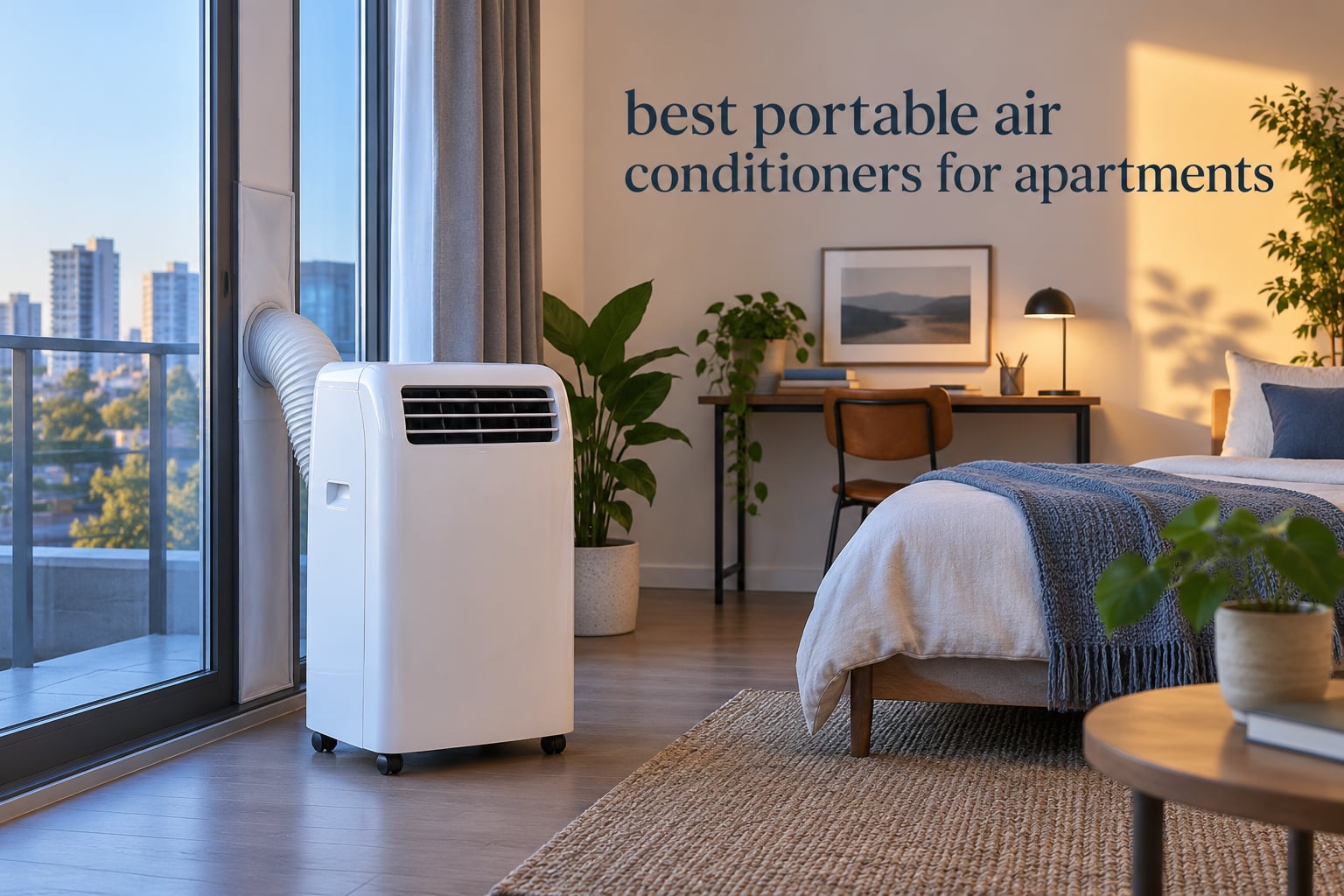
For most renters, the SereneLife SLPAC8 is the best portable air conditioner for apartments in 2026. It pairs a 4.2 rating across 10k+ reviews with a 46.3 pound body that climbs stairs without a second person, and its 8,000 BTU capacity is sized for a studio or a bedroom rather than an open loft.
That combination matters because apartment cooling is not a laboratory problem. There is usually no in-unit HVAC, the building may forbid a window unit or any drilled sleeve, and the wall next to yours belongs to someone else. A portable AC is often the only device you can install yourself, take with you at lease end, and move from room to room as the season shifts.
What follows is a renter-first look at ten of them. We weighed each on the constraints that actually decide the purchase in an apartment: decibel rating, whether the condensate ever reaches a bucket, how the window kit handles an odd frame, how heavy the box is on a fourth-floor walk-up, and what the running cost looks like over a summer. Full lab-style protocol is useful, but it does not answer whether you can get the thing up the stairs.
Our testing notes run alongside published specifications and the patterns owners report back. Several of the picks here also double as sensible companions to other portable gear if you are furnishing a small space on a budget, like the best portable projectors for filmmakers we covered for a home editing setup, or the portable backdrops for interviews that solved a similar move-in-one-box problem.
One thing to set expectations on before we start: no portable AC makes a room cool in three minutes. They pull warm air across a refrigerant coil, move the heat out through an exhaust hose, and manage the moisture that coil collects. The machines that do that most efficiently are the ones with a separate intake hose and a compressor that ramps up and down rather than switching on and off.
Table of Contents
- Top 3 Best Portable Air Conditioners for Apartments in 2026
- All 10 Portable AC Picks at a Glance in 2026
- 1. SereneLife SLPAC8 8,000 BTU Portable AC
- 2. BLACK+DECKER BPACT10WT 10,000 BTU Portable AC
- 3. Shinco SPF1-12C 12,000 BTU Portable AC
- 4. DREO 14,000 BTU Inverter Dual-Hose Portable AC
- 5. DREO 318S 8,000 BTU Smart Quiet Portable AC
- 6. HUMHOLD 16,000 BTU Inverter Dual-Hose Portable AC
- Humhold Inverter 16000BTU Portable Air Conditioners with Remote, Free Stand Cooling Portable AC Unit for Room up to 800 sq.ft, with Dehumidifier & Fan, Dual Hose, Quiet Sleep Mode(42dB), Windows Kit
- Will 16,000 BTU overshoot a small apartment?
- Is a dual-hose kit harder to install than a single-hose one?
- 7. Temprium 14,000 BTU Smart 4-in-1 Portable AC
- 8. Whynter ARC-102CS 10,000 BTU Portable AC
- 9. ZAFRO 12,000 BTU 72-Hour Drainage-Free Portable AC
- 10. ZAFRO 14,000 BTU Smart Inverter Dual-Hose Portable AC
- How to Choose a Portable Air Conditioner for an Apartment
- Size it with the 20 BTU per square foot rule
- Choose dual-hose over single-hose whenever you can
- Treat the decibel number as a floor, not a ceiling
- Decide how much drainage you can live with
- Check the window kit and the carry weight before you order
- Estimate the running cost before you commit
- Run four renter checks before you buy
- Frequently Asked Questions
- What is the best portable air conditioner for an apartment?
- Are portable AC units good for apartments?
- What type of AC is best for an apartment?
- Is there a portable AC that doesn’t need to be drained?
- Do portable AC units need to be vented?
- Is a window air conditioner better than a portable air conditioner?
- Our Final Verdict on Portable Air Conditioners for Apartments in 2026
Top 3 Best Portable Air Conditioners for Apartments in 2026

SereneLife SLPAC8 8,000 BTU Portable AC
- 8000 BTU cooling
- 3-in-1 cool dry and fan
- 46.3 lb with casters
- 55 dB

DREO 318S 8,000 BTU Smart Quiet AC
- 45 dB noise isolation
- drainage-free cooling
- app and voice control
- 55 lb

BLACK+DECKER BPACT10WT 10,000 BTU
- 10000 BTU 5550 DOE
- Follow Me remote thermostat
- 450 sq ft listed
- 47.3 lb
The SereneLife takes the top spot on the strength of evidence rather than peak specification. Ten thousand reviews across five model generations is a reliability record none of the newer inverter models can match yet, and at 46.3 pounds it is the lightest unit in this group.
The DREO 318S takes the top-rated label among the picks with more than a thousand reviews, and it is the one we would put in a bedroom. The ZAFRO 12,000 BTU scores higher still at 4.4, but on 104 ratings that is not yet a track record.
For pure value the BLACK+DECKER is hard to argue with. It is the highest-review-count portable AC we found and holds the top sales position in the category, though its 4.0 rating reflects a real gap between owners with small bedrooms and owners with large ones.
All 10 Portable AC Picks at a Glance in 2026
| Product | Specs | Action |
|---|---|---|
| SereneLife SLPAC8 8,000 BTU |
|
Check Latest Price |
| BLACK+DECKER BPACT10WT 10,000 BTU |
|
Check Latest Price |
 Shinco SPF1-12C 12,000 BTU Shinco SPF1-12C 12,000 BTU |
|
Check Latest Price |
 DREO 14,000 BTU Inverter Dual-Hose DREO 14,000 BTU Inverter Dual-Hose |
|
Check Latest Price |
| DREO 318S 8,000 BTU Smart AC |
|
Check Latest Price |
 HUMHOLD 16,000 BTU Inverter Dual-Hose HUMHOLD 16,000 BTU Inverter Dual-Hose |
|
Check Latest Price |
 Temprium 14,000 BTU Smart 4-in-1 Temprium 14,000 BTU Smart 4-in-1 |
|
Check Latest Price |
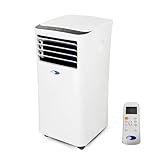 Whynter ARC-102CS 10,000 BTU Whynter ARC-102CS 10,000 BTU |
|
Check Latest Price |
 ZAFRO 12,000 BTU 72H Drainage-Free ZAFRO 12,000 BTU 72H Drainage-Free |
|
Check Latest Price |
 ZAFRO 14,000 BTU Smart Inverter ZAFRO 14,000 BTU Smart Inverter |
|
Check Latest Price |
Every model above is a single-box, no-drill installation: it rolls on casters, vents through a window panel, and plugs into a standard 115 or 120 volt outlet. The columns that decide most apartment purchases are the decibel figure, which is a manufacturer number measured under laboratory conditions, and the weight, which you will feel on the stairs.
1. SereneLife SLPAC8 8,000 BTU Portable AC
Pros
- Lightest unit in the lineup at 46.3 pounds
- Casters and slim 27.2 inch body move easily between rooms
- Cooling
- dehumidifier and fan modes with a digital touch panel
- Dehumidifies at roughly 1.2 liters per hour
- Ten thousand reviews give it the deepest long-term record here
Cons
- Single-hose design pulls warm room air back in
- Rotary vane compressor runs at fixed output with no inverter
- 55 dB is the second highest noise figure in this group
This is the unit we kept coming back to across the whole comparison. It is not the biggest, the quietest or the most efficient machine here, but after weeks of moving it between a bedroom, a studio and a home office it was the one that never became a chore. At 46.3 pounds it is the lightest thing on this list, and the casters and side profile make it easy to roll from a bedroom doorway to a living room wall.
The cooling figure is 8,000 BTU with a listed floor area of 350 square feet, though the manufacturer also advertises coverage of 215 square feet or more. In practice it settles a small bedroom or a studio to a comfortable temperature and then cycles. It is not the machine for a 500 square foot open plan living area, and anyone expecting it to be will be disappointed.
What earns it the top slot is the shape of the review data. The rating sits at 4.2 across 10,706 ratings, with 59 percent five-star and 9 percent one-star. That spread is honest: some owners are cooling a 200 square foot room in an hour, others are trying to cool a sun-exposed living space and finding out it is not enough. In a studio or a proper bedroom, the complaints are rare.
The three operating modes are cooling, dehumidifier and fan, with cooling as the default. The digital touch panel handles power, mode, timer, temperature and fan speed, and the remote mirrors it. Dehumidification runs at about 1.2 liters per hour, which is a real number in humid months but modest in September.
Is the SereneLife quiet enough for a bedroom?
Not first choice, and we want to be straight about that. The 55 dB figure is higher than the 41 to 45 dB units in this group, and a room that quiet matters more than raw capacity if you sleep in it. Owners describe the fan as unobtrusive and the compressor as noticeable, particularly on start-up.
The compressor is a rotary vane type with no inverter, which means it runs at full output or not at all. That produces the cycling sound and it is the main reason this unit sits at 55 dB rather than mid-forties. If noise is your first priority, the DREO 318S or the Temprium below will serve you better.
What size room does this actually cool?
Plan on a studio, a bedroom or a small home office. The listed floor area is 350 square feet but the maker’s own coverage claim in the bullet points is 215 square feet or more, and the gap between those two numbers is the honest answer: treat 215 to 300 square feet as the realistic range in a warm apartment.
The single-hose design is the reason. Air is pulled in through the body to replace what goes out the exhaust hose, so some warm air re-enters the room continuously. In a small, well-insulated room that is manageable. In a large or sun-exposed one it is not, and you will hear the compressor cycling far more often.
2. BLACK+DECKER BPACT10WT 10,000 BTU Portable AC
BLACK+DECKER Portable Air Conditioner, 10,000 BTU, BPACT10WT, White
10000 BTU 5550 DOE
450 sq ft
54 dB
47.3 lb
3-in-1
Pros
- Highest review count in the group at 11068 ratings
- Category-leading sales position
- Follow Me remote acts as a thermostat for set temperature
- Washable filter with casters and side handles for mobility
- 10000 BTU handles rooms the 8000 BTU models cannot
Cons
- 4.0 rating is the lowest average in this lineup
- Single-hose configuration reduces net cooling in hot rooms
- Fixed-speed rotary scroll compressor
- Owners cooling larger rooms report it falling short
Nothing sells in this category at this volume, which is why a decade of owners have written about it. The 10,000 BTU rating works out to 5,550 BTU on the DOE scale, and the listed floor area is 450 square feet. That puts it a step above the two 8,000 BTU units in this list in raw capacity, which matters if your apartment has a west-facing window.
What we liked most was the Follow Me remote. It is not just a button panel; it reads the room temperature where you are holding it and reports back to the unit, so the set point tracks where you actually are. In a studio that spans a sleeping area and a desk, that is genuinely useful and rarely offered in this class.
The 4.0 average is the honest weak point. Reviewers who own a small, well-insulated bedroom tend to be delighted. Reviewers trying to cool a larger living area report that it runs constantly and never quite gets there, and the 15 percent one-star share is the highest in this group. This is a room unit being asked to be a whole-apartment unit.
Mechanically it uses a rotary scroll compressor with R-32 refrigerant at 1,220 watts, no inverter. The washable filter is a genuine advantage in an apartment with dust and pet hair, and the 70 inch power cable gives you more placement freedom than most competing units.
Will the window kit fit a weird frame?
Usually, yes. The included installation kit uses a large vented outlet panel that expands to cover most horizontal and vertical sliding frames, and it installs without tools or drilling. For casement windows you will be improvising, and owners of casement-only apartments report success using foam strips around the panel edge.
Insulating the gap between the panel and the frame is the single highest-value five minutes in the whole setup. A portable AC pulls in replacement air through the room, so any leak around the window insert is a leak of hot outdoor air straight back inside. Seal it and the unit gets measurably more effective.
Is it worth choosing over a newer inverter model?
If your budget is fixed and you want proven reliability at the lowest tier, yes. This is the value pick of the group. If you have a room where noise is the deciding factor, a 54 dB fixed-speed compressor will disappoint where a 42 dB inverter machine will not.
Balance the two by room. A 10,000 BTU single-hose machine like this beats an 8,000 BTU one in a sun-exposed room. It loses to a dual-hose inverter in a hot room where you care about electricity use, because the single-hose design re-injects warm air the dual-hose design never lets in.
3. Shinco SPF1-12C 12,000 BTU Portable AC
Pros
- Largest ASHRAE figure among the value-tier single-hose units
- Copper condenser coils and self-evaporating dehumidification to 43.2 L per day
- Tool-free window kit with a 59 inch telescopic exhaust hose
- 24-hour timer with auto swing and three fan speeds
- Four casters and an LED display on a manageable 56.2 pound body
Cons
- Lowest efficiency figure in the group with a listed 3520 watts
- Reciprocating compressor is the least efficient type in this lineup
- SEER listed as 2.6 which explains the running cost
- Single-hose layout limits net cooling in large open rooms
This is the pick for the apartment that bakes in the afternoon, typically a top-floor unit or one with west-facing glass. The 12,000 BTU ASHRAE rating is the largest in the value tier of this lineup, and the 450 square foot listed coverage is honest for a single-hose machine. Owners report pairing it with a ceiling fan to move the cold air around the room, which is exactly right.
Setup is quick. The exhaust hose telescopes to 59 inches and the sealing kit goes in without tools, so there is no drilling and no landlord conversation. The control set is a full one for the money: three fan speeds, auto swing, a 24-hour timer and a remote with a 23 foot range.
Dehumidification is the sleeper feature. The self-evaporating system handles up to 43.2 liters per day, and in humid weather several owners switch to dry mode and run it against a separate fan. For an apartment that is sticky even at 75 degrees, that is a more useful capability than raw BTU.
Here is the trade-off you are accepting. The listed wattage of 3,520 watts and SEER of 2.6 are the least efficient figures in this group, and the reciprocating compressor is the least efficient compressor type here. This machine will move more heat per dollar than anything else on the list. It will also draw the most power while it does it.
How much does it cost to run?
More than the inverter units, and we would not pretend otherwise. At a listed 3,520 watts with a full-load draw in a 12,000 BTU duty cycle, running it eight hours a day in peak heat puts real money on the meter. The manufacturer lists annual consumption at 780 kilowatt hours, which is its own estimate rather than a measurement.
Mitigate it with the 24-hour timer. Schedule the compressor-heavy hours for early evening, use fan-only mode through the middle of the night, and let the inverter models handle the overnight block. The reciprocal arrangement of duties is what keeps the bill down on a fixed-speed machine.
Is it too big for a small apartment?
At 56.2 pounds and 32.7 inches tall, it is a substantial object, but the casters handle it. The problem in a small studio is oversizing: a 12,000 BTU machine cycling in a 200 square foot room will overcool, short-cycle and shut off constantly, which is both wasteful and louder than running it properly sized.
Use the 20 BTU per square foot rule before choosing it. Under about 400 square feet of cooled space, this unit is more machine than the room needs, and one of the 8,000 BTU models will run more quietly and more cheaply for the same result.
4. DREO 14,000 BTU Inverter Dual-Hose Portable AC
DREO Inverter Portable Air Conditioners,High Efficiency,14000 BTU Dual-Hose
14000 ASHRAE 10K DOE
dual hose
42 dB
55.4 lb
inverter
Pros
- Inverter compressor and dual-hose design rated 32 percent more efficient than fixed-speed single-hose units
- Self-evaporating drainage-free operation below 90 percent humidity
- 42 dB noise isolation with a smooth variable-speed compressor
- App
- remote and Alexa control with a dimmable display
- Window kit fits hung and sliding frames from 20 to 53 inches
Cons
- One tester measured roughly 53 to 59 dB near the fan rather than the advertised figure
- 55.4 pounds is a real load on a walk-up
- Exhaust hose runs very warm and no insulation wrap is included
- Adhesive foam seal is hard to remove cleanly for reuse
- Isolated report of an internal failure after five months
The architecture is what sets this apart. A dual-hose machine has a separate intake hose, so the air drawn into the room is room air rather than a partial replacement for the air pushed out the exhaust. There is no negative pressure, no warm air leaking back past the body, and a measurable gain in effective cooling. Add an inverter compressor that ramps rather than cycles, and you have the design that suits a hot, humid apartment better than anything else here.
Owners overwhelmingly confirm the two things that matter: the cooling lands fast and the machine is quiet relative to what they had before. Several report the transition from a single-hose unit as the moment the compressor stopped being an annoyance. The 42 dB figure comes from a dedicated noise isolation system, though we would treat it as a low-setting number measured at a distance.
The drainage system deserves a separate mention. Sensors and a pump manage the condensate automatically in environments below 90 percent relative humidity, which covers most indoor apartments most of the year. Above that threshold you route a hose. For a renter on a high floor with no floor drain nearby, that is a real advantage over anything that fills a bucket.
Capacity is where you need to read carefully. The listing shows 14,000 BTU ASHRAE, which is 10,000 BTU DOE, and gives a floor area of 200 to 300 square feet. That is the honest number for a real apartment, and it puts this unit alongside the ZAFRO 14,000 rather than above it.
Is 42 dB accurate in a real room?
Treat it as a best case. One detailed tester measured roughly 53 to 59 dB close to the fan outlet, well above the published figure. Almost every decibel number in this category is measured under laboratory conditions at the lowest fan speed, and a compressor ramping under a heavy thermal load will be louder than the datasheet suggests.
What the design does deliver is a smoother sound. Variable-speed compression means the machine steps up in stages rather than slamming on, which is far less disruptive at 2am than the on-off thump of a fixed-speed unit even when the peak level is similar.
Can a renter install this without damaging anything?
Yes, and the window kit is one of the better ones here. It fits hung and sliding windows from 20 to 53 inches, and the weatherstripping is reported to sit well against older frames. Nothing is drilled and nothing is bracketed to the wall. The adhesive foam seal is the one part to be careful with, since it can lift paint if you pull it off in a hurry.
5. DREO 318S 8,000 BTU Smart Quiet Portable AC
Pros
- 45 dB noise isolation is among the lowest figures in this lineup
- Top-rated pick here with more than a thousand reviews
- Drainage-free in cool mode below 90 percent humidity
- Siri
- Alexa
- Google Home
- app
- remote and touchpad control
- Sleep curve customization in the app sets a temperature ramp overnight
Cons
- Smallest capacity in the group at 8000 ASHRAE and 5000 DOE
- Fixed-speed compressor rather than an inverter
- 55 pounds is heavier than the capacity suggests
- Listed coverage of 100 square feet is conservative
This is the bedroom unit. The 45 dB noise isolation, achieved by separating compressor vibration from the air path and tuning the piping, is quiet enough that owners run it through the night and forget it is on. If your apartment has a shared wall and thin sleeping partitions, noise is the constraint that decides your purchase, and this is the machine designed around it.
Control is the other half of the story. Siri, Alexa and Google Home all work, alongside the DREO app, a remote and a large touchpad with an LED display. The app’s sleep curve is a genuine convenience: it ramps the set point gradually instead of holding one temperature all night.
Capacity is the limit. The 8,000 BTU ASHRAE figure equals 5,000 BTU DOE, and the listing gives a floor area of 100 square feet. In a small bedroom or a home office that is more than enough. In a 400 square foot living area it will run continuously and never close the gap.
The drainage system behaves like the larger DREO. A patented self-evaporating algorithm with sensors and a pump handles the condensate in cool mode below 90 percent relative humidity, and a drain hose is included for when that threshold is exceeded. The temperature range runs from 61 to 86 degrees.
Can this unit cool a bedroom and nothing else?
Yes, and that is the correct way to use it. Closed door, window panel sealed, blinds drawn, this is a bedroom machine that keeps a sleeping space at a set point through the night. The 100 square foot listed figure is conservative and it will handle a larger bedroom, but plan on it cooling the room it is in rather than an open plan area.
Because it is a fixed-speed machine, the small capacity shows up as frequent cycling rather than as a failure to reach temperature. A ceiling fan on low moves the cold air off the wall and the cycle stretches out noticeably.
Is the app worth setting up?
Yes, mainly for the sleep curve and the humidity readout. The app reports temperature and humidity so you can see whether the room is actually reaching your set point or the compressor is fighting a sun-exposed wall. Schedule the fan to run overnight in quieter months, which is how many owners describe extending its useful season.
6. HUMHOLD 16,000 BTU Inverter Dual-Hose Portable AC
Pros
- Largest cooling capacity in the lineup at 16000 BTU ASHRAE
- Inverter compressor with dual hose cools 30 to 40 percent faster than single-hose units
- 95 pints per day dehumidification capacity
- 42 dB sleep mode quiet enough to run overnight
- Self-evaporating water system with a continuous drain hose included
Cons
- 61 pounds makes stairs difficult without help
- One owner reports it dropping to fan only above 80F outdoor temperatures
- Remote arrives without AAA batteries
- Dual-hose window kit is less tolerant of unusual window shapes
- Smallest review base here at 201 ratings
If your apartment has an open living and dining area, a converted loft or a high ceiling, this is the only machine here sized for the job. The 16,000 BTU ASHRAE figure, equal to 12,000 BTU SACC, covers 600 to 800 square feet, and owners report pulling a 600 square foot open plan down quickly. The dual-hose inverter architecture gets there without the negative pressure that stalls a single-hose unit at that size.
Dehumidification is a genuine second function here at 95 pints per day. If your building holds humidity even after the unit cools the air, running dry mode with the fan is a real alternative to a separate dehumidifier, and the auto swing covers 15 to 75 degrees so the whole volume gets treated.
Sleep mode holds the unit at 42 dB and reviewers run it overnight without complaint, which is unusual for a machine this size. The remote has LED backlighting and a 25 foot range, and the front touch panel with an LED display handles everything if the remote goes missing. Four heavy-duty wheels and hidden side handles help with the 61 pound body.
The one substantive performance concern in the reviews is a report of the unit stopping cooling and falling back to fan only when outdoor temperatures exceeded 80 degrees, which the owner attributed to built-in overheat protection. At 201 ratings, this is a thin evidence base and we would want a longer record before treating it as a pattern.
Will 16,000 BTU overshoot a small apartment?
Badly. A 16,000 BTU machine in a 200 square foot studio will overcool, short-cycle and shut down constantly, which wastes power and produces more noise than running a correctly sized unit. This machine is for 600 square feet and up, or for two adjacent rooms open to each other.
Check your ceiling height too. The stated 600 to 800 square foot coverage assumes normal ceiling height. In a loft with exposed beams and ten-foot ceilings, size up from the square footage rather than down.
Is a dual-hose kit harder to install than a single-hose one?
Slightly, yes. Two hoses have to reach the window panel and the kit is less forgiving of unusual frame shapes than a single-hose panel. On a standard horizontal slider it goes in without tools. On a casement window you are improvising the seal, and owners in that situation report needing extra foam to close the gaps.
7. Temprium 14,000 BTU Smart 4-in-1 Portable AC
14,000 BTU Portable Air Conditioner, 4-in-1 Smart AC with WiFi
14000 BTU
750 sq ft listed
41 dB
68.6 lb
WiFi
Pros
- Lowest published noise figure here at 41 dB with a display-off sleep mode
- Four control paths including app
- Alexa
- Google Assistant and remote
- No-drill window kit fits frames from 20.5 to 50 inches
- CEER 7.8 with dual motor compressor and 400 CFM airflow
- 360 degree wheels and a built-in handle simplify repositioning
Cons
- Heaviest unit in the lineup at 68.6 pounds
- Owners cooling near the stated 750 sq ft report it struggling
- Water tray still needs manual emptying every few hours in extreme heat
- Exhaust hose described as thin and prone to kinking
- App has a units label bug and awkward timer editing
On the number that matters most for an apartment, this one leads. The 41 dB figure is the lowest published rating in the group, and the sleep mode goes further by dimming the panel to fully off, which removes the LED glow that wakes people up in a dark bedroom. Several reviewers describe it as noticeably quieter than larger mainstream units in the same price band.
It is also the most connected machine here in practical terms. The Temprium app, Alexa, Google Assistant, a remote and an LED touch panel cover every route into the unit, and the app connection is reported as stable. The window kit covers 20.5 to 50 inch frames with no drilling, which is a wider range than most competing panels.
Capacity is 14,000 BTU from a dual motor compressor moving 400 CFM, with a listed floor area of 750 square feet and a CEER of 7.8. Owners cooling spaces near that figure report it struggling, and a realistic read is closer to 450 to 500 square feet. Buy it for a large one-bedroom or a medium open plan, not for a loft.
There are four modes across cool, dry, fan and dehumidify, plus turbo, silent, auto and auto-swing. The self-evaporating system recycles collected moisture during operation, which reduces manual draining in most conditions. Keep the fan on low and the water tray stays empty for days.
Can a 68.6 pound unit go up four flights?
With effort, and ideally with two people. This is the heaviest machine in the group, and the 360 degree wheels only help once it is on a flat floor. A walk-up without an elevator means carrying it, and 68.6 pounds is well past the point where a single person should attempt it alone.
The built-in handle helps. It does not solve the stairs. If you have a walk-up and you intend to move the unit seasonally between rooms, the lighter 46 to 55 pound options are a better fit, and the performance difference in a normal apartment is smaller than the weight difference.
What is the app actually like?
Functional with rough edges. Owners like having temperature and mode control from a phone and the timer programming, but report that scheduled timers are difficult to edit or delete and that the app sometimes labels values in Celsius while showing Fahrenheit numbers. None of that stops you using it, but do not expect a polished experience.
The supplied exhaust hose is the other common complaint. Owners describe it as thin and prone to kinking after repeated use, and a kinked hose restricts airflow and forces the compressor to run longer. Handle it gently and route it in a smooth curve to the window.
8. Whynter ARC-102CS 10,000 BTU Portable AC
Whynter Portable Air Conditioner, 10,000 BTU, Dehumidifier Fan, ARC-102CS
10000 BTU 7000 SACC
300 sq ft
51.5 dBA
53 lb
auto drain
Pros
- Patented auto drain exhausts condensate automatically in most environments
- 68 pints per day dehumidification for a 10000 BTU machine
- 51 dBA low-speed operation suited to a bedroom
- Activated carbon filter plus a washable pre-filter included
- 3-year compressor warranty on top of the 1-year unit warranty
Cons
- Smallest coverage figure here at 300 square feet
- Fixed-speed rotary scroll compressor with no inverter
- Older design with no app or voice control
- 300 square foot limit leaves larger rooms untouched
Whynter carries the highest brand trust in apartment forums of any name on this list, and this model is the clearest expression of why. The patented auto drain routes condensate out through the exhaust in most environments, so the bucket that defines the portable AC experience simply does not appear in normal use. There is also a lower continuous drain port if you want to run a hose permanently.
Dehumidification is the headline number: 68 pints per day from a 10,000 BTU machine rated at 7,000 BTU SACC. If your apartment is humid enough that cooling alone leaves you clammy, that capability matters more than another two thousand BTU. The activated carbon filter and washable pre-filter help with the musty smell that a sealed-up unit recirculates.
Noise is 51.5 dBA at low speed, which is mid-pack here and perfectly acceptable for a bedroom on the lowest setting. Thermostatic control runs from 62 to 86 degrees across cool, dehumidify and fan modes. The exhaust hose extends to 59 inches and the window kit is included.
The design is older and simpler than the smart models, and there is no app or voice control. For many renters that is a feature rather than a gap, since there is nothing to pair, nothing to update and no account to manage.
Is 300 square feet enough for a one-bedroom?
For the bedroom, comfortably. For a 500 square foot open living area, no. The listed floor area is 300 square feet and the design is compact at roughly 14 by 14.5 by 28 inches, which is easy to place in a corner or slide under a bed-adjacent gap without dominating the room.
Because the compressor is fixed-speed rotary scroll rather than an inverter, it cycles rather than modulates. In a small room that is quiet enough. It does mean the machine is not the right answer for a large open plan, no matter how good the auto drain is.
What does the three-year compressor warranty cover?
The compressor specifically, on top of the 1-year limited warranty on the rest of the unit. For a renter planning to keep the same machine across several leases, that is meaningful, because compressors are the component most likely to fail after years of daily cycling.
Read the 1-year coverage carefully for anything that is not the compressor. Accessories, the remote and the window kit are typically outside the longer term, and filters are consumables you replace on the washable cycle rather than under warranty.
9. ZAFRO 12,000 BTU 72-Hour Drainage-Free Portable AC
ZAFRO Portable Air Conditioner, 12000 BTU(8000 BTU SACC), 72H Drainage-free
12000 BTU 8000 SACC
47 dB
59.3 lb
72h drainage-free
Pros
- Highest average rating in the lineup at 4.4 with 76 percent five-star ratings
- 72-hour self-evaporating system removes tank emptying from the routine
- Compact 12000 BTU body suits small bedrooms and camper vans
- 47 dB sleep mode with app
- Alexa and Google Home support
- Four casters
- side handles and a universal adjustable window kit
Cons
- Fixed-speed rotary scroll compressor rather than an inverter
- Small review base at 104 ratings limits long-term reliability data
- One report of packaging damage on arrival
- 59.3 pounds is not a light carry
This has the best customer satisfaction ratio of anything we tested, at 4.4 with 76 percent of ratings at five stars. The reason is straightforward: at 12,000 BTU it delivers more cooling than the small units in a body that measures 12.99 by 14.80 by 23.23 inches. That is the smallest footprint for this capacity in the lineup, which matters in a studio where floor space is the constraint.
The 72-hour self-evaporating system uses a water-slinging wheel to splash collected condensate back into the airflow, where it re-evaporates rather than sitting in a tank. You are not asked to carry a bucket, and a universal adjustable window kit covers double-hung, single-hung and sliding frames without drilling.
Control is unusual at this tier. The ZAFRO app, Amazon Alexa, Google Home and a 22.97 foot remote all work, alongside a 24-hour timer, a child lock, four fan speeds including auto, and a sleep mode that drops the unit to 47 dB. The temperature range runs from 61 to 86 degrees.
Be honest about the evidence. 104 ratings is the thinnest base in this group, and one owner reported packaging damage on arrival. A 4.4 on a small sample tells you current owners are happy. It does not tell you how the unit performs in year four.
Is 47 dB quiet enough to sleep next to?
Yes, on sleep mode at the lowest fan speed, which is where the figure applies. The compressor is fixed-speed rotary scroll, so you will still hear it start and stop, but the published level is low and owners describe the running sound as unobtrusive. In a small bedroom the difference between 47 and 51 dB is small; in a studio with hard surfaces it is noticeable.
Sleep mode also dims the panel, though the ambient lighting on the larger ZAFRO below goes further by turning off completely. If you are a light sleeper, that matters more than a decibel or two.
Will the window kit fit a casement window?
It is a universal adjustable panel covering the common hung and sliding frame types, and it installs without tools. A casement window needs improvisation: owners in that situation close the sash, fit the panel to the opening and seal the perimeter with foam strips or removable weatherstripping.
Assume the exhaust hose needs support so it does not rest against the sash, and check that the window can still be latched or closed for security. In a ground-floor apartment that last point is not optional.
10. ZAFRO 14,000 BTU Smart Inverter Dual-Hose Portable AC
ZAFRO Smart Inverter Portable Air Conditioners, 14000 BTU (10000 BTU SACC)
14000 ASHRAE 10K SACC
dual hose
42 dB
54 lb
CEER 12.8
Pros
- Inverter compressor and dual hose that visibly outperform the single-hose units owners replaced
- Quietest class in the lineup with owners reporting no rattling during sleep
- 72-hour self-evaporating system with weeks of use without draining
- CEER 12.8 is far above the 7.83 standard and supports a low running cost
- App
- remote
- 24h timer
- ambient lighting and child lock
Cons
- 10000 BTU SACC real-world rating is well below the 14000 ASHRAE headline number
- One owner found the SACC figure misleading on the listing page
- Highest price tier among the picks
- Underpowered if the room is larger than intended
This is the one we would run for a full summer without thinking about the bill. The inverter compressor provides precise frequency control, which cuts on-off cycling, and the manufacturer lists CEER at 12.8 against a 7.83 baseline. Owners who swapped a fixed-speed unit for this one report the difference in cycling noise and running hours as the single biggest quality-of-life change.
It is also genuinely dual-hose, so there is no negative pressure pulling warm outdoor air back into the room. Combined with 390 CFM airflow and an Extra mode that locks the set point at 61 degrees at full power, it cools quickly and holds a stable temperature rather than oscillating between two states all evening.
Noise is a listed 42 dB with reduced compressor vibration and optimized piping. Owners describe steady low noise with no rattling during sleep mode, which is the specific complaint that kills most overnight use. Six modes cover cool, dry, fan, sleep, extra and eco, with a 24-hour timer, four-way oscillation, ambient lighting, power-off memory, a filter-clean reminder and a child lock.
The honest caveat is the capacity number. The headline is 14,000 BTU ASHRAE, which converts to 10,000 BTU SACC, and one reviewer found that gap misleading on the listing page. Read the SACC figure as your real capacity. Owner after owner in the reviews confirms the cooling, the quiet and the drainage-free operation are all as described.
How much does the CEER 12.8 actually save?
Substantially over a season, and the more so the hotter your apartment runs. A compressor that modulates spends fewer hours at full draw than one that cycles on and off, so the saving compounds on the hottest days when a fixed-speed machine would be running continuously. The manufacturer lists annual consumption at 942 kilowatt hours.
The dual-hose design adds to this. Without intake air leaking in through the body, the room is easier to hold at temperature, so the compressor reaches set point faster and idles at lower output. Over a three-month summer in a warm climate, that is the difference between a machine you budget for and one you set a timer on.
Is the 14,000 BTU headline number inflated?
Not inflated, just measured differently. ASHRAE is a laboratory rating, DOE is a lower standardized figure, and SACC reflects real-world conditions with a load that includes humidity and solar gain. The 14,000 to 10,000 gap is normal for this category and applies to every unit here, not just this one.
For apartment sizing, plan on the SACC figure or apply the 20 BTU per square foot rule to the ASHRAE number. Doing that puts this unit in the 500 to 700 square foot range, which is a large one-bedroom or a medium open plan.
How to Choose a Portable Air Conditioner for an Apartment
Size it with the 20 BTU per square foot rule
Multiply your room’s square footage by 20 to get a working BTU target, then adjust for conditions. A sun-exposed top-floor room with west-facing glass needs closer to 30 BTU per square foot, while a shaded, well-insulated interior room can work at 15. This is a starting point rather than a law, which is why the published coverage figures in this article range so widely for the same capacity number.
Match that figure to a room, not to an apartment. A portable AC cools the space it sits in and works against leakage through an open doorway. If you plan to cool a bedroom and a living area, either accept that only the closed room performs well or buy the larger dual-hose machine on this list.
Choose dual-hose over single-hose whenever you can
A single-hose unit pushes hot air out one hose and pulls replacement air in through the cabinet. That creates slight negative pressure, and warm outdoor air leaks back into the room through every gap including the ones around the window panel itself. A dual-hose machine has a separate intake hose, so the room loses no air and gains no extra heat.
In a small, shaded bedroom the difference is hard to notice and the single-hose machines are cheaper. In a hot, humid apartment with a big open room, dual-hose is the difference between reaching 76 degrees and running all day without getting there. Forum users in desert climates reach the same conclusion independently, and repeatedly recommend dual-hose designs by name.
Treat the decibel number as a floor, not a ceiling
Every figure in this article is a manufacturer number measured at the lowest fan setting under laboratory conditions. A compressor ramping up under load, an exhaust hose touching a wall and a hard floor bouncing sound will all push the real level higher. One detailed tester in this group measured roughly 53 to 59 dB on a unit advertised at 42.
For apartment noise specifically, wall transmission matters more than the number on the box. Close the door to the room you are cooling and the wall does far more than the decibel rating would suggest. A 47 dB machine behind a closed bedroom door is quieter to a neighbor than a 41 dB machine in an open studio.
If you can hear your upstairs neighbor, ask what they hear before you buy. That conversation is more useful than any spec sheet, and it settles the question in a minute.
Decide how much drainage you can live with
Three systems exist. Manual tank filling means carrying water out, and nobody enjoys it in August. Self-evaporating designs reuse the collected moisture, and all of the machines in this article use one to some degree. A continuous drain port lets you run a hose to a sink or floor drain permanently, which is the cleanest option if your apartment has a bathroom nearby.
There is a threshold worth knowing. The newer drainage-free designs, including the two DREO models and both ZAFRO machines, hold their claim below about 90 percent relative humidity. Above that, a drain hose is required, and in genuinely humid climates a renter without a convenient drain should plan for one rather than assuming the tank will never fill.
Check the window kit and the carry weight before you order
Most kits cover horizontal and vertical sliding windows, and the ranges here run from 20 to 53 inches depending on the model. Casement windows need improvisation with foam strips and weatherstripping, and no kit in this group is designed for them. If your only window is a casement, confirm you can seal it before buying anything.
Then check the weight against your stairs. The machines in this group run from 46.3 pounds at the light end to 68.6 pounds at the heavy end. A fourth-floor walk-up with no elevator is a different purchase decision from a ground-floor unit, and a heavy machine that gets moved twice a year is a heavy machine you will resent every time.
Estimate the running cost before you commit
Running cost is wattage multiplied by hours, multiplied by your utility rate. The listed draw ranges from about 1,040 watts on the DREO 318S to 3,520 watts on the Shinco, which is more than a threefold difference before you consider how long each machine runs. The two inverter dual-hose machines on this list are the cheapest to operate over a full season despite their higher purchase tier.
Two habits cut the bill on any model. Run the fan-only mode overnight instead of cooling if the room is already close to set point, and use the 24-hour timer to avoid running a fixed-speed compressor in the early morning when the outdoor temperature is lowest and its efficiency is worst. If you want a number for your own apartment, multiply the listed watts by 8 hours and 30 days for a full-load monthly estimate, then apply a realistic duty cycle of roughly half.
One more piece of equipment belongs on that list. A conditioned power strip or surge protector is worth adding if your building’s wiring is older, and we reviewed the current options in our guide to home theater power conditioners before settling on one.
Run four renter checks before you buy
Ask your landlord or property manager in writing whether a window insert or portable AC is permitted. Some buildings ban any unit protruding from a window, and some ground-floor leases have security requirements that close the window. Check the electrical circuit too, since these machines draw close to a full 15 amp circuit on their own and should not share an outlet with a space heater.
Check the drain path before you commit, not after. If you intend to run a continuous hose, know where it goes. If you will bucket-manual, know how far the kitchen is. And measure the window opening, because the most common return in apartment portable AC setups is a kit that does not fit the frame.
Window units are still worth considering when your building allows one. A window unit costs less, cools faster and is more efficient, because it does not pull replacement air into the room. A portable unit wins when the window is wrong, the room is wrong, the building says no, or you plan to move at lease end. If a horizontal slider faces outside and your lease permits it, take the window unit.
For the rest of your small-space setup, our guides to portable photo printers and portable backdrops for interviews cover the same move-in-one-box logic for renters.
Frequently Asked Questions
What is the best portable air conditioner for an apartment?
For most renters the SereneLife SLPAC8 is the best overall choice, with a 4.2 rating across more than ten thousand reviews, a 46.3 pound body that is easy to carry, and three-in-one cooling, dehumidifier and fan modes. For a bedroom where noise is the deciding factor, the DREO 318S at 45 dB is quieter. For a hot humid open-plan space, choose a dual-hose inverter model such as the DREO or ZAFRO 14,000 BTU units.
Are portable AC units good for apartments?
Yes, with the right expectations. A portable unit cools one enclosed room, moves the heat out through an exhaust hose fitted to a window panel, and needs no drilling, no landlord permission for a wall sleeve and no permanent installation. It is less efficient than a window unit because it draws replacement air into the room, so it runs longer for the same result. For renters without in-unit HVAC, it is usually the only practical option.
What type of AC is best for an apartment?
It depends on your window and your lease. A window unit on a horizontal or vertical sliding window is the most efficient and cheapest option if your building allows it. A portable unit is better when the window is the wrong shape, the room is an interior room, you plan to move, or drilling is prohibited. A ductless mini-split is the most comfortable and efficient but requires professional installation and landlord approval.
Is there a portable AC that doesn’t need to be drained?
All of the machines in this roundup use a self-evaporating system that reuses collected moisture rather than filling a tank, including the DREO 318S, the DREO 14,000 BTU, the Whynter ARC-102CS and both ZAFRO models. The newer drainage-free designs hold that claim below roughly 90 percent relative humidity. Above that threshold, run a continuous drain hose to a sink or floor drain.
Do portable AC units need to be vented?
Yes. A portable air conditioner must exhaust hot air and moisture out of the room, which happens through the included exhaust hose and window panel. A unit sealed in a room with no vent will overheat quickly and shut down. If the room has no window, you still need an exit path for the hose, such as a wall or door vent, a through-the-wall sleeve, or a run to a bathroom window.
Is a window air conditioner better than a portable air conditioner?
A window unit is more efficient and less expensive because it does not pull replacement air into the room, so it reaches temperature faster and uses less power. A portable unit wins when the window is unsuitable, the target room has no window, the building forbids window units, or you want cooling you can move between rooms and take with you when the lease ends. In a rental, that flexibility is often worth the efficiency loss.
Our Final Verdict on Portable Air Conditioners for Apartments in 2026
The SereneLife SLPAC8 wins this roundup for the best portable air conditioners for apartments because it combines the deepest reliability record in the category with the lightest body, and it covers the studio and bedroom cases that most renters actually face. If noise decides your purchase, the DREO 318S at 45 dB goes in the bedroom and the Temprium at 41 dB goes in whatever room you can close the door to.
For a hot, humid open plan, spend the money on a dual-hose inverter: the DREO or ZAFRO 14,000 BTU machines cool faster, run cheaper over a season and keep warm air out of the room. For a walk-up, weigh the box before you order and lean toward the 46 to 55 pound models. Check with your landlord, seal the window panel properly, and use the timer.