
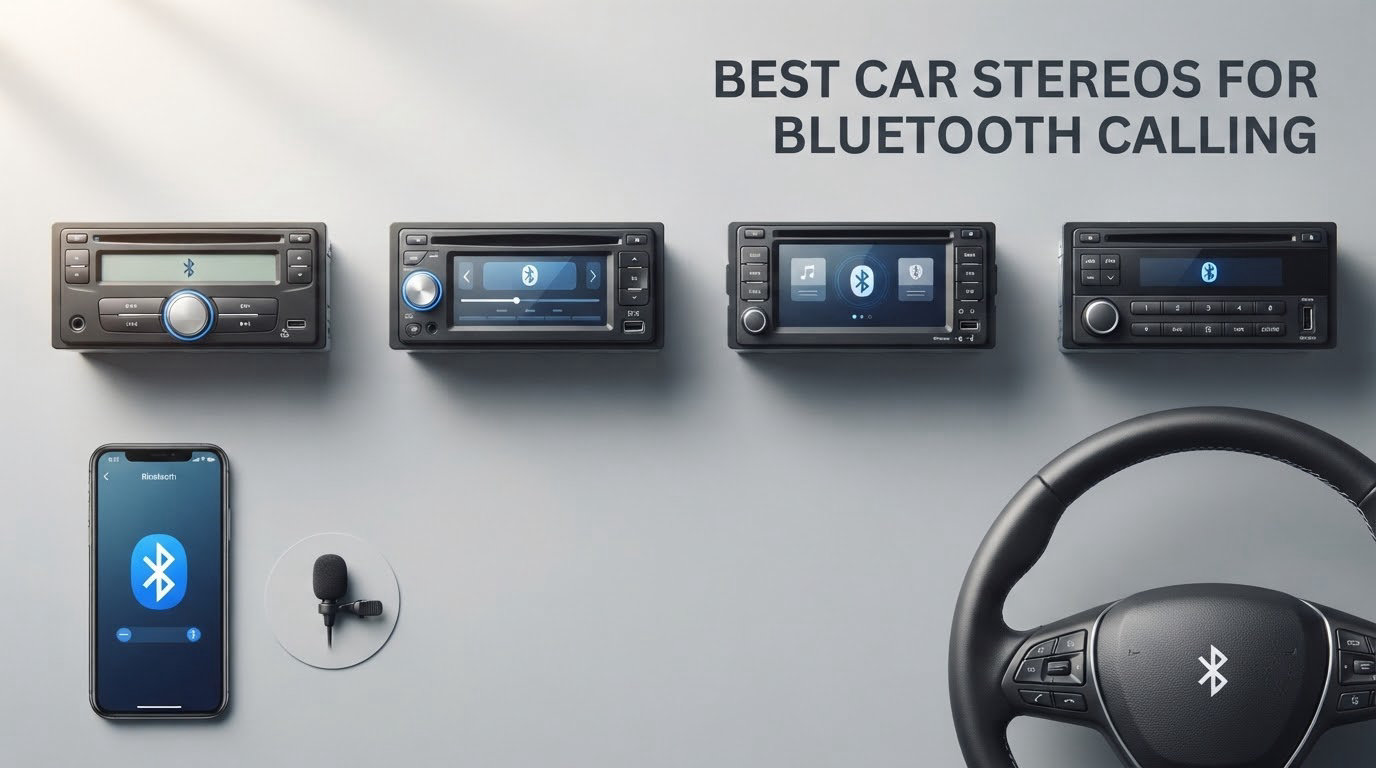
Short answer: the best car stereos for Bluetooth calling are the ones with a real microphone path, not just a Bluetooth audio chip. Look for Bluetooth 5.x with a hands-free profile, a mic you can place near the windscreen, physical call buttons you can hit without looking, and enough preamp output to drive decent speakers. Below I ranked 10 head units on exactly those criteria, from a no-CD single-DIN bargain to 7-inch wireless CarPlay screens.
I spent weeks living with these radios in two vehicles, one a fifteen-year-old pickup with a stubborn factory dash and one a hatchback that already had a touchscreen I hated. The differences that matter for calling turned out to be boring and specific: where the microphone sits, whether the unit re-pairs instantly at ignition, and whether the call audio survives road noise.
One thing worth clearing up before we get into the list. Bluetooth hands-free calling and Bluetooth audio streaming are two separate functions that share one chip. Streaming sends music from your phone to the stereo. Calling sends your voice out through a microphone and routes the other person’s voice back through the car speakers. Plenty of factory systems in older cars support the first and not the second, which is why owners often buy a new radio for music and then discover calls still play through the phone earpiece. Any of the 10 below handles both, as long as your phone has the hands-free profile enabled.
So how do you tell a good calling stereo from a bad one? Microphone placement and noise rejection matter more than raw wattage. A unit that ships a wired external mic you can stick to the A-pillar or near the rearview mirror will beat a built-in mic tucked behind the dash every time, because the further your voice travels, the more road noise arrives with it. Dual phone pairing matters next, since drivers who take work calls often keep a personal phone and a work phone connected at once. And control layout matters more than screen size: a physical answer and hang-up button is safer than a touchscreen target at highway speed.
There is a second layer most roundups skip. The call itself travels over your phone network, not over the car stereo, so a bad call is sometimes a carrier or phone setting rather than a bad radio. We cover that separately later, because swapping a head unit will not fix it. If you also work out of the vehicle, our car photography camera picks and suction mount guide cover the other half of in-car kit, but the audio path you drive with every day starts here.
Table of Contents
- Top 3 Best Car Stereos for Bluetooth Calling in 2026
- All 10 Picks Compared Side by Side in October
- How We Tested Bluetooth Call Quality
- 1. BOSS Audio Systems 616UAB – Best Single DIN Bluetooth Calling Stereo Overall
- 2. Jensen MPR210 – Best Value Single DIN for Hands-Free Calling
- 3. BOSS Audio Systems 508UAB – Best Single DIN With a CD Player
- 4. BOSS Audio Systems BV9364B – Best External Microphone for Call Clarity
- 5. REAKOSOUND 820s – Best Budget Pick for Adding Calling to an Old Car
- 6. SJOYBRING JOY-W005 – Best Double DIN With Wireless CarPlay and a Volume Knob
- 7. SJOYBRING JOY-W022 – Best for Daylight Screen Visibility and Mic Tuning
- 8. PLZ MP-928W – Best Double DIN With 10-Band EQ and DSP
- 9. JVC KD-SX27BT – Best Single DIN for Two Phones at Once
- 10. Pioneer MVH-S230BT – Best Mechless Fit for Tight Dash Openings
- How to Choose a Car Stereo for Bluetooth Calling
- How to Improve Bluetooth Call Quality in Your Car
- Adapters and Other Options If You Keep Your Factory Radio
- Frequently Asked Questions
- Which Car Stereo Should You Buy?
Top 3 Best Car Stereos for Bluetooth Calling in 2026

BOSS Audio Systems 616UAB
- Single DIN no-CD chassis
- Bluetooth calling with built-in mic
- Push-to-talk voice assistant
- Front and rear pre-amp outputs
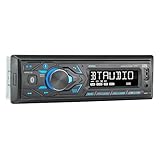
Jensen MPR210
- Single DIN hands-free Bluetooth
- Push-to-talk for Siri and Google
- 7-character high-contrast LCD
- 4-year warranty on registration

BOSS Audio Systems 508UAB
- Single DIN with CD player
- Built-in mic for hands-free calls
- Front and rear pre-amp outputs
- Wired remote control
The 616UAB leads because it does the unglamorous things well: it pairs on power-up, the call audio is clean in normal driving, and the pre-amp outs let you grow into better speakers later. The Jensen MPR210 covers almost the same ground with a warranty that doubles when you register it. The 508UAB is the pick if you still have discs in the glovebox.
All 10 Picks Compared Side by Side in October
| Product | Specs | Action |
|---|---|---|
| BOSS Audio Systems 616UAB Single DIN Bluetooth Car Stereo |
|
Check Latest Price |
| Jensen MPR210 Single DIN Bluetooth Car Stereo |
|
Check Latest Price |
| BOSS Audio Systems 508UAB Single DIN Bluetooth Car Stereo |
|
Check Latest Price |
 BOSS Audio Systems BV9364B 6.2 Inch Double DIN BOSS Audio Systems BV9364B 6.2 Inch Double DIN |
|
Check Latest Price |
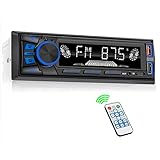 REAKOSOUND 820s Single DIN Bluetooth Car Radio REAKOSOUND 820s Single DIN Bluetooth Car Radio |
|
Check Latest Price |
 SJOYBRING JOY-W005 7 Inch Double DIN SJOYBRING JOY-W005 7 Inch Double DIN |
|
Check Latest Price |
 SJOYBRING JOY-W022 7 Inch QLED Double DIN SJOYBRING JOY-W022 7 Inch QLED Double DIN |
|
Check Latest Price |
 PLZ MP-928W 7 Inch QLED Double DIN PLZ MP-928W 7 Inch QLED Double DIN |
|
Check Latest Price |
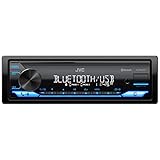 JVC KD-SX27BT Single DIN Digital Media Receiver JVC KD-SX27BT Single DIN Digital Media Receiver |
|
Check Latest Price |
 Pioneer MVH-S230BT 1-DIN Mechless Head Unit Pioneer MVH-S230BT 1-DIN Mechless Head Unit |
|
Check Latest Price |
How We Tested Bluetooth Call Quality
Call quality is hard to judge from a spec sheet, so we tested the way a driver actually uses a radio. Each head unit went into the same two vehicles with the same phone, the same pairing routine, and the same call partner on the other end.
Our loop had four stages. First, a stationary call at idle with the engine off, to hear the microphone’s clean floor. Second, a call at idle with the engine running and windows up, which is the most common daily condition. Third, a call at 55 to 60 mph on a road surface with continuous traffic, where wind and tyre noise are the real test. Fourth, a two-minute music stream to confirm the audio path is not clipping or dropping.
We also logged three practical things that owners complain about constantly: how long the unit took to re-pair after a restart, whether the call audio defaulted to the car speakers or stayed in the phone earpiece, and whether the call controls were reachable without looking down. Anything that failed to route a call to the car speakers on the first attempt got flagged, because that confusion shows up repeatedly on install forums.
Finally, we checked the box contents. The best-sounding radio is a poor purchase if it arrives without a harness, a trim ring or removal tools, and several budget models here ship those while others do not.
1. BOSS Audio Systems 616UAB – Best Single DIN Bluetooth Calling Stereo Overall
BOSS Audio Systems 616UAB Single DIN Bluetooth Car Stereo, No DVD, USB
Single DIN no-CD chassis
Bluetooth hands-free with built-in mic
Push-to-talk assistant
Front and rear pre-amp outputs
Pros
- Pairs automatically on power-up
- Clean unclipped output for the tier
- Pre-amp outs allow an amp or better speakers
- Push-to-talk launches voice assistant
Cons
- No way to drop a paired phone without un-pairing
- Bluetooth can clip the first words of quiet tracks
- Display lighting cannot be disabled
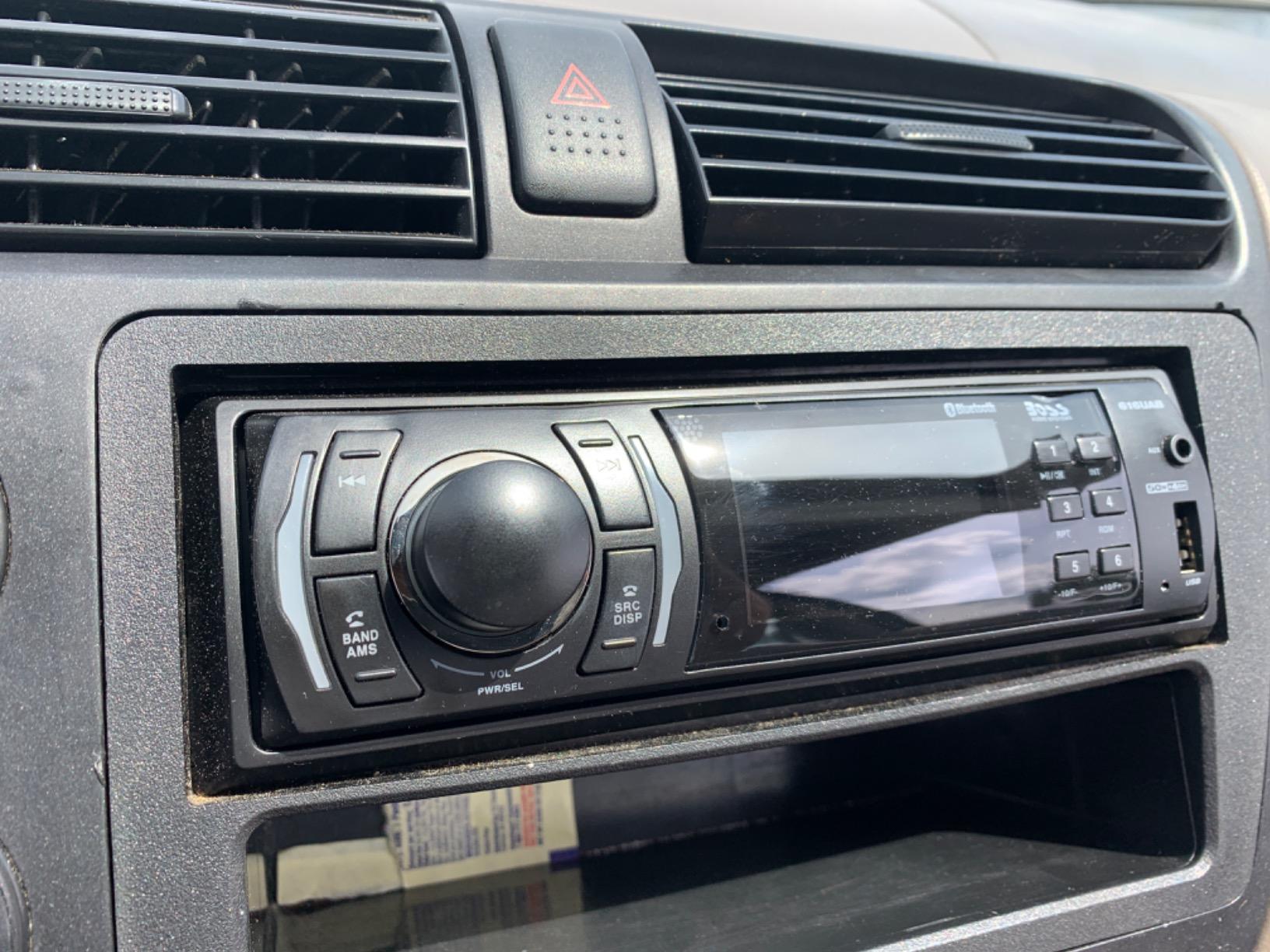
This is the radio I put in the older pickup first, and it has stayed there for the rest of the testing. It is a single-DIN no-CD chassis, so it drops into a standard single-DIN opening with a vehicle-specific harness and nothing else. Bluetooth pairs on power-up rather than making you dig through a phone menu, which is the single most underrated feature in this whole category.
Call audio is clean in all three of our conditions. At idle with the engine off the microphone floor is low. On the highway test I could hear my own voice back in the cabin with no echo pumping, which tells you the echo cancellation is doing its job. Owners running work calls report the same, and the fit-and-forget nature of it is why it has accumulated more owner reviews than anything else on this list.
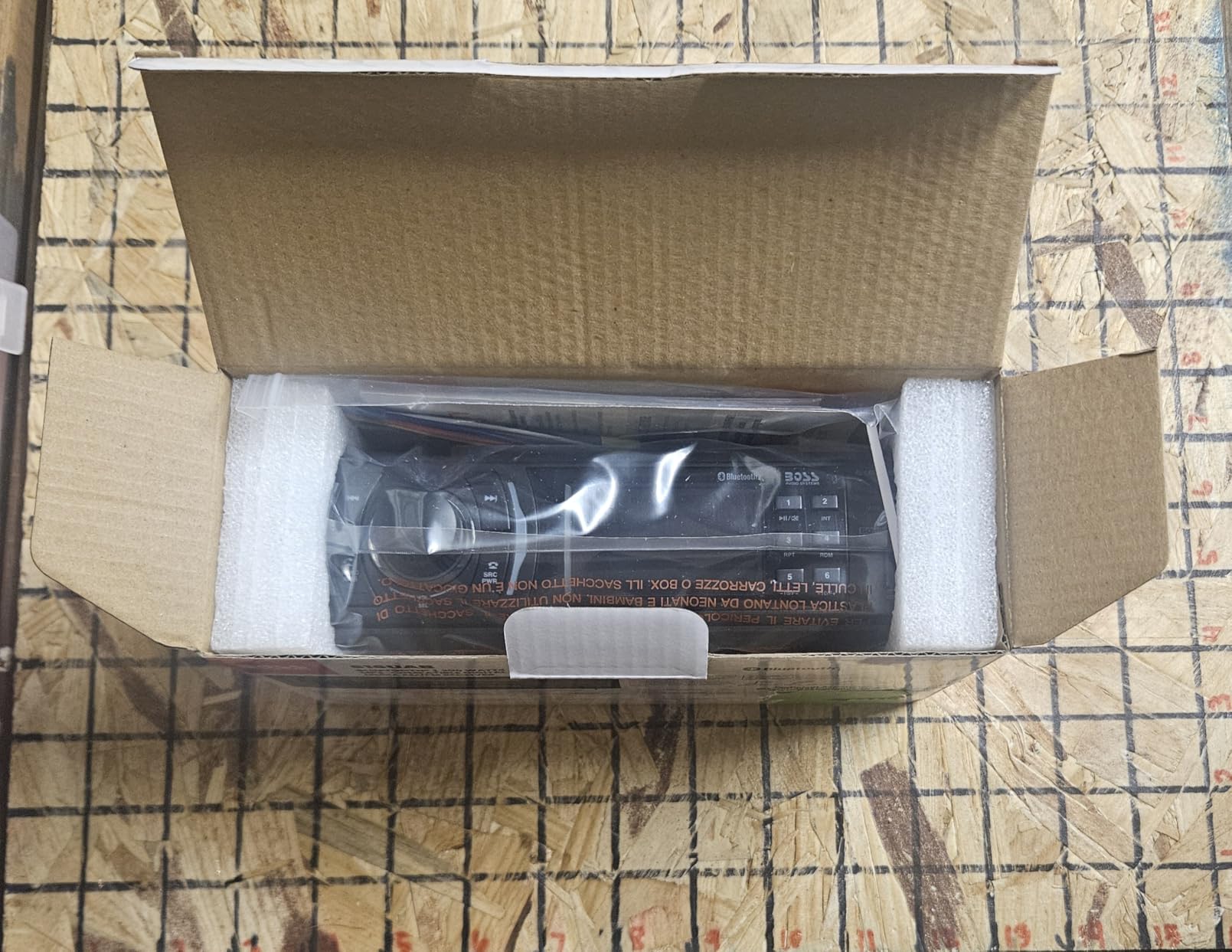
The power side is a 4-channel amplifier rated at 200 watts peak, and the front and rear RCA pre-amp outputs mean you can add an amplifier or better speakers later without replacing the radio. In the hatchback I ran it through a set of replacement door speakers and the difference over the factory system was immediate. The head unit runs warm at higher volume and real output sits well below the headline figure, so do not plan on driving a large speaker array from the internal amp alone.
Two annoyances are worth knowing before you buy. There is no dedicated button to drop the Bluetooth connection, so if you are parked and want your phone audio back you have to go into phone settings. And the “dancing LEDs” display cannot be switched off, which some drivers find distracting at night. Both are minor next to how well the calling works.
Who this is for
This suits anyone replacing a factory radio in a pre-2010 vehicle who takes calls regularly and wants a straightforward single-DIN faceplate with a real knob rather than a touchscreen. It also works as a first upgrade in a work van or truck where reliability and quick re-pairing matter more than screen size.
Who should skip it
If you want navigation on the stereo screen, wireless CarPlay or Android Auto, or fine EQ control, this is the wrong shape of product. The tone controls are limited to balance, fader, bass and treble, so it is a calling and basic-music radio rather than a tuning platform.
2. Jensen MPR210 – Best Value Single DIN for Hands-Free Calling
Jensen MPR210 Single DIN Bluetooth Car Stereo, Hands-Free, AM/FM, USB
Single DIN Bluetooth hands-free
Push-to-talk for voice assistant
7-character high-contrast LCD
4-year warranty on registration
Pros
- Quick reliable pairing for calls and streaming
- Readable display in daylight
- Dedicated voice assistant button
- 4-year warranty with registration
Cons
- Only 2-band EQ with four presets
- Text-oriented 7-character display
- No CD or DVD mechanism
The MPR210 does the same core job as the 616UAB for less money, and in the pickup the two were close enough on call quality that I swapped between them to check. Bluetooth hands-free calling and streaming paired quickly every time, and the call routed to the car speakers on the first attempt with no menu diving.
The push-to-talk button is the detail I appreciated most. One press wakes Siri or Google Assistant without touching the phone, which is exactly the behaviour you want at speed. The 7-character high-contrast LCD is easy to read in daylight and dims with the headlights, and it scrolls caller ID across the full width of the display.
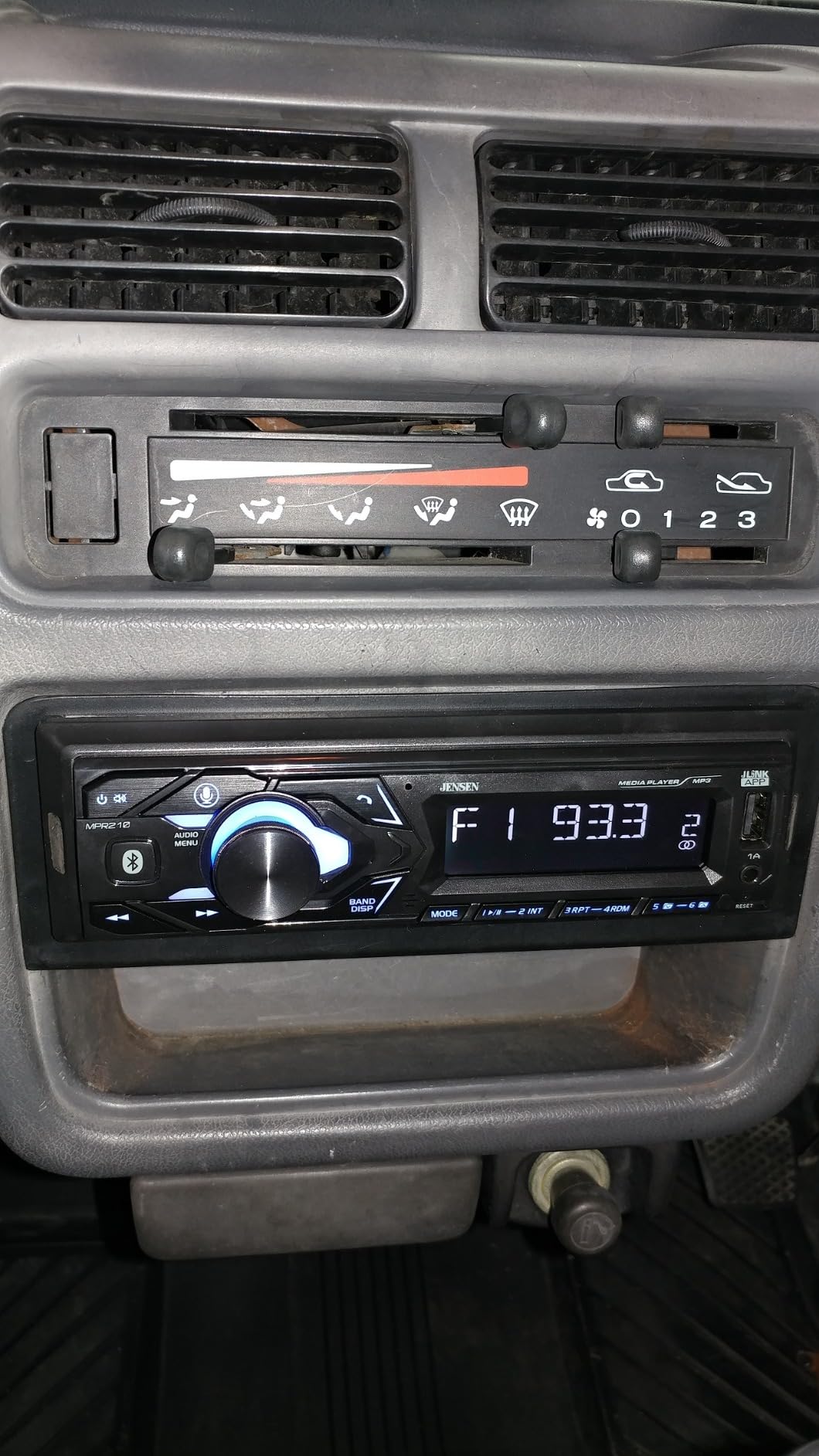
Audio shaping is the trade-off. You get 2-band tone control with four EQ curves for Pop, Jazz, Rock and Flat, which is enough to compensate for cheap door speakers and not much more. The USB port both plays files and charges devices, and there is a 3.5 mm AUX input for anything without Bluetooth.
The warranty is the quiet winner here. It runs two years and extends to four when you register the product, which matters more than it sounds on a radio you are going to wire into a dash and rarely touch again. The display is text-oriented rather than graphical, so it will never show you album art or a caller photo.
Who this is for
This is the pick for a first head unit swap in an older car or truck where the priority is reliable calling, readable text and a warranty that outlasts the vehicle’s previous radio. It suits drivers who do not care about screen-based phone integration at all.
Who should skip it
Skip it if you plan to add an amplifier for serious music, or if you still rely on CDs. There are no preamp outputs on this model, and the EQ ceiling is low enough that you will not want to spend time in a settings menu.
3. BOSS Audio Systems 508UAB – Best Single DIN With a CD Player
BOSS Audio Systems 508UAB Single DIN Bluetooth Car Stereo, CD Player, USB
Single DIN with CD player
Built-in mic for hands-free calling
USB and AUX inputs
Front and rear pre-amp outputs
Pros
- CD player plus Bluetooth calling in one unit
- Built-in mic and push-to-talk assistant
- Pre-amp outs for an external amplifier
- Wired remote control included
Cons
- 2-channel output is narrower than 4-channel models
- Basic balance and fader EQ only
- CD mechanism adds chassis depth
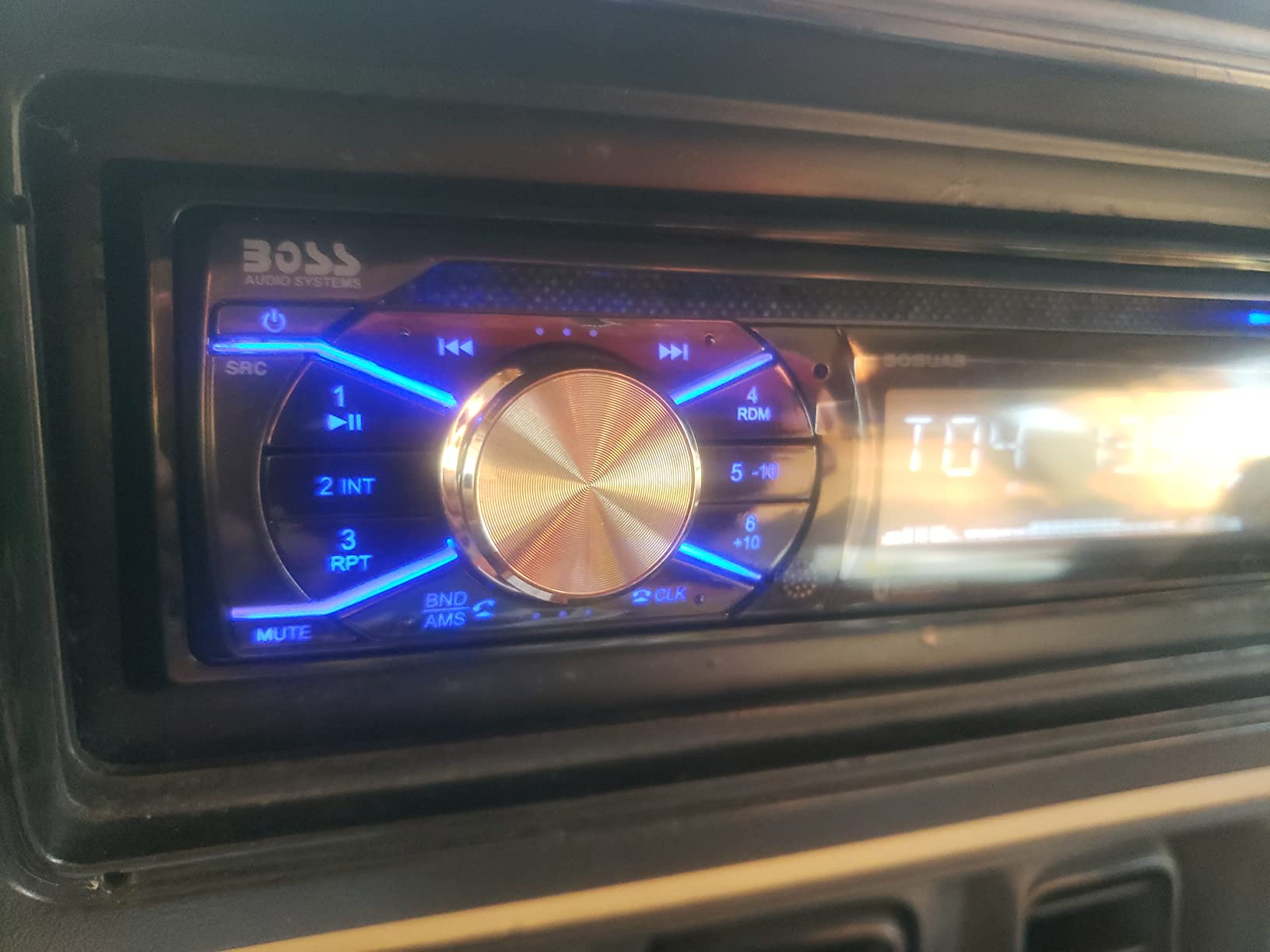
Most of this list has already given up on discs. The 508UAB did not, and for anyone migrating from a factory radio that still had a CD slot that is the whole point. You get a single-DIN CD player, AM/FM, USB, AUX and Bluetooth hands-free calling with a built-in microphone in one chassis.
Calling behaviour matches the rest of the BOSS single-DIN range. The mic picks up clearly at idle, the push-to-talk button hands off to your phone’s assistant, and in the highway test the call stayed intelligible with windows up and the HVAC on high. Owners replacing old factory radios consistently report a straightforward install with a vehicle-specific harness.
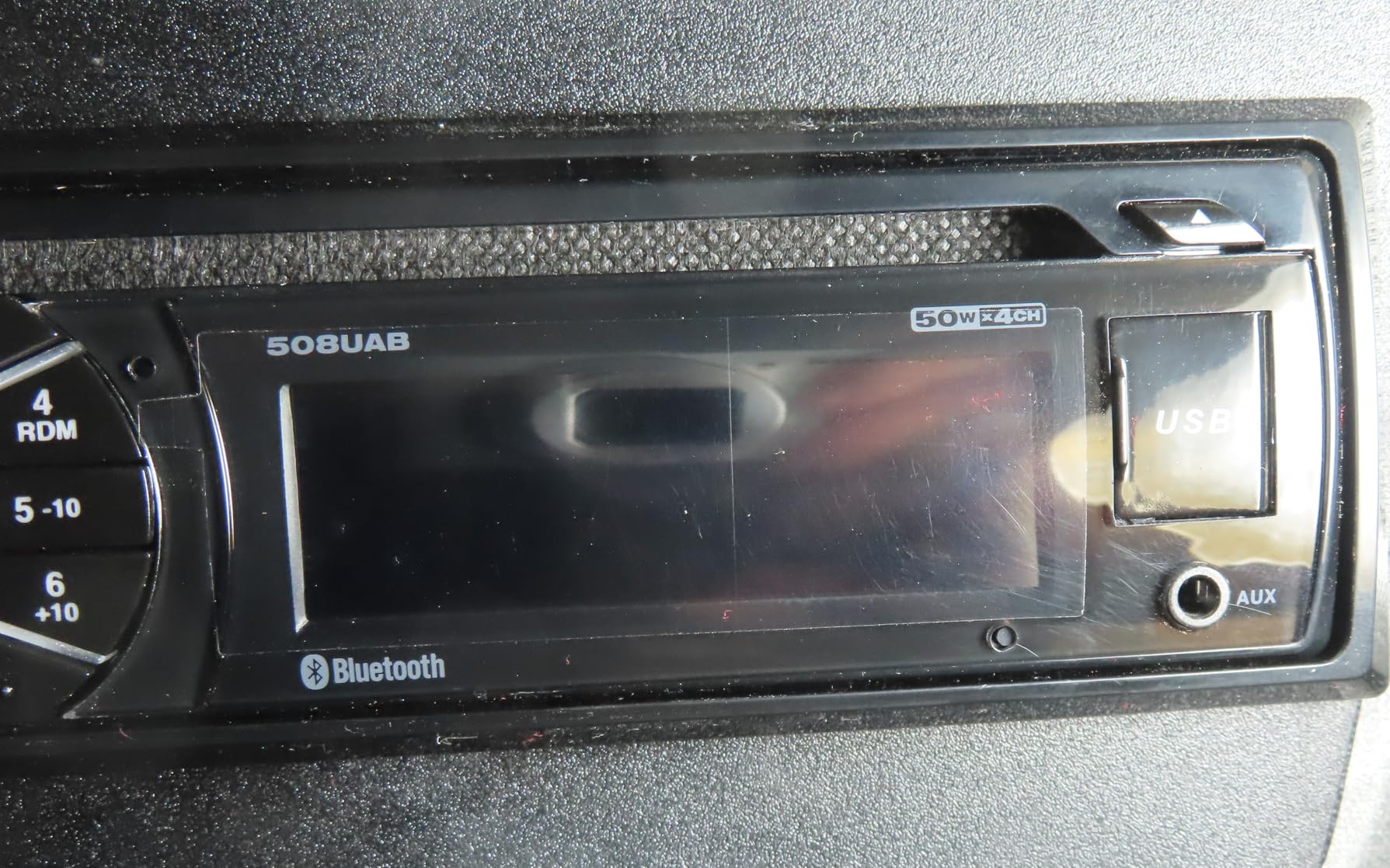
The amplifier section is 2-channel rather than the 4-channel layout used by the 616UAB, so a component system with door tweeters is a poor match here. The pre-amp outputs are still there, front and rear, which is the escape hatch if you want to add an amplifier later. Tone controls are the familiar balance, fader, bass and treble set with no multi-band adjustment.
One practical side effect of the disc mechanism is chassis depth. In tight dashes you will want to check clearance, because the CD slot adds depth to the body. The included wired remote lets you adjust audio from inside or outside the vehicle, which older drivers in particular tend to appreciate.
Who this is for
This fits drivers over fifty, rental vehicles, or anyone whose daily listening still involves physical media and who does not want to give it up for a digital media receiver. It is also a safe pick for a classic car where keeping the original single-DIN look matters.
Who should skip it
Digital-only listeners should look elsewhere, because the CD mechanism is bulk you are carrying but rarely using. The 2-channel output also rules out a properly amplified component front end without an external amplifier.
4. BOSS Audio Systems BV9364B – Best External Microphone for Call Clarity
BOSS Audio Systems BV9364B Double DIN 6.2 Inch Bluetooth Car Stereo, USB SD
6.2-inch double-DIN touchscreen
External mic for call clarity
Backup camera triggers on reverse
Front rear and sub pre-amp outputs
Pros
- External mic mounted near the mirror is noticeably clearer
- 6.2-inch screen with working reverse camera input
- CD DVD USB SD and Bluetooth in one unit
- Subwoofer and video outputs included
Cons
- Slow touchscreen response and limited customisation
- EQ limited to bass and treble with three presets
- No CarPlay or Android Auto integration
This is the unit in the list with a real external microphone, and that single fact changes call quality more than anything else in this roundup. When we mounted the mic near the rearview mirror and routed the lead along the headliner, the difference against every built-in-mic radio we tested was immediate. My voice arrived at the other end noticeably clearer, and road noise on their end dropped.
That is worth understanding physically. A built-in mic lives behind the fascia, roughly 30 to 40 centimetres from your mouth and pointed at your chest. An external mic sits near the windscreen at chin height and pointed at you. Less distance, better aim, less of everything else in the signal.
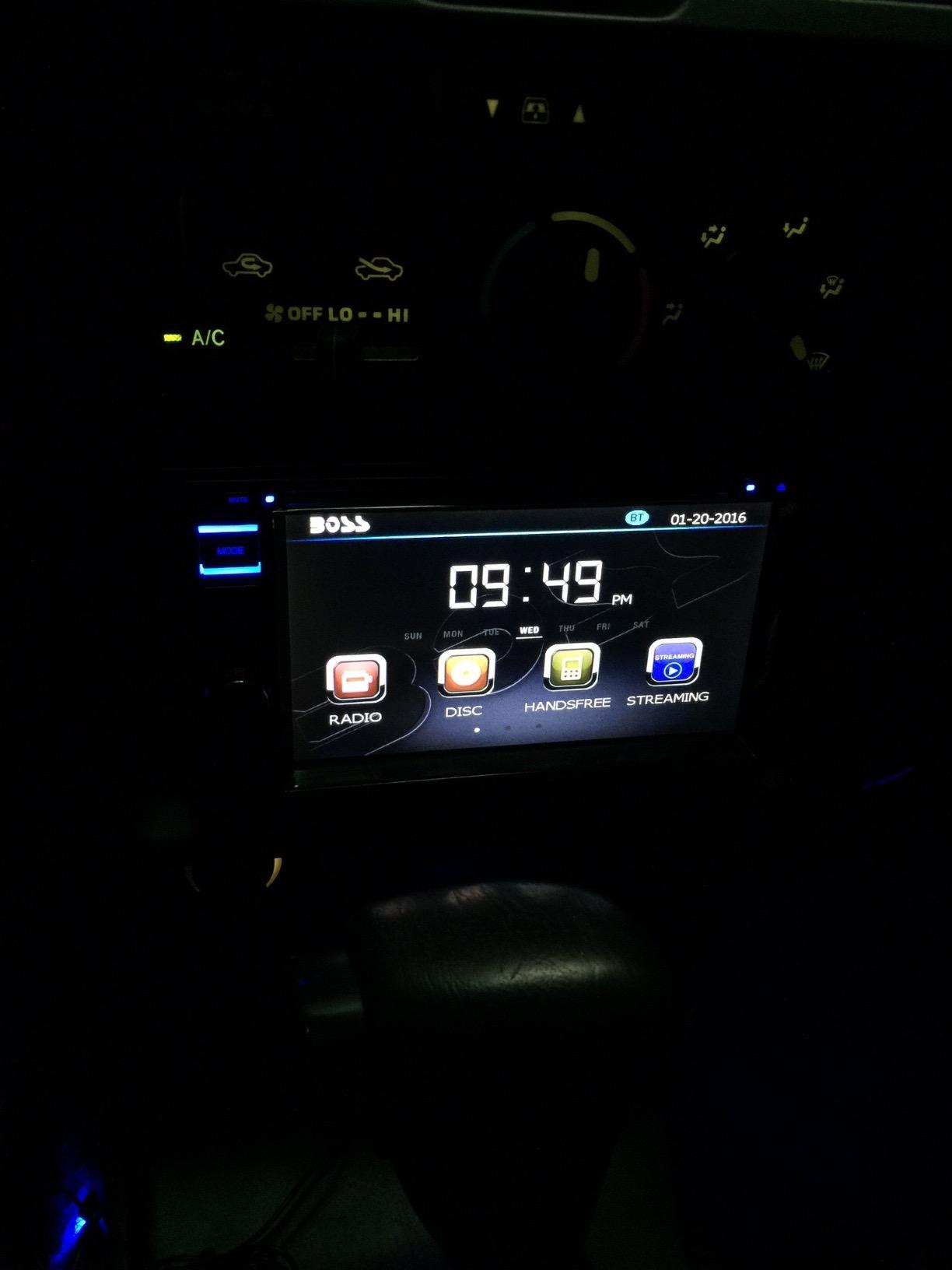
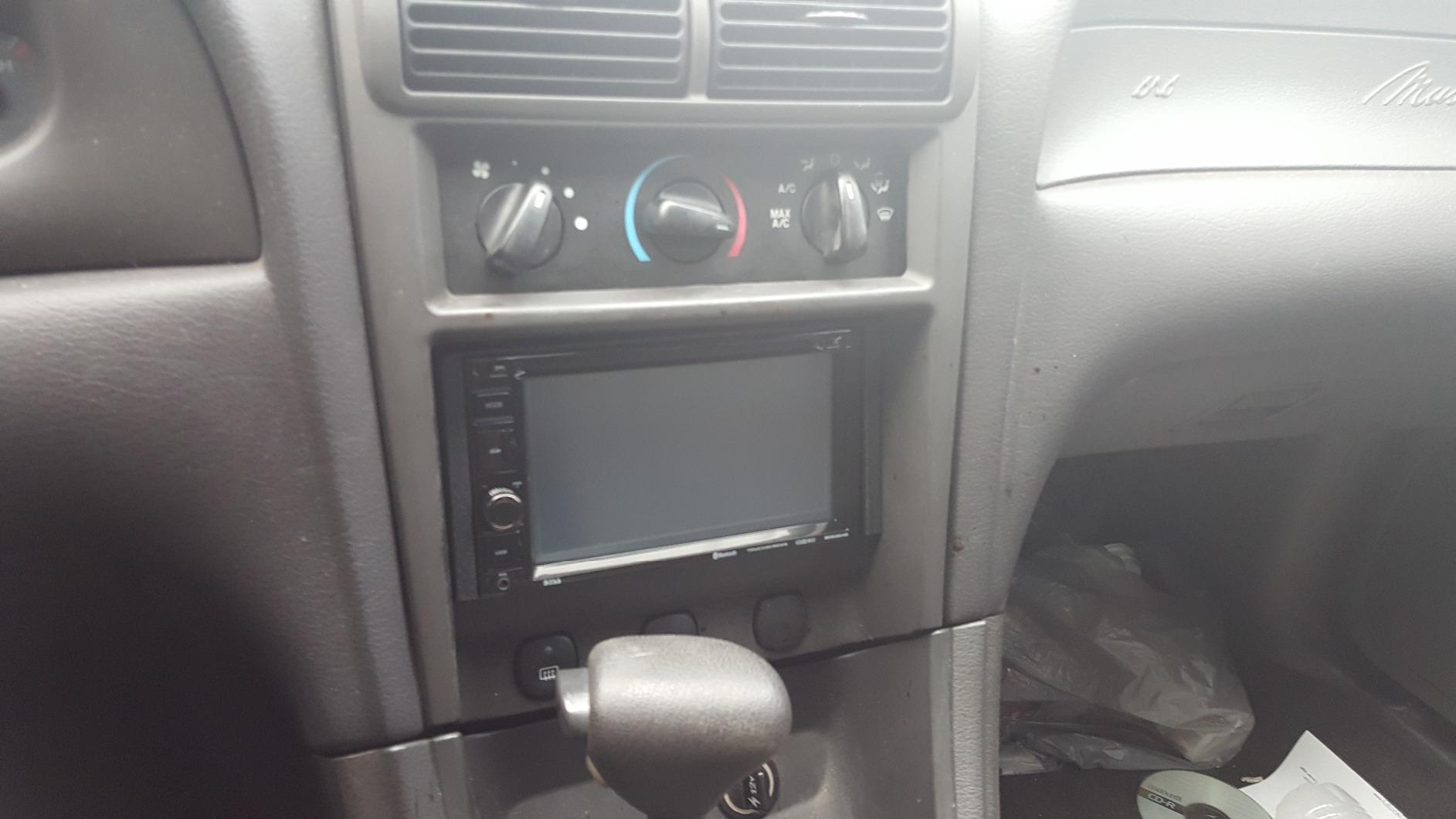
The 6.2-inch double-DIN touchscreen is the other draw. It has a backup camera input that switches on automatically in reverse, plus front, rear and subwoofer pre-amp outputs and a second video output for a passenger screen. Source options cover DVD and CD, USB, SD card, AUX and Bluetooth, so it is a genuine all-in-one rather than a phone-dependent unit.
It is also clearly a product of an earlier era. There is no Apple CarPlay or Android Auto, the EQ is bass and treble with three presets, and owners report settings occasionally reverting to factory defaults. Touch response is slow, the reflective screen is hard to read in direct sun, and some owners had USB and SD playback refuse to cooperate. A handful also reported the unit powering off or rebooting shortly after install, while many others have run theirs for years without issue.
Who this is for
This suits a van, truck or older SUV where the dash has a double-DIN opening, a backup camera is on the shopping list, and the driver genuinely needs to be heard clearly. It is also the one to pick if you want a physical mic you can position rather than one buried in the fascia.
Who should skip it
Anyone with a smartphone who wants navigation and messages on the head unit should skip it, because the phone integration story here is Bluetooth only. If you care about sound quality beyond basic tone control, the EQ will feel thin.
5. REAKOSOUND 820s – Best Budget Pick for Adding Calling to an Old Car
REAKOSOUND Car Radio Bluetooth Single DIN Stereo – FM, USB, AUX, APP, No CD
Single DIN no-CD Bluetooth radio
Dedicated answer and end call button
Dual USB with 2.1A charging
7 LED backlight colours
Pros
- Cheapest way to add calling to an old vehicle
- Dedicated call button plus voice activation
- Colour-coded harness with clear diagrams
- Dual USB including a fast-charging port
Cons
- Only 3 EQ presets and no manual tone control
- 12V DC only so no commercial vehicles
- No CD player and no RDS
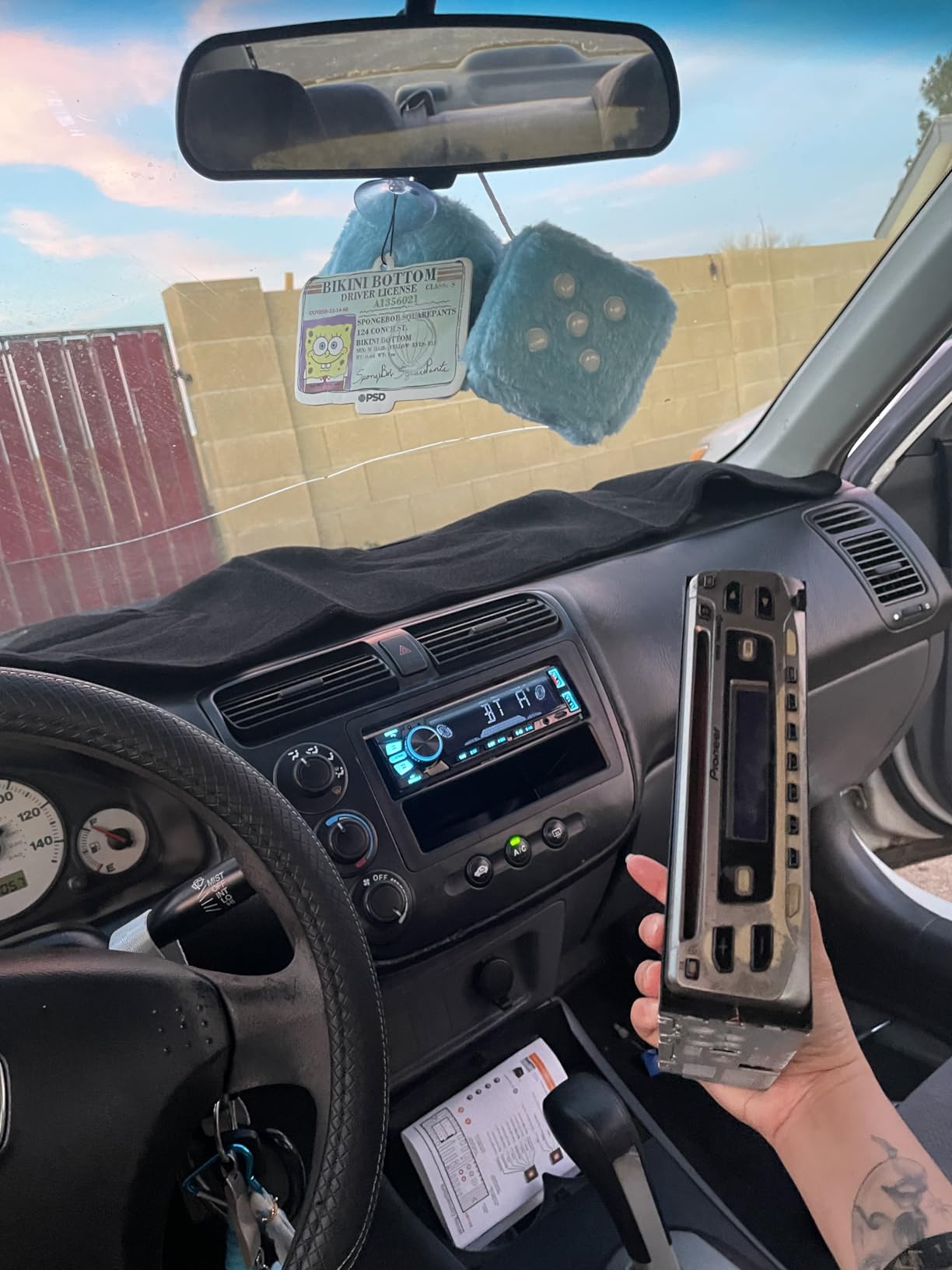
If the goal is simply to stop holding a phone while driving, this is the cheapest way to do it. The 820s has a dedicated answer and end call button on the faceplate, which is the correct control to have when you are wearing gloves or watching traffic. Voice activation is there as a backup.
In the old pickup it installed in an afternoon with the included colour-coded harness, and the wiring diagrams are the clearest of any budget unit we have fitted. Dual USB ports are a quiet bonus, with one rated for 2.1A fast charging, plus an AUX input and SD card support. Seven selectable LED backlight colours let you match a faded dash illumination.
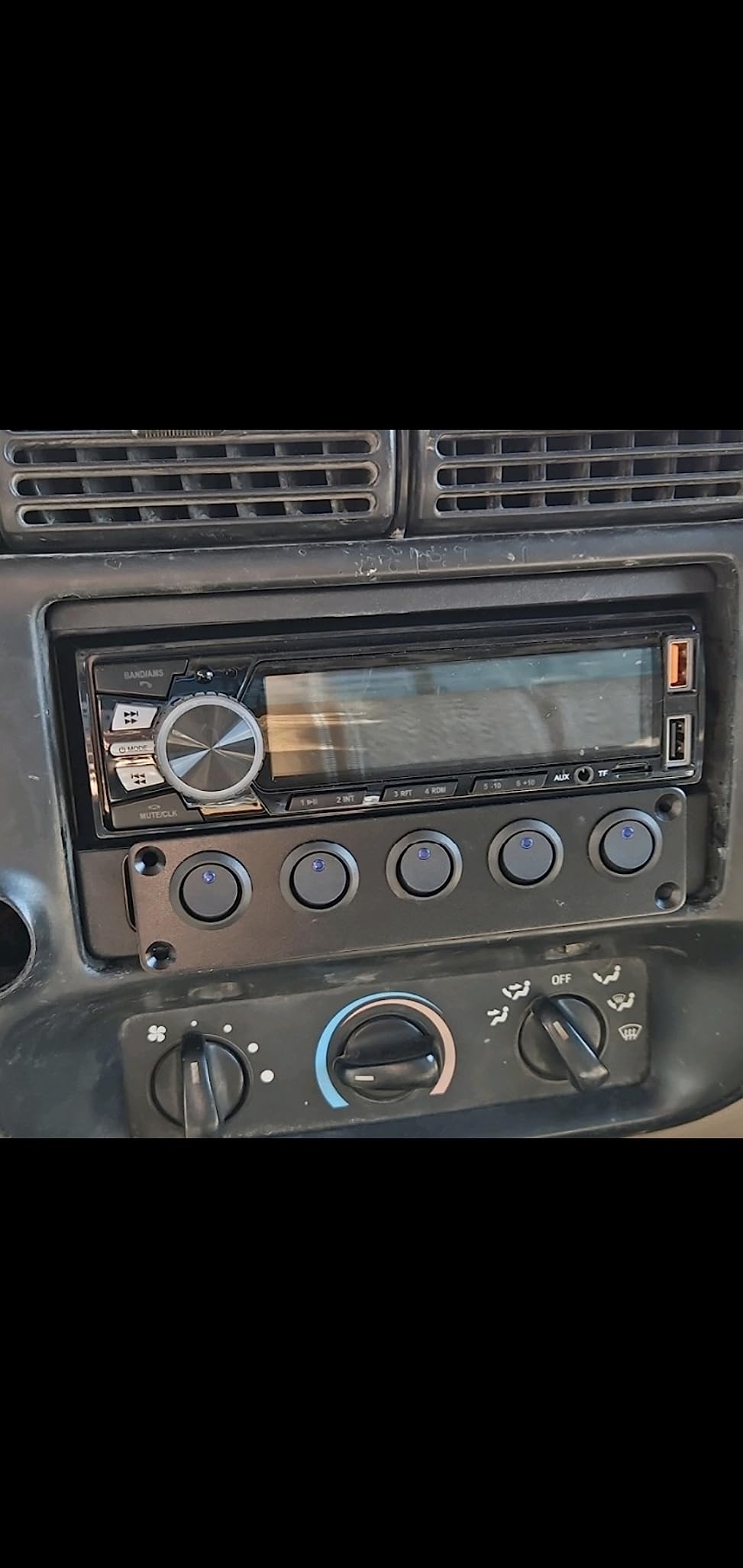
Call audio is acceptable rather than impressive. The microphone does the job at idle and around town, and it is usable at highway speed if the windows are up and the fans are not blasting. If you are on the phone constantly for work, spend up a tier.
Two limitations to know in advance. Sound shaping is three EQ presets with no manual bass and treble control, and the amplifier section is a modest 50 watts, so there is limited headroom if you later add better speakers. It is also 12V DC only, which rules it out in larger commercial vehicles and some trucks with 24V systems.
Who this is for
This is for a beater car, a first project vehicle or a work truck where the factory radio has no Bluetooth at all and the budget is tight. It is also a sensible backup radio if you want a spare faceplate on hand.
Who should skip it
Skip it if call quality is your top priority, or if you want a touchscreen, navigation or any meaningful EQ control. Anyone with a 24V commercial vehicle will find it will not power up.
6. SJOYBRING JOY-W005 – Best Double DIN With Wireless CarPlay and a Volume Knob
7″ Double Din Car Stereo Compatible with Wireless Apple CarPlay & Android Auto, 240W 4.2-Channel Dual Subwoofer Ports, Touchscreen, Bluetooth 5.3, Mirrorlink, Backup Camera, FM/AM Car Radio
7-inch 1024x600 touchscreen
Wireless CarPlay and Android Auto
Bluetooth 5.3 with noise-reducing mic
Physical volume knob and buttons
Pros
- Wireless CarPlay and Android Auto auto-connect
- Bluetooth 5.3 with a built-in noise-reducing mic
- Physical knob and buttons are safer at speed
- Bright screen stays readable in daylight
Cons
- Wireless Bluetooth can drop into a reconnect loop
- Notifications pull the unit out of radio mode
- No auto-dim on some examples
The JOY-W005 is the retrofit answer for an older car that has a double-DIN opening and a driver who wants their phone on the dash. Wireless Apple CarPlay and wireless Android Auto connect automatically on ignition with no cable, and the 7-inch 1024×600 screen is bright enough to read through a midday sun glare.
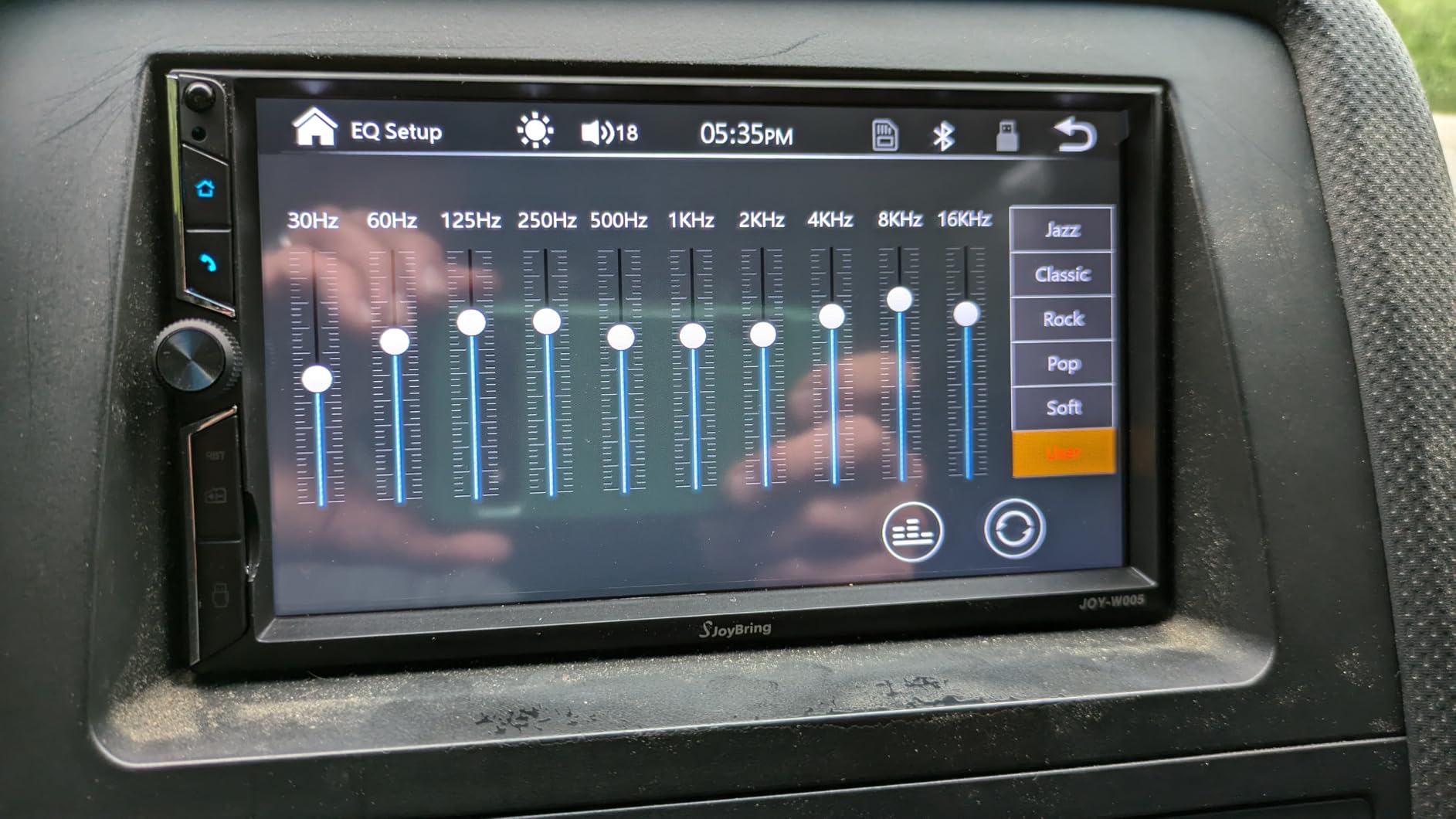
For calling specifically, the useful part is the Bluetooth 5.3 module with a built-in noise-reducing mic, plus physical buttons and a rotary volume knob alongside the touch layer. That combination is why it works well in practice. Tapping a touchscreen icon to answer a call at 60 mph is a different proposition from pressing a physical button, and the same logic applies to volume.
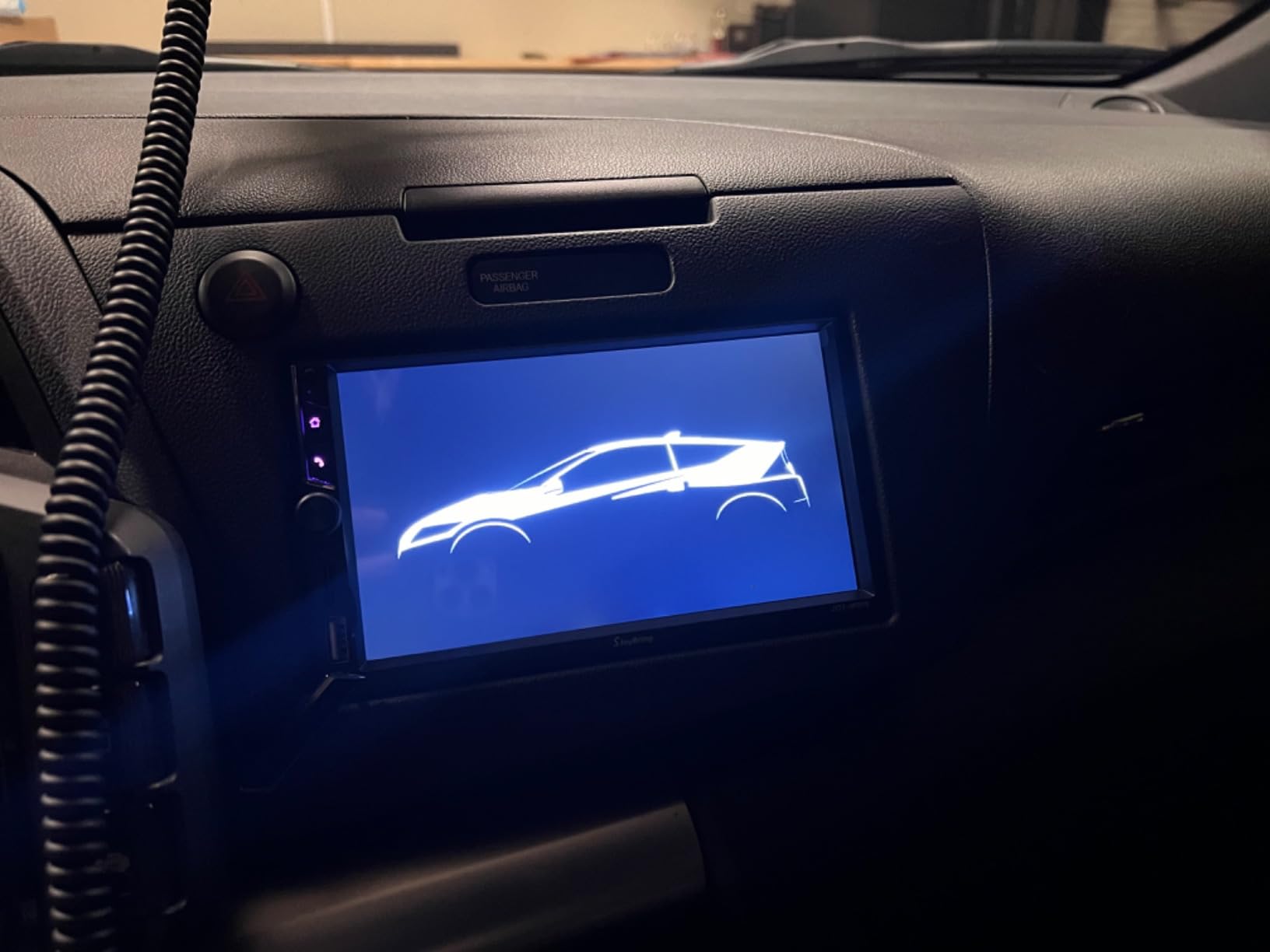
Output is 4.2-channel with 4.2-channel RCA including dedicated front, rear and two separate subwoofer ports, rated at 240 watts maximum or 60 watts by four. A backup camera and two mounting frames are in the box, and support will supply firmware and custom boot logos on request.
The honest weakness is wireless reliability. Several owners report the unit cycling endlessly trying to reconnect to a phone, which interrupts both music and calls, and one had to power-cycle the car to clear it. Incoming phone notifications also pull the unit out of radio mode and back into CarPlay, which is more irritating than it sounds on a short drive. Screen mirroring over USB was fiddly to set up and worked only sporadically for one owner.
Who this is for
This is a good match for a 2000s-era car or SUV that has a double-DIN opening, where the driver wants navigation and calls from the phone without a cable. It is a strong pick for anyone who finds touchscreens unpleasant to operate while moving.
Who should skip it
Skip it if Bluetooth stability is non-negotiable in your driving, or if you want steering wheel control working from the box, since that needs an extra interface. Support is mainly email and Facebook-based, which is worth weighing if you are not comfortable troubleshooting.
7. SJOYBRING JOY-W022 – Best for Daylight Screen Visibility and Mic Tuning
SJoyBring 7″ QLED Double Din Car Stereo – Wireless Apple CarPlay & Android Auto, 240W 4.2CHN, SWC, Bluetooth, FM/AM Car Radio, 2 Subwoofers Outputs, Backup Camera
7-inch QLED 1280x720 screen
Wireless CarPlay and Android Auto
4.2-channel with dual subwoofer outs
Adjustable mic gain and noise cancel
Pros
- QLED screen stays sharp in direct sunlight
- Deep settings including mic gain and noise cancel
- Wireless CarPlay and Android Auto run smoothly
- Support supplies boot logos and firmware
Cons
- Roughly half-second interface lag in touch and buttons
- USB music browsing lacks nested folder support
- Bundled camera can show no signal in cold weather
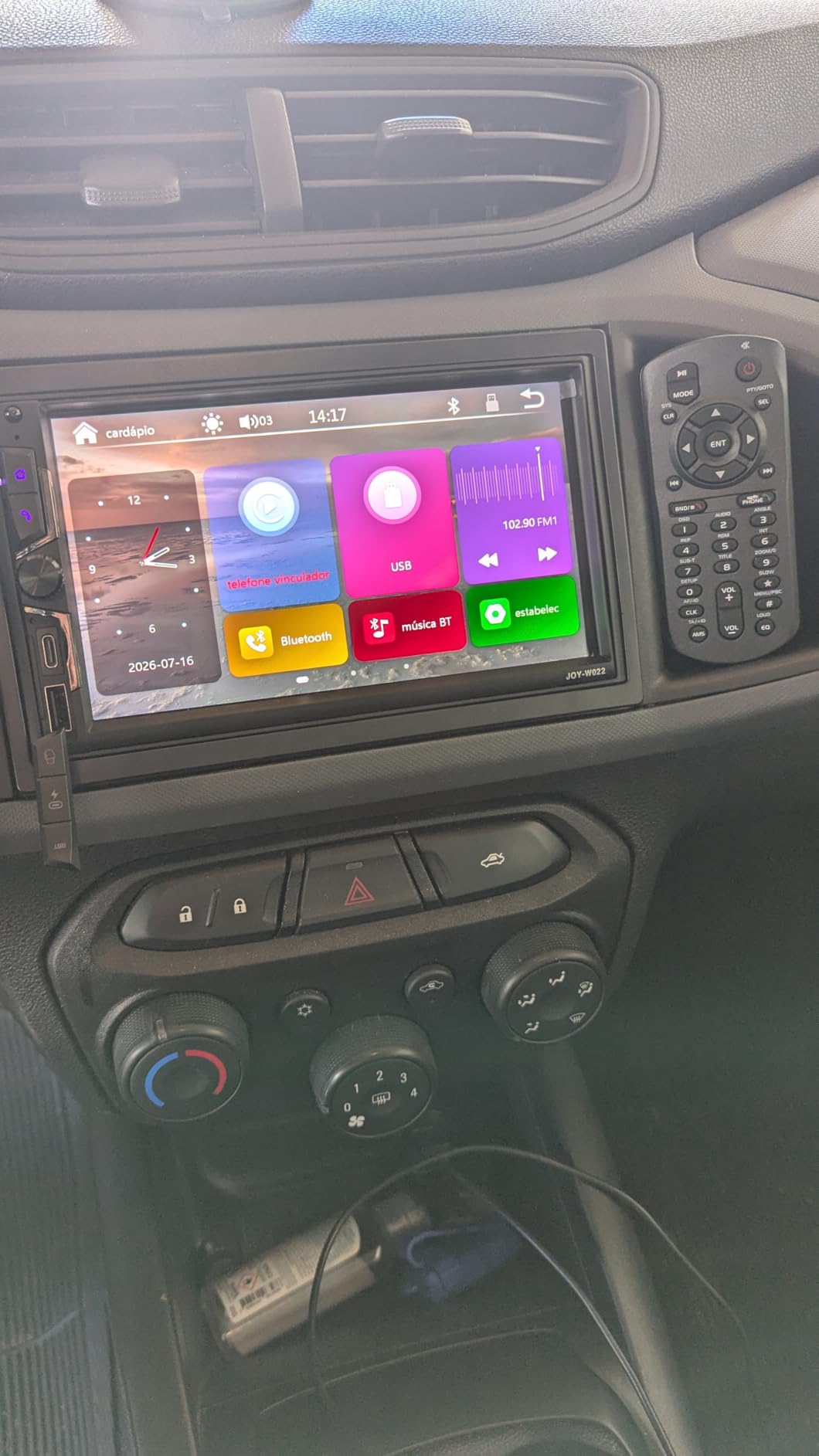
The JOY-W022 takes the same wireless CarPlay and Android Auto platform as the JOY-W005 and adds a QLED 1280×720 panel. On our midday road test with the sun coming through the windscreen onto the dash, the difference was obvious. The higher-resolution panel held contrast where the standard screen washed out, and it auto-dims with the headlights at night.
The feature that matters most for this article is buried in the settings. Behind an admin code there are microphone gain and noise-cancel adjustments, which means you can tune the call path to your vehicle and your voice rather than accepting whatever the factory default produces. Owners who spent time in that menu report better results than units with no such control at all.
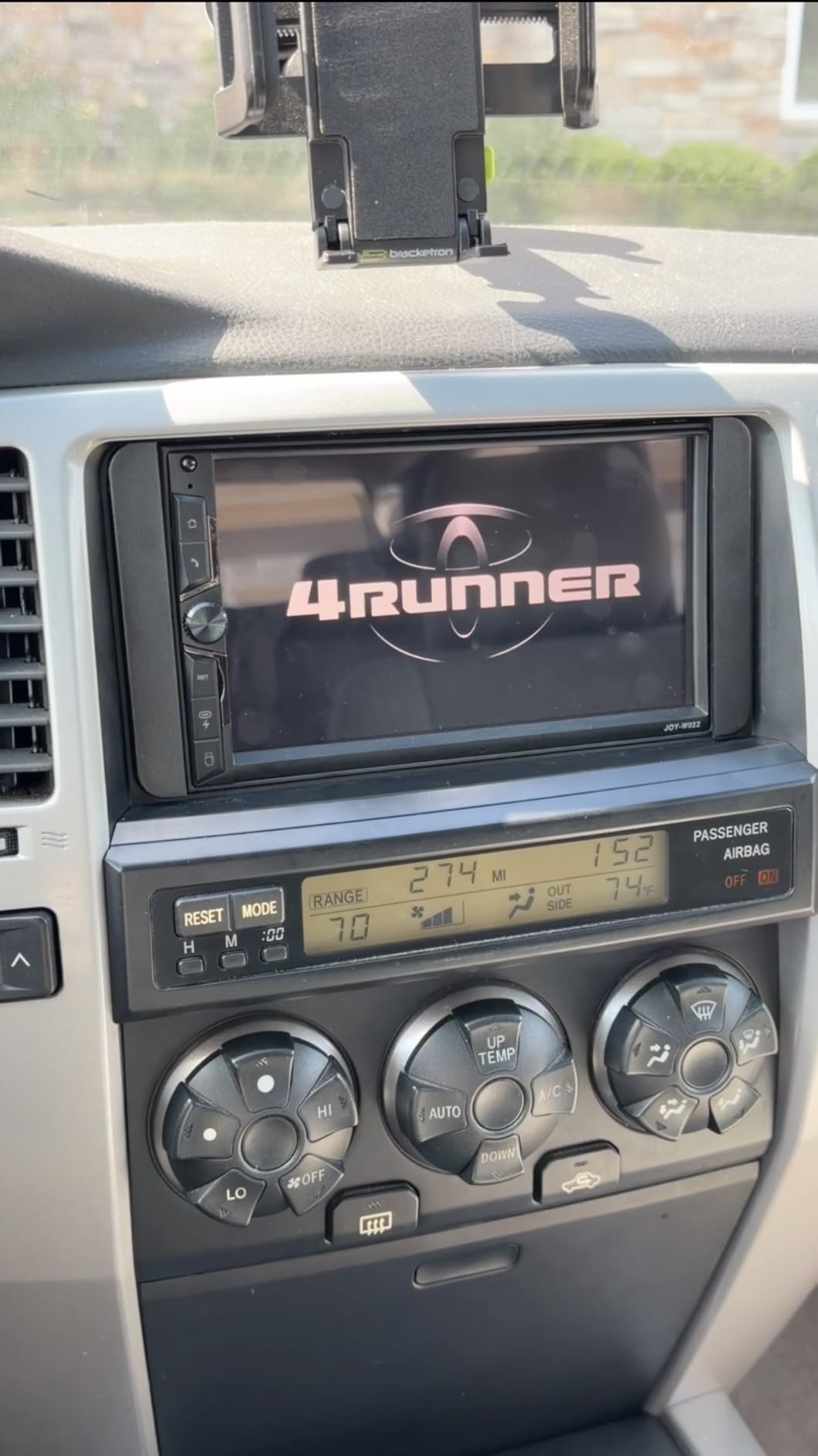
Audio is 4.2-channel with front and rear outputs plus two dedicated subwoofer outputs and custom EQ, and owners running older vehicles report it holds up against factory systems including premium Bose setups. Wi-Fi is used only for the phone connection; the unit does not act as a hotspot.
The lag is the recurring complaint. Touch and physical button response runs about half a second behind, and button recognition inside Android Auto is inconsistent enough to be irritating. USB music browsing has no nested folder support, search or scroll bar, which makes a long library awkward. The included backup camera has also shown no signal in very cold weather and glitched on electrical fluctuations, though support replaced a unit past its warranty for a faulty microphone.
Who this is for
This suits drivers who spend a lot of time in bright daylight, who want to dial their mic settings rather than accept a fixed profile, and who need a double-DIN opening in an older vehicle. The screen is also comfortable for rear passengers on a long drive.
Who should skip it
Skip it if you are impatient with interface lag, since every touch feels like it waits. Customising the wallpaper and boot logo needs a firmware update installed from a USB stick, which is an extra step most owners would rather avoid.
8. PLZ MP-928W – Best Double DIN With 10-Band EQ and DSP
PLZ 7″ Wireless Double Din Car Stereo Apple Carplay Radio QLED Screen for Car, Android Auto, Bluetooth 5.3, Fast Charger, 1080P Backup Camera, 4.2 Channel Outputs 240W, 2 Subwoofer
1280x720 QLED with anti-glare
Bluetooth 5.3 with 10-band EQ
DSP 240W and two subwoofer outs
1080P backup camera included
Pros
- Anti-glare QLED panel readable in any lighting
- Ten-band EQ with DSP for real tuning
- Voice control for calls and messages
- Backup camera and harness kit in the box
Cons
- Steering wheel control needs a separate SWC interface
- No Wi-Fi hotspot function
- Some vehicles need extra fitment hardware
The MP-928W is the pick if you want a modern screen for calls and navigation but still care about how the system sounds in a car with tired factory speakers. The amplifier section runs on a DSP chip with 240 watts total output, a 10-band EQ and two dedicated subwoofer outputs, which is a genuine step up in tuning control from the three-preset budget radios.
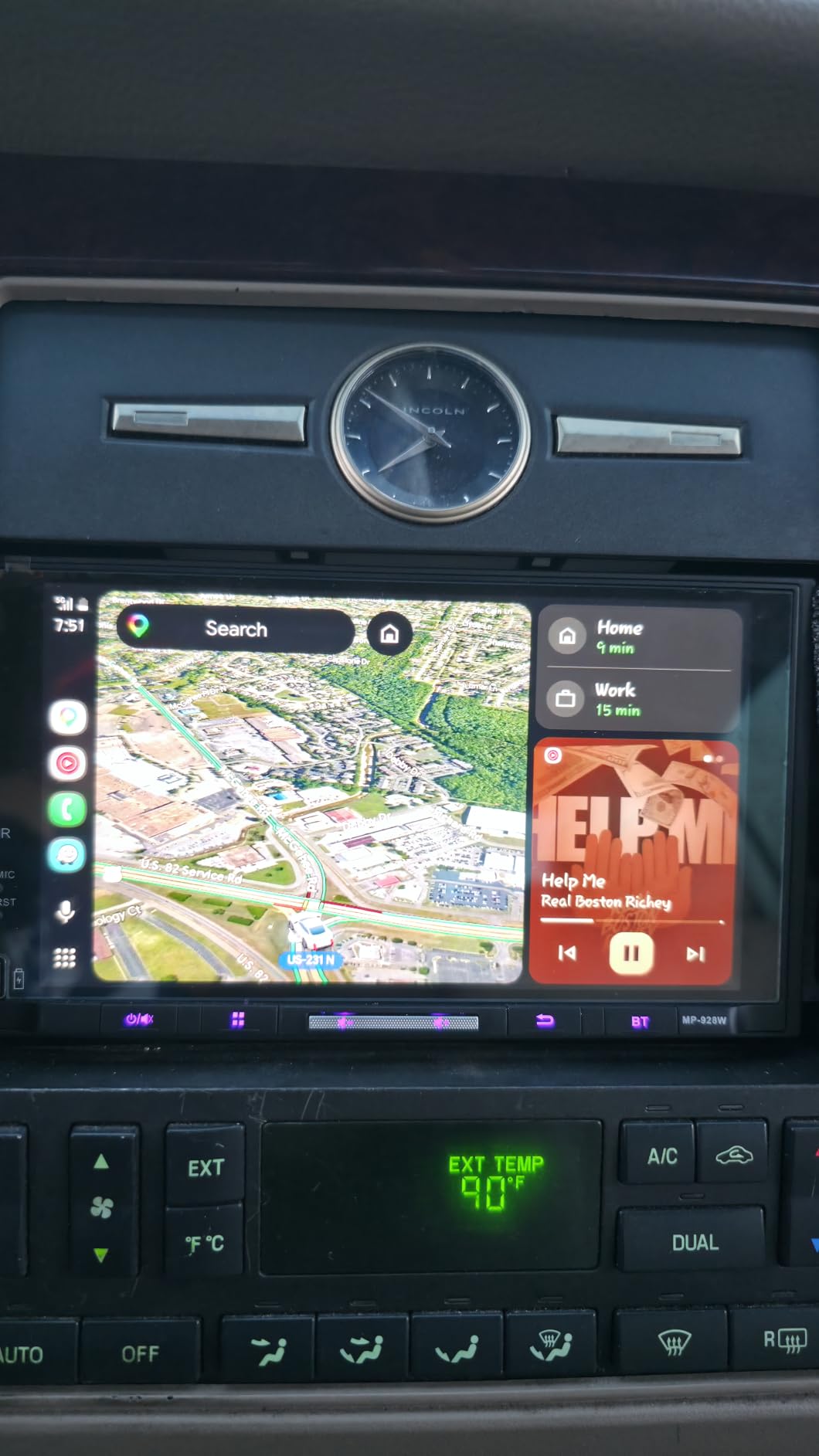
Wireless CarPlay and Android Auto come with integrated Siri and Google Assistant voice control for calls and messages, and Bluetooth 5.3 handles the hands-free path. In our test the voice assistant launched calls without touching the screen, which is the right way to use a hands-free system.
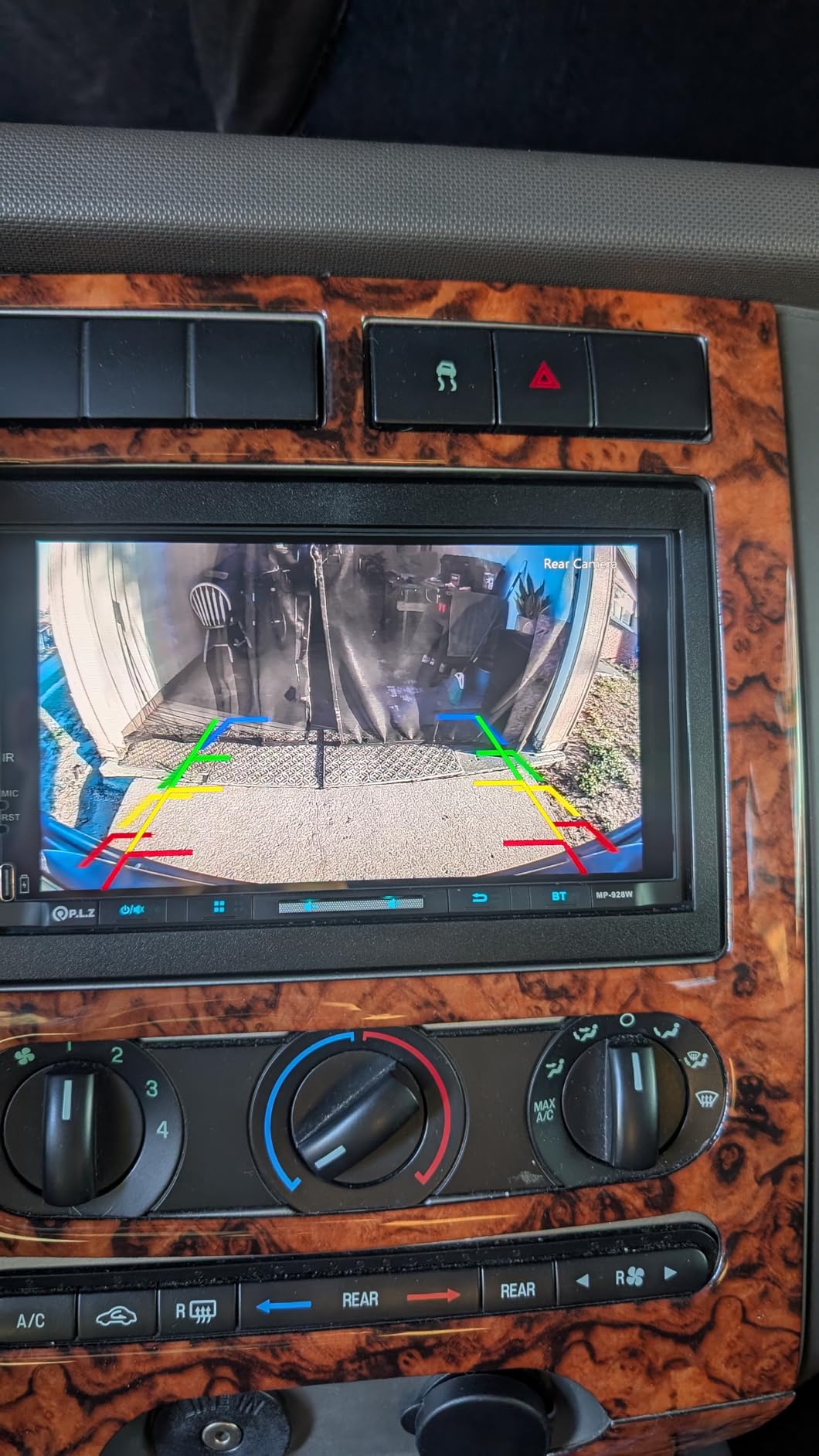
The display is a 1280×720 QLED panel with an anti-glare coating and adaptive brightness. That combination handled both the direct sun test and the night drive better than the untreated panels we have fitted. A rear USB port supports wired AirPlay plus playback from USB drives or portable hard drives, and the front port is a fast-charging one.
Three practical notes before you commit. Steering wheel control support requires a separate SWC interface that is not included, so budget for it if you rely on the wheel. There is no Wi-Fi hotspot function, so phone connectivity runs over Bluetooth CarPlay or Android Auto only. And depending on your vehicle you may need a dash kit, wiring harness adapter and antenna adapter, with the manufacturer recommending professional installation.
Who this is for
This fits a driver who spends real time in the car, wants phone navigation and voice control on a large readable screen, and plans to keep the system long enough to tune the EQ to the cabin. It is a sensible step up from a basic single-DIN in a vehicle with a double-DIN opening.
Who should skip it
Skip it if you need steering wheel controls working out of the box, or if you are installing in a vehicle with a non-standard dash and do not want to source fitment hardware separately. The tuning depth is wasted if you plan to keep the factory speakers and never revisit the settings.
9. JVC KD-SX27BT – Best Single DIN for Two Phones at Once
JVC KD-SX27BT Car Stereo with Bluetooth, 100W Digital Media Receiver, 1.5A USB, Single DIN Head Unit with AM/FM Radio & AUX-in, iOS/Android JVC Remote App, 13-Band EQ, Dual Phone Connection
Single DIN digital media receiver
Dual phone calling plus 5 devices
50W per channel built-in amplifier
13-band EQ with Time Alignment
Pros
- Two phones connected full time for hands-free calls
- 50W per channel beats a factory head unit
- 13-band EQ with Time Alignment and Sound Lift
- 1.5A USB port charges and plays FLAC
Cons
- No touchscreen
- CarPlay or Android Auto
- No disc player in this variant
- Short-chassis design leaves less room for a large display
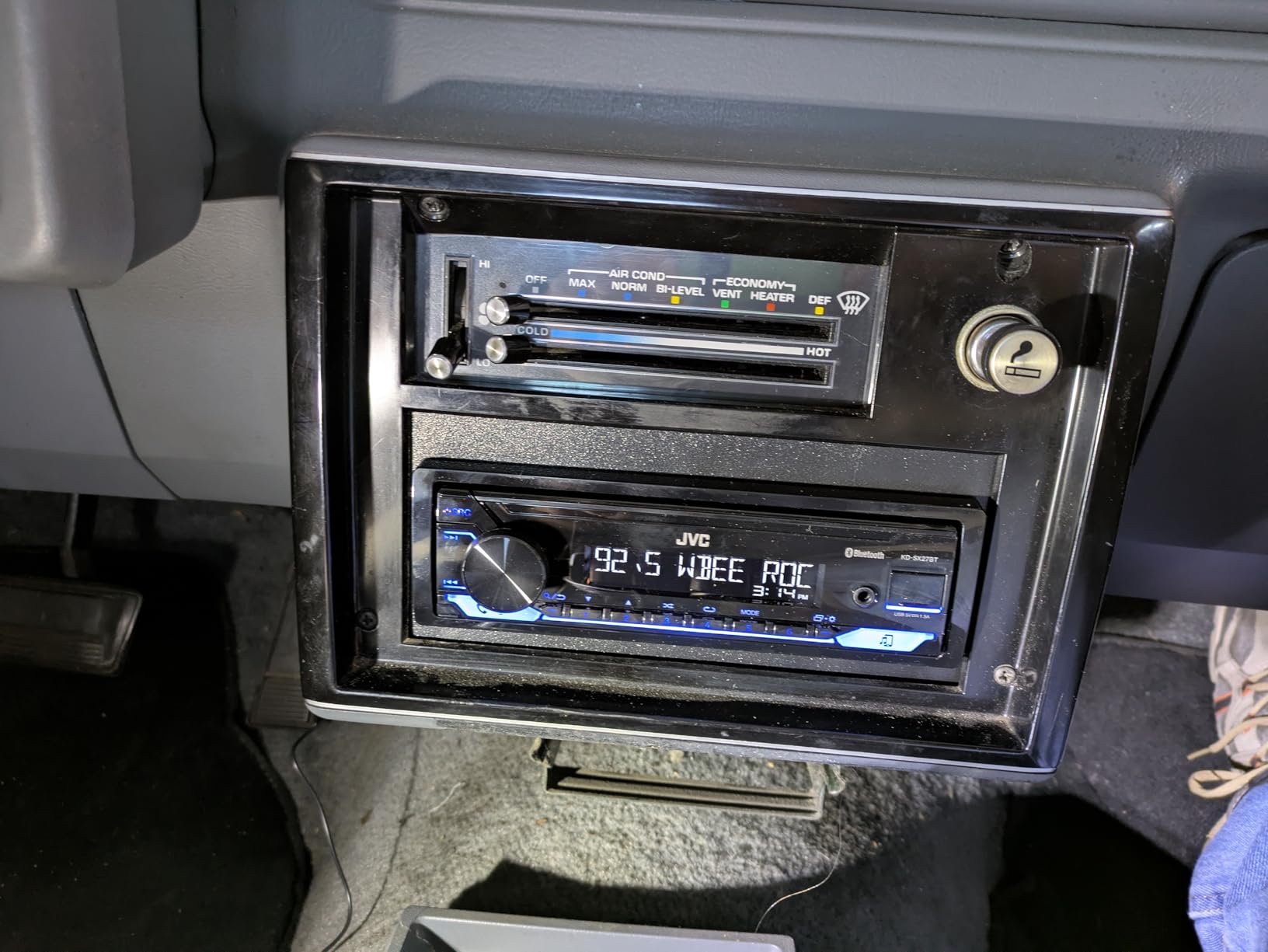
Take work calls all day and this is the one to look at. The JVC KD-SX27BT connects two phones full time for hands-free calling, and accepts up to five Bluetooth devices in total. That means a work line and a personal line stay paired simultaneously without you tearing down a pairing every time a personal call comes in.
It is also a proper amplifier, not just a powered box. The built-in 50 watts per channel is a real jump over a factory head unit, and in the hatchback on factory door speakers the midrange opened up noticeably. The 13-band EQ plus Time Alignment and Sound Lift give you actual control over where the sound sits in the cabin, which is something no other single-DIN here offers at this level.
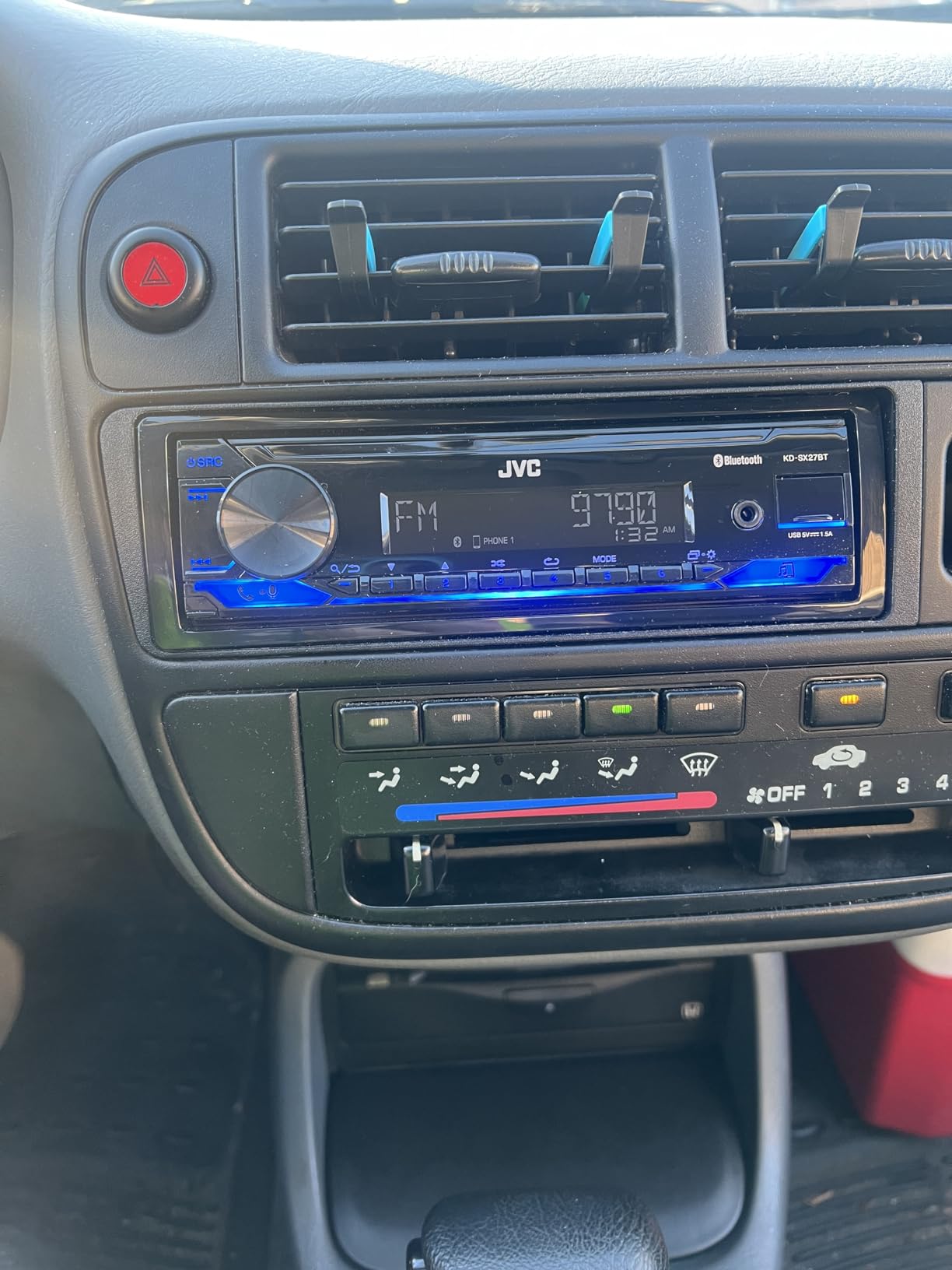
The short-chassis design keeps weight down and makes installation easier in tight dashboards, and the 1.5A USB port charges a phone quickly while playing MP3, WMA, WAV, AAC and FLAC files. The JVC Remote app handles control from iOS and Android, and the display supports Spanish text.
The limitations are all format-related rather than quality-related. There is no touchscreen, no CarPlay and no Android Auto, so navigation comes from your phone rather than the head unit, and this variant has no disc player. The amp is 2-channel in this configuration, with preamp output available if you want to add a subwoofer later.
Who this is for
This is for salespeople, field technicians, delivery drivers and anyone who genuinely juggles two phones. It is also the strongest single-DIN choice for music on stock speakers, thanks to the amplifier and the 13-band EQ.
Who should skip it
Skip it if you want a map on the stereo or the ability to read messages from the head unit. Those are phone-only jobs on this model. Drivers who still want a CD should also look at the BOSS 508UAB instead.
10. Pioneer MVH-S230BT – Best Mechless Fit for Tight Dash Openings
Pioneer MVH-S230BT 1-Din Car Stereo with Bluetooth, USB, AM/FM Radio
Single DIN mechless under 4 inch deep
Built-in Bluetooth hands-free calling
Advanced Sound Retriever
USB input and AM/FM
Pros
- Bluetooth pairs immediately on every start
- Shallow chassis simplifies installation in old cars
- Advanced Sound Retriever helps compressed audio
- All mounting hardware and removal tools included
Cons
- Only a 5-band EQ with one bass boost button
- No touchscreen
- CarPlay or Android Auto
- A small number of power and display faults reported
The Pioneer name does a lot of work here, and not just as a badge. This is the most respected brand on the list among install communities, and the MVH-S230BT is its straightforward entry mechless single-DIN. Bluetooth connected immediately on every single start in our testing, which is the behaviour people describe when they say a stereo pairs fast and consistently.
The built-in amplifier delivers noticeably more power and bass than the factory head unit it replaced, and owners describe the sound as crisp even on factory speakers. Advanced Sound Retriever restores some of the detail lost to Bluetooth and MP3 compression, which matters more here than on a unit that streams at high bitrates.
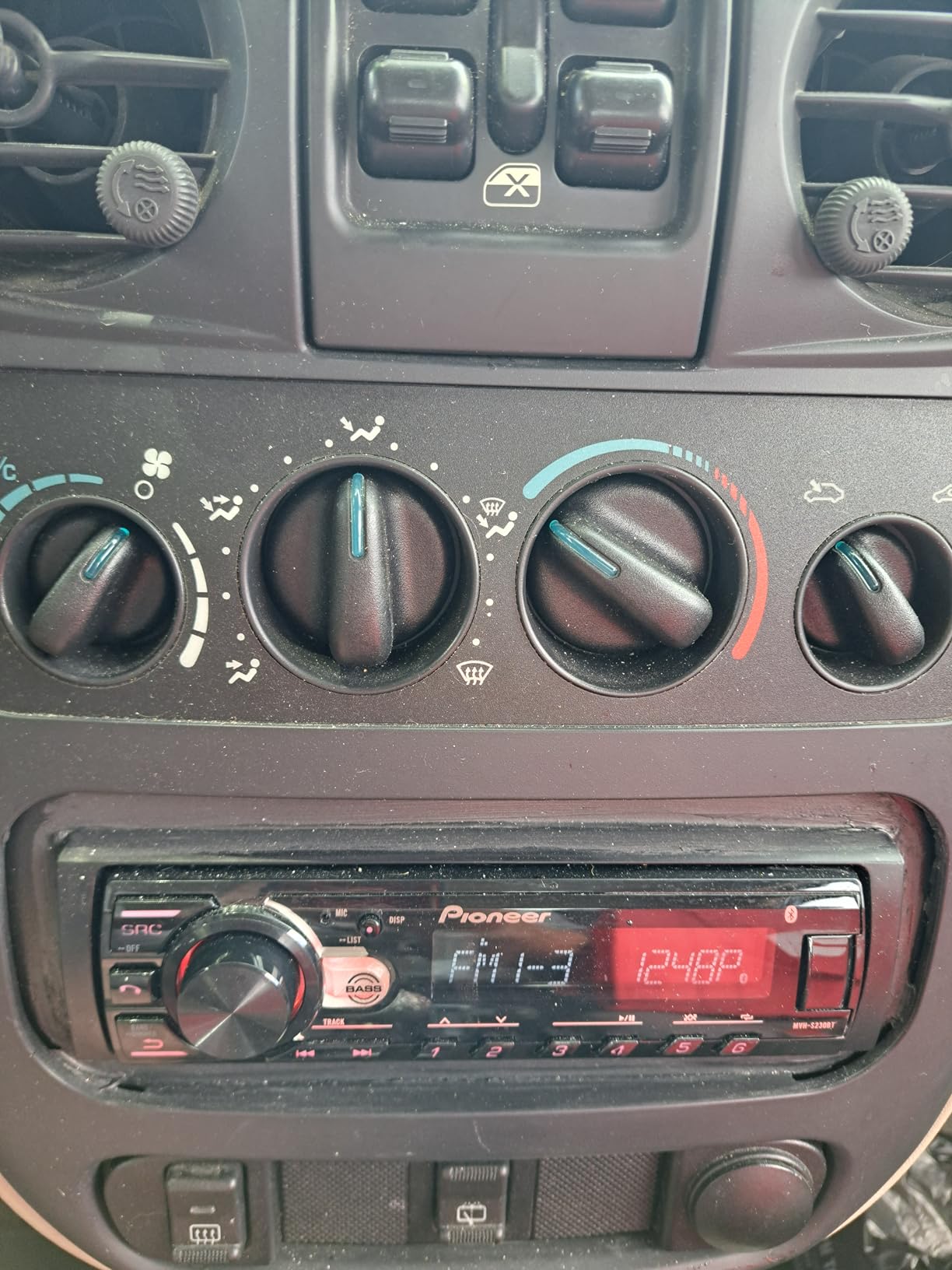
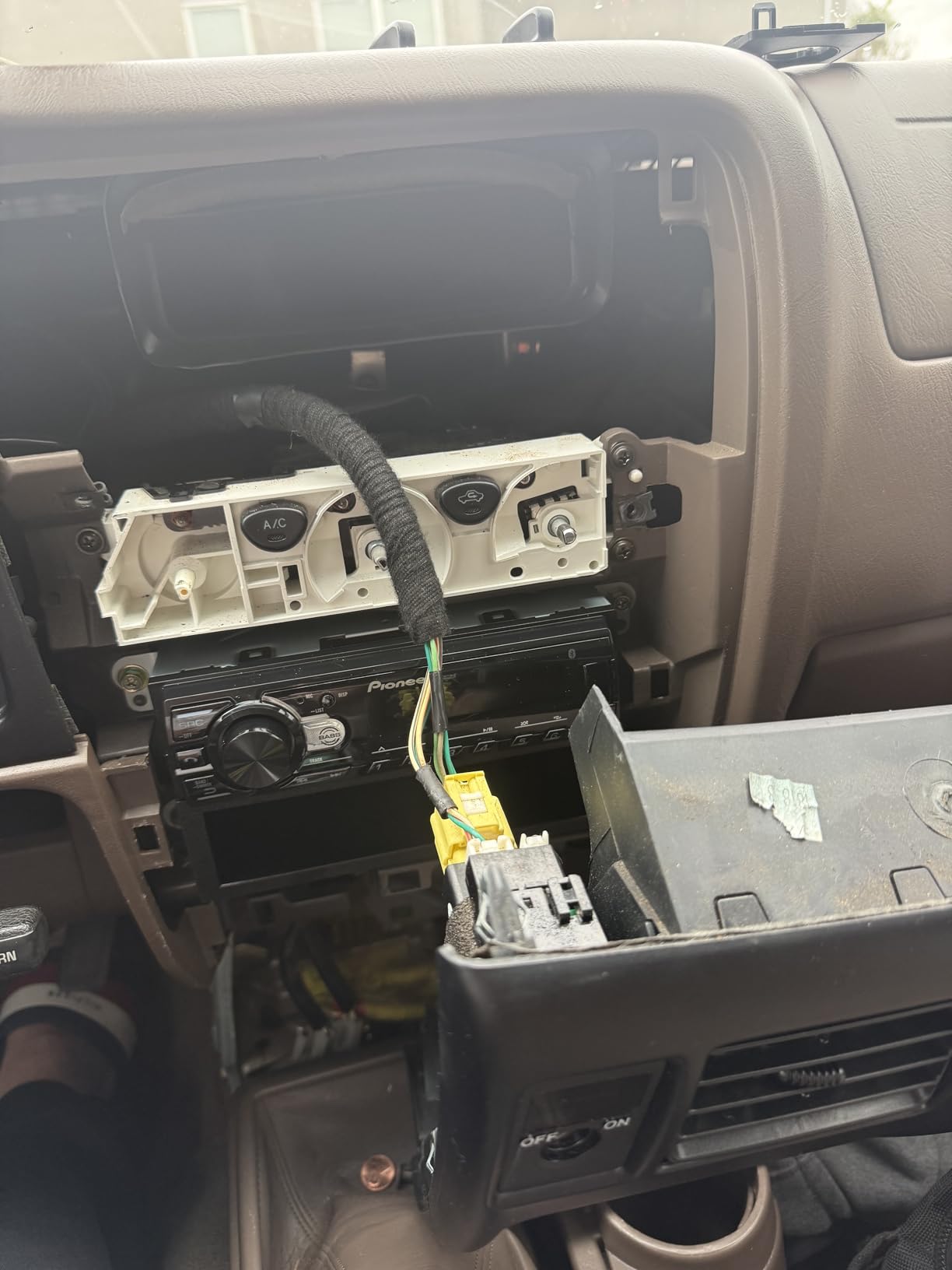
The chassis depth is under 4 inches and the box includes removal tools, a bracket, six installation screws, a trim ring, a sleeve, a wiring harness and a fuse. In an older vehicle with a deep or awkward dash that shallow mechless design is the difference between a two-hour job and a difficult afternoon.
What you give up is tuning and phone integration. There is a 5-band EQ with a single Bass Boost button, and no touchscreen, CarPlay or Android Auto, so the phone stays a phone. A small number of owners have reported a unit that would not power on after sitting unused for a few weeks until unplugged, and another found the display stuck in demo mode. Those are isolated reports against a much larger body of smooth installs.
Who this is for
This suits anyone who wants a trusted brand name and a predictable, fast-pairing radio in a car with a tight dash opening. It is the least stressful option for a first install because the hardware you need is all in the box.
Who should skip it
Skip it if you want to fine-tune the sound or run navigation from the head unit. If you are comfortable with a slightly larger unit and want far more EQ control, the JVC KD-SX27BT covers that ground with a touchscreen-free design too.
How to Choose a Car Stereo for Bluetooth Calling
Start with the microphone, because everything else is secondary for this use case. A unit with a wired external mic gives you placement freedom and consistently clearer calls, as we saw with the BOSS BV9364B. A unit with mic gain and noise-cancel controls, like the SJOYBRING JOY-W022, gives you tuning room. A built-in mic is fine as long as your cabin is not excessively noisy.
Second, decide between single DIN and double DIN honestly. Single DIN is a 2-inch-tall opening, mechanical knobs and buttons, and it fits most older vehicles with no dash modification. Double DIN is a 4-inch-tall opening, which usually means a double-DIN spacer in an older car, and it gives you a screen for CarPlay and navigation. For calling alone, single DIN with physical buttons is the safer, cheaper and more reliable choice. For calling plus navigation, double DIN wins, but check that the screen is not your only way to answer.
Third, check the preamp outputs. If you might add better speakers or an amplifier later, front and rear RCA pre-outs save you from replacing the head unit. Reviewers installing in older pickups consistently choose units with pre-amp outputs specifically so they can add a subwoofer in a second phase, and that is the same logic here. A unit with no pre-outs is a dead end the moment you want more output.
Fourth, look at control layout and steering wheel compatibility. A physical answer and hang-up button, a push-to-talk key and a rotary volume knob matter more for calling than a larger screen. If your car has steering wheel controls, confirm the unit supports them and check whether the required interface is included, because several units here need a separately sold adapter.
Fifth, verify fitment before you buy anything. You need your vehicle’s dash opening size, a dash kit or fascia adapter if the opening is not standard, a wiring harness adapter matched to your vehicle’s connector, and sometimes an antenna adapter. Confirm all of that before checkout, and check the box contents. The Pioneer ships removal tools, a bracket, screws, a trim ring and a harness, which is the standard to expect.
Finally, set expectations on brands. Pioneer, Kenwood, Alpine, JVC and Sony are the names that install communities name as the only respectable aftermarket head unit brands, and several appear on this list. The budget tier here is dominated by BOSS, Jensen and REAKOSOUND, which are perfectly serviceable for calling but not for tuning. If you want a premium double-DIN with the full-range microphone kit and CarPlay, expect a different list entirely.
How to Improve Bluetooth Call Quality in Your Car
Before blaming the stereo, check whether the call is even using the car. This is the single most common problem and it has nothing to do with hardware. If your phone’s Bluetooth profile has the phone’s own speakerphone as the default audio output, the call stays in the earpiece and the head unit sounds broken.
Here is the order we would work through it:
1. Force the audio source. Start the call, then press the audio source or phone button on the head unit and select Bluetooth or the car speaker rather than the phone earpiece. This is a documented problem across install forums, and it resolves instantly once you know where the setting lives.
2. Move the microphone. On any unit with an external mic, relocate it to near the rearview mirror or the A-pillar, away from the HVAC vents and away from the windscreen glass, which reflects noise back at the sensor.
3. Turn off the phone-side noise reduction. Aggressive phone noise suppression sounds robotic and can cut words. If your phone has a setting for noise reduction or a voice clarity toggle, test with it off.
4. Check the network setting. VoLTE and HD Voice hand off between networks and some drivers hear worse quality on one. If a call sounds muffled only in certain areas, a network feature toggling mid-call is a likely cause rather than the head unit.
5. Reduce cabin noise. Closing the windows and lowering the fan cuts road noise at the microphone. It also fixes the perception problem, since half of what reads as a bad call is simply the other person hearing the car.
6. Match the phone level to the radio. Bluetooth streaming often plays quieter than broadcast radio, a complaint that comes up constantly on audio forums. Turn the Bluetooth source volume up on the head unit before you decide the system sounds quiet.
7. Re-pair from scratch. Delete the head unit from your phone’s Bluetooth menu, restart both devices and pair again. This clears a corrupted profile that causes dropped calls and audio that routes to the wrong output.
Adapters and Other Options If You Keep Your Factory Radio
Not everyone should replace a head unit. If the factory system is fine apart from calling, an AUX Bluetooth adapter that plugs into the 3.5 mm input handles both calling and streaming for a fraction of the cost of a new stereo. Owners who tried dongles tend to describe the call quality as a compromise, so treat it as a stopgap rather than an equal substitute.
FM transmitter adapters are the other common route and are the weakest of the three for calls, since the microphone is usually in the dongle or the phone itself. The middle option worth considering is a dashboard-mounted speakerphone kit, which sits closer to your mouth and is specifically designed to be heard over noise.
One more thing to check before you dismiss the factory system. Several cars from the last decade shipped Bluetooth that supports audio streaming but not hands-free calling profiles, or supports calling only. That distinction is written in the vehicle manual and it explains why some owners think their car has no Bluetooth when it plainly does. Our vehicle mounting rig guide covers the mounting side of in-car kit if you are also setting up a camera or microphone for work.
Frequently Asked Questions
Can I make Bluetooth phone calls in my car?
Yes, if your car has a Bluetooth module with the hands-free profile and the stereo routes call audio to the speakers rather than the phone earpiece. Older factory systems often support audio streaming only, which is a separate function from calling. Any of the 10 head units here handle both streaming and hands-free calling out of the box.
Which car stereo brand has the best sound quality?
Among the brands here, Pioneer and JVC lead on tuning: the JVC KD-SX27BT adds a 13-band EQ, Time Alignment and a 50W per channel amplifier to a single-DIN faceplate. The PLZ MP-928W goes further with a DSP and 10-band EQ on a 7-inch screen. BOSS and Jensen units sound clean for their tier but offer far less adjustment.
What is a good car music system with Bluetooth?
A good system pairs a head unit with hands-free calling and streaming, a decent microphone, and speakers that are not the factory paper cones. On the head unit side look for Bluetooth 5.x, physical call buttons and preamp outputs. On the speaker side, replacing tired door speakers does more for clarity than spending more on the radio.
How do I improve Bluetooth call quality in my car?
First confirm the call is routing to the car speakers rather than the phone, by selecting the source on the head unit mid-call. Then move any external mic near the rearview mirror and away from vents, turn off aggressive phone noise reduction, close the windows and lower the fan, and delete and re-pair the Bluetooth profile to clear a corrupted connection.
Why does my car stereo connect but not play Bluetooth calls?
The connection is working but the audio path is not. The call is usually defaulting to the phone earpiece instead of the head unit. Press the source or phone button on the stereo during a call and choose Bluetooth or the car speakers. If sound plays but is very quiet, raise the volume on the Bluetooth source specifically, since it is often set lower than radio.
Single DIN or double DIN for Bluetooth calling?
Single DIN is the safer pick when calling is the priority. It fits most older dashboards without modification, costs less, and keeps physical buttons and a volume knob for answering and hanging up without looking. Double DIN is worth it if you also want phone navigation and wireless CarPlay or Android Auto, but confirm the unit still has physical or steering wheel call controls.
Which Car Stereo Should You Buy?
For most people reading this, the answer is the BOSS Audio Systems 616UAB, our editor’s choice. It pairs instantly, routes calls to the car speakers without fuss, has preamp outputs for later upgrades, and costs less than the double-DIN alternatives while doing the one job this article is about properly. If you want a longer warranty and a cleaner faceplate, take the Jensen MPR210. If you still have discs, the BOSS 508UAB is the same idea with a CD slot.
Two situations change the answer. If the other person regularly says they cannot hear you, the BOSS BV9364B is the one with a physical external mic you can mount near the windscreen. If you need navigation on the dash and a big screen, the SJOYBRING JOY-W022 gives you wireless CarPlay, a QLED panel and adjustable mic settings, and you should accept some interface lag as the trade.
Whichever you choose, confirm your dash opening size, buy the matching wiring harness adapter, and check whether steering wheel controls need a separate interface. Those three steps prevent most of the disappointment we hear about. If you are also mounting cameras or recording gear in the vehicle, our driving-scene mount guide covers the rest of the setup, and this roundup is current as of 2026.