
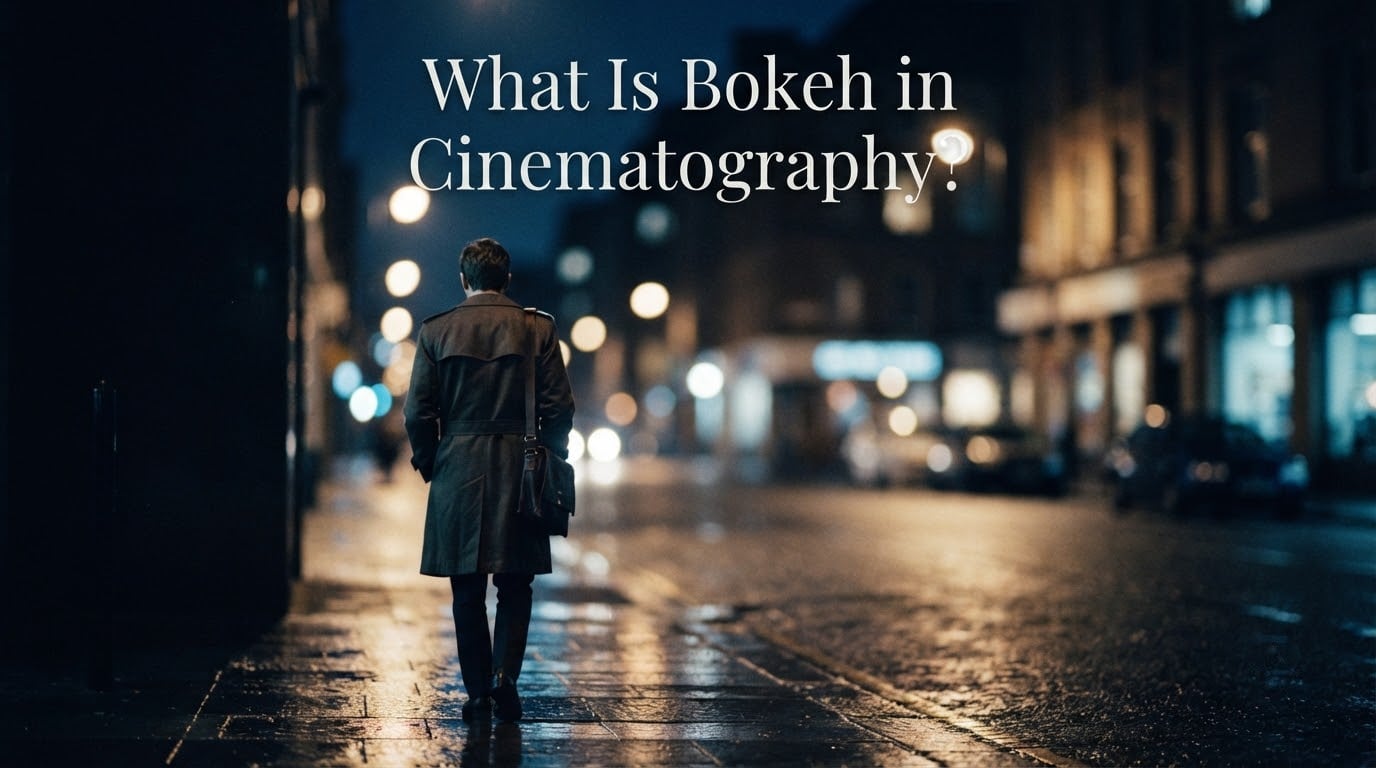
Bokeh in cinematography is the aesthetic quality of the out-of-focus areas of a film image. It describes how a lens renders background highlights, light sources, and shapes that fall outside the plane of focus, not the blur itself, but the look of that blur. When you watch a scene where the subject is sharp and the city lights behind them melt into soft glowing circles, you are looking at bokeh at work. In this guide, our team breaks down what bokeh really means on a film set, how cinematographers control it, and why it remains one of the most powerful visual storytelling tools available to a director of photography.
If you are choosing glass for an upcoming project, our guide to the best lenses for cinematic bokeh pairs naturally with this explainer. For those still building foundational skills, our roundup of beginner cinematography courses covers depth of field in much greater depth.
Table of Contents
- What Is Bokeh in Cinematography?
- Where Does the Word ‘Bokeh’ Come From?
- What Causes Bokeh in a Lens?
- Bokeh vs. Blur: What’s the Difference?
- Bokeh Shapes: Circle, Polygon, Oval
- Types of Bokeh in Cinematography
- How Cinematographers Use Bokeh to Tell Stories
- Bokeh Cheat Sheet: Lens and Aperture Choices
- How to Achieve Bokeh While Shooting
- Common Mistakes and How to Avoid Bad Bokeh
- Bokeh in Mobile and Digital Cinematography
- Frequently Asked Questions
- Conclusion
What Is Bokeh in Cinematography?
Bokeh is the aesthetic quality of the out-of-focus regions of a film frame. It refers to how a lens renders the soft, defocused areas, especially the shapes, brightness, and smoothness of background highlights. Bokeh is not the amount of blur, but how pleasing or characterful that blur looks.
In cinematography, bokeh is shaped by three forces working together: a wide aperture that narrows the plane of focus, the optical design of the lens itself, and the presence of bright point light sources in the background. When a cinematographer lights a night street scene with practical lamps and shoots it at T1.5, those lamps become bokeh balls: glowing disks that signal place, time, and mood without ever pulling focus from the actor’s face.
Bokeh matters because narrative film relies on guiding the viewer’s eye. Sharp focus on the subject and pleasing bokeh in the background tells the audience exactly where to look and what to feel.
Where Does the Word ‘Bokeh’ Come From?
The word bokeh comes from the Japanese word boke, which means blur or haziness. It entered English photographic vocabulary in the mid-1990s and quickly spread into cinematography vocabulary through trade magazines and online forums.
Bokeh is pronounced BOH-keh, with two syllables and equal stress on each. The final syllable rhymes with “meh” or “kayak.” On a film set you will rarely hear working DPs say bokeh aloud. Reviewers note that professionals usually say “shallow focus,” “subject isolation,” or “background separation” instead. The word bokeh lives more in marketing copy, lens reviews, and post-production conversations than in actual set communication.
What Causes Bokeh in a Lens?
Four technical factors combine to produce bokeh in any given shot. Understanding each one gives you direct creative control over the final look on screen.
- Aperture: A wide aperture (low T-stop number) creates a shallow depth of field, which throws the foreground and background into defocus and produces visible bokeh on any bright point source.
- Focal length: Longer focal lengths compress the scene and exaggerate background blur. A 100mm lens at T2.8 produces more visible bokeh than a 25mm lens at the same T-stop from the same distance.
- Subject-to-background distance: The farther the background sits from your subject, the more pronounced the bokeh becomes. Press the subject up against a wall and the background stays sharp. Pull them three meters from the wall and the background softens.
- Lens optics: Spherical aberration, chromatic aberration, lens coatings, and aperture blade count all leave a fingerprint on the bokeh. Vintage Cooke K35 lenses and modern ARRI Signature Primes render bokeh very differently even at the same T-stop.
The interaction of these four factors is why two cinematographers shooting at T2.8 can produce wildly different bokeh on the same camera body. The lens design is the silent fifth collaborator in every shallow-focus decision you make.
Bokeh vs. Blur: What’s the Difference?
Blur describes the fact that something is out of focus. Bokeh describes the quality of that out-of-focus rendering. Every blurry image contains blur, but only some blurry images contain beautiful bokeh.
Reviewers note that fast kit zooms can defocus a background just as well as a master prime, but the resulting bokeh often looks nervous, doubly-imaged, or busy. A high-quality cinema prime renders the same defocus as a smooth, creamy gradient with clean circular highlights. Both are blurry. Only one is bokeh in the cinematographic sense the term is meant to evoke.
This distinction matters because narrative film depends on sustained mood. If the background looks harsh or unstable, the audience reads the shot as amateur even when the actor’s performance is flawless.
Bokeh Shapes: Circle, Polygon, Oval
The shape of bokeh is determined primarily by the aperture diaphragm inside the lens. Open the iris and you see the bokeh in its true shape: a small window onto the lens’s aperture opening.
Round Bokeh
Round bokeh comes from lenses with curved or high-blade-count aperture diaphragms. A 9-blade or 11-blade iris produces near-circular bokeh balls even when stopped down a little. Most modern cinema primes aim for this look because it feels organic and never distracts from the subject.
Polygonal Bokeh
Polygonal bokeh (often hexagonal or octagonal) comes from lenses with fewer aperture blades, typically older or consumer-grade designs. Each blade edge leaves a visible flat side on the bokeh ball. Photographers and filmmakers on Reddit regularly ask how to get octagon-shaped bokeh, and the honest answer is that it is a side effect of inexpensive diaphragm design rather than a feature to chase.
Oval Bokeh
Oval bokeh is the signature of anamorphic cinematography. Anamorphic lenses use cylindrical optics and a horizontal squeeze to capture widescreen images, and that same squeeze stretches the bokeh horizontally into soft ovals. The stretched highlights are instantly recognizable and have become shorthand for “cinematic” in modern trailer and music-video work.
Reviewers note that you can fake anamorphic-style oval bokeh on a budget by placing an oval mat filter in front of a spherical lens, but the result lacks the natural horizontal flare and gentle fall-off of true anamorphic glass.
Types of Bokeh in Cinematography
Beyond shape, cinematographers describe bokeh by its texture and character. Different lens designs produce bokeh that feels smooth, harsh, busy, or swirly.
- Smooth or creamy bokeh: A clean, gradient fall-off with no visible texture. Cooke S4/i, ARRI Signature Primes, and most modern cinema primes aim for this look.
- Harsh or busy bokeh: Doubled edges, visible outlines, or nervous texture in the defocused areas. Often caused by optical correction artifacts in fast consumer zooms.
- Swirly bokeh: Background blur that swirls around the edges of the frame. Vintage Petzval-style lenses and the Canon K35 family are famous for this look.
- Cats-eye bokeh: Bokeh balls that stretch into oval shapes toward the corners of the frame, caused by vignetting in wide-aperture designs.
The “best” bokeh is the bokeh that serves the story. A documentary about a surgeon benefits from creamy, distraction-free bokeh. A music video set in 1970s Lisbon might lean into swirly Cooke K35 character. The DP’s job is matching bokeh personality to emotional intent.
How Cinematographers Use Bokeh to Tell Stories
Bokeh is rarely used just because it looks pretty. Working directors of photography reach for shallow focus and pronounced bokeh when the scene needs a specific emotional read.
Roger Deakins, ASC, BSC is known for using shallow focus to isolate a single character inside a busy environment. In 1917 he often held focus on a soldier while the background fell into soft, painterly bokeh, turning landscapes and trench walls into abstract color fields. Deakins has spoken about treating bokeh as composition, not as decoration.
Emmanuel Lubezki, AMC, AMC took the opposite approach in The Revenant, using available natural light and ultra-wide focal lengths with deep focus rather than heavy bokeh. His choice told the audience that the wilderness was a character in itself, not a backdrop. Comparing the two DPs side by side shows how bokeh is one tool among many, and the choice to avoid it can be just as powerful as the choice to embrace it.
Reviewers on Reddit’s r/cinematography regularly emphasize that bokeh is a storytelling choice, not just a technical feature. Subtle bokeh is often better than heavy bokeh, and the cinematographer’s responsibility is to match the depth cue to the scene’s emotional register.
Bokeh Cheat Sheet: Lens and Aperture Choices
The cheat sheet below maps cinematographic intent to the lens and aperture combination most likely to produce it. Use it as a starting point, then test on your own camera before committing to a setup.
- Creamy subject isolation: Modern cinema prime (ARRI Signature, Cooke S4/i) at T1.4 to T2 produces smooth, round, near-invisible fall-off.
- Wes Anderson-style stylization: Vintage prime or zoom at T2.8 to T4 produces polygonal, slightly busy, nostalgic highlights.
- Anamorphic film look: Anamorphic prime or vintage still lens with adapter at T2.8 to T4 produces oval bokeh with horizontal flares.
- Documentary observation: Mid-range zoom at T4 to T5.6 keeps minimal bokeh and deep focus across the frame.
- 1970s character: Cooke K35, Canon K35, or vintage still lens at T2 to T2.8 produces swirly, painterly fall-off with strong edge rendering.
For aerial and establishing shots, our guide to professional cinematography drones covers how altitude and lens choice interact on real productions. Drone pilots managing ND filtration in bright air often pair that drone guide with our drone filter kit roundup to keep highlights from clipping behind the subject.
How to Achieve Bokeh While Shooting
Five practical levers control bokeh on set. Adjust them in this order for predictable results.
- Open the aperture. Step down to the widest T-stop your lens offers. This is the single fastest way to increase visible bokeh on any camera.
- Move closer to your subject. Decreasing camera-to-subject distance narrows the depth of field and pushes the background further out of focus.
- Switch to a longer focal length. Doubling focal length from 50mm to 100mm at the same aperture roughly doubles the background blur.
- Increase subject-to-background distance. Pull the subject away from the wall, the window, or the street behind them. More separation equals more visible bokeh.
- Add point light sources to the background. Practical lamps, fairy lights, and streetlights give bokeh something to render. Without bright highlights in the defocused area, bokeh can be invisible even at T1.4.
Test each change one at a time. Pulling aperture and focal length simultaneously makes it nearly impossible to repeat the look on a future shoot.
Common Mistakes and How to Avoid Bad Bokeh
Bad bokeh pulls the viewer’s eye away from the subject and breaks the illusion of the scene. Watch out for these four pitfalls during camera tests.
- Busy bokeh in a cluttered background: A street full of competing point lights will turn into visual noise behind the actor. Either re-light the background, throw it further out of focus with a longer lens, or move the shot.
- Double-edged or nervous bokeh: A sign of optical correction issues in fast zooms. Stop the lens down by half a stop or switch to a prime if you see ghosted highlights.
- Too shallow on a moving subject: A T1.4 lens on a handheld close-up leaves no margin for focus error. Pull to T2 or T2.8 and follow focus more reliably.
- Mismatched lens character across cuts: Mixing vintage K35 bokeh with modern Signature Prime bokeh in the same scene reads as inconsistent. Commit to one lens family per sequence.
Bokeh in Mobile and Digital Cinematography
Modern smartphones simulate bokeh through computational photography. Portrait mode on iOS and Android devices uses dual cameras, depth sensors, or machine-learning depth maps to apply artificial background blur to a photo or video. The result can look convincing at a glance but reveals its limitations on close inspection: edges around hair and glasses often blur incorrectly, and out-of-focus highlights do not behave the way real glass renders them.
Several newer phones, including recent iPhone Pro and Samsung Galaxy Ultra models, can record cinematic-mode video with simulated rack focus and oval-shaped highlights. These tools are useful for previsualization, social content, and indie projects with no lens budget. They are not yet a substitute for a 50mm cinema prime at T1.4 on a Super 35 sensor.
For indie teams starting with a small drone and a phone, our beginner drone roundup walks through the gear pairing that keeps handheld footage consistent with aerial coverage.
Frequently Asked Questions
Why is blur called bokeh?
The word bokeh comes from the Japanese word boke, which simply means blur or haziness. Photographers borrowed it in the 1990s to describe the aesthetic quality of defocused areas, and the term spread into cinematography shortly after. Blur is the fact that something is out of focus. Bokeh is how that blur looks once the lens has rendered it.
How is bokeh pronounced?
Bokeh is pronounced BOH-keh, with two syllables and roughly equal weight on each. The final syllable rhymes with the meh in kayak or the keh in karate. On set, you will more often hear cinematographers say shallow focus, subject isolation, or background separation instead of bokeh.
What is bokeh in cinematography example?
A clear example is the street-lamp scene at the opening of Blade Runner 2049, where neon signs dissolve into soft orange bokeh balls while Officer K remains in sharp focus. Similar examples appear in Taxi Driver’s urban night sequences, the lantern-lit forest scenes of Interstellar, and the pastel bokeh backgrounds throughout The Grand Budapest Hotel. Each shot uses bokeh to isolate the character and signal mood.
Which lens has the best bokeh?
There is no single lens with the best bokeh because bokeh quality is subjective. For creamy, distraction-free rendering, working cinematographers reach for ARRI Signature Primes, Cooke S4/i, and Zeiss Supreme Prime Radiance. For character and swirly fall-off, vintage Cooke K35 and Canon K35 glass is highly sought after. For the oval anamorphic look, Panavision C-Series and modern Atlas Orion anamorphics are industry references.
How to get rid of bokeh?
To reduce or eliminate bokeh in a shot, stop the lens down to a smaller aperture such as T5.6 or T8, switch to a wider focal length like a 24mm instead of an 85mm, move the subject closer to the background to minimize separation, and remove or dim any bright practical lights in the background. Deep-focus cinematography uses all four techniques together to keep foreground, midground, and background sharp at once.
Conclusion
Bokeh in cinematography is one of the most expressive tools a director of photography has at their disposal. It shapes how an audience reads depth, mood, and importance inside every frame, and it works because it guides the eye without ever calling attention to itself.
Open a lens, add a point light source, pull focus on your actor, and you have just made a deliberate choice about what is bokeh in cinematography on your set. If you want to dig deeper into the lenses that produce great bokeh, our guide to the best lenses for cinematic bokeh is a good next step. Updated for 2026.