
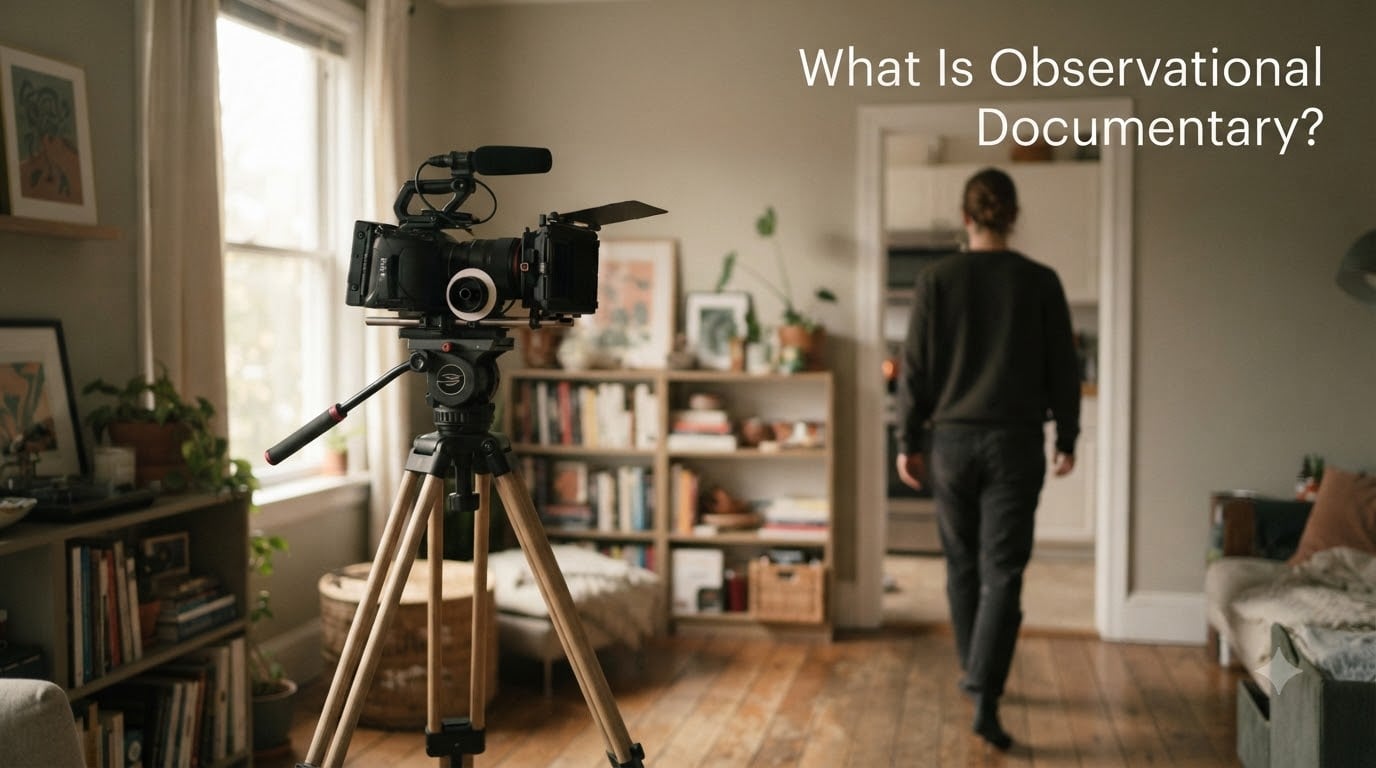
Imagine watching real life unfold on screen with no host telling you what to think, no dramatic music signaling how to feel, and no re-enactments padding the runtime. That is the essence of observational documentary, a filmmaking approach that drops you into the middle of reality and lets you make sense of it yourself.
If you have ever wondered what makes a documentary “observational” compared to other styles, you are in the right place. In this guide, I break down what observational documentary is, where it came from, the techniques that define it, and how it differs from other documentary modes.
Whether you are a film student, an aspiring documentarian, or simply curious about how some of the most powerful non-fiction films get made, understanding the observational mode will sharpen how you watch and create documentaries in 2026 and beyond.
Table of Contents
- What Is Observational Documentary? A Clear Definition
- Key Characteristics of Observational Documentary
- The Origins of Observational Documentary
- Famous Examples of Observational Documentaries
- Observational vs Other Documentary Modes
- Ethical Considerations in Observational Filmmaking
- Frequently Asked Questions
- Conclusion
What Is Observational Documentary? A Clear Definition
An observational documentary is a style of non-fiction filmmaking that records real people and real events as they happen, with the filmmaker staying as unobtrusive as possible. The director does not interview subjects on camera, narrate over the footage, or stage scenes for the camera. Instead, the camera acts as a silent witness to life.
This approach goes by several names in film studies. You will see it called cinema verite (from the French for “truthful cinema”), direct cinema, fly-on-the-wall filmmaking, or simply the observational mode. While these terms have subtle historical differences, they all point to the same core idea: the filmmaker observes rather than participates.
Film scholar Bill Nichols formalized this idea in his widely cited framework of six documentary modes. In his system, observational mode sits between participatory (where the filmmaker is on screen interacting with subjects) and reflexive (where the film calls attention to its own construction). The observational mode emerged in the late 1950s and early 1960s, made possible by lighter, more portable camera and recording equipment.
The defining promise of observational documentary is immediacy. You see unposed moments, genuine reactions, and the texture of everyday life that staged productions cannot replicate. The trade-off is that the filmmaker gives up direct control over the narrative, trusting the audience to interpret events on their own.
Key Characteristics of Observational Documentary
Observational documentaries share a recognizable set of techniques and choices that set them apart from other non-fiction filmmaking styles. Here are the six characteristics that define the mode:
- Handheld camera work: Filmmakers use lightweight, often shoulder-mounted cameras to follow the action. This produces a slightly unsteady, you-are-there quality that signals authenticity. The camera moves with people rather than waiting for them to enter a fixed frame.
- Long, uninterrupted takes: Instead of cutting rapidly between shots, observational films let scenes play out in real time. A single take might run several minutes, allowing tension, emotion, or humor to build naturally without editorial interference.
- No voice-over narration: There is no omniscient narrator guiding your interpretation. Information comes from the subjects themselves, from on-screen text, or simply from watching events unfold. This forces the viewer to pay closer attention and draw their own conclusions.
- No staged interviews or re-enactments: Subjects are never seated in front of a camera and asked formal questions. Historical events are never dramatized by actors. Everything captured is something that would have happened whether the camera was there or not.
- Synchromized direct sound: Location audio is recorded live, capturing natural dialogue, ambient noise, and environmental sounds. This was a breakthrough enabled by portable sync-sound recording technology in the 1960s, and it remains a defining technical feature.
- Minimal on-screen filmmaker presence: The director stays behind the camera and out of the frame. Unlike participatory documentaries where the filmmaker interviews subjects or becomes part of the story, observational filmmakers aim to be invisible, or at least ignorable, presences in the room.
These characteristics work together to create what film critics call a fly-on-the-wall effect. The audience feels like a hidden observer watching life happen without anyone performing for the camera.
The Origins of Observational Documentary
The observational mode did not exist before the late 1950s because the technology to support it simply was not available. Early documentary cameras were heavy, bulky, and required significant setup time. Sound recording equipment was similarly impractical for location work, meaning documentaries relied heavily on staged scenes and post-production narration.
Everything changed when portable 16mm cameras and lightweight sync-sound recording systems hit the market. In the United States, a group of filmmakers associated with what became known as direct cinema took advantage of this new mobility. Robert Drew, Richard Leacock, D. A. Pennebaker, and the Maysles brothers (Albert and David) began following their subjects into real situations and filming events as they happened.
Meanwhile in France, Jean Rouch and Edgar Morin were developing a parallel tradition they called cinema verite. Their approach was slightly more participatory, with filmmakers sometimes engaging subjects on camera, but the goal of capturing unscripted truth was the same.
Frederick Wiseman took the observational approach to its purest extreme, producing dozens of institutional studies beginning with “Titicut Follies” in 1967. His method of filming inside hospitals, schools, police departments, and other organizations, then editing the footage without narration or interviews, established a template that documentary filmmakers still follow today.
Famous Examples of Observational Documentaries
The best way to understand observational documentary is to watch it in action. These six landmark films demonstrate the range and power of the mode:
- Primary (1960): Directed by Robert Drew, this film followed John F. Kennedy and Hubert Humphrey during the Wisconsin Democratic primary. It is widely considered the first American direct cinema documentary, capturing intimate behind-the-scenes moments that political reporting had never shown before.
- Don’t Look Back (1967): D. A. Pennebaker filmed Bob Dylan’s 1965 concert tour of England, capturing the singer’s interactions with fans, journalists, and fellow musicians with no narration. The opening sequence of Dylan holding cue cards became one of the most iconic images in music documentary history.
- Grey Gardens (1975): The Maysles brothers spent months filming Edith Bouvier Beale and her daughter “Little Edie” in their decaying East Hampton mansion. The film’s fly-on-the-wall intimacy revealed a world of faded aristocracy and complex family bonds that a scripted approach never could have captured.
- Titicut Follies (1967): Frederick Wiseman’s debut documented conditions inside a Massachusetts institution for the criminally insane. Shot entirely without narration or interviews, the film exposed patient mistreatment so powerfully that it was banned from public distribution for over two decades.
- High School (1968): Another Wiseman landmark, this film observed a Philadelphia high school over several weeks. By simply pointing the camera at classrooms, hallways, and administrative offices, Wiseman revealed the unspoken power dynamics of American education.
- Salesman (1969): The Maysles brothers followed four door-to-door Bible salesmen, capturing the exhaustion, desperation, and camaraderie of the job. The film’s subjects never address the camera directly, creating a startling sense of eavesdropping on private struggles.
Each of these films uses different techniques within the observational framework, but they all share a commitment to watching life happen without directing it. Forum communities on Reddit frequently cite these titles as essential viewing for anyone studying the form, with particular praise for Wiseman’s discipline and the Maysles brothers’ empathy.
Observational vs Other Documentary Modes
To truly understand observational documentary, it helps to see how it differs from the other modes in Bill Nichols’ framework. Each mode represents a different relationship between filmmaker, subject, and audience.
Observational vs Expository: Expository documentaries (think Ken Burns’ history series or nature films with a narrator) use an authoritative voice-over to deliver information and argument. Observational films reject this entirely, offering no narrator and no on-screen titles telling you what to think. The expository mode argues a point; the observational mode presents evidence.
Observational vs Participatory: Participatory documentaries feature the filmmaker on screen, interviewing subjects and sometimes becoming part of the story. Think of Michael Moore’s films or Louis Theroux’s documentary series. In observational documentary, the filmmaker stays behind the camera and never conducts formal interviews. The difference is between watching people and engaging with them.
Observational vs Reflexive and Performative: Reflexive documentaries draw attention to their own filmmaking process, making the audience aware of the camera and the director’s choices. Performative documentaries emphasize the subjective, emotional experience of the filmmaker. Observational films do the opposite: they try to make the filmmaking apparatus invisible so the audience forgets a camera is present at all.
Observational Documentary vs Reality TV: This is a distinction almost no competitor covers, yet it matters a great deal. Reality television borrows surface elements from observational documentary: handheld cameras, real people, unscripted moments. But reality TV producers manufacture conflict through casting choices, editing tricks, and staged scenarios. Contestants know they are on television and perform accordingly. True observational documentary films subjects who are simply living their lives, with the goal of understanding rather than entertainment. The camera in a reality show is a participant in the drama; the camera in an observational film strives to be a non-entity.
Ethical Considerations in Observational Filmmaking
The fly-on-the-wall approach raises questions that other documentary modes avoid. When filmmakers never intervene, what happens when a subject makes a decision the filmmaker finds troubling? Wiseman has said he filmed everything in “Titicut Follies” without stepping in, trusting the audience and the editing room to convey his perspective.
Consent is another challenge. Subjects may agree to be filmed without fully understanding how the final edit will portray them. The Maysles brothers faced criticism over how “Grey Gardens” presented the Beale women, even as the subjects themselves welcomed the attention.
Aspiring observational filmmakers should obtain informed consent, be transparent with subjects about the project, and consider the ethical weight of every editing choice. Capturing reality is only half the job; presenting it fairly is the other half.
Frequently Asked Questions
What is an example of an observational documentary?
Classic examples include Primary (1960), Don’t Look Back (1967), Grey Gardens (1975), and Frederick Wiseman’s Titicut Follies (1967). These films follow real subjects in their natural environments without narration, interviews, or staged scenes.
What are the four types of documentaries?
Bill Nichols actually identified six modes: poetic, expository, participatory, observational, reflexive, and performative. However, many introductory courses group them into four broad categories: expository (narrated), observational (fly-on-the-wall), participatory (filmmaker on screen), and reflexive (self-aware about the filmmaking process).
Is Amy an observational documentary?
Asif Kapadia’s Amy (2015) is not a pure observational documentary. It relies entirely on archival footage and audio recordings with no new observational filming, and it uses voice-over from interview subjects. It borrows some observational aesthetics but functions more as an expository archival film.
What is the difference between participatory and observational documentaries?
In observational documentary, the filmmaker stays behind the camera and never interviews or interacts with subjects on screen. In participatory documentary, the filmmaker appears on camera, conducts interviews, and sometimes becomes part of the story. Observational films watch life happen; participatory films engage with it directly.
Conclusion
Observational documentary remains one of the purest and most challenging forms of non-fiction filmmaking. By stepping back and letting the camera record life without intervention, filmmakers in this tradition have produced some of the most honest and enduring portraits of human experience ever committed to film.
Understanding what observational documentary is, from its technical hallmarks to its ethical tensions, gives you a deeper appreciation for every fly-on-the-wall film you watch. If you want to explore further, start with the six films listed above, then seek out Frederick Wiseman’s extensive catalog, which continues to grow into 2026. His decades of work offer a masterclass in what observational documentary can achieve when a filmmaker trusts reality enough to simply watch it.