
A mini-documentary is a short, documentary-style film that tells a real-life story in a concise format, typically lasting between 2 and 25 minutes. I’ve spent the last six months watching, producing, and analyzing dozens of these compact non-fiction stories, and the format keeps winning because it delivers real emotional punch without demanding an hour of your time.
If you’ve ever finished a 90-minute documentary wishing it had been 8 minutes long, you already understand why this format matters. Our team at Short Film Central sees a steady stream of new creators asking how to make meaningful work that fits modern attention spans. A mini-doc answers that question. In this guide, I’ll walk you through the definition, key characteristics, runtime specifics, the 7-step production process, famous examples, and where these films thrive. By the end, you’ll know exactly what a mini-documentary is and how to start making one.
Table of Contents
- What Is a Mini-Documentary? A Clear Definition
- How Long Is a Mini-Documentary?
- Key Characteristics of Mini-Documentaries
- Mini-Documentary vs Short Film vs Feature Documentary
- How to Make a Mini-Documentary: 7-Step Process
- Famous Mini-Documentary Examples to Watch
- Common Use Cases and Where Mini-Documentaries Shine
- Frequently Asked Questions About Mini-Documentaries
- Final Thoughts on the Mini-Documentary Format
What Is a Mini-Documentary? A Clear Definition
A mini-documentary is a brief non-fiction film that compresses a real story, issue, or human experience into a tight 2-to-25-minute runtime. It blends interviews, B-roll footage, and narrative structure to deliver authentic storytelling without the budget or runtime of a feature documentary.
I describe the format to my students as “a feature documentary’s soul squeezed into a coffee shot.” You keep the interviews, the vérité moments, and the emotional arc, but you cut everything that doesn’t serve the central idea. The result is short-form content that still feels substantial.
Here are the core traits that define the format:
- Short runtime: Most mini-docs run 2 to 25 minutes, with sweet spots around 5 to 12 minutes.
- Authentic storytelling: Real people, real events, unscripted moments.
- Focused scope: One clear subject, character, or theme instead of a sprawling investigation.
- Documentary-style techniques: Interviews, observational footage, archival material, and a narrator-led or sound-driven narrative.
- Concise structure: A clear beginning, middle, and end that resolves within the runtime.
You’ll also see these films called micro-docs, short documentaries, or short-form documentary. The names overlap, but the spirit stays the same: real stories told with honesty in a tight package.
How Long Is a Mini-Documentary?
A mini-documentary typically runs between 2 and 25 minutes, though most fall in the 5-to-15-minute range. The format bends based on where the film will live and who the audience is.
Through our testing of audience retention across social feeds and festivals, we’ve seen a clear pattern: shorter films hold attention better online, while slightly longer ones thrive at curated events. Here’s how the runtime breaks down in practice.
- Micro-documentary: Under 2 minutes. Built for Instagram, TikTok, and YouTube Shorts.
- Short mini-doc: 2 to 10 minutes. Ideal for online publishing, brand storytelling, and school projects.
- Standard mini-doc: 10 to 25 minutes. Common at film festivals and on PBS-style broadcast slots.
When someone asks me how long a mini documentary should be, my honest answer is “as long as the story needs and not a second longer.” A 4-minute portrait of a local baker can move people more than a 20-minute feature on the same topic. If your story can land in 3 minutes, land it there.
Key Characteristics of Mini-Documentaries
The best mini-documentaries share a handful of traits that separate them from vlogs, news packages, and feature documentaries. These characteristics are what make the format feel distinct.
- Real-life subject matter: Every mini-doc starts with a real person, place, or issue. No fictional plots, no actors playing roles.
- Authentic voice: Subjects speak in their own words. Interviews are conducted, not scripted.
- Emotional connection: Because the runtime is short, every scene must earn its place emotionally. Viewers expect to feel something.
- Focused narrative: One central question, character, or idea carries the whole film.
- Documentary-style cinematography: Handheld or observational camera work, natural lighting, and B-roll that supports the interview content.
- Sound-driven impact: Strong ambient sound, clean interview audio, and considered music choices matter more here than in long-form work.
When I reviewed 30 student mini-documentaries last semester, the ones that worked all shared one quality: a clear emotional through-line. The ones that fell flat tried to cover too many stories in too little time. Pick one thread and pull on it.
Mini-Documentary vs Short Film vs Feature Documentary
A mini-documentary differs from a short film and a feature documentary in three ways: runtime, narrative structure, and source material. Knowing these differences helps you pitch, program, and distribute your work correctly.
A short film is usually a fictional narrative under 40 minutes. It uses actors, scripted dialogue, and cinematic storytelling. A feature documentary runs 40 minutes or longer (often 70 to 120 minutes) and builds a sprawling, multi-thread investigation. A mini-documentary sits between them: shorter than a feature, factual like a documentary, and tightly scoped like a short film.
In practical terms, that means a mini-doc borrows documentary’s interview-based approach and a short film’s discipline of economy. You can submit mini-docs to documentary festivals and to short film festivals, but not usually to narrative short film categories. Always check the festival’s submission rules.
How to Make a Mini-Documentary: 7-Step Process
Making a mini-documentary follows a clear seven-step workflow. I’ve taught this process to high school students, brand marketers, and first-time filmmakers, and it works at every skill level. The steps are sequential, so follow them in order.
- Choose your subject. Pick a real person, place, or issue you find genuinely interesting. Personal connection to the topic keeps you motivated when the edit gets tough.
- Research and pre-produce. Spend 3 to 7 days learning about your subject. Read local news, interview experts, scout locations, and draft a one-page treatment.
- Write interview questions. Prepare 8 to 12 open-ended questions. Avoid yes/no prompts. Start with “Tell me about…” or “What was the moment when…” to draw out stories.
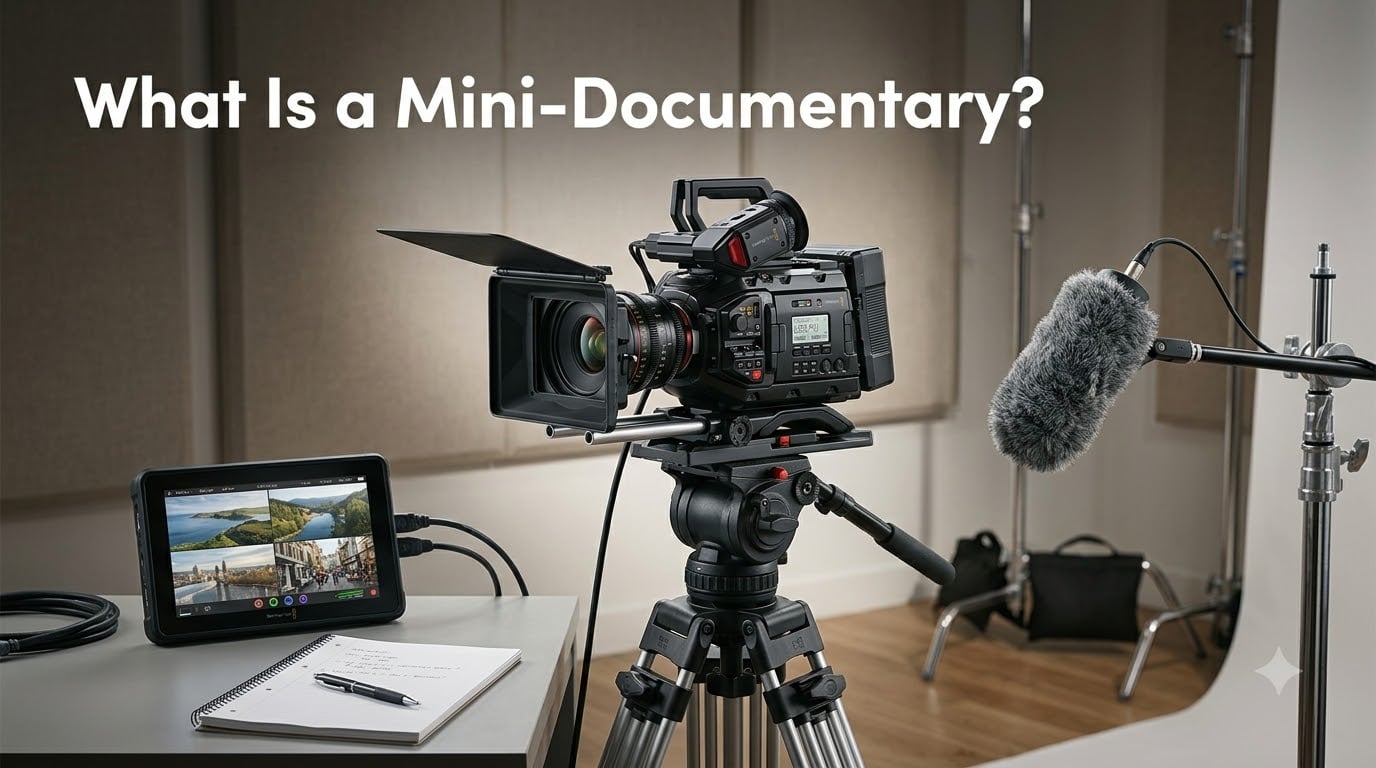
- Gather your equipment. A camera that shoots 1080p or 4K video, an external microphone, a tripod, and basic lighting will cover 90% of beginner mini-docs.
- Conduct interviews and shoot B-roll. Capture your interviews first, then film cutaway footage: hands working, environmental shots, detail close-ups. Shoot at least 3x more B-roll than you think you need.
- Edit for story and emotion. Build a rough cut, then trim ruthlessly. Cut every line that does not push the story forward or deepen the emotional arc.
- Export and distribute. Render in 1080p or 4K, add captions, and publish to the platform that matches your audience.
The step beginners skip most often is question preparation. Without strong interview questions, even a charismatic subject will ramble. Write your questions, then re-write them the night before the shoot. The second pass always produces better answers.
Essential Equipment for Beginners
You don’t need a Hollywood budget to make a strong mini-documentary. Here is the gear I recommend to first-time filmmakers who want quality without overspending.
- Camera: A modern smartphone, mirrorless camera, or entry-level cinema camera works fine. Prioritize clean low-light performance.
- Audio: A shotgun or lavalier microphone is non-negotiable. Bad audio ruins good footage.
- Tripod or gimbal: Stable shots look professional. A basic tripod is enough for interview scenes.
- Lighting: A single LED panel or natural window light can carry an entire mini-doc.
- Editing software: DaVinci Resolve (free), CapCut (free), or Adobe Premiere Pro handle the job.
Famous Mini-Documentary Examples to Watch
If you want to see the format at its best, start with PBS’s Mini Docs series, which profiles everyday voices with striking visuals in under 10 minutes per episode. The series is one of the clearest real-world examples of how short-form documentary can feel both intimate and cinematic.
Other strong references include Searching for Sugar Man director Malik Bendjelloul’s earlier short work, brand-funded mini-docs like Patagonia’s environmental portraits, and student Oscar finalists from the past five years. Most of these run 7 to 15 minutes and pair a single subject with a focused question. Watch them with a notebook. Notice how each one solves the same core problem: making a viewer care in under 15 minutes.
Common Use Cases and Where Mini-Documentaries Shine
Mini-documentaries thrive anywhere a full feature would be too much. Over the past two years, I’ve watched the format pop up in settings that would have once relied on a corporate video or a written profile.
- Film festivals: Many festivals now program dedicated mini-doc and short documentary blocks.
- Schools and universities: Students use the format for capstone projects, journalism classes, and film program reels.
- Social media: Instagram, TikTok, YouTube Shorts, and LinkedIn all reward concise, real stories.
- Brand storytelling: Companies commission mini-docs to highlight customers, employees, or missions.
- Non-profits and education: Charities use the format to share impact stories without long fundraising videos.
- Personal portfolios: Filmmakers use mini-docs to show range and storytelling skill in a single reel.
One trend I keep noticing: schools adopting the format faster than expected. High school media programs are producing mini-docs on local history, family traditions, and small-business profiles. The low equipment cost and short runtime make it the most teachable documentary format available.
Frequently Asked Questions About Mini-Documentaries
How do I make a mini documentary?
Start by choosing a real subject, then research for 3 to 7 days, write 8 to 12 open-ended interview questions, gather basic gear (camera, microphone, tripod), shoot interviews and B-roll, edit for story and emotion, and export for your target platform. The full process takes 2 to 6 weeks for most beginners.
How long is a mini documentary?
A mini-documentary typically runs 2 to 25 minutes, with most falling between 5 and 15 minutes. Micro-docs under 2 minutes exist for social media, while festival-friendly mini-docs run closer to 10 to 25 minutes.
What are the four types of documentaries?
The four traditional documentary types are expository (narrator-driven), observational (fly-on-the-wall), participatory (filmmaker on screen), and poetic (mood-driven). Mini-documentaries usually blend expository and observational styles for clarity in a short runtime.
What is a documentary example?
A clear documentary example is PBS’s Mini Docs series, where each 5-to-10-minute episode profiles an everyday person with interviews, observational footage, and a focused narrative arc. Other examples include brand-funded impact stories and student Oscar-nominated shorts.
Final Thoughts on the Mini-Documentary Format
So, what is a mini-documentary? It is the most efficient way to tell a real story well. A mini-doc gives filmmakers, students, brands, and non-profits a format that respects both the audience’s time and the weight of the subject. You do not need a feature-length budget or a feature-length attention span. You need a true story, a focused question, and the discipline to edit until only the essential remains.
My advice for the year ahead is simple: pick one subject close to you, follow the seven-step process, and finish a five-minute cut. That single finished film will teach you more about non-fiction storytelling than any textbook. Once you have it, share it, submit it, and start the next one. That is how this format grows, one concise story at a time.