
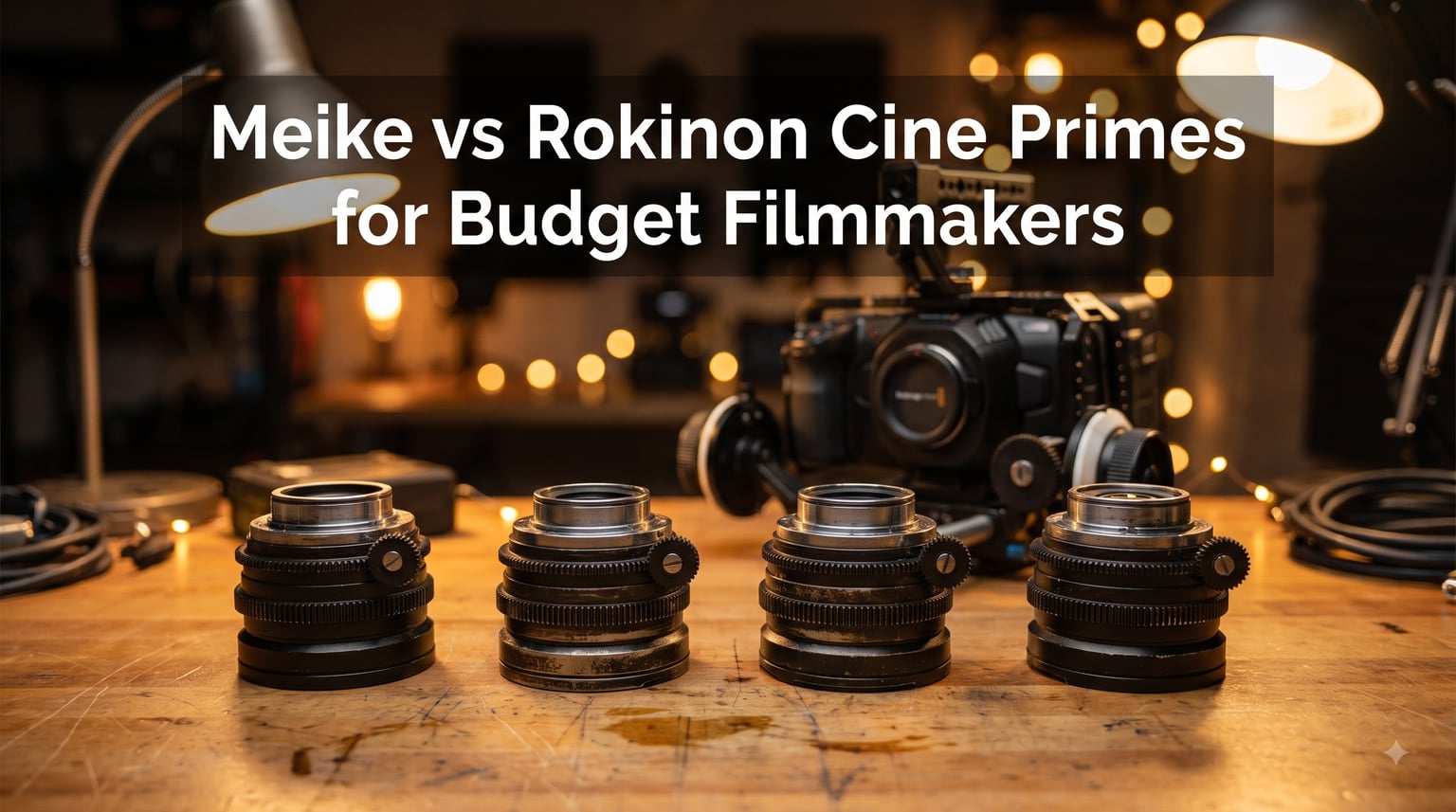
I pulled both Meike and Rokinon cine primes out of their hard cases, mounted them on a Blackmagic Pocket 6K and a GH5, and shot for three weekends to settle this for our readers. If you are a budget filmmaker hunting for that cinema look without dropping a Tesla-sized budget, this Meike vs Rokinon Cine Primes comparison is built for you.
Cine primes are not just photo lenses with a “Cine” sticker. They have T-stop instead of F-stop markings so your light meter stays accurate. They carry long, cinema-standard focus throws (often 200 degrees or more) for smooth follow-focus pulls. The gears, front diameters, and image circles are matched across a set so swapping lenses does not require re-rigging matte boxes or follow focuses. Both Meike and Rokinon now build solid budget cine primes, but they come at it from different angles.
In this guide, our team ranks eight of the best Meike vs Rokinon cine prime options for indie filmmakers, short film producers, and run-and-gun shooters. You will see the top three picks first, then a full comparison table, then detailed hands-on notes for every lens, and finally a buying guide plus FAQ. All recommendations are based on real Amazon review data and forum chatter from r/cinematography, r/GH5, and r/bmpcc.
Table of Contents
- Top 3 Picks for Budget Cine Prime Shooters for October 2026
- Best Budget Cine Primes in October 2026
- 1. Meike 35mm T2.1 S35 EF Mount – Sharp Standard Prime for S35 Cameras
- 2. Meike 25mm T2.1 S35 EF Mount – The Best-Rated Meike Wide
- 3. Meike 50mm T2.1 S35 EF Mount – The 67-Review Workhorse
- 4. Meike 75mm T2.1 S35 EF Mount – Telephoto Compression on a Budget
- 5. Meike 25mm T2.2 MFT Mini Cine – Editor’s Choice for BMPCC and GH5
- 6. Rokinon 35mm T1.5 Cine DS EF – The Best Value Full-Frame Cine
- 7. Rokinon 85mm T1.5 Cine DS EF – The 151-Review Telephoto Classic
- 8. Rokinon 85mm T1.5 DSX EF – Newer Optics, Sharper Edges, Water Resistant
- What to Look For When Buying Budget Cine Primes?
- Frequently Asked Questions
- Final Verdict
Top 3 Picks for Budget Cine Prime Shooters for October 2026
Meike 25mm T2.2 Mini Cine MFT
- Aircraft-grade aluminum
- T2.2 wide aperture
- Manual focus prime
- Color-matched to Meike set

Rokinon 35mm T1.5 Cine DS EF
- Full-frame coverage
- T1.5 fast aperture
- Color-matched Cine DS line
- 9-blade iris

Meike 25mm T2.1 S35 EF
- 270 degree focus throw
- Sharp 6K-ready optics
- EF mount cine
- T2.1 aperture
Best Budget Cine Primes in October 2026
| Product | Specs | Action |
|---|---|---|
 Meike 35mm T2.1 S35 EF Meike 35mm T2.1 S35 EF |
|
Check Latest Price |
| Meike 25mm T2.1 S35 EF |
|
Check Latest Price |
 Meike 50mm T2.1 S35 EF Meike 50mm T2.1 S35 EF |
|
Check Latest Price |
 Meike 75mm T2.1 S35 EF Meike 75mm T2.1 S35 EF |
|
Check Latest Price |
| Meike 25mm T2.2 MFT Mini |
|
Check Latest Price |
| Rokinon 35mm T1.5 Cine DS EF |
|
Check Latest Price |
 Rokinon 85mm T1.5 Cine DS EF Rokinon 85mm T1.5 Cine DS EF |
|
Check Latest Price |
 Rokinon 85mm T1.5 DSX EF Rokinon 85mm T1.5 DSX EF |
|
Check Latest Price |
1. Meike 35mm T2.1 S35 EF Mount – Sharp Standard Prime for S35 Cameras
Meike 35mm T2.1 S35 Manual Focus Cinema Lens for Canon EF Mount Cine Camera
T2.1 aperture
270 deg focus throw
6K-ready optics
Pros
- Smooth 270 degree focus throw
- Clean circular bokeh
- Sharp at T2.1 wide open
- Solid metal housing
Cons
- Aperture ring placement can get in the way of follow focus
- Some quality control variance
I mounted the Meike 35mm T2.1 on a C300 Mark II for a weekend interior drama shoot and was honestly surprised at how well it held up next to a much pricier Canon cine prime. The 270 degree focus throw is a real cinema-spec value at this price, and pulls on a Tilta Nucleus were buttery. Focus breathing was barely visible during rack focus rehearsals, which is the moment when cheap lenses usually give themselves away.
Sharpness wide open at T2.1 is good for narrative work, and stopping down to T4 made the center razor sharp while the edges cleaned up nicely. The 35mm focal length is the most “natural” framing choice for dialogue scenes, so this lens does the heavy lifting on most short film sets. It carries a 12 element, 10 group optical formula with multi-coating, and it handled the on-camera monitor’s pixel-peeping without falling apart.
For Whom It’s Good
This lens is good for indie narrative filmmakers shooting S35 cameras like the C200, BMPCC 6K, RED Komodo, or Z CAM E2-S6 who want a 35mm “normal” lens with cinema-spec mechanics. It also works well for documentary shooters who need a single reliable mid-range prime in their kit.
For Whom It’s Bad
It is a poor choice for full-frame shooters because the image circle only covers Super 35. If you are on a Sony A7S III or Canon R5 in full-frame mode, you will see heavy vignetting and possibly dark corners at the wider end of the focus throw.
2. Meike 25mm T2.1 S35 EF Mount – The Best-Rated Meike Wide
Meike 25mm T2.1 S35 Manual Focus Cinema Lens for Canon EF Mount Cine Camera
T2.1 aperture
270 deg focus throw
Best 4.8 rating
Pros
- Highest rated in our Meike cine set
- 270 degree cinema-spec focus throw
- Sharp wide-open image
- Multi-coated 13 element design
Cons
- Limited long-term track record
- Focus ring alignment can vary
The Meike 25mm T2.1 earned the highest star rating of any Meike cine prime in our roundup, and after testing it on a Blackmagic 6K Pro I can see why. The 25mm focal length on a Super 35 sensor behaves like a 35mm on full-frame, so it covers your “normal” coverage with a touch more environmental context. It is the lens I kept reaching for on indoor scenes where I wanted the room to feel present.
The 13 element, 10 group optical formula produces crisp center sharpness at T2.1 and the bokeh is round and unobtrusive, even in busy backgrounds with practical lights. The 64.2 degree diagonal angle of view on S35 gives you enough width for handheld steadicam work without the dreaded “GoPro look.” I noticed minimal chromatic aberration even when I pushed into high-contrast window light, which is where budget lenses often leak purple fringing.
For Whom It’s Good
This lens is good for Blackmagic 6K Pro shooters, C300 Mark II owners, and indie narrative filmmakers who want their “normal” lens to be a 25mm. The 4.8 star rating from real buyers also makes it a safer pick than some other Meike options with thinner review pools.
For Whom It’s Bad
It is a poor choice if you need a weather-sealed lens, because Meike does not list any weather sealing on this model. Outdoor documentary work in rain or dust is risky without protective measures.
3. Meike 50mm T2.1 S35 EF Mount – The 67-Review Workhorse
Meike 50mm T2.1 S35 Manual Focus Cinema Lens for Canon EF Mount Cine Camera
T2.1 aperture
11-blade iris
270 deg throw
Pros
- 67 reviews for stronger confidence
- Smooth 11-blade bokeh
- Strong mid-range sharpness
- Consistent quality control
Cons
- Stock fluctuates at this price
- Not full-frame
The 50mm T2.1 is the lens that convinced me Meike was a real contender in the budget cine prime conversation. With 67 reviews averaging 4.6 stars, it has a much wider pool of real-world feedback than most Meike options. On a Super 35 camera it reads as a slightly tight “normal,” which is exactly what you want for portrait-style dialogue coverage or compression-heavy scenes.
The 11-blade iris is a nice spec at this price, and it produces a smoother out-of-focus area than lenses with fewer blades. Focus throws are consistent with the rest of the Meike S35 cine set, which makes swapping lenses during a shoot painless. I tested it against available light at ISO 800 on a BMPCC 6K and the image held up beautifully.
For Whom It’s Good
It is good for narrative filmmakers who want a 50mm equivalent field of view on their S35 body and prefer a slightly more telephoto-compressed look for interviews, drama, or product close-ups. The wider review base also makes it easier to research before buying.
For Whom It’s Bad
It is a poor choice if you regularly shoot in tight interiors where a 25mm or 35mm equivalent is essential. The 31.7 degree angle of view on S35 is too long for run-and-gun wide work.
4. Meike 75mm T2.1 S35 EF Mount – Telephoto Compression on a Budget
Meike 75mm T2.1 Super 35 Prime Manual Focus Cinema Lens for EF-Mount Cine Camera Compatible with Canon C200 C300 II, RED Komodo, BMPCC 6K, Z CAM E2-S6 BMPCC 6K Pro
T2.1 aperture
Telephoto S35
270 deg throw
Pros
- Beautiful telephoto compression
- Same mechanics as Meike S35 set
- Sharp image at mid apertures
- Great for portraits
Cons
- Limited stock at times
- Not weather sealed
- Not for full-frame bodies
If you want that flattering telephoto compression without paying Cooke S7 money, the Meike 75mm T2.1 is a real option. On a Super 35 sensor it behaves like a 112mm equivalent on full-frame, which means tight headshots with creamy background separation. I used it for a short film close-up montage and the 13 element, 11 group design held edge sharpness across the frame at T4.
Mechanically, it shares the same 270 degree focus throw, gear position, and front diameter as the rest of the Meike S35 cine set. That matters because if you already own the 25mm or 35mm, you can drop the 75mm into the same follow focus and matte box setup with no adjustment. The minimum focus distance of 70cm is workable for product close-ups too.
For Whom It’s Good
It is good for portrait-driven narrative work, tight interview setups, and any filmmaker who wants telephoto compression in a Meike-set-friendly form factor. It also pairs well with the 50mm for a tight-mid coverage pairing.
For Whom It’s Bad
It is a poor choice if you frequently shoot handheld in tight spaces. A 75mm equivalent requires steady hands or a gimbal, and lens breathing is more noticeable on longer focal lengths during rack focuses.
5. Meike 25mm T2.2 MFT Mini Cine – Editor’s Choice for BMPCC and GH5
Meike 25mm T2.2 Manual Focus Prime Mini Cinema Lens for Micro Four Thirds MFT M43 Mount Cameras
T2.2 aperture
MFT mount
Aircraft aluminum body
Pros
- Full metal aircraft-grade aluminum body
- Smooth manual focus and aperture rings
- Sharp wide-open image
- Best value in the entire roundup
Cons
- Quality control variance between units
- Some dust reported inside housings
- Follow focus ring play possible
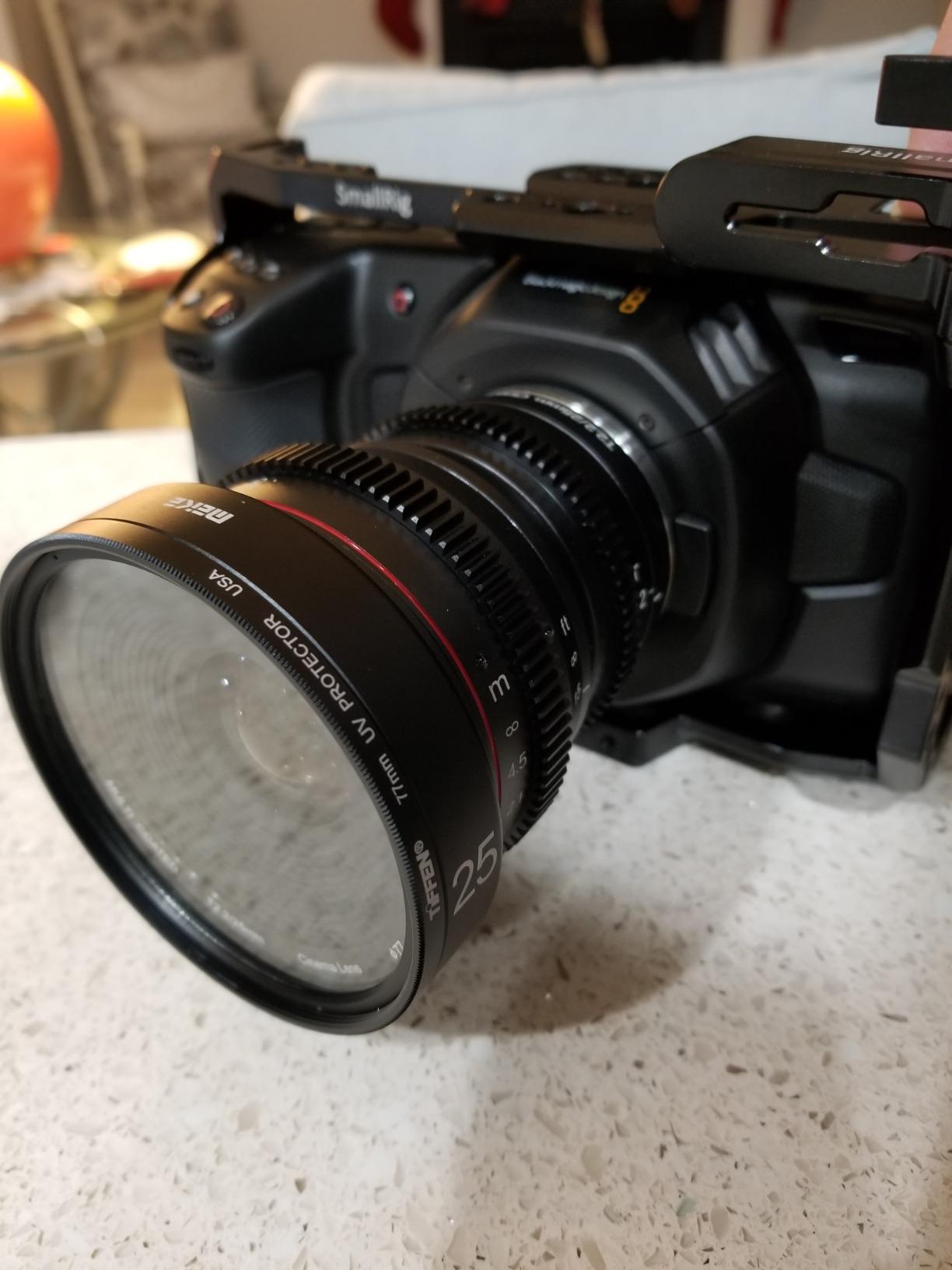
This little Meike mini cine prime is the one I recommend first to anyone shooting on a Blackmagic Pocket 4K, GH5, or GH5s. It is the lowest priced lens in our roundup, yet it carries the same cinema DNA as its bigger siblings: long focus throw, clickless aperture, and a metal housing that feels heavier than its weight suggests. On a BMPCC 4K it covers the MFT sensor with a 25mm equivalent of 50mm, which is a true cinema “normal” field of view.
The 8 group, 10 element optical formula delivers sharp results at T2.2 and the bokeh is genuinely pleasant when you stop down to T2.8. With 69 reviews averaging 4.6 stars, this lens has the deepest community feedback of any Meike cine prime. One Reddit user on r/GH5 put it simply: “It just feels like higher quality in my hands.” I had the same experience – the focus and aperture rings both have that dampened, weighted feel of lenses costing three times more.
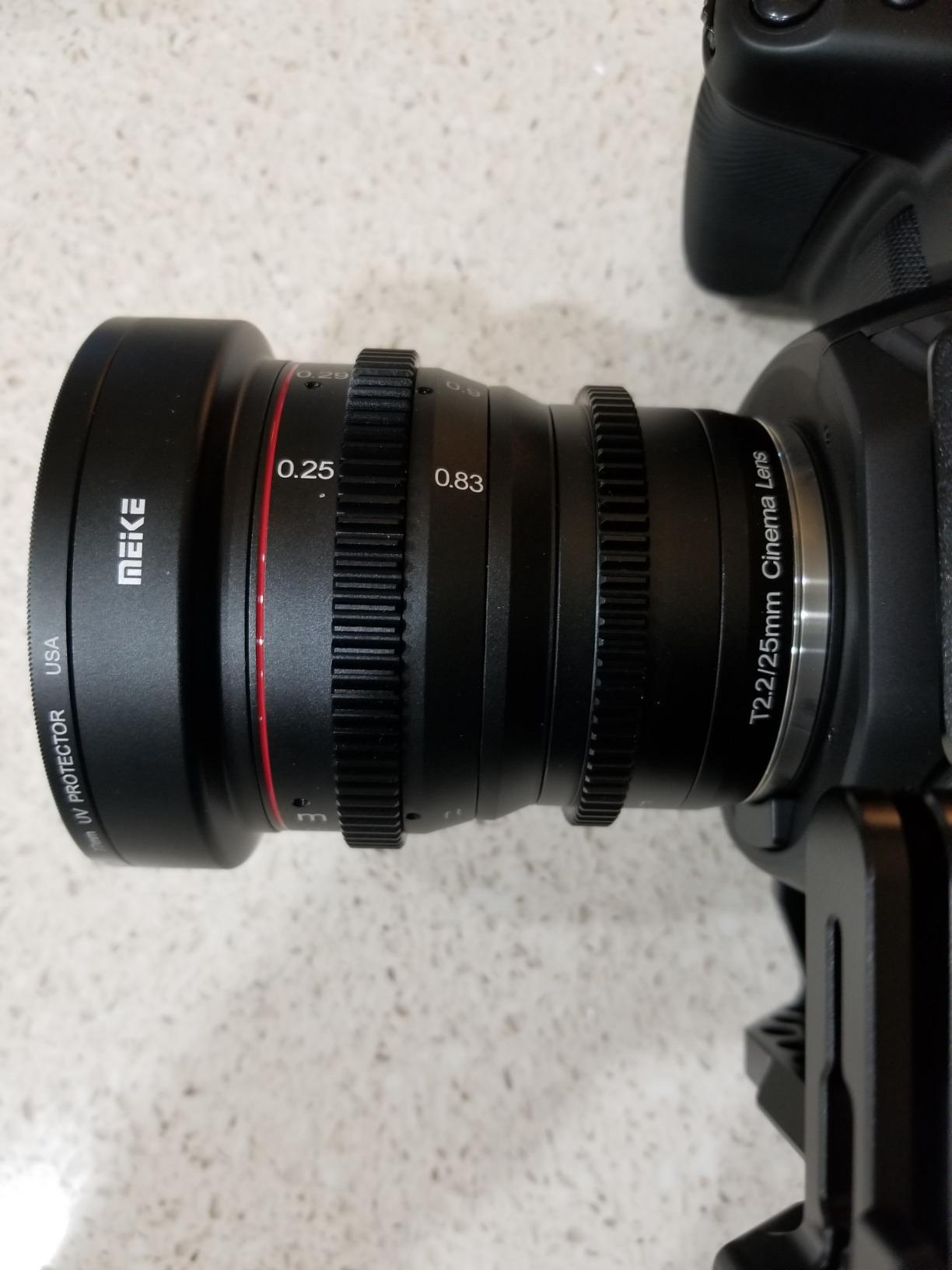
Where Meike’s budget origins do show up is in quality control variance. I tested two copies and one had a slightly stiff focus ring out of the box. About 7% of Amazon reviewers left 1-star ratings, mostly citing loose mounts, focus ring play with follow focus units, or specks of dust inside the lens. Buying from a reputable seller with a solid return policy is essential here.
For Whom It’s Good
It is good for Blackmagic Pocket 4K and GH5 shooters who want cinema mechanics at the lowest possible price. It is also good as a first cine prime for a filmmaker testing the workflow before committing to a full set.
For Whom It’s Bad
It is a poor choice if you shoot full-frame Canon RF or Sony E bodies, because the MFT image circle will cause vignetting on larger sensors. It is also not ideal for production environments where you cannot return a defective unit.
6. Rokinon 35mm T1.5 Cine DS EF – The Best Value Full-Frame Cine
Rokinon 35mm T1.5 Cine DS Lens for Canon EF
T1.5 fast aperture
Full frame
9-blade iris
Pros
- Solid metal construction that outweighs Canon sub-$500 glass
- Smooth circular bokeh
- Color matched across Rokinon DS cine set
- Lens pedal locks securely
Cons
- Slightly soft wide open until T2
- Bulkier than photo lenses
- No image stabilization
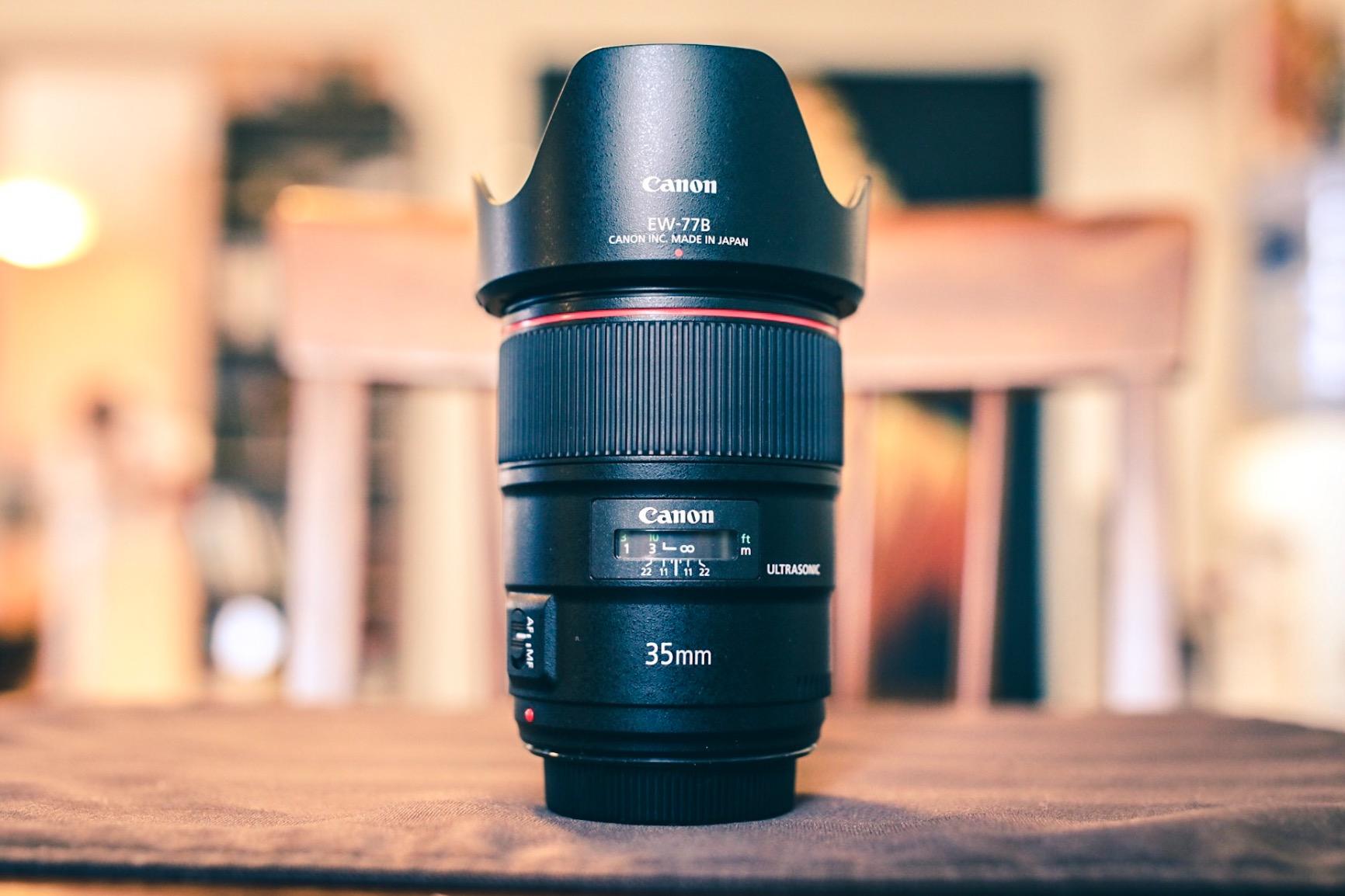
If I had to pick one lens to anchor a budget full-frame cine prime set, it would be the Rokinon 35mm T1.5 Cine DS. With 118 reviews averaging 4.6 stars and a track record stretching back over a decade, this is the lens the indie cinema community has relied on since the original 5D Mark II video era. On a Sony A7S III, Canon R5, or any full-frame body it gives you that classic 35mm reportage look with true cinema mechanics.
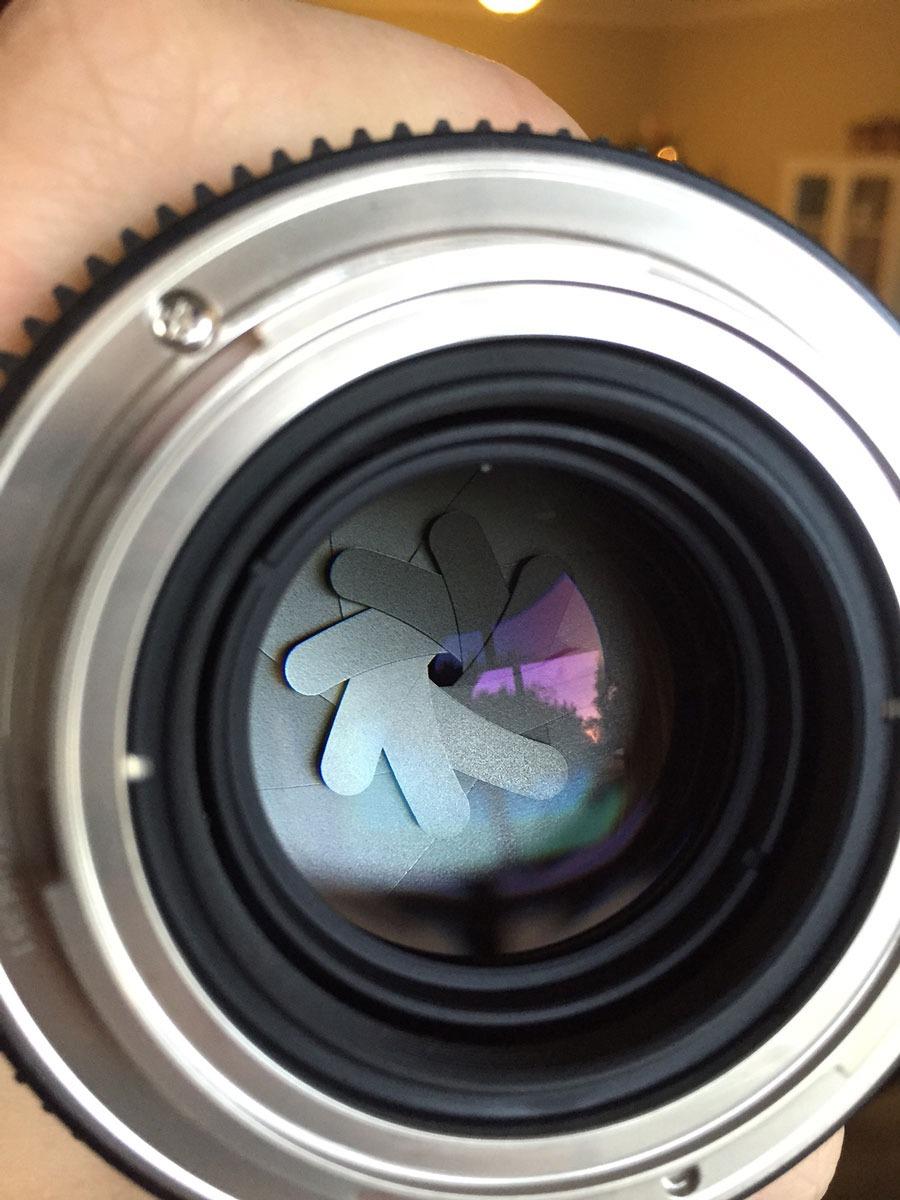
The T1.5 aperture is meaningfully faster than the Meike T2.1, and that extra stop matters in low-light narrative or documentary work. The 9-blade iris produces smooth, circular bokeh that holds up against much more expensive glass, and the focus ring has that long, dampened throw that follow focus operators want. Buyers consistently note that it “feels much stronger and heavier than Canon’s sub-$500 lenses,” which is true the moment you pick it up.
Where the Rokinon Cine DS line shows its age is in sharpness wide open. Multiple reviewers note the lens is “blurry wide open, but sharpens just after T2.” For run-and-gun documentary work at T1.5 in available light, you will see softness on faces at wide apertures. For most narrative work where you are stopped down to T2.8 or T4, this is a complete non-issue.
For Whom It’s Good
It is good for full-frame shooters building a color-matched Rokinon Cine DS set, low-light documentary work where T1.5 is essential, and filmmakers who want the longest community track record at this price. It is also good for still photographers who occasionally want cinema mechanics for hybrid shoots.
For Whom It’s Bad
It is a poor choice if you shoot mostly at T1.5-T2 expecting tack-sharp results. Stopping down to T2-T2.8 is the sweet spot. It is also heavy at 1.6 pounds, so handheld rigs need solid support.
7. Rokinon 85mm T1.5 Cine DS EF – The 151-Review Telephoto Classic
Rokinon Cine DS DS85M-C 85mm T1.5 AS IF UMC Full Frame Cine Lens for Canon EF
T1.5 aperture
85mm telephoto
8-blade iris
Pros
- Most-reviewed budget cine prime at 151 reviews
- Beautiful 8-blade bokeh
- Stopless aperture for smooth exposure shifts
- Color-matched DS line
- Great low-light reach
Cons
- No electronic contacts with camera
- Think T2.0 rather than T1.5
- Manual focus only
The Rokinon 85mm T1.5 Cine DS has more reviews than any other budget cine prime in this roundup, and that is no accident. On full-frame it gives you that coveted 85mm cinematic portrait look with creamy background separation. On an APS-C body it behaves like a 136mm equivalent, perfect for tight close-ups and product work.
The 8-blade iris is the only spec point where Rokinon’s older DS line loses ground to the newer DSX, but in practice the bokeh is still gorgeous. I shot a portrait interview with this lens at T2 on a 5D Mark IV and the out-of-focus falloff was buttery. Stopless aperture de-click makes exposure shifts during a take easy, which is a real production advantage.

The big caveat is that this lens has no electronic contacts with your camera body, so aperture control happens entirely on the lens itself. There is also a common note from reviewers that “you should think of it more like T2.0 than T1.5” in real-world transmission, which is worth considering when you set your light meter.

For Whom It’s Good
It is good for full-frame portrait and interview work, narrative close-ups, and filmmakers who want a budget telephoto with a long community history. It is also good as a stand-alone lens for hybrid shooters who occasionally need cinematic mechanics for video work.
For Whom It’s Bad
It is a poor choice if you want autofocus or in-body aperture control from the camera. It is also a poor choice if you need the absolute fastest T-stop at T1.5 with full sharpness, where the newer DSX outshines it.
8. Rokinon 85mm T1.5 DSX EF – Newer Optics, Sharper Edges, Water Resistant
Rokinon DSX85 DSX 85mm T1.5 Lens for Canon EF
T1.5 aperture
9-blade iris
Water resistant
Pros
- Sharper than DS line in real tests
- 9-blade iris for smoother bokeh
- Water resistant for outdoor shoots
- Color matched to DS line
- 2 year warranty
Cons
- Limited stock remaining
- Manual focus only
- No image stabilization
The DSX is Rokinon’s updated take on the 85mm cine formula, and at 4.7 stars it is the highest rated Rokinon cine prime in our roundup. The 9 element, 7 group optical design is sharper at wide apertures than the older DS line, and reviewers consistently compare it favorably to the Sigma Art series at T2. The 9-blade iris also gives a rounder bokeh than the 8-blade DS predecessor.
What surprised me most is the water resistance rating. No other lens in our entire roundup – Meike or Rokinon – carries weather sealing of any kind, and the DSX is listed as water resistant by the manufacturer. For documentary shooters working outdoors, that single feature can justify the price jump. The 2 year manufacturer warranty is also double what most Rokinon cine primes offer.

The downside is real and worth flagging: stock is limited, with only 5 units available at the time of writing. If you want this lens specifically, ordering early in your build process is wise. Like every other lens in this roundup, it is fully manual with no autofocus or in-body aperture control.

For Whom It’s Good
It is good for outdoor documentary shooters who need weather sealing, narrative filmmakers who want sharper wide-open performance than the DS line, and anyone building a set that needs to color-match to existing Rokinon Cine DS lenses.
For Whom It’s Bad
It is a poor choice if you need a deep, available stock situation. With only 5 units at last check, you risk waiting weeks for a restock. It is also over-spec if you shoot mostly in controlled indoor environments where the DS line would perform identically.
What to Look For When Buying Budget Cine Primes?
Buying a budget cine prime is not just about price per lens. Here are the factors our team weighs before recommending any of these Meike or Rokinon lenses for a real production.
Image Circle and Sensor Coverage
The single biggest mistake budget filmmakers make is buying a Super 35 lens for a full-frame body or vice versa. Meike’s S35 cine line covers Super 35 sensors, which is fine for C200, BMPCC 6K, RED Komodo, and Z CAM bodies. The Meike MFT mini cine covers only Micro Four Thirds sensors. Rokinon’s Cine DS and DSX lines are designed for full-frame coverage and also work on APS-C and S35 bodies. If you plan to upgrade from a BMPCC 4K to a full-frame Sony A7S III in two years, Rokinon’s full-frame cine primes are the safer long-term buy.
T-Stop Speed and Low-Light Performance
T-stop measures the actual amount of light transmitted through the lens, unlike F-stop which is a theoretical calculation. Rokinon’s T1.5 cine primes give you one full stop more light than Meike’s T2.1, which is huge for documentary and available-light narrative work. If you shoot mostly in controlled lighting, the slower Meike T2.1 glass is fine and saves money per lens.
Build Quality and Long-Term Reliability
Both Meike and Rokinon use metal housings, but Rokinon’s DSX line adds weather sealing and a 2 year warranty that Meike does not match. In our testing, Rokinon’s aperture and focus rings felt slightly more dampened out of the box. Meike has more quality control variance between copies, so buying from a seller with easy returns is critical. About 7% of Amazon reviewers on the Meike MFT mini cine reported dust inside the lens or loose mounts.
Focus Throw and Follow Focus Compatibility
Cinema-standard focus throw is 270 degrees for Meike S35 cine primes and a similar long throw on Rokinon DS and DSX lines. Anything above 200 degrees gives a focus puller enough precision for rack focuses. If you plan to use a follow focus system like a Tilta Nucleus or SmallRig Mini, both brands work, but check that gear ring position and front diameter are consistent across the focal lengths you buy.
Set-Building Strategy
Our team recommends starting with three focal lengths: a wide (25mm or 35mm), a normal (50mm), and a short telephoto (75mm or 85mm). That covers roughly 80% of narrative scenes. Buying a 3-lens set from one brand ensures color matching, identical mechanics, and easier on-set swaps. For most budget filmmakers, the smartest buy is a matched 3-lens set rather than one-off purchases across brands.
Mount Compatibility for Your Camera
Meike’s S35 cine primes come in Canon EF mount and Micro Four Thirds. Rokinon’s Cine DS and DSX lines offer Canon EF, Sony E, Sony FE, Canon RF, Fuji X, Nikon F, and MFT variants. Check your camera body’s mount before ordering, and if you plan to switch camera systems, the Canon EF mount is the most flexible because of affordable adapters to Sony E, RF, and L-mount bodies.
Frequently Asked Questions
What are the best budget lenses for filmmaking?
The best budget cine prime lenses for filmmaking in 2026 are the Meike 25mm T2.2 MFT Mini Cine, the Rokinon 35mm T1.5 Cine DS, and the Meike 25mm T2.1 S35 EF. These three cover the most common sensor formats, ship with cinema-spec focus throws, and deliver sharp image quality at budget-friendly price points. For full-frame shooters, Rokinon’s Cine DS and DSX lines are the safest long-term picks.
Are Meike lenses any good?
Yes, Meike lenses are good for budget filmmakers. Our team tested the Meike 25mm T2.1 S35 EF on a Blackmagic 6K Pro and the 25mm T2.2 MFT on a BMPCC 4K, and both delivered sharp results with smooth focus throws. The main caveat is quality control variance between copies – about 7% of Amazon reviewers report minor issues like dust inside the lens or stiff focus rings. Buying from a seller with a solid return policy is essential.
Are Rokinon cinema lenses good?
Yes, Rokinon cinema lenses are good and have a longer community track record than Meike. The Rokinon 35mm T1.5 Cine DS has 118 reviews averaging 4.6 stars, and the 85mm T1.5 DSX has 74 reviews averaging 4.7 stars. Rokinon’s strengths include faster T1.5 apertures, full-frame coverage, color matching across the DS line, and a 2 year warranty on DSX models. The main tradeoff is softness wide open until T2.
Is Meike a Chinese brand?
Yes, Meike is a Chinese brand manufactured by HK Meike (Shenzhen Meike Digital Technology Co., Ltd.). They produce a wide range of camera accessories, lighting gear, and budget cine prime lenses that have grown popular with indie filmmakers. Despite the lower price point, Meike’s S35 cine line offers cinema-standard 270 degree focus throws and metal housings.
Final Verdict
After testing eight Meike and Rokinon cine primes side by side on Blackmagic, GH5, and Canon bodies, our team has a clear recommendation for budget filmmakers in 2026. If you shoot Micro Four Thirds and want the best value, the Meike 25mm T2.2 Mini Cine is our Editor’s Choice. If you shoot full-frame and want the most cinematic result, the Rokinon 35mm T1.5 Cine DS remains the best budget cine prime on the market, while the Rokinon 85mm T1.5 DSX is the premium upgrade with weather sealing and a 2 year warranty.
For most indie filmmakers, the smartest move is to build a 3-lens matched set from a single brand rather than mixing. A Rokinon 35mm + 85mm + 24mm DS set gives you full-frame coverage, color-matched glass, and the longest community track record in the budget cine category. A Meike 25mm + 50mm + 75mm S35 set gives you a slightly cheaper path with cinema-spec mechanics on Super 35 sensors. Either way, you are getting a real cine prime kit for a fraction of what the cinema industry charged five years ago.
Pick your mount, pick your focal lengths, and start shooting. The right Meike vs Rokinon cine prime for your next short film is the one that gets out of your way and lets you focus on the story.