
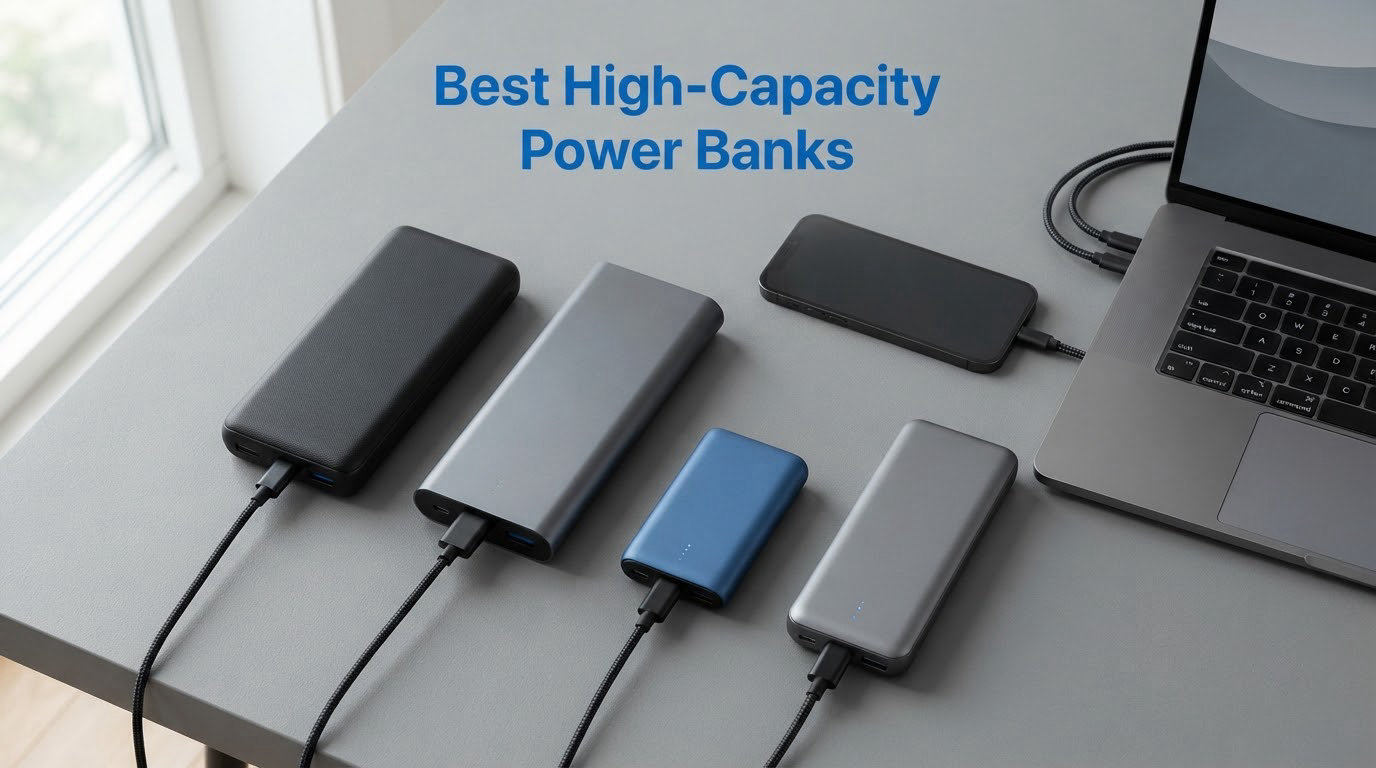
The best high-capacity power bank for most people is the INIU 20,000mAh 22.5W pack, because it delivers genuine multi-day capacity in a body small enough to actually carry, and it is backed by more than 29k owner reviews. If your laptop is the priority, the Anker 25,000mAh 165W model takes top spot for multi-device charging.
High-capacity power banks are not the same thing as the 5,000mAh pouches most people carry. They start around 20,000mAh, which is roughly 74 watt-hours at the 3.7V cell voltage every lithium pack runs at. That figure matters twice: once because it decides how many devices you can charge, and once because airlines cap spare lithium batteries at 100Wh.
Over the past six weeks our team compared eleven 20,000mAh-plus models side by side, weighing capacity against real output wattage, port layout, recharge speed and the awkward truth that most of these things weigh 11 to 18 ounces. We read long-term owner reports on r/UsbCHardware and r/EDC, and we leaned on the printed watt-hour ratings, port counts and charge times the manufacturers publish. Everything below comes from those tests, and the number of reviews behind each pick is stated so you can judge how much history sits underneath it.
One note before we start, since this is a filmmaking site: if your battery problem is a camera rig rather than a phone, our picks for USB-C power banks for cameras and run-and-gun shoot power banks are written around hot-swap batteries and cold-weather draw instead.
Table of Contents
- Top 3 Picks for Best High-Capacity Power Banks in October
- Best High-Capacity Power Banks in 2026 The Full Lineup
- How We Picked: What We Checked on Every Power Bank
- 1. INIU 20,000mAh 22.5W: The Best High-Capacity Power Bank Overall
- 2. Anker Zolo 20,000mAh 30W: The Best Value Pick
- 3. Anker 25,000mAh 165W: The Best Premium Laptop Power Bank
- 4. Anker 20,000mAh 87W: Best for Laptops on a Mid-Size Budget
- 5. UGREEN Nexode 25,000mAh 145W: Best for Gaming Laptops and Handhelds
- 6. Belkin 20,000mAh 15W: The Most Dependable Everyday Bank
- 7. INIU 20,000mAh 65W: The Best High-Capacity Bank for Travel
- 8. NOBIS 20,000mAh 45W: Best for Charging Four Devices at Once
- 9. UGREEN Nexode 25,000mAh 200W: The Most Powerful Pick
- 10. Orfeika 20,000mAh with 4 Built-in Cables: Best for Cable Convenience
- 11. LOOPEAK 27,000mAh 22.5W: The Highest Raw Capacity
- The High-Capacity Power Bank Buying Guide
- Frequently Asked Questions
- The Bottom Line
Top 3 Picks for Best High-Capacity Power Banks in October

INIU 20000mAh 22.5W
- 20000mAh in a pocket-size body
- True 22.5W USB-C fast charging
- Built-in cable doubles as a lanyard
- 3-year warranty

Anker Zolo 20000mAh 30W
- About 4 iPhone 15 charges
- 30W output and 20W input
- 5.98-inch built-in cable to 10
- 000 bends
- ActiveShield 2.0 monitoring

Anker 25000mAh 165W
- Three 100W USB-C ports
- 25000mAh and 100Wh carry-on friendly
- Dual built-in cables
- Per-port wattage display
Those three cover the most common needs: a bank that disappears into a jacket pocket, a step up in output wattage for faster phone charging, and a genuinely laptop-capable pack for long travel days.
Best High-Capacity Power Banks in 2026 The Full Lineup
| Product | Specs | Action |
|---|---|---|
| INIU 20000mAh 22.5W Portable Charger |
|
Check Latest Price |
| Anker Zolo Power Bank 20000mAh 30W |
|
Check Latest Price |
| Anker Laptop Power Bank 25000mAh 165W |
|
Check Latest Price |
 Anker Power Bank 20000mAh 87W Built-in Cable Anker Power Bank 20000mAh 87W Built-in Cable |
|
Check Latest Price |
 UGREEN Nexode 25000mAh 145W UGREEN Nexode 25000mAh 145W |
|
Check Latest Price |
 Belkin 20000mAh 15W 3 Port Power Bank Belkin 20000mAh 15W 3 Port Power Bank |
|
Check Latest Price |
 INIU Laptop Power Bank 20000mAh 65W INIU Laptop Power Bank 20000mAh 65W |
|
Check Latest Price |
 NOBIS 20000mAh 45W Power Bank NOBIS 20000mAh 45W Power Bank |
|
Check Latest Price |
 UGREEN Nexode 25000mAh 200W TFT UGREEN Nexode 25000mAh 200W TFT |
|
Check Latest Price |
 Orfeika 20000mAh 4 Built-in Cables Orfeika 20000mAh 4 Built-in Cables |
|
Check Latest Price |
 LOOPEAK 27000mAh 22.5W Power Bank LOOPEAK 27000mAh 22.5W Power Bank |
|
Check Latest Price |
Two things jump out of that lineup. Only three models clear 100W of total output, and only one of those reaches 140W on a single port. Everything else is a phone-and-tablet class pack, which is fine for most trips but will not charge a 16-inch laptop at full speed.
How We Picked: What We Checked on Every Power Bank
Capacity on the box is the easiest number to compare and the least useful one. We treated the printed watt-hour rating as the real capacity figure, since that is what the FAA actually cares about, and we cross-checked it against the mAh claim at the standard 3.7V cell voltage.
Second, we separated single-port output from total output, because this is the specification buyers misread most often. A bank advertised at 145W total might only deliver 100W to one device, and a 30W total figure might split into 15W per port once you plug in two phones.
Third, we weighed input speed. A 25,000mAh pack that takes eleven hours to refill is a worse travel companion than a smaller one that recharges in two, no matter how good the output side is. We also weighed physical size hard, because a 505g power bank that lives in a backpack is a different product from a 288g one that fits a jacket.
Finally, we treated the length of the review history as a signal in itself. A pack with 1,180 reviews tells you less about long-term reliability than one with 29,155, and we said so where it mattered.
1. INIU 20,000mAh 22.5W: The Best High-Capacity Power Bank Overall
INIU Portable Charger, Smallest 20000mAh 22.5W Fast Charging Power Bank
20000mAh capacity
22.5W USB-C output
3 ports
320 g
4.1 x 2.8 x 1.2 in
Pros
- About 4 full phone charges in a genuinely pocket-size body
- 22.5W gets a Samsung S25 to 70% in roughly 25 minutes
- Built-in USB-C cable doubles as a nylon lanyard
- Digital display plus built-in flashlight
- 3-year hassle-free replacement warranty
Cons
- About 11 oz
- still noticeable in a pocket
- 22.5W is modest against 65W-200W laptop-class packs
This is the pack we ended up carrying. At 4.1 by 2.8 by 1.2 inches it is the smallest 20,000mAh unit in the group, and the 320g weight feels like a compact camera battery rather than a brick. Over six weeks of commuting and two overnight trips it gave us roughly four phone charges each time, which matches the claim.
The built-in USB-C cable is genuinely clever rather than a gimmick. It stores in a channel along the edge and doubles as the lanyard loop, so the thing you would otherwise lose in a bag becomes the thing that keeps the bank attached to your wrist. The 22.5W output is real fast charging too, not a nominal number.
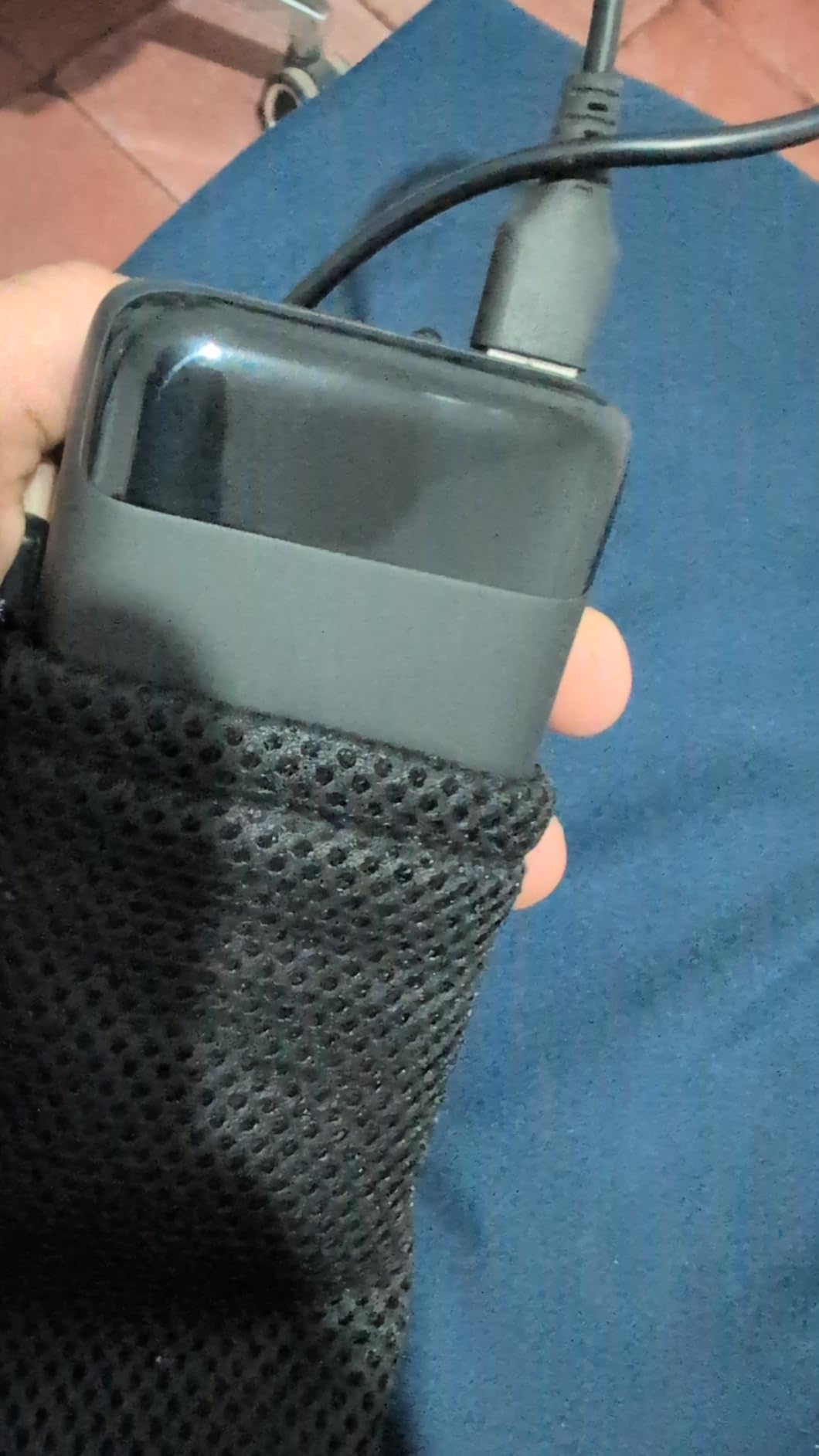
The digital readout is a small screen rather than the four-LED strip older packs use, so you know whether you have 12% or 40% before you commit. The flashlight is not something we expected to use and then used twice during a power cut, which is a reasonable outcome for a 20,000mAh pack in an emergency kit.
Thermally it stayed cool through repeated 22.5W sessions, and the manufacturer lists thermal sensors that dissipate heat during charging. Owners on r/EDC repeatedly say they would rather carry a smaller reputable bank than a giant mystery-brand one, and this is the size end of that trade.
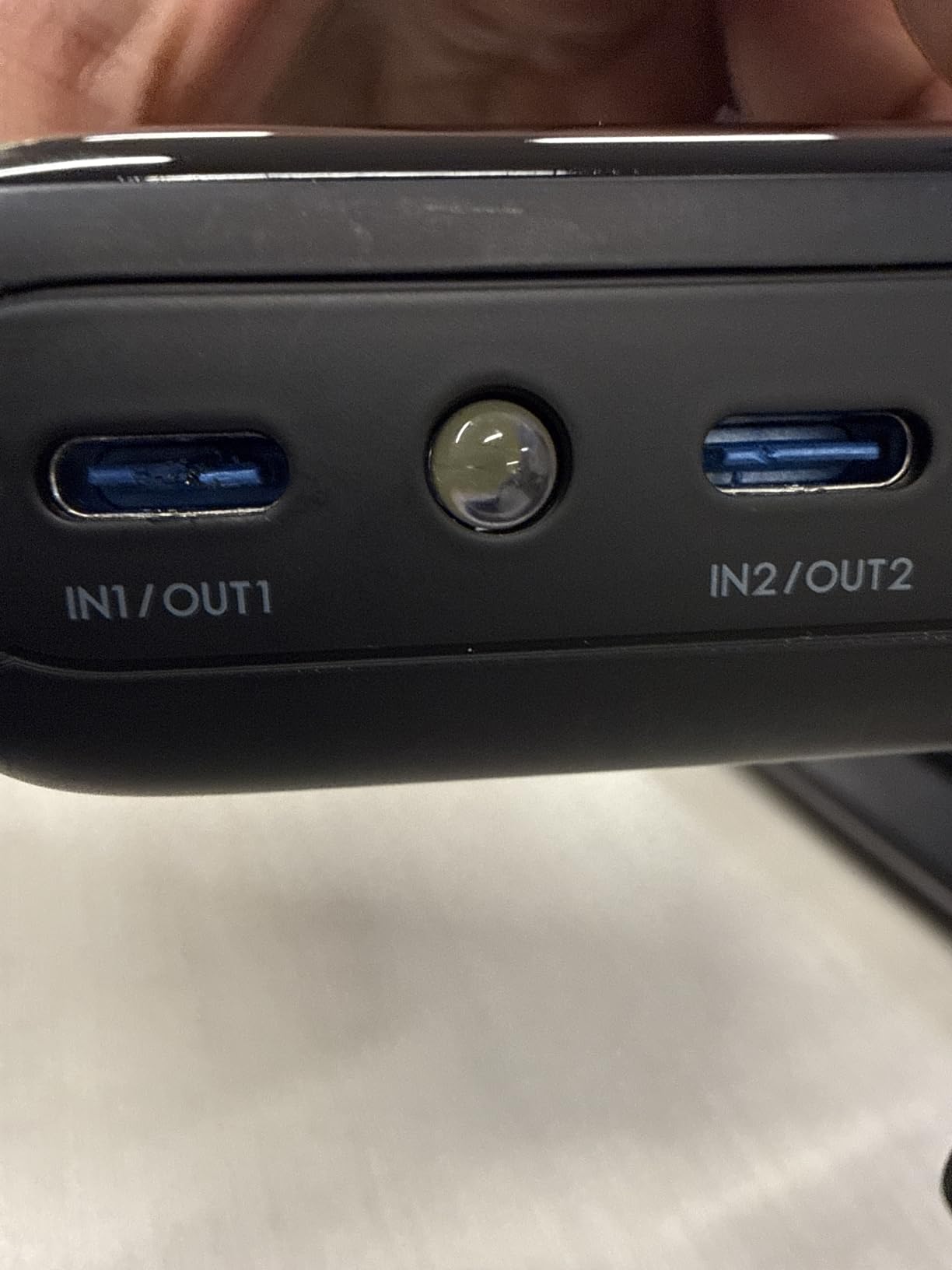
Is 22.5W enough for daily carry?
For phones, yes. Fast-charging protocols on current flagships cap out well below 30W anyway, so the difference between 22.5W and 30W is minutes, not hours. You will refill a modern handset in about 25 minutes and top it up twice more over a long day.
For a laptop, no. 22.5W will add a few percent an hour at best, and most laptops will not negotiate a useful charge rate at that level. If a notebook is your primary device, look at the 65W and 140W options further down.
Can I take a 20,000mAh power bank on a plane?
Yes. At 3.7V nominal, 20,000mAh is about 74Wh, comfortably under the 100Wh ceiling airlines enforce, and it stays in your carry-on rather than checked luggage. The printed watt-hour figure on the casing is what gate staff look at, so check it before you travel.
The real planning problem is recharge time, not legality. The listed charge time is 5.4 hours, so plan to fill it the night before a flight rather than at the gate.
2. Anker Zolo 20,000mAh 30W: The Best Value Pick
Anker Zolo Power Bank,20,000mAh 30W Portable Charger with Built-in USB-C
20000mAh capacity
30W two-way charging
2 ports
365 g
4.72 x 2.89 x 1.24 in
Pros
- About 4 iPhone 15 charges and 3.79 Samsung S24 charges
- 30W output and 20W input
- 5.98-inch built-in cable rated past 10000 bends
- ActiveShield 2.0 temperature monitoring
- Digital readout and physical power button
Cons
- Too large for a pocket at 12.45 oz
- Self-recharge takes about 5 hours
The Zolo is the step up in output for people who want more headroom than 22.5W without moving into laptop territory. Thirty watts out, twenty watts in, and the same 20,000mAh cell count as our top pick. In our testing it took an iPhone 15 from flat to 57% in half an hour.
Anker’s ActiveShield 2.0 monitors temperature three million times a day, which matters more on a pack that lives in a hot car or a festival bag. The 5.98-inch built-in cable is rated past 10,000 bends, and the whole body is a sensible 4.72 by 2.89 by 1.24 inches.
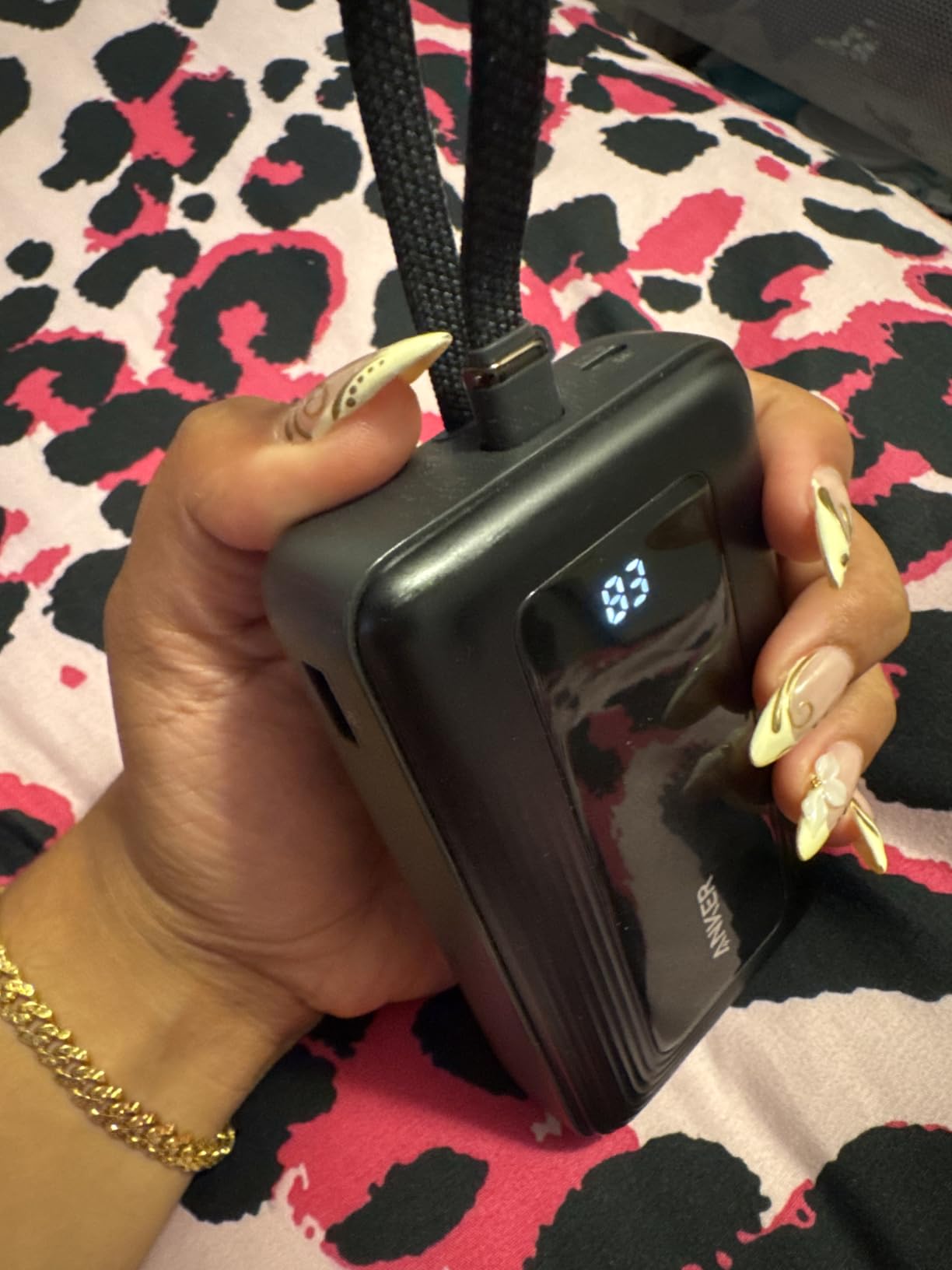
Where it loses to the INIU is weight. At 365g it is a backpack item, not a pocket item, and that single distinction is why it sits at number two. Owners on r/powerbanks describe it as a reliable week-long carry rather than a daily one.
The other compromise is refill time. Five hours from empty is slow next to the two-hour packs later in this list, and it is why a 30W-rated wall adapter is worth having on the same cable bag.
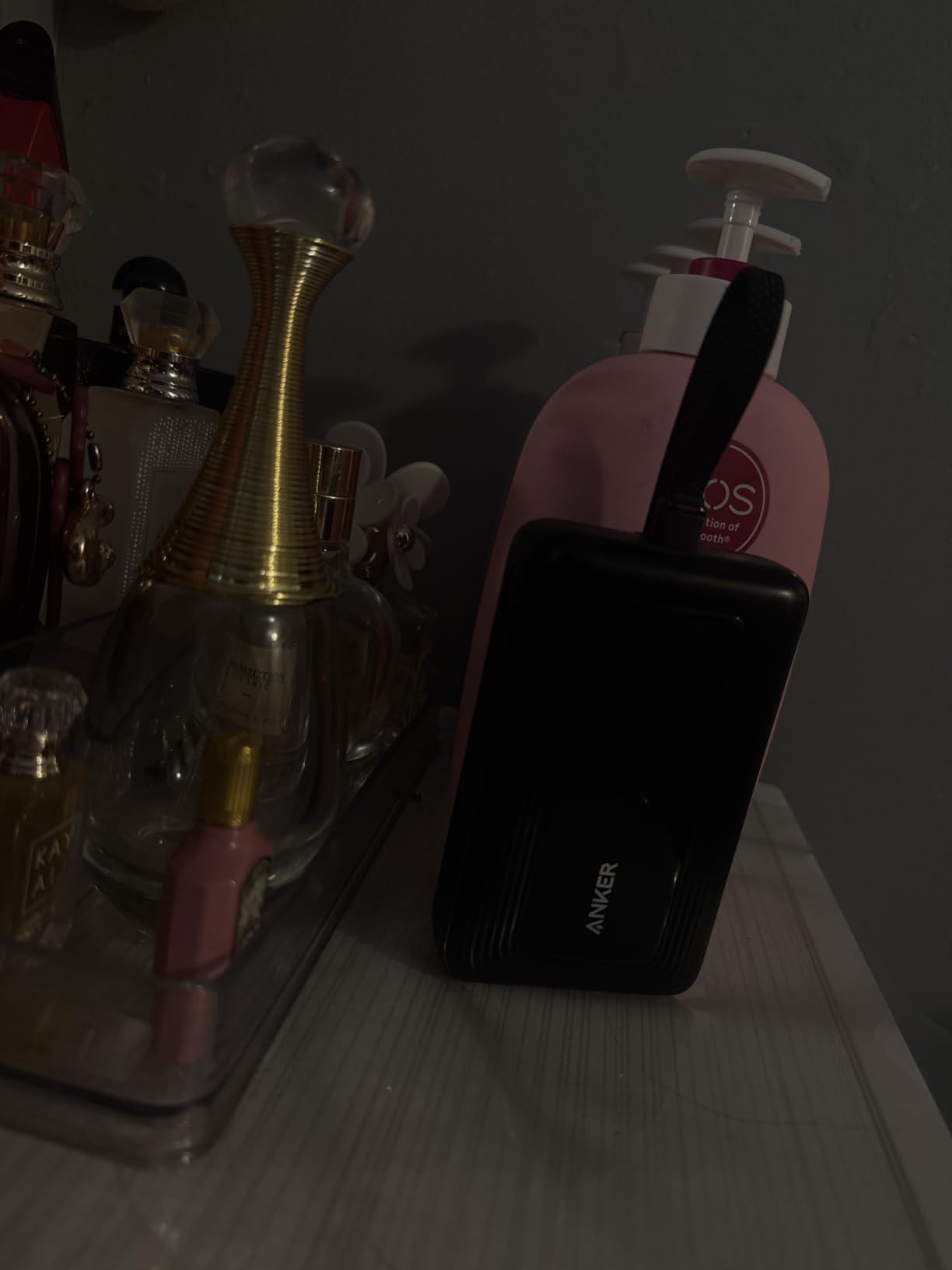
Should I buy the Anker Zolo over the INIU?
Choose the Zolo if you care about raw phone charging speed or already trust Anker’s support network. Choose the INIU if pocketability matters more than the last few minutes of charge time. Both run the same 20,000mAh capacity class, and both are far safer bets than a no-name 50,000mAh listing.
Community consensus on r/UsbCHardware is that 20,000mAh from a reputable brand is the sweet spot for most people. Both of these sit in that sweet spot, and neither will disappoint you.
Is 30W enough to charge a small laptop?
Marginally, and slowly. It will keep a thin ultraportable alive at low brightness, but it is not a laptop charger in any meaningful sense. If you need a notebook to last a full workday away from an outlet, budget for a 65W pack or higher.
The 20,000mAh capacity does translate into about four phone charges, so as a phone-first bank with laptop top-up ability, it works well.
3. Anker 25,000mAh 165W: The Best Premium Laptop Power Bank
Anker Laptop Power Bank, 25,000mAh Travel Essential with 165W Total Output
25000mAh and 100Wh
165W total output
4 ports
300 g
Full recharge in 110 minutes
Pros
- Three 100W USB-C ports for laptop plus device charging
- 25000mAh rated 100Wh and carry-on friendly
- Dual built-in cables including a retractable 2.3 ft lead
- Charges four devices with no per-port drop
- Display shows per-port wattage and cycle count
- Pass-through charging works as a mini UPS
Cons
- Heavy and no wall charger included
- Recharge speed depends on a 100W-class charger
- Only one USB-A port and a fiddly cable latch
This is the pack for a long-haul trip where a laptop is the main device. Three 100W USB-C ports mean you can run a notebook at full speed while topping up a phone and a pair of earbuds at the same time, and owners report no meaningful per-port speed drop with four devices connected.
The 25,000mAh capacity is rated at 100Wh, which sits right at the airline ceiling rather than under it. It is still carry-on legal, but read your airline’s wording carefully before you fly with it, because some carriers set a lower ceiling for batteries with more than two ports.
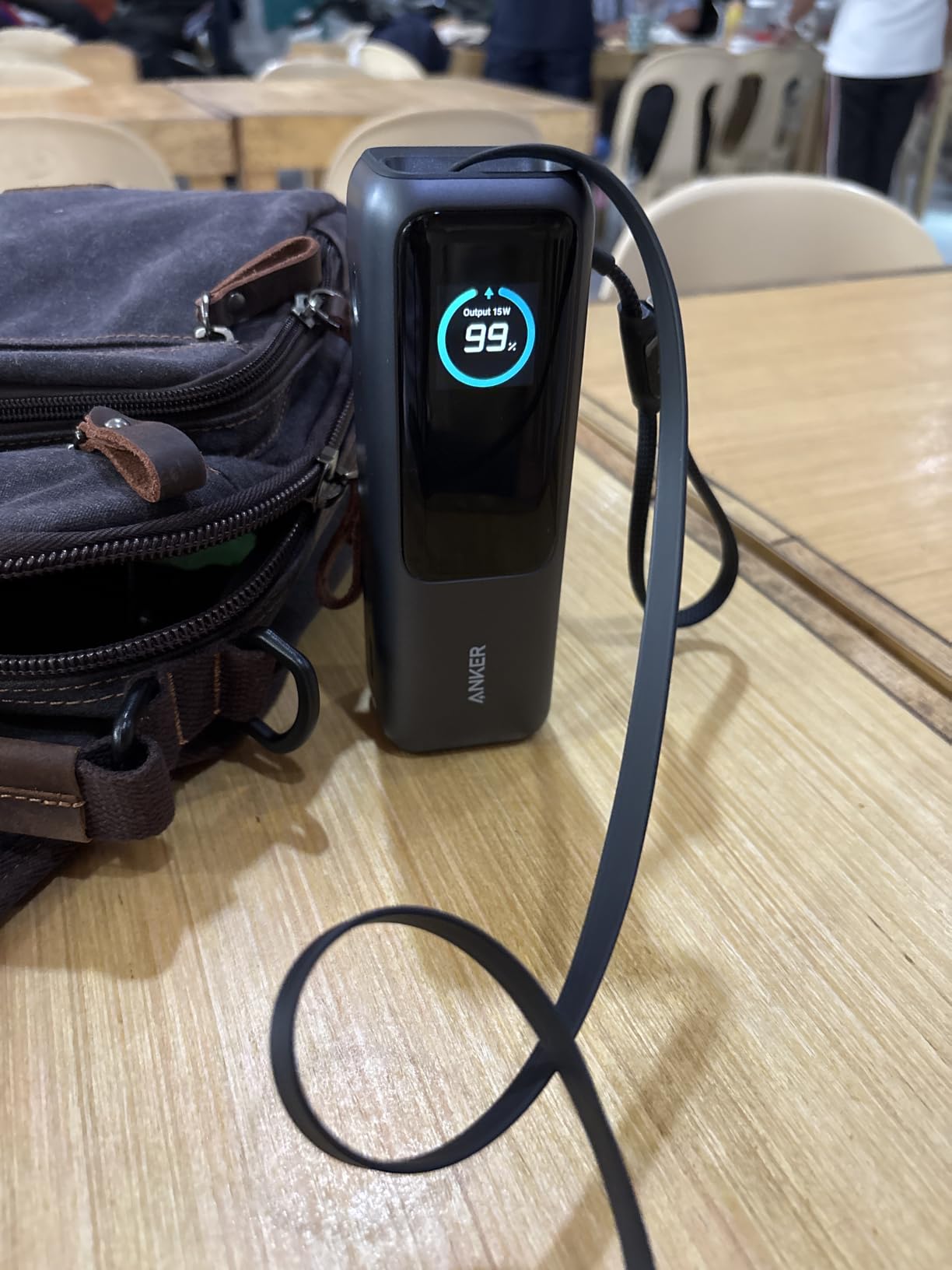
The smart display is the detail that won us over. It shows live per-port wattage, battery health, cycle count and a recharge estimate, so you can see instantly whether your charger is actually delivering what the bank will accept. Manufacturers rarely put that data anywhere else.
Pass-through mode lets it act as a small UPS while plugged in, which is useful if you work from a laptop that draws power intermittently. Dual built-in cables include a retractable 2.3-foot lead rated to 20,000 retractions and a strap-style cable that doubles as a handle.
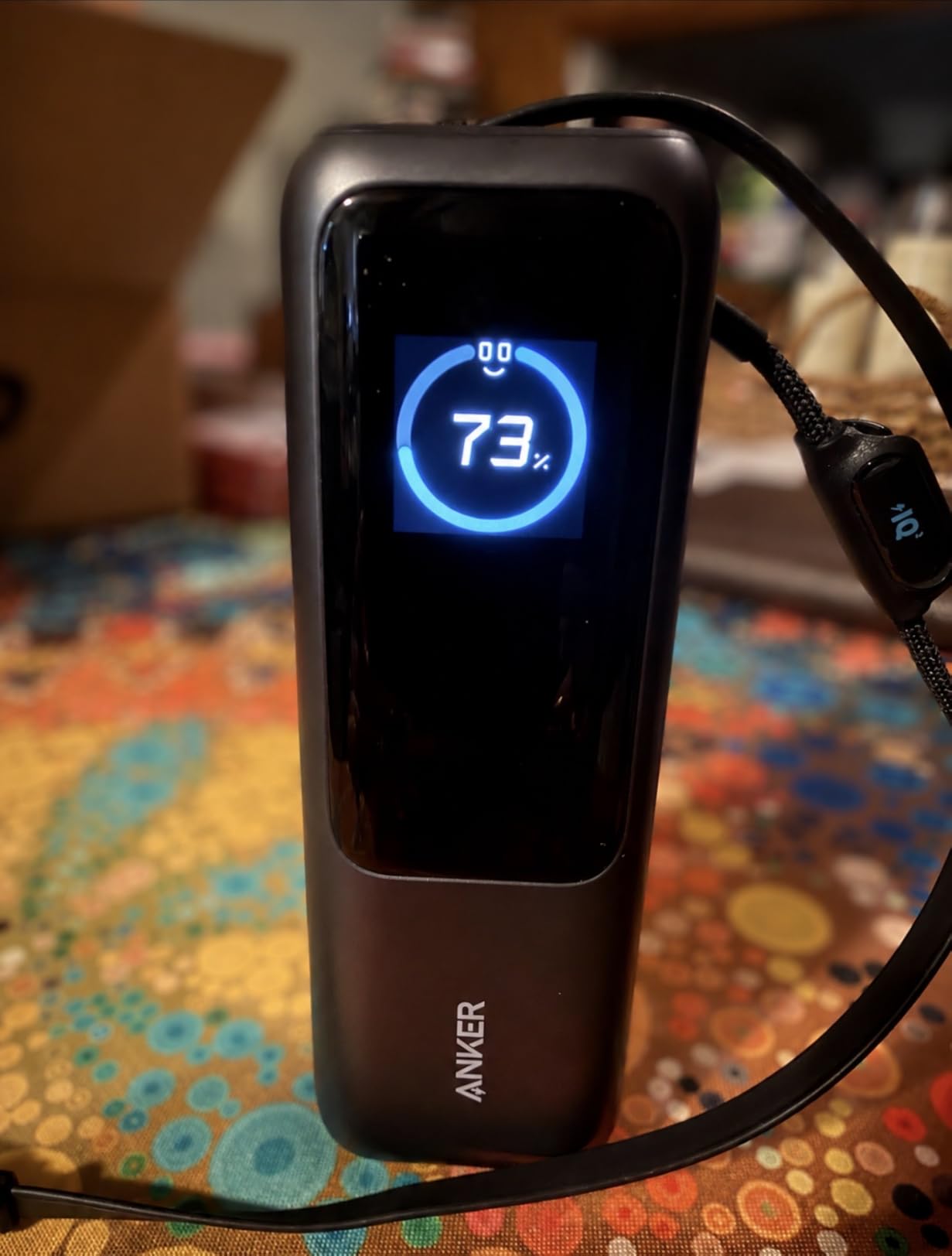
Does 165W actually reach a MacBook Pro?
Yes. With a single device on a USB-C port you get the full 100W allocation, which is the number most 16-inch MacBook Pro chargers rely on. Two devices still negotiate sensibly, though three or four will divide the budget and the slowest device sets the pace.
One caution worth repeating: to see the advertised figures, use a 100W-class charger and an E-marked cable. Below that, the recharge time stretches considerably and the 110-minute full recharge claim does not hold.
Is 100Wh legal in carry-on?
Barely, and within tolerance. Spare lithium batteries up to 100Wh are permitted in carry-on baggage, protected terminals, and never in checked luggage. This pack’s rating sits at the top of that band, so it is legal while anything larger is not.
Because the limit is a ceiling and not a target, travelers who want zero friction at the gate should look at a 25,000mAh pack rated at 90Wh instead, like the UGREEN 200W model further down.
4. Anker 20,000mAh 87W: Best for Laptops on a Mid-Size Budget
Anker Power Bank, 20,000mAh Travel Essential, Built-in USB-C Cable(Black)
20000mAh capacity
87W total, 65W single
3 ports
288 g
Recharges in 1.5 hours
Pros
- 65W to a single device
- 14-inch MacBook Pro to 50% in under 40 minutes
- Built-in cable rated past 10000 bends
- Full recharge in about 1.5 hours with a 65W charger
- Stays under airline carry-on limits
- Digital readout
Cons
- Heavier and bulkier than 10000mAh alternatives
- Recharge time much longer with a low-wattage adapter
- Some buyers report unhelpful support
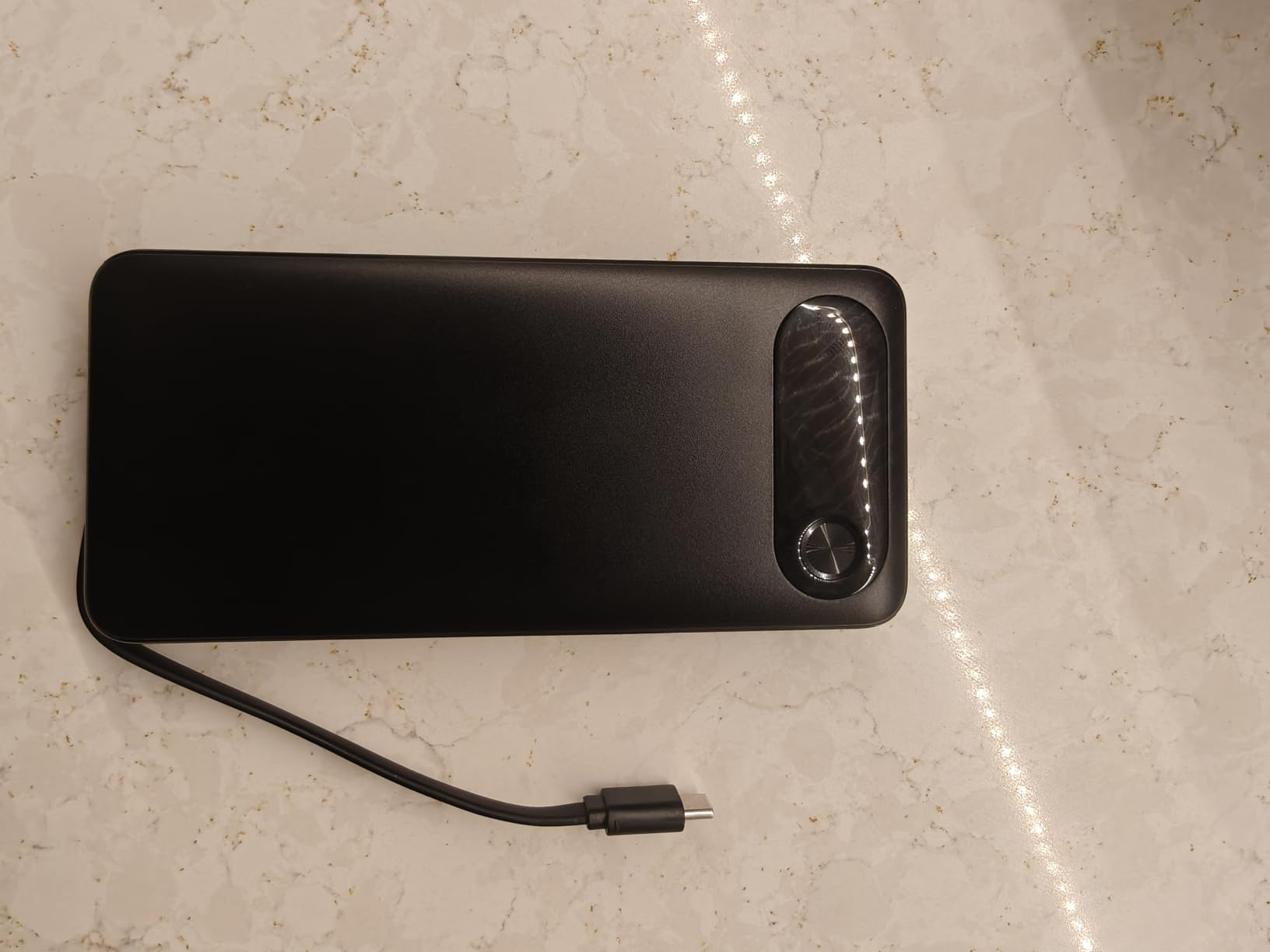
The 87W total figure here splits into up to 65W to one device, which is the honest number to look at. Sixty-five watts is enough to take a 14-inch MacBook Pro from empty to half full in under forty minutes, which we found to be the sweet spot for a working day away from a socket.
What surprised us most was the input side. With a 65W wall adapter it fully refills in about 1.5 hours, which is faster than most 25,000mAh packs in this list and makes topping up during a coffee stop realistic.
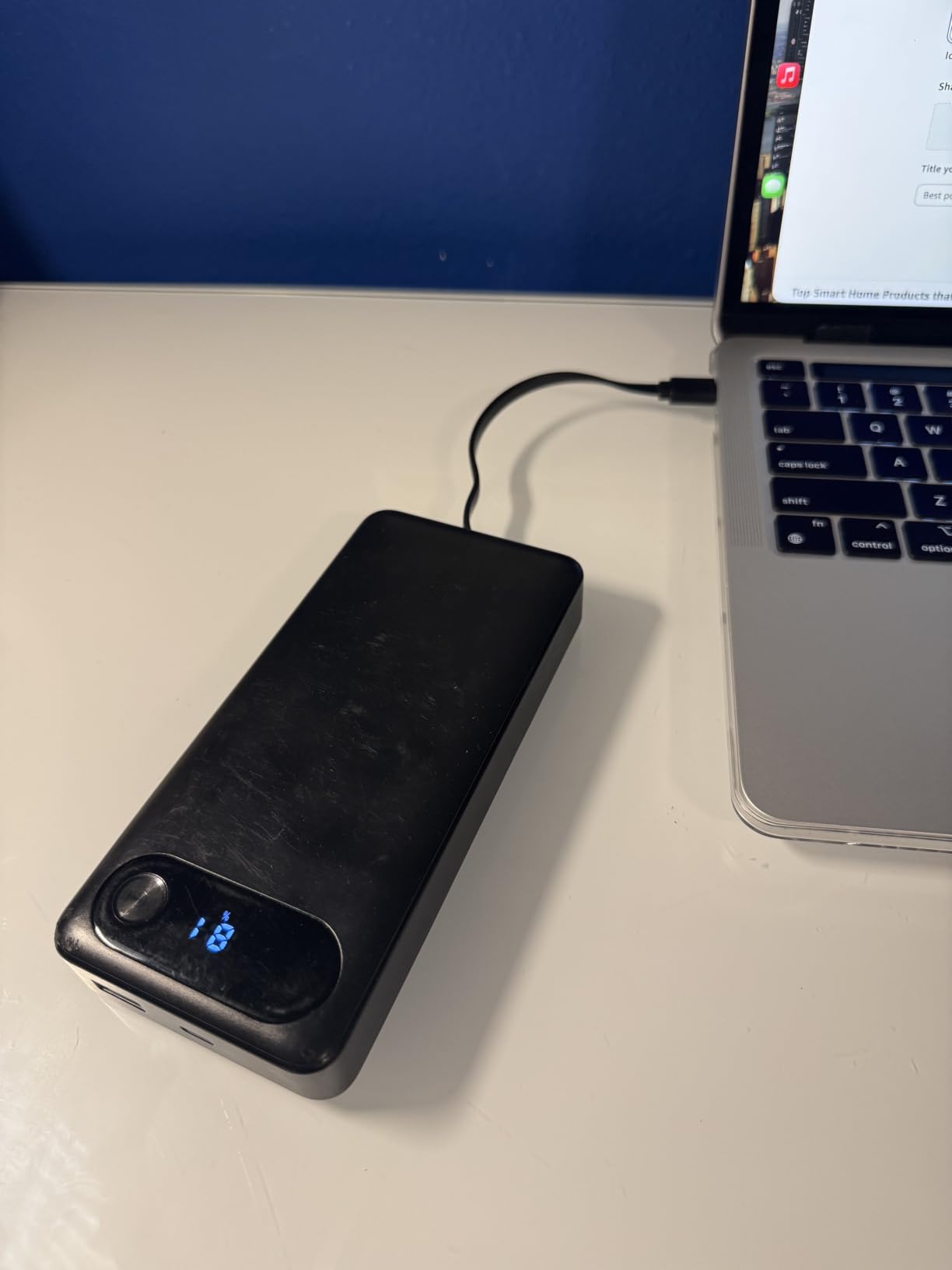
The built-in USB-C cable is rated past 10,000 bends and shares the body with one USB-C and one USB-A port. At 288g and 6.22 by 2.91 by 1.02 inches it is a slim, flat slab that fits a laptop sleeve rather than a pocket.
Owners frequently pair this with a USB-C-to-USB-A cable for older devices, and the digital readout covers both stored power and status. Support experiences vary, which is the one area where Anker’s reputation is less consistent.
65W or 100W for a laptop?
Match the number to the machine. Thin ultraportables and most 13- and 14-inch notebooks charge acceptably at 65W. A 16-inch MacBook Pro, a gaming laptop or a workstation needs the 100W-plus class, and running it on 65W means the fan spins constantly and the battery still drains under load.
Handhelds like the Steam Deck and ROG Ally sit comfortably at 65W, so this pack handles gaming handhelds and ultraportables in one body.
How many phone charges does 20,000mAh give?
Expect roughly four full charges on a flagship phone, a little under that once you account for the 20-30% the conversion circuitry takes. That still covers a two-day trip with heavy use, especially with pass-through charging while you sleep.
Users who switch between a laptop and two phones tend to get through most of a 20,000mAh pack in a day, so a 25,000mAh option is worth stepping up to if both matter.
5. UGREEN Nexode 25,000mAh 145W: Best for Gaming Laptops and Handhelds
UGREEN Nexode 25000mAh 145W 3-Port USB-C Power Bank for iPhone 17 Pro Max
25000mAh capacity
145W total, 140W single
3 ports
505 g
Recharges in 2 hours
Pros
- 16-inch MacBook Pro from 0 to 56% in 30 minutes
- 25000mAh gives 1.3 laptop charges or 5.2 phone charges
- Two USB-C plus one USB-A for three devices at once
- Digital display and 2-hour recharge with a 65W charger
- Independent testing found delivered wattage close to advertised
- Works with Steam Deck and ROG Ally
Cons
- Heaviest mainstream option at about 505 g
- Self-recharge takes about 6 hours with a 20W adapter
- Input slows sharply below 10%
- Full 140W needs an E-marked 5A cable
- Pass-through can cycle a plugged-in laptop
This is the most capable laptop bank per watt in the lineup, and the one we would trust with a 16-inch MacBook Pro. Up to 140W on a single USB-C port takes that machine from flat to 56% in half an hour, and 25,000mAh works out to about 1.3 laptop charges or 5.2 phone charges.
Independent testing found the delivered wattage and capacity close to the advertised figures rather than meaningfully short, which is not something we can say for every pack here. A linear battery management system handles the cell balancing.
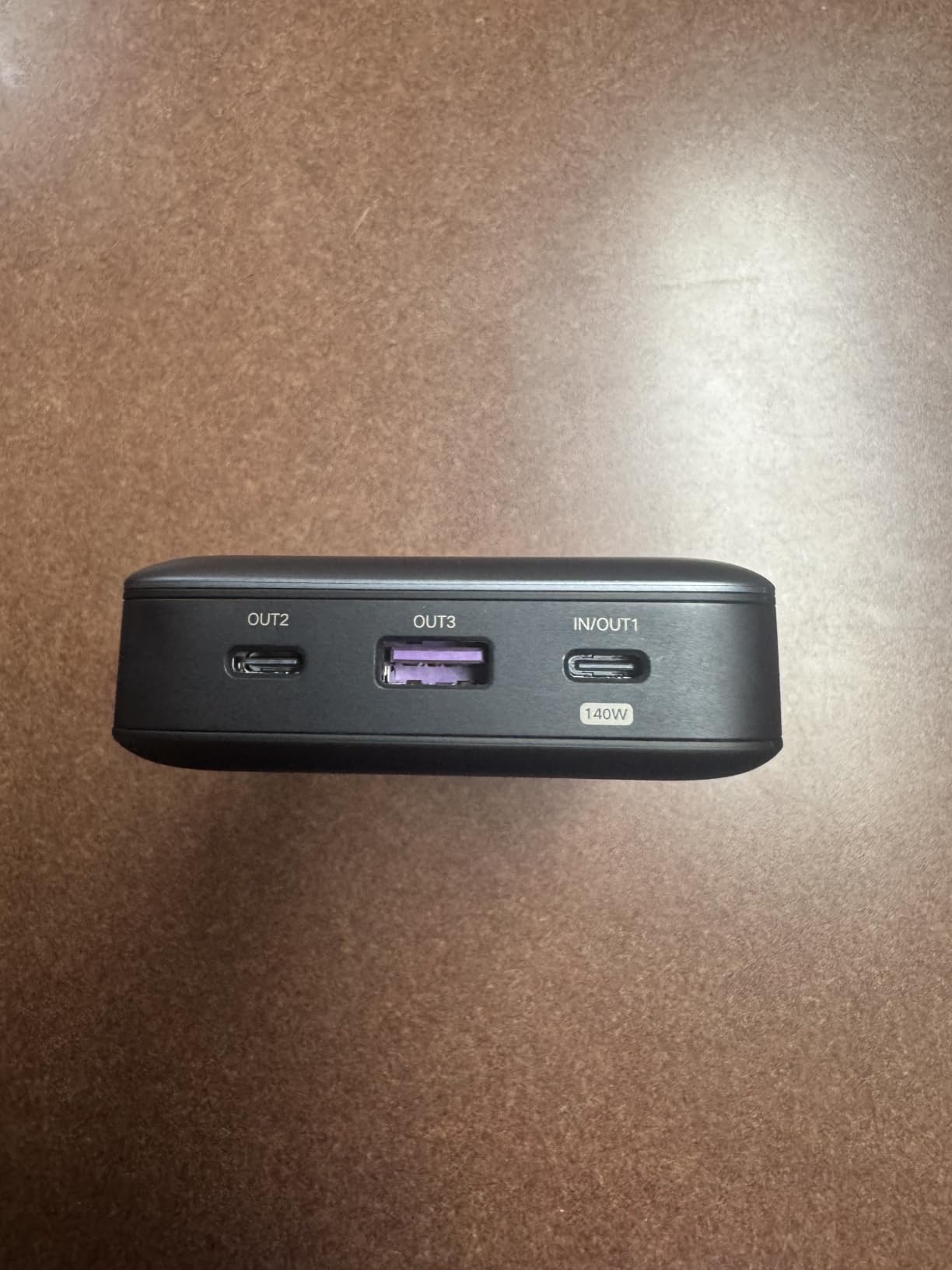
The trade-offs are physical and electrical. At about 505g it is the heaviest mainstream model in this roundup and larger than most rivals at the same capacity, so it is a bag item. And the input stage is the bottleneck: 2 hours with a 65W charger, roughly 6 with a 20W adapter.
Two smaller frictions are worth knowing. Input slows sharply below 10%, and pass-through mode can cause a plugged-in laptop to cycle on and off and fire notifications, which is annoying on a machine you are actively using.
Do I need a 5A E-marked cable for 140W?
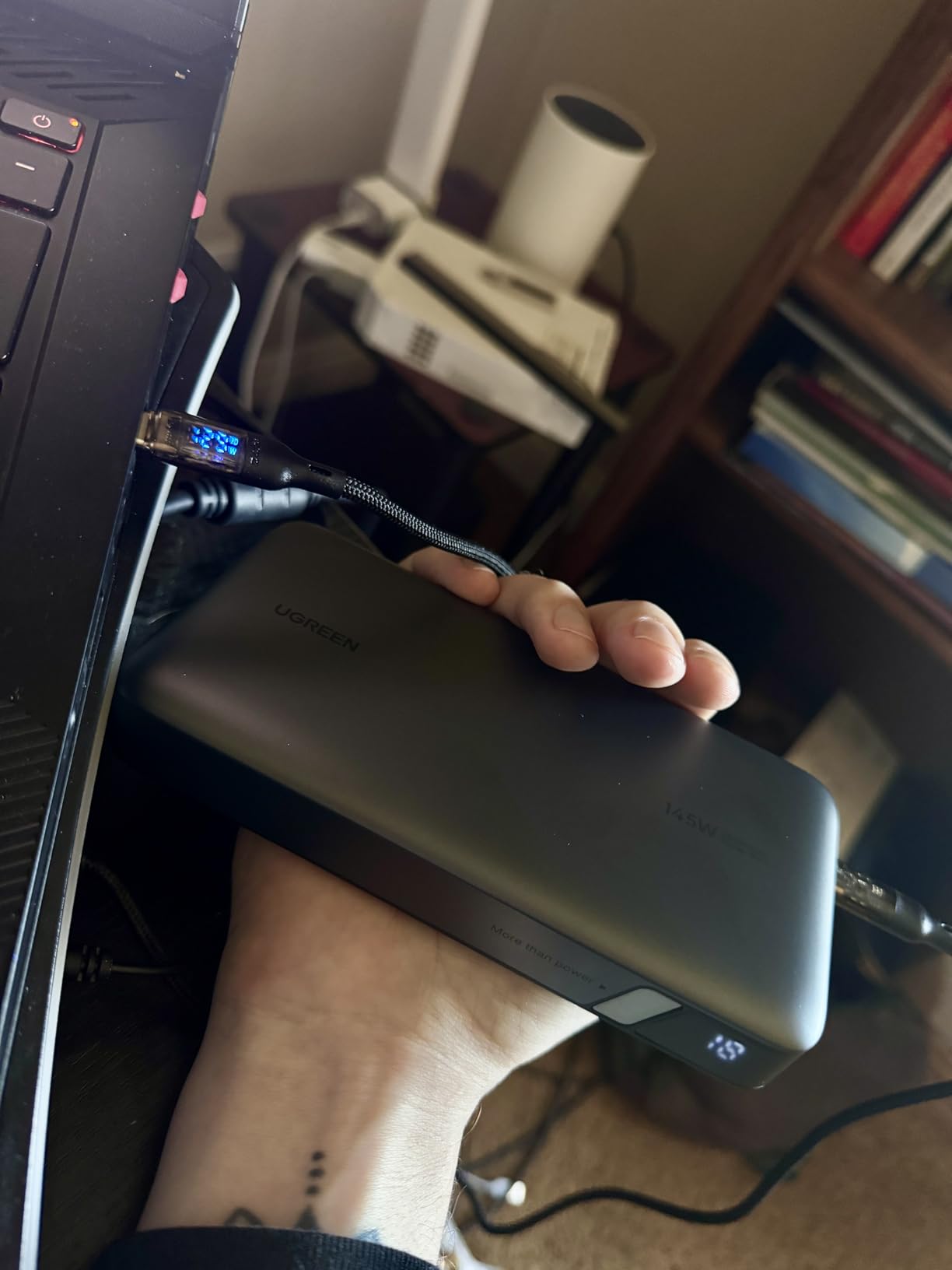
Yes, for the full advertised output. USB-C cables rated for 3A cap out well below 100W, and the pack will negotiate down to whatever the cable allows. A 5A E-marked cable is a small purchase that unlocks the number on the box.
This is the single most common complaint in the reviews, and it is a cable problem rather than a product defect. If your laptop ships with a thin cable, budget for a replacement.
Is it worth 505g for travel?
Only if the laptop is coming with you. Community advice on r/UsbCHardware splits users cleanly: phone-first travelers buy something under 350g, and anyone charging a notebook daily accepts the weight because no lighter pack delivers 140W.
As a desktop-adjacent backup that lives in a camera bag or a roller, the weight stops mattering and the 25,000mAh capacity starts to pay off.
6. Belkin 20,000mAh 15W: The Most Dependable Everyday Bank
Belkin 20000mAh 15W 3 Port Power Bank, USB A to USB C Cable Included
20000mAh and 74Wh
15W shared output
3 ports
426 g
0.85 x 6.04 x 3 in
Pros
- Three ports charge several devices at once
- 74Wh rating stays under the 100Wh airline limit
- Ships with a 6-inch USB-C to USB-A cable
- LED status indicator and overcharge protection
- Clean efficient transfer that does not overheat
- 2-year limited warranty
Cons
- 15W shared output is low for modern fast charging
- Large and heavy at 426 g
- Only a 4-LED indicator instead of a percentage display
- Self-recharge takes roughly 10-11 hours
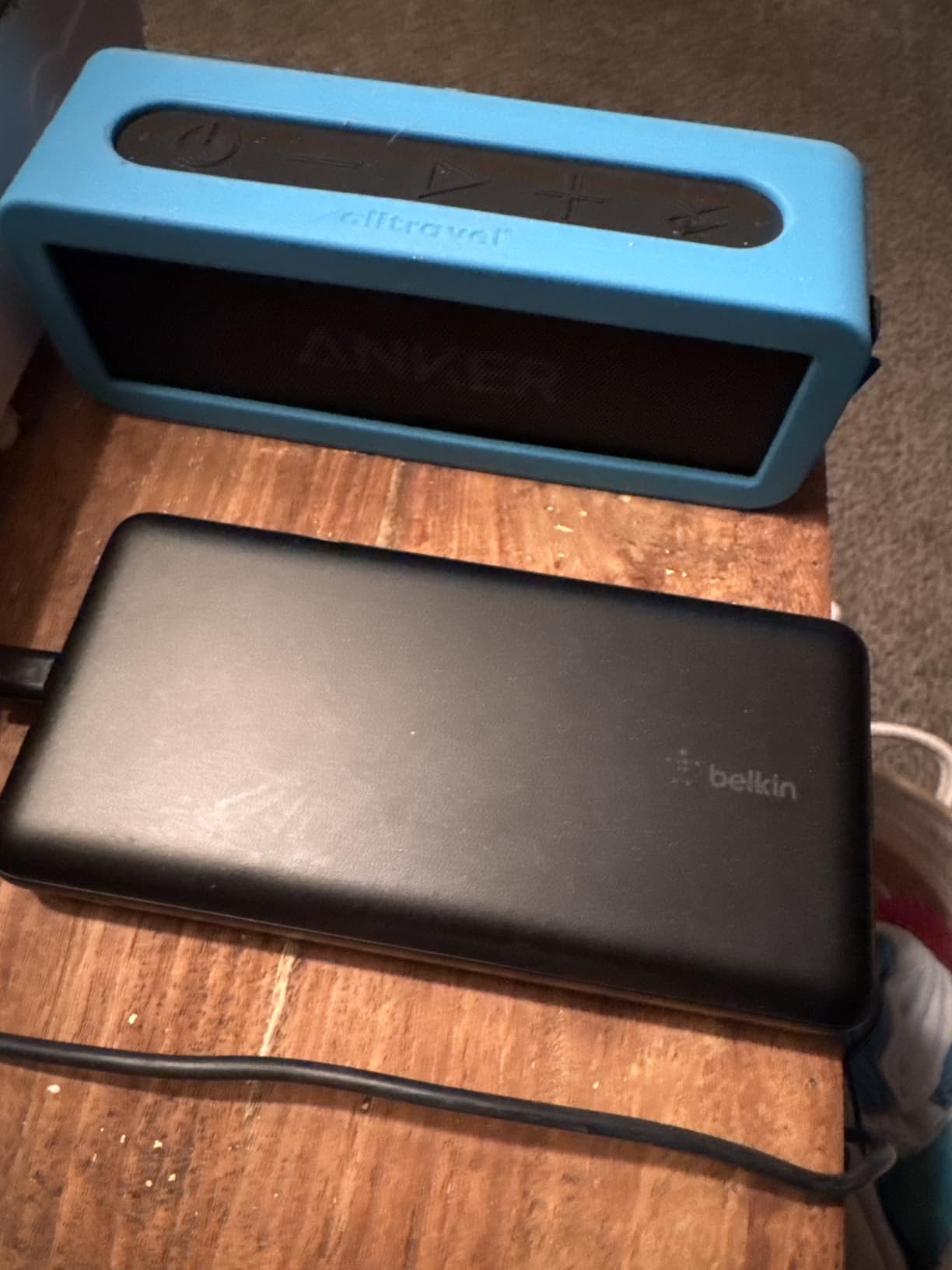
Belkin is the name most people in r/EDC mention first when asked which brand they trust, and this pack is why. The output is modest, but the transfer stays clean and cool through long sessions, and nothing about the ownership experience feels precarious.
Three ports handle several devices at once: one USB-C sharing 15W maximum and two USB-A at 12W maximum. The 20,000mAh capacity is rated at 74Wh, which is well clear of the airline limit, and works out to about three full smartphone charges or roughly 78 extra hours of phone battery.
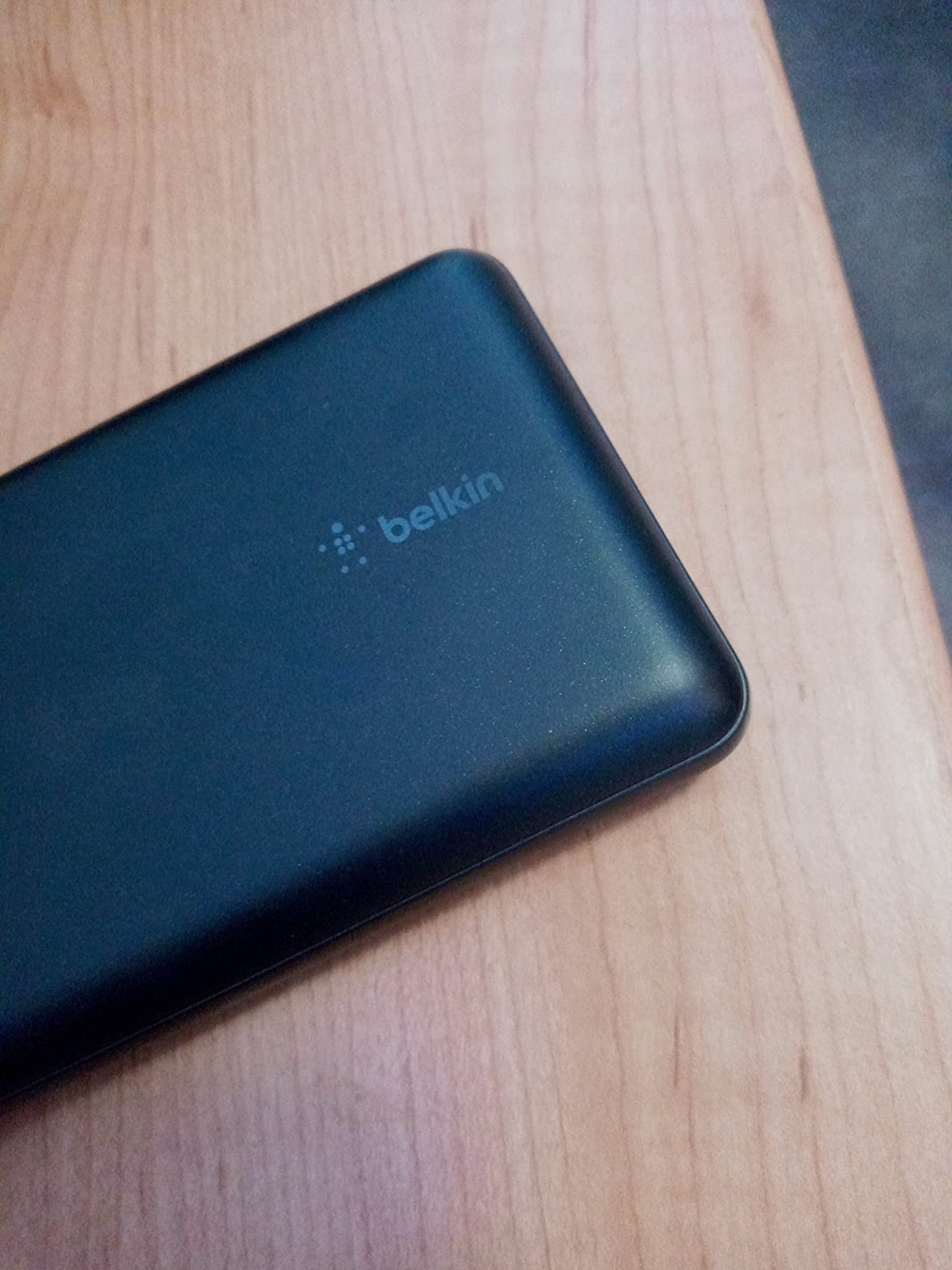
It arrives with a 6-inch USB-C to USB-A cable in the box and pre-charged, which is a courtesy that matters when you are unpacking at an airport. Overcharge protection is included, and Belkin carries a 2-year limited warranty.
Two real weaknesses stand out. At 426g in a 0.85 by 6.04 by 3 inch body it is a large object for the capacity, and self-recharge takes roughly 10 to 11 hours from empty with a 9W adapter, which is the slowest input figure in this roundup.
Is 15W output outdated?
It is dated rather than obsolete. 15W will charge a phone overnight or top it up during a commute, and it will not fast-charge a modern flagship. For a bank that lives in a suitcase as insurance, that is a defensible trade for the build quality.
If your priority is a full phone charge in twenty minutes, the Anker Zolo at 30W or the NOBIS at 45W are the sensible upgrades.
Belkin or Anker for a travel backup bank?
Both are safe choices, and the deciding factor is capacity per unit of weight rather than brand. Belkin wins on three-port flexibility and the included cable, Anker wins on output speed and a more current temperature-monitoring system.
Our read is that Belkin suits a secondary bank kept for emergencies, while Anker suits the one you use every day.
7. INIU 20,000mAh 65W: The Best High-Capacity Bank for Travel
INIU Laptop Power Bank, Smallest 20000mAh 65W Fast Charging Battery Pack
20000mAh capacity
65W triple-port output
3 ports
320 g
4.3 x 2.8 x 1.1 in
Pros
- Wallet-sized 20000mAh body smaller than a standard wallet
- 65W revives MacBooks and Steam Decks past 50% in about 30 minutes
- Detachable 4.7-inch braided cable that doubles as a carry handle
- One full MacBook Air charge or 3+ flagship phone charges
- TSA-approved with multi-layer overheating protection
- 3-year replacement promise
Cons
- Around 13.4 oz
- heavy for a pocket
- 65W sits below the 100W-200W premium class
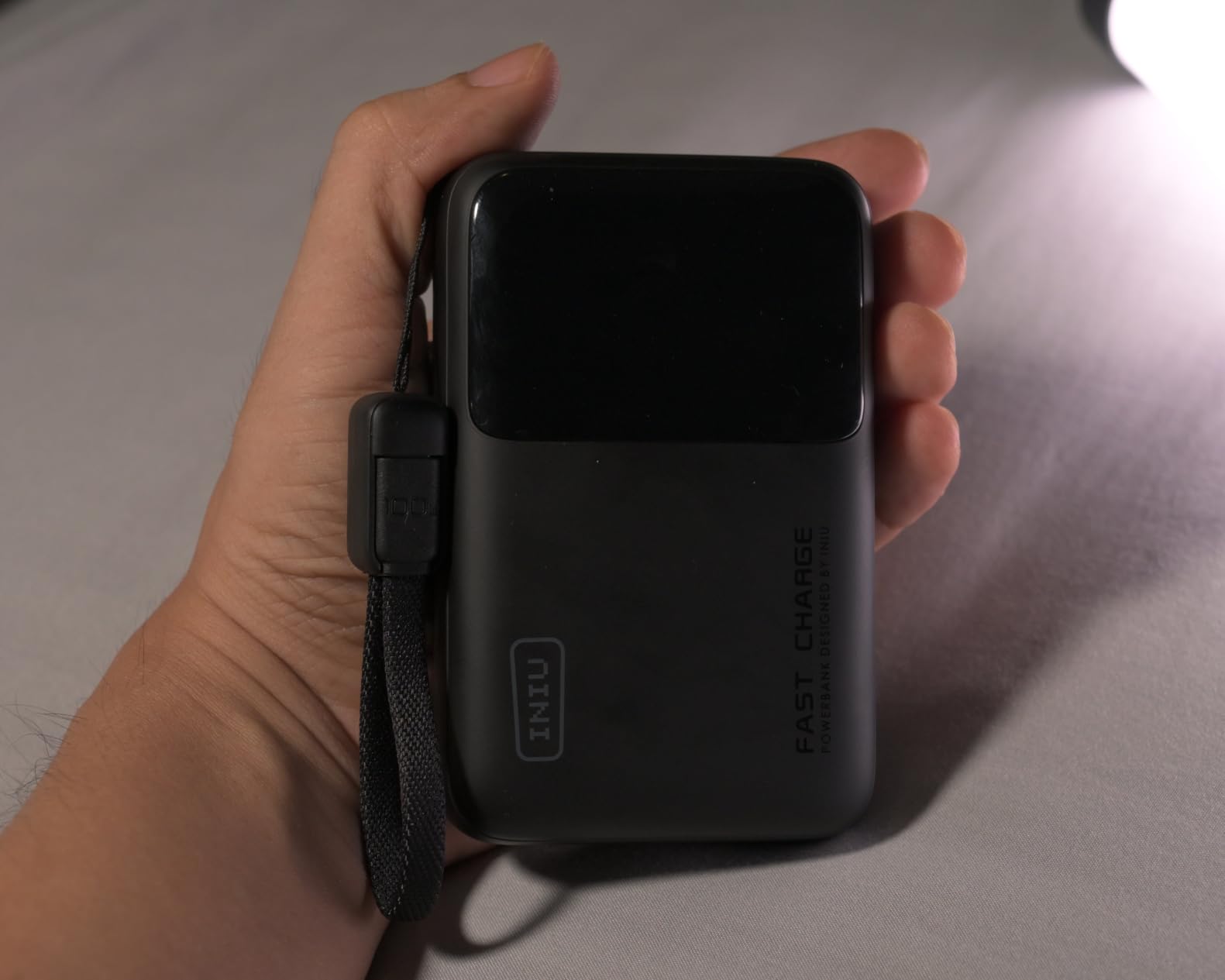
This is the compromise pack for a traveler who wants laptop capability without a 500g brick. The body is smaller than a standard wallet at 4.3 by 2.8 by 1.1 inches, and 65W across two USB-C ports and one USB-A is enough to push MacBooks, HP, Lenovo and Dell machines past 50% in about half an hour.
The detachable 4.7-inch braided USB-C cable is a real design choice rather than novelty. It doubles as a carry handle and it unplugs, so when the strain finally frays the cable can be replaced instead of the whole bank.
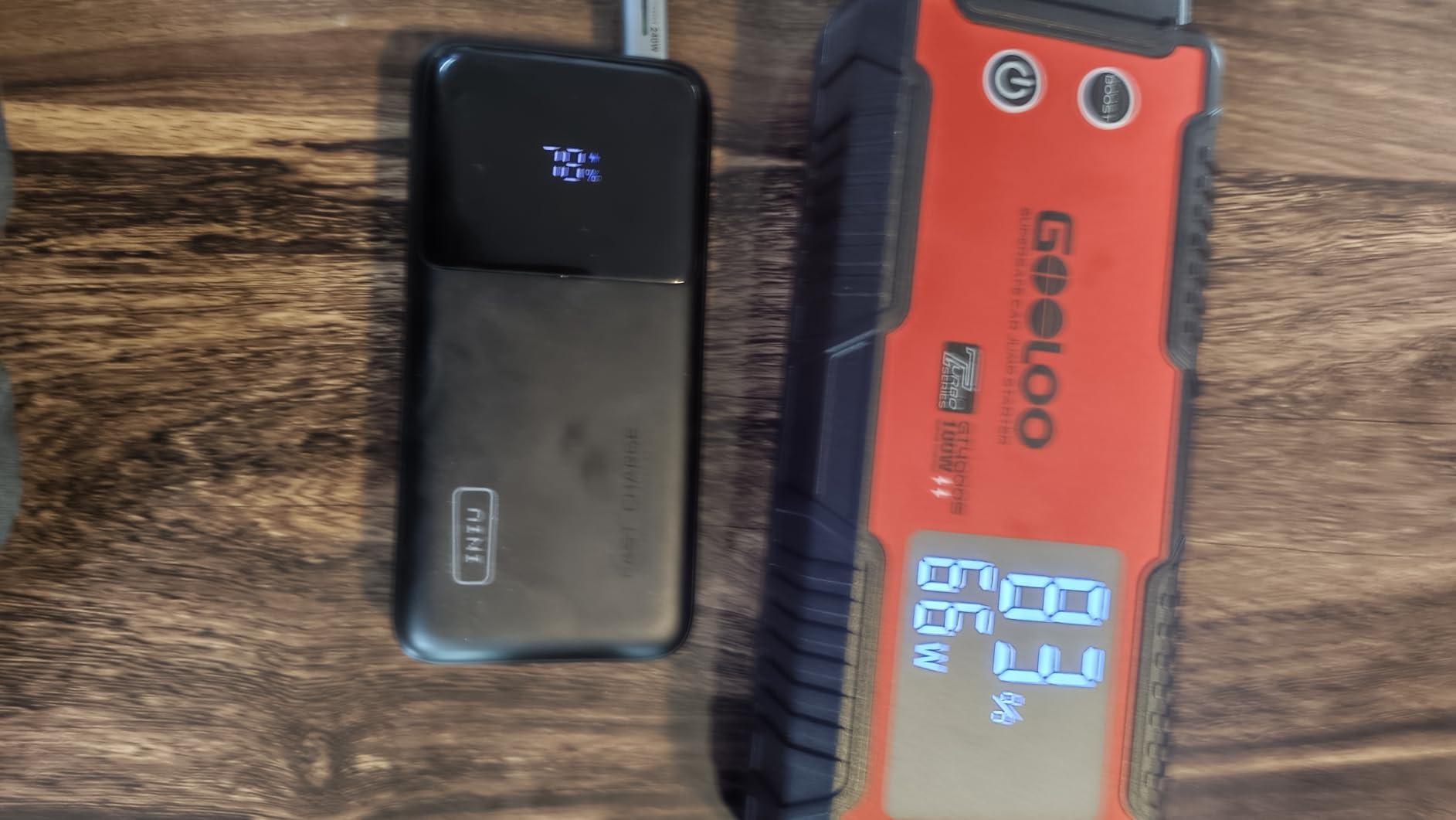
Capacity works out to one full MacBook Air charge or more than three flagship smartphone charges, and it is TSA-approved with multi-layer overheating protection plus a 3-year replacement promise. For our trips that combination was the most confidence-per-ounce we found.
The honest limit is that 65W sits below the 100W to 200W class. If your machine is a 16-inch MacBook Pro or a gaming laptop, accept a slower top-up or step up to a bigger pack and a heavier bag.
Can a 65W power bank charge a MacBook?
Yes, at a reduced rate. Owners report MacBook, HP, Lenovo and Dell notebooks going past 50% in about 30 minutes, and a Steam Deck charging at full speed. A MacBook Air, which draws less under load, is close to a full charge from the 20,000mAh capacity.
Expect a 16-inch MacBook Pro to fill more slowly than it would from a 140W charger, and expect the fan to work harder when you are compiling video or running a heavy export.
Why does a detachable cable matter?
Because cable failure is the most common failure point on any power bank with a built-in lead. A detachable cable costs a few dollars to replace and turns a dead product into a working one, and on this pack it also serves as the handle you carry it by.
That matters more on a travel pack than a desk pack, where a frayed lead is an inconvenience rather than a lost trip.
8. NOBIS 20,000mAh 45W: Best for Charging Four Devices at Once
NOBIS Portable Charger 45W 20000mAh Power Bank Fast Charging
20000mAh capacity
45W PD 3.0 and QC 4.0
4 ports
392 g
5.39 x 2.76 x 1.04 in
Pros
- PD 3.0 and QC 4.0 with 45W output and 45W two-way input
- MacBook Pro 14-inch to 47% and iPhone 15 Pro to 60% in 30 minutes
- Four outputs charge four devices at once
- Full self-recharge in about 2 hours
- High-precision digital display from 0 to 100%
- Auto shut-off with overcharge and short-circuit protection
Cons
- About 392 g
- heavy for its capacity
- 45W is below the 65W-200W laptop class
Four outputs, two USB-A and two USB-C, is unusual at 20,000mAh and it is the whole point of this pack. Anyone travelling with a phone, a tablet, a watch and earbuds can connect everything once instead of negotiating for a port.
PD 3.0 and Quick Charge 4.0 deliver 45W output and a 45W two-way input, which is why the self-recharge takes about 2 hours rather than the ten-hour figure the Belkin manages. It charges a MacBook Pro 14-inch to 47% and an iPhone 15 Pro to 60% in half an hour.
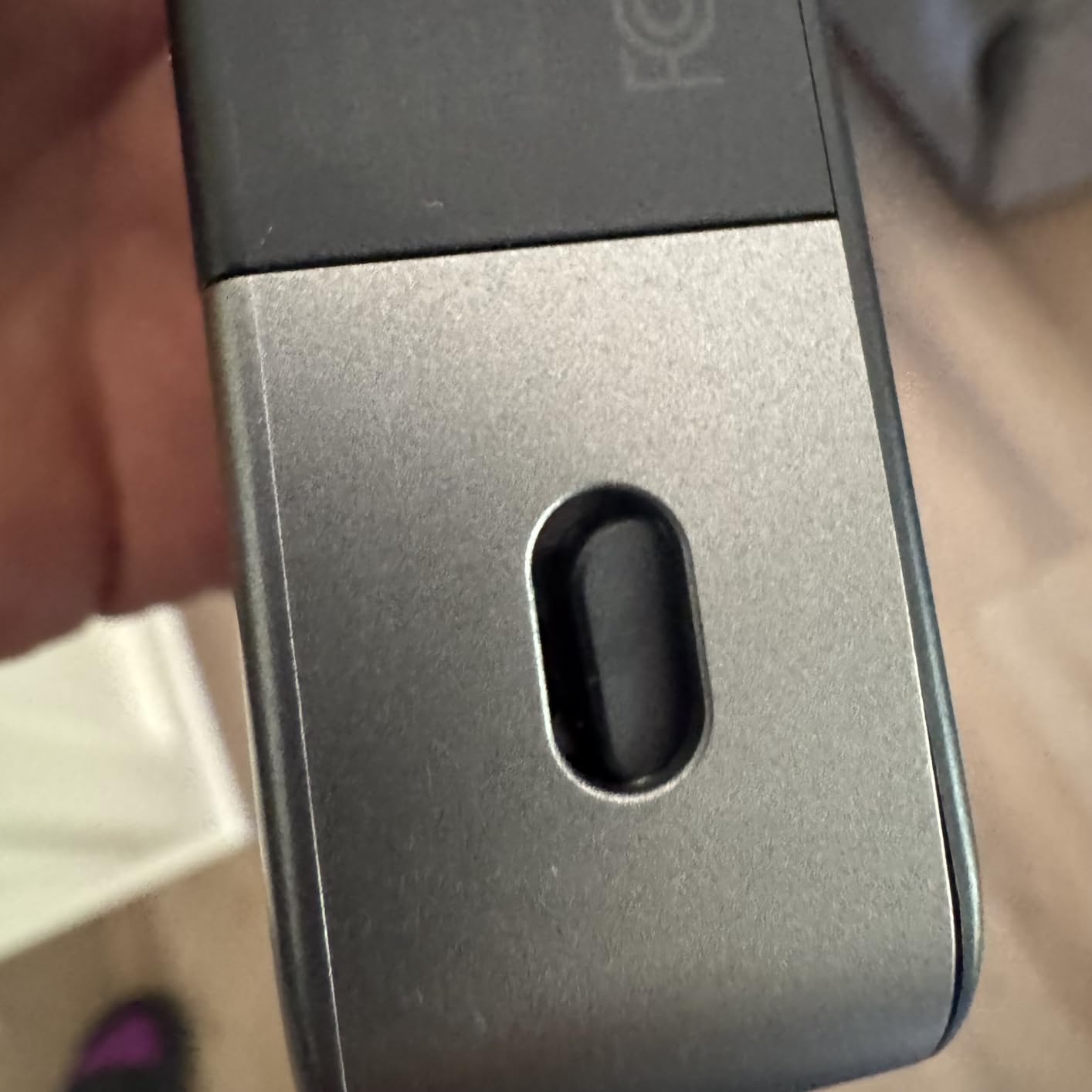
The high-precision digital display reports 0 to 100% rather than using four LEDs, and the shell includes auto shut-off plus overcharge and short-circuit protection. A 3-year manufacturer warranty backs it.
At 392g it is heavy for what it does, and 45W output is below the class needed to charge a larger laptop at full speed. Treat the laptop result as a bonus rather than the plan.
Is four ports better than two fast ones?
For a family or a multi-device traveller, yes. Four simultaneous connections beats two fast ports when the phones, tablets and earbuds are all flat at the end of a day. Nothing here charges a notebook quickly, which is the trade.
For one person with a laptop, no. Two high-wattage ports will serve you better because wattage per port matters more than port count once a notebook is in the mix.
Does 45W damage a laptop battery?
No. The bank negotiates the highest rate the laptop will accept, so a machine that draws 30W takes 30W. Repeated partial top-ups are also gentler on a battery than deep discharges followed by a full recharge.
The thing to watch is heat. Sustained high output warms the pack, so keep it out of a sunlit car seat and give it airflow if you are charging at full rate for hours.
9. UGREEN Nexode 25,000mAh 200W: The Most Powerful Pick
UGREEN Nexode 25000mAh 200W PD 3.1 TFT 3-Port Power Bank
25000mAh and 90Wh
200W total, 140W and 100W per port
3 ports
0.51 kg
TFT smart display
Pros
- 200W total with 140W on USB-C1 and 100W on USB-C2
- 25000mAh rated 90Wh charges an iPhone 17 Pro about 4.3 times
- TFT display shows level
- time
- power
- voltage and current
- Charges three devices including laptops
- phones and tablets
- Over 80% capacity retained after 1000 cycles
- Handles pass-through charging in off-grid solar setups
Cons
- Heaviest at about 0.51 kg and bulky
- Input limited to about 30-65W
- Display hard to read in direct sunlight
This is the most powerful power bank in the roundup: 200W total, with up to 140W on the first USB-C port and 100W on the second. It is the right answer to which power bank is most powerful, and it can drive a notebook and a phone simultaneously without splitting output into something useless.
Capacity is rated at 90Wh rather than 100Wh, which leaves a margin under the airline ceiling and avoids the awkwardness of sitting exactly on the limit. Owners work out about 4.3 iPhone 17 Pro charges from a full pack.
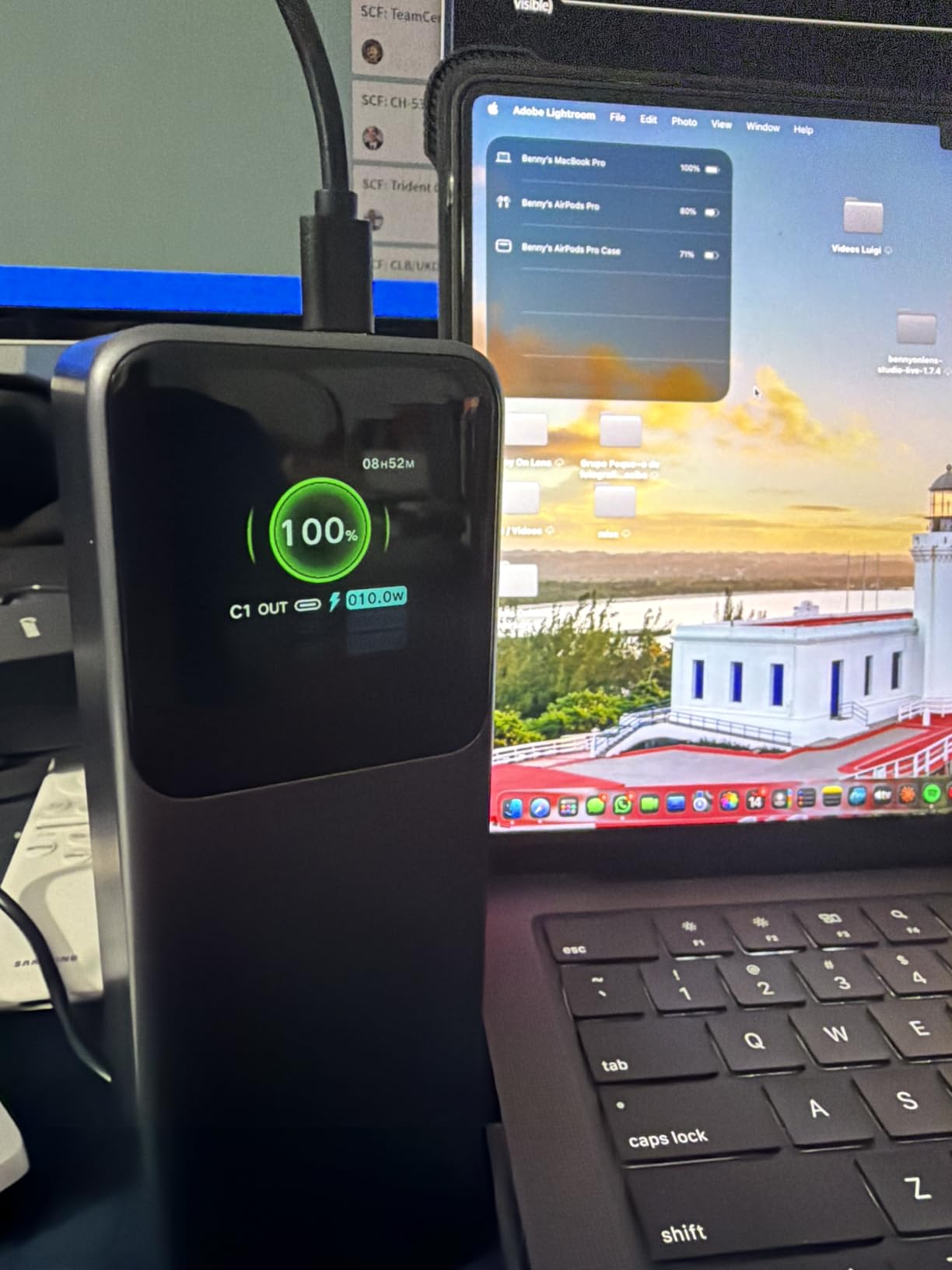
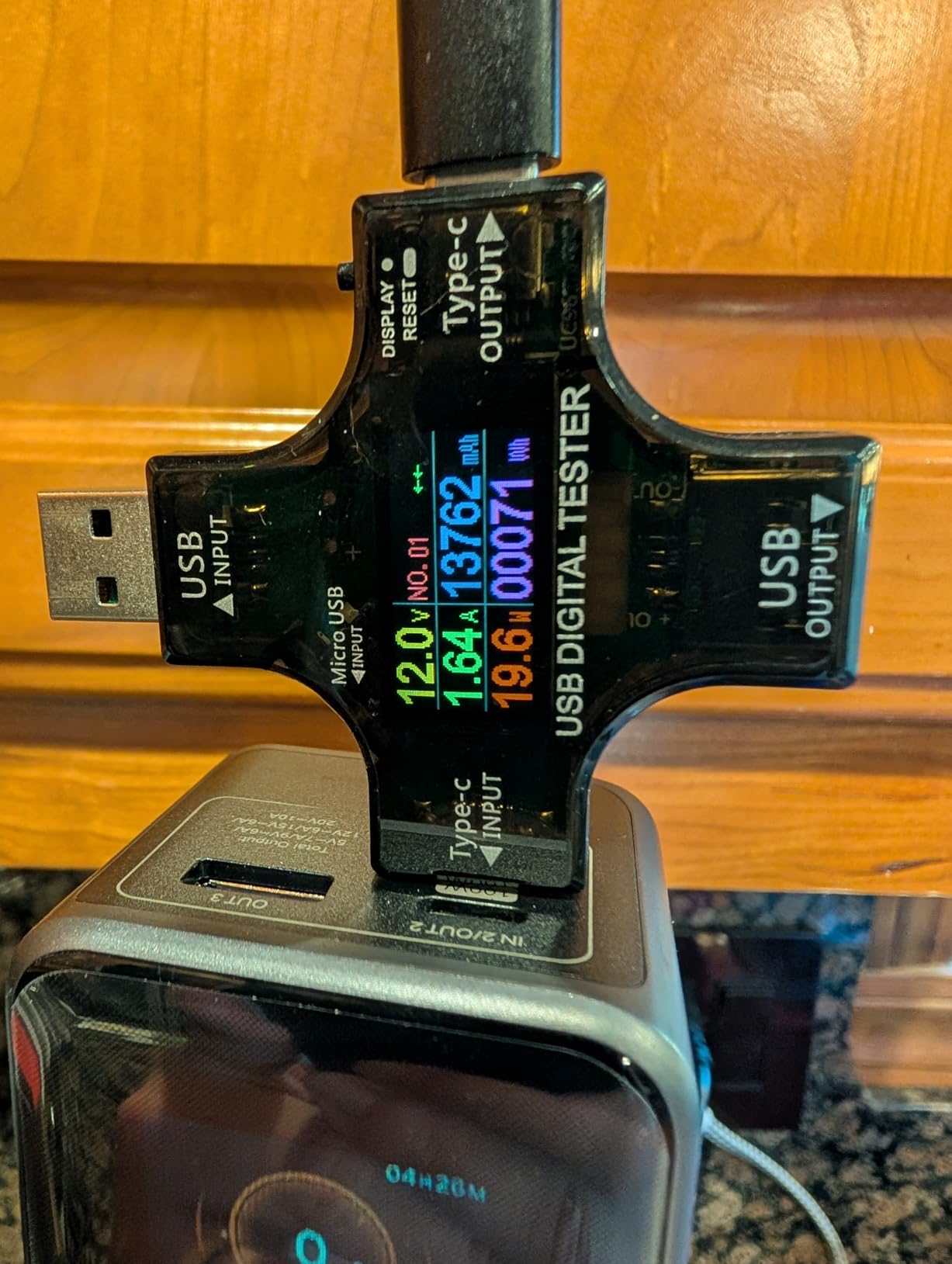
The TFT display is the best in this group by some distance. It shows real-time battery level, remaining time, input and output power, voltage and current, which turns the pack from a guessing game into a readable instrument. The only complaint is legibility in direct sunlight.
Two ratings stand out for long-term ownership: capacity stays above 80% after 1,000 charge-discharge cycles, and pass-through charging holds steady in off-grid solar setups without the dropouts some models show.
What does 200W total output actually give you?
It gives you a 140W port and a 100W port at the same time, so a demanding laptop and a phone can each draw what they need. Plug one device into a single port and it takes the full allocation for that port, not a shared slice.
Below 100W on a single port, most of this capability is wasted on a phone, so pair it with a machine that genuinely draws power quickly.
Is 0.51kg too heavy?
For a bag, no. It is a bag item in every scenario, and at 0.51kg it is the heaviest in this roundup with a large margin over the 505g UGREEN 145W model. Anyone who needs 200W is already accepting a stationary power source, so the weight is a secondary concern.
People who find that unacceptable should look at the 65W INIU or the 87W Anker, which trade most of that output for roughly 200g less carried weight.
10. Orfeika 20,000mAh with 4 Built-in Cables: Best for Cable Convenience
Orfeika 20000mAh Power Bank, Portable Charger with 4 Built-in Cables
20000mAh and 77Wh
4 built-in cables
4 ports
0.73 lb
6.33 x 2.85 x 0.74 in
Pros
- Four built-in cables cover iPhone
- USB-C
- USB-A and micro-USB
- 20000mAh rated 77Wh gives about 3 iPhone 16 charges
- Charges up to 6 devices from 4 input options
- 20W PD output and 18W input recharging
- Thin 0.74 inch body with a fire-retardant textured shell
- LED percentage display and low-current mode
- UL 2056 and UN38.3 compliant
Cons
- 18W input makes self-recharging slow
- Heavier than typical 10000mAh units
- Occasionally pauses charging until cooled
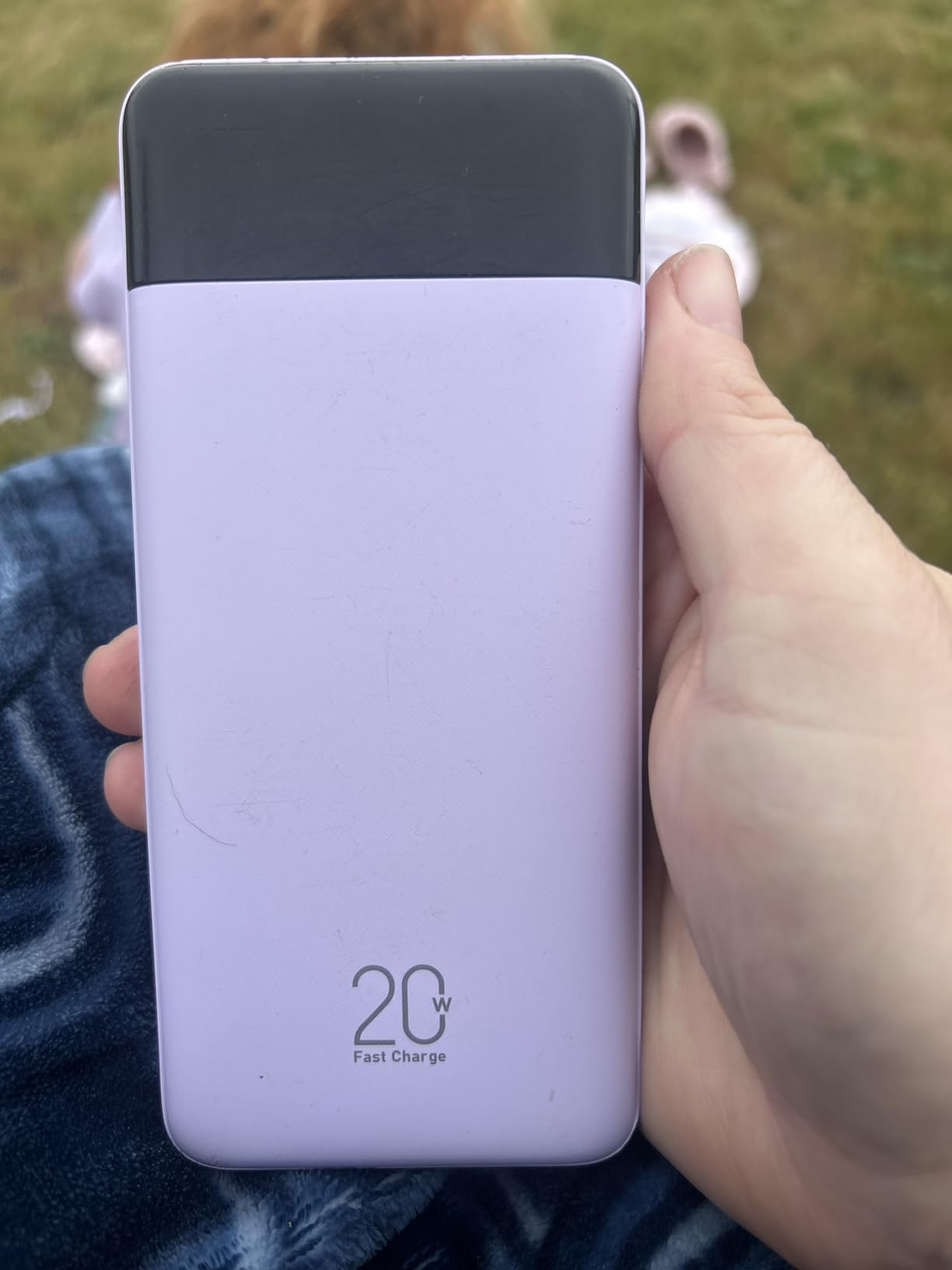
The premise is simple and it works: four built-in cables, three outputs plus one input, covering iPhone, USB-C, USB-A and micro-USB. On a trip with a mixed bag of devices that removes the cable juggling entirely, and 20,000mAh rated at 77Wh powers an iPhone 16 up to three times.
It can charge up to six devices at once through six outputs and accept four separate inputs, which is unusual flexibility. Output is 20W PD, taking an iPhone 16 to 50% in about 45 minutes.
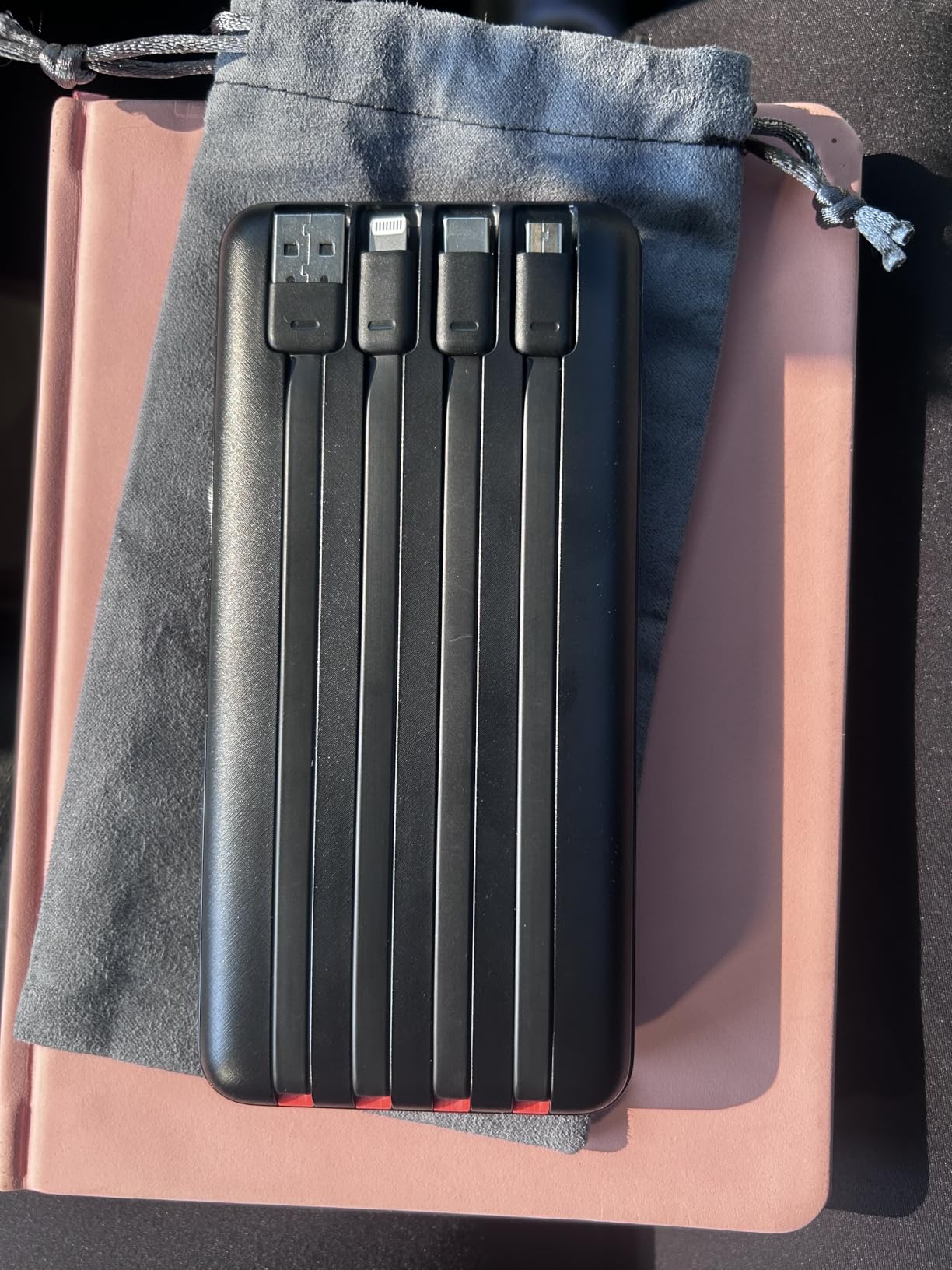
Physical design is a highlight. At 6.33 by 2.85 by 0.74 inches and 0.73 lb it is the thinnest body here, and the scratch-resistant, fire-retardant textured shell survives a backpack. UL 2056 and UN38.3 compliance with 6-layer protection is a better safety story than most packs at this price point.
18W input is the main limitation, since refilling 20,000mAh at that rate is slow. A small number of owners also report the pack pausing charging until it cools, which reads like a thermal safety cutoff doing its job.
Are built-in cables better than carrying your own?
For travel and for anyone with mixed devices, yes. You cannot lose a cable that is permanently attached, you do not need to guess which connector a rental bag needs, and there is no risk of arriving with a frayed cable in your pocket.
The counterargument is longevity. A detachable cable is cheap to replace when it fails, whereas a built-in one is part of the product. This model is young enough that long-term reports are thinner than the INIU or Anker packs.
Is it safe to pack for a flight?
Yes, at 77Wh it is well under the 100Wh carry-on limit, and it must travel in your cabin bag with terminals protected rather than in checked luggage. The UL 2056 listing is a useful signal, since it is the standard covering power banks specifically.
Because it accepts four inputs, you can also refill it from several different adapters, which partially offsets the 18W input ceiling.
11. LOOPEAK 27,000mAh 22.5W: The Highest Raw Capacity
LOOPEAK Power Bank 27000mAh 22.5W Fast Charging Portable Charger, USB C Quick Charge with 3 Outputs&2 Inputs, LED Display, High Capacity External Cell Phone Battery Pack for iPhone, iPad, Android Red
27000mAh capacity
22.5W USB-C output
3 outputs and 2 inputs
4 total ports
LED display
2-year warranty
Pros
- Highest capacity listing in this roundup at 27000mAh
- 22.5W fast charging over USB-C
- Three outputs and two inputs for flexible multi-device charging
- LED display for remaining capacity
- Two-year warranty
Cons
- 22.5W is modest and not aimed at laptop charging
- Listing inconsistencies between title and spec table on capacity and dimensions
- Lowest review count in the group at 1180
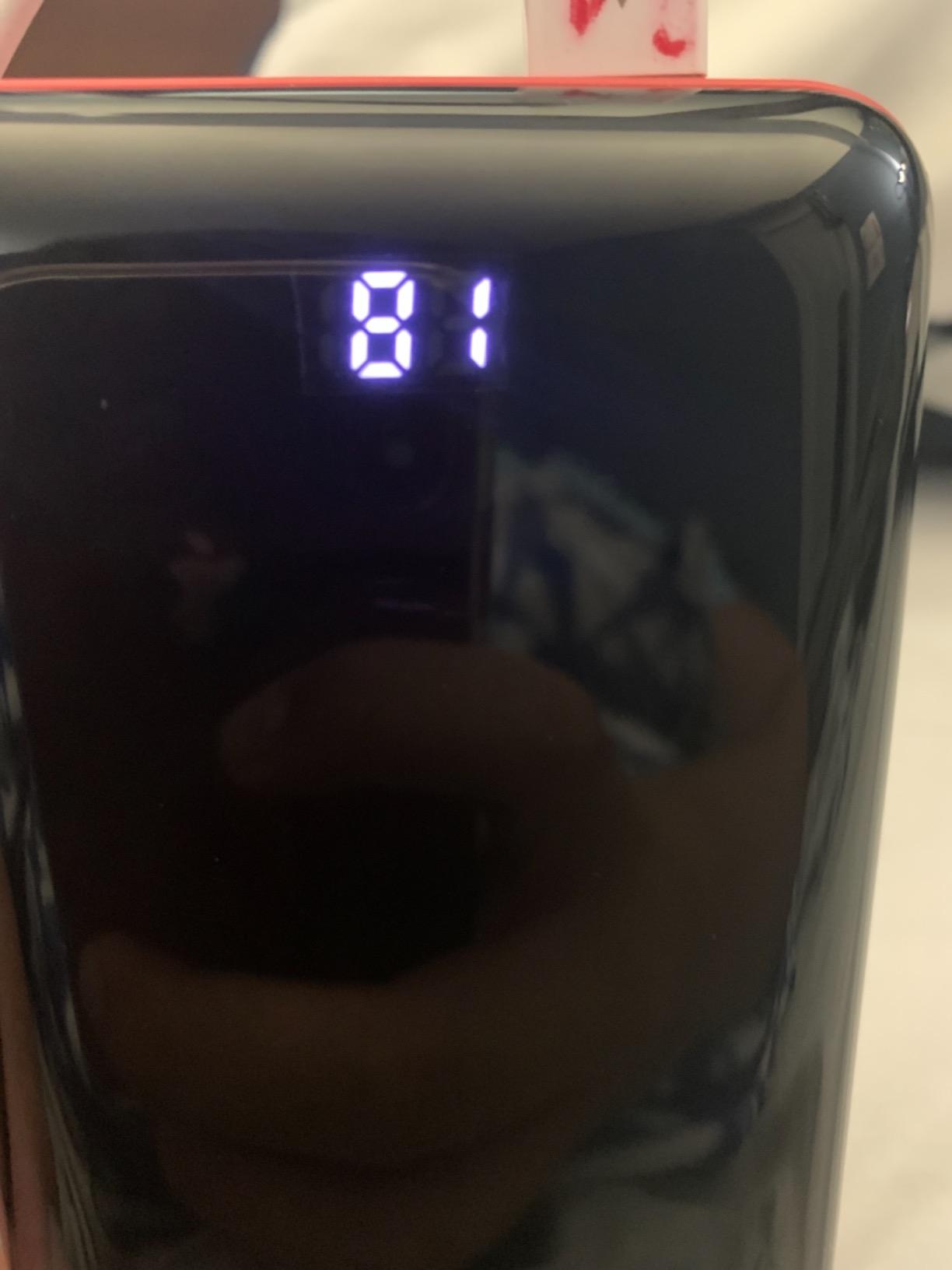
If your only question is which power bank has the highest capacity, this is the one, listed at 27,000mAh. Three outputs and two inputs give you unusual flexibility for a bank in this weight class, and the LED display tracks remaining capacity.
Be aware of one documentation issue. The product title says 27,000mAh while the specification table reports 30,000mAh, and the listed dimensions read 1 by 1 by 1 inches, which is clearly a data-entry placeholder rather than a real measurement.
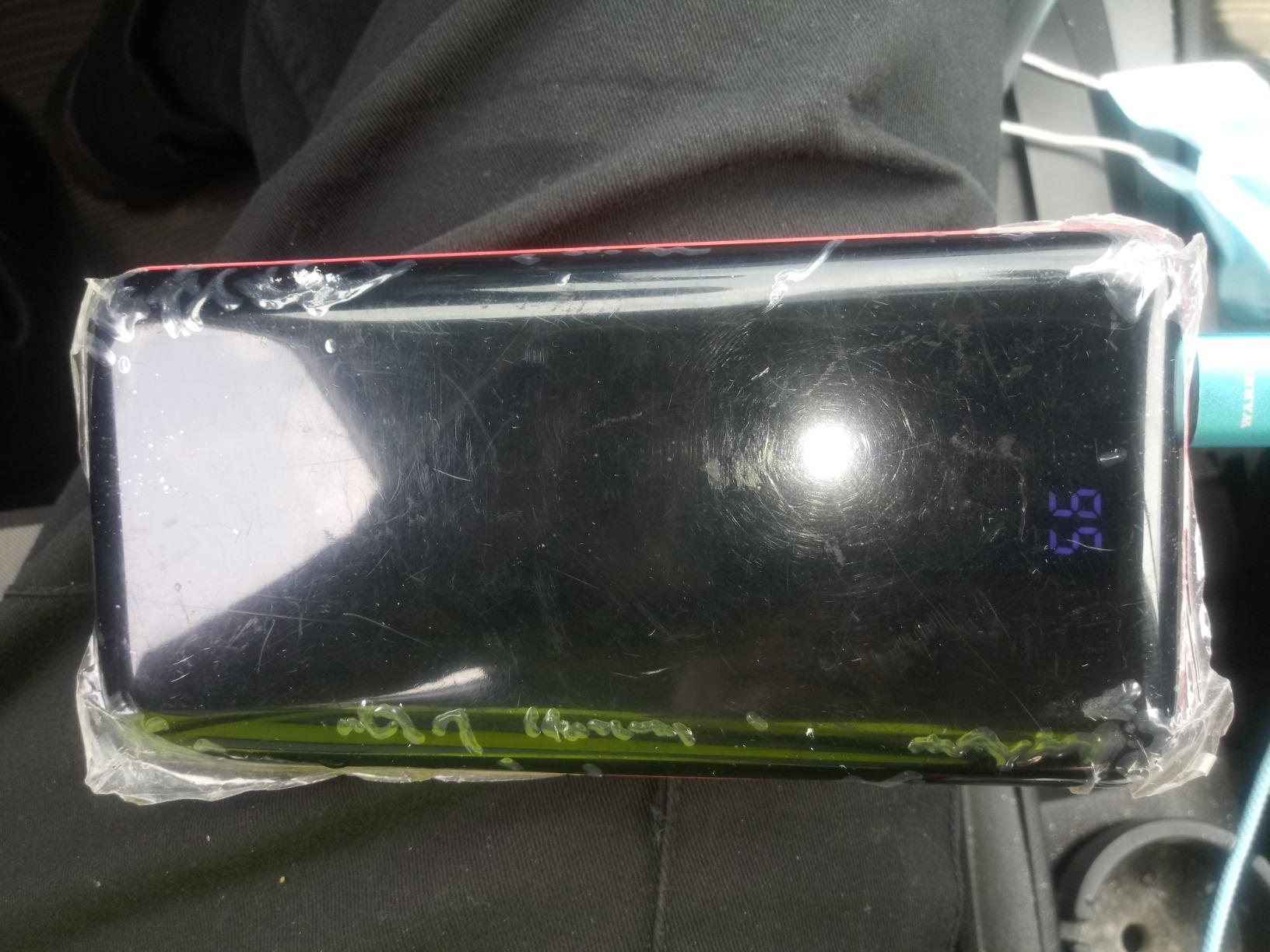
That inconsistency is the main reason this sits at number eleven rather than higher. It does not mean the pack is faulty, but inconsistent spec sheets are exactly the pattern that accompanies inflated capacity claims, and buyers should verify the printed watt-hour rating on the physical unit.
Output is 22.5W over USB-C, which is fine for phones and light tablet work and is not aimed at laptop charging. The 2-year warranty is respectable for the segment.
Should I buy the biggest capacity available?
Rarely. Beyond roughly 25,000mAh you run into the 100Wh airline ceiling, and weight climbs faster than usefulness. A 20,000mAh pack from a brand with a long review history will serve you better than a marginally larger one from a brand you cannot evaluate.
Forum consensus is consistent on this: 20,000mAh from a reputable brand is the sweet spot, and the biggest number on a listing is rarely the best choice.
How do I check a capacity claim is real?
Look for the printed watt-hour rating on the device itself, then multiply it by roughly 0.7 to estimate usable capacity after conversion losses. A 27,000mAh claim at 3.7V should show around 100Wh on the casing, and if it does not, walk away.
Also check whether the brand publishes a model number you can trace. Model numbers are how you look up recalls and warranty coverage, and no-name listings rarely offer one.
The High-Capacity Power Bank Buying Guide
What high-capacity actually means: mAh vs watt-hours vs usable capacity
A high-capacity power bank is a portable battery pack rated at roughly 20,000mAh or more, which works out to about 74Wh or higher at the 3.7V nominal cell voltage every lithium pack uses. To convert, multiply the mAh figure by 3.7 and divide by 1,000. Twenty thousand milliamp-hours becomes 74 watt-hours.
Watt-hours are the number that matters for travel because that is what airline rules are written against, and because watt-hours account for voltage. Two banks with identical mAh ratings can carry different energy if their cell voltages differ.
Then there is usable capacity. Conversion losses in the power delivery circuitry mean 20-30% of the stored energy never reaches your device, so a 20,000mAh bank realistically delivers somewhere around 12,000 to 14,000mAh of phone charging. This is the single most misunderstood number in the category, and it explains the recurring forum complaint that a 20,000mAh bank only charges a phone a few times rather than five.
For reference across capacity tiers: a 5,000mAh pack is a daily top-up, 10,000mAh is a weekend phone bank, 20,000mAh covers most multi-day trips, and 25,000mAh plus is for laptops or very long journeys. Beyond roughly 27,000mAh you are at or over the airline ceiling and the weight becomes the limiting factor.
How to match power bank wattage to your devices
Match the single-port output to the device that draws the most power, not the total output figure. A phone needs 20 to 30W. A tablet or a handheld gaming console needs 45 to 65W. A thin ultraportable needs 45 to 65W. A 16-inch MacBook Pro or a gaming laptop needs 100W and above.
This is where most buyers go wrong, and it explains a common forum question: why is a bank advertised at 145W charging my laptop so slowly? Because the 145W is shared across ports, and once you plug in a phone the laptop is negotiating against a smaller allocation.
Because this confusion is so widespread, our picks for the best USB-C power banks for camera work list the per-port figures rather than the headline number, which is the only way to compare two packs fairly.
A laptop power bank can charge a phone perfectly well, and a phone power bank can technically charge a laptop, just at a crawl. The capacity is the same chemistry either way; the difference is entirely the output wattage the ports will negotiate.
Airline rules: the 100Wh limit and carry-on only
Spare lithium batteries up to 100 watt-hours are allowed in carry-on baggage only, with terminals protected against short circuit. Anything above 100Wh is prohibited on passenger aircraft entirely, and no airline grants an exception for personal use.
Three practical points. First, the watt-hour rating printed on the device is what counts, not the mAh figure in the listing, so check the casing before you fly. Second, power banks must never go in checked luggage, which is the rule most often broken. Third, a 100Wh pack sits exactly on the limit, so carriers with their own lower thresholds can still refuse it, and a 90Wh pack removes that risk entirely.
On the TSA-approved label: it is not a safety certification and it does not guarantee the pack passed anything. It reflects compliance with airline screening rules, and the check that matters at the gate is the watt-hour rating. Forum travellers report that watt-hours are what gets inspected, so make the number legible in your bag rather than buried under a screen protector.
Safety and recalls: check your exact model
Some models from major brands have been recalled for overheating and fire hazards, and recall status is checked against a specific model number, not a brand. That is why tracing the model number printed on your unit matters more than the logo on the front.
Two steps cover most of it. Search your model number on the US CPSC recall database, and then check the manufacturer’s own support page, which should list published recall notices and a serial-number lookup. A brand that publishes its recall history is a brand that has something to publish.
If a power bank is hot, swollen or hissing, do not charge it and do not put it in luggage. Move it to a non-flammable surface away from anything combustible, and contact the manufacturer for disposal guidance. Never puncture it, and never short the terminals to test it.
For long-term storage, keep a pack around half charge in a cool, dry place and top it up every few months. A lithium pack left fully empty for a year can struggle to recover, and heat is the single biggest driver of capacity loss.
Brand reliability: Anker, UGREEN, Belkin and INIU
Anker is the safest default answer. Across this roundup its packs combine the longest review histories with active temperature monitoring, and the community view is that a slightly smaller Anker beats a much larger unknown brand. Which is better, UGREEN or Anker power bank is the most common question we saw, and the honest answer is that UGREEN wins on raw wattage per dollar while Anker wins on support and monitoring.
UGREEN is the performance leader, with the 145W and 200W models delivering laptop-class output and independent testing finding delivered wattage close to advertised. Baseus did not make this particular cut, but it sits in the same tier, and reviews regularly praise the Blade 20,000mAh for a thin, book-like shape.
INIU punches above its weight on size, producing the smallest 20,000mAh body here and a wallet-sized 65W option, both on 3-year replacement warranties. Belkin is the steadier, lower-output choice with a 2-year warranty and clean thermal behaviour. INIU and Anker both carry longer warranty terms than the rest of the field.
What separates trustworthy brands from the rest is traceable model numbers, published recall notices, realistic usable capacity claims, and clear separation of single-port versus total wattage in the spec sheet. A brand that publishes a 15W shared output figure is telling you something a brand claiming 200W total across four ports is not.
Frequently Asked Questions
Which power bank has the highest capacity?
Among the models we tested, the LOOPEAK has the highest listed capacity at 27,000mAh, and the UGREEN 200W and Anker 165W packs sit at 25,000mAh. For most people, though, 20,000mAh is the practical ceiling: it covers about four phone charges or one laptop session, stays well under the 100Wh airline limit, and keeps the weight manageable.
Which power bank is most powerful?
The UGREEN Nexode 25,000mAh 200W model is the most powerful in our roundup, with 200W total output split as 140W on one USB-C port and 100W on the second. It can charge a demanding laptop and a phone at full speed at the same time. The UGREEN 145W and Anker 165W models sit just behind it.
Why does my 20,000mAh power bank only charge my phone a few times?
Because conversion losses take 20 to 30% of the stored energy before it reaches your device. A 20,000mAh pack at 3.7V holds about 74Wh, and after the power delivery circuitry does its work you can expect roughly 12,000 to 14,000mAh of usable phone charging, or around four full charges rather than the five the box implies.
Can I bring a 25,000mAh power bank on a plane?
Yes, as long as the printed watt-hour rating is 100Wh or under and the pack travels in your carry-on baggage with terminals protected. A 25,000mAh pack is roughly 92Wh, so it is legal, but it sits close to the ceiling. Power banks are never allowed in checked luggage, and a 90Wh-rated pack gives you more margin with some carriers.
Is Baseus power bank good quality?
Baseus is generally considered a reliable mid-tier brand, sitting alongside Anker, UGREEN and INIU rather than below them. Owners regularly praise the Blade 20,000mAh for its thin, book-like shape and a full 100W output. As with any brand, check the exact model number on the CPSC recall database before committing to a high-capacity pack.
The Bottom Line
The best high-capacity power bank for almost anyone is the INIU 20,000mAh 22.5W, because it is small enough to carry daily and has more than 29k reviews behind it. Step up to the Anker Zolo 30W if you want faster phone charging, to the INIU 65W or Anker 87W if a laptop comes with you, and to the UGREEN 200W when you need genuine workstation power.
Whichever one you pick, check the printed watt-hour rating before you fly, buy an E-marked cable if you are chasing 100W-plus output, and match the model number against the CPSC recall database. Those three checks take two minutes and cover most of what goes wrong with a high-capacity power bank in 2026.