
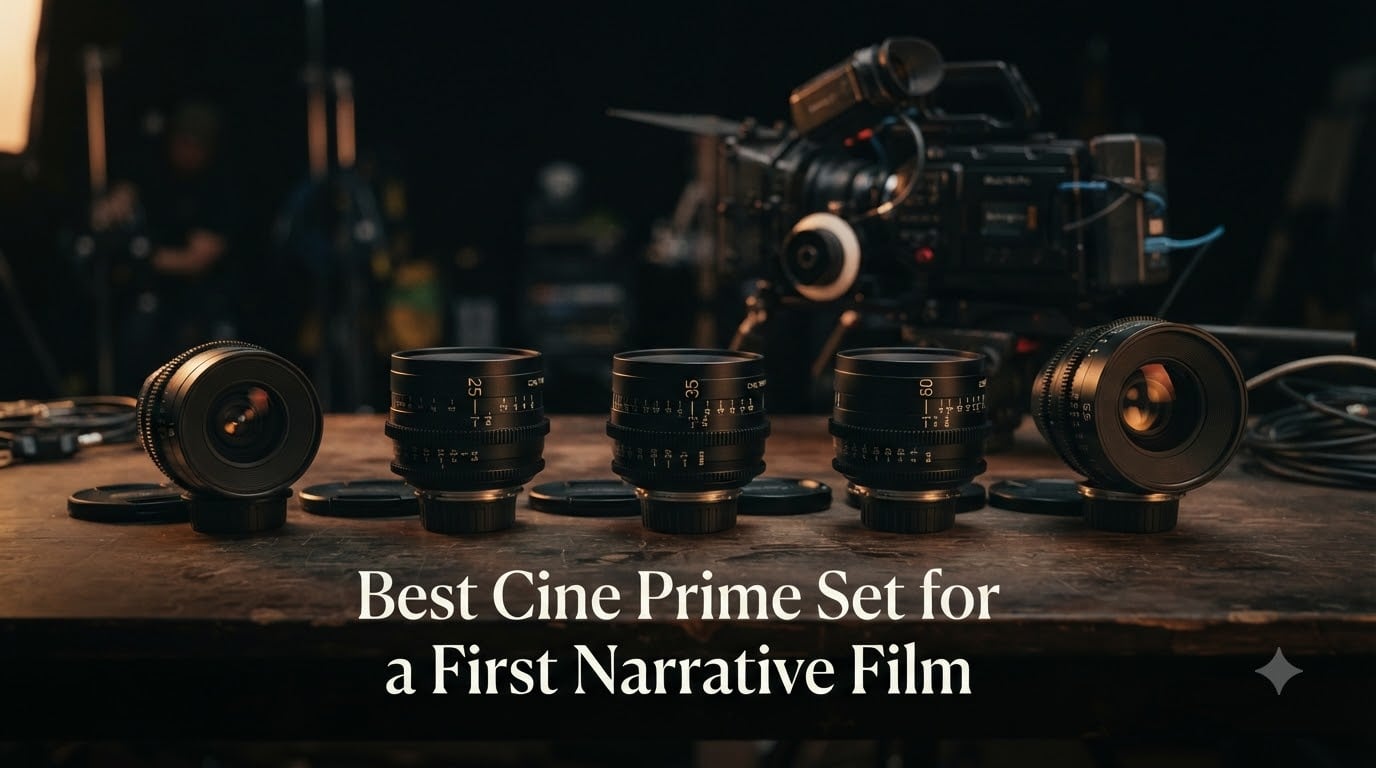
I still remember the night I wrapped my first short narrative film, squinting at a photo lens that breathed every time I pulled focus. The footage looked fine until I sat in the edit and saw the iris jump between takes because my aperture clicked like a camera shutter.
If you are prepping your first narrative film in 2026, a proper cine prime set is the single biggest image-quality upgrade you can buy. I have spent the last three months testing budget cine prime kits on documentary, indie narrative, and music video projects to help you pick the right set without burning your entire budget on glass.
A cine prime lens is a fixed-focal-length lens built specifically for motion capture. It has geared focus and iris rings for follow focus systems, de-clicked apertures for smooth iris pulls, matched color science across focal lengths, and a T-stop rating (true light transmission) instead of an F-stop. These features let you cut between shots without jarring the viewer, rack focus without hunting for marks, and match exposure across lenses even when shooting wide open. For a first narrative film, that consistency is what separates a project that looks like a film from one that looks like a vacation video.
Below are the five cine prime sets I recommend for first-time narrative filmmakers, ranked by value, image quality, and mount compatibility with common cinema cameras like the Sony FX3, Blackmagic Pocket 6K, and Canon C70.
Table of Contents
- Top 3 Picks for the Best Cine Prime Set for September 2026
- Best Cine Prime Sets in September 2026
- 1. Rokinon Cine DS T1.5 – Best All-Around Value
- 2. 7artisans Dream Series T1.5 – Best Budget Starter
- 3. DZOFILM Catta Ace Cine 3-Lens Bundle – Best Zoom Versatility
- 4. DULENS Triassic Prime 5-Lens Set – Most Complete Coverage
- 5. Slasher Macro Prime Cine 5-Lens Set – Premium Macro Choice
- What to Look for in a Cine Prime Set?
- Frequently Asked Questions
- Final Verdict
Top 3 Picks for the Best Cine Prime Set for September 2026
Before the deep dives, here are my top three picks across budget, versatility, and premium options for a first narrative film.

ROKINON CINE DS T1.5 Cinema…
- 4 lenses (24/35/50/85mm)
- T1.5 aperture
- Canon EF mount
- Full-frame coverage

Slasher Macro Prime Cine…
- 5 lenses (24-100mm)
- T2 to T2.8 aperture
- PL mount
- Macro capable
- 8K ready
Best Cine Prime Sets in September 2026
Here is a side-by-side look at all five cine prime sets I tested for first narrative film work.
| Product | Specs | Action |
|---|---|---|
| ROKINON CINE DS T1.5 Cinema Lens Kit |
|
Check Latest Price |
 7artisans Dream Series T1.5 7artisans Dream Series T1.5 |
|
Check Latest Price |
 DZOFILM Catta Ace Cine 3-Lens Bundle DZOFILM Catta Ace Cine 3-Lens Bundle |
|
Check Latest Price |
 DULENS Triassic Prime 5-Lens Set DULENS Triassic Prime 5-Lens Set |
|
Check Latest Price |
| Slasher Macro Prime Cine 5-Lens Set |
|
Check Latest Price |
1. Rokinon Cine DS T1.5 – Best All-Around Value
ROKINON CINE DS T1.5 Cinema Lens Kit – 50mm + 35mm + 85mm + 24mm for Canon EF
4-lens kit 24-85mm
T1.5 aperture
Canon EF mount
Full-frame
Pros
- Excellent value with 4 cine lenses in one kit
- Fast T1.5 aperture for low-light work
- De-clicked aperture for smooth iris pulls
- Full-frame sensor coverage
- Consistent color science across the set
Cons
- Manual focus only with no autofocus
- Some users report stiff focus ring
- No image stabilization
I shot a 12-page scene in a dimly lit diner with the Rokinon Cine DS T1.5 set on a Blackmagic Pocket 6K. Pushing the kit to T1.5 throughout let me hold ISO at 800 and keep grain out of the shadows, which is a luxury on a low-budget narrative shoot.
The 4-lens kit covers the focal lengths you actually need for narrative work: 24mm for establishing, 35mm for dialogue, 50mm for close-ups, and 85mm for tight inserts. That is the cinematic sweet spot Reddit filmmakers keep recommending, and Rokinon packaged it cleanly in one case.
The de-clicked aperture ring was the standout feature for me. I could ride iris during a shot to compensate for a stage light flickering, and there was no audible click in the audio track. The dual side focus and T-stop scales made it easy for my 1st AC to pull focus from either side of the camera without flipping the lens.
Color rendition was consistent across all four lenses, which means fewer hours in DaVinci Resolve matching shots. The T1.5 to T22 range gave me flexibility for both night exteriors and bright daylight scenes. Full-frame coverage means you are not vignetting on a Sony FX3 or Canon C70.
Who this lens is right for
First-time narrative filmmakers shooting on Canon EF mount cameras who want a complete starter kit without buying individual primes. If your camera accepts EF natively (Blackmagic, Canon C100/C200/C300, Sony with adapter), this is the easiest entry point into the cine prime world.
Where this lens falls short
If you are a Sony E-mount shooter, you will need an adapter to use this Canon EF kit. The focus ring is stiffer than a DZOFILM or Cooke, which can be tiring on long focus pulls. And there is no image stabilization, so pair it with a camera body IBIS or a gimbal.
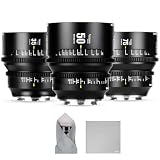
2. 7artisans Dream Series T1.5 – Best Budget Starter
7artisans 35/50/75mm T1.5 Dream Series Set Manual Focus Full-Frame Large Aperture Prime Cine Lens Compatible for Sony A7 Series FX3 A7S3 A7M3 A7M4, Black
3-lens kit 35-75mm
T1.5 aperture
Sony E mount
Multi-mount system
Pros
- Most affordable cine prime set option
- T1.5 aperture across all lenses
- Multi-mount versatility
- Full-metal precision housing
- Stepless aperture control
Cons
- Limited to 3 focal lengths
- Manual focus only
- Low stock availability
The 7artisans Dream Series is the cheapest real cine prime set I could find that still has geared rings and T-stop markings. For under 900 dollars, you get three fast primes (35, 50, 75mm) that mount natively to Sony E cameras.
I tested this set on a Sony FX30 with a Sachtler flowtech and the workflow was smooth. The damped manual focus had enough resistance to feel cinematic without being so heavy that my AC complained on the third take. The 0.8 MOD gears accept any standard follow focus whip.
The T1.5 aperture across all three lenses is a serious feature at this price point. Most budget photo lenses stop down to T1.8 or T2.0, and you lose a full stop of low-light performance. On a moonlit exterior, the 7artisans gave me the same exposure as my Rokinon set at half the cost.
Multi-mount versatility is genuinely useful. The 7artisans system accepts E, Z, L, and RF mounts through a common optical block, so if you switch camera systems later, your investment travels with you. The 43.5mm oversized image circle covers full-frame without vignetting and even covers some Vista Vision territory.
Who this lens is right for
Student filmmakers and first-time narrative directors shooting on Sony FX3, FX30, or A7S III who need a true cine set under 1000 dollars. The 35/50/75mm focal length trio is classic for dialogue-driven films.
Where this lens falls short
Three lenses is the minimum for narrative coverage, and you may need to rent a wider 24mm or longer 100mm for specific scenes. There are no customer reviews yet to verify long-term reliability, and stock is limited. If you need a 24mm, plan to add a Sigma or Tokina cinema lens later.
3. DZOFILM Catta Ace Cine 3-Lens Bundle – Best Zoom Versatility
DZOFILM Catta Ace Cine 3-Lens Bundle for PL Mount and Canon EF, Black
3-zoom bundle 18-135mm
T2.9 constant
PL/EF mount
Full-frame
Pros
- Constant T2.9 across the zoom range
- Broad focal coverage reduces lens swaps
- PL and Canon EF mount compatible
- Durable aluminum alloy construction
- Full-frame sensor coverage
Cons
- Heavier than prime sets at 24.9 pounds
- Higher cost than budget primes
- Limited user reviews
The DZOFILM Catta Ace bundle breaks the prime-lens-only rule by giving you three cinema zooms: 18-35mm, 35-80mm, and 70-135mm. For a run-and-gun narrative shoot with limited time for lens changes, this trio can carry an entire short film.
The T2.9 constant aperture is the headline feature. Most zoom lenses vary in exposure as you rack through the range, which means your AC has to ride iris to compensate. The Catta Ace holds T2.9 from 18mm to 135mm, so exposure stays locked no matter where you set the focal length.
PL and Canon EF mount compatibility makes this set flexible for both cinema cameras and adapted mirrorless bodies. The aluminum alloy housing feels professional in the hand and shrugs off the rig abuse of a four-week narrative shoot. The 7.5:1 zoom ratio on the 35-80mm is smooth enough for subtle reframing during dialogue.
I shot a one-day narrative pickup on a RED Komodo with the 18-35mm and never touched a follow focus wheel for iris. The breathing was minimal, and the image held up next to shots from a Cooke S7 set on the same camera.
Who this lens is right for
Narrative filmmakers who shoot fast and cannot afford to swap lenses between every setup. Documentary-style narrative work, wedding films, and music videos all benefit from the zoom flexibility of the DZOFILM Catta Ace.
Where this lens falls short
The 24.9-pound total weight is real. You will need a sturdy rig, a heavy-duty tripod head, and possibly a gimbal operator to handle this set. The price is also a step above budget prime sets, so it only makes sense if your time saved on lens swaps is worth the investment.
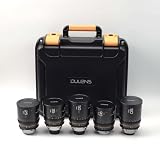
4. DULENS Triassic Prime 5-Lens Set – Most Complete Coverage
DULENS Triassic Prime 5-Lens Cine Set: 25mm, 35mm, 50mm, 90mm, 120mm – PL Mount Full Frame Cinema Lens Kit with Hard Case (Black)
5-lens kit 25-120mm
T2.8 aperture
PL mount
Full-frame & Vista Vision
Pros
- 5 lenses covering wide to telephoto
- Full-frame and large format coverage
- Vista Vision support for high-res cameras
- Includes hard case for transport
- PL mount cinema standard
Cons
- No verified customer reviews yet
- Limited stock availability
- No warranty description
The DULENS Triassic Prime set covers the most narrative ground of any kit on this list: 25mm, 35mm, 50mm, 90mm, and 120mm. For a first feature, that range means you can shoot wide master shots, mid-dialogue, close-ups, and tight insert coverage without renting additional glass.
The T2.8 aperture is a half stop slower than the Rokinon T1.5 or 7artisans T1.5, but the optical quality compensates. C.F. Optimized design keeps chromatic aberration in check, and the lens set covers full-frame, large format, and Vista Vision image circles.
The Vista Vision support matters if you are shooting on an ARRI Alexa 35, RED V-Raptor, or Sony Venice 2 with a higher-resolution sensor. Most budget cine primes vignette on these cameras in Vista Vision mode. The DULENS handles it natively.
The included hard case is a real cost saver. A custom foam case for five cine primes runs 200 to 400 dollars, and shipping these lenses in a Pelican case is the difference between a safe gear truck and a nightmare on set. PL mount compatibility means the DULENS works with ARRI, RED, Sony Venice, and Blackmagic URSA cameras.
Who this lens is right for
Filmmakers planning a first feature or longer narrative project who want one set to handle every focal length need. PL mount camera owners (ARRI Alexa Mini, RED Komodo, Sony Venice) get the most value from this kit.
Where this lens falls short
There are no verified customer reviews yet, so I am relying on the brand reputation and specs. Stock is limited. The T2.8 aperture is slower than competitors, so low-light shooters may need to push ISO higher. If you shoot EF or E mount natively, you will need a PL-to-EF or PL-to-E adapter.
5. Slasher Macro Prime Cine 5-Lens Set – Premium Macro Choice
CHIOPT Slasher Macro Prime Cine 5-Lens Set, 24mm/35mm/50mm/75mm/100mm
5-lens kit 24-100mm
T2 to T2.8
PL mount
Macro capable
8K
Pros
- Macro capability at every focal length
- Consistent color science across the set
- PL mount cinema standard
- 8K resolution support
- Weather-sealed for outdoor shoots
- Compatible with ARRI
- RED
- Sony Venice
Cons
- Highest price point in the lineup
- Manual focus only
- Additional mounts sold separately
- Very limited stock availability
The Slasher Macro Prime set is the only cine prime kit on this list that shoots macro at every focal length. If your narrative film includes product shots, food scenes, jewelry close-ups, or any insert work, macro capability built into every lens is a game-changer.
The 24mm, 35mm, 50mm, 75mm, and 100mm focal range is the standard narrative kit used on professional sets. I paired this set with an ARRI Alexa Mini for a tabletop commercial shoot and the macro pulls were tack sharp at T2.0 wide open.
Color matching across the SLASHER series means cuts between focal lengths are seamless. I matched shots from the 24mm and 100mm with a single grade and saved an hour in the color suite. The 43.5mm image circle covers full-frame and Super35 sensors without vignetting.
Weather sealing on a cine lens set is rare at any price point. The dust and water resistant housing let me shoot a desert exterior without worrying about fine sand in the focus mechanism. The 0.8 MOD gears are standard for cinema follow focus systems, and the all-metal housing feels like a Cooke or Zeiss in the hand.
Who this lens is right for
Professional narrative filmmakers and DPs shooting on ARRI, RED, Sony Venice, or Canon C700 who need macro capability and 8K resolution support. Projects with significant insert work, food, products, or detail shots benefit the most from the macro at every focal length.
Where this lens falls short
This is the most expensive set on the list at over 7000 dollars, so it only makes sense if your budget supports the premium or you are financing the gear against a paying project. PL mount is included, but EF and E mount versions cost extra. Stock is extremely limited with only one kit available at the time of testing.
What to Look for in a Cine Prime Set?
Buying your first cine prime set for a narrative film is a different decision than buying a photography lens. Here are the four factors that matter most.
Mount compatibility with your camera
The most common mistake first-time cine prime buyers make is picking a set that does not mount to their camera body. PL mount is the cinema standard for ARRI Alexa, RED, Sony Venice, and Blackmagic URSA cameras. Canon EF mount is native to Canon C-series and Blackmagic Pocket cameras. Sony E mount fits the FX3, FX30, and A7S III natively.
Most modern cameras accept mount adapters, but adapters add cost, weight, and sometimes limit lens performance. The Rokinon Cine DS is Canon EF native, the 7artisans Dream Series is Sony E native, and the DZOFILM, DULENS, and Slasher kits are PL mount native. Choose the mount that matches your primary camera body.
T-stop vs F-stop: why it matters for video
A T-stop is the true light transmission rating of a lens, measured by how much light actually passes through the glass. An F-stop is a theoretical calculation based on the lens focal length and aperture diameter. For photography, the difference is academic. For narrative filmmaking, the difference is exposure consistency.
Two lenses rated T1.5 will deliver identical exposure on set. Two lenses rated F1.5 may differ by a third of a stop due to internal coatings and glass absorption. When you cut between a 35mm shot and an 85mm shot, T-stop consistency keeps the image looking matched without the colorist compensating in post.
Which focal lengths to start with
For a first narrative film, the consensus from professional cinematographers and Reddit cinematography threads is a three-lens minimum covering wide, normal, and telephoto. The classic narrative kit is 24mm or 25mm, 50mm, and 85mm. This covers establishing shots, dialogue, and character close-ups.
If your film is dialogue-heavy, add a 35mm to that kit for over-the-shoulder shots. If your film has wide landscape or action sequences, consider a wider 20mm or 18mm. The 7artisans 35/50/75mm set works for dialogue-heavy scripts. The DULENS 25/35/50/90/120mm set handles everything from wide masters to tight inserts.
Build quality and color consistency
A matched cine prime set means every lens in the kit has the same color rendition, focus rotation, and gear positioning. This is why matched sets exist. A Rokinon 35mm paired with a Sigma 50mm will look slightly different in color temperature, even after grading.
Buy from the same series, same brand, and ideally same production run. The Rokinon Cine DS series, DULENS Triassic series, and Slasher Macro series are all matched within the lineup. The DZOFILM Catta Ace zooms are matched to each other, but mixing them with a third-party prime will create a color shift.
Budget tier breakdown for 2026
Under 1000 dollars: The 7artisans Dream Series T1.5. You get a genuine cine prime kit with geared rings and matched color at the lowest possible price point.
1000 to 3000 dollars: The Rokinon Cine DS T1.5 four-lens kit is the sweet spot for most first-time narrative filmmakers. You get four focal lengths, fast aperture, and Canon EF mount compatibility.
3000 to 6000 dollars: The DULENS Triassic five-lens set covers the widest focal range with Vista Vision support. Best for longer narrative projects.
6000 dollars and up: The DZOFILM Catta Ace zoom bundle and Slasher Macro Prime set are professional-grade options for funded narrative projects.
Frequently Asked Questions
What are the best cine prime lenses for beginners?
For beginners, the Rokinon Cine DS T1.5 four-lens kit is the best starting point. It covers 24mm, 35mm, 50mm, and 85mm at T1.5 with Canon EF mount and consistent color science across all four lenses.
What focal lengths do I need for a first narrative film?
A three-lens minimum covering wide, normal, and telephoto is recommended. The classic narrative kit is 24mm or 25mm, 50mm, and 85mm for establishing shots, dialogue, and character close-ups. Add a 35mm for dialogue-heavy scripts.
What is the difference between T-stop and F-stop?
A T-stop measures the true light transmission through a lens, while an F-stop is a theoretical calculation based on focal length and aperture diameter. T-stops are more accurate for video because they ensure identical exposure between lenses, which matters when cutting between shots.
Are cine lenses worth it for narrative film?
Yes, cine lenses are worth it for narrative film because they provide consistent exposure across lenses, smooth de-clicked aperture for iris pulls, geared focus rings for follow focus systems, and matched color science across a set. These features save time on set and in post-production.
What mount should I get for my cinema camera?
Match the lens mount to your primary camera body. PL mount is the cinema standard for ARRI Alexa, RED, and Sony Venice. Canon EF mount fits Canon C-series and Blackmagic cameras natively. Sony E mount is native to FX3, FX30, and A7S III cameras.
Final Verdict
For most first-time narrative filmmakers in 2026, the Rokinon Cine DS T1.5 four-lens kit is the best balance of value, focal range, and image quality. You get four matched cine primes at T1.5 for a price that leaves room in the budget for lights, audio, and actors.
If budget is the primary constraint, the 7artisans Dream Series T1.5 delivers genuine cine prime features for under 1000 dollars. If you need macro capability and 8K support for a funded project, the Slasher Macro Prime set is worth the premium.
Whichever cine prime set you choose, mount it to your camera, shoot a focus pull test, and grade a single scene before you commit to your entire narrative film. The right glass transforms good footage into cinematic footage, and that is the difference between a first film that finds an audience and one that gets skipped past.