
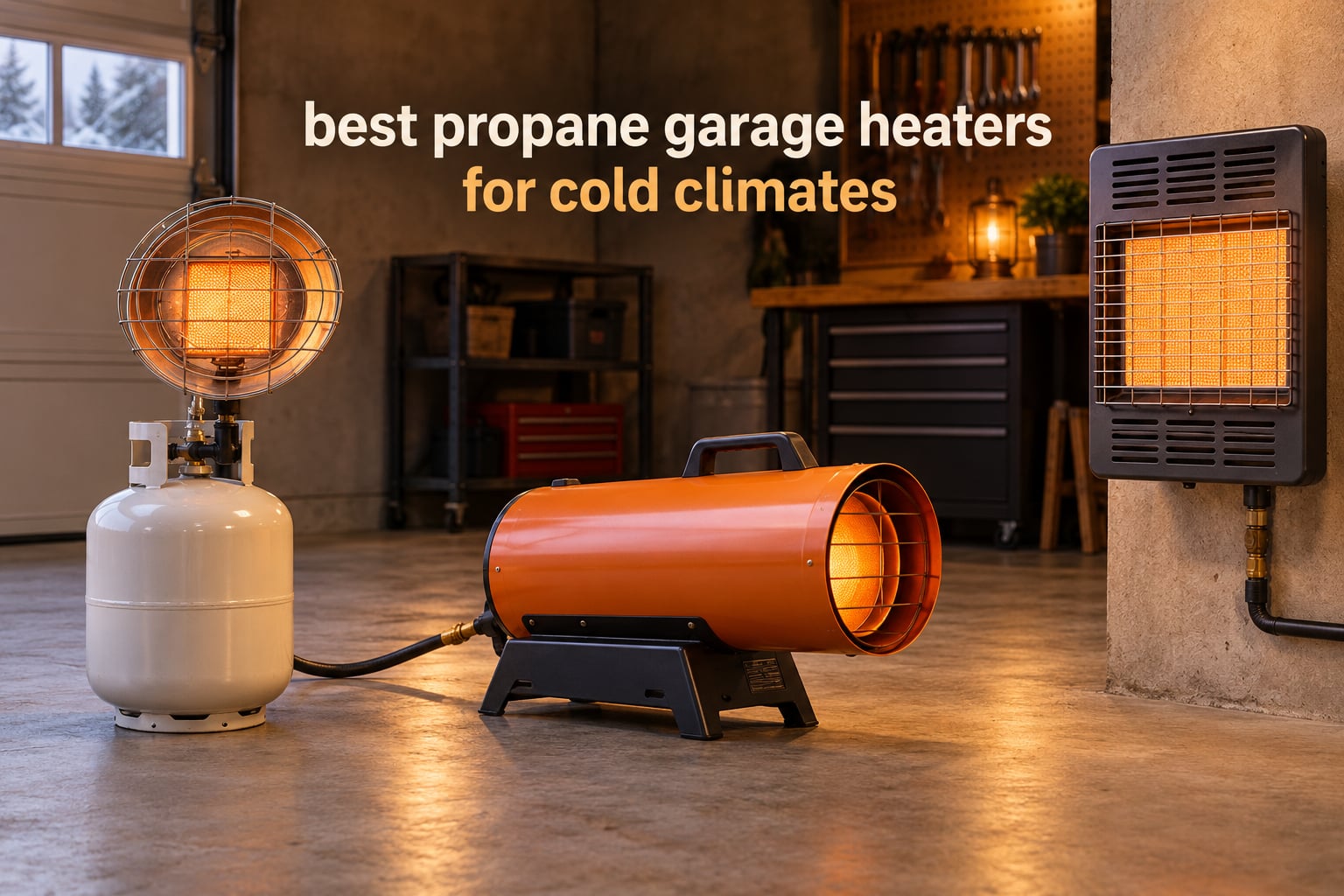
A garage in a cold climate is one of the hardest rooms in the house to heat. It has a bare concrete floor, thin steel walls, and one enormous door that leaks every time someone drives in from a snowy driveway. Stand in one in January and you understand why the best propane garage heaters for cold climates have become a winter-season staple for a lot of homeowners, not a luxury purchase.
The direct answer: for most cold-climate garages the right unit is a permanently installed, vented, ceiling-mounted forced-air heater between 50,000 and 80,000 BTU, matched to the square footage and the insulation level of the space. If your garage is uninsulated, smaller, and you only need it warm on weekends, a portable 40,000 to 60,000 BTU forced-air model will do the same job for a fraction of the installation effort. If you need heat in a spot rather than a room, a radiant heater aimed at your work position is the answer.
Three variables decide the purchase, and every recommendation in this roundup is organized around them: BTU output relative to garage size and insulation, venting type, and install form factor. We compared ten propane garage heaters, read the owner feedback on each, and paid particular attention to how they behave when the temperature outside drops into the teens and below. If you also spend winter mornings bundled up before touching a bike, our cold weather motorcycle glove picks cover the other half of that problem.
Table of Contents
- Top 3 Propane Garage Heaters for Cold Climates
- All 10 Best Propane Garage Heaters Compared in 2026
- 1. Mr. Heater Original 540-Degree 45,000 BTU Tank Top Radiant Propane Heater
- 2. Mr. Heater 20,000 BTU Vent Free Blue Flame Propane Heater
- 3. Mr. Heater 50,000 BTU Forced-Air Unit Heater for Ceiling Mount
- 4. Remington 60,000 BTU LP Forced Air Heater
- 5. Dyna-Glo Delux RMC-FA60DGD 30,000-60,000 BTU LP Forced Air Heater
- 6. XtremepowerUS 30,000 BTU Propane Tank Top Heater with Dual Burner
- 7. GASLAND MHA18B 18,000 BTU Propane Cabinet Heater
- 8. Flame King 60,000 BTU Portable Propane Forced Air Heater
- 9. ProCom ML250TPA-B 25,000 BTU Ventless Infrared Plaque Heater
- 10. Avenger 22BF-A00 18,000 BTU Propane Cabinet Radiant Heater
- How We Picked and How to Size BTU for a Cold Garage
- Insulate the Garage Before You Buy a Heater
- Vented vs Vent-Free vs Radiant Garage Heaters
- Propane Runtime and Running Cost Compared to Electric
- Carbon Monoxide Safety and Attached Garage Rules
- Mounted vs Portable: Which Form Factor to Buy
- Frequently Asked Questions
- What is the best heater for a cold garage?
- How many BTUs do I need to heat a 24×24 garage?
- Is it cheaper to heat a garage with propane or electric?
- Will a propane heater give off carbon monoxide?
- Which is better for my garage, a Modine Hot Dawg or a Mr. Heater unit?
- How long does a 20 lb propane tank last on a garage heater?
- The Best Propane Garage Heaters for Cold Climates: Final Verdict
Top 3 Propane Garage Heaters for Cold Climates
Mr. Heater 45,000 BTU Tank Top Radiant
- 45000 BTU radiant output
- Mounts to a 20 lb propane tank
- Adjustable tilt head
- Tip-over shutoff

Mr. Heater 20,000 BTU Blue Flame
- 20000 BTU convection output
- Heats up to 700 sq ft
- Built-in thermostat
- No electricity needed

Mr. Heater 50,000 BTU Unit Heater
- 50000 BTU forced air
- Covers up to 1667 sq ft
- Ceiling mount
- 24V or Wi-Fi thermostat ready
All 10 Best Propane Garage Heaters Compared in 2026
| Product | Specs | Action |
|---|---|---|
| Mr. Heater 45,000 BTU Tank Top Radiant |
|
Check Latest Price |
| Mr. Heater 20,000 BTU Blue Flame |
|
Check Latest Price |
| Mr. Heater 50,000 BTU Forced-Air Unit |
|
Check Latest Price |
 Remington 60,000 BTU Forced Air Heater Remington 60,000 BTU Forced Air Heater |
|
Check Latest Price |
 Dyna-Glo 30000-60000 BTU LP Heater Dyna-Glo 30000-60000 BTU LP Heater |
|
Check Latest Price |
 XtremepowerUS 30,000 BTU Tank Top Heater XtremepowerUS 30,000 BTU Tank Top Heater |
|
Check Latest Price |
 GASLAND MHA18B 18,000 BTU Cabinet Heater GASLAND MHA18B 18,000 BTU Cabinet Heater |
|
Check Latest Price |
 Flame King 60,000 BTU Forced Air Heater Flame King 60,000 BTU Forced Air Heater |
|
Check Latest Price |
 ProCom 25,000 BTU Ventless Infrared Plaque ProCom 25,000 BTU Ventless Infrared Plaque |
|
Check Latest Price |
 Avenger 18,000 BTU Cabinet Radiant Heater Avenger 18,000 BTU Cabinet Radiant Heater |
|
Check Latest Price |
1. Mr. Heater Original 540-Degree 45,000 BTU Tank Top Radiant Propane Heater
Mr. Heater Original 540-Degree 45,000 BTU Tank Top Radiant Propane Heater
45000 BTU radiant
Heats up to 1125 sq ft
45/36/30K BTU settings
Tip-over shutoff
Pros
- Mounts directly to a 20 lb propane tank
- Solid heavy-duty feel
- Adjustable tilt head aims the heat
- About 9.5 hour run time on high
Cons
- Most heat radiates upward until you tilt it
- Hose and control knob sit awkwardly
- Three Phillips screws are hard to reach
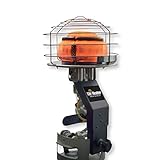
This is the unit I recommend first more often than any other, and the reason is simple: it does the least amount of installation work while still producing heat you can feel from across the garage. It screws straight onto a standard 20 lb propane cylinder, needs no electricity, and the whole assembly weighs 5.6 pounds, so you can drag it outside in October and bring it back in April without thinking about it.
The design is radiant rather than forced air. That means it does not heat the air so much as it heats whatever is in front of it: your torso, your hands on a wrench, the side of a car you are working on. Owners consistently describe minutes-long rather than minutes-to-heat-the-room warming, which is a different and often more useful experience when you are standing still.
What I like is the range of control. The regulator steps the output between 45,000, 36,000, and 30,000 BTU, and the tilt head rotates so you can aim the cone downward at a workbench or sideways at a chair. Several owners mention that placing it where a light breeze moves air across the emitter increases the perceived output, because radiant heat plus moving air is a much better combination than radiant heat alone.
The three heat settings matter for fuel planning. At the highest setting, the burner pulls about a pound of propane an hour, which works out to roughly 9.5 hours of runtime on a full 20 lb tank. Running on the 30,000 BTU setting stretches that considerably, and in deep cold that is the setting most people actually live on.
Where this heater earns its place
It wins in any garage where you have one defined spot rather than a whole room to warm. A repair bay, a welding bench, a spot beside a snowblower, a garage bay you sweep and use on Saturdays. It also works in a completely uninsulated space where a mounted unit would be spending most of its fuel fighting drafts, because radiant heat does not care about air leakage as much as convection does.
It is also the most forgiving unit in this group on the safety side. The tip-over switch cuts gas flow if the heater is knocked, and reviewers report it starting reliably after the first time. Read the instructions and keep the cylinder upright on a stable surface, and it is a low-friction tool.
Where this heater falls short
It is rated for outdoor use, which matters more than most listings admit. In a closed garage you are depending on cross-ventilation to move combustion products out, and a drafty uninsulated garage in January does not offer much. For a space you heat for hours at a time with the door shut, a vented unit is the safer and more efficient long-term answer.
Physically, most of the heat leaves straight up until you angle the head, and the hose and control knob face a slightly awkward direction. The three mounting screws are also fiddly. None of this is serious, but you are aware of all three on the first afternoon.
2. Mr. Heater 20,000 BTU Vent Free Blue Flame Propane Heater
Mr. Heater 20,000 BTU Vent Free Blue Flame Propane Heater
20000 BTU convection
Heats up to 700 sq ft
Wall mount or floor stand
ODS low-oxygen shutoff
Pros
- Built-in thermostat cycles the burner automatically
- Runs on one AAA battery with no electricity
- No venting or chimney required
- 99.9 percent efficient convection heat
Cons
- Burns about a pound of propane an hour on high
- Hose regulator and fittings not included
- Narrow thermostat range
- Builds window condensation over long runs
This is the reason so many cold-climate owners keep one in the house and never run it. It is a 700 sq ft class convection heater with a real mechanical thermostat dial, and owners report it holding an interior temperature of about 70F in weather down to -11F. That is a genuinely useful claim in a region that sees that kind of cold.
Unlike a torpedo heater, it does not just blast hot air across the room and stop. A blue flame heats air directly and the resulting column of warm air circulates naturally, which is why reviewers describe it as warming a space evenly rather than from one direction. It runs on electronic ignition powered by a single AAA battery, so power outages are not a problem.
What I appreciate most is the thermostat. Set the dial and the burner cycles on and off, which is the difference between a heater that heats and a heater that holds. A unit without cycling will overshoot, then run out of fuel, then you start over. This one settles.
It is also the most flexible install in the group. It sits on the supplied feet or goes on the wall with the included hardware, which matters if counter space is tight or you want it mounted above a work surface where the rising heat collects.
Good fit for a small bay or a backup heater
Think single-car garages, detached workshops in the 400 to 700 sq ft range, mudrooms, and utility rooms. It is also the model I would keep as a secondary unit for outage heating, since it needs no electricity at all and holds its own temperature unattended.
For a hobby space where you are stationary for a few hours at a time, the combination of thermostat and no install requirement is very hard to beat. A remote cabin or a hunting shack owner gets the same benefit.
Where it does not fit
Twenty thousand BTU is a small number against a cold-climate heat load. In an uninsulated two-car or three-car garage in a northern January, this will not keep up, and reviewers who expected it to are the source of the lower ratings. It also heats a room rather than a spot, so it gives you no radiant warmth when you are working outside.
Two practical notes. The hose, regulator, and fittings are not included and must be sourced separately. And because it is vent-free, it adds moisture to the room, which shows up as condensation on cold windows during a long run. The oxygen depletion sensor helps, but ventilation still matters.
3. Mr. Heater 50,000 BTU Forced-Air Unit Heater for Ceiling Mount
Mr. Heater 50,000 BTU Forced-Air Unit Heater (Propane or Natural Gas)
50000 BTU forced air
Heats up to 1667 sq ft
10 ft ceiling needed
24V or Wi-Fi thermostat ready
Pros
- Warm within about 7 minutes in 12F weather
- Very quiet fan operation
- Works with 24V and Wi-Fi thermostats
- Flame sensor and high-temp shutoff
Cons
- Gas line and vent kit require professional install
- Thermostat and vent pipe sold separately
- A few examples arrived with a loose fan set screw
This is the unit I would plan an entire winter around. It is a permanently mounted, ceiling-hung, 50,000 BTU forced-air heater rated for garages up to 1,667 sq ft, which is a full three-car bay. Owners in northern climates report warm air within about seven minutes on a 12F day, and then the fan running at a low fraction of capacity holding the space with a 10 degree rise in 15 to 20 minutes inside an insulated shop.
That last point is the one that matters for cold climates. Once the space is up to temperature, a thermostat-cycled unit heater is not burning propane continuously, because the duty cycle drops as the building gets tighter. The result is a garage you can use every weekend through February rather than one you visit when it happens to be mild.
What separates this from a portable forced-air heater is control. It accepts standard 24-volt thermostats and Wi-Fi-enabled models, sold separately. Owners use the Wi-Fi option to pull the garage up to temperature on the drive home from work, which is the feature that converts a heater from a seasonal chore into background comfort.
Safety hardware is the standard commercial set: a high-temperature safety shutoff switch and a gas safety flame sensor shutoff. The unit is 60.3 pounds, which tells you what kind of appliance this is, and it ships with angle brackets for the ceiling mount plus an NG to LP conversion kit.
Best reasons to install it permanently
If your garage is attached to the house, this is the category that lets you hold a setpoint near 50F through deep cold without worrying about combustion products migrating into living space. The exhaust goes outdoors through a flue. It is also the only category in this roundup that can be cycled by a wall thermostat, which means unattended overnight preheat before a cold morning.
It suits a man cave or a four-season woodworking shop too, where the far end of the room needs warmth while you are sawing at the other end. If you are also planning the garage as a gym space, our slam ball picks for garage workouts assume a warmed floor, which this unit can deliver.
The installation barrier nobody warns you about
Ceiling height is a hard filter. The unit requires a minimum 10 ft ceiling and 8 ft of clearance from the base of the heater to the floor. Many residential garages are 8 or 9 ft, and owners cite this as the single most common reason a permanently mounted heater is not an option for them.
Beyond ceiling height, you need a gas line and a vent kit, and reviewers report the install cost approaching the cost of the heater itself. A few models also arrived with a loose or cross-threaded fan set screw that caused a loud wobble until tightened. None of that is a dealbreaker, but it should be in the budget before you buy, not after.
4. Remington 60,000 BTU LP Forced Air Heater
Remington LP Forced Air Heater, Portable 60,000 BTU Space Heater for up to 1500 Square Feet – Liquid Propane Gas Powered, Tank Not Included
60000 BTU forced air
Heats up to 1500 sq ft
11 lb steel body
10 ft LP hose and regulator included
Pros
- Warms 800 to 1500 sq ft in 10-20 minutes
- Includes hose and regulator for fast setup
- Variable heat settings and adjustable height
- Thermocouple and flame-out fuel cut
Cons
- Very loud where conversation matters
- Power cord is under a foot long
- Settings feel almost moot at full output
When the garage is uninsulated and large, raw output is the priority, and this is the most heat you can get without wiring anything. Sixty thousand BTU across up to 1,500 sq ft, in a steel body that weighs 11 pounds and carries a handle. Several owners report lifting a two-car garage from genuinely cold to comfortably warm in under twenty minutes with a window open.
That recovery behavior is the cold-climate argument. A door opening in a snowstorm dumps a large volume of outside air into the space, and the heater that gets the room back to a workable temperature fastest is the one you want. On a 50,000 BTU installed unit, recovery from that event takes longer.
Convenience at the fuel connection is better than most competitors in this group. The 10 ft propane cylinder hose and regulator are in the box, so setup is one job rather than a parts run. A heat-sensitive sticker on the tube shows when the metal has cooled enough to handle, which is a small touch that matters when you move it repeatedly.
It also has a real safety stack: a thermocouple, a high-temperature limit shutoff, and a flame-out fuel cut. Electronic ignition is continuous, so the igniter does not have to be held down while you work.
Suited to detached garages and jobsites
This is the right call for a pole barn, a detached workshop, or a construction site where you want heat where the work is and no one is worried about a ceiling-flue installation. It is also the sensible backup for a house with a detached garage, stored against the wall in summer and dragged out when the temperature drops.
Owners like the adjustable height and variable settings for cold-weather work, where you are stationary and would rather not cook the space to 90F.
Where noise rules it out
This is the loud heater in the roundup. Owners are explicit that it is fine in a work area but that several returned it looking for something quieter. If the garage shares a wall with a bedroom or an office, the fan and burner noise is a real issue and a quieter 60,000 BTU option exists.
Two more limitations worth knowing before you buy. The power cord is under a foot long, so an outdoor-rated extension cord is effectively required. And the output is so high that the adjustment settings feel nearly irrelevant, since the difference between the top and bottom of the range matters less than you expect in a space this size.
5. Dyna-Glo Delux RMC-FA60DGD 30,000-60,000 BTU LP Forced Air Heater
Dyna-Glo Delux RMC-FA60DGD 30,000 – 60,000 BTU LP Forced Air Heater
30000 to 60000 BTU
Heats up to 1350 sq ft
Continuously variable output
Overheat auto shutoff
Pros
- Continuously variable output stretches tank fuel
- Adjustable heat angle aims the output
- Arrives assembled and fired in under five minutes
- Season-long fuel economy reported by owners
Cons
- Thin sheet metal with a slightly pinched tube
- Very short cord and no on/off switch
- Roaring flame is louder than the fan
Continuous output adjustment is the feature that distinguishes this one, and in a cold climate it is worth more than it sounds. Instead of stepping between two or three fixed settings, the burner ramps smoothly from 30,000 to 60,000 BTU. You can hold a low, steady heat all afternoon without overshooting the space and burning a full tank.
Owners report raising a garage temperature 10 to 15F in roughly 10 to 15 minutes on the low setting, and several describe finishing a season of regular use on a single 30 lb fill. For someone heating a space intermittently through a long winter, that difference in fuel consumption is the number that decides the purchase.
Setup is the easiest in this category. It arrives fully assembled, gas connections included, and owners report firing it in under five minutes. The 10 ft hose and regulator ship in the box, and the adjustable heat angle lets you aim the output toward wherever you are working rather than across an empty floor.
Current owners are notably more positive than early production reviews, with several noting that the manufacturer addressed the original defects involving bent fan blades and damaged examples. If you have read older reviews, the picture has improved.
A strong fit for gradual warming
It is well suited to basements, finished workshops, and any garage where you want the temperature to come up steadily and stay there without a thermostat cycling a big burner on and off. The smooth control also means less overshoot, which is what produces the uneven drafts people complain about with fixed-output units.
Coverage of up to 1,350 sq ft puts it in the same class as the 60,000 BTU units in this roundup, so it covers a two-car garage or most of a three-car one. If the garage is insulated, the low end of the range is where you will spend most of the season.
Build quality is the trade
The construction is thin and reviewers say so directly: sheet metal that flexes when you lift by the handle, a fire tube that arrives slightly pinched and oval, and a housing that creaks. None of it stops the heater from working, but it is the difference between an appliance you keep for a decade and one you replace.
There is no on/off switch, so it runs the moment it is plugged in, and the cord is very short. Noise is a recurring minor complaint, with several owners noting the roaring flame is louder than the fan itself, particularly on the low setting.
6. XtremepowerUS 30,000 BTU Propane Tank Top Heater with Dual Burner
XtremepowerUS 30,000 BTU Propane Tanktop Heater Infrared Dual Burner Safety Shut-Off Valve, Tip-Over Switch for Garage, Camping, Hunting Double Burner
30000 BTU radiant
750 sq ft coverage
15K and 30K settings
Tip-over safety switch
Pros
- Hooks straight to a standard propane tank
- Aimable cone of heat rather than diffuse output
- Low profile safe for decks and porches
- Rust-proof steel frame and emitter guard
Cons
- Match lighting only with no electric or piezo ignition
- Outdoor rated so a closed garage needs ventilation
- Utilitarian tank-top form
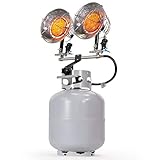
Two burners and 30,000 BTU in a unit with no assembly required, no hose, and no regulator. It mounts directly to a 20 lb propane cylinder. For anyone who needs heat in an open or semi-open space, this is one of the least fussy ways to get it.
The metal dish behind the emitter is the part that makes it work well outdoors. It reflects and focuses the output into a directed cone rather than letting it disperse in every direction, which reviewers say resists strong wind. If you are working on a dock, a porch, a tailgate, or a hunting blind, that concentration is the whole point.
Heat settings run 15,000 and 30,000 BTU across three positions. The 15,000 BTU step is genuinely useful on a moderate day, and it roughly doubles tank life compared with full output. Owners also report buying multiple units rather than one large one, which is a reasonable strategy if you have two work spots.
The frame is hard rust-proof steel with a chrome emitter guard, and the tip-over switch cuts gas flow if the heater is knocked. The low profile means it can run on a porch without ceiling clearance or fire risk concerns.
Best for open-air and cold-weather work spots
Owners report heating a two-car garage effectively while working on winter projects, and it handles the semi-open situations a wall unit cannot: an unfinished pole barn with one side open, a carport, an outdoor workbench, or a garage door that is up half the time. It is also the right tool for anyone whose heating need follows them between the garage, the yard, and a remote spot.
If your garage is a full four-season room, this is not the answer. It heats the area in front of it and cools quickly when it stops.
What you give up for that simplicity
There is no electric or piezo ignition, so the first start means a match through a side ignition hole. That is a real inconvenience in wind or rain, and it is the most common complaint in the review set alongside missing mounting screws in one shipment.
It is also rated for outdoor use only, so a closed garage still needs ventilation, and the form factor is deliberately utilitarian rather than a piece of patio furniture. The two-burner design also means more radiant heat directly in front of the emitter, so position it carefully rather than at head height.
7. GASLAND MHA18B 18,000 BTU Propane Cabinet Heater
GASLAND MHA18B Propane heater Outdoor,18,000 BTU, Max Heat 450 Sq.Ft
18000 BTU radiant
450 sq ft coverage
CSA certified
Tip-over and oxygen depletion shutoff
Pros
- No electricity needed so it runs through an outage
- Built-in rolling wheels and carry handle
- Tank housed inside the cabinet
- Quiet enough to work beside
Cons
- 450 sq ft class is small for a full three-car garage
- Zone heater rather than whole-room forced air
The defining feature is that the propane cylinder lives inside the cabinet. Nothing trails across the floor, nothing trips, and the whole thing rolls from the garage to the patio on built-in wheels when you are done. That single design decision makes it the tidiest heater here.
It also needs no electricity at all, which is why it stays on our list for cold climates. When a winter storm takes out power, this keeps running on a tank while every forced-air model with an electric fan or a powered thermostat goes quiet. For a household that heats through outages, that is not a minor feature.
Three modes step up to 18,000 BTU and cover spaces up to 450 sq ft. Buyers consistently single out three things: it needs no electricity, it runs quietly enough to read or work beside, and the enclosed cabinet with wheels makes it far more portable than a bare tank-top unit. Owners also treat the CSA certification with the tip-over and oxygen-depletion shutoffs as meaningful safety credentials.
It is a warm-your-face-and-hands heater. Place it where you are standing and it does the job without trying to condition the whole room, which is why reviewers rate it so highly despite the modest number on the box.
A strong fit for outage and zone heating
It suits patios, workshops, barns, construction sites, and small garage bays. In a four-season workshop where you are at a bench, the radiant output plus the mobility means you can follow the work around the room. In a power outage, it keeps a room above freezing with no generator running.
For anyone who already owns a cold smoking setup in a shed or garage, this is a natural companion, since the smoking run and the heating run often share the same shelter and neither depends on grid power.
Where the 450 sq ft rating becomes a limit
Eighteen thousand BTU across 450 sq ft is a zone heater, not a room heater. In a two-car or three-car garage with a closed door in January, it will warm the area in front of it and lose ground everywhere else. If the goal is a usable garage rather than a warm corner, size up.
It also carries a propane cylinder inside, which means moving it requires lifting or rolling a full tank, and a radiant cabinet warms a zone in front rather than circulating air. Reviewers do not treat either as a defect, but they are the reasons it is not the answer for a large cold garage.
8. Flame King 60,000 BTU Portable Propane Forced Air Heater
Flame King 60,000 BTU Portable Propane Forced Air Heater Outdoor Great for Jobsite, Construction, Garage, Patio, Stainless Steel
60000 BTU forced air
Heats up to 1500 sq ft
8 hours per 20 lb tank
CSA certified
Pros
- Quiet for a 60K forced-air unit
- 20 to 30 degree rise in about 15 minutes
- About 8 hours on a 20 lb tank
- No odor during operation
Cons
- Included hose needed an extra adapter for a standard tank
- Piezo igniter can fail to light
- A few models stopped working after a few days
Same 60,000 BTU class as the Remington, but this is the one to buy if noise is part of your decision. Owners repeatedly compare it favorably to loud salamander-style units and describe working beside it with music playing. In an attached garage where conversation or a power tool matters, that difference is worth more than raw output.
The heating is measured rather than dramatic: roughly a 20 to 30 degree rise in 15 to 20 minutes, and a 20 lb tank lasting a full working day. Owners also report that it does not smell during operation, which is a point in its favor for a space where you spend hours.
Safety is handled with three layers: a built-in safety fuel shutoff, a fire detection system, and a safety tilt shutoff. It is CSA certified, and customer service is a genuine positive here, with at least one owner reporting a replacement sent after the warranty period had passed.
The stainless steel body and integrated regulator hose give it a more finished feel than most portable forced-air heaters at this output, and the auto piezo ignition with a gas control button means you are not holding anything down while it lights.
Where it earns the quiet-performance pick
Attached garages, workshops where you need to hear a radio or hold a conversation, and any space where a loud burner would be genuinely irritating. It also handles the recovery-from-an-open-door case well for its class, which is the situation a cold climate produces most often.
It suits a three-car garage or a pole barn bay up to 1,500 sq ft, and the eight-hour tank runtime means one fill covers a full weekend of intermittent use.
Two things to fix and one to watch
The most common practical complaint is the fuel hookup. Several owners had to buy a separate hose, regulator, and adapter because the included assembly did not fit a standard 20 lb bottle. Budget for that before first use rather than discovering it in the cold.
Second, the piezo igniter can be finicky and occasionally fails to light. Third, and this is why the rating sits where it does, a smaller set of reviews reports units that stopped working after a few days, and the one-star share is the highest in this group. Heating itself is real; the durability picture is less settled than the models above it.
9. ProCom ML250TPA-B 25,000 BTU Ventless Infrared Plaque Heater
ProCom Heating Liquid Propane Ventless Infrared Plaque Heater With Base Feet – 25,000 BTU, T-Stat Control – Model# ML250TPA-B
25000 BTU infrared
Heats up to 1150 sq ft
Thermostat control
Wall mount hardware included
Pros
- Keeps an 800 sq ft garage warm on its own
- Wall mount hardware and base feet both included
- No electricity needed
- Slim profile suits a finished room
Cons
- Fittings for a 20 lb tank not included
- Factory oil causes heavy smoke on first start
- One heater would not relight after a tank swap
This is the only heater here that looks like a home appliance. A thin white infrared plaque on a wall bracket, roughly 26 inches wide and 23 inches tall, it disappears into a finished room in a way that shop equipment never does. If your garage doubles as a man cave or an office, that matters.
Twenty-five thousand BTU is more output than the smaller radiant cabinets, and coverage is rated to 1,150 sq ft. Owners report an 800 sq ft garage staying comfortably warm on its own, and the thermostat control with high, medium, and low settings holds temperature rather than running flat out.
It needs no electricity, which means it works through an outage and does not require you to run a generator for a small space. Push-button ignition with a built-in pilot oxygen depletion sensor handles startup, and it is ANSI certified. Wall mount hardware and base feet are both included, so you choose the configuration on the day.
Propane efficiency gets good marks, with owners reporting roughly one 20 lb barbecue bottle every three days in a working garage, which is a sensible figure for intermittent use.
Where the slim profile pays off
A garage that has been finished into a usable room, a basement workshop, a home office conversion, or an attached space where a boxy torpedo unit would look out of place. Mounted at roughly chest height it warms the person standing in front of it rather than the whole volume, which is comfortable and efficient for desk work.
It is also a good secondary heater for a large garage, covering a bench or a corner of a space that a single forced-air unit leaves cold.
The most common first-week problems
Three things trip people up, and all three are fixable. The fittings needed to attach a 20 lb propane tank are not included, so buy a brass elbow, a regulator hose, and a carbon monoxide detector at the same time. Factory oil on internal components produces heavy smoke on the first start, which can set off smoke alarms, and one owner held the knob for up to ten minutes before the pilot caught.
Beyond that, the infrared panels light all together or not at all, you will get humidity and a faint propane scent as with any unvented heater, and it runs louder than the size suggests. It carries the lowest rating in this roundup, and the one-star share reflects reliability and first-use experience rather than a lack of output. A unit that would not relight after a tank swap is the most serious report in the set.
10. Avenger 22BF-A00 18,000 BTU Propane Cabinet Radiant Heater
Avenger Portable Outdoor Propane Cabinet Heater – 18,000 BTU Radiant Gas Heater with Tip-Over & ODS Safety Shut-Off – Model # 22BF-A00
18000 BTU radiant
6K 12K and 18K settings
Up to 72 hours on low
ODS and tip-over shutoff
Pros
- Up to 72 hours on low with a 20 lb tank
- Push-and-turn piezo ignition with no electricity
- Steel cabinet on smooth casters
- Dual oxygen and tip-over protection
Cons
- 450 sq ft capacity suits a single zone
- Warms the area in front rather than the whole room
The number that makes this interesting is the runtime. On its lowest setting, owners report up to 72 hours of operation from a standard 20 lb tank, which is the longest stated runtime in this group. If you want heat available in a workshop or a garage for a whole weekend without a fuel delivery, that changes the economics.
Three settings at 6,000, 12,000, and 18,000 BTU cover spaces up to 450 sq ft. The lowest step is the one this unit is really built for, and in a mild shoulder month with the door closed, that is where it will spend most of its time.
Push-and-turn piezo ignition means it starts without electricity, so it keeps working through a power outage. The steel cabinet sits on smooth-rolling casters, and the oxygen depletion sensor combined with the automatic tip-over shutoff gives it the same dual safety story as the better-reviewed units in this category.
It carries a 4.6 rating with 81 percent of reviews at five stars and only 5 percent at one star, which is the strongest rating-to-review balance in this roundup.
Where it makes sense
Patios, workshops, small garage bays, and any space where you want long unattended runtime on a single tank. A detached shop that only needs to stay above freezing through a cold snap is a natural fit, as is a covered outdoor work area where a full-size garage heater is unnecessary.
It is also a natural companion to a garage gym setup, since a warm floor matters more when you are training through the winter months indoors. Our garage gym power rack picks cover the equipment side of that room.
Why it is tenth and not higher
Eighteen thousand BTU across 450 sq ft is a zone rating, and radiant cabinet designs warm the area in front of them rather than circulating air through a large space. In a two-car or three-car garage with the door shut in deep cold, this will not keep the whole volume comfortable.
The rating is also based on a smaller number of reviews than the units above it, so there is less long-term evidence behind it. Nothing in the feature set is troubling; the ceiling is simply capacity.
How We Picked and How to Size BTU for a Cold Garage
Every heater in this roundup was judged against the same four things: rated BTU against realistic coverage in below-freezing weather, the venting arrangement, the installation effort required, and the density of owner feedback about cold-weather performance. Products built for outdoor seasonal use were included only where the owner reports justify them, and we flagged every one that is not appropriate for a closed garage.
The sizing rule of thumb most people use is between 30,000 and 50,000 BTU per 1,000 sq ft for a well-insulated garage, and closer to 60,000 BTU per 1,000 sq ft for an uninsulated one. A 24×24 garage is 576 sq ft, which puts a well-insulated space in the 20,000 to 30,000 BTU range and the same garage uninsulated closer to 40,000 BTU. In a region with sustained sub-zero nights, add a margin and choose the next size up.
Why the insulation number swings the answer so much: a heated garage loses heat through walls, ceiling, and door whether or not there is insulation in the assembly, and an uninsulated 24×24 space can lose several times what an insulated one of the same size does over a three-hour evening. Sizing to the uninsulated number and then insulating is a mistake twice over, because the oversized heater burns fuel at high output to satisfy a load that no longer exists.
For sizing by garage, a 12×24 single-car garage around 288 sq ft works at roughly 20,000 to 30,000 BTU insulated and 40,000 BTU uninsulated. A 24×24 two-car garage at 576 sq ft lands at 30,000 to 40,000 BTU insulated and 50,000 to 60,000 BTU uninsulated. A 30×40 three-car garage at 1,200 sq ft needs roughly 50,000 to 60,000 BTU insulated and 80,000 BTU or more uninsulated. Round up when you are in a climate with sustained temperatures below 20F.
Insulate the Garage Before You Buy a Heater
No heater makes an uninsulated garage cheap to heat, and this is the step that determines your propane bill more than the model you choose. Insulation on the walls, the ceiling above the framing, and an insulated garage door entry typically cuts the heat loss dramatically compared with bare stud walls and an uninsulated steel door.
Garage doors are usually the largest single loss. A double insulated steel door with weatherstripping across the full perimeter changes the recovery time after you drive in from a snowy driveway more than any other single improvement. After that, the ceiling is the biggest surface area, and the walls matter most on the side facing prevailing winter wind.
Insulating first also lets you buy a smaller heater, which is a real saving. A 50,000 BTU unit in a newly insulated garage runs at a much lower duty cycle than the same unit in a bare one, and the thermostat cycles less often because the temperature holds better once the door closes.
Vented vs Vent-Free vs Radiant Garage Heaters
Vented units, like the ceiling-mounted forced-air category, send combustion gases outdoors through a flue. That is the correct answer for an attached garage, for any space you heat for many hours, and for anyone who wants to run the heater overnight on a thermostat. The cost is a gas line, a vent kit, ceiling height, and professional installation.
Vent-free units recirculate indoor air and rely on an oxygen depletion sensor to shut the burner down if combustion gases build up. They are simpler and cheaper, they add a small amount of humidity to the room, and they are appropriate for smaller spaces with good ventilation and regular use rather than continuous unattended heating. Check your local code before installing one in an attached garage, because requirements vary and many jurisdictions restrict vent-free appliances in garages.
Radiant heaters warm objects and people directly rather than the air. That is efficient for spot heating, since you are not paying to condition an entire volume, and it feels comfortable at lower room temperatures. Their limit is that the far end of a large garage stays cold no matter how long they run.
Forced-air units sit in between. They move a large volume of air quickly, which is why they recover fastest after a garage door opens in a snowstorm, but they heat the air rather than your body directly, so drafts are more noticeable. In a cold climate, recovery speed after door openings is the deciding factor more often than people expect.
Propane Runtime and Running Cost Compared to Electric
Propane consumption scales directly with burner output, which makes runtime math straightforward. A propane burner consumes roughly 1 lb of fuel per hour for every 50,000 BTU of input. So a 50,000 BTU unit runs about one hour per pound, a 30,000 BTU unit about 1.7 hours per pound, and a 60,000 BTU unit about 50 minutes per pound. A full 20 lb tank therefore lasts roughly 20 hours on a 50,000 BTU heater, and the manufacturer figures quoted for the products here line up: about 9.5 hours at 45,000 BTU radiant, and about 8 hours at 60,000 BTU forced air.
That number is the honest answer to whether propane is cheap, and it is not. Propane is a fuel that produces a lot of heat and no electricity to run a compressor, but the price per unit of heat is high. Electric resistance heating converts close to 100 percent of its input into heat, while a gas appliance at roughly 80 percent thermal efficiency is throwing away a fifth of what it buys. If you have a solar array or a very low electricity rate, resistance heat is hard to beat on cost.
The reason propane still wins in a cold climate garage is duty cycle and the fact that garages are not living space. Heating an attached garage to 70F all day is the case where a heat pump or a mini-split clearly wins, and owners in true cold climates increasingly report running mini-splits instead, noting that modern high-efficiency heat pumps perform well in cold weather. If your garage is a finished room you use daily, look at that option seriously before committing to combustion.
Where propane earns its place is the intermittent case. You need the garage at 50F for a few hours on Saturday, not at 70F continuously. Propane gets you there, holds it, and shuts off. If your goal is only to keep pipes and batteries from freezing through a cold snap, running the lowest setting on a thermostat-controlled unit for a few hours a day is the cheapest path by a wide margin.
Carbon Monoxide Safety and Attached Garage Rules
Any propane appliance produces carbon monoxide as a byproduct, so the honest answer to whether a propane heater gives off carbon monoxide is yes, and the mitigation is venting plus detection. Properly installed vented units exhaust combustion products outdoors through the flue by design, which is why they are the right category for an attached garage or a room you heat for long stretches.
Install a working carbon monoxide detector in the garage regardless of which type you choose, and one inside the living space above an attached garage as well. Treat the alarm as real equipment rather than a formality. A detector with a fresh test button and a documented replacement date is worth more than two units you have never checked.
For attached garages specifically, the practical rule most jurisdictions apply is that combustion appliances should not be located in the living space, and many codes restrict or prohibit vent-free appliances in garages altogether. Check your local building department before purchase rather than after, especially for a vent-free unit, and keep combustion appliances at least a foot or more from living space openings. If your garage shares a wall with the house, a vented ceiling unit is the low-risk path.
Clearance is the other discipline that gets overlooked. Follow the manufacturer clearances to combustible surfaces, keep the area around the unit free of stored material, and never run a fuel-burning heater unattended in a space you cannot check. The tip-over switch, oxygen depletion sensor, and high-temperature shutoff in the units here are real protections, not replacements for the installation rules.
Mounted vs Portable: Which Form Factor to Buy
Choose a ceiling-mounted unit heater if your garage has 10 ft of ceiling, you are willing to have a gas line and vent installed, and you want thermostat-controlled heat you can schedule. It is the only category that can safely run unattended, and it is the only one that heats an attached garage properly. Owners who install one generally describe it as a fixture for the life of the building.
Choose a portable forced-air heater if the ceiling is too low, the install is not in the budget, or you only need heat on weekends. Sixty thousand BTU covers up to 1,500 sq ft, which is enough for a two-car or three-car garage, and the model you pick matters more for noise than for output.
Choose a radiant heater if you are stationary and want warmth on your body rather than in the room. This is the efficient choice for one work spot, and the least useful choice if you need the whole space at a temperature you can work in. Our number one pick is a radiant unit for exactly that reason, and the biggest mistake buyers make is expecting a radiant heater to heat a garage the way a unit heater does.
Frequently Asked Questions
What is the best heater for a cold garage?
The best propane garage heater for most cold-climate garages is a vented, ceiling-mounted forced-air unit heater between 50,000 and 80,000 BTU, sized to your garage square footage and insulation level. If you cannot install a gas line and vent, a portable 40,000 to 60,000 BTU forced-air heater covers up to 1,500 sq ft and is the most flexible option. For warming one work spot rather than a whole room, an aimed radiant heater is more efficient.
How many BTUs do I need to heat a 24×24 garage?
A 24×24 garage is 576 sq ft. A well-insulated space needs roughly 30,000 to 40,000 BTU, while the same garage uninsulated needs closer to 50,000 to 60,000 BTU, and more in a climate with sustained temperatures below 20F. The general rule of thumb is 30,000 to 50,000 BTU per 1,000 sq ft insulated, and about 60,000 BTU per 1,000 sq ft uninsulated. Insulating the walls, ceiling, and garage door before buying lets you size down.
Is it cheaper to heat a garage with propane or electric?
Electric resistance heating is cheaper per unit of heat because it converts nearly all of its input into heat, while a propane appliance runs at roughly 80 percent thermal efficiency. Propane still wins for intermittent use in a garage that only needs to sit near 50F for a few hours, because you are not conditioning the space around the clock. If you need a finished garage at living temperature most of the day, a high-efficiency heat pump or mini-split usually costs less over a full season.
Will a propane heater give off carbon monoxide?
Yes. Any propane appliance produces carbon monoxide as a combustion byproduct. Vented ceiling-mounted units exhaust combustion gases outdoors through a flue, which makes them the correct choice for an attached garage or a space heated for long stretches. Vent-free units recirculate indoor air and rely on an oxygen depletion sensor, so they need good ventilation and careful placement. Install a working carbon monoxide detector in the garage and in the living space above an attached garage regardless of which type you choose.
Which is better for my garage, a Modine Hot Dawg or a Mr. Heater unit?
They serve different needs. A Hot Dawg is a permanently mounted commercial-style unit built for a gas line, a flue, and a thermostat, and owners on heating forums commonly report 13 years or more of service from them in cold climates. Mr. Heater offers both that same installed category and a wide range of portable and vent-free models, so you can match the budget and the install. Choose the mounted category if you have the ceiling height and will have it installed; choose a portable model if you cannot.
How long does a 20 lb propane tank last on a garage heater?
A propane burner consumes roughly 1 lb of fuel per hour for every 50,000 BTU of input, so a full 20 lb tank lasts about 20 hours on a 50,000 BTU heater, roughly 9.5 hours at 45,000 BTU radiant output, and about 8 hours on a 60,000 BTU forced-air unit. Running a heater on its lowest setting stretches that dramatically, with some 18,000 BTU cabinet heaters rated at up to 72 hours on low from a single 20 lb tank.
The Best Propane Garage Heaters for Cold Climates: Final Verdict
Start with the Mr. Heater 45,000 BTU tank top radiant heater if you want the most heat for the least commitment and a single defined work spot. It carries the highest rating and the deepest owner history in this roundup, it needs no electricity, and it moves with the season. It is our pick because it solves the actual problem most people in cold climates have, which is one person needing to be warm in a freezing garage, rather than a whole room needing to be conditioned.
If your garage is a full two-car or three-car space and you can have a gas line and vent installed, the 50,000 BTU ceiling-mounted unit heater is the better long-term decision, because it is thermostat controlled, it exhausts outdoors, and it makes the space usable every weekend through February. For pure output without installation, the 60,000 BTU portable units cover up to 1,500 sq ft, and the Flame King is the one to buy if noise is part of the equation.
Insulate before you buy, size to square footage and insulation level, and fit a carbon monoxide detector in any garage you heat. Those three steps decide whether your propane bill is a reasonable winter expense or a running lesson in thermodynamics.