
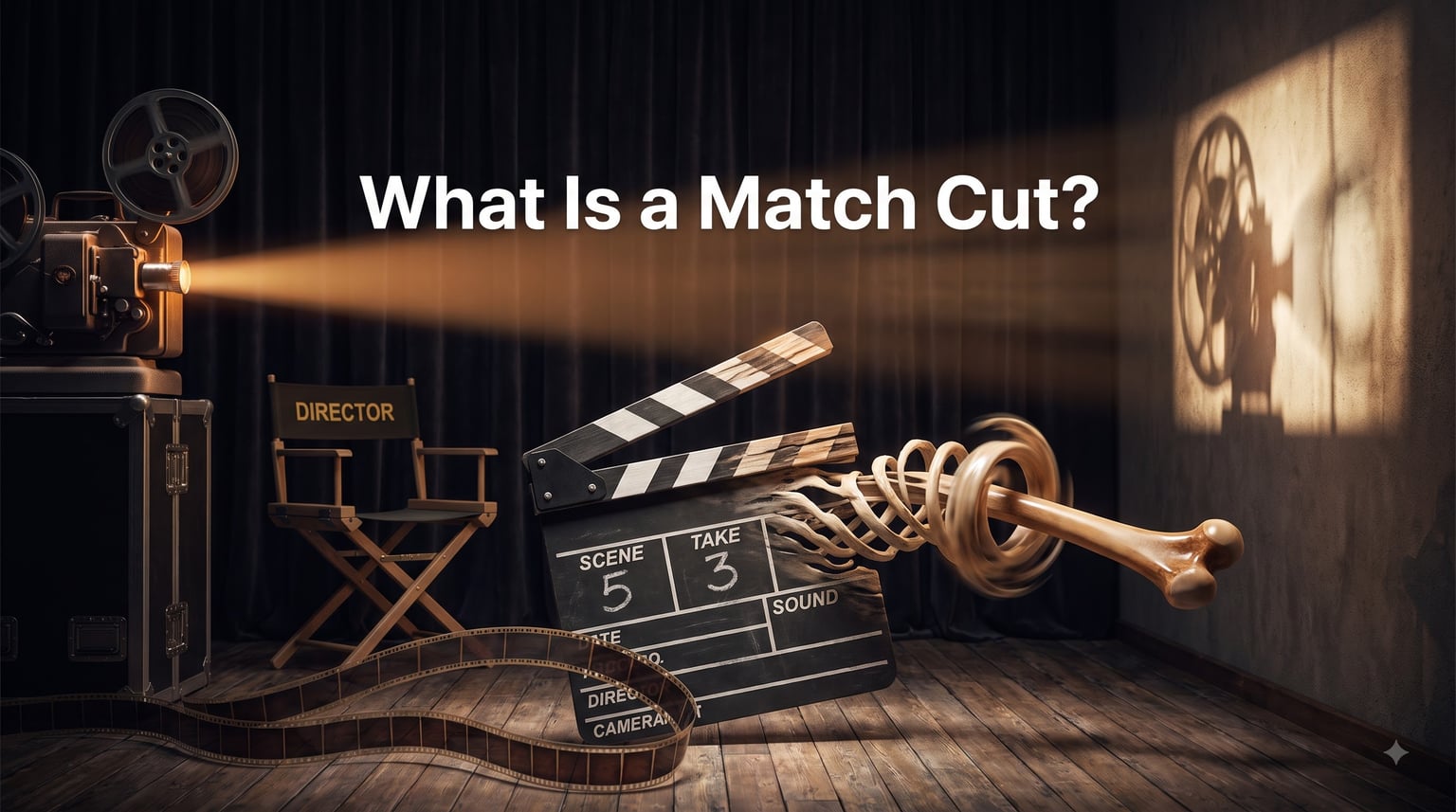
A match cut is a film editing technique where two different shots are joined by sharing similar visual shapes, actions, or sounds to create a smooth transition with thematic meaning. Think of it as the cinematic glue that connects ideas through a shared element, whether that element is the curve of a spinning bone, the arc of a thrown object, or even the rumble of a passing train.
If you have ever wondered how directors compress time, geography, or metaphor into a single seamless edit, the answer almost always involves a match cut. In this guide, I will break down what a match cut is, explore the three main types, walk through famous examples from cinema history, and show you exactly how to create one in your own short film work in 2026.
Table of Contents
- What Is a Match Cut in Film?
- The Three Types of Match Cuts Every Filmmaker Should Know
- Famous Match Cut Examples from Cinema History
- How to Create a Match Cut: Step-by-Step Process
- Match Cut vs Jump Cut vs Flash Cut: Key Differences
- Common Mistakes to Avoid When Using Match Cuts
- Match Cuts in Short Films: Practical Applications
- Frequently Asked Questions About Match Cuts
- Final Thoughts on Using Match Cuts
What Is a Match Cut in Film?
A match cut is a transition between two shots that links them through a matched visual, action, or audio element. The term comes from classical continuity editing, where editors “matched” the position, movement, or composition of two separate pieces of footage to disguise the cut or create meaning.
The technique was formalized by film theorists David Bordwell and Kristin Thompson, who described match cuts as cuts where the composition of two shots are matched by action, subject, or subject matter. In practice, this means a viewer’s eye finds continuity between two completely different scenes because one element lines up, echoes, or mirrors another.
Here is the simplest way to think about it: a regular cut just moves you from one shot to another. A match cut moves you through a shared element that says something about both scenes at once. That shared element could be a spinning object, a matching shape, a piece of movement, or even a sound that bridges the gap.
The match cut definition you will hear most often in film school centers on three qualities: visual continuity, thematic connection, and seamless flow. When all three align, the cut feels almost invisible, but it also carries meaning that a standard straight cut could never achieve.
Match Cut vs Regular Cut
The difference between a cut and a match cut comes down to intent and effect. A regular cut simply moves the viewer from shot A to shot B, with no visual rhyme or reason linking them beyond the narrative.
A match cut, by contrast, deliberately aligns one element across two shots. That alignment can be graphic (matching shapes or colors), action-based (matching movement), or sonic (matching sound). The goal is not just continuity but also meaning: the match itself becomes a small argument the film is making.
In a short film, this distinction matters even more. You have less screen time to establish character, place, and theme. A well-placed match cut can compress information, skip exposition, and add visual sophistication in a fraction of a second.
The Three Types of Match Cuts Every Filmmaker Should Know
Most match cuts fall into three categories. Understanding them is the first step toward using them confidently in your own projects.
Graphic Match Cut
A graphic match cut aligns the visual composition, shape, color, or framing of two shots, even when the subjects themselves are completely different. The bone-to-satellite transition in 2001: A Space Odyssey is the textbook example: a prehistoric bone tossed into the air matches the shape of an orbiting spacecraft thousands of years later.
Graphic match cuts are powerful because they let you compress enormous leaps in time and space into a single frame. They are also a favorite of short film creators because you can design them in pre-production without needing expensive location shoots.
Match on Action
A match on action cut begins one shot mid-action and completes that same action in the next shot, often from a different angle or location. The classic example: a character starts to open a door in shot A, and the cut lands on the door being opened in shot B, hiding the transition entirely.
This type is technically a subtype of graphic match cut, but it is so common in modern editing that editors treat it as its own category. It is the workhorse of action films, music videos, and Edgar Wright’s entire filmography.
Sound Bridge Match Cut
A sound bridge (sometimes called an audio match cut) uses audio rather than visuals to connect two scenes. A line of dialogue, a musical sting, or an ambient sound carries over from one shot to the next, creating continuity even when the visuals jump wildly.
Stanley Kubrick used sound bridges extensively in 2001 and The Shining. In short films, sound bridges are an underrated tool because they let you cut on the beat of dialogue, a scream, or a musical hit without breaking the viewer’s immersion.
Famous Match Cut Examples from Cinema History
Studying famous match cuts is the fastest way to train your eye. Here are the scenes every short filmmaker should know.
2001: A Space Odyssey (1968) – The Bone and the Satellite
Kubrick cuts from a prehistoric ape throwing a bone into the air to a satellite orbiting Earth in a single frame-perfect match. The bone’s spinning shape lines up with the satellite’s spinning form, compressing four million years of human evolution into three seconds.
Lawrence of Arabia (1962) – The Match to the Sunrise
David Lean’s film cuts from a character blowing out a match in darkness to a sunrise over the desert. The shape and timing of the dying flame mirror the rising sun, signaling the dawn of a new era for the protagonist.
Psycho (1960) – The Shower to the Eye
Alfred Hitchcock cuts from a wide shot of Janet Leigh’s shower murder to an extreme close-up of her lifeless eye. The circular drain and the round pupil create a graphic match that lingers in the viewer’s mind long after the scene ends.
Citizen Kane (1941) – The Sled and the Mansion
Orson Welles famously cut from a child’s wooden sled being burned to the towering mansion it would eventually lead to. The sled’s frame shape echoes the mansion’s doorway, creating a circular journey through one man’s life.
The Royal Tenenbaums (2001) – The Family Portrait
Wes Anderson uses a match cut to jump from a family portrait hanging on a wall to the same family sitting in the same position years later. It is one of the cleanest match cuts in modern cinema and a masterclass in subtle visual storytelling.
Baby Driver (2017) – The Walking to the Running
Edgar Wright uses match on action throughout his films, and Baby Driver is no exception. He matches footsteps, head bobs, and even gun recoil across cuts, creating a rhythm that almost feels musical.
How to Create a Match Cut: Step-by-Step Process
Creating a match cut is more about planning than post-production magic. Here is the workflow I use with short film clients and my own projects.
Step 1: Identify the thematic connection you want to make.
Before you shoot anything, ask yourself: what idea am I trying to compress? Time jump? Character arc? Symbol-to-subject link? The answer determines which type of match cut you need.
Step 2: Find the shared element.
Look for shapes, movements, sounds, or colors that exist in both shots. A thrown object, a circular form, a footstep, a laugh, a musical note. The shared element does not have to be obvious; subtlety often works better.
Step 3: Plan both shots in pre-production.
Match cuts almost always fail when you try to “find” them in the edit. Storyboard or shot-list both sides of the cut so you know exactly how the framing and timing will line up.
Step 4: Shoot with matching composition.
Use the rule of thirds, eye-line, and screen direction deliberately. If your first shot has the subject on the right third, your second shot should mirror that placement or deliberately break it for effect.
Step 5: Edit on the shared action or beat.
Place the cut exactly at the moment of the shared element: the apex of a spin, the peak of a sound, the flash of a match. Cut too early or too late and the match breaks.
Step 6: Test with cold viewers.
Show the cut to someone who has never seen the footage. If they notice the visual rhyme, you have done your job. If they notice the cut first, refine the timing.
Screenplay Notation for Match Cuts
In a script, match cuts are usually written into the action line. A common format looks like:
MATCH CUT:
The spinning top matches the rotating planet below.
You do not need special software; a simple capitalized note above the action line is enough to flag the edit for your director and editor.
Match Cut vs Jump Cut vs Flash Cut: Key Differences
Editing terminology is notoriously tangled. Here is how match cuts differ from two close relatives.
Match Cut vs Jump Cut
A jump cut is an abrupt cut within the same shot, used to compress time or create a sense of unease. It usually breaks continuity on purpose. A match cut, by contrast, smooths continuity by aligning two different shots. Both can compress time, but match cuts create meaning while jump cuts create disorientation.
Match Cut vs Flash Cut
A flash cut is a very brief shot (often less than a second) inserted to suggest a thought, memory, or shock. It is usually used for emotional effect, not continuity. A match cut can be any length and is always about connection, whether thematic or visual.
The confusion comes from the fact that both techniques can be quick and surprising. The clearest way to remember the difference: a match cut connects two shots; a flash cut interrupts one shot with another.
Match Cut vs Smash Cut
A smash cut is a sudden, often jarring transition used for comedic or dramatic impact. It is the opposite of a match cut’s smoothness. If you cut from a peaceful sunrise to a screaming alarm, that is a smash cut, not a match cut.
Common Mistakes to Avoid When Using Match Cuts
Match cuts are easy to get wrong. Here are the mistakes I see short film creators make most often, and how to fix them.
Mistake 1: Trying to force a match that isn’t there.
If the visual link feels strained, the audience will feel it too. Drop the cut and find another transition.
Mistake 2: Hiding the cut so well that viewers miss the meaning.
Match cuts are not just invisible edits. They are arguments. Make sure the thematic connection is clear.
Mistake 3: Overusing match cuts in one short film.
One strong match cut per short scene is usually plenty. Multiple match cuts in a row become predictable and lose impact.
Mistake 4: Relying on stock footage.
Stock footage rarely matches your custom shot. Shoot both sides of the cut whenever possible to control framing and lighting.
Mistake 5: Ignoring sound.
Even the cleanest graphic match fails if the audio jumps awkwardly. Use a sound bridge or matched ambience to carry the cut.
Match Cuts in Short Films: Practical Applications
Short film creators have a unique advantage with match cuts: tight runtimes mean every edit has to earn its place. Here is how to use match cuts effectively in shorts under 15 minutes.
Open with a match cut to set tone.
Your first 30 seconds matter. A match cut from an everyday object to a thematic one signals to viewers that this film will reward close attention.
Use match cuts to skip exposition.
Instead of a title card saying “Three years later,” let a match cut show the time jump visually. It is faster and more cinematic.
End on a match cut for a resonant final image.
Short films live and die by their final shot. A match cut closing image ties your themes together in a way that sticks with festival juries.
Keep it low-budget friendly.
The best match cuts often use everyday objects: a spinning coin, a thrown ball, a cup of coffee. You do not need a satellite or a mansion to make one work.
Frequently Asked Questions About Match Cuts
What is an example of a match cut?
A match cut is a transition that links two shots through a shared visual, action, or sound. The most famous example is the bone-to-satellite cut in 2001: A Space Odyssey, where a spinning prehistoric bone matches the shape of an orbiting spacecraft. Other classic examples include the match-to-sunrise transition in Lawrence of Arabia and the shower-to-pupil graphic match in Psycho.
What are the three types of match cuts?
The three main types of match cuts are graphic match cuts (aligning shape, color, or composition), match on action (continuing the same movement across two different shots), and sound bridge match cuts (using audio like dialogue, music, or ambience to bridge two scenes). Each type creates continuity in a different way, and most editors use a mix of all three.
What is the difference between a cut and a match cut?
A regular cut simply moves the viewer from one shot to the next with no deliberate visual or thematic connection. A match cut aligns one element (shape, action, or sound) across two shots to create meaning and continuity. The match itself becomes part of the storytelling, often compressing time, space, or symbolism into a single transition.
What is the difference between a match cut and a flash cut?
A match cut connects two different shots through a shared element to create continuity and meaning. A flash cut is a very brief insert shot used to interrupt another scene, often to suggest a thought, memory, or shock. Match cuts are about connection; flash cuts are about interruption.
Final Thoughts on Using Match Cuts
A match cut is one of the oldest and most powerful tools in the filmmaker’s kit. From Kubrick’s bone-to-satellite to Wes Anderson’s family portraits, the technique has been used for nearly a century to compress meaning, time, and theme into a single elegant edit.
If you are making short films in 2026, my advice is simple: plan your match cuts before you shoot, keep them rare enough to feel earned, and always test them with a fresh pair of eyes. A great match cut rewards attention; a forced one breaks immersion.
Pick one scene from your current project, identify the shared element, and try a single match cut. You will feel the difference in the edit almost immediately.