
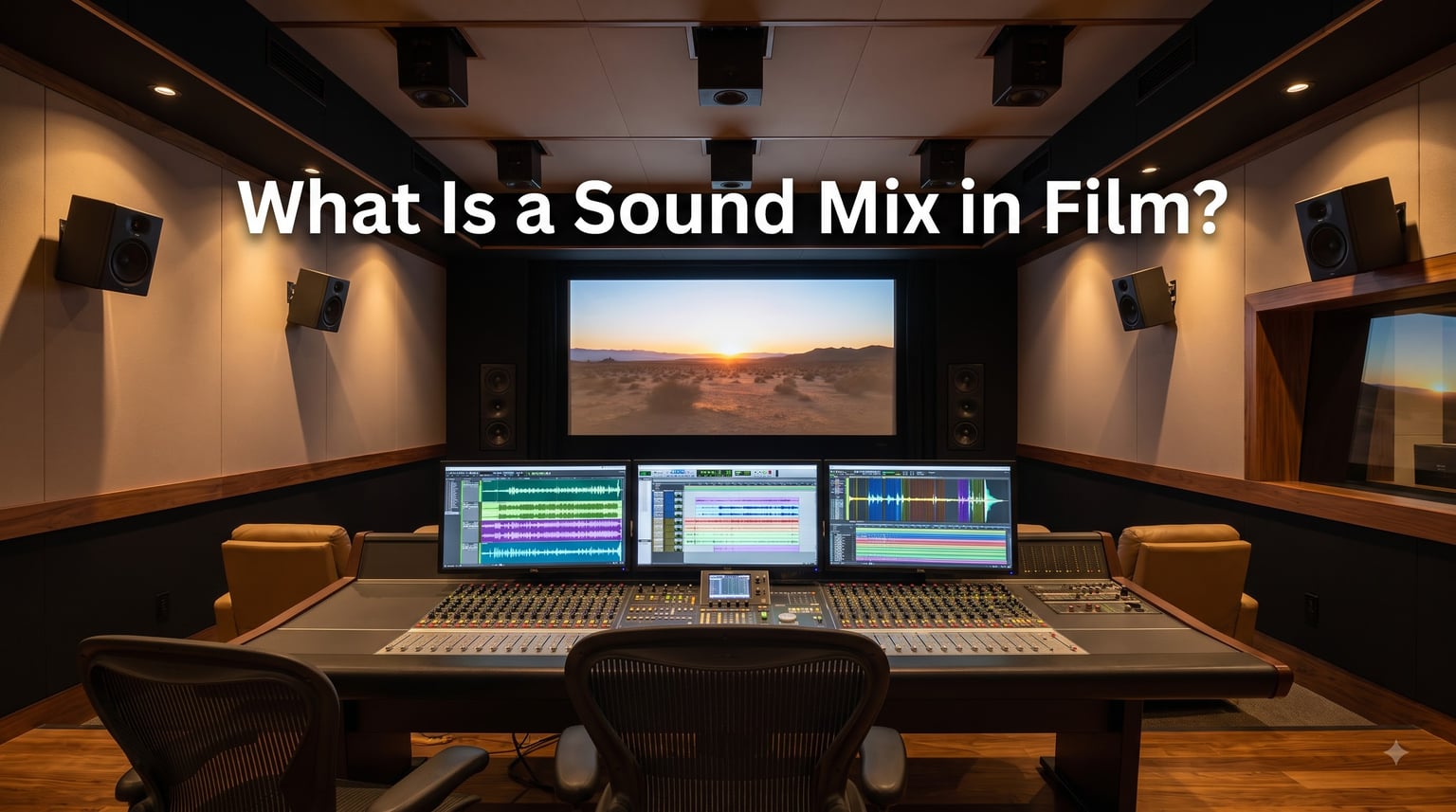
A sound mix in film is the post-production stage where every audio element in a movie gets balanced, layered, and shaped into one cohesive soundtrack. The sound mix brings together dialogue, music, sound effects, and Foley into a final mix that audiences hear in theaters, on streaming platforms, or at film festivals.
I work with short film audio every week, and I can tell you this stage makes or breaks a production. In this guide, I’ll walk you through exactly what a sound mix in film is, how it differs from sound editing, the step-by-step process, and what you need to know if you’re mixing your own short film.
Table of Contents
- What Is a Sound Mix in Film?
- The Three Core Audio Elements in a Film Sound Mix
- Sound Editing vs Sound Mixing: What’s the Difference?
- The Sound Mixing Process Step by Step
- What Does a Re-Recording Mixer Actually Do?
- Sound Mix Standards: LUFS, Loudness, and Delivery Specs
- Sound Mixing for Short Films: Timelines and Budget Realities
- Tips for Beginner Sound Mixers
- FAQs
- Final Thoughts on the Sound Mix in Film
What Is a Sound Mix in Film?
A sound mix in film is the final audio post-production process where a re-recording mixer combines and balances every sound element into one unified soundtrack. This includes dialogue, Foley, sound effects, ambient sounds, and the musical score.
Think of it as the orchestra conductor of the entire audio world. The sound mix determines whether a whisper carries emotional weight, an explosion lands with impact, or a quiet scene still feels tense. Without a proper sound mix, even a beautifully shot film feels flat.
Here’s what the sound mix actually accomplishes in practice. First, it ensures dialogue stays clear and intelligible throughout the entire film. Second, it balances music so it supports the story without overpowering voices. Third, it layers sound effects and Foley to create a believable world. Finally, it locks in loudness levels so the film sounds consistent whether viewed at home or in a cinema.
According to industry data from the Academy of Motion Picture Arts and Sciences, sound mixing is one of the most technically demanding roles in post-production. A single feature film can have hundreds of individual audio tracks that all need to work together.
The Three Core Audio Elements in a Film Sound Mix
Every sound mix in film is built from three core audio elements. Understanding these stems is the first step toward understanding the entire process.
Dialogue
Dialogue is usually the most important element in any film sound mix. It carries the story, reveals character, and drives emotional connection. A re-recording mixer always prioritizes dialogue clarity above everything else.
In a typical sound mix, dialogue gets the loudest, most consistent treatment. Even during loud explosions or sweeping music, dialogue must remain intelligible. This is why mixing engineers spend so much time riding dialogue levels scene by scene.
Music
Music in a film sound mix serves the emotional arc of the story. It can underscore tension, signal danger, or punctuate a moment of joy. The music stem includes the original score, licensed tracks, and sometimes source music playing within the scene.
A skilled sound mix keeps the score present but never competing with dialogue. When characters speak, music dips. When the visual takes over, music swells. This dynamic balance is one of the hardest skills to master in film audio.
Sound Effects and Foley
Sound effects (SFX) and Foley create the world of the film. SFX include things like explosions, car crashes, doors slamming, and rain. Foley refers to everyday sounds recorded in sync with the picture, like footsteps, clothing rustle, or a character picking up a coffee cup.
In a well-crafted sound mix, these elements blend so naturally that audiences never notice them consciously. They simply feel the world is real. This is exactly what professional mixers spend weeks achieving on every film.
Sound Editing vs Sound Mixing: What’s the Difference?
Sound editing and sound mixing are two distinct stages of film audio post-production. Sound editing happens first, creating and organizing the raw audio assets. Sound mixing happens after, balancing all those assets into the final soundtrack.
Sound editing is the process of gathering, creating, cleaning, and synchronizing every audio element. Sound editors handle dialogue cleanup, Foley recording, sound effects design, and ADR (Automated Dialogue Replacement). They deliver stems, which are grouped audio files containing related material.
Sound mixing takes those stems and balances them together. The re-recording mixer adjusts levels, applies EQ and compression, uses automation to ride faders scene by scene, and locks in the final loudness.
Here’s a quick comparison:
Sound editing: Creates the raw audio material and organizes it into stems
Sound mixing: Balances stems together into the final soundtrack
Sound editing focus: Individual sound quality, timing, selection
Sound mixing focus: Overall balance, clarity, emotional impact
Sound editing tools: DAW, RX, dialogue editing software
Sound mixing tools: Pro Tools, dubbing stages, monitor systems
The two roles work closely together, but the responsibilities are distinct. Think of sound editing as gathering ingredients and cooking them, while sound mixing is plating the meal.
The Sound Mixing Process Step by Step
The sound mixing process for a film follows a clear sequence. Knowing these steps helps you plan your own short film project realistically.
Step 1: Confirm Picture Lock
Picture lock is the moment when the visual edit is final and no further changes will be made. Sound mixing cannot begin in earnest until the picture is locked, because every audio decision ties to specific frames. If the picture changes, the mix has to be redone.
Step 2: Receive Stems and OMF/AAF Files
The sound editor delivers stems (grouped audio files) and session files (OMF or AAF format) containing all the audio material. These files include dialogue, ADR, Foley, hard effects, ambience, and music. The re-recording mixer imports these into a DAW, typically Pro Tools.
Step 3: Pre-Dub or Spotting Session
A spotting session brings the director, mixer, and sometimes producers together to review the film and discuss the creative direction of the mix. They identify problem areas, plan music timing, and confirm any missing elements.
Step 4: Rough Mix
The rough mix is the first complete balance of all stems. Levels are set, basic EQ and compression are applied, and the overall shape of the soundtrack emerges. The rough mix usually takes several passes.
Step 5: Final Mix
The final mix refines the rough mix with detailed automation, scene-by-scene adjustments, and final loudness targets. This is where every whisper, footstep, and music swell gets refined. For a feature film, this stage alone takes 8 to 10 weeks according to industry professionals.
Step 6: Print Master and Deliverables
Once approved, the final mix is printed to the required deliverable formats. This might include theatrical prints (5.1 or 7.1 surround), broadcast masters, streaming specs (like Netflix or Amazon), and festival DCP audio.
What Does a Re-Recording Mixer Actually Do?
A re-recording mixer is the professional who performs the sound mix on a film. They sit at the mixing console in a dubbing stage and make thousands of micro-decisions about volume, timing, and tone throughout the film.
The job is part engineer, part musician, part storyteller. The re-recording mixer shapes how audiences emotionally experience every scene. A great mixer can take the same raw audio and produce a mix that feels suspenseful, intimate, or epic, depending on the creative direction.
On major features, two re-recording mixers often share the work. One typically handles dialogue, the other handles sound effects and music. For short films and indie productions, a single mixer usually handles the entire film solo.
Sound Mix Standards: LUFS, Loudness, and Delivery Specs
Modern sound mix in film follows loudness standards measured in LUFS (Loudness Units Full Scale). LUFS replaces older peak-based measurements because it reflects how humans actually perceive loudness.
Different platforms require different loudness targets. Here are the most common ones for 2026:
Theatrical release: -27 LUFS integrated, calibrated to 85 dB SPL
Netflix: -27 LUFS dialogue gated, with -2 dB true peak maximum
Broadcast television: -24 LUFS (EBU R128 standard)
YouTube and streaming: -14 LUFS for online content
Film festivals: Usually theatrical specs, around -27 LUFS
Beyond loudness, delivery specs also cover channel layout (mono, stereo, 5.1, 7.1), sample rate (typically 48 kHz), and bit depth (24-bit). For short films submitting to festivals, sticking to theatrical standards ensures compatibility.
If you’re mixing your own short film, checking your deliverable specs early saves major headaches later. Festival technical requirements are often strict, and a rejected audio file can mean missing a submission window.
Practical LUFS Guidance for Short Filmmakers
Measuring LUFS correctly takes some practice. You need a LUFS meter plugin, and the most reliable ones are free. I recommend Youlean Loudness Meter 2 for beginners because it shows integrated, short-term, and momentary values at a glance.
For short films targeting festivals, mix to -27 LUFS integrated across the entire program. Don’t trust your ears alone at this stage. Calibrate your monitoring to 85 dB SPL using a reference tone, and always check your integrated LUFS at the very end of the session.
One common trap is mixing loud scenes only and ignoring quiet moments. Run your LUFS meter over the full duration of your film, not just the action sequences. A dialogue-gated measurement often reads 2 to 4 LU higher than the full mix, which is exactly why Netflix and theatrical specs use that method.
Watch your true peak too. Even if your LUFS is correct, peaks above -2 dBTP can cause distortion on consumer playback systems. Use a limiter as the last plugin on your master bus, but never as a crutch. If your mix needs heavy limiting to hit targets, the underlying balance probably needs work.
Sound Mixing for Short Films: Timelines and Budget Realities
Short films have very different mixing timelines than features. A 5 to 15 minute short might need 1 to 3 weeks of dedicated mixing time, depending on complexity and the experience of the mixer.
For a typical 10-minute short film, here’s a realistic breakdown:
Sound editing and cleanup: 1 to 2 weeks
Foley and sound design: 1 to 2 weeks
Final sound mix: 3 to 5 days
Mastering and deliverables: 1 to 2 days
Budget-wise, professional sound mixing for short films ranges widely. A beginner-friendly freelancer might charge a few hundred dollars for a 10-minute short, while a seasoned re-recording mixer on a dubbing stage can charge several thousand. For most indie short film creators, a hybrid approach works well: handle dialogue cleanup and basic edits yourself, then hire a professional for the final mix and master.
The biggest mistake I see indie filmmakers make is treating sound as an afterthought. They spend months on cinematography and editing, then rush the audio in the final week before submission. The result is dialogue that’s hard to hear, music that fights voices, and a submission that gets rejected on technical grounds.
Realistic Short Film Budget Examples
Let’s break down what you might actually spend. For a 10-minute festival-bound short in 2026, here’s what I see across three common scenarios.
The DIY route costs almost nothing in cash but demands serious time. You handle dialogue cleanup with iZotope RX Elements (around 100 dollars one-time), do Foley with household props, and mix in a free DAW like Reaper or DaVinci Resolve’s Fairlight. Total out-of-pocket is roughly 100 to 200 dollars, plus 60 to 100 hours of your own time.
The hybrid route is where most short filmmakers land. You do dialogue cleanup and basic sound design yourself, then hire a freelance re-recording mixer for the final mix. Expect 800 to 2000 dollars for the mix, plus 50 to 80 hours of your own time on pre-mix prep.
The professional route covers everything. A small post house or seasoned mixer handles the entire audio pipeline, including editing, Foley, sound design, mix, and master. For a 10-minute short, this runs anywhere from 3000 to 8000 dollars depending on the city and mixer reputation.
Festival Audio Requirements You Need to Know
Major short film festivals have specific audio delivery specs, and they vary more than you’d expect. Here are real examples from 2026.
Sundance requires a 5.1 surround mix at -27 LUFS, plus a stereo mix for backup, both as 24-bit 48 kHz WAV files. Cannes Film Festival Short Film Palme d’Or submissions ask for stereo at -23 LUFS or 5.1 at -27 LUFS. Tribeca follows similar theatrical standards at -27 LUFS integrated.
Smaller regional festivals are usually more forgiving. Many accept stereo files at -23 to -27 LUFS, with or without a separate 5.1 mix. But here’s the catch: the technical specs document often includes extra rules about file naming, channel routing, and DCP formatting that catch filmmakers off guard.
I always tell clients to download the festival’s technical specifications PDF before starting the mix. Read it twice, then plan your deliverables around it. If you wait until after mixing to discover you needed a specific channel layout or a separate M&E (music and effects) stem, you’ll be redoing work you already paid for.
DIY Mixing vs Hiring a Pro: When to Make the Call
Mixing your own short film works fine in certain situations. If your film is dialogue-heavy with minimal action, you have a treated room and decent monitors, and you understand LUFS targets, you can absolutely deliver a competitive mix.
Hiring a pro makes sense when your film relies on dynamic sound design, complex music cues, or surround delivery. It also makes sense when you’re submitting to top-tier festivals where technical rejection is a real risk. A professional mixer brings calibrated rooms, years of trained ears, and fast turnaround.
The honest middle ground: do your own sound editing and pre-mix, then book 1 to 2 days with a professional mixer for the final balance and master. This gives you the cost savings of DIY prep with the polish of a pro finish, and it’s how many award-winning shorts actually get made.
Tips for Beginner Sound Mixers
If you’re mixing your own short film for the first time, these tips come from years of working with both beginners and professionals.
Always start with picture lock confirmed. Mixing before the visual edit is final means doing the work twice. Once picture is locked, build your mix stems in proper groups from the start.
Prioritize dialogue before anything else. If dialogue isn’t clear and consistent, nothing else in the mix matters. Use automation instead of heavy compression to ride levels scene by scene.
Take breaks and check your mix on multiple systems. A mix that sounds great on studio monitors can fall apart on laptop speakers or TV soundbars. Reference your work on at least three playback systems before locking the final.
Use reference tracks from professional films in similar genres. They help you gauge loudness, balance, and emotional tone. Just don’t copy them exactly.
Get your room treatment right before anything else. A mixer in an untreated room makes bad decisions without realizing it. Even basic absorption panels at first reflection points make a huge difference.
Save your mix versions and label them clearly. I keep rough mixes, alternate versions, and rejected client notes in dated folders. When a director says “I liked last Tuesday’s version,” you’ll be glad you have it.
Use proper gain staging from the start. Keep your individual tracks peaking around -18 dBFS before processing, and let your bus compressors do the heavy lifting. Hot tracks into plugins sound muddy fast.
Edit before you mix. Pulling breaths, removing clicks, and tightening dialogue timing during the mix stage slows everything down. Clean production audio saves hours during the final balance.
Watch your reverb and room tone. Every location has its own room tone, and when you cut between scenes the change is obvious. Layer consistent room tone under dialogue to keep the world feeling unified.
Build relationships with your sound editor early. The best mixes start with clean, well-organized stems. If you’re collaborating, agree on file naming and stem layout before anyone opens Pro Tools.
Watch out for the most common mistakes beginner mixers make. First, don’t over-process dialogue with EQ and compression chains. A clean recording with subtle automation almost always beats a heavily processed noisy one. Second, avoid loudness war habits from music production. Film mixes are not mastered to be as loud as possible. Stick to your LUFS target and trust the standard. Third, never deliver without listening on earbuds or phone speakers. If dialogue disappears on a small driver, your mix isn’t done. Fourth, don’t ignore phase relationships when layering Foley and effects. Out-of-phase elements cancel out and your mix will feel hollow on certain systems.
Keep your session organized from day one. Color-code tracks by stem type, label every clip meaningfully, and use markers for scene changes. When a client asks for a revision two weeks later, you’ll thank yourself for the structure. Mixing is technical work, but organization is what separates professionals from hobbyists.
Finally, know when to ask for help. If your film requires surround sound and you’ve never mixed in 5.1, consider hiring out at least the final stage. The same goes for theatrical deliverables and DCP creation. A small investment at the end often determines whether your film screens or sits on a hard drive.
FAQs
How long does sound mixing take for a short film?
Sound mixing for a short film typically takes 1 to 3 weeks total, including sound editing, Foley, the final mix, and mastering. A 10-minute short usually needs 3 to 5 days of dedicated final mix time, plus earlier sound editing work.
What are the three types of sound in film?
The three types of sound in film are dialogue, music, and sound effects (including Foley). Dialogue carries the story, music sets emotional tone, and sound effects plus Foley build the world of the film.
What does cinematic audio mix do?
A cinematic audio mix combines dialogue, music, sound effects, and Foley into a balanced final soundtrack. It ensures clarity, emotional impact, and consistent loudness throughout the film.
How loud should a film mix be?
A film mix should target around -27 LUFS integrated for theatrical and festival delivery, -24 LUFS for broadcast television, and -14 LUFS for online platforms like YouTube. Peak levels should stay below -2 dB true peak.
Final Thoughts on the Sound Mix in Film
Understanding what a sound mix in film is gives you a real advantage as a filmmaker. Whether you’re hiring a professional or mixing your own short, knowing the process helps you plan timeline, budget, and deliverables with confidence.
Start by confirming picture lock early, organize your audio into clean stems, prioritize dialogue, and target the right loudness standard for your distribution channel. The sound mix is your film’s emotional closer. Treat it like it matters, and your film will stand out.