
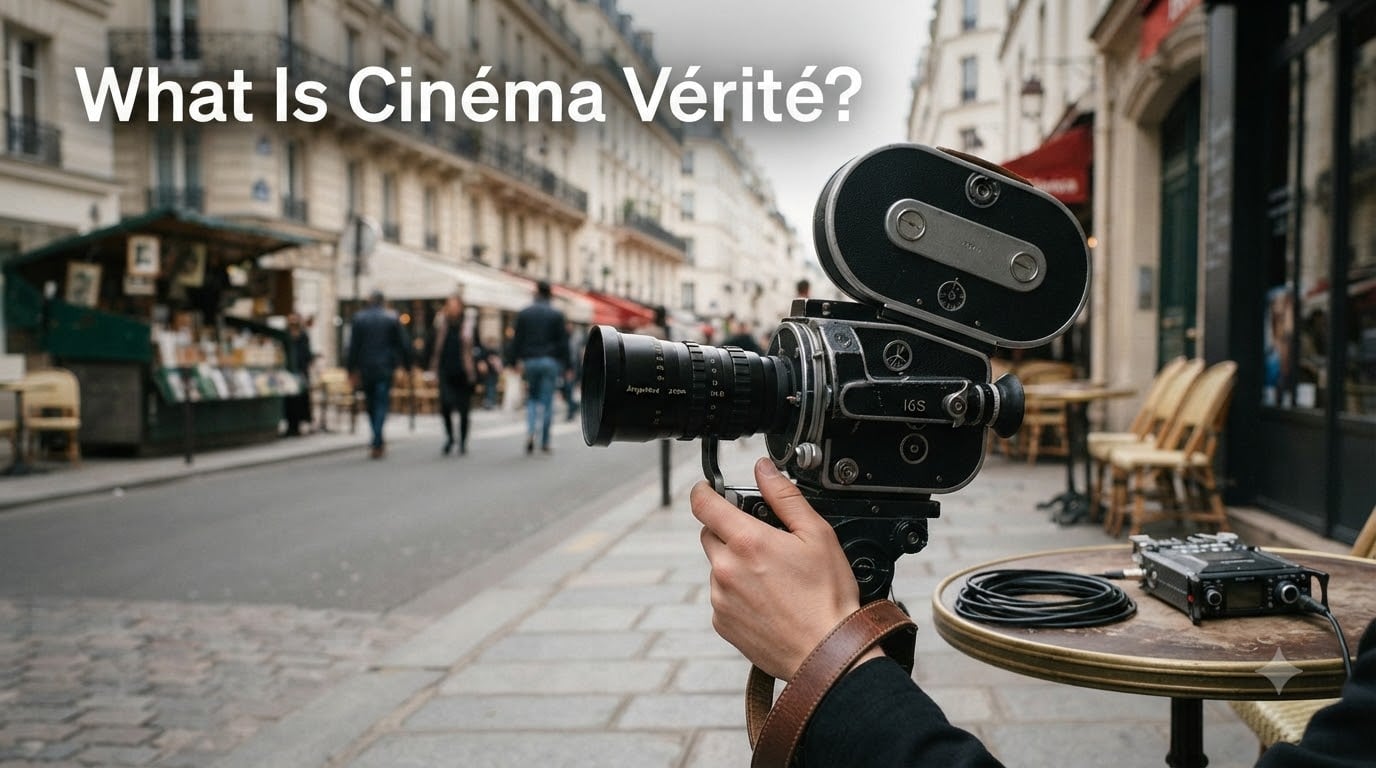
Cinéma vérité translates to “truth cinema” — a French documentary filmmaking style that emerged in the late 1950s and early 1960s, built on handheld cameras, natural lighting, and unscripted real-life action. Rather than staging scenes or writing scripts, filmmakers using this approach follow their subjects through authentic moments, capturing genuine reactions as they unfold. The result feels raw, intimate, and unmistakably real.
If you have ever watched a documentary that felt less like a narrated educational film and more like you were standing in the room with real people living their lives, you have felt the impact of this movement. The style fundamentally changed how we capture reality on camera, and its DNA runs through everything from modern political documentaries to reality television.
In this guide, our team breaks down exactly what cinéma vérité is, where it came from, what separates it from similar styles like Direct Cinema, and how you can apply its techniques to your own short films and documentary projects.
Table of Contents
- What Is Cinéma Vérité? The Definition
- The Origins: How Cinéma Vérité Was Born
- Key Characteristics of Cinéma Vérité
- Cinéma Vérité vs Direct Cinema: What Is the Difference?
- Notable Cinéma Vérité Films and Filmmakers
- How to Shoot Cinéma Vérité: Practical Tips for Filmmakers
- Modern Influence: From Reality TV to Social Media
- FAQs
- The Enduring Power of Truth Cinema
What Is Cinéma Vérité? The Definition
Cinéma vérité is a documentary filmmaking style that aims to capture truth through a combination of observation and filmmaker participation. The term combines the French word “cinéma” (cinema) and “vérité” (truth), literally meaning “truth cinema” or “cinema of truth.” Unlike traditional documentaries that rely on voiceover narration, staged reenactments, or carefully scripted interviews, this style captures people in everyday situations with authentic dialogue and natural behavior.
The approach is defined by a philosophical commitment to honesty. Filmmakers using this technique do not hide their presence. They may interact with subjects, ask questions on camera, and even appear in the film themselves. This is a core distinction that separates the French movement from the American Direct Cinema approach, where filmmakers attempt to remain completely invisible.
Think of it this way: traditional documentary filmmaking tells you about reality. Cinéma vérité drops you into it and lets you experience it in real time.
The Origins: How Cinéma Vérité Was Born
The roots of cinéma vérité stretch back to the Soviet filmmaker Dziga Vertov and his concept of Kino-Pravda, which translates to “film truth.” In the 1920s, Vertov rejected staged fiction cinema and believed the movie camera could capture a deeper truth than the human eye. His 1929 film Man with a Movie Camera documented daily Soviet life with an inventiveness that would inspire documentary filmmakers for decades.
The term “cinéma vérité” itself was coined by the Soviet-influenced French sociologist Edgar Morin, who used it to describe the approach he developed with ethnographic filmmaker Jean Rouch. The two collaborated on the landmark 1961 film Chronicle of a Summer (Chronique d’un été), widely regarded as the defining work of the movement.
In that film, Rouch and Morin walked the streets of Paris asking strangers a simple question: “Are you happy?” They filmed the responses with handheld cameras, then showed the footage to the participants and filmed their reactions to seeing themselves on screen. This reflexivity — the acknowledgment that the camera and filmmaker are part of the reality being captured — became a hallmark of the style.
The movement would have been impossible without specific technological breakthroughs. The development of lightweight 16mm film cameras and portable synchronous sound recording equipment in the late 1950s freed filmmakers from bulky studio gear. For the first time, a small crew could carry their equipment into the streets, into homes, and into real-life situations. This portability was the technical foundation that made truth cinema possible.
Key Characteristics of Cinéma Vérité
When you watch a film in this style, certain signatures jump out immediately. These characteristics distinguish vérité from other documentary approaches and give the movement its distinctive feel.
The core characteristics include:
1. Handheld cameras and portable equipment — Filmmakers move with their subjects rather than locking cameras on tripods. The slight shakiness and spontaneous framing create a sense of immediacy and intimacy.
2. Natural lighting and location shooting — No studio lights, no sets. Everything is filmed where it actually happens, using available light. This gives the footage an unpolished, authentic look.
3. Unscripted dialogue and real situations — There is no screenplay. People speak naturally, and events unfold without predetermined direction. The camera follows rather than leads.
4. Non-professional subjects in everyday life — Rather than casting trained actors, filmmakers work with real people going about their actual lives. The authenticity of their reactions is the entire point.
5. Filmmaker involvement and provocation — This is the key differentiator from pure observational cinema. The filmmaker may interact with subjects, ask questions, and provoke situations to elicit genuine responses. The camera is not hidden — it is an acknowledged participant.
6. Synchronous sound recording — Audio is captured live on location rather than dubbed later. This commitment to sync sound creates a more immersive, documentary-realistic experience for the audience.
Cinéma Vérité vs Direct Cinema: What Is the Difference?
These two terms are constantly confused, and it is easy to see why. Both emerged in the early 1960s. Both used portable equipment to capture real life. Both rejected the heavy-handed narration and staged approach of traditional documentaries. But they have one fundamental philosophical difference that changes everything about how the films feel.
Direct Cinema is the American approach, developed by filmmakers like Robert Drew, Richard Leacock, and the Maysles brothers. The goal is to be a fly on the wall. The filmmaker stays invisible. No questions are asked on camera. No interaction with subjects. The camera simply observes and records, and the presence of the filmmaker is minimized as much as possible.
Cinéma vérité is the French approach, developed by Jean Rouch and Edgar Morin. The filmmaker is an active participant. They acknowledge the camera, interact with subjects, and may even appear on screen. The philosophy is that pure objectivity is impossible — the camera always changes the situation. So instead of pretending it does not exist, the vérité filmmaker embraces their role in shaping the truth that gets captured.
Here is a simple way to remember the difference: Direct Cinema watches. Cinéma vérité engages.
Both styles value authenticity and reject traditional documentary artifice. But they disagree on the best way to reach the truth. Direct Cinema believes truth emerges when subjects forget the camera is there. Cinéma vérité believes truth emerges when everyone acknowledges the camera and engages with the situation it creates.
In practice, many documentary filmmakers blend elements of both approaches. You will rarely find a pure example of either style in a contemporary film. But understanding the distinction helps you make intentional choices about your own filmmaking approach.
Notable Cinéma Vérité Films and Filmmakers
The best way to understand this style is to study the films that defined it. These works span decades and demonstrate how vérité techniques have evolved while staying true to their core principles.
Chronicle of a Summer (1961) — The film that started it all. Jean Rouch and Edgar Morin took to the streets of Paris with handheld cameras and asked people about their lives and happiness. The film ends with the filmmakers showing the footage to participants and filming their reactions, creating a reflexive layer that asks whether cinema can ever truly capture truth.
Grey Gardens (1975) — The Maysles brothers spent months filming Edith Bouvier Beale and her daughter “Little Edie” in their decaying East Hampton mansion. While the Maysles are often associated with Direct Cinema, this film’s intimate, participatory quality gives it a vérité feel. The relationship between the filmmakers and their eccentric subjects is palpable throughout.
Titicut Follies (1967) — Frederick Wiseman’s controversial film documented conditions inside a Massachusetts institution for the criminally insane. Wiseman shot with remarkable access and minimal intervention, creating a raw portrait that raised profound questions about institutional power and human dignity.
Don’t Look Back (1967) — D.A. Pennebaker followed Bob Dylan during his 1965 British tour, capturing the musician in unguarded moments that revealed a complex figure behind the public persona. The film’s loose, observational style became a template for music documentaries.
Primary (1960) — Robert Drew’s film followed John F. Kennedy and Hubert Humphrey during the Wisconsin Democratic primary. It is often cited as a foundational work of both Direct Cinema and vérité, using lightweight equipment to capture political campaigning with unprecedented intimacy.
How to Shoot Cinéma Vérité: Practical Tips for Filmmakers
If you want to apply these techniques to your own short films or documentaries, the process is both technically straightforward and philosophically demanding. Here is what our team has learned from studying the masters and talking with working documentary filmmakers.
Choose your equipment carefully. You need gear that is lightweight enough to move freely and unobtrusive enough that it does not dominate every room you enter. A mirrorless camera with a fast prime lens and a portable audio recorder with a lavalier or shotgun microphone will get you started. The goal is to be present without being distracting.
Build trust before you roll. The biggest challenge filmmakers report is getting authentic moments from non-actors. People act differently when they know a camera is pointed at them. Spend time with your subjects before filming. Let them get comfortable with you and your equipment. The footage you capture after a week of trust-building will be dramatically better than what you get on day one.
Embrace the rough edges. Resist the urge to perfect every shot. Slightly imperfect framing, ambient noise, and natural lighting are part of the aesthetic. When you try to make vérité footage look polished, you lose the very authenticity that makes it powerful. Let the moment be what it is.
Decide your level of involvement. Before you start shooting, think about where you fall on the spectrum between pure observation and active participation. Will you ask questions on camera? Will you appear in the film? Will you provoke situations or simply wait for them to unfold? There is no wrong answer, but you should make the choice intentionally.
Plan for a massive editing challenge. One of the most common pain points filmmakers discuss is the sheer volume of raw footage. Without a script to guide your structure, you may end up with dozens or hundreds of hours of material. One documentary editor described working through 90 hours of vérité footage to find a coherent 90-minute story. Start logging and organizing your footage from day one. Look for narrative threads, recurring themes, and emotional arcs that can anchor your structure.
Consider the ethics. When you film real people in vulnerable moments, you carry a responsibility. Think about consent, representation, and the potential impact of your film on your subjects’ lives. The best vérité filmmakers treat their subjects as collaborators, not specimens.
Modern Influence: From Reality TV to Social Media
The legacy of cinéma vérité extends far beyond art house documentaries. Its DNA runs through an enormous range of contemporary media, sometimes in forms its founders might not recognize.
Reality television borrowed heavily from the vérité aesthetic, though it often stripped away the philosophical commitment to honesty. Shows that follow people with handheld cameras in unscripted situations are using vérité techniques, even when producers manipulate scenarios behind the scenes. The look and feel of truth cinema became a commercial formula.
The mockumentary genre takes vérité conventions and applies them to fictional stories. Shows like The Office and films like Borat use handheld cameras, direct-to-camera interviews, and unscripted-looking moments to create the impression of documentary reality. The humor works precisely because audiences have learned to read vérité aesthetics as a signal of authenticity.
Social media has created an entirely new generation of vérité practitioners. Vloggers who film their daily lives with handheld cameras, interact directly with their audience, and present unfiltered moments are working in a tradition that traces directly back to Jean Rouch and Edgar Morin. The technology has changed, but the impulse to capture and share authentic human experience remains the same.
For short film creators, this means vérité techniques are more accessible than ever. You do not need a film school degree or expensive equipment to start experimenting with observational storytelling. A smartphone, a microphone, and a genuine curiosity about your subjects are enough to begin.
FAQs
What is an example of cinéma vérité?
The most famous example is Chronicle of a Summer (1961) by Jean Rouch and Edgar Morin, who walked the streets of Paris asking strangers if they were happy. Other notable examples include Grey Gardens (1975), Titicut Follies (1967), and Don’t Look Back (1967).
Is cinéma vérité staged?
Cinéma vérité is not staged in the traditional sense. Filmmakers do not write scripts or direct actors. However, they may provoke situations, ask questions, and interact with subjects to elicit genuine reactions. The style acknowledges that the camera always influences the situation rather than pretending it does not.
What does vérité mean?
Vérité is a French word that translates to truth in English. Combined with cinéma, the full term cinéma vérité means truth cinema or cinema of truth, reflecting the style’s commitment to capturing authentic reality.
What is the difference between cinéma vérité and documentary?
Cinéma vérité is a specific style within documentary filmmaking. While all cinéma vérité films are documentaries, not all documentaries use vérité techniques. Traditional documentaries may use narration, scripted interviews, archival footage, and reenactments, whereas vérité relies on handheld cameras, natural lighting, unscripted action, and active filmmaker participation.
The Enduring Power of Truth Cinema
Cinéma vérité gave filmmakers a way to pursue truth that felt radically honest for its time and remains deeply relevant today. By acknowledging the camera, engaging with subjects, and embracing raw authenticity over polished artifice, the movement created a filmmaking language that continues to shape how we document reality.
Whether you are producing a short documentary, experimenting with observational storytelling, or simply want to understand why certain films feel so immediate and real, the principles of truth cinema offer a powerful toolkit. Start small, build trust with your subjects, let moments unfold, and remember that the goal is not perfection — it is honesty.
Grab a camera, find a story worth telling, and go capture something true.