
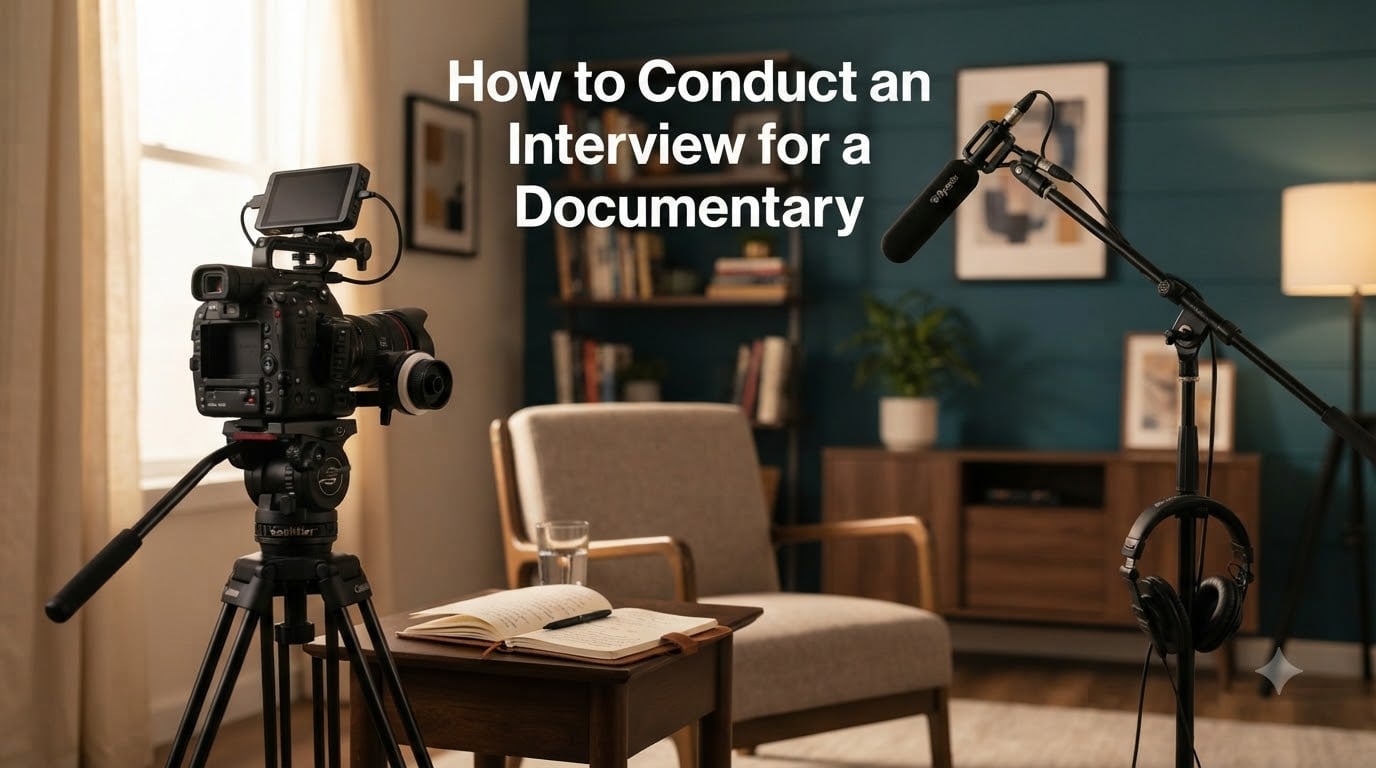
I have sat across from nervous first-time subjects, media-trained politicians, and grieving parents, and if there is one thing every documentary interview has taught me, it is this: the technical setup matters far less than the human connection you build before the camera ever starts rolling. Knowing how to conduct an interview for a documentary is about creating a space where real people feel safe enough to share stories they might not tell their closest friends.
Our team has spent years filming interviews for short documentaries, and we have made every mistake in the book. Subjects who memorized rehearsed answers because we sent questions in advance. Audio that captured our own breathing instead of the emotional moment unfolding in front of us. Lighting so harsh it made a Holocaust survivor look like a suspect in an interrogation room.
This guide distills everything we have learned into a practical, step-by-step framework. You will learn documentary interview techniques covering pre-interview preparation, camera and eyeline setup, question crafting, active listening, and handling emotional moments. Whether you are filming your first short documentary or your fiftieth, these are the techniques that separate forgettable talking-head footage from interviews that move audiences to tears.
Table of Contents
- Step 1: Master Your Pre-Interview Preparation
- Step 2: Set Up Your Interview Space Like a Pro
- Step 3: Build Genuine Rapport With Your Subject
- Step 4: Ask Questions That Get Real Answers
- Step 5: Listen More Than You Talk
- Step 6: Handle Difficult and Emotional Moments
- Step 7: End the Interview Professionally
- Common Documentary Interview Mistakes to Avoid
- Legal Considerations and Releases
- Frequently Asked Questions
- Conclusion
Step 1: Master Your Pre-Interview Preparation
Pre-interview preparation is where great documentary interviews are won or lost. The actual filming session is just the tip of the iceberg. Everything you do before that moment determines whether your subject opens up or shuts down.
Research Your Subject Thoroughly
Watch existing interviews they have given. Read articles about them. Talk to people who know them. This research does two things: it prevents you from asking questions they have answered a hundred times before, and it helps you spot the stories nobody has uncovered yet.
When I was preparing to interview a retired firefighter for a short doc about a 1998 warehouse fire, I spent three days reading old newspaper clippings and department records. That research led me to a detail nobody had ever asked him about, a specific rescue that haunted him for decades. That single question produced the most powerful moment in the entire film.
Conduct a Pre-Interview Conversation
A documentary pre-interview is an off-camera conversation, usually by phone or video call, where you talk through the subject’s story without recording anything. This serves multiple purposes: you build initial rapport, you map out the narrative arc of their experience, and you identify the emotional beats worth exploring on camera.
Take detailed notes during this conversation. Write down the phrases they use in their own words, because those unscripted expressions are gold when you want authentic language during the filmed interview. Also note which topics make their voice crack or pause, because those are the emotional pressure points to revisit on camera.
Develop Your Question List, But Do Not Share It
Write 15 to 25 questions organized around three or four themes. This gives your interview structure without locking you into a rigid script. But here is the critical part: never send your specific questions to the subject in advance.
Filmmakers on Reddit’s r/documentaryfilmmaking community consistently warn about this mistake. One user shared how they sent questions ahead and the subject spent the weekend rehearsing answers. The resulting interview sounded corporate, flat, and completely stripped of authenticity. Instead, tell your subject the general topics you plan to cover. Give them a sense of the conversation’s direction without handing them a script to memorize.
Step 2: Set Up Your Interview Space Like a Pro
The physical environment of your documentary interview setup directly affects how your subject feels and how your footage looks. A well-designed space puts people at ease and produces broadcast-quality footage. A poorly planned one makes subjects feel like they are in an interrogation room.
Get the Eyeline Right
Eyeline in documentary interviews refers to the direction your subject looks while answering questions. The most natural and intimate setup positions the interviewer right next to the camera lens, so the subject appears to look just slightly off-camera at the person asking questions. This creates the feeling of a private conversation between the subject and the viewer.
Director Errol Morris invented a device called the Interrotron specifically for this purpose. It uses a teleprompter system to project the interviewer’s face directly over the camera lens, so the subject makes what appears to be direct eye contact with the audience. You do not need an Interrotron to achieve this effect, but the principle matters: control the eyeline and you control the emotional connection.
Choose Camera Placement and Framing
For most documentary interviews, position your primary camera at the subject’s eye level and frame them in a medium close-up, from mid-chest to just above the head. This framing captures facial expressions and emotional nuance while including enough of the body to convey posture and gesture.
If you have a second camera, set it at a slightly different angle for a tighter close-up or a wider shot. This gives you editing flexibility to cut between angles and hide trims. Position the second camera at a 30 to 45 degree angle from the primary, close enough that the subject’s head size stays similar between cuts.
Set Up Three-Point Lighting
Three-point lighting is the standard setup for documentary interviews. Your key light is the main source, positioned at a 45-degree angle to one side of the subject. The fill light softens shadows on the opposite side, at about half the intensity of the key. The backlight, placed behind and slightly above the subject, separates them from the background and adds depth.
Use soft light sources whenever possible. Diffused light from a softbox or bounced off a white surface creates gentle shadows that flatter faces and feel natural. Hard, direct light creates deep shadows that look harsh and unflattering, especially for older subjects or people with weathered skin.
Control Your Background and Environment
Choose a background that tells something about your subject without being distracting. A mechanic in their shop, a teacher in their classroom, an artist in their studio, these settings add visual context that reinforces their story. If you must use a neutral background, add a single meaningful prop or let practical lights create depth.
Check the room temperature before you start filming. Cold rooms make subjects tense up and shiver on camera. Hot rooms make them sweat and uncomfortable. Aim for a comfortable 68 to 72 degrees Fahrenheit. Always have water within reach, and make sure the chair is comfortable enough for a 45-minute sit but not so soft that the subject slouches.
Step 3: Build Genuine Rapport With Your Subject
Rapport building is not a checkbox you complete before the interview starts. It is an ongoing process that begins the moment you contact your subject and continues through the final handshake. The best documentary interviews happen when the subject forgets the camera exists and starts talking to you like a trusted friend.
Start With Genuine Small Talk
When your subject arrives, do not rush them into position and start firing questions. Spend 15 to 20 minutes chatting about anything except the interview topic. Ask about their drive in. Compliment something in their home or office. Offer them coffee or water. This informal time lets them acclimate to your presence and the camera equipment without the pressure of being recorded.
While you chat, watch their body language. Are their shoulders tight? Are they fidgeting? Do they keep glancing at the camera? Use this information to gauge their anxiety level and adjust your approach accordingly.
Explain the Process Before You Start
Uncertainty creates anxiety. Before the camera rolls, walk your subject through exactly what will happen. Tell them you will ask warm-up questions first. Explain that they can ask you to repeat a question, take a break, or pause at any time. Make it clear that nothing is live and everything can be edited.
One phrase that works wonders: tell them this is a conversation, not a test. There are no wrong answers. You are there to hear their story, not to catch them in a mistake. This single reassurance transforms the dynamic for nervous subjects.
Roll Camera During Warm-Up Questions
Start recording before the subject realizes the interview has begun. Ask easy, low-stakes questions about their background, their day, their favorite meal. These warm-up questions serve two purposes: they get the subject comfortable speaking on camera, and they give you natural, relaxed footage that often contains usable material.
Some of the best quotes I have ever captured came from these first few minutes, when the subject was relaxed and unguarded because they did not think the real interview had started yet. Keep the camera rolling and treat the entire session as one continuous conversation.
Step 4: Ask Questions That Get Real Answers
The questions you ask and how you ask them determine whether your documentary interview produces compelling footage or a string of forgettable sound bites. Mastering documentary question techniques is about asking the right questions in the right way, and knowing when to abandon your list entirely.
Always Use Open-Ended Questions
Open-ended questions are the backbone of documentary interviewing. Instead of asking “Were you scared?” ask “What was going through your mind at that moment?” Instead of “Did you enjoy the experience?” try “Tell me about what that experience was like for you.”
Open-ended questions start with phrases like “tell me about,” “what was it like,” “how did you feel,” “walk me through,” and “describe.” These prompts force the subject to construct a narrative rather than reaching for a single word. They produce complete sentences that edit cleanly into your film without needing your voice asking the question.
Have Your Subject Repeat the Question
One of the most effective documentary interview tips from working filmmakers: ask your subject to incorporate the question into their answer. If you ask “What happened when the fire started?” their answer should begin “When the fire started, I…” rather than just “Well, I was…” This gives you self-contained sound bites that make sense without hearing the question.
Explain this technique during your warm-up conversation. Say something like, “As we talk, it helps me if you include my question in your answer. So if I ask about your childhood, start by saying ‘Growing up, I…’ That way your answers make sense on their own.”
Follow Up on Emotional Beats
Your question list is a starting point, not a contract. The real interview happens in the follow-up questions, the ones you ask in response to something the subject just said. When you hear hesitation, a crack in the voice, a sudden pause, or a deflection, that is your cue to dig deeper.
Effective follow-up prompts include “Tell me more about that,” “What do you mean when you say…”, “How did that feel?”, and simply “Go on.” These short, open prompts keep the subject talking without steering them in a specific direction. The goal is to follow their emotional trail, not your prepared list.
Avoid Yes-or-No Questions Entirely
Yes-or-no questions kill documentary interviews. They produce one-word answers that are useless in editing and shut down the conversation. Scan your question list before the interview and rewrite every question that can be answered with a simple yes or no.
Also avoid compound questions that ask two things at once. “What was the hardest part, and how did you overcome it?” gives the subject permission to answer only the second half. Ask one question at a time, wait for the full answer, then move to the next.
Use Silence as a Tool
After a subject finishes answering, do not immediately jump in with the next question. Count to five in your head. Let the silence hang. Often, the most revealing material comes after the subject has given their prepared answer and the uncomfortable silence prompts them to fill the void with something more honest.
People are conditioned to fill silence. If you can tolerate the awkwardness of not speaking, your subject will often continue talking, and what they say next is usually more raw and unfiltered than their initial response. This silence technique is one of the most powerful tools in documentary interviewing, and it costs you nothing but self-control.
Step 5: Listen More Than You Talk
Active listening is what separates interviewers from checklist readers. Documentary listening techniques require you to be fully present, processing what the subject says in real time, and responding to their actual words rather than waiting for your turn to speak.
Stop Saying “Mm-Hmm” and “Yeah”
The most common mistake new interviewers make is making verbal acknowledgments while the subject is speaking. Every “mm-hmm,” “yeah,” “right,” and “wow” gets recorded on the subject’s microphone and becomes an editing nightmare. When you cut between answers, the viewer hears your voice bleating in the background.
Instead of verbal feedback, use physical cues. Nod your head. Lean forward slightly. Maintain warm eye contact. Smile or furrow your brow in response. These nonverbal signals tell the subject you are engaged without contaminating the audio. Train yourself to communicate encouragement through your body, not your mouth.
Listen for What Is Not Being Said
Sometimes the most important part of an answer is the topic the subject avoids. If you ask about a specific event and they give a brief, surface-level response before changing the subject, that deflection is information. Note it and circle back later with a gentler, more specific question.
Watch body language for mismatches with spoken words. A subject who says “I was fine” while their jaw tightens and their eyes drop is telling you two different stories. Gentle, non-confrontational follow-ups like “You mentioned you were fine, but I noticed your expression change. Can you help me understand what was happening there?” can unlock material the subject did not plan to share.
Know When to Abandon Your Question List
If the conversation moves in an unexpected direction that produces compelling material, follow it. Your question list exists to keep you oriented, not to dictate the flow of the interview. The best documentary moments often come from detours that no amount of preparation could have predicted.
That said, keep track of which topics you still need to cover. If you stray too far, gently steer back by connecting the current thread to a planned question. “That reminds me, earlier you mentioned your brother. Can you tell me about his role in all of this?” Transitions like this keep the conversation natural while ensuring you capture everything you need.
Step 6: Handle Difficult and Emotional Moments
Not every subject will be easy to interview. Some are media-trained and give polished, rehearsed answers. Others are camera-shy and struggle to speak at all. Some are sharing traumatic experiences that bring them to tears mid-answer. How you handle these moments defines the quality of your documentary.
Working With Media-Trained Subjects
Media-trained subjects, politicians, executives, public figures, are comfortable on camera but often deliver rehearsed talking points instead of genuine responses. The key is to break through their script with questions they have not prepared for.
Ask for specific sensory details. Instead of “What was the company culture like?” ask “What did the office smell like on your first day?” Personal, unexpected questions force media-trained subjects out of their prepared responses and into genuine memory. Ask the same question multiple ways throughout the interview. Their first answer will be polished. Their third attempt will be honest.
Working With Nervous or Camera-Shy Subjects
First-time documentary subjects are often terrified. The lights, the camera, the microphone, the stranger asking personal questions, it is overwhelming. Take it slow. Spend extra time on warm-up conversation. Start with easy biographical questions before moving to emotional territory.
Tell them they can redo any answer. Remind them that you will edit out mistakes. If they stumble or freeze, say “Take your time, we can start over whenever you are ready.” Your patience directly translates to their comfort, and their comfort directly translates to usable footage.
Navigating Emotional Moments
When a subject starts crying or becomes visibly emotional, do not stop them. Do not offer a tissue on camera unless they reach for one. Do not say “It is okay” or “You do not have to talk about this.” Let them feel what they are feeling and continue at their own pace.
If they need to pause, let them. Keep the camera rolling during these pauses, because the unguarded moments between answers are often the most human and the most powerful. When they are ready to continue, simply repeat your last question or offer a gentle prompt like “Take me back to that moment.”
Dealing With Reluctant or Hostile Subjects
Some interviews involve subjects who do not want to talk to you, or who are hostile to your project. Be honest about your intentions. Do not pretend to be sympathetic if you are not, but do remain respectful. Ask your hardest questions directly but without aggression. Give them every opportunity to tell their side of the story.
Documentary subjects who feel they have been treated fairly, even when the questions were tough, are more likely to give you material you can actually use. Subjects who feel ambushed will shut down or demand you stop filming.
Step 7: End the Interview Professionally
The way you close a documentary interview matters as much as how you open it. A strong ending captures final thoughts, gathers material you might have missed, and leaves your subject feeling valued rather than used.
Ask the Magic Final Question
Every interview should end with some version of “Is there anything I should have asked you about but did not?” or “What else should I know about this story?” This open invitation gives the subject a chance to share something important that fell outside your question framework.
Filmmakers consistently report that this final-question technique produces some of their best material. Subjects often hold back their most meaningful story because they were waiting for you to ask, and this prompt gives them permission to share it. After they answer, follow up. Their initial response is often just the doorway to something deeper.
Keep the Camera Rolling After the Interview
One of the most consistent tips from working documentary filmmakers: do not stop recording when the interview ends. The moments right after you say “That is a wrap” are often when subjects relax, drop their guard, and say the most authentic, unscripted things.
As one Reddit user put it, “You sometimes get the best stuff when you least expect it, so always keep the camera rolling and do not interrupt.” This off-the-record gold can sometimes be negotiated back on the record with a simple “That was amazing, can we get that on camera?”
Thank Your Subject Properly
After the camera stops, spend time debriefing with your subject. Ask how they felt about the experience. Answer any questions they have about the film, the timeline, or how their interview will be used. Make sure they feel heard and respected, not extracted from.
This is not just about decency, though it is certainly that. Subjects who feel good about the interview process will refer you to other potential interviewees, agree to follow-up sessions, and become advocates for your film. Documentary filmmaking is built on relationships, and every interview is an opportunity to strengthen your network.
Common Documentary Interview Mistakes to Avoid
Even experienced documentary filmmakers make mistakes. Here are the most common ones and how to avoid them:
1. Sending questions in advance. This is the fastest way to kill authenticity. Share topics, not specific questions.
2. Interrupting during answers. Let the subject finish completely. What comes after the pause is often better than what came before it.
3. Making verbal sounds while listening. Nod instead of saying “mm-hmm.” Your audio contamination ruins otherwise perfect sound bites.
4. Rushing through silence. Uncomfortable silence produces gold. Learn to tolerate it.
5. Asking leading questions. “You must have been terrified, right?” steers the answer. Ask “What were you feeling?” instead.
6. Ignoring the background. A messy or distracting background undermines even the best interview content. Scout and dress your shot.
7. Forgetting to capture room tone. Record 30 seconds of silence in the interview space. You will need it during editing to smooth audio cuts.
8. Running out of storage or battery. Always bring more media cards and batteries than you think you need. A dead battery at the emotional climax is a nightmare.
Legal Considerations and Releases
Before you film any documentary interview, you need a signed appearance release from your subject. This document grants you the legal right to use their image, voice, and words in your film. Without it, you may not be able to distribute or screen your documentary.
A proper release should cover the scope of use, meaning where and how the footage can appear, and whether the subject waives the right to review the final film. Have the release reviewed by an entertainment attorney, especially if your documentary touches on sensitive or potentially defamatory material.
If your subject is a minor, you need parental or guardian consent. If you are filming on private property, you need location releases from the property owner. For documentaries involving investigative or potentially harmful subject matter, consult a media lawyer early in the process, not after you have shot 40 hours of footage you cannot legally use.
Frequently Asked Questions
What are the 5 C’s of interviewing?
The 5 C’s of interviewing are Curiosity (genuine interest in the subject), Compassion (empathy for their experience), Clarity (asking clear, focused questions), Candor (creating space for honest answers), and Control (guiding the conversation without dominating it). Together, these principles help interviewers build trust and extract meaningful responses from documentary subjects.
What is the 30-60-90 rule in an interview?
The 30-60-90 rule in interviewing refers to timing benchmarks for interview preparation and pacing. The first 30 minutes should focus on building rapport and warm-up conversation. The next 60 minutes cover the core interview questions and follow-ups. The final 90 seconds are reserved for the wrap-up, final-question prompt, and capturing any remaining thoughts before the camera stops.
What are the 5 techniques used in documentaries?
The 5 core techniques used in documentary interviewing are: 1) Pre-interview research and conversation, 2) Open-ended questioning that avoids yes-no answers, 3) Active listening with strategic silence, 4) Eyeline and camera placement for emotional intimacy, and 5) Building genuine rapport through warm-up and trust-building. Mastering these five techniques produces authentic, emotionally resonant interview footage.
What are the 5 P’s of an interview?
The 5 P’s of interviewing are Preparation (researching your subject and topic), Purpose (knowing what you need from the interview), Presence (being fully engaged and actively listening), Patience (allowing silence and not rushing answers), and Permission (getting proper legal releases and consent). These five pillars ensure every interview is productive, ethical, and legally sound.
Conclusion
Learning how to conduct an interview for a documentary is a skill that develops with every subject you sit across from. The technical elements, camera placement, eyeline, lighting, framing, can be learned in a weekend. The human elements, rapport, listening, silence, emotional intelligence, take a career to master.
The seven steps in this guide give you a framework: research and prepare off-camera, set up a comfortable and professional interview space, build genuine rapport before the camera rolls, ask open-ended questions and follow the emotional trail, listen more than you talk, handle difficult moments with grace, and always end with the magic final question.
If you remember nothing else, remember this: your subject is not a source to be extracted from. They are a human being sharing a piece of their life with you and your audience. Treat them with respect, give them the space to be honest, and your documentary interviews will produce the kind of footage that stays with viewers long after the credits roll. Now go set up your next interview with confidence.