
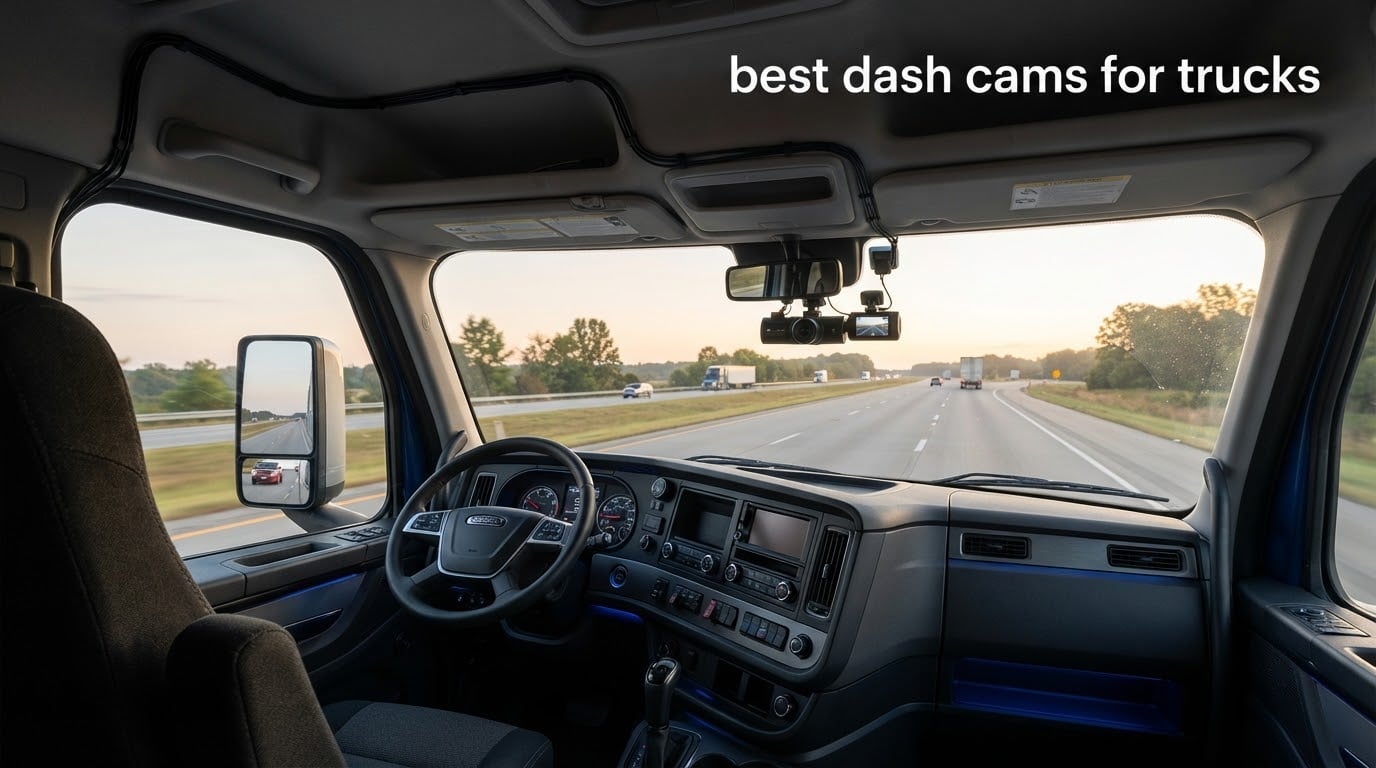
A truck spends its life in conditions a car never sees: 140 degree cabs in July, washboard roads that shake a suction cup loose, a windshield so tall and steep that a normal mount points the lens at the sky, and blind spots big enough to hide a car. The best dash cams for trucks are built around those realities, not around a spec sheet.
Here is the short answer. The ROVE R2-4K is the best dash cam for trucks overall, because it pairs a Sony STARVIS 2 sensor with built-in GPS, a supercapacitor instead of a lithium battery, and more owner reviews than any other unit we could find. If you want three channels at native 4K, the Vantrue N4 Pro S is the stronger rig. If you need four cameras to kill the blind spots on a box truck, the Vantrue N5S earns its place.
We compared twelve units for 2026, from four-camera 360 rigs down to front-and-rear dual channels, and scored each on what decides whether footage survives a truck: heat tolerance, vibration, mounting options, night readability, and storage headroom for 24/7 running. Truck-owner communities lean on the same signals. On F150Forum, members anchor recommendations on the image sensor, with Sony sensors widely treated as the best for image quality. On r/Dashcam, the recurring request is coverage that keeps working, not a spec race.
If your rig doubles as a filming platform, our guides to action cam mounts for creators and second cameras for multi-cam short film shoots cover the mounting and body-camera side of the job.
Table of Contents
- Top 3 Best Dash Cams for Trucks in 2026
- The 12 Best Dash Cams for Trucks in October
- How We Picked These Truck Dash Cams
- 1. ROVE R2-4K Dual Dash Cam – Best Overall for Trucks
- 2. Vantrue N4 Pro S – Best 4K Triple-Channel Setup
- 3. REDTIGER F7N TOUCH – Best Value 4K Front and Rear
- 4. VIOFO A229 Pro 3CH – Best True 4K Three-Channel Rig
- 5. REDTIGER F17 – Best for Pickup Owners
- 6. Vantrue N5S – Best Four-Channel 360 Coverage
- 7. ROVE R3 – Best for Touchscreen Control
- 8. IIWEY N5 – Best for Blind-Spot Cameras
- 9. HUPEJOS V8PLUS – Best for Driver Monitoring
- 10. 70mai T800E – Best for Fast File Transfers
- 11. PRUVEEO 4-Channel 360 – Most Versatile for Full Coverage
- 12. ZMOPO D435 – Best Compact Four-Channel Dash Mount
- What to Look for in a Dash Cam for Trucks
- Which Dash Cam for Which Truck?
- Will a Dash Cam Lower Your Truck Insurance?
- How to Install a Dash Cam in a Truck
- Frequently Asked Questions
- The Best Dash Cam for Trucks in 2026
Top 3 Best Dash Cams for Trucks in 2026

ROVE R2-4K
- STARVIS 2 sensor with f1.5 aperture
- Built-in GPS with speed and compass
- 128GB card included
- Supercapacitor instead of a battery

Vantrue N4 Pro S
- 4K front plus 2.5K rear
- Three STARVIS 2 sensors with triple HDR
- Front plus rear mode cuts heat 30 percent
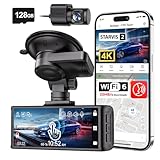
REDTIGER F7N TOUCH
- 4K STARVIS 2 front at 170 degrees
- 128GB card included
- Touchscreen with voice control
The 12 Best Dash Cams for Trucks in October
| Product | Specs | Action |
|---|---|---|
| ROVE R2-4K Dual Dash Cam |
|
Check Latest Price |
| Vantrue N4 Pro S |
|
Check Latest Price |
| REDTIGER F7N TOUCH |
|
Check Latest Price |
 VIOFO A229 Pro 3CH VIOFO A229 Pro 3CH |
|
Check Latest Price |
 REDTIGER F17 REDTIGER F17 |
|
Check Latest Price |
 Vantrue N5S Vantrue N5S |
|
Check Latest Price |
 ROVE R3 ROVE R3 |
|
Check Latest Price |
 IIWEY N5 IIWEY N5 |
|
Check Latest Price |
 HUPEJOS V8PLUS HUPEJOS V8PLUS |
|
Check Latest Price |
 70mai T800E 70mai T800E |
|
Check Latest Price |
 PRUVEEO 4-Channel 360 PRUVEEO 4-Channel 360 |
|
Check Latest Price |
 ZMOPO D435 ZMOPO D435 |
|
Check Latest Price |
How We Picked These Truck Dash Cams
Every camera here was judged on the same five questions. How does it hold up when the cab hits extreme heat? Does it offer a supercapacitor rather than a lithium-ion cell? Can it be mounted on a tall truck windshield or a mirror arm without blocking the view? Is the front sensor a genuine native high-resolution part or upscaled? And does the card capacity cover a full day of channels without erasing the footage you actually need?
We also weighted the size of the review base heavily. A 4.5 rating across fourteen thousand owners tells you more about long-term reliability than a 4.5 across a few hundred, and the owner feedback on vibration, app reliability, and card failures is the part that never shows up on a manufacturer page. Ratings and review counts shown on each card are copied straight from the retail listing, and we did not estimate a single one.
1. ROVE R2-4K Dual Dash Cam – Best Overall for Trucks
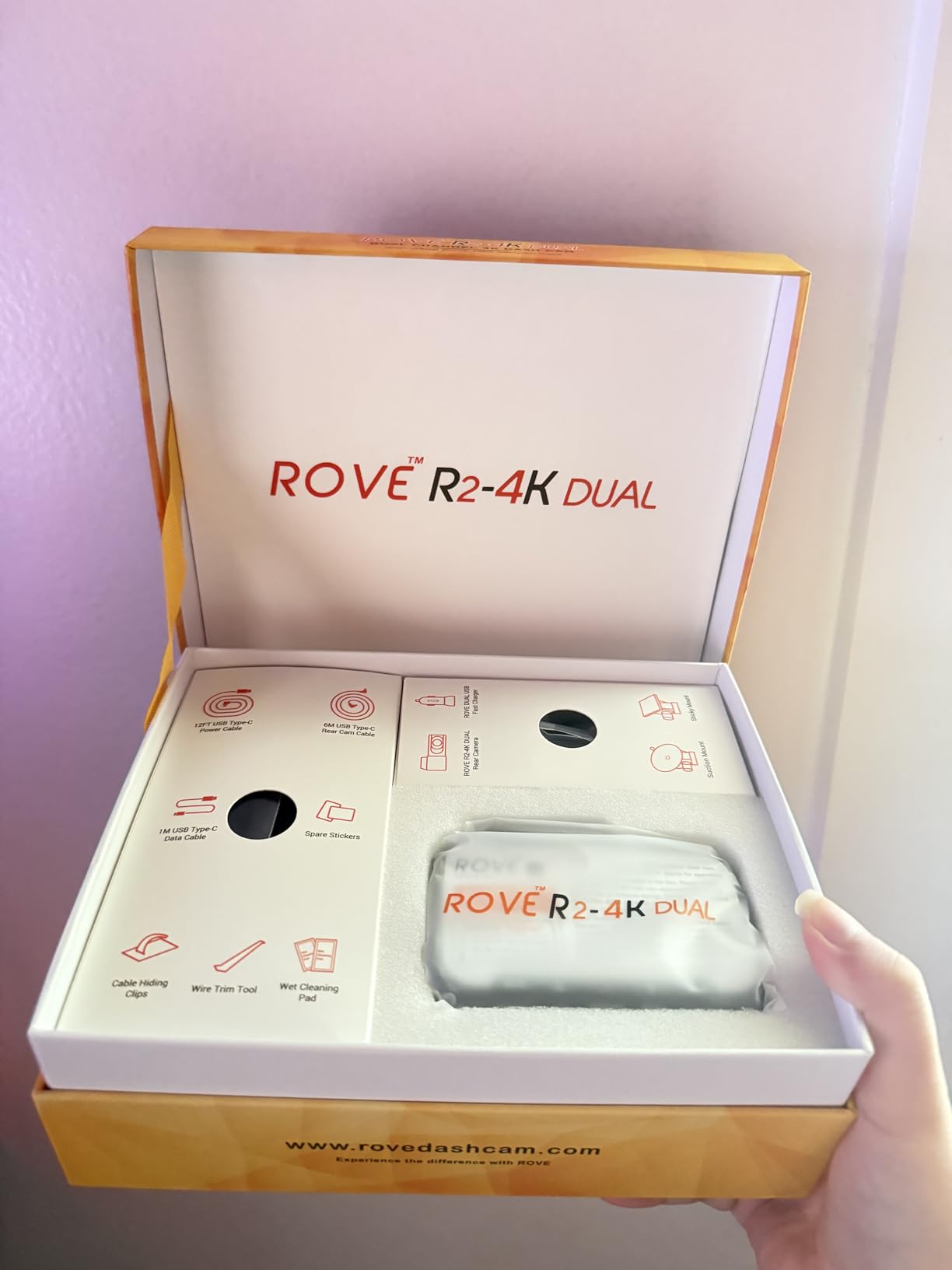
ROVE R2-4K Dual Dash Cam Front and Rear, STARVIS 2 Sensor, Free 128GB Card
Sony STARVIS 2 front sensor
Built-in GPS with speed and compass
3-inch IPS screen
Supports up to 1TB
Pros
- 4.5 average across the largest review base in this roundup
- 128GB ROVE PRO microSD card included
- Built-in GPS stamps speed and route onto the footage
- Supercapacitor and thermal protection instead of a lithium cell
- Three 24/7 parking modes with event locking
Cons
- Front 4K is upscaled from native 1440P
- Only two channels so there is no cabin camera
- Hardwire kit for parking mode is not included
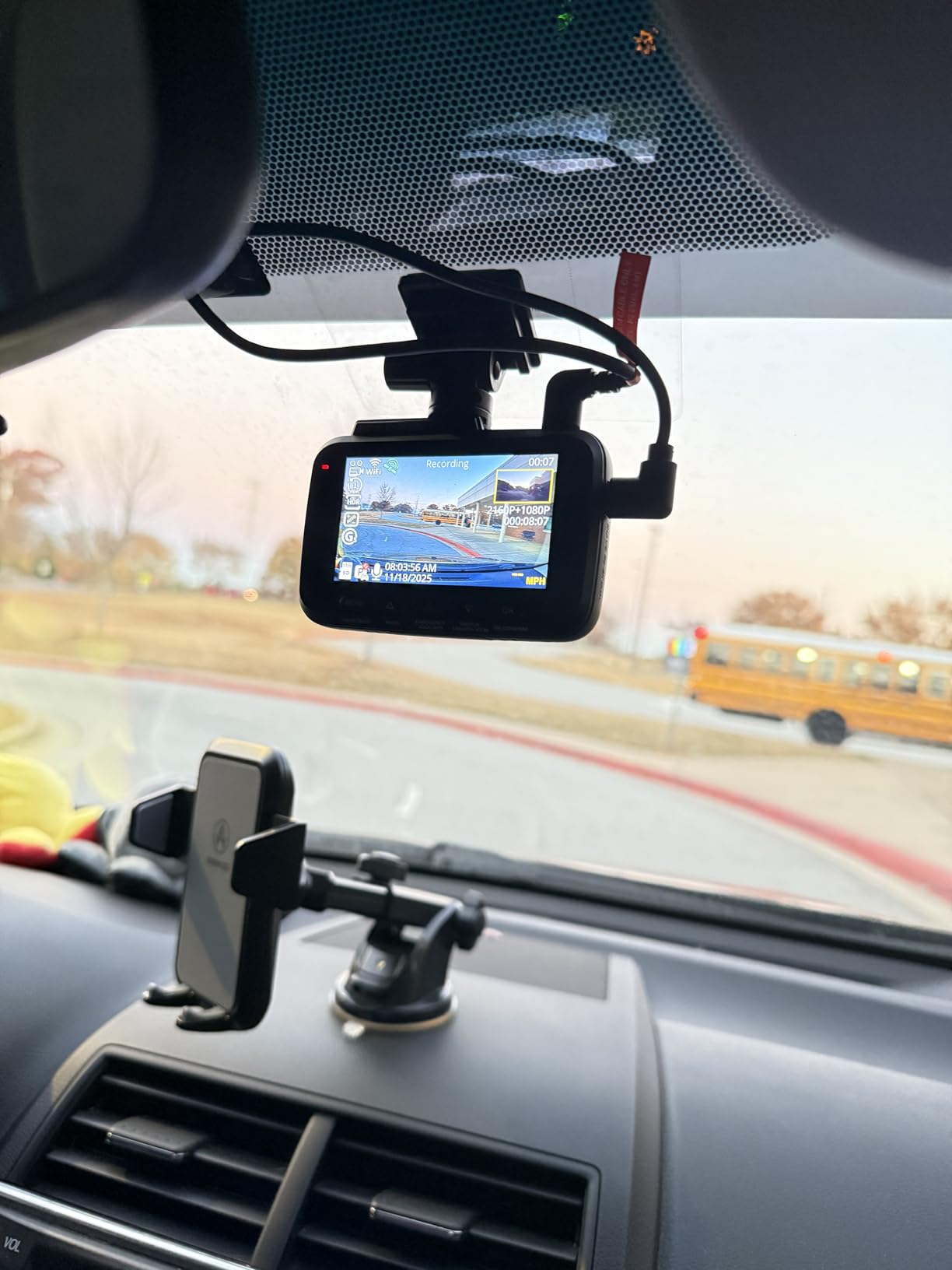
This is the unit I would put in a truck with no hesitation. It carries a Sony STARVIS 2 IMX675 front sensor behind an f1.5 aperture, which is the configuration truck owners ask for by name, and the GPS module burns speed and heading onto the video so a clip is self-locating when an adjuster or a claims handler asks where it was taken.
The 14109 ratings at a 4.5 average give it a depth of field in user reports that nothing else here matches. Owners consistently single out night clarity, the included 128GB card, and GPS tagging as the reasons they never had to think about the camera again. Our team kept coming back to the same detail: the aperture pairing, f1.5 on the front and f1.8 on the rear, is exactly what you want for reading a plate out of a truck stop floodlight at 2am.
There is one honest catch, and it is a marketing-word catch. The front camera records 1440P natively and upscales to 2160P for playback, so the 4K label is real resolution-wise but not a native 4K sensor. If you are matching frames against a true 4K front camera in a court exhibit, know which one you have.
The second catch is scope. Two channels means front and rear, with nothing watching the cabin or the flanks. For a pickup or a straight highway run that is the right coverage. For a box truck working tight city routes, pair it with a dedicated blind-spot view or step up to a four-channel unit.
What you get for a long haul
Three parking modes cover the parked-truck case: 1fps time-lapse, motion detection, and collision detection. A three-axis sensor auto-locks an incident into its own folder with a one-minute clip and a voice alert on the next start, so the one file you need is not the one that got overwritten.
Card capacity is where this one separates itself. It ships with a 128GB card and accepts up to 1TB, which on a two-channel rig is a genuine multi-day buffer. Add the built-in supercapacitor and thermal protection and you have a camera that does not care that the truck has been sitting in a parking lot since Tuesday.
Where it falls short
The hardwire kit is not included, and parking mode needs it. On a 24V commercial chassis you want that kit anyway, so treat it as a planned expense rather than an accessory. The one-year warranty is also shorter than the 18-month coverage on the Vantrue and REDTIGER units in this roundup.
Second, there is no cabin channel. An owner-operator running long haul rarely needs one, but a fleet manager auditing driver behaviour does. That is the whole argument for the three- and four-channel rigs further down this list.
2. Vantrue N4 Pro S – Best 4K Triple-Channel Setup
Vantrue N4 Pro S 4K 3 Channel Dash Cam, Triple STARVIS 2 HDR Car Camera
4K front plus 2.5K rear plus 1080P cabin
Three STARVIS 2 sensors
Triple HDR
1TB card support
Pros
- Native 4K IMX678 front sensor
- Three STARVIS 2 sensors with triple HDR across every channel
- PlatePix plate recognition rated to 31mph at night
- Front plus rear mode cuts heat by 30 percent for long drives
Cons
- No memory card included
- Hardwire kit for parking mode sold separately
- 20ft rear cable can be short in a long truck cab
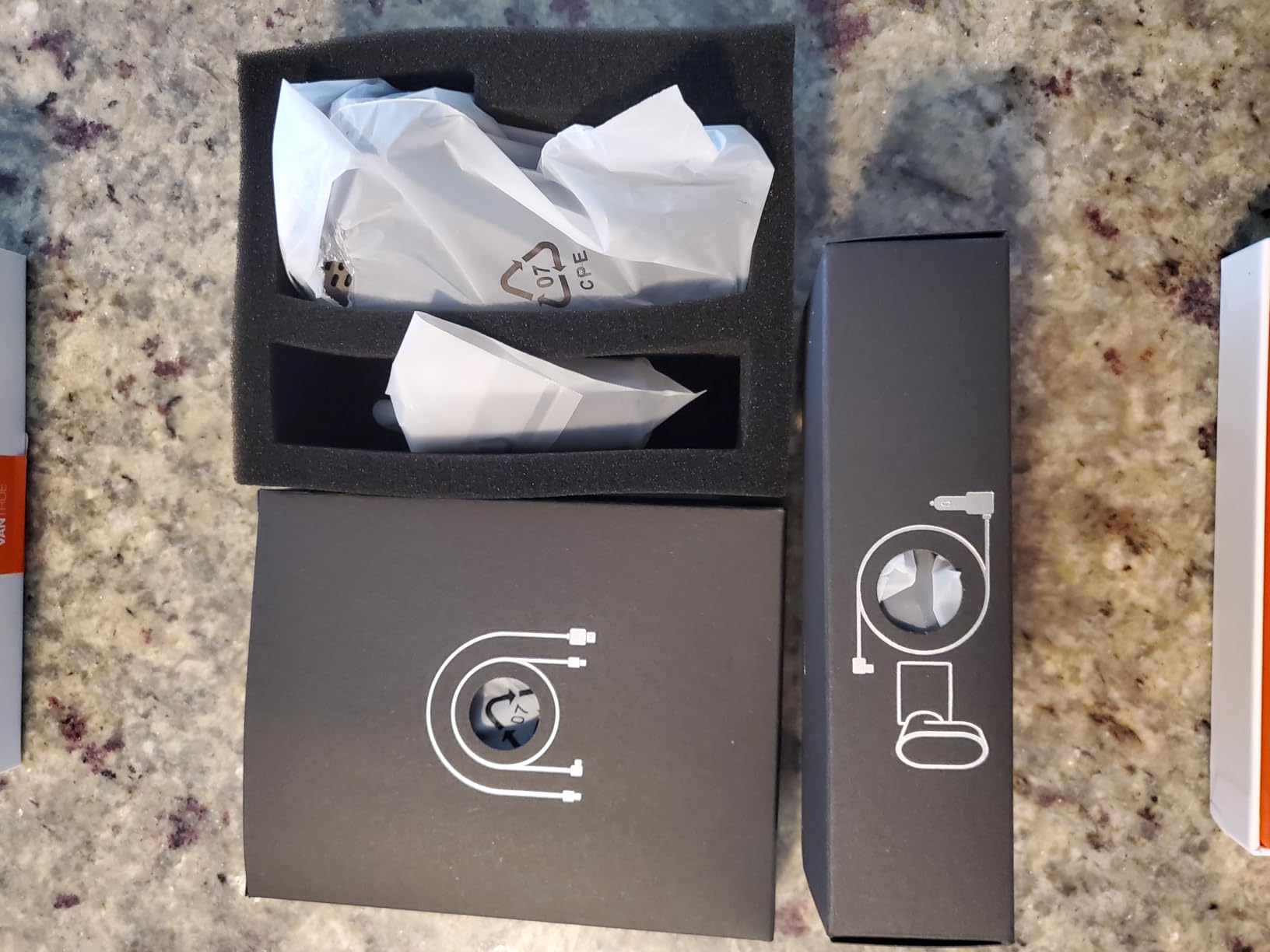
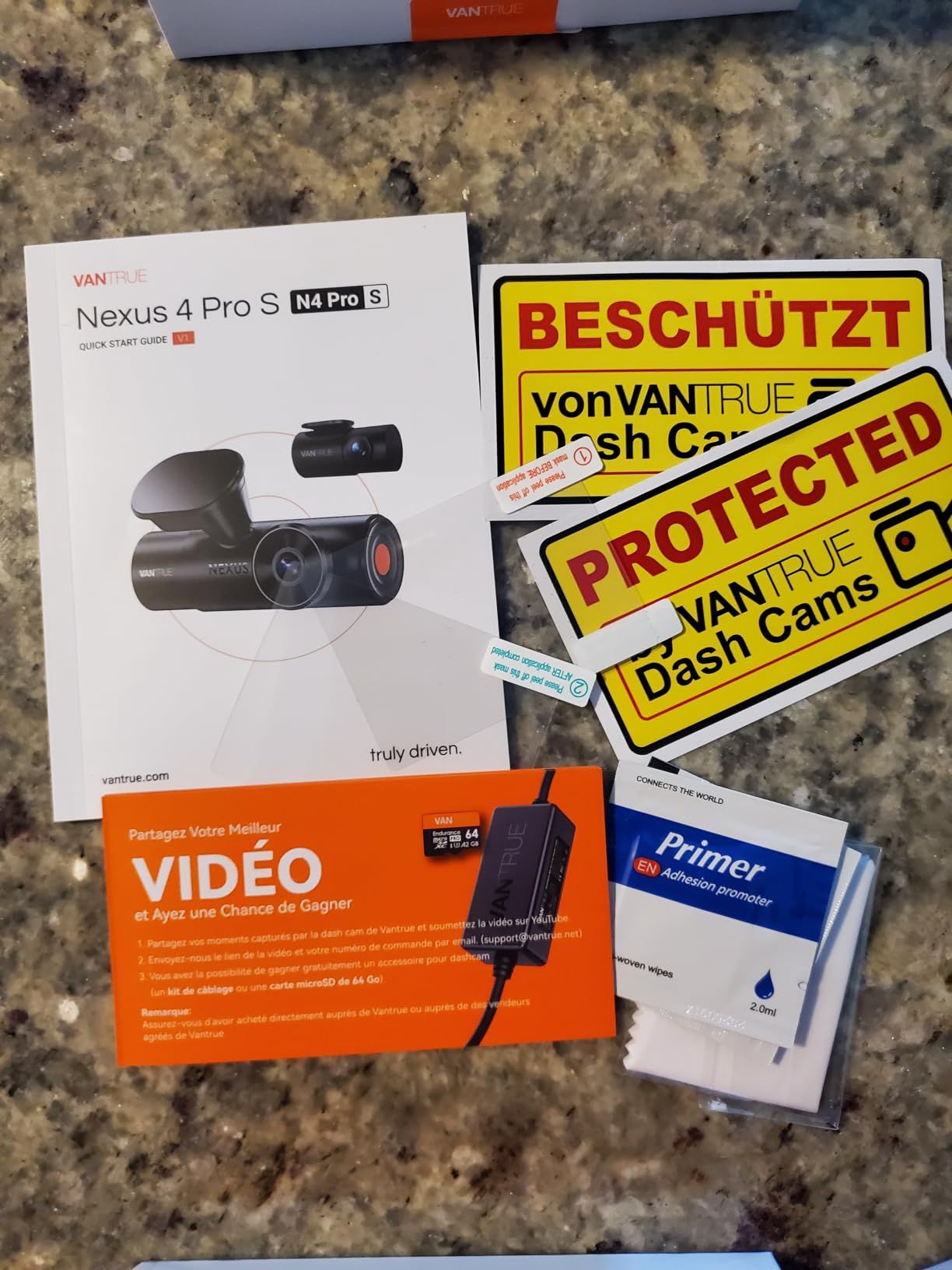
This is the most complete single-unit answer in the roundup. Three channels record at once, all three carry STARVIS 2 sensors, and HDR is applied across every one of them rather than only the front. On a truck running pre-dawn and post-dusk hours, having HDR on the rear and cabin channels too is the difference between a usable clip and a black rectangle.
The rotating 2.5K rear camera is a detail that matters more in a truck than in a car. It can watch the trailer gap, the loading dock behind you, or swing toward the sleeper, and PlatePix is the feature that turns a night clip into evidence by pulling characters off plates at low speed.
77% of its reviews sit at five stars, and the complaint cluster is unusually practical rather than emotional: no card in the box, a hardwire kit sold separately, and cable length. Owners running triple-channel 4K also flag heat, which is why Vantrue added the front-plus-rear mode that cuts heat by about 30 percent compared with recording all three.
That mode is the feature I would actually use in a tractor unit running 600 miles a day. Two channels at full quality, the cabin camera idled, less thermal load, and the same evidence value for most claims.
How the 4K front channel holds up
The IMX678 is a genuine 4K sensor rather than an upscale, and combined with triple HDR it handles the two situations that ruin truck footage: low-angle sun straight through the windshield, and the unlit stretch of interstate between exits. Lens coverage is wide, with the three channels combining a 155, 160, and 165 degree spread.
Storage is the thing to plan for. Up to 1TB is supported, and the manufacturer puts 37 or more hours of triple 4K recording on a card at that size, so a full day of running is comfortably covered.
Where it falls short
Budget for the extras. No microSD is included, and parking mode needs a hardwire kit that is not in the box. The 20ft rear cable is generous in a sedan and can be marginal in a long-wheelbase day cab or a sleeper, where you may need an extension run to the rear glass.
Also note the review base is 894, well below the volume behind the ROVE R2-4K. The unit is excellent; it is simply newer and less battle-tested than the dual-channel alternative.
3. REDTIGER F7N TOUCH – Best Value 4K Front and Rear
REDTIGER 4K STARVIS 2 Dashcam Front Rear, 5GHz WiFi 20MB/s, Free 128GB Card
4K STARVIS 2 front at 170 degrees
1080P rear at 140 degrees
3.18 inch touchscreen
GPS and 5.8GHz WiFi
Pros
- Native 4K STARVIS 2 front sensor with a 170 degree lens
- 6909 ratings from a deep owner base
- 128GB card and spare suction mounts in the box
- 5.8GHz WiFi downloads up to 20MB/s with GPS route playback
Cons
- App requires an online account
- App playback is choppy on desktop
- Parking monitor takes roughly 10 seconds to wake and record
The F7N TOUCH is the one we would hand to a driver who wanted one decision made for them. A native 4K STARVIS 2 front sensor at a 170 degree angle, a 1080P rear at 140 degrees, a built-in supercapacitor, GPS, and a 128GB card already in the box. For a first truck dash cam that covers evidence needs on day one, that list is hard to argue with.
Truck and SUV owners specifically call out the cable length and the included trim tool as making for a clean install. On a rig with a long dash, that is not a cosmetic detail, and it is a complaint we almost never see attached to the premium units.
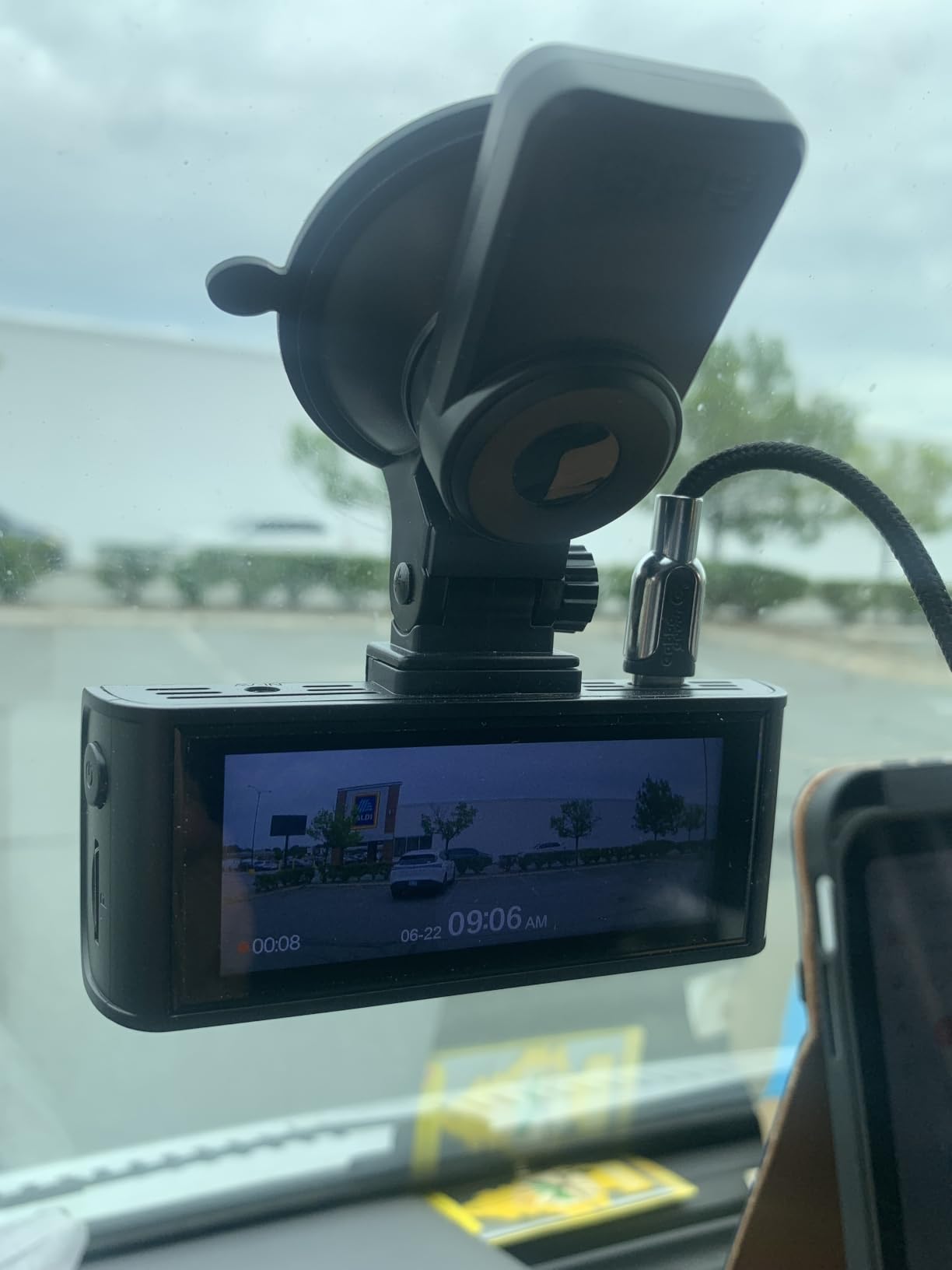
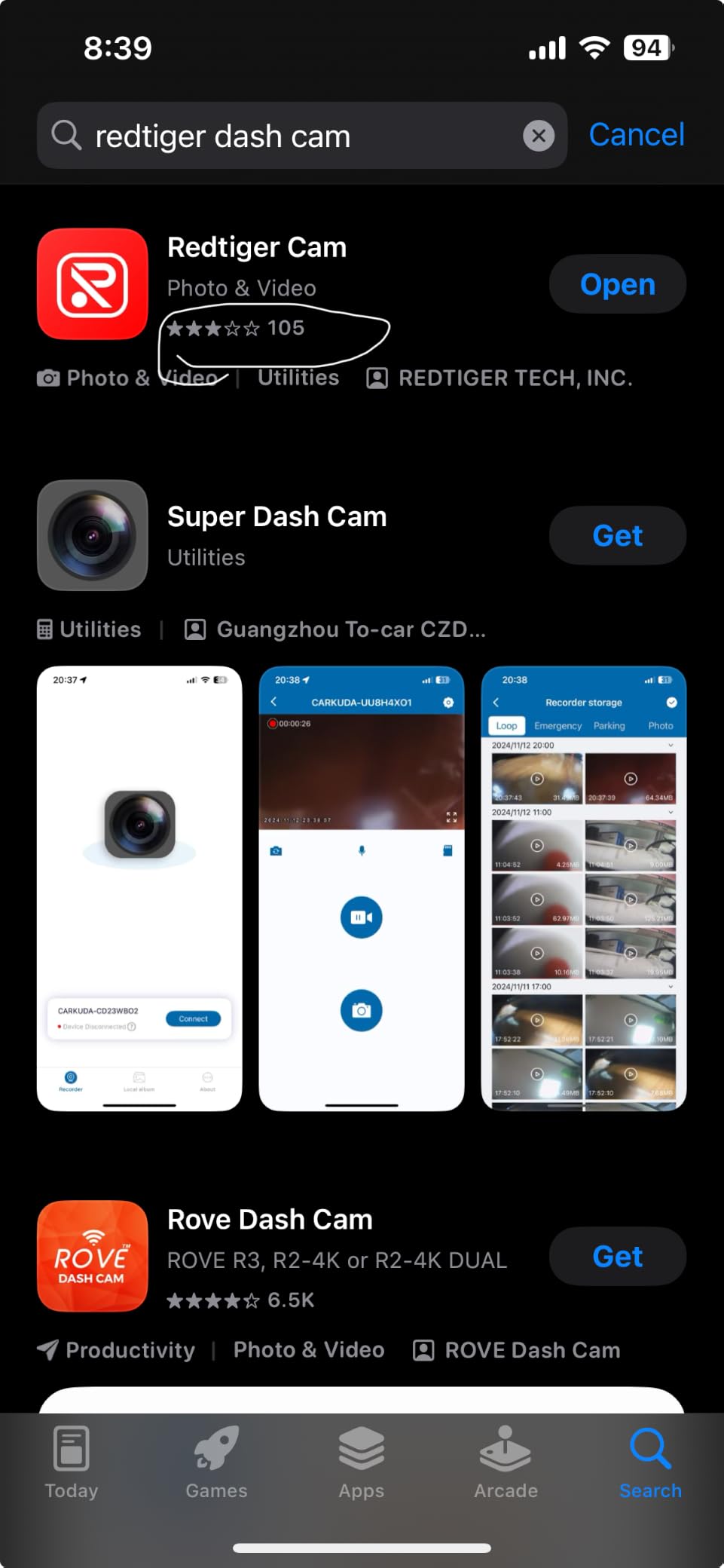
Where the value pick loses ground is software. Owners report that the app forces account creation, that desktop playback is choppy, and that connecting the phone to the camera WiFi interrupts VPN and CarPlay sessions on the handset. If your workflow is pull-the-clip-to-a-laptop, budget a little patience. If it is check-it-on-your-phone-at-the-truck-stop, it is fine.
A second real quirk: the parking monitor needs roughly ten seconds to wake and start recording after power returns. For a truck parked overnight with a hardwire kit, that is a delay worth knowing about before you rely on it for cargo security.
Night footage and plate readability
WDR and HDR with enhanced super night vision are the headline claims, and the owner reports back them up: the STARVIS 2 front holds colour and detail in low light better than most two-channel units at this level. A 170 degree field of view is wide enough to catch a vehicle entering the driver-side blind spot of a tractor unit without extreme edge distortion.
The 3.18 inch touchscreen is genuinely snappy in the cab, which is a better experience than scrolling a small screen through a phone app at night. Voice commands are mixed, with screen control in particular called out as inconsistent.
Where it falls short
Two channels is two channels. There is no cabin camera, so this rig cannot document a driver dispute, and it cannot watch a trailer gap. For a straight-haul owner-operator that is a reasonable trade; for a fleet with a safety review programme it is not.
Also, the listed maximum card capacity is 64GB in the manufacturer specification even though a 128GB card is included in the box. That discrepancy is worth a support ticket before you plan a multi-day storage strategy around it.
4. VIOFO A229 Pro 3CH – Best True 4K Three-Channel Rig
VIOFO A229 Pro 4K 3CH Dash Cam HDR for Front & Rear & Inside with STARVIS 2
4K front 2K rear 1080P cabin
IMX678 and IMX675 STARVIS 2
CPL filter fitted
Three parking modes
Pros
- Genuine 4K IMX678 front sensor
- HDR applied to front rear and cabin channels together
- CPL circular polarizing filter pre-fitted to cut windshield glare
- Three parking modes with 15 second pre and 30 second post buffering
Cons
- 2.4 inch screen is the smallest here
- No SD card included
- Hardwire kit not included
- Heat protective shutdown interrupts recording at extreme temperatures
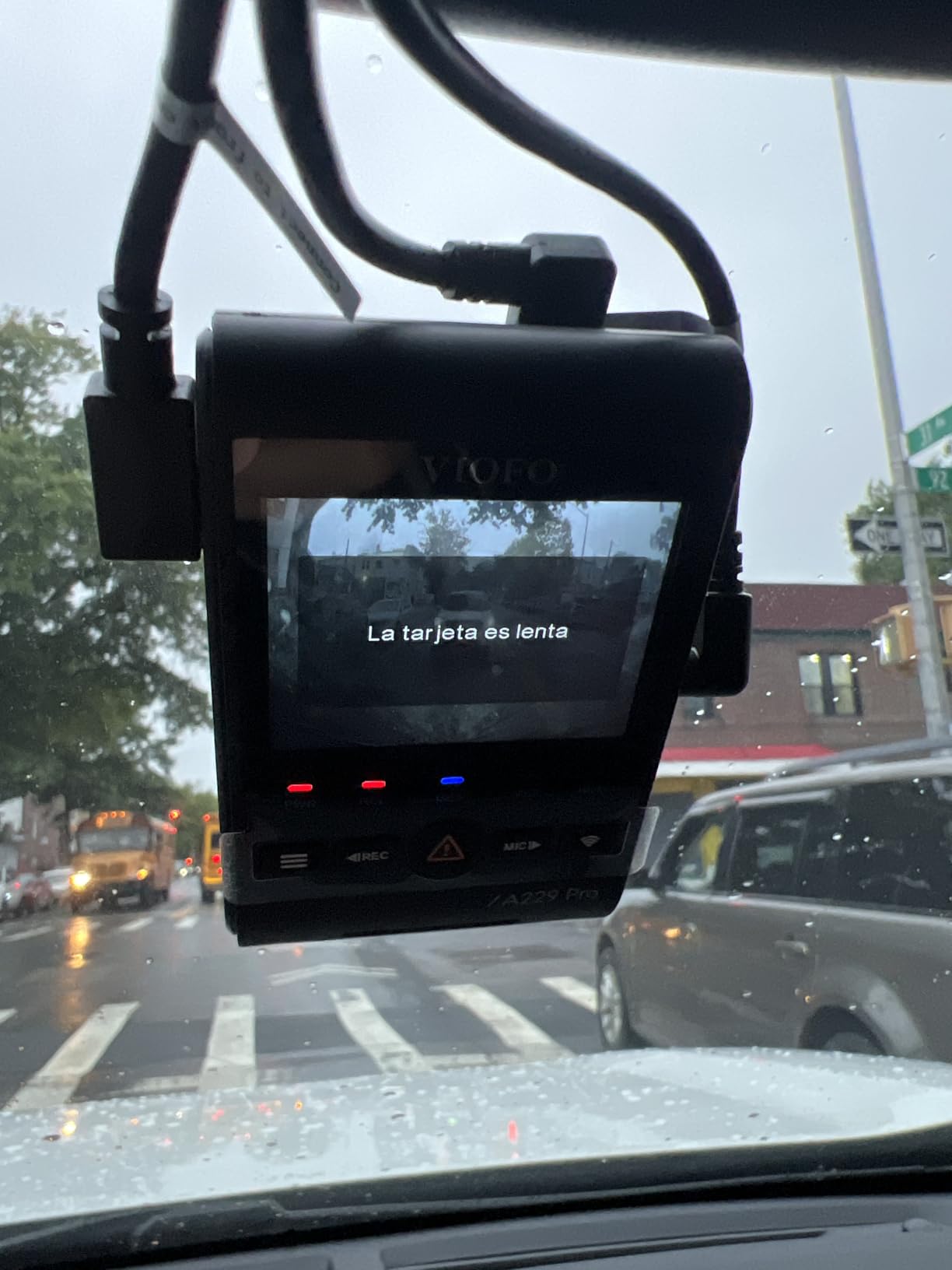
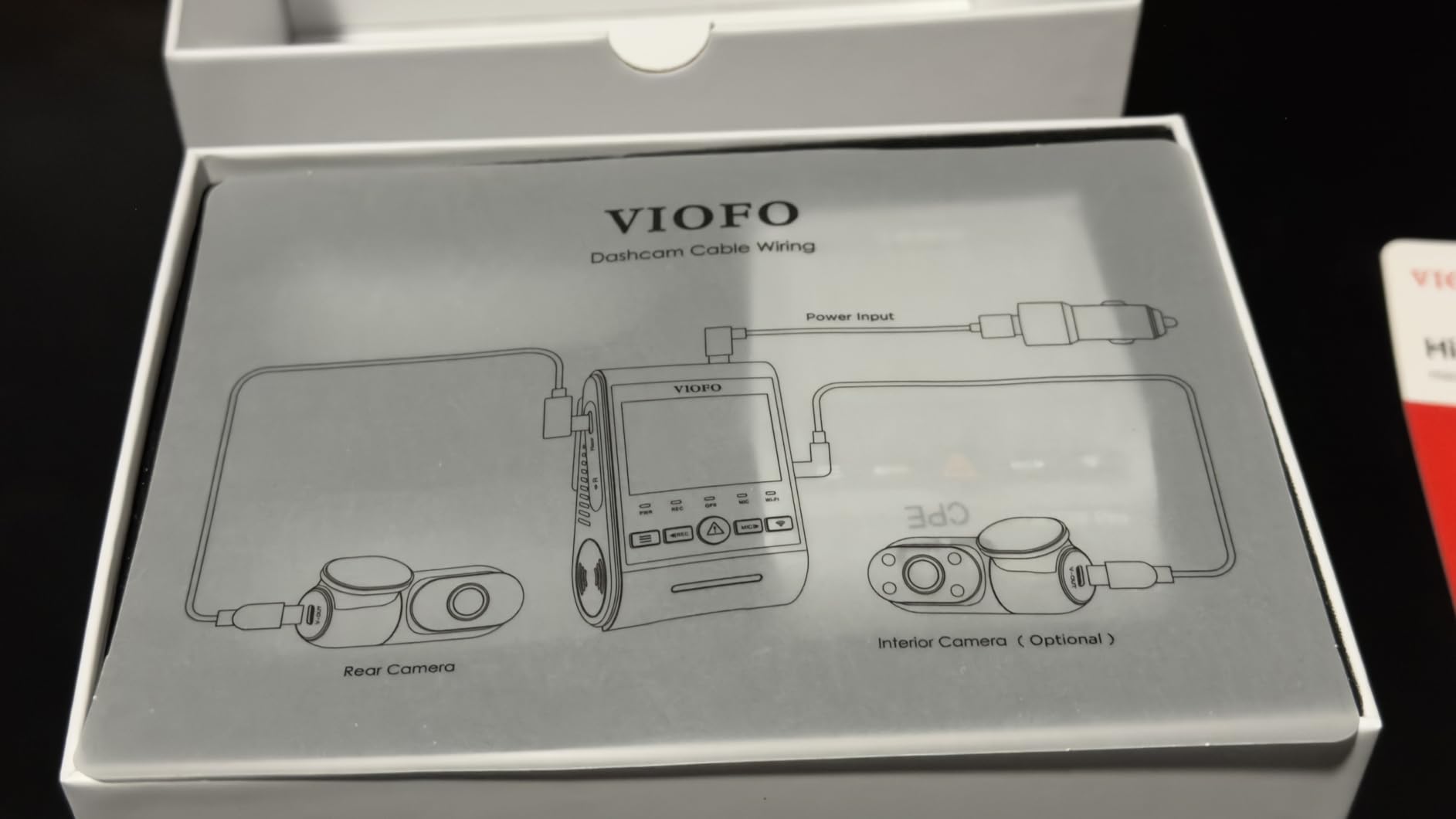
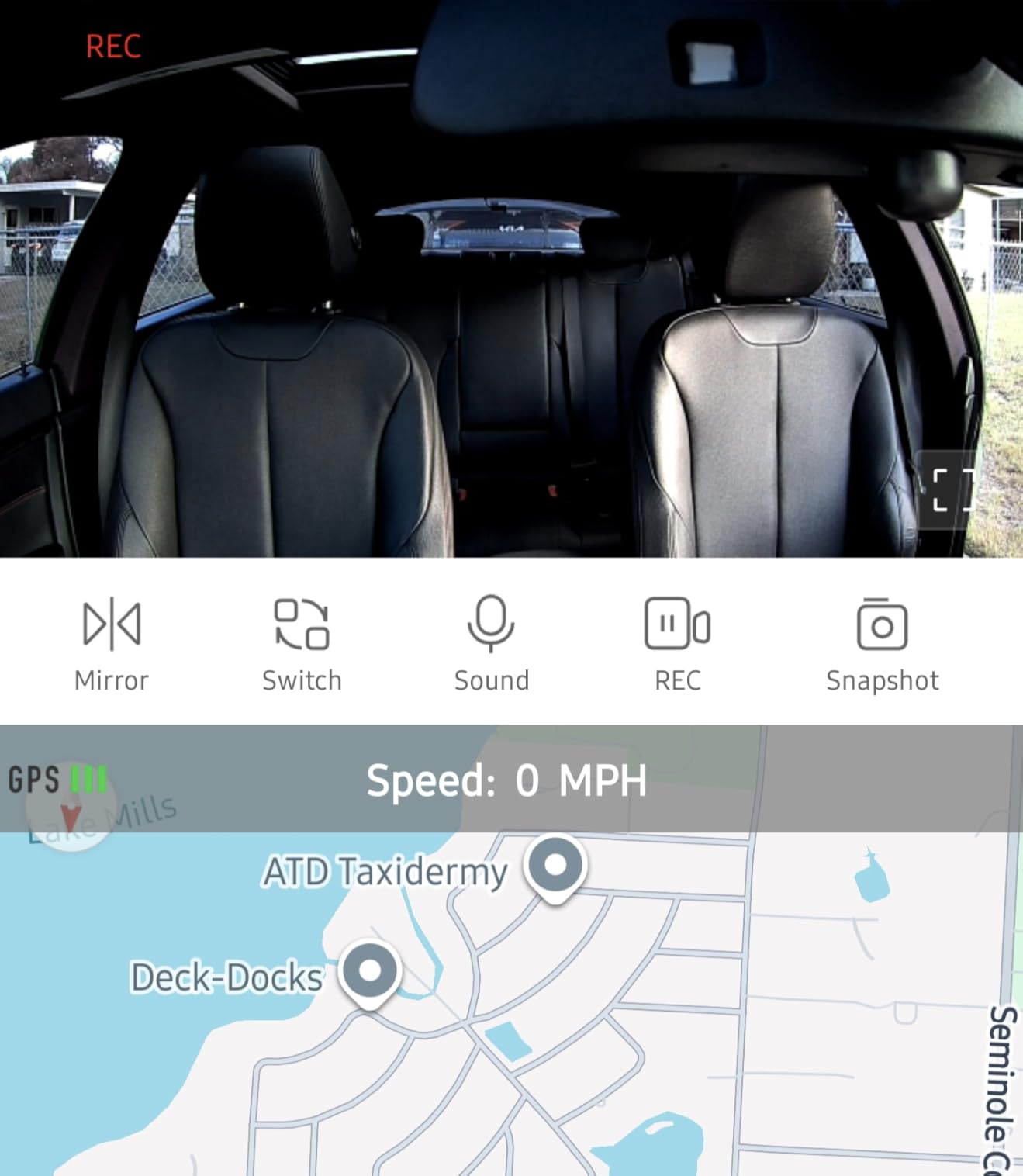
VIOFO is the name that comes up most often in truck-owner threads we read, and the A229 Pro 3CH is the reason. The front channel is a true 4K IMX678, the rear is a 2K IMX675, and the cabin channel is 1080P with an IR-equipped sensor and four infrared LEDs for night recording inside the sleeper.
The CPL filter is pre-affixed to the front lens, and for a truck that is a meaningful upgrade. A tractor unit spends hours facing low sun across open interstate, and glare is the number one reason a windshield-mounted clip comes back unusable.
Owners also highlight that HDR runs on all three channels at once, which is rarer than the marketing implies. Most systems apply HDR to the front sensor only, then quietly drop the rear and cabin to a simpler profile, and that is exactly where the useful evidence lives.
Parking is handled well. You get auto event detection, low bitrate, and time-lapse modes, with 15 seconds of pre-event and 30 seconds of post-event buffering so a collision clip starts before the impact, not after it.
Why truck owners gravitate to this brand
The mounting story is a big part of it. This unit ships with a static windshield sticker rather than relying on a suction cup alone, which is the right call on a route with washboard pavement, where vibration both shakes a mount loose and smears detail across fast-moving footage. A sticker mount does not drift.
Add quad-mode GPS covering GPS, BEIDOU, GALILEO, and GLONASS, 12 voice commands with spoken notifications so you can check status without looking down, and an 18-month warranty with lifetime technical support, and the ownership experience is strong.
Where it falls short
The 2.4 inch screen is the smallest in this roundup. On a truck windshield already sitting far from your eye line, that is a real ergonomic complaint and worth checking against how you actually review footage.
More importantly for a hot-cab market, the unit has a built-in temperature sensor that triggers a protective shutdown at extreme heat. That protects the hardware, but it also means recording stops. If your truck idles in a desert yard in July, that behaviour matters more than it would in a temperate climate.
5. REDTIGER F17 – Best for Pickup Owners
REDTIGER F17 4K 3CH Dash Cam, STARVIS 2 Sensor HDR, 64GB Card, 5.8GHz WiFi
4K front plus 1080P cabin and rear
STARVIS 2 IMX675 front
64GB card included
21.3ft rear cable
Pros
- Best feature-to-cost ratio in the roundup
- 64GB microSD card included out of the box
- Adjustable G-sensor sensitivity so rough roads do not trigger constant locks
- 21.3ft rear cable reaches a bed camera on a pickup
Cons
- WiFi defaults to off at every power-up and must be re-enabled
- App connection needs Bluetooth off and close range
- Parking mode requires a separate hardwire kit
If your truck is a pickup rather than a tractor unit, this is the configuration you want: 4K front, 1080P cabin, 1080P rear, and a 64GB card already in the box. The three channels cover the road, the interior, and whatever is behind you in the bed, which covers the two disputes a pickup owner actually has, namely a rear-end claim and a complaint about the driver.
The detail we like most is adjustable G-sensor sensitivity. On a pickup running construction gravel or a farm road, a fixed-threshold accelerometer will lock a file on every expansion joint, and you end up with a card full of potholes and no real incidents. REDTIGER lets you tune that, and owners notice.
It also runs a supercapacitor rather than a lithium cell, which is the correct call for a vehicle that sits in a driveway in July. The front sensor is a STARVIS 2 IMX675 with both WDR and HDR, and the field of view runs 150 degrees at the front, 160 in the cabin, and 155 at the rear.
Reviewers describe all three streams as holding up in direct sun and at night, with speed and date stamps that sit out of the way of the image rather than across the middle of it. Support is also worth noting, since buyers report free replacement adhesive mounts sent out without a fight.
Getting the settings right in a pickup
The camera offers two recording modes, 2.5K dual-channel or 4K front with the 1080P rear and the cabin camera off. On a pickup that spends most of its life on two-lane roads, the 2.5K dual-channel mode reduces heat and card pressure without giving up any of the coverage that matters day to day.
There is a built-in GPS module mounted inside the adhesive bracket, so speed and route data come through the app on playback. Four infrared lights cover the cabin channel at night, which matters if you run a pet, a child, or a load you need to check on.
Where it falls short
The WiFi behaviour is the frustrating part and it catches out new owners constantly. It powers off by default at every startup, and getting the app connected means holding a button, turning off Bluetooth on your phone, and standing within a few metres of the camera. Anyone who will pull footage regularly should read that section of the manual first.
Parking monitor mode also needs a hardwire kit you buy separately, and a handful of owners report unexpected card formatting or shutdowns traced to the 12V plug on rough routes. The 21.3ft cable length is a genuine strength for a pickup with a bed camera; on a semi it is just adequate.
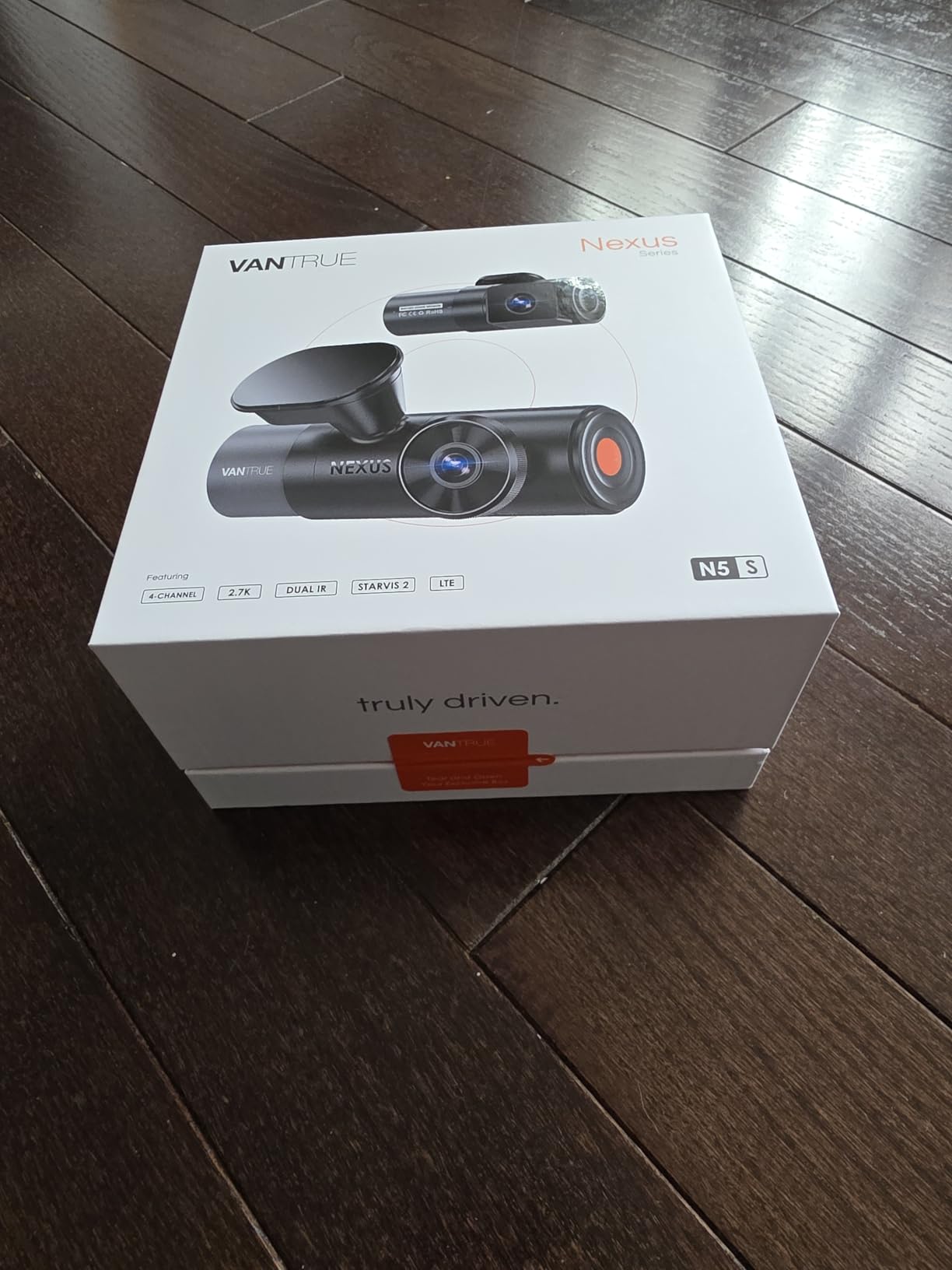
6. Vantrue N5S – Best Four-Channel 360 Coverage
Vantrue N5S 4 Channel 360 Degree 2.7K Dash Cam
Four channel 360 degree coverage
STARVIS 2 IMX675 front and IMX662 rear cabin
2.5K rear with HDR
Supports up to 1TB
Pros
- All four cameras use STARVIS 2 sensors
- Four channel coverage removes the usual truck blind spots
- 1TB storage for roughly 40 hours of four channel recording
- Super capacitor rated from -4F to 140F
- Optional 50ft rear camera extension for long vehicles
Cons
- Lowest average rating among the premium multi-channel units
- 15 percent of ratings are one star
- Parking mode requires a separately purchased hardwire kit
- 50ft extension cable and suction mount are separate purchases
It is the coverage play. Four channels at once, with a 360 degree combined field of view, and every one of the four cameras running a STARVIS 2 sensor. For a box truck working tight urban routes, or a tractor unit that spends real time in yard shuffling, that configuration is the one that finally documents the sideswipe that front-and-rear rigs miss entirely.
Storage is the quiet strength. Up to 1TB of microSD is supported, which the manufacturer puts at roughly 40 hours of four-channel recording. On a 24/7 rig that turns the card from a limitation into a multi-day evidence buffer, and it is a real differentiator against the 256GB ceiling most four-channel systems impose.
The supercapacitor is rated from -4F to 140F, which covers both a Minnesota January start and a Texas August idle. The front camera is an IMX675, the rear cabin an IMX662, and the 2.5K rear channel gets HDR processing of its own rather than inheriting the front sensor’s profile.
Connectivity is solid for a four-channel unit: 5GHz WiFi, dual-system GPS, and OTA firmware updates so you are not visiting a dealer to fix a bug. Voice control covers English, Russian, Chinese, French, and Japanese, and a three-axis G-sensor locks incident files automatically.
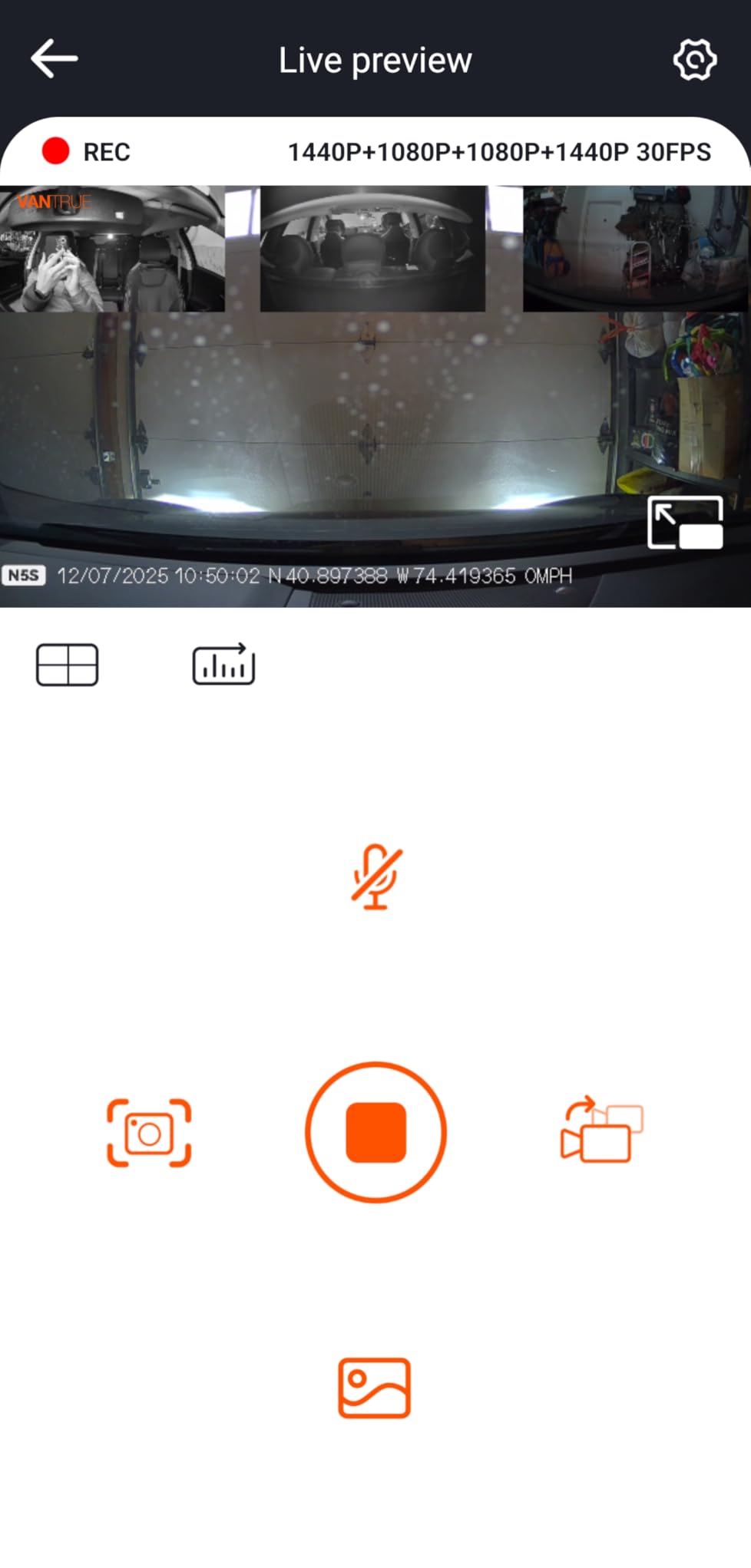
What four channels actually get you
Think about where your truck is least protected. A tractor unit has enormous side and rear quarter blind spots, and a box truck has the same problem plus a tall body that hides pedestrians from the driver in traffic. Four channels cover front, rear, and both flanks, and on this unit you can aim the side cameras at mirror depth or lower for a sideswipe record.
For a fleet manager, the 24/7 buffered parking mode with 10 seconds of pre-recording is the feature that justifies the hardware. Combined with a hardwire kit, it gives you a wake-on-motion record of the cargo area while the truck is parked overnight, which is the single most common cargo-theft claim we hear from owner-operators.
Where it falls short
Be honest about the rating. Its average across 2163 reviews is 4.1, the lowest of the premium multi-channel units here, and roughly 15 percent of its ratings are one star, the highest one-star share in the roundup. That pattern usually points to reliability or install complexity rather than image quality, and it is the reason this is not our top pick.
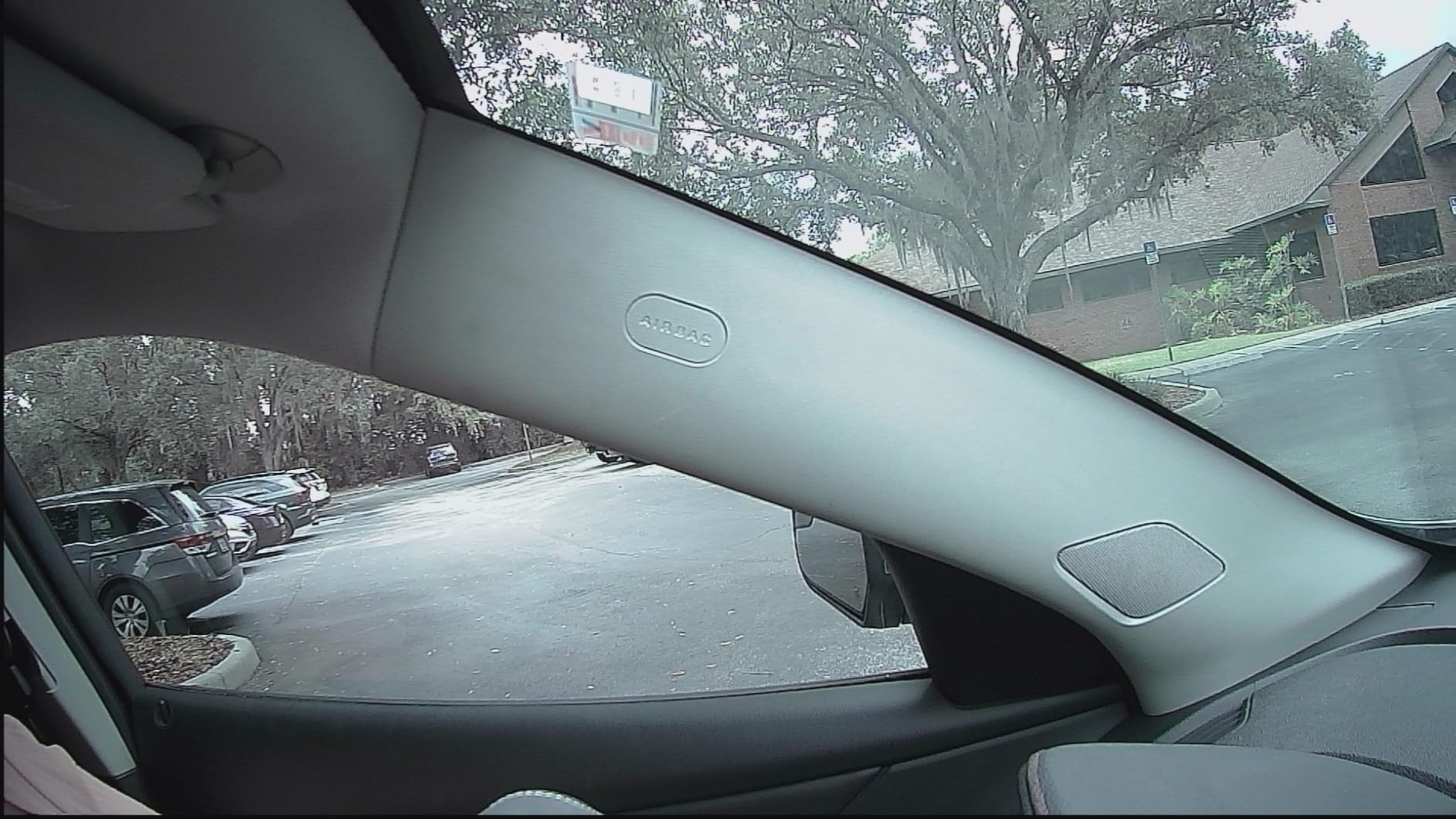
You will also be chasing extras. The hardwire kit, the 50ft rear extension cable, and the suction mount are all sold separately, and a four-camera install is more wiring than a dual-channel one. Budget an afternoon, and route the cables away from the A-pillar airbags.
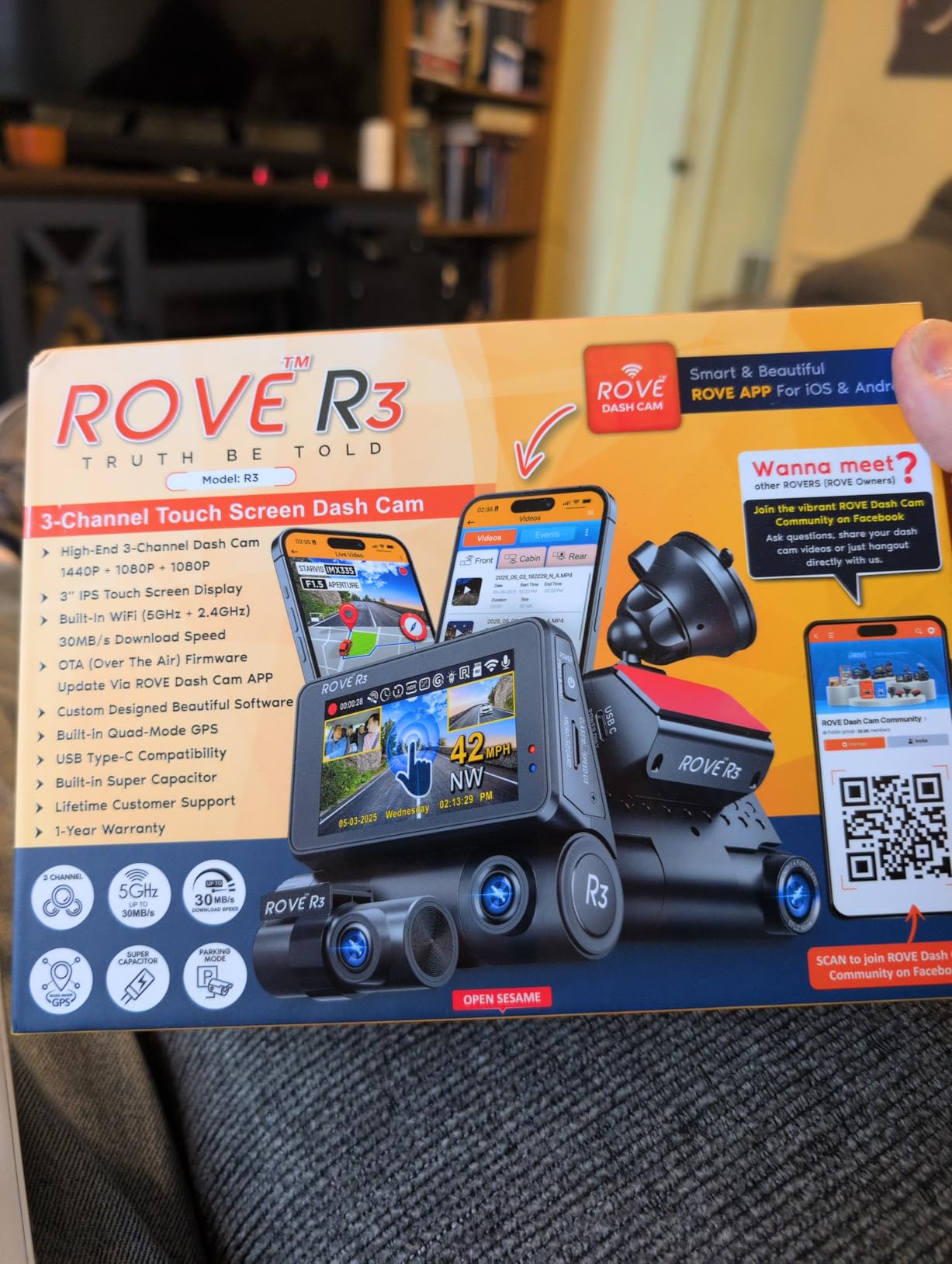
7. ROVE R3 – Best for Touchscreen Control
ROVE R3 3 Channel Dash Cam Front and Rear with Cabin, 3in IPS Touch Screen
3 channel 1440P front plus 1080P cabin and rear
3 inch IPS touchscreen
Dual-band 5GHz and 2.4GHz WiFi
Quad-mode GPS
Pros
- 3 inch IPS touchscreen is rare in this category and easy to operate in a cab
- Supercapacitor design avoids battery degradation in parked trucks
- Quad-mode GPS locks satellites quickly
- Dual-band WiFi transfers up to 30MB per second
Cons
- Rear camera is not waterproof and must be mounted inside the vehicle
- Front is 1440P rather than true 4K
- Out-of-box firmware reportedly needs an update
- Parking mode hardwire module sold separately
The R3 is the one to buy if you refuse to use your phone to check footage. A 3 inch IPS touchscreen on a single-button chassis is rare at this level, and in a truck cab where your phone is on a mount and your hands are on the wheel, a real screen with real buttons is worth more than a faster app.
It records 1440P at the front with 1080P cabin and 1080P rear simultaneously, and each channel can be switched on or off independently. That flexibility matters if you decide mid-route that the cabin camera is not worth the storage on a clear day.
The supercapacitor design is the right one for a hot cab, and four hidden infrared LEDs light the cabin channel in darkness. Wireless is dual-band, 5.0GHz and 2.4GHz always on, with transfer speeds up to 30MB per second, which is the fastest in this roundup. A 6m rear camera extension is included in the box.
Owners are also generous about support, with several citing replacement units shipped quickly when hardware failed. That kind of response matters more in the second year of ownership than the spec sheet did on day one.
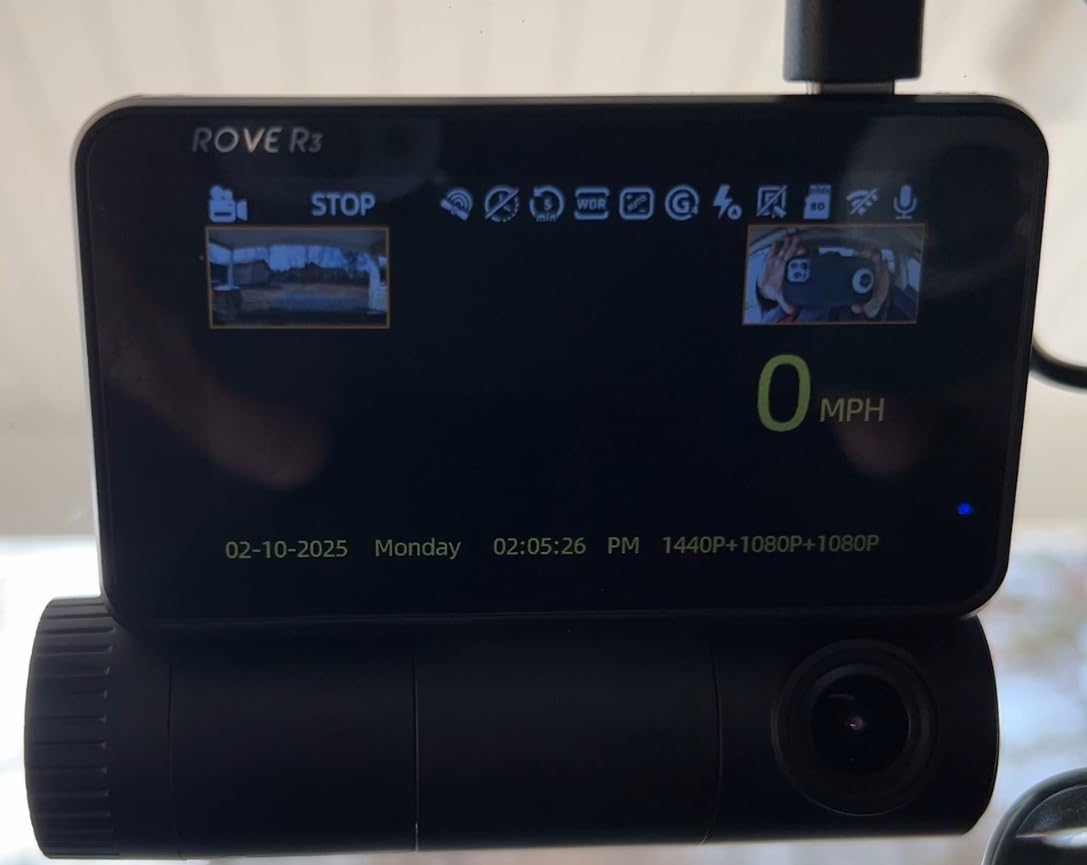
Why a touchscreen earns its place in a truck
Reviewing footage on a three-inch display is not a gimmick in a cab that sits well back from the windshield. You can confirm a clip is framed correctly, check that the mount has not drifted, and confirm the card is actually writing without pulling over and pairing a phone. For a driver running dawn-to-dusk, that saves a lot of stopped-truck time.
The GPS is quad-mode and stamps speed, compass, and location, and the f1.5 aperture with wide dynamic range and digital image stabilisation is a sensible low-light package for a windshield-mounted unit.
Where it falls short
The rear camera is not waterproof. That is a hard limit for exterior mounting on a trailer or box body, and it means this rig is an interior installation only. Anyone whose pain point is a wet-weather side or rear camera needs one of the sealed four-channel units instead.
Resolution is the other limit. A 1440P front is below the true 4K units here, and owners note that out-of-box firmware can arrive with bugs that an update clears. There is also no cloud storage, so files come off the card or the app and that is the whole workflow.
8. IIWEY N5 – Best for Blind-Spot Cameras
IIWEY N5 4 Channel Dash Cam for Cars, 360° View 2K Front 1080P Rear Inside
Four channel 360 front rear sides and interior
2.5K front or 1080P across all channels
128GB card pre-installed
Supercapacitor to 167F
Pros
- Side cameras on adjustable arms catch blind spots the mirrors miss
- Supercapacitor rated to 167F
- the highest temperature tolerance in this roundup
- 128GB microSD card already installed
- Compact and discreet behind the rearview mirror
Cons
- No GPS despite the category's usual feature set
- Rear camera is hardwired to the front unit rather than wireless
- WiFi auto-disables after 5 minutes and there is no Bluetooth
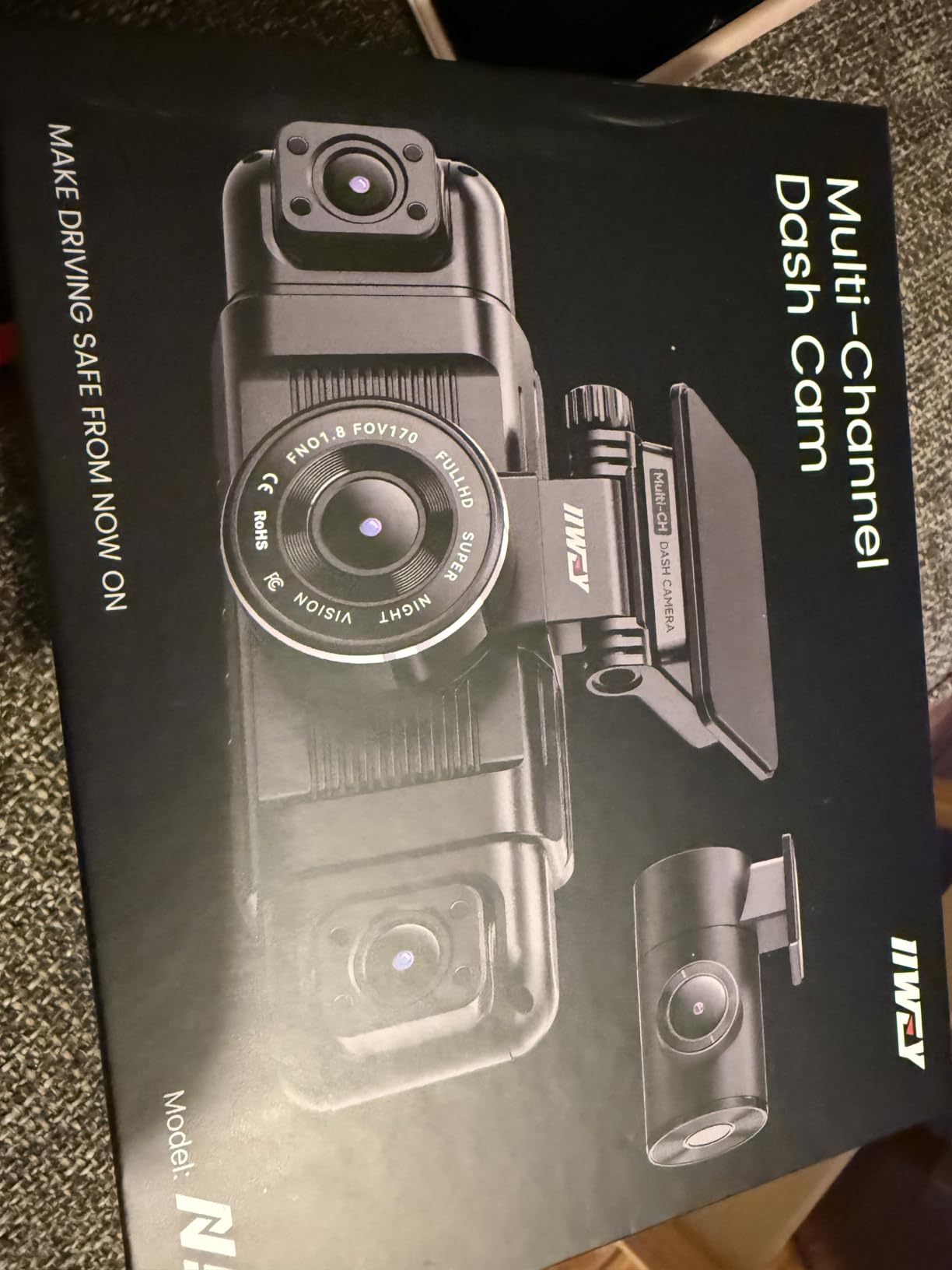
The IIWEY N5 exists for one job: seeing what the mirrors do not. Four channels covering front, rear, both sides, and the interior, with the side cameras on adjustable arms that you can physically aim at the mirror depth where a sideswipe actually happens. For a box truck in city traffic, that is the coverage that decides a claim.
It runs either 2.5K front with 1080P on the other three channels, or 1080P across all four. Lenses are 170 degrees front and rear and 150 degrees on the sides, and a 128GB card comes pre-installed so there is nothing to buy before first power-on.
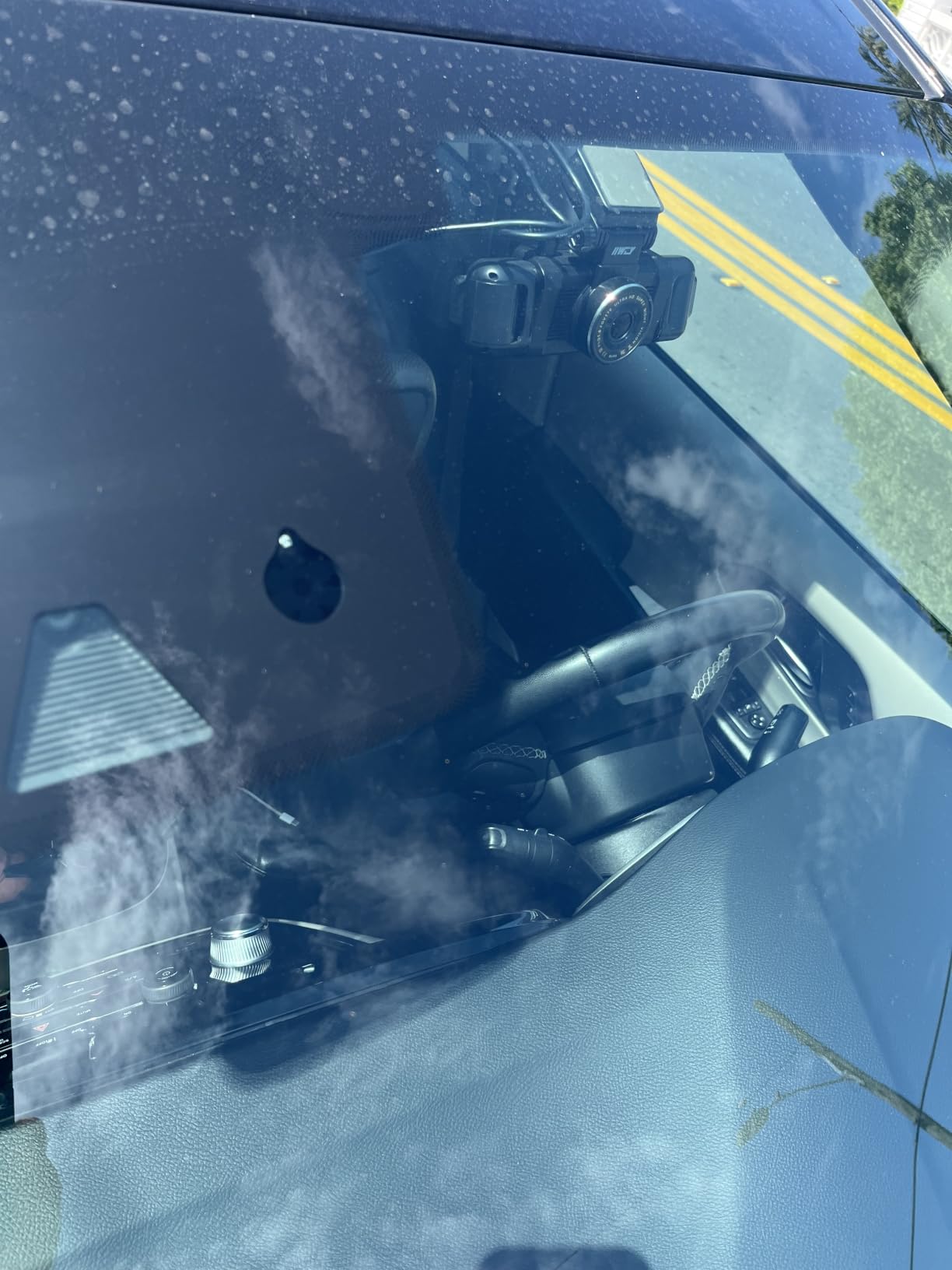
The thermal headroom is the standout. The supercapacitor is rated from -4F to 167F, the highest temperature tolerance in this roundup, and there is no internal battery at all. If your truck spends its summer parked in the sun, that rating is not a marketing line, it is the difference between a camera that records and one that does not.
The G-sensor also auto-locks impact footage with a 10-second buffer, and the app is reported as better behaved than several competing apps in this price bracket. Card capacity tops out at 256GB rather than 1TB, which is the main constraint for a rig that might run four channels continuously.
Mounting four cameras without losing sightlines
The main bracket adjusts 90 degrees and the rear camera swivels a full 360, which means you can tuck the unit high behind the rearview mirror and still get the side cameras to the right angle. On a truck that already has a tall windshield and a lot of mirror hardware, that adjustability is what makes the install possible at all.
Two parking modes are offered, 1fps time-lapse and impact detection with automatic 10-second locking. For a truck parked at a dock overnight, time-lapse gives you a compressed record of the whole stop without filling a card in an hour.
Where it falls short
There is no GPS. That is a genuine omission for insurance evidence, because a clip with no location stamp requires corroboration from somewhere else. If your claims are going to rest on this footage, that matters.
Wiring is also less flexible than the wireless competitors. The rear camera must be physically cabled to the front unit, and the unit must be powered by the original 12V cigarette-lighter style charger rather than USB or Type-C. On a 24V commercial chassis you will be sorting out a converter regardless, and the body is bulkier than some alternatives and can crowd the driver’s view.
9. HUPEJOS V8PLUS – Best for Driver Monitoring
HUPEJOS AI 4K Dash Cam Front and Rear, 4 Channel 360° View Camera for Car
Four adjustable 150 degree lenses
AI driver monitoring for fatigue and distraction
4K front with 1080P sides
GPS and voice control
Pros
- AI driver monitoring flags fatigue
- distraction
- yawning
- absence
- phone use and smoking
- Four independently adjustable lenses give true 360 degree coverage
- CPL filter with 8 IR lamps handles glare and night driving
- Supercapacitor rated from -20F to 140F
- Customer service is repeatedly called out as a standout positive
Cons
- Some units report the screen going blank in extreme heat
- Rear camera failures are reported and need replacement
- Cable routing and rear camera installation take some care
- Card support tops out at 256GB
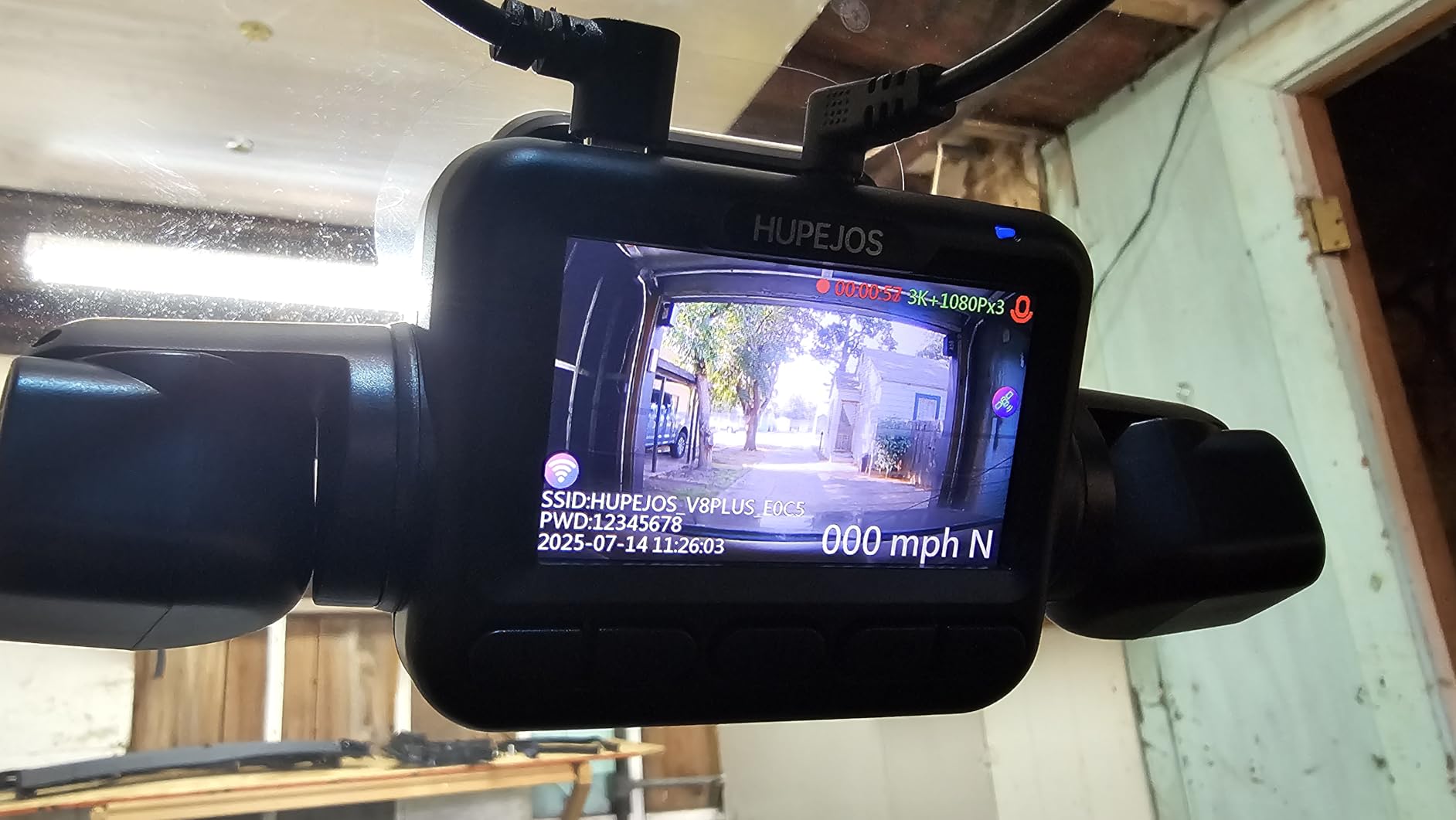
This is the only unit in the roundup with a dedicated AI driver monitoring system built in. It watches the cabin channel and flags fatigue, distraction, yawning, absence, phone use, and smoking. For a fleet running a safety scorecard programme, that is the difference between a camera that records and a camera that coaches.
Coverage comes from four independently adjustable 150 degree lenses. Two recording modes are available, 4K front with dual-channel 1080P on the sides, or 3K front with three channels of 1080P, and the CPL filter plus 8 infrared lamps handle both windshield glare and night driving.
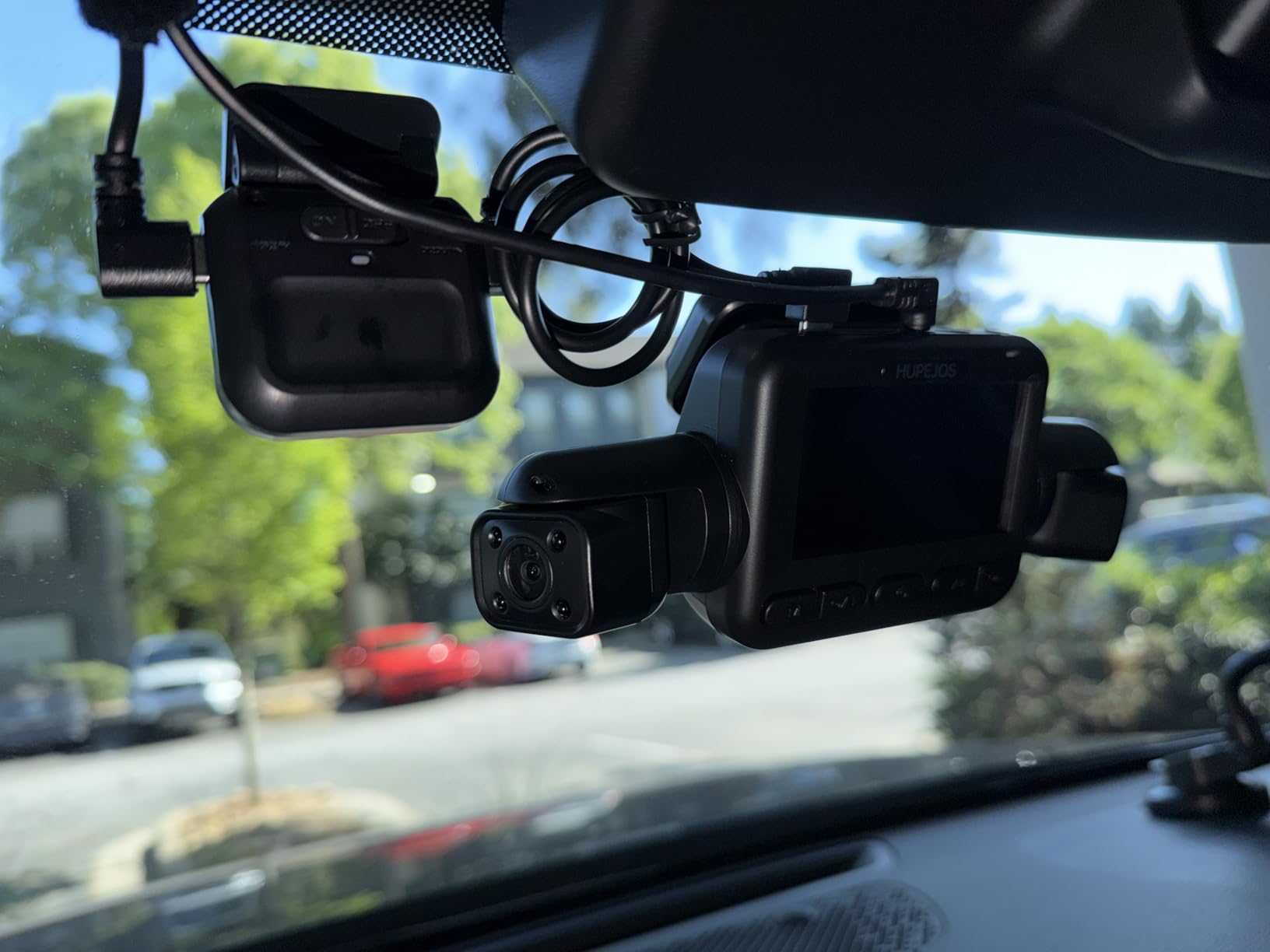
The supercapacitor is rated from -20F to 140F, which gives it the widest low-end range in this group and covers winter starts in the northern states. Parking monitoring works in either radar motion mode at 3 to 4 metres or collision-detection mode, and a 64GB card is pre-installed.
Owners consistently praise the multi-angle coverage and the clarity day and night, and several reviewers go out of their way to recommend the brand’s customer service, which offers free replacements. 71 percent of ratings sit at five stars.
What driver monitoring actually catches
The detection set is broader than most systems of this type. Fatigue and yawning catch the microsleep that ends a run on a single-car highway. Absence catches the driver who leaves the seat at a fuel stop with the engine running. Phone use and smoking catch the two behaviours most fleets are formally fighting and rarely see evidence of.
Handy context for a film or content angle: this is the closest thing in the roundup to a purpose-built behind-the-scenes camera rig, and our guide to cable cam systems for filmmakers covers the mount and rig side if you need a more mobile setup.
Where it falls short
The hardware complaints are worth taking seriously in a hot cab. Some units report the screen going blank in extreme heat, and rear camera failures show up often enough that a replacement is a realistic expectation over the life of the unit. Cable routing on a four-camera install also takes real care.
The 256GB card ceiling is the other limit. On a four-channel rig running continuously that is a short buffer, and the four small on-screen views are hard to read at once when you are checking coverage after a mount shift.
10. 70mai T800E – Best for Fast File Transfers
70mai 4K Dash Cam Front and Rear Inside, 3 Channel Car Dash Camera for Cars, Dashcam with GPS, Wi-Fi 6, Voice Control, Parking Monitor, Night Vision, Loop Recording, 64GB SD Card Included (T800E)
3 channel 4K front 1080P interior 1080P rear
WiFi 6 at up to 10MB per second
5-mode GPS
64GB card included
Pros
- Only unit in the roundup with WiFi 6
- roughly 5x faster than WiFi 4
- 64GB card included with support up to 512GB
- Super capacitor rated from 14F to 140F for hot climates
- Long included cables make rear routing easy on long-wheelbase vehicles
Cons
- Front 4K is upscaled from a native 2K sensor
- App is WiFi-only and requires being in the vehicle
- No cloud backup or remote viewing
- Recording all three channels fills a 64GB card quickly
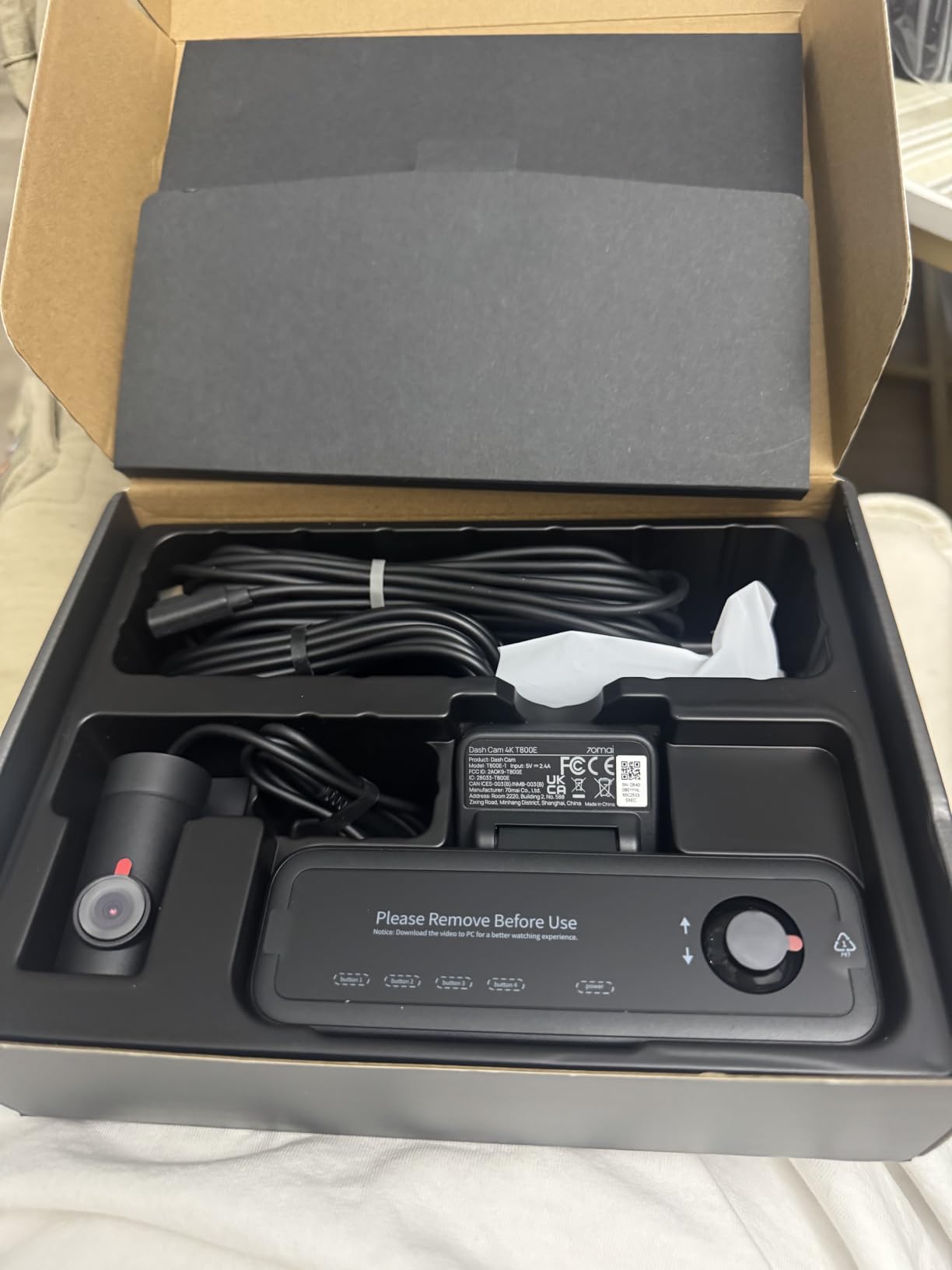
The T800E is the connectivity pick. It is the only camera here running WiFi 6, which the manufacturer rates at roughly five times the transfer speed of WiFi 4 and up to 10MB per second in practice. On a rig where you pull a long day of multi-channel footage every evening, that is a genuine time saving rather than a spec-sheet line.
It records 4K front with 1080P interior and 1080P rear, with an f1.55 aperture, HDR plus 3D noise reduction for low light, and a switchable IR on the interior camera for night cabin recording. Voice control handles photos, recording, and locking clips hands-free.
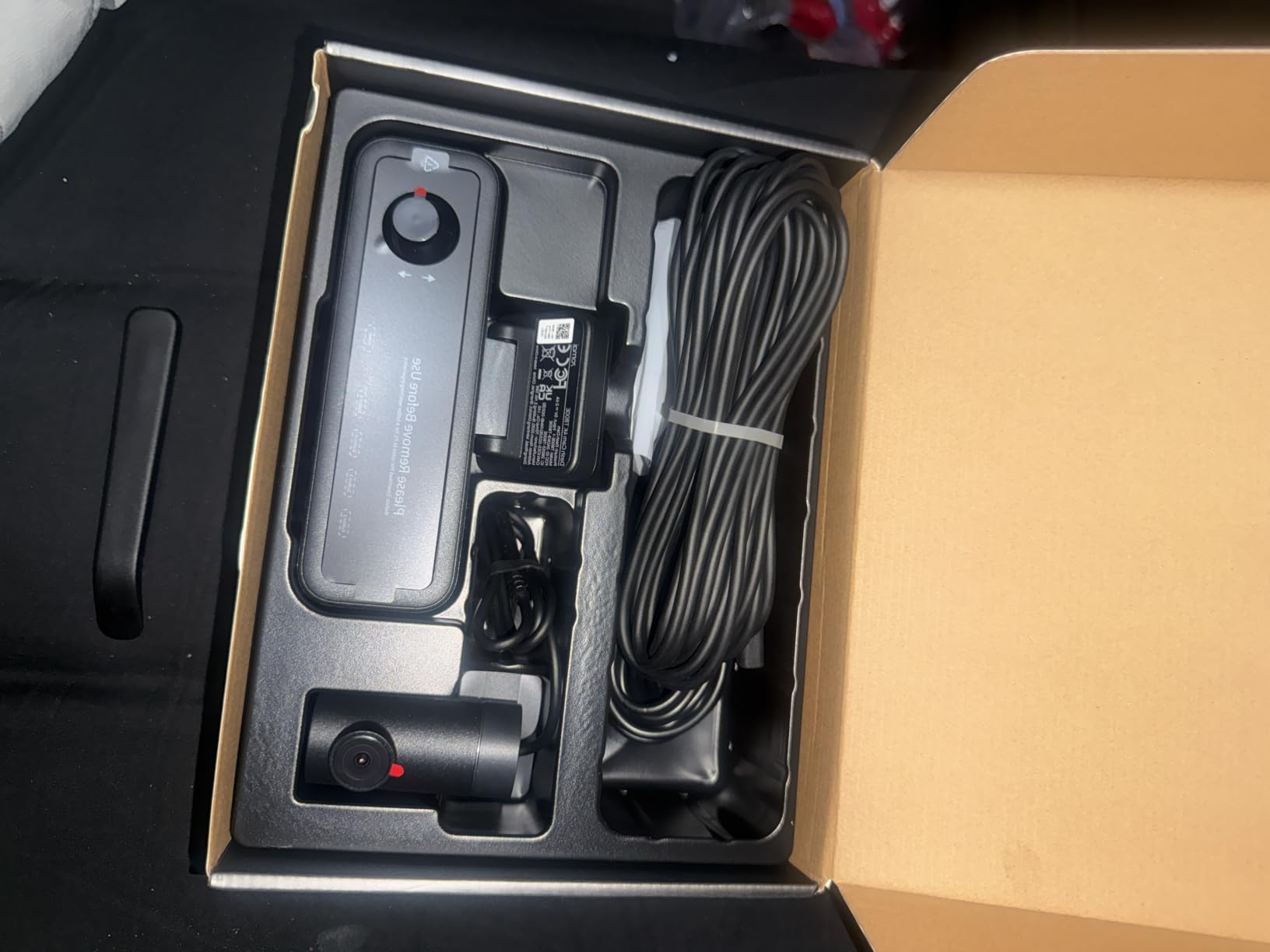
The supercapacitor is rated from 14F to 140F, the built-in GPS is five-mode, and a 64GB card is included with support up to 512GB. One long-term owner comparing it head to head against a VIOFO A229 Duo preferred this camera’s plate readability, which is exactly the kind of head-to-head we would expect on a truck forum.
Support has also been responsive, shipping a missing car charger and providing a firmware fix. Compatibility is unusually broad on paper, listing semi trucks, RVs, buses, tractors, ATVs, and UTVs.
Where WiFi 6 earns its keep
Consider the arithmetic. A 24/7 multi-channel day at three streams can produce tens of gigabytes before you even decide to save it. At 10MB per second, that transfer is a few minutes of waiting. At 5.8GHz speeds on the comparable units here, it is closer to a quarter of an hour. Neither is fatal, but the difference is felt every single night.
GPS stamps location, speed, and route, and the G-sensor provides emergency lock. Parking monitoring is available with 10 seconds of pre-recording, though it needs the separately sold hardwire kit.
Where it falls short
Two limits are worth knowing before you buy. First, the 4K front is upscaled from a native 2K GalaxyCore GC4663 sensor, so a reviewer chasing true 4K detail should look at the Vantrue N4 Pro S or the VIOFO A229 Pro instead. Second, recording all three channels fills the included 64GB card in under half a day, so plan to swap in a larger card immediately.
The app is also WiFi-only, with no CarPlay or Android Auto route and no cloud backup. You need to be standing at the vehicle to pull footage, and the 1.9 inch screen is small enough that menu navigation in a moving cab is awkward.
11. PRUVEEO 4-Channel 360 – Most Versatile for Full Coverage
PRUVEEO 360° 4 Channel Dash Cam Front and Rear Inside Left Right, Dash Camera for Cars, Built-in GPS WiFi Night Vision, 24/7 Recording Parking Mode Monitor, 128G Card Included
Four 1080P channels front rear left right
128GB card included
GPS and WiFi
Battery-free design
Pros
- Four channel 360 degree coverage with a 128GB card already in the box
- 128GB card included with support up to 256GB
- Three front lenses are angle-adjustable for blind-spot aiming
- No internal battery reduces heat-related failure risk
Cons
- Companion app is widely reported as unreliable and only works within range of the vehicle
- Backup camera mounting bracket and screws are described as flimsy
- ACC hardwire kit sold separately
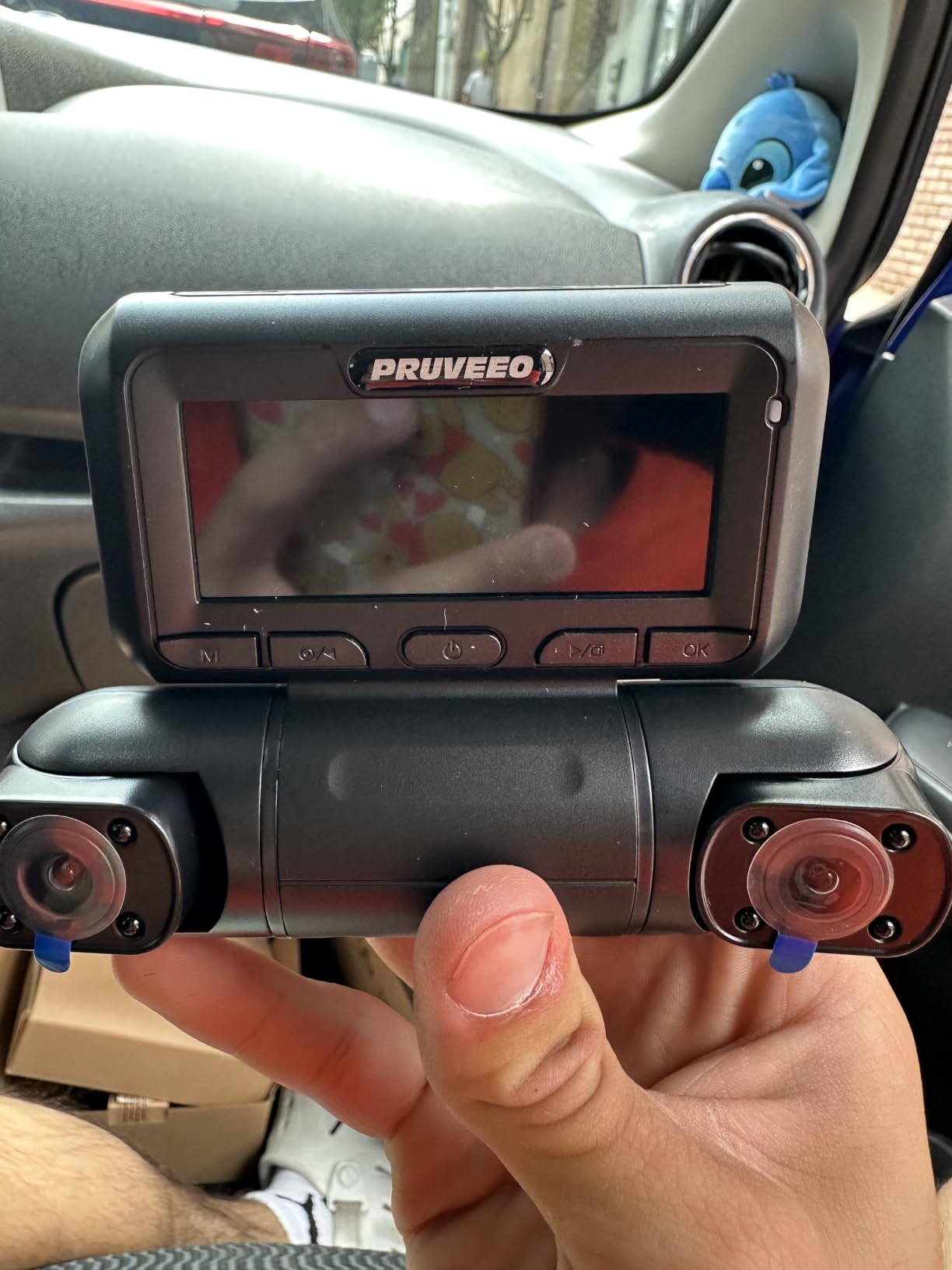
When we say four-channel coverage should not be a luxury feature, this is the argument. The PRUVEEO records 1080P on all four cameras, covering front, rear, left, and right simultaneously, and a 128GB card comes in the box. No other camera in this roundup gives you all four angles and included storage at this level.
There is no internal battery at all, which is the correct architecture for a hot vehicle. The design choice removes the lithium cell entirely rather than trying to protect it, and that is the single change that most improves survival in a truck parked in the sun.
Three of the lenses are angle-adjustable, so you can aim the side cameras at the blind spot zones beside a box body rather than accepting a fixed factory direction. The time-lapse mode compresses 60 minutes of footage into 1, which makes overnight parking surveillance practical on a single card.
Loop recording runs with collision-triggered file locking, and the cabin lens is f1.8 with four infrared lights for night recording.
The honest limitation: the app
Almost every negative review of this camera points at the same thing. The phone app is repeatedly described as fiddly, needing reinstalls and repeated WiFi reconnection, and files cannot be viewed remotely, so the app only works within range of the vehicle. If your routine is pulling footage over dinner, plan on removing the card.
Build quality of the supplied backup camera mount also draws criticism as flimsy, which is the piece most likely to be holding an exterior camera on a washboard road.
Where it falls short
At a 4.2 average it sits in the lower half of the ratings in this roundup, with 11 percent of ratings at one star. That is a fair reflection of a unit where the hardware is adequate and the software is not yet finished.
All four channels running at 1080P also consume storage quickly, and with a 256GB ceiling you are looking at a shorter buffer than the 1TB-capable units give you. Parking mode needs a separately sold ACC hardwire kit on top of that.
12. ZMOPO D435 – Best Compact Four-Channel Dash Mount
360 View 4 Channel Dash Cam Front and Rear Left Right Inside Camera for Cars, GPS and 5G Band WiFi, Night Vision, 160 Wide Angle, WDR, 24H Parking Mode, Supercapacitor, Included 128GB Card
Four 1080P channels with 160 degree lenses
128GB card included
8 IR LEDs and WDR
5GHz WiFi
Pros
- Compact body that does not obstruct the driver's view
- 4 channel 1080P coverage with 160 degree real angle of view
- 128GB card included
- Quick straightforward installation with clear instructions
Cons
- WiFi connection to the phone can drop and fail to stay synced
- Adhesive mount can lose grip in high heat
- Power cord ends in a cigarette-lighter style plug rather than USB-C
- GPS logger and parking mode hardwire kit sold separately
The ZMOPO D435 is worth considering if your problem is glass real estate rather than image quality. It mounts on the dashboard rather than the windshield, which on a truck with a deep dash and a lot of mirror hardware can be the difference between a clean install and a permanent obstruction.
Coverage is 4 channel 1080P across front, rear, left, and right, with a 160 degree real angle of view giving a 360 degree total field, and a 1.6 f-stop aperture on the front. Eight infrared LEDs and WDR exposure adjustment handle the night side.
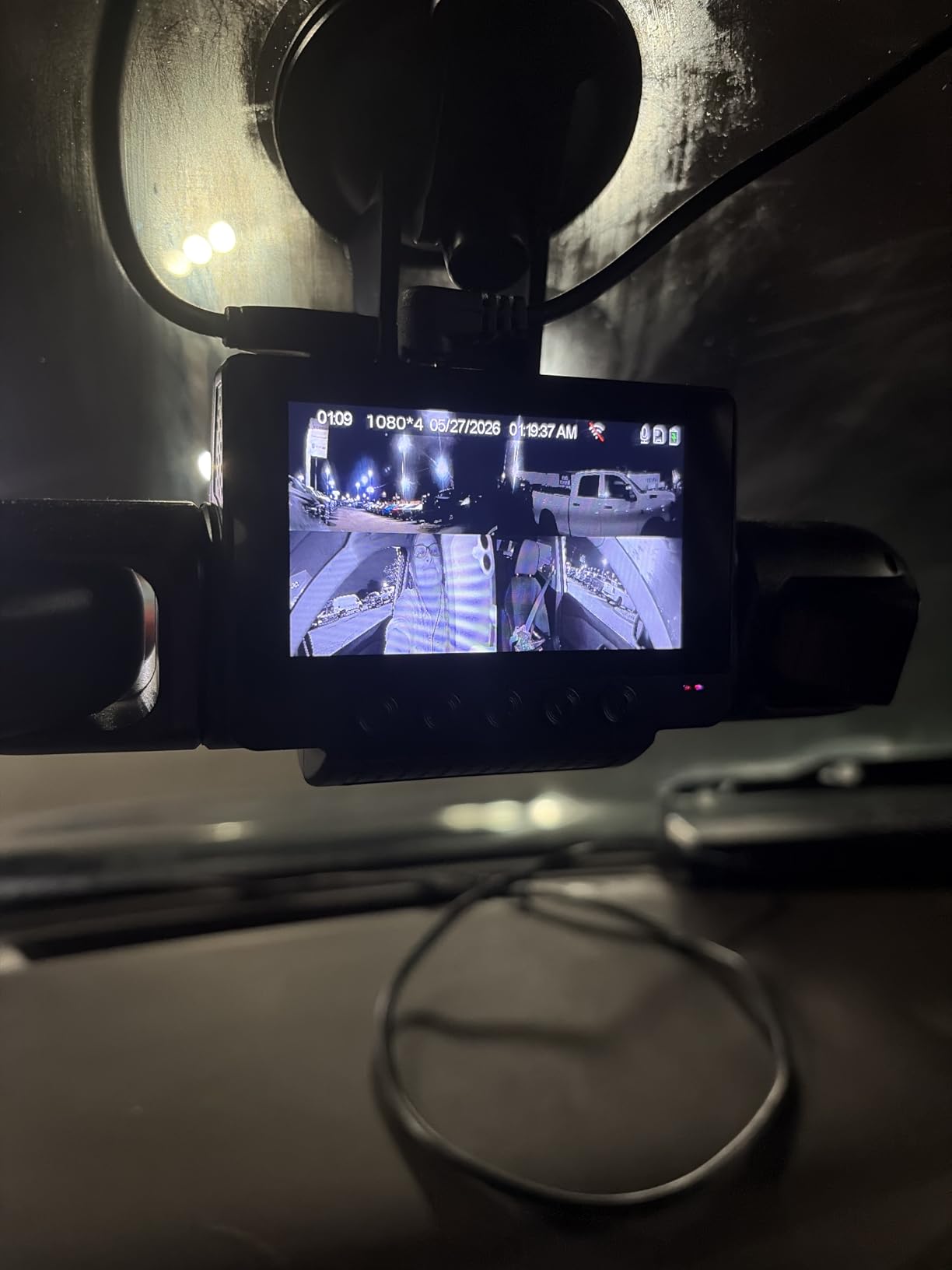
The 128GB card is included, the box carries a cable clip, car charger, mount, installation tool, and manual, and 69 percent of ratings sit at five stars. Owners consistently mention crisp, bright picture quality with adjustment available on every camera as the thing they notice first.
Time-lapse mode compresses 60 minutes into 1, loop recording has incident lock, and supercapacitor power buffering handles the parked state. A two-year warranty is included.
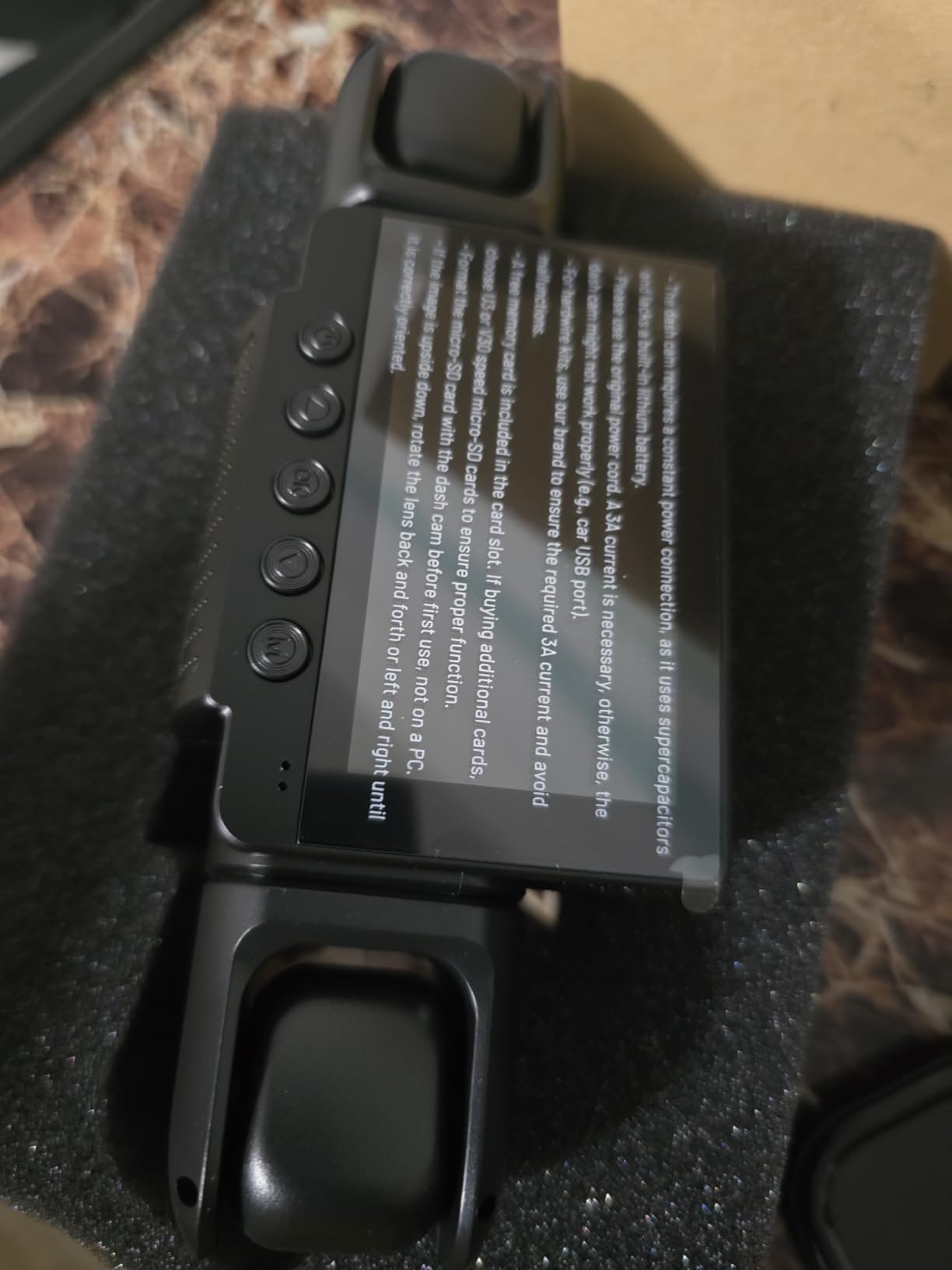
Why the dash mount matters on a truck
Tractor unit windshields are tall and steep. A windshield-mounted camera ends up high, close to the headliner, and often angled down at the hood rather than down the road. A dash mount lets you set the lens angle relative to the road ahead instead, which in practice means more of the lane and less of your own chrome in frame.
The compact body also matters for mirror-arm clearance. On a truck with a large mirror assembly, a small camera that tucks behind the rearview mirror leaves the sightlines exactly where the inspection put them.
Where it falls short
The adhesive mount is the concern in a hot climate, since owners report it can lose its grip in high heat. On a truck that parks outdoors year round, plan to check it periodically or use a mechanical retention method alongside it.
WiFi pairing can also drop and fail to stay synced, and the power cord ends in a cigarette-lighter style plug rather than USB-C. Note that the GPS logger and the parking mode hardwire kit are both sold separately, so the headline feature set is not the delivered feature set until you add them.
What to Look for in a Dash Cam for Trucks
The differences between these twelve units matter less than the four or five things you have to get right for a truck. Here is what actually decides whether a camera is worth mounting in a commercial cab.
Match the channel count to the job
Two channels, front and rear, is the entry requirement and it is genuinely sufficient for a straight-haul owner-operator on open road. Three channels adds a cabin camera, which is the configuration you want if you tow, if you run a pickup with a bed camera, or if anyone ever questions your following distance. Four channels adds side coverage, and that is the only configuration that documents a sideswipe, which is the single most common collision type in a truck fleet.
The trade is heat and card consumption. Every extra channel is another sensor drawing power in a cab that is already the hottest place in the vehicle, and the Vantrue N4 Pro S is the clearest example of a manufacturer solving this directly: its front-plus-rear mode cuts heat by about 30 percent compared with triple recording. If you are running three or four channels 24/7, expect to use that reduced mode overnight and full coverage while rolling.
Super capacitors vs. batteries in a hot cab
This is the criterion that separates a truck dash cam from a car dash cam, and it is the one most often left out of buying advice. A lithium-ion battery inside a parked truck cab in summer is a cell sitting at the top of its safe charge and discharge range for weeks at a time. Owners across truck forums report swelling, sudden death, and units that simply stop recording until the cell cools down.
A supercapacitor avoids the problem by design. It charges quickly, discharges quickly, and tolerates heat far better, and it is why nearly every unit in this roundup uses one. Check the rating, not just the presence of the word. The IIWEY N5 goes to 167F, the HUPEJOS V8PLUS runs down to -20F, and the 70mai T800E and Vantrue N5S both top out at 140F.
Two cautions. A unit with a temperature sensor that triggers a protective shutdown, like the VIOFO A229 Pro, is protecting its hardware correctly but will still stop recording when it gets too hot, so check where that threshold sits for your climate. And several units here also have no internal battery at all, which is the cleanest solution of the three.
Sony STARVIS 2 and low-light image sensors
Truck footage is night footage. Long haul runs happen between dusk and dawn, and city delivery work is worst at exactly the hours when a car dash cam gives up. The sensor is where that fight is won, and the STARVIS family is the name truck owners cite most consistently. On F150Forum, members anchor recommendations on the sensor, treating Sony as the benchmark for image quality, and the units in this roundup that carry STARVIS 2 sensors are the ones whose night reviews hold up.
Look past the resolution number. Two of the units here market 4K while recording 1440P natively and upscaling for playback, which is fine for most purposes but is not a native 4K sensor. Genuine 4K front sensors in this roundup come from the IMX678, used in the Vantrue N4 Pro S and the VIOFO A229 Pro.
A CPL filter is worth checking for separately. A tractor unit spends hours facing low sun, and a circular polarizer on the front lens is the cheapest fix for windshield glare available to a buyer.
Waterproof exterior cameras and blind spots
Exterior cameras mounted on a trailer or box body face rain, road spray, and road salt, which kills an unsealed camera. The ROVE R3 is the counter-example in this roundup: its rear camera is explicitly not waterproof and has to live inside the vehicle, so it cannot be mounted outside at all.
For exterior work you want sealed housings, cable runs through a grommet rather than along a bare body panel, and a mount that resists vibration. A suction cup on an exterior camera over washboard pavement is a timing question, not a design question.
Storage sizing for 24/7 multi-channel recording
Resolution and channel count set your bitrate, and bitrate sets how far back your buffer reaches. The pattern across this roundup is clear: a single channel at high resolution eats through a 64GB card quickly, and owners of the 70mai T800E report all three channels filling an included 64GB card in under half a day. Meanwhile a single channel in time-lapse mode can run roughly two days on a 128GB card.
Buy the largest card your unit supports. Ceilings here run from 256GB on the IIWEY N5 and HUPEJOS V8PLUS up to 1TB on the ROVE R2-4K, the Vantrue N4 Pro S, and the Vantrue N5S, which the manufacturer rates at roughly 40 hours of four-channel recording. More capacity is simply more time before an incident gets overwritten.
Use a high-endurance card, not the one that came in the box once you are past the first month. Constant rewriting kills consumer cards, and formatted-versus-full behaviour on a 24/7 unit is a common source of lost footage.
Connectivity, 4G and the monthly cost question
None of the twelve units here includes 4G, and that is worth being blunt about. Cellular upload is a fleet-technology feature, and every unit in this roundup records locally to microSD and connects over WiFi. The 70mai T800E specification is explicit that 4G connectivity is not supported.
That is largely a cost decision, and for a single truck it is usually the right one. A 4G-connected commercial DVR adds a SIM, a data plan, and a cloud subscription, all recurring, in exchange for footage that uploads off-site before anyone can pull the card. An owner-operator running one vehicle gets most of that value from a 1TB card and a hardwire kit. A fleet with a risk department that needs to pull a clip from a truck three states away is a different calculation, and it is a fleet telematics purchase rather than a dash cam purchase.
Also plan for the hardwire kit. Parking mode and 24/7 monitoring require one on nearly every unit here, and almost none of them include it.
Which Dash Cam for Which Truck?
The right answer changes with the vehicle, so here is the short segmentation. A semi-truck or owner-operator on long haul wants front, rear, and cabin, a hardwired install, and enough card to cover several days. The ROVE R2-4K handles the road evidence, and the Vantrue N4 Pro S or VIOFO A229 Pro 3CH handles the case where the cab needs watching too.
A box truck or delivery van lives or dies by side coverage. The IIWEY N5 with its adjustable side arms, or the Vantrue N5S with 360 degree four-channel coverage, is the answer, and in both cases the mount has to be aimed at mirror depth rather than left at the factory default.
A pickup owner typically wants a rear camera for a bed or tow setup plus a cabin camera for the load and the dog. The REDTIGER F17 gives you all three channels with a 64GB card in the box and a rear cable long enough to reach a bed mount, which is why it is our pickup pick.
An RV or motorhome driver wants the same thing as a truck owner who sleeps in it: 24/7 parking surveillance, a large card, and heat survival. The Vantrue N5S with 1TB support and a supercapacitor rated to 140F fits that brief better than anything else here.
A fleet manager needs things no consumer unit provides: tamper-resistant hardware, driver scorecards, remote access, and cloud retention. None of the twelve picks is a fleet telematics platform. If your requirement is a defensible record across twenty vehicles, budget for a commercial DVR rather than scaling up a consumer dash cam.
And to answer the question truck owners ask most often: yes, a car dash cam will physically work in a semi. It will not survive the heat cycle, it will not cover your blind spots, and its suction mount will not last a season on rough road. Buy the truck-rated unit.
Will a Dash Cam Lower Your Truck Insurance?
Honest answer: the evidence value is high, and the discount is not automatic. Dash cam footage is broadly accepted in accident claims and is regularly used to settle disputes, which is the practical reason most owners buy one. On rdforum, a pickup fleet operator running basic dashcams reports the footage being extremely helpful for settling issues, and that matches what we hear across owner forums.
Premium discounts, though, are decided by your carrier, your vehicle class, and your claims history, and plenty of carriers do not offer one at all for a dash cam specifically. Ask your insurer directly and get the answer in writing before you assume it in a budget. The Vantrue N5S, the Vantrue N4 Pro S, and the HUPEJOS V8PLUS include driver monitoring, which is the category of feature that actually tends to move a fleet safety score, rather than the mere presence of a camera.
How to Install a Dash Cam in a Truck
Start at the mount. On a tall, steep truck windshield, position the camera high and to the side so the lens clears the hood and points down the road rather than into it. Confirm before you route anything that the view out of the driver’s position is not blocked, because that sightline matters more than any feature on the camera. A dash mount, as on the ZMOPO D435, is often easier to angle correctly on a deep truck dash.
Route cables along the headliner and down the A-pillar, never across the airbag seam, and keep the rear run along the door frame or roof edge where a door adjustment will not pinch it. A rear camera on a long-wheelbase cab may need the longer cable or an extension, so check the included length against your wheelbase before you buy.
Power it properly. For parking mode and 24/7 operation you need a hardwire kit, and on a 24V commercial chassis you need one rated for that voltage or a converter between it and the unit. Route the constant-power and ground leads to the fuse box, and leave the ACC lead optional. A cigarette-lighter plug in a truck is a power connection waiting to come loose on a washboard road, which is the complaint we hear most often from owners who skipped the hardwire kit.
Finally, format the card in the camera rather than on a laptop, confirm each channel is recording before you close the windshield, and set the G-sensor sensitivity so expansion joints do not fill your card with false events. If the mount is adhesive, re-check it after the first week of heat.
Frequently Asked Questions
What is the best dash camera for trucks?
The ROVE R2-4K is the best overall truck dash cam for most owners, pairing a Sony STARVIS 2 front sensor, built-in GPS, a supercapacitor instead of a lithium battery, and the largest owner review base in its category. If you need three channels at native 4K, the Vantrue N4 Pro S is the stronger rig, and for four-camera 360 blind-spot coverage on a box truck, the Vantrue N5S is the pick.
What is the best rear dash cam for a pickup truck?
For rear coverage on a pickup, the REDTIGER F17 is the strongest fit: it records 1080P at the rear alongside a 4K front and 1080P cabin channel, and its 21.3ft rear cable reaches a bed-mounted camera without an extension. The ROVE R2-4K is the simpler front-and-rear answer if you do not need a cabin channel, and it ships with a 128GB card.
Will my insurance go down if I have a dash cam?
Not automatically. Dash cam footage is broadly accepted in claims and is regularly used to settle disputes, which is the main practical value, but premium discounts depend on your carrier, your vehicle class, and your claims history, and many carriers do not offer one for a dash cam specifically. Ask your insurer before you count on it, and get the answer in writing.
Do dash cams work in extreme heat in a truck cab?
They do, if the unit uses a supercapacitor rather than a lithium-ion battery. A lithium cell in a parked summer cab is the most common failure point, and owners across truck forums report swelling and sudden death. Look for the supercapacitor rating: the IIWEY N5 is rated to 167F, and the 70mai T800E, Vantrue N5S, and VIOFO A229 Pro reach 140F or have heat-protective shutdown behaviour.
Do I need a 3-channel or 4-channel dash cam for a semi?
Three channels is the right minimum for a semi or owner-operator, since the cabin camera is what documents a following-distance or distracted-driving dispute. Four channels is worth it if you run tight routes or spend time in yards, because the side cameras are the only way to record a sideswipe. Expect more heat and faster card consumption, and use a reduced two-channel mode while parked overnight.
How much storage does a truck dash cam need?
Plan on the largest card your unit supports. Recording three channels at high resolution can fill a 64GB card in under half a day, and time-lapse on a single channel can run roughly two days on 128GB. The Vantrue N5S, ROVE R2-4K, and Vantrue N4 Pro S accept up to 1TB, which turns the card from a short buffer into a multi-day evidence window, and a high-endurance card is worth adding after the included one ages out.
The Best Dash Cam for Trucks in 2026
After working through twelve units, the ROVE R2-4K is our best dash cam for trucks. A native STARVIS 2 front sensor, built-in GPS that stamps speed and heading onto the footage, a supercapacitor instead of a lithium cell, three 24/7 parking modes, and 14109 owner ratings at a 4.5 average. It is the most proven unit in the roundup and the one we would trust without a second thought.
Move up to the Vantrue N4 Pro S if you need a true 4K front with rear and cabin channels covered, and to the Vantrue N5S if your routes demand 360 degree blind-spot coverage with 1TB of storage. The REDTIGER F7N TOUCH is the value answer if you want 4K and a 128GB card in the box today, and the REDTIGER F17 is the one to buy for a pickup.
Whatever you choose, three things matter more than the model number: get a supercapacitor, get a hardwire kit installed, and buy the biggest card the unit accepts. Those three decisions do more for the quality of your evidence than any resolution upgrade will.
We refresh this roundup through 2026 as new models land and owner feedback accumulates. If your rig also serves as a shoot vehicle, our guide to editing software for multi-cam short films is the natural next step after the footage is in hand.