
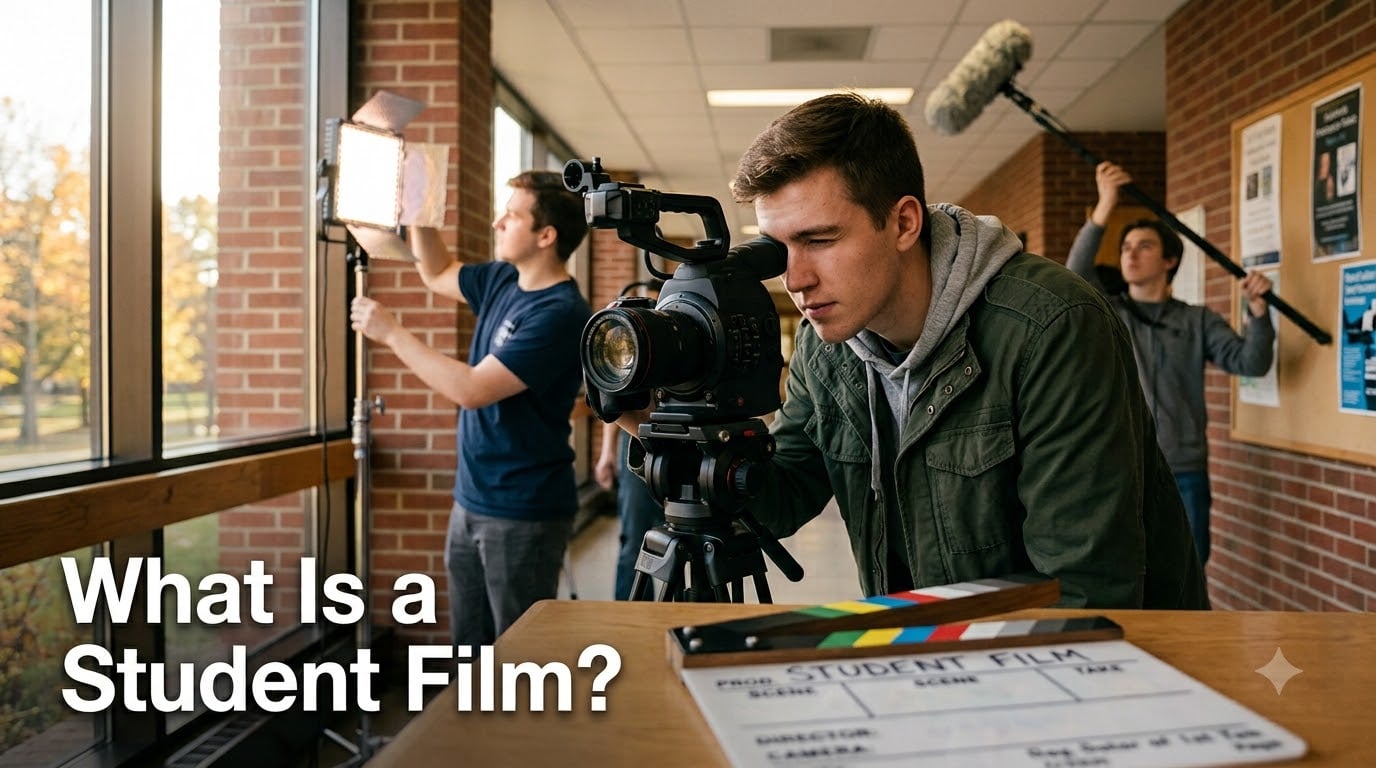
A student film is a motion picture created by someone enrolled in a high school, college, or university film program, typically produced as a class assignment or independent campus project. I have spent years covering short films at Short Film Central, and few categories spark more confusion than the student film. So I want to walk you through what qualifies, what makes one different from a short film, and why these projects matter so much to the film industry.
By the end of this guide, you will understand the technical definition, the production realities, the famous careers that started this way, and how to find or make a student film of your own in 2026.
Table of Contents
What Is a Student Film? The Core Definition
A student film is a film made by a student currently enrolled in an educational institution, usually as part of a film studies, media arts, or cinematography curriculum. The defining requirement is enrollment. The filmmaker must be a student at the time of production, and the project is typically tied to coursework, a thesis, or a campus production program.
This definition matters because it separates student films from amateur films made by hobbyists, indie films produced by self-funded creators, and short films made by working professionals. Enrollment in an educational institution is the key qualifier that makes a film a student film.
Student films exist at every level of education. High school students produce them in media classes, college undergraduates create them for film school assignments, and graduate students use them as thesis projects or capstone pieces. The category also extends to students at specialized film conservatories and boot camps, though enrollment still remains the requirement.
Key Characteristics That Define a Student Film
Student films share a recognizable set of traits that set them apart from other low-budget productions. Here are the defining characteristics you will see again and again across the genre.
Low budget. Most student films operate on budgets ranging from a few hundred dollars for a high school project to a few thousand dollars for a college thesis. Equipment loans and shared resources keep costs manageable.
Short runtime. The typical student film runs between 5 and 30 minutes, though some thesis projects stretch to 40 minutes or longer.
Volunteer cast and crew. Almost everyone working on a student film is unpaid. Friends, classmates, and aspiring actors volunteer their time in exchange for experience, reel footage, and on-set learning.
School equipment and facilities. Cameras, lighting kits, editing suites, and sound stages are nearly always borrowed from the school’s media department.
Educational purpose. The film must serve a learning goal, whether that is fulfilling a course requirement, building a portfolio, or mastering a specific filmmaking skill.
Creative freedom. Because instructors grade the process, student filmmakers often take creative risks that professionals cannot afford. This is why student films are a hotbed for experimental storytelling.
Festival and portfolio focused. The end goal is usually a film festival submission, a demo reel entry, or a clip for a portfolio rather than a commercial release.
These characteristics show up consistently because the constraints are built into the academic environment. Limited money, limited time, and limited experience force students to be resourceful, and that resourcefulness is part of what audiences love about the genre.
How Student Films Are Produced
Student film production follows a tighter, more structured process than most indie projects. Our team has talked to dozens of film school graduates, and the pattern is remarkably consistent. Here’s how a typical student film comes together.
Concept and proposal. The student develops a logline, synopsis, and treatment, then submits it for instructor approval or peer review within their program.
Pre-production. This includes script breakdowns, location scouting (often limited to campus, dorms, or nearby apartments), casting calls, and crew assignments. Casting notices usually go out through school networks or free platforms like Backstage and student film Facebook groups.
Equipment checkout. The student reserves cameras, lights, and audio gear from the school’s equipment cage. Most film schools let students borrow gear for free or for a small deposit.
Production days. Shooting typically happens over 2 to 5 days, with weekends and evenings used to fit around class schedules. Crews are small, often 5 to 10 people, and everyone is working unpaid.
Post-production. Editing happens in school labs using free or student-licensed software like DaVinci Resolve, Adobe Premiere, or Final Cut Pro. Sound mixing, color grading, and score work happen in the same environment.
Submission and screening. The finished film is submitted to class critiques, school showcases, and external student film festivals like the Student Academy Awards, campus film festivals, or regional student showcases.
One thing I always tell new filmmakers is that the TFP model (trade for print, or trade for portfolio) is the economic engine of student films. Crew members trade their time for reel footage and on-set experience. Actors trade their performance for a copy of the finished film and IMDB credit. Nobody gets a paycheck, but everyone walks away with experience and proof of work.
Student Films vs Short Films: What’s the Difference?
This is the question I see most often on Reddit and in our reader inbox. The confusion is understandable because student films are almost always short films, and most short films are not student films. The distinction comes down to intent and creator status.
A short film is defined purely by runtime. A short film is any film under 40 minutes, regardless of who made it. Short films can be produced by students, professional filmmakers, hobbyists, or studios. They can be funded, sponsored, or self-financed.
A student film is defined by the creator’s status. The filmmaker must be enrolled in an educational institution at the time of production. Student films are almost always short, but the defining feature is the student enrollment, not the runtime.
Here is a quick comparison to make the difference clear.
Defining feature: Short film = runtime under 40 minutes. Student film = creator enrolled in school.
Funding: Short films can be self-funded, crowdfunded, or studio-backed. Student films rely on school resources and tiny personal budgets.
Compensation: Short films may pay cast and crew. Student films almost always use the TFP model.
Audience: Short films target festivals, streaming platforms, and online release. Student films target class critiques, student festivals, and portfolio showcases.
Career function: Short films can be standalone projects or stepping stones. Student films typically serve as training exercises and portfolio pieces.
One question forum users ask a lot is whether a film made by a student outside of coursework still counts. If the student is enrolled at the time of production and the project is connected to their academic program, yes. If the student graduated and is making a film independently, it is a short film, even if it looks identical to their student work.
Famous Actors Who Started in Student Films
Some of the most recognizable names in Hollywood began their careers on student film sets. I love this part of the story because it shows just how powerful a student film can be as a launchpad.
Robert De Niro appeared in student productions at the Stella Adler Conservatory and during his early training in New York before becoming one of the greatest actors of his generation.
Jon Heder (Napoleon Dynamite) was studying animation at Brigham Young University when he and a classmate made the student short that eventually became the cult feature film.
Robert Redford made student films at the American Academy of Dramatic Arts in the 1950s.
Darren Aronofsky directed his breakout film Pi as a thesis project at Harvard, a student film that landed him a major studio deal.
The Coen Brothers made several student films at NYU before going on to win multiple Academy Awards.
These examples are not exceptions. They are proof that student films serve as real industry entry points. Casting directors, agents, and festival programmers do watch student films, especially at major events like the Student Academy Awards, Cannes Cinéfondation, and the BAFTA Student Film Awards.
Why Student Films Matter: Benefits and Industry Entry
Student films are not just homework. They are the training ground for the next generation of filmmakers, actors, editors, and cinematographers. From where I sit, three benefits stand out.
First, student films provide hands-on practice that no classroom can replicate. Students learn by directing, shooting, editing, and problem-solving on real sets with real deadlines. That experience is what turns a film student into a working filmmaker.
Second, student films build the portfolio that gets you hired. In the film industry, your work speaks louder than your resume. A strong student film can land you representation, open doors to indie projects, and earn you a spot in competitive graduate programs. The IMDb credit, the festival mention, the reel clip. These small pieces add up to a career.
Third, student films feed the festival circuit. Major festivals have dedicated student sections, and winning a Student Academy Award or screening at Cannes Cinéfondation is a credential that lasts a lifetime. Some of the most acclaimed indie films of the past decade started as student projects.
The honest truth is that student films can be rough. Audio problems, weak lighting, and uneven performances are common. But as one film school grad told me, “every flaw is a lesson you never forget.” Student films are where those lessons get learned.
FAQs
What classifies as a student film?
A student film is a film made by a student currently enrolled in an educational institution, typically as part of a film studies, media arts, or cinematography curriculum. The defining requirement is enrollment. The film usually functions as a course assignment, thesis project, or independent campus production connected to an academic program.
Are student films worth it?
Yes, student films are worth the time and effort for both filmmakers and actors. They provide hands-on production experience, build a portfolio with real credits, and offer networking opportunities with peers, instructors, and visiting industry professionals. For actors, student films give on-set experience and reel footage that can help land representation.
How do student films work?
Student films are produced through academic film programs using school equipment, facilities, and volunteer crews. Students develop a script, pitch it for approval, cast classmates or open-call actors, borrow cameras and lighting from the school, shoot over a few days, edit in school labs, and submit the finished film to class critiques and student film festivals.
Do student films pay?
Most student films do not pay cast or crew. The standard model is TFP (trade for print), where participants receive a copy of the finished film, on-set experience, and IMDB credit in exchange for their time. Some advanced thesis projects funded by grants may offer small stipends, but paychecks are rare in student productions.
What is the difference between short films and student films?
A short film is defined by runtime (typically under 40 minutes) and can be made by anyone. A student film is defined by the creator’s enrollment status at an educational institution, regardless of runtime. Almost every student film is a short film, but most short films are not student films. The key qualifier is whether the filmmaker was enrolled in school at the time of production.
What makes a shot look like a student film?
A shot tends to look like a student film when the lighting is flat, the audio is rough, the lensing is uninspired, and the performances feel unrehearsed. These are common because students are still learning cinematographic techniques like motivated lighting, sound mixing, and shot composition. The good news is that these are exactly the skills studying at film school teaches you to fix.
Conclusion
A student film is a motion picture created by an enrolled student, usually as part of a film school or media program. These projects are defined by low budgets, short runtimes, volunteer crews, and an educational purpose. They are different from short films in one key way: the filmmaker’s enrollment status.
Student films are the training ground, the portfolio builder, and the launchpad for the next generation of filmmakers. If you are starting a film program this year, get on a set. If you are an actor looking for experience, audition for a student film. The best way to learn what a student film is, is to make one.