
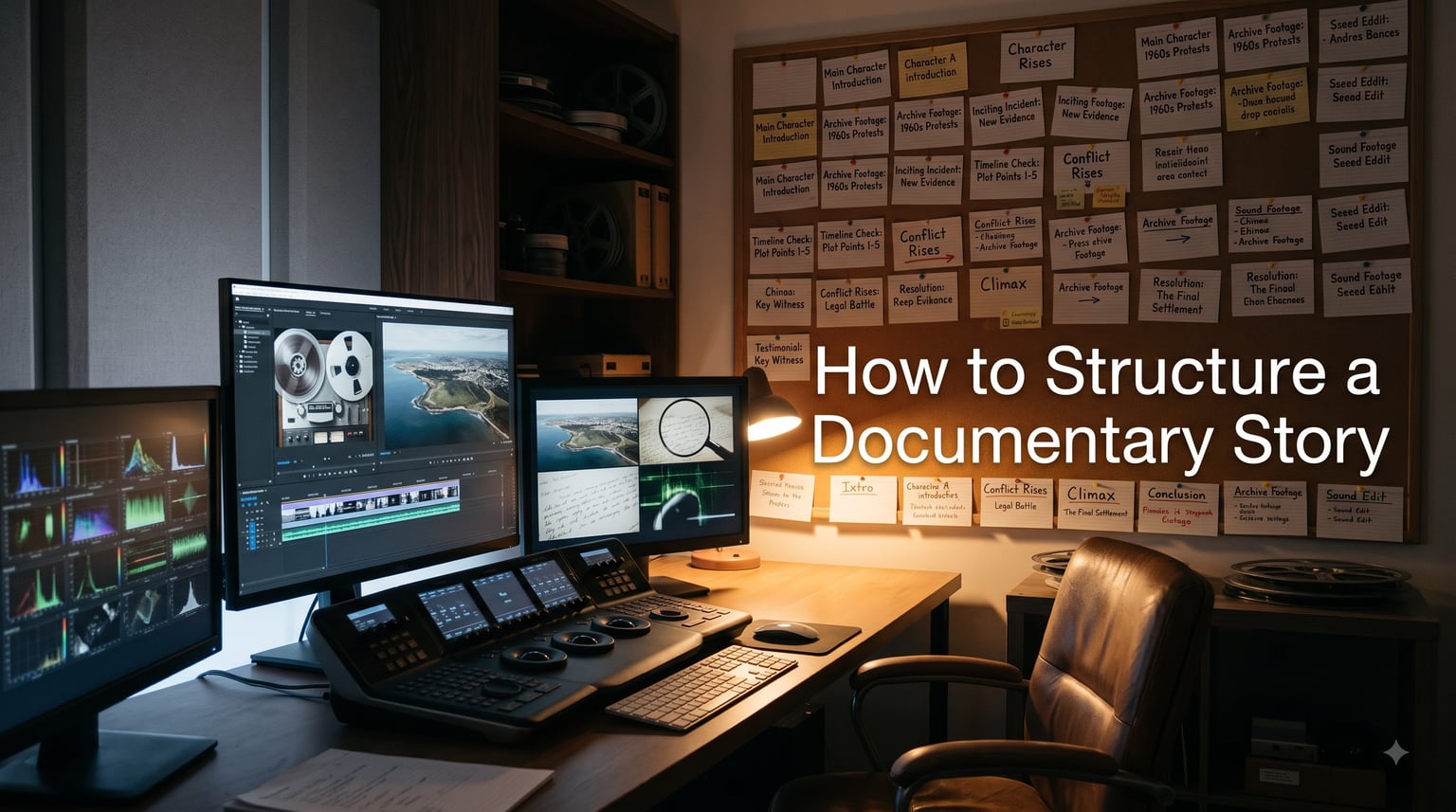
Real life is messy. Documentary story structure is what turns that mess into something an audience will sit still for 90 minutes to watch. Without a deliberate framework, your footage is just a pile of beautiful, boring footage. With one, it becomes a film.
In this guide, I will walk you through exactly how to structure a documentary story from the first beat of Act 1 to the closing shot. We will cover the classic three-act framework, alternative models like Dan Harmon’s story circle, the realities of editing, and the pacing tricks working documentarians rely on. By the end, you will have a clear template you can apply to a short doc, a feature, or a multi-part series.
Table of Contents
- What Is Documentary Story Structure?
- The Five Building Blocks of Any Documentary
- The Three-Act Structure for Documentaries
- Act 1: The Setup — Introducing Your Subject and World
- Act 2: Confrontation — Building Tension and Conflict
- Act 3: Resolution — The Climax and What Comes After
- Alternative Frameworks: The Story Circle and Real-Life Drama
- Character Arcs in Documentary Filmmaking
- Chronology vs. Story Order
- Finding the Story in the Edit
- Pacing Techniques That Hold an Audience
- Planning vs. Letting the Footage Lead
- Short Documentary Structure: What Changes Under 30 Minutes
- Common Documentary Structure Mistakes to Avoid
- FAQs
- Final Thoughts on Documentary Story Structure
What Is Documentary Story Structure?
Documentary story structure is the framework that organizes real-life events into a compelling narrative, guiding viewers through a beginning, middle, and end. It is not about making things up. It is about selecting, sequencing, and shaping actual footage, interviews, and archival material so that an audience feels the same emotional pull they would in a fiction film.
The reason this matters is simple: raw reality does not arrive in three acts. A whistleblower may blow the whistle in month three of filming. Your protagonist may transform quietly over two years, with no obvious turning point. Structure is the editorial lens that makes that material readable. As editor Walter Murch once put it, the cut is the creative act.
For our team, the moment a documentary project clicks is almost always the moment we find its structure. Not the story. The structure. The story lives in the footage. The structure decides how the audience meets it.
The Five Building Blocks of Any Documentary
Before you choose a framework, you need five working ingredients. Most documentary failures I have seen come back to one of these being missing or fuzzy. Here is the checklist I run every project through before I cut a single scene.
Subject. What is the film about in one sentence? If you cannot say it in under 15 words, you do not yet have a subject.
Premise. Why does the subject matter now? What is the larger point the film is making about the subject?
Protagonist. Who is the audience going to follow? A documentary can have multiple characters, but it needs at least one clear throughline figure.
Conflict. What does the protagonist want, and what is stopping them from getting it? Without conflict, you have a profile, not a story.
Arc. How does the protagonist change by the end? Real change, implied change, or a refusal to change — all are valid, but one of them must be visible.
Keep these five on a single index card above your editing bay. When you are stuck, the gap usually lives in one of them.
The Three-Act Structure for Documentaries
The three-act structure is the most widely used documentary story structure, and for good reason. It mirrors how humans actually tell stories to each other around a dinner table. The form is older than cinema, and the form keeps working because audiences are wired to receive it.
Here is how the three acts break down for a typical 90-minute feature documentary:
Act 1 — Setup (0 to 25 minutes). Introduce the subject, the world, the protagonist, and the central conflict. End with the inciting incident that sets the rest of the film in motion.
Act 2 — Confrontation (25 to 75 minutes). The protagonist faces escalating obstacles. Tension builds toward a midpoint reversal and a dark moment often called the abyss.
Act 3 — Resolution (75 to 90 minutes). A climax, a denouement, and an emotional landing that gives the audience something to carry home.
The split is roughly 25 / 55 / 20 percent of runtime. You do not need a stopwatch to hit those numbers exactly, but if Act 2 is shorter than Act 1, you almost certainly have a pacing problem.
One thing I want to flag for beginners: the three-act structure is not a cage. It is a container. The best documentaries stretch it, fold it, and sometimes break it. But they always know they are doing that, and they always know what they are breaking it against.
Act 1: The Setup — Introducing Your Subject and World
Act 1 has one job: convince the audience to stay. Ken Burns has said many times that the first 30 seconds matter more than any other part of a documentary. If viewers do not know why they should care by minute five, the rest of the film is performing for an empty room.
A strong Act 1 does four things in roughly this order:
Establish the world. Show the audience where they are, visually and emotionally.
Introduce the protagonist. Give them a face, a voice, and a want.
Plant the central question. What is this film going to answer, or at least explore?
Trigger the inciting incident. The event that kicks the rest of the film into motion.
In Citizenfour (Laura Poitras, 2014), Act 1 is the meeting between Laura and Edward Snowden in a Hong Kong hotel room. By the end of that meeting, the audience knows who Snowden is, what he has done, and why it matters. Everything after flows from there.
A common mistake here is to spend Act 1 on context. Background is important, but it is not story. If your Act 1 is 30 minutes of history lesson before we meet anyone, you will lose the room. Solve context through character whenever you can.
Act 2: Confrontation — Building Tension and Conflict
Act 2 is where most documentary structures fall apart. It is also where the best ones separate themselves from the merely competent.
The job of Act 2 is to make the audience feel the cost of the protagonist’s pursuit. That means escalating obstacles, reversals, and at least one moment where everything looks lost. Documentary filmmakers often call this low point the abyss, borrowed from the hero’s journey. It is the beat right before the climax, where the protagonist either breaks or breaks through.
Inside Act 2, three sub-beats help you stay on track:
The midpoint reversal. Around the 50 percent mark, the protagonist either gains something crucial or loses something critical. Either way, the stakes rise.
The false climax. A moment that looks like resolution but is not. It raises the tension again instead of releasing it.
The abyss. The lowest point. Often a moment of failure, doubt, or genuine risk that makes the eventual climax feel earned.
In Free Solo (Jimmy Chin and Elizabeth Chai Vasarhelyi, 2018), the midpoint is Alex Honnold’s relationship talk with his partner. The false climax is an early rehearsal climb. The abyss is the moment he decides to attempt El Capitan without ropes anyway. None of that is invented. It all happened. The structure made it feel like a thriller.
Act 3: Resolution — The Climax and What Comes After
Act 3 has two parts: the climax itself and the denouement. The climax is the moment the central question is answered, or finally refused. The denouement is the breathing room after, where the audience gets to feel what the answer means.
In documentary, the climax rarely looks like a fiction climax. There are no explosions. There is usually a quiet conversation, a piece of footage shot months before that suddenly lands differently, or a piece of information that reframes everything. The job of the structure is to give that quiet moment the weight it deserves.
The denouement is what Ken Burns calls sending the audience home safe. After 90 minutes of tension, viewers need a clear emotional exit. A final interview answer, a single recurring image, a quiet score swell. Without it, even a great film can feel incomplete.
If your Act 3 feels rushed, the problem is almost always that Act 2 was too long. Cut from the middle, not the end.
Alternative Frameworks: The Story Circle and Real-Life Drama
The three-act structure is a starting point, not a religion. Two alternative frameworks are worth knowing because they handle real-life material especially well.
Dan Harmon’s Story Circle
Popularized by the writer behind Rick and Morty and Community, the story circle is an eight-step loop adapted from Joseph Campbell’s hero’s journey. It works beautifully for character-driven documentaries because it puts transformation at the center.
The eight beats are: you, need, go, search, find, take, return, change. A documentary about a recovering addict, for example, might start with “you” (the person in their everyday life), move through “need” (the recognition that something is missing), and so on around the loop. The story ends with “change” — the new self the protagonist has become.
The Journey-and-Transformation Model
This is the framework used by Jennifer Peedom, director of Sherpa and Mountain. It treats the documentary as a literal or metaphorical journey, with the transformation happening in the movement itself.
This model works well when your subject is a place, an expedition, or a community. The structure is the journey, and the audience experiences the transformation by being carried along it.
The Real-Life Drama Model
Some documentaries follow a public event as it unfolds: a campaign, a trial, a disaster, a contested election. Here the structure is dictated by chronology, but the storytelling still needs shape. The trick is to identify the dramatic question early — the thing the audience is waiting to find out — and pace your reveals around that question.
Making a Murderer uses this model. The dramatic question is in the title. The structure is the investigation. But the editing still imposes a three-act feel on top of chronology.
Character Arcs in Documentary Filmmaking
Fiction gives you written characters. Documentary gives you real ones, and they do not cooperate. They are guarded on day one, exhausted on day forty, and sometimes completely absent the week you needed them most.
The job of structure is to make that unpredictability feel intentional. Here is how to handle it.
First, pick the right protagonist. Not the most photogenic subject, not the loudest voice — the person whose want is clearest and whose obstacle is biggest. If you cannot articulate what your protagonist wants in one sentence, you do not yet have a protagonist.
Second, shoot the change, not the person. The arc is the story. If your protagonist is interesting but static, the film will be too. Aim for characters in motion, literally or emotionally.
Third, accept that the arc may not be visible until the edit. I have had projects where the protagonist’s transformation only became clear in the last week of editing, after 200 hours of footage. That is normal. Plan for it.
Chronology vs. Story Order
This is one of the most common questions on documentary forums: should I tell the story in the order it happened, or in the order the audience needs to experience it?
The short answer: almost never in strict chronological order. Real-life events have lulls, repetitions, and false starts. Audiences do not.
The longer answer: chronology is your safety net, not your structure. Use it to fact-check the order of events, then build the actual structure around dramatic beats. The classic example is opening with a flash-forward that establishes the dramatic question, then jumping back to the beginning to answer it.
That said, some subjects demand chronology. If you are documenting a process that takes place in a fixed order — a surgery, a launch sequence, a refugee journey — chronology and structure may end up the same thing. Do not contort a clear chronological story into a flashy non-linear one just to seem sophisticated.
The rule of thumb: structure follows tension. Wherever the tension is, that is where your scene should go.
Finding the Story in the Edit
If you take only one thing from this guide, take this: the story is found in the edit. Pre-production and shooting collect material. The structure is discovered in the cutting room.
Here is the workflow that has worked for our team across roughly 40 documentary projects.
Log everything. Every interview, every B-roll clip, tagged with subject, emotion, and rough timestamp.
Build a paper edit. Pull the strongest 5 to 10 percent of clips and arrange them on a wall or in a sequence. Ignore gaps. The goal is to see shape.
Find the spine. Identify the one scene that, if removed, makes the whole film collapse. That scene is your climax. Build outward from it.
Test the structure on someone outside the project. If a stranger cannot summarize the story in one sentence after watching a rough cut, your structure is not yet landing.
Rearrange. Documentary editing almost always involves multiple restructurings. Expect to rebuild Act 1 at least twice.
The community at The D-Word, a documentary forum with over 23,000 members, often says the same thing: editing is where the writing happens. Treat the edit like a writing desk, not a finishing room.
Pacing Techniques That Hold an Audience
Pacing is the difference between a documentary people finish and one they abandon at minute 12. Here are the techniques I lean on most.
Open on your strongest hook. Do not build to it. Lead with it. You can always go back in time.
Vary scene length. A 90-minute film made entirely of 90-second scenes will feel frantic. Mix long observational passages with short interview beats.
Cut on emotion, not action. End scenes at the moment an emotional thought lands, not when the physical action finishes.
Boil the pot. Ken Burns’ phrase for keeping tension alive between big moments. Use small payoffs, returns to a recurring image, or brief reminders of the central question.
Use silence. The cheapest, most underused pacing tool. A two-second pause after a powerful answer will do more than any score.
When pacing feels off, the diagnosis is usually that the audience knows what is coming. Surprise is the engine of pacing. Restraint is its steering.
Planning vs. Letting the Footage Lead
This is the philosophical question of documentary structure, and the forum threads get heated about it.
On one side: write a tight treatment, build a scene-by-scene outline, shoot to that outline, and structure the film around it. This is the approach most first-time documentarians take, and it produces films that feel planned but sometimes lifeless.
On the other side: shoot loosely, collect everything, and find the structure in the edit. This is the approach directors like Werner Herzog sometimes advocate. It produces films full of surprises but can easily sprawl.
The honest answer is neither extreme. The best documentary filmmakers I have worked with do this:
They write a treatment with a clear dramatic question, but not a fixed ending.
They shoot with a scene list, but they stay open to unplanned material.
They structure the film in the edit, but they check that structure against the dramatic question from the treatment.
If you plan too rigidly, real life will not cooperate and your film will feel false. If you plan too little, you will end up with 400 hours of footage and no film. Aim for a structure that is firm enough to guide you and loose enough to bend.
Short Documentary Structure: What Changes Under 30 Minutes
Short documentaries under 30 minutes follow the same principles as features, but the proportions shift dramatically. You do not have time for a slow build, a long Act 2, or a leisurely denouement.
In a 10-minute short doc, your three-act split is closer to 1 / 6 / 3 minutes. Your protagonist needs to be introduced inside the first 30 seconds, your inciting incident before the two-minute mark, and your climax by minute seven.
Two structural moves help in shorts:
Skip Act 1 entirely. Open on the inciting incident and fill in context through flashback or interview.
Use a single dramatic question. With no time for subplots, the entire film should rotate around one tension.
Short docs also tend to lean harder on a strong opening image and a poetic final line, because the audience has less time to settle in. Make every shot earn its place.
Common Documentary Structure Mistakes to Avoid
I have made most of these mistakes. Here is the short list to watch for.
Slow rolling the exposition. Spending the first 10 minutes on context before any story begins. Cut it or move it later.
No clear protagonist. Three subjects in 90 minutes usually means zero subjects in 90 minutes. Pick one.
Missing conflict. A documentary about a problem without obstacles is a TED talk, not a film.
Theme masquerading as story. Saying something important about the world is not the same as showing a person facing it. Lead with the person.
A climax that is not earned. If the audience does not feel the abyss, the resolution will not land. Cut from the middle, not the end.
Ending on a quote. Closing with a famous quotation instead of your own material is a tell that the structure is incomplete.
If you can avoid these six, your film will already be ahead of most of the documentaries submitted to festivals.
FAQs
What is the basic structure of a documentary?
The basic structure of a documentary is the three-act framework: a setup that introduces the subject and central conflict (Act 1), a confrontation that builds tension through escalating obstacles (Act 2), and a resolution containing the climax and denouement (Act 3). Roughly 25 percent of runtime goes to Act 1, 55 percent to Act 2, and 20 percent to Act 3.
How do you write a story for a documentary?
You write a documentary story in three stages. First, define your subject, premise, protagonist, conflict, and arc during pre-production. Second, collect material with a clear dramatic question in mind. Third, find the actual story in the edit by building a paper edit, identifying the spine scene, and rearranging until the structure lands on a test viewer.
What are the 5 parts of story structure?
The five parts of documentary story structure are: setup (introducing the world and character), inciting incident (the event that kicks off the story), rising action (escalating obstacles and tension), climax (the moment the central question is answered), and resolution or denouement (the emotional landing after the climax).
What are the five elements of a documentary?
The five elements of a documentary are subject (what the film is about), premise (why it matters now), protagonist (who the audience follows), conflict (what stands in their way), and arc (how they change by the end). All five must be present for the structure to work.
Should I plan my documentary structure before shooting or find it in the edit?
Do both. Write a treatment with a clear dramatic question before shooting to guide your coverage. Stay loose enough during production to capture unplanned material. Then find the actual structure in the edit, where documentary writing really happens, and check it against the dramatic question from your treatment.
Final Thoughts on Documentary Story Structure
Documentary story structure is the bridge between what happened and what an audience experiences. The three-act framework, the story circle, and the journey-and-transformation model are all tools for building that bridge. None of them work without the five building blocks underneath: subject, premise, protagonist, conflict, and arc.
Pick a framework, write a treatment, shoot openly, and find the real structure in the edit. That is the path I trust, and it is the path that has produced most of the documentaries worth watching in 2026 and every year before it.
If you are starting a project this week, write your five building blocks on an index card today, then come back to this guide when you begin the paper edit. The structure will meet you halfway.