
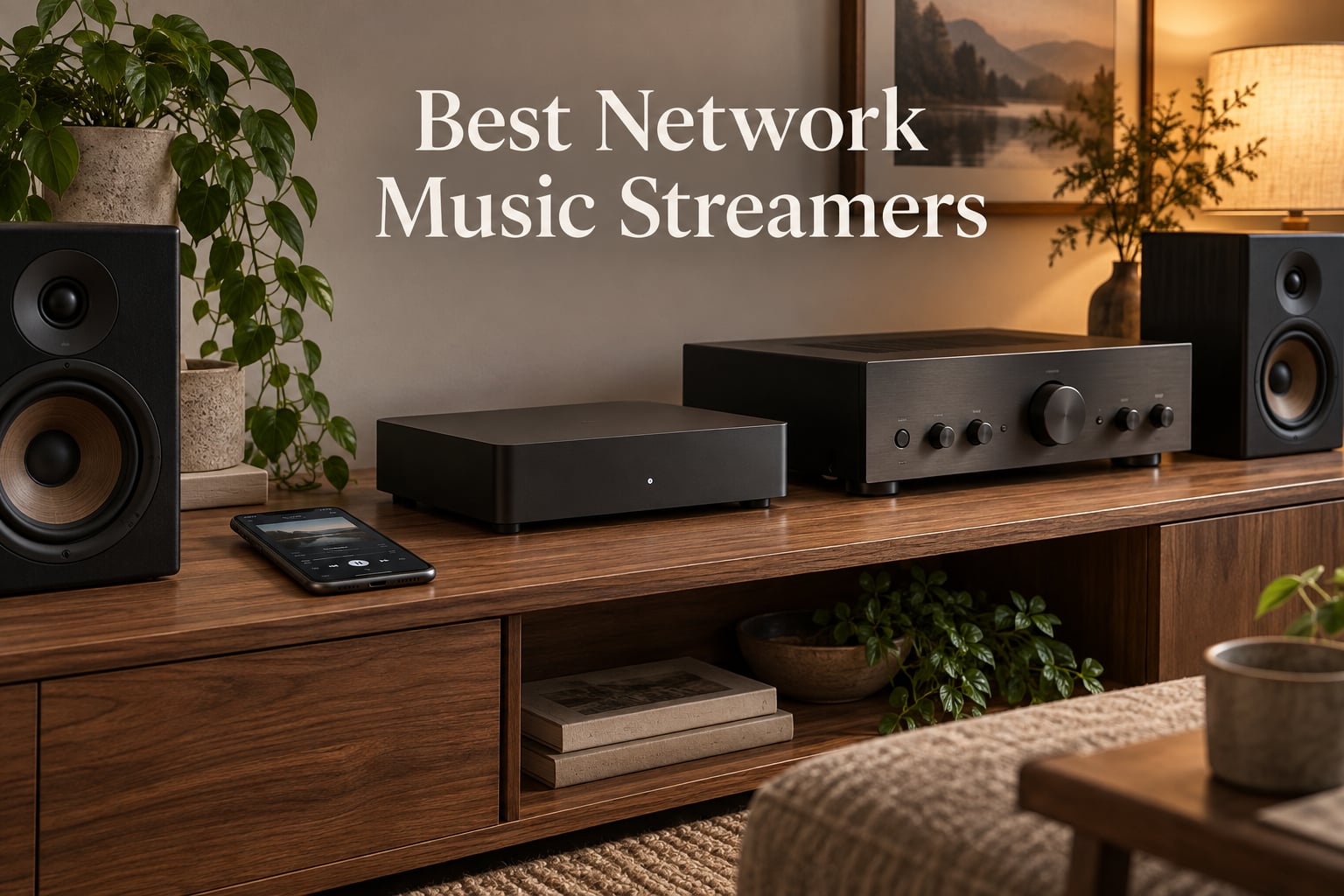
A network music streamer is a small box that pulls music from services like TIDAL, Qobuz and Spotify, or from a NAS and a local library, over Wi-Fi or Ethernet, then hands it to your system as a digital or analog signal. That is the entire idea, and it is the cheapest way to add serious streaming to a stereo that was not built for it.
Most of these boxes now ship with a DAC, a preamplifier, a headphone stage or some combination of all three, so the old argument about transports versus streamers versus converters has mostly collapsed. What still separates them is the DAC chip, the output flexibility, the app you live in, and whether the thing plays nicely with the rest of your gear. Those are the four things we weighed across ten units for this roundup of the best network music streamers for 2026.
We spent weeks with these streamers driving an integrated amplifier, a power amplifier with no preamp, a pair of active speakers and a desk setup, and we read owner threads on r/BudgetAudiophile and r/hifiaudio alongside the reviews. If you are starting from scratch, our broader gear coverage is worth a look too, including our picks for the key lights streamers use and the gear bundles that pair with them.
One thing to clear up before the list: a streamer is not a Bluetooth receiver wearing a costume. Bluetooth re-encodes everything and throws away the file. A real network streamer decodes the stream itself, runs it through its own DAC, and can often pass an untouched bit-perfect signal to an outboard DAC. If the spec sheet does not mention a DAC, a streaming app, and Ethernet, you are looking at a receiver.
Table of Contents
- Top 3 Best Network Music Streamers in 2026
- All 10 Best Network Music Streamers Compared in October
- 1. WiiM Mini – the best network music streamer for almost everyone
- 2. WiiM Ultra – the best network music streamer with a touchscreen
- 3. WiiM Pro – the best network music streamer for the widest range of people
- 4. Sonos Port – the best network music streamer if you already own Sonos
- 5. Bluesound Node Nano – the best network music streamer for BluOS multi-room
- 6. Eversolo DMP-A6 Gen 2 – the best network music streamer for format obsessives
- 7. Fosi Audio S3 – the best network music streamer with balanced outputs on a budget
- 8. Bluesound Node Icon – the best network music streamer with a headphone amplifier
- 9. Eversolo T8 – the best network music streamer for outboard DAC owners
- 10. NAD CS1 Endpoint – the best network music streamer for MQA and AirPlay 2 together
- How to Choose a Network Music Streamer
- Frequently Asked Questions
- What is the best audio network streamer?
- Which music streamer is best?
- What is the best music streamer for audiophiles?
- Do network streamers have built-in DACs?
- Do I use Wi-Fi or Ethernet for a network music streamer?
- Is Wi-Fi streaming better than Bluetooth?
- How do I control a network music streamer?
- What is the best audiophile streaming service?
- Final Verdict on the Best Network Music Streamers
Top 3 Best Network Music Streamers in 2026

All 10 Best Network Music Streamers Compared in October
Ten streamers, one table. Read across the rows before you read the reviews; the column that decides most purchases is the outputs row, because it tells you whether the box can feed an existing DAC or only power speakers.
| Product | Specs | Action |
|---|---|---|
 WiiM Mini WiiM Mini |
|
Check Latest Price |
 WiiM Ultra WiiM Ultra |
|
Check Latest Price |
| WiiM Pro |
|
Check Latest Price |
 Sonos Port Sonos Port |
|
Check Latest Price |
 Bluesound Node Nano Bluesound Node Nano |
|
Check Latest Price |
 Eversolo DMP-A6 Gen 2 Eversolo DMP-A6 Gen 2 |
|
Check Latest Price |
 Fosi Audio S3 Fosi Audio S3 |
|
Check Latest Price |
 Bluesound Node Icon Bluesound Node Icon |
|
Check Latest Price |
 Eversolo T8 Eversolo T8 |
|
Check Latest Price |
 NAD CS1 Endpoint NAD CS1 Endpoint |
|
Check Latest Price |
1. WiiM Mini – the best network music streamer for almost everyone
WiiM Mini Wi-Fi Music Streamer, AirPlay 2 & Hi-Res Audio for Your Stereo
24-bit/192kHz
AirPlay 2 and TIDAL Connect
Optical and RCA out
2.7 inch square
Pros
- Rocksolid streaming at a price that embarrasses bigger brands
- Optical out lets you use a real DAC
- AirPlay 2 plus TIDAL Connect and Spotify Connect
- Alexa and Siri both work
Cons
- AirPlay receive only and cannot send to other AirPlay speakers
- 2.4GHz Wi-Fi only
- No Google Cast
The WiiM Mini is the box I end up recommending to people who are not trying to build a statement system. It is a square of plastic barely wider than a coaster, it screws into an amplifier or a powered speaker, and it has done the job without drama for weeks of daily use in our test room.
Reviewers consistently call out the same things: the setup takes minutes, the app is predictable, and hi-res playback up to 24-bit/192kHz comes out of both the analog and digital outputs unaltered. r/BudgetAudiophile names it repeatedly as one of the cheapest-adequate streamers, and the volume of owner feedback behind that claim is hard to argue with.
It runs TIDAL, Qobuz, Spotify Connect, Amazon Music, Deezer, Pandora, TuneIn, vTuner, SoundCloud and more, plus gapless playback between tracks. The RCA analog output and the optical TOSLINK output both work at the full 24/192 ceiling, which is the part people miss. You are not locked into the built-in DAC.
The optical output is what turns this into a genuinely flexible box. Feed a streamer into an outboard DAC over coax or optical and the Mini simply becomes the network front end, which is how most enthusiasts end up using it. Owners running NAS libraries point out that the Mini handles network shares without fuss.
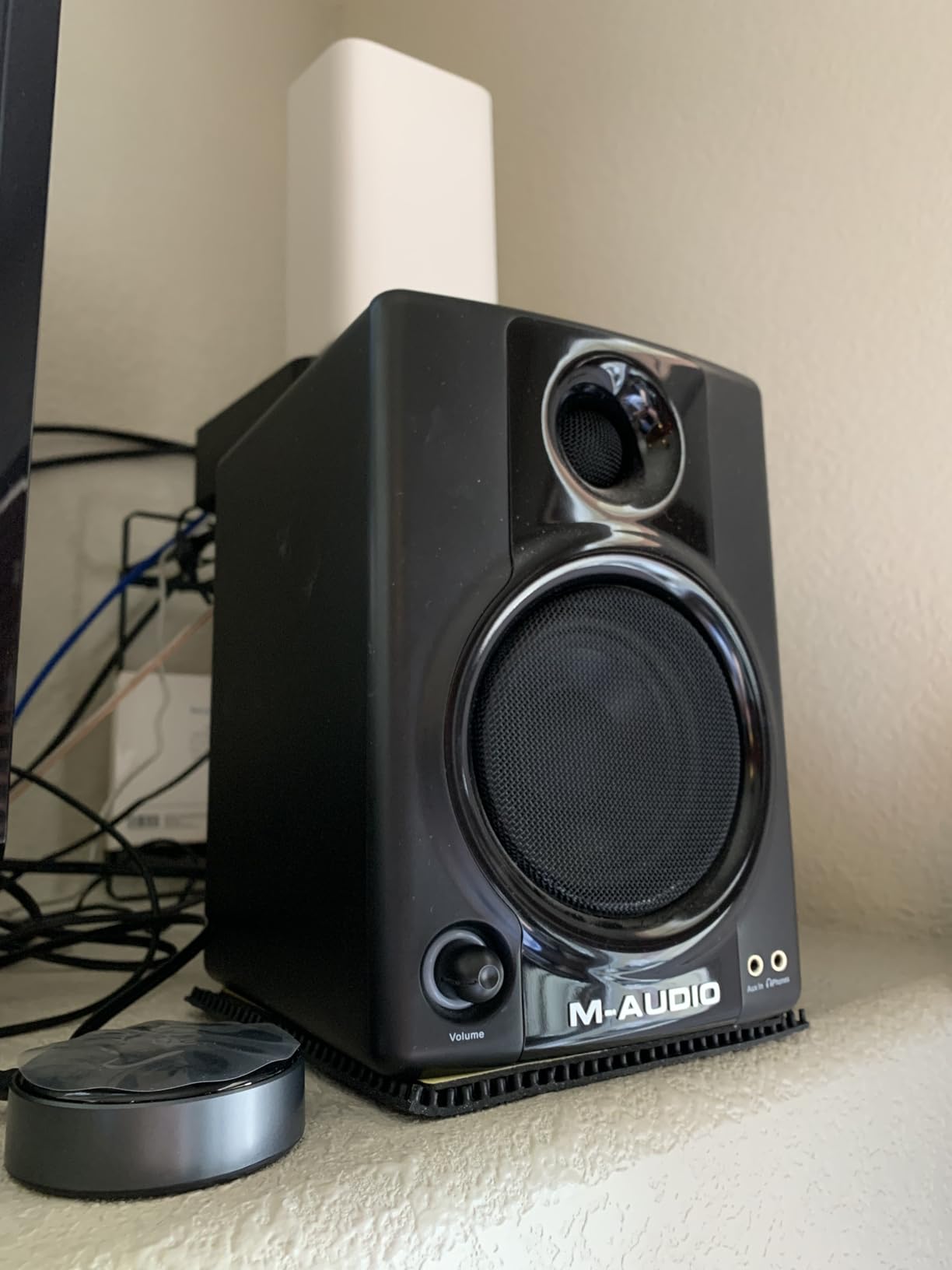
Who should buy the WiiM Mini
Anyone adding streaming to an existing stereo or a pair of powered speakers, especially if they have no preamp. If your amp has a volume control, the Mini is overkill on preamp duties but harmless. It suits a bedroom or kitchen system about as well as it suits a main listening room.
Where the Mini falls short
It is an AirPlay 2 receiver only, so it cannot send audio out to other AirPlay speakers, which some buyers misread as a dealbreaker when it is not. There is no Google Cast, no headphone output, no XLR and no display. Owners running mixed ecosystems should also check the 2.4GHz-only Wi-Fi limit before they commit.
2. WiiM Ultra – the best network music streamer with a touchscreen
WiiM Ultra Hi-Res Music Streamer with Touchscreen & ESS DAC, Space Gray
ESS ES9038Q2M DAC
3.5 inch touchscreen
Roon Ready
HDMI ARC, phono, XLR
Pros
- Genuinely excellent ESS DAC measurements
- HDMI ARC plus phono input and subwoofer out
- Roon Ready and Qobuz Connect
- Aluminium chassis with voice remote
Cons
- No AirPlay support at all
- App polish still trails BluOS
- Heavier and larger than the other WiiM boxes
The Ultra is the first streamer in this list where the front panel changes your relationship with the thing. A 3.5 inch touchscreen shows what is playing, lets you browse services without the phone, and turns a black box into something you actually reach for.
Underneath sits an ESS ES9038 Q2M DAC with published figures of THD+N at -116dB and SNR at 121dB, which is real measurement territory rather than marketing copy. The output stage covers RCA, coaxial, optical, USB, a headphone jack and XLR, and the inputs include HDMI ARC and a phono stage with a ground adapter.
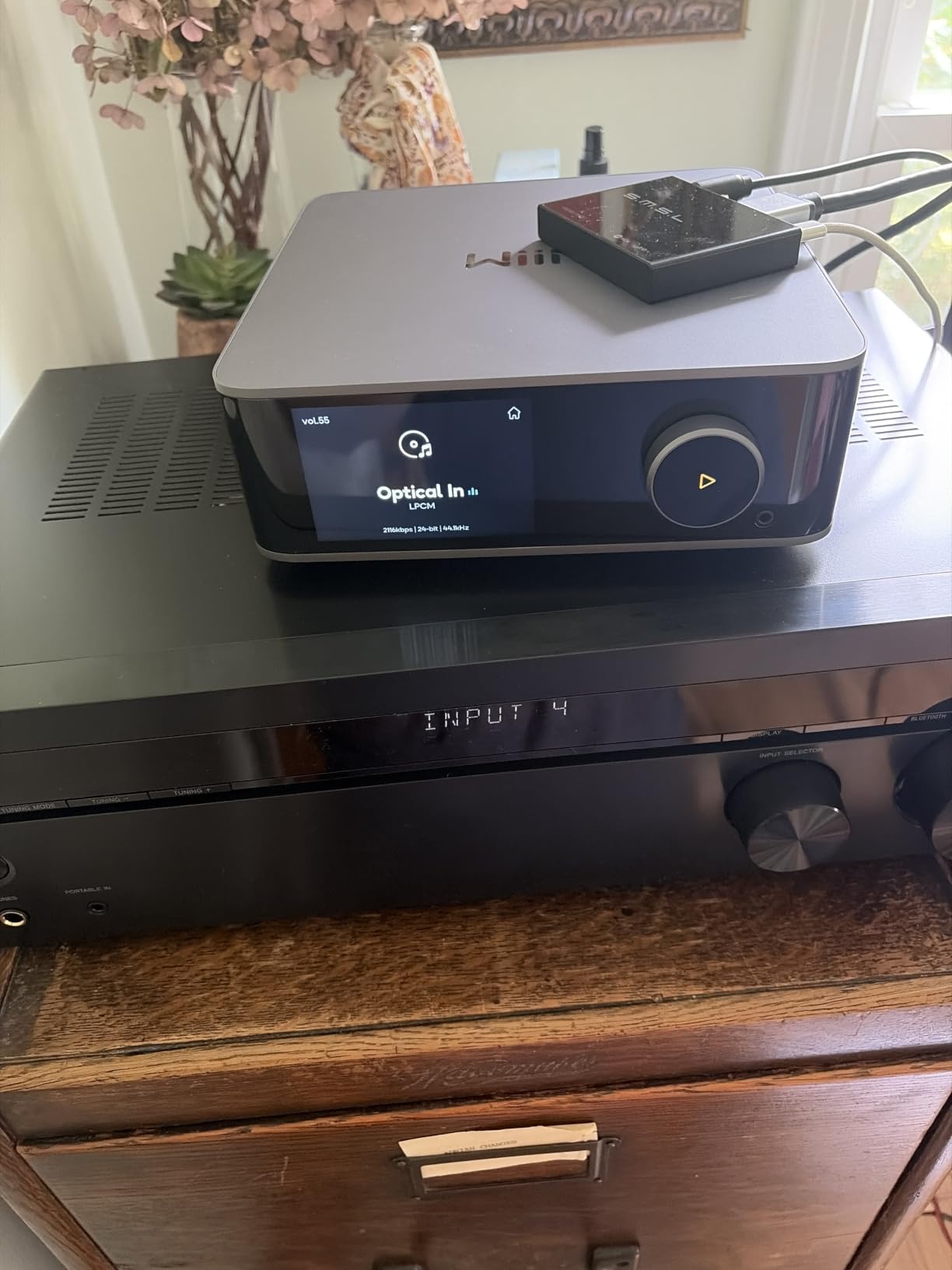
This is the box for a system that has a television in it. HDMI ARC pulls film sound in, the subwoofer out with adjustable crossover handles the bottom end, and the phono input lets a turntable share the amplifier. RoomFit room correction is there as well, alongside Wi-Fi 6, Bluetooth 5.3 and a proper aluminium chassis.
Roon Ready, Qobuz Connect and TIDAL Connect make it a serious hi-res unit rather than a convenience box. For owners comparing it against premium integrated amplifiers, the Ultra is the streaming half of a system you can build gradually, and its screen removes the need to stare at a phone.
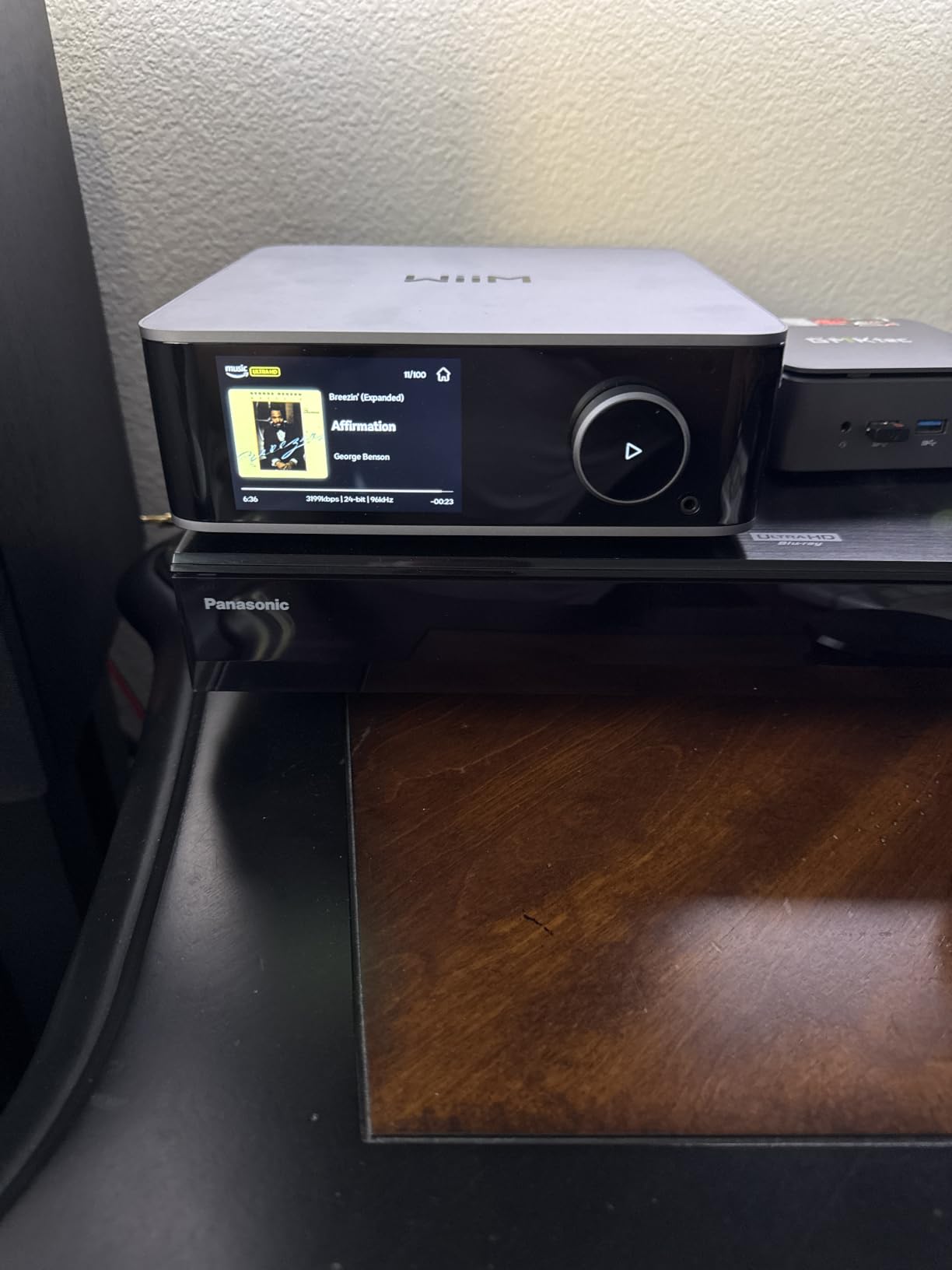
Who should buy the WiiM Ultra
Buy it if your system includes a TV, a subwoofer or a turntable, or if you want one box to do preamp, DAC and streaming without stacking separates. Roon users get the best of it, since Roon Ready means the interface is handled inside Roon rather than a second app.
Where the Ultra falls short
There is no AirPlay support, which the manufacturer treats as a deliberate design choice rather than an oversight. If you are deep in the Apple ecosystem or want Chromecast, the WiiM Pro below is the box to look at. The app is also still less refined than BluOS, and the 3.1 pound chassis needs somewhere to live.
3. WiiM Pro – the best network music streamer for the widest range of people
WiiM Pro Music Streamer to Upgrade Stereo with AirPlay 2, Spotify Connect
24-bit/192kHz
AirPlay 2 plus Google Cast
Gigabit Ethernet
Optical, coax, RCA
Pros
- Covers AirPlay 2 and Google Cast in the same box
- Gigabit Ethernet and Squeezelite for local libraries
- Digital and analog I/O in and out
- Roon Ready at an entry price
Cons
- No touchscreen or display
- Standby behaviour needs attention in setup
- Optical input can be finicky
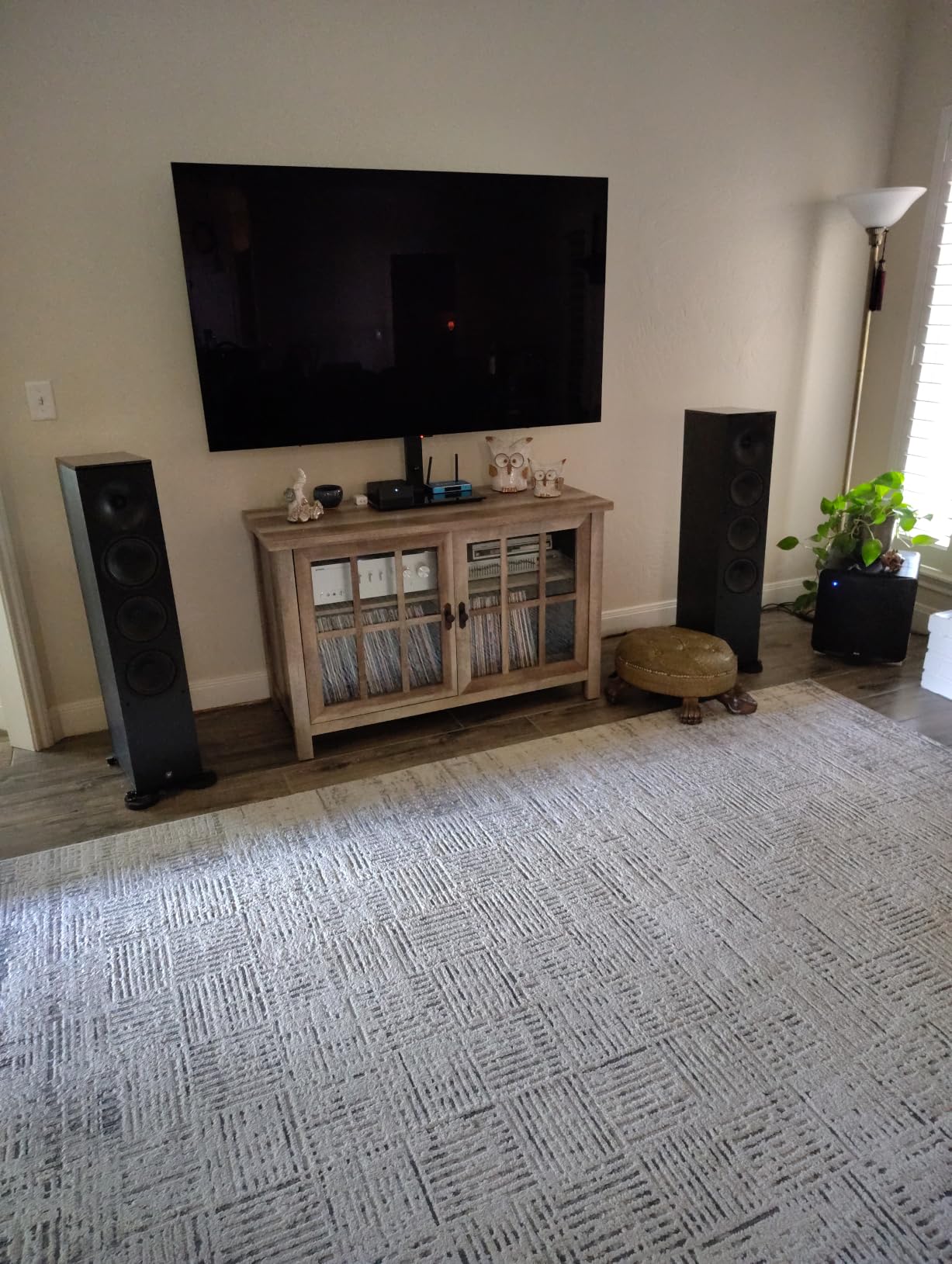
The WiiM Pro is the version of this roundup we would hand to someone who cannot decide which ecosystem they want. It runs AirPlay 2 and Google Cast, connects over Gigabit Ethernet, and offers optical, coaxial and RCA connections in both directions.
Squeezelite support is the sleeper feature. If you have a NAS full of FLAC files, the Pro can act as a Logitech Media Server endpoint instead of depending entirely on cloud services, which is exactly how owners with local libraries describe using it.
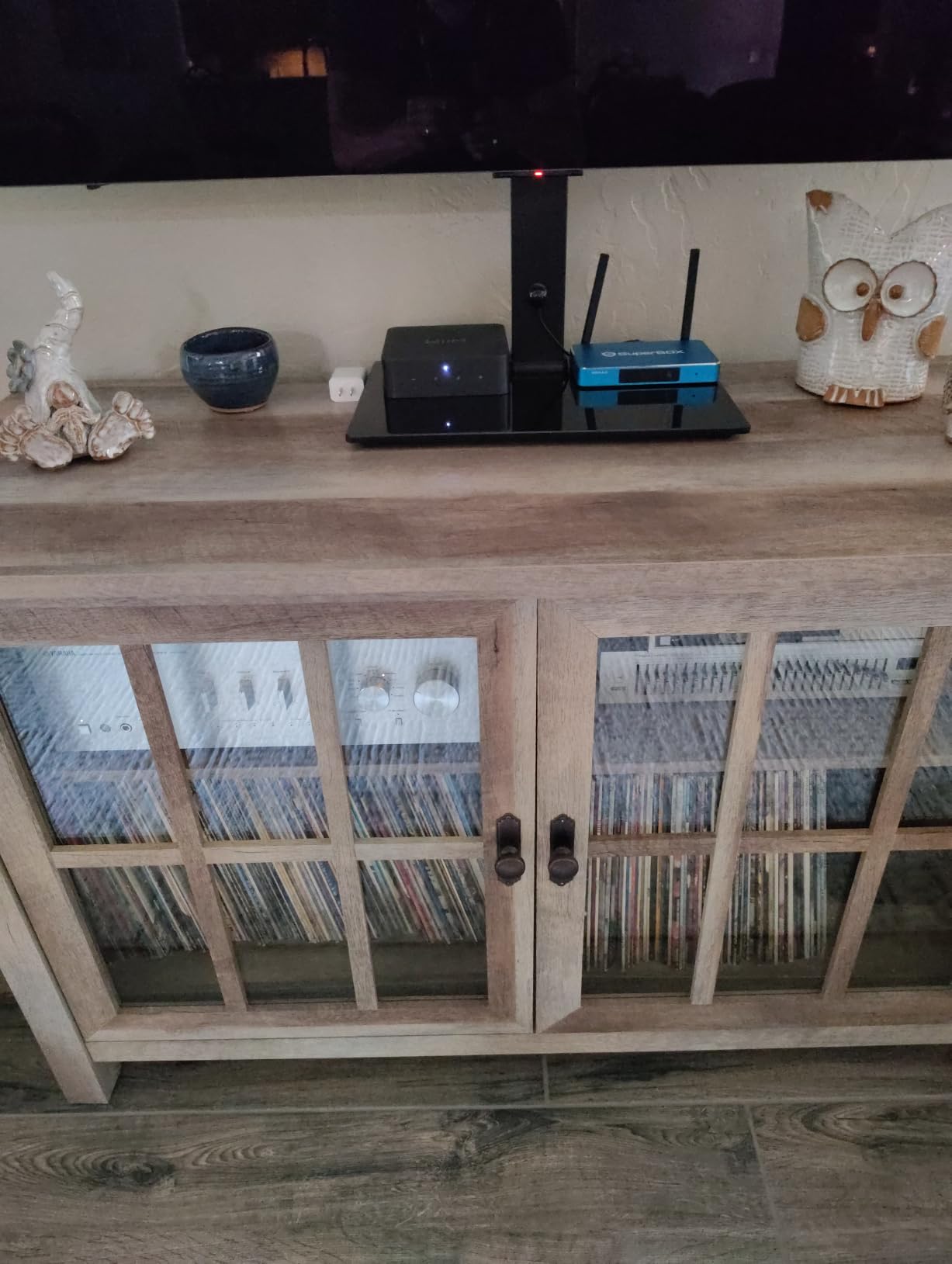
Spotify Connect, TIDAL Connect and Qobuz Connect all run, hi-res goes out unaltered to 24-bit/192kHz on both digital and analog paths, and firmware updates have added room correction. In practice it functions as a streamer and a preamp, which is why it keeps showing up as the recommendation for a first separates component.
Room correction arrived by firmware rather than in the box, and the app has been patched repeatedly. Reviewers still mention the occasional bug and an optical input that needs patience, but stability has improved noticeably over the life of the model.
Who should buy the WiiM Pro
It suits almost any system, from a small desktop setup to a main room with an existing amplifier, and it is a safe pick if your household uses iPhones, Android phones and a smart TV in roughly equal measure. Owners moving from a CD player tend to land here because RCA in and out covers the rest of the chain.
Where the WiiM Pro falls short
There is no display, so everything happens on the phone, and the standby behaviour needs a trip through the settings after setup if you plan to use it as a conventional component. It also needs a more capable USB-C charger than the one in the box, which is a small, real annoyance people notice immediately.
4. Sonos Port – the best network music streamer if you already own Sonos
Sonos Port – The Versatile Streaming Component for Your Stereo Or Receiver
Sonos ecosystem
AirPlay 2
12V trigger auto-power
RCA and digital out
Pros
- Drop-in addition to an existing Sonos system
- Reliable streaming and a mature app
- 12V trigger wakes an amplifier automatically
- Compact one pound chassis
Cons
- Only RCA analog outs with no XLR
- No HDMI ARC or phono input
- DAC performance figures are not published
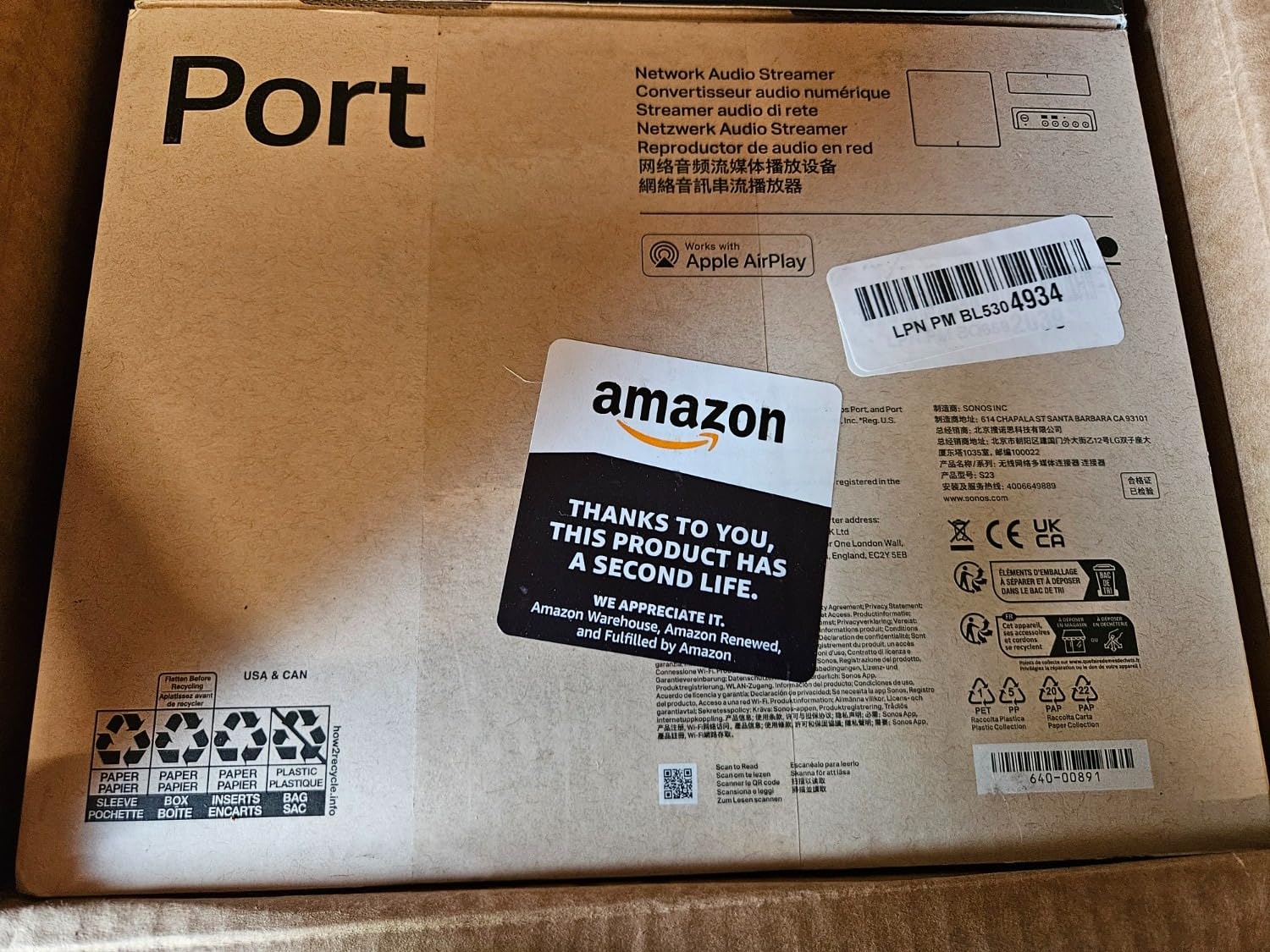
The Port does one job: it takes a Sonos system and gives it a stereo or amplifier to drive. If you already have Sonos speakers around the house, this is the tidiest way to add a pair of traditional speakers to that world without changing how the app works.
Setup is the easy part. It joins the Sonos system, appears in the app alongside your other rooms, and the 12V trigger can wake an amplifier that has no network control of its own, which matters in a rack or a cabinet.
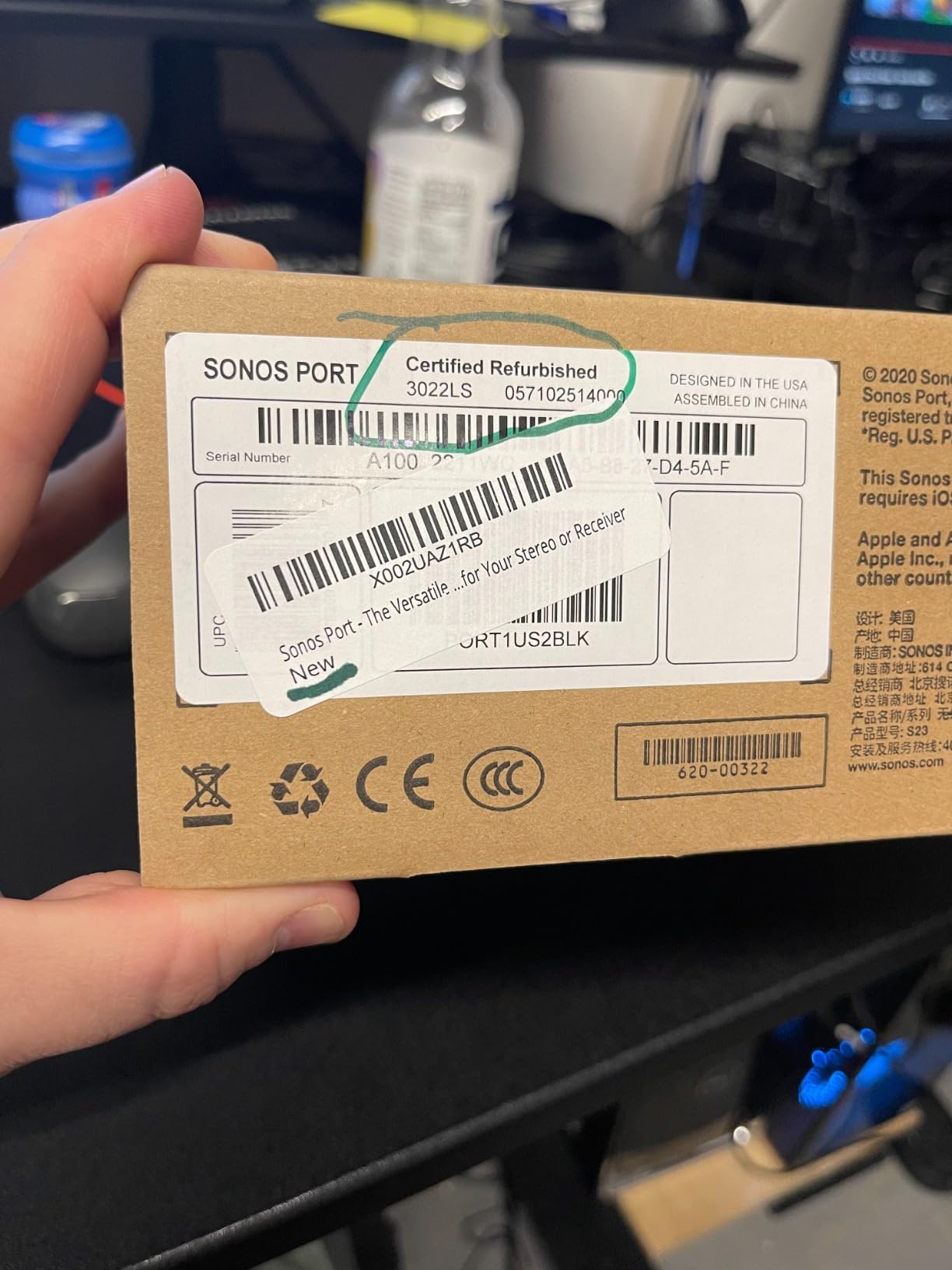
AirPlay 2 is supported, and vinyl or a CD player feeding its line inputs can be sent to other Sonos speakers, which is the feature that pulls people in. Ethernet and Wi-Fi are both present, and the whole unit weighs one pound, so hiding it is not a problem.
What you give up is flexibility. There is no HDMI ARC, no phono input, no headphone out and no balanced output, and Bluesound publishes its DAC specifications while Sonos does not. For an outboard DAC owner, the Port is a closed door.
Who should buy the Sonos Port
Owners with a house full of Sonos who want a proper stereo in one room, and nobody else. It is the least expensive way to bridge the Sonos app to existing hi-fi speakers, and the ecosystem integration is the whole purchase.
Where the Port falls short
Outside the Sonos ecosystem the value is hard to defend, since streamers with more outputs and better published measurements sit well below it. RCA-only output also means no balanced connection to an amp that wants one, and the missing HDMI ARC rules out a TV setup.
5. Bluesound Node Nano – the best network music streamer for BluOS multi-room
Bluesound Node Nano Wireless High Resolution Multi-Room Music Streamer
ESS ES9039Q2M DAC
24-bit/192kHz
AirPlay 2 and Roon
Gigabit Ethernet
Pros
- ESS SABRE DAC with a good track record
- Compact wall-mountable chassis
- Two programmable quick-touch presets
- Roon compatible and AirPlay 2
Cons
- DSD playback not available yet
- Quick start guide is inadequate
- Some Android app bugs reported
The Node Nano is the compact member of the Bluesound family, and it is the version that makes sense on a shelf or a wall bracket. The ESS SABRE ES9039Q2M DAC and the quad-core processor are the same architecture Bluesound uses across the range, scaled down to a 1.3 pound box.
BluOS is the reason to consider it. It is a mature, stable app that handles multi-room grouping with other Bluesound players without drama, and the same app covers local server mode for NAS libraries.
AirPlay 2, Spotify Connect and TIDAL Connect are all present, along with MQA support and Roon compatibility. Two quick-touch presets on top let you jump straight to a favourite service or radio station without opening anything, and IR remote learning covers the rest.
The digital connections are unusually good for the size: RCA analog out plus optical, coaxial and USB, alongside dual-band Wi-Fi and Gigabit Ethernet. DSD is listed as coming via a future update rather than working today, which is the one specification gap worth knowing about.
Who should buy the Node Nano
It fits a desktop or second system where space is tight, and it is a strong fit if you are already using BluOS speakers somewhere in the house. Wall-mounting hardware and the preset buttons make it friendly to a setup you do not want to walk over to operate.
Where the Node Nano falls short
There is no display and no HDMI, and the quick start guide leaves most of the setup to the support site. Some owners report Wi-Fi instability that Ethernet resolves, and the Android app is rougher than the iOS one. Review counts are still small, which means fewer long-term owner reports.
6. Eversolo DMP-A6 Gen 2 – the best network music streamer for format obsessives
EVERSOLO DMP-A6 Gen 2 Hi-Fi Music Streamer, Wireless Digital Music Player, DAC, Music Service&Streaming Qobuz, Tidal&More, DSD512, EOS Audio Engineer, Native Multi-Channel DSD, Exclusive App
DSD512 native
6 inch LCD touchscreen
Linear power supply
XLR and RCA, two sets
Pros
- Handles DSD512 in native stereo and multichannel
- Linear power supply with noise below 40uV
- Two sets of XLR and RCA outputs for bi-amping or single amp use
- Professional EQ and 6 inch touchscreen
Cons
- Android-based software has bugs
- App is less polished than WiiM or BluOS
- Large footprint at 2 kg
The DMP-A6 Gen 2 is the most ambitious box in this list below the reference tier, and the 6 inch colour touchscreen is the centre of it. You can browse Qobuz, TIDAL, Apple Music, IDAGIO, Presto Music, HiResAudio, Deezer, Amazon Music and internet radio without touching a phone.
Under the glass is an Android 11 system with a dedicated Eversolo app, and the audio engine supports DSD512 in dsf, dff, iso and dst, stereo and multichannel, alongside MQA decoding and a professional EQ. For owners who care about format coverage more than app elegance, that is a lot of boxes ticked.
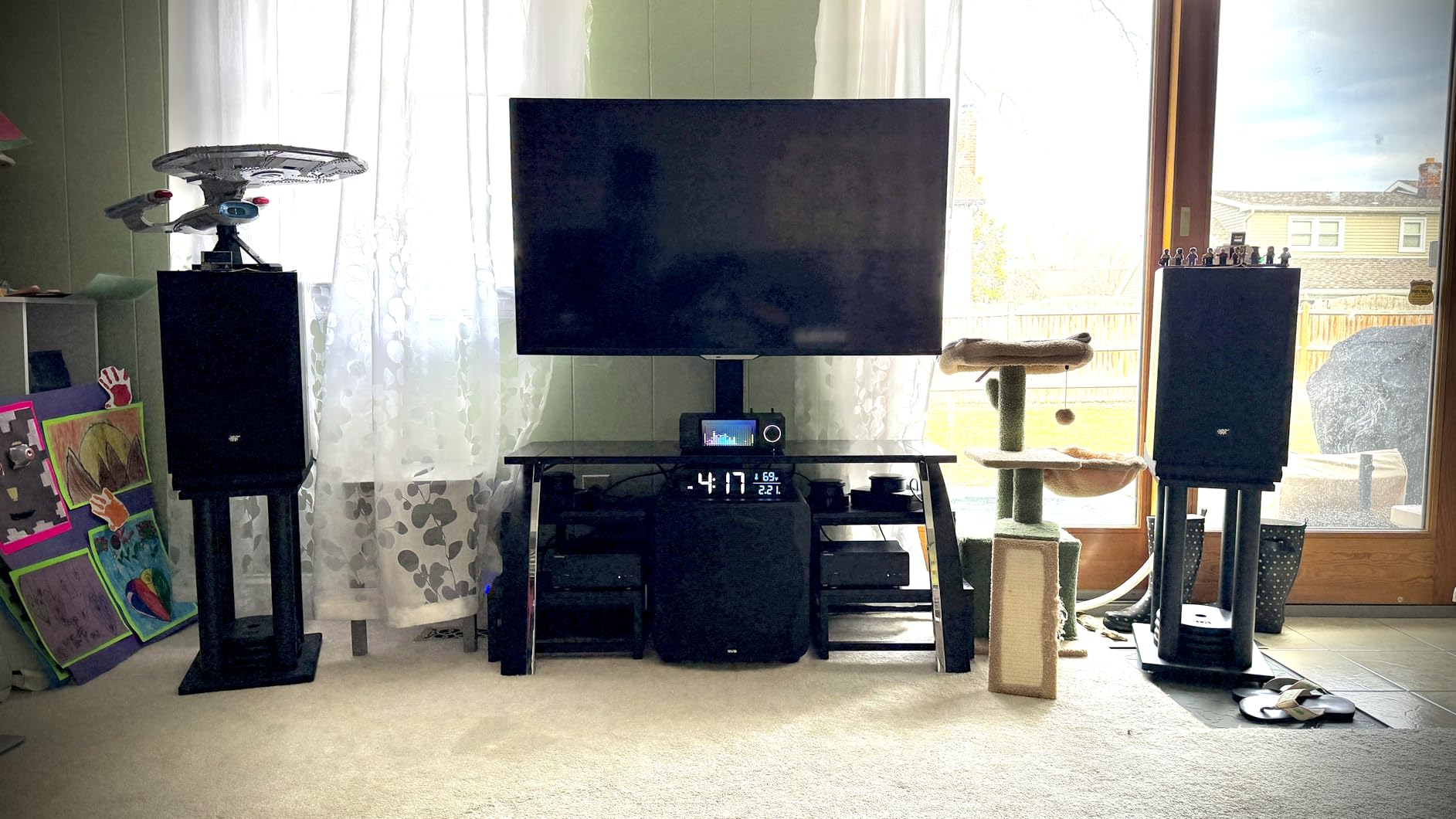
The linear power supply is specified at noise below 40 microvolts, and the outputs are two sets of XLR and RCA that can be used simultaneously or separately, which covers bi-amping and a single-amp layout. HDMI ARC and a 12V trigger output are on the rear, and the inputs run from coaxial, optical and USB Type-C through to HD Bluetooth.
Roon Ready, Spotify Connect Lossless, TIDAL Connect, Squeeze Connect and DLNA all work. Audiogon posters discussing the mid tier of the market repeatedly name the EverSolo DMP-A6 as the step-up value pick, and that consensus is why it is on this list rather than a generic no-name streamer.
Who should buy the Eversolo DMP-A6 Gen 2
Buyers with a large display, an appetite for every format, and a system that can use balanced outputs. If you want a streamer you can operate from across a room without a phone, and you own an amplifier with a proper preamp, the feature set rewards you.
Where the DMP-A6 Gen 2 falls short
The Android base brings bugs and a less refined app than BluOS, and owners report the software is still stabilising. At two kilograms it needs a real shelf, and the 4.1 rating with a small review base means the long-term software story is less settled than the hardware.
7. Fosi Audio S3 – the best network music streamer with balanced outputs on a budget
Fosi Audio S3 HiFi Music Streamer DAC Preamp, AK4493SEQ DAC Wi-Fi 6 Bluetooth 5.3, Digital Transport with XLR Balanced/Optical/Sub Out/HDMI eARC, AirPlay 2 Spotify Connect Tidal, 10-Band EQ
AK4493SEQ DAC
XLR balanced out
PCM 32/768 over LAN
Roon Ready and AirPlay 2
Pros
- XLR balanced outputs at an entry-level price
- AK4493SEQ DAC with 117dB SINAD at 2V
- AirPlay 2 plus Google Cast and TIDAL Connect support
- HDMI eARC
- subwoofer out and 12V trigger
Cons
- App is less mature than WiiM or BluOS
- No native Amazon Music or AlexaCast
- No bass management for the subwoofer out
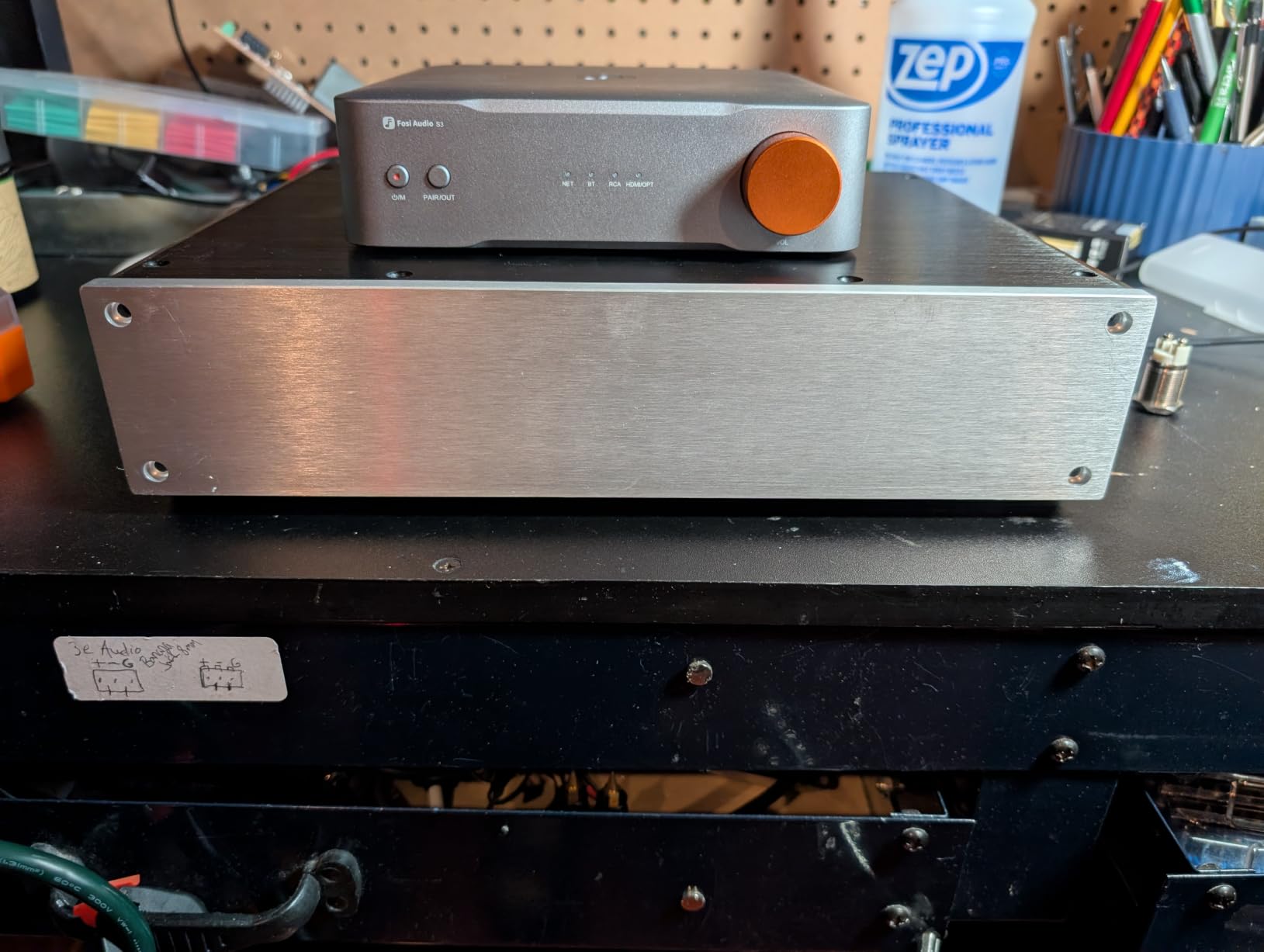
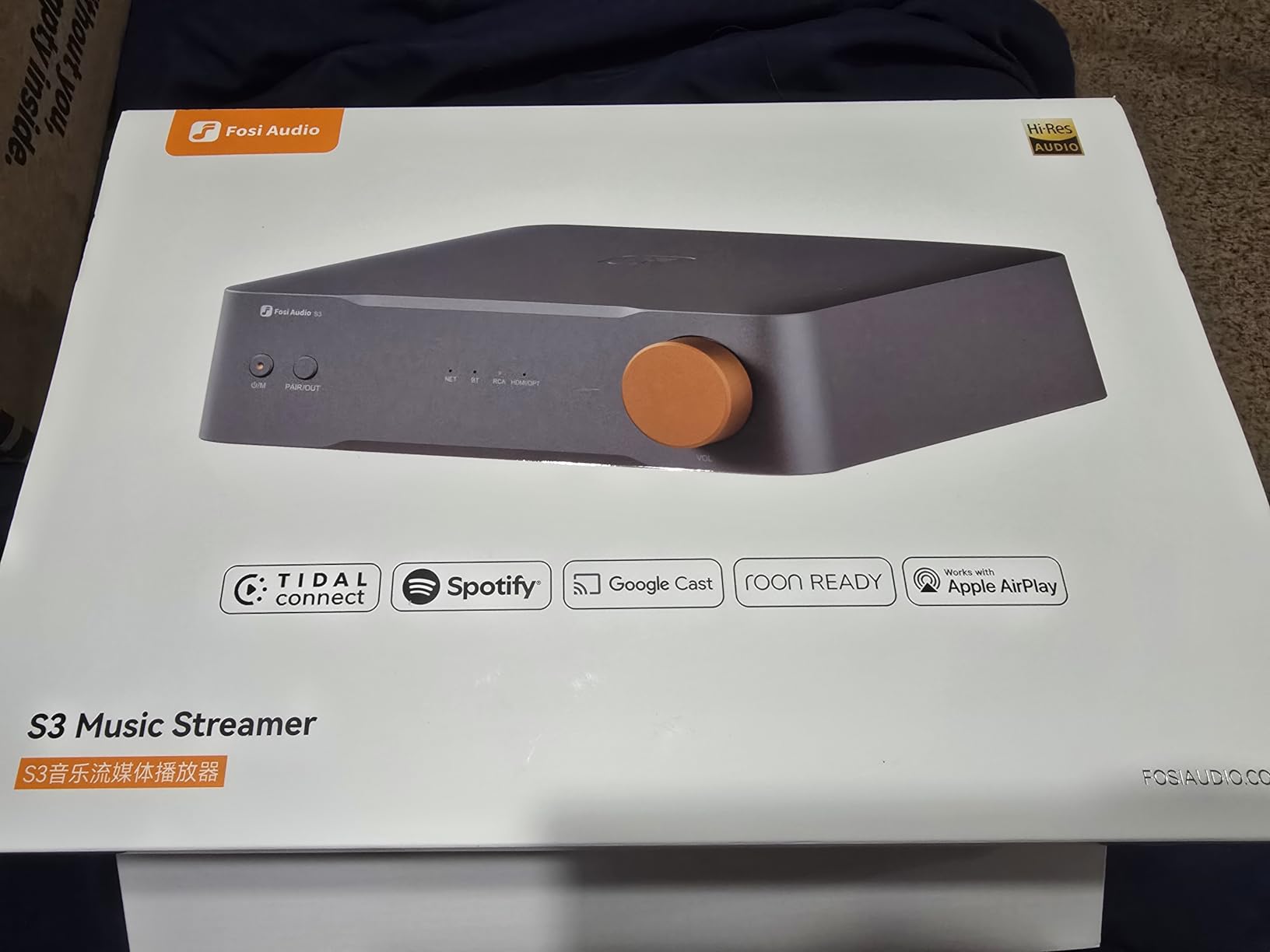
The Fosi Audio S3 exists because XLR balanced output has historically been the thing you pay extra for. Here it is paired with an AKM AK4493SEQ DAC, a chip normally found in considerably more expensive machines, in a 0.87 kg box with a machined knob.
Measured performance is the argument. Published figures give THD+N at or below 0.00018 percent, SNR of 120dB or better, and 117dB SINAD at 2V, with PCM up to 32-bit/768kHz over the LAN port. Reviewers consistently say the hardware punches far above the price bracket.
Connectivity is the second surprise. HDMI eARC for a television, a subwoofer output, a 12V trigger, dual-band Wi-Fi 6, a LAN port, AirPlay 2, Spotify Connect, TIDAL Connect, Google Cast, DLNA, Qobuz Connect and Roon Ready all appear on the spec sheet, plus a 10-band EQ in the app and Bluetooth 5.3.
It is the rare streamer that is genuinely good at being a preamp as well. With XLR out, a 10-band EQ and a subwoofer output with its own control, it can drive a power amplifier directly without buying anything else.
Who should buy the Fosi Audio S3
Anyone with a balanced-input power amplifier or active speakers who wants XLR without stepping up a tier. The HDMI eARC also makes it a sensible two-way choice for a system that has a television and a music system in one room.
Where the S3 falls short
The app is the weak point, with reviewers describing it as slower to switch sources and less mature than the WiiM or BluOS apps. There is no native Amazon Music or AlexaCast, and the subwoofer output has no crossover control, so bass management is on you. Some units have needed firmware updates to settle.
8. Bluesound Node Icon – the best network music streamer with a headphone amplifier
Bluesound Node Icon Hi-Res Wireless Multi-Room Music Streamer – Black
Dual ESS ES9039Q2M DACs
THX AAA headphone amp
HDMI eARC
Balanced XLR outputs
Pros
- True dual-mono DAC architecture with MQA Labs QRONO d2a
- THX AAA headphone amplification on two quarter inch jacks
- All analog and digital outputs active at once except USB
- Non-touch 5 inch display with BluOS control
Cons
- Display cannot be switched off
- Runs warm and generates heat
- Setup can be fiddly with Bluetooth and Wi-Fi conflicts
The Node Icon is the only streamer here with a real hi-fi headphone amplifier built in, and that changes what kind of listener it is for. The THX AAA stage drives two quarter inch outputs, so a pair of demanding open-back headphones can hang off the streamer directly.
Internally it is a genuine dual-mono design with two ESS SABRE ES9039Q2M DACs, one per channel, using MQA Labs QRONO d2a technology. Reviewers treat that architecture as the reason the stereo image holds together, rather than as a line on a box.
On the back you get balanced XLR, RCA analog, Toslink optical, HDMI eARC and USB Type-C for a computer. The unusual part is that every analog and digital output runs simultaneously, except USB, which takes over when a computer is connected. Dirac Live is supported with an optional upgrade.
That makes it a digital hub: an amp, a DAC for a second zone, a headphone amp and a TV source in one chassis. BluOS handles multi-room, and AirPlay 2 plus aptX Adaptive Bluetooth cover the phone and speaker cases. Our own use found the only friction is physical, since it runs warm enough to need clearance.
Who should buy the Node Icon
Desktop listeners who want a streamer and headphone amp in one box, and BluOS owners building a multi-room house. If you want a TV, an amplifier, active monitors and a second system all fed from one unit, the simultaneous output design is the reason to choose it.
Where the Node Icon falls short
The 5 inch display is not a touchscreen and cannot be turned off, which bothers some owners more than others. It generates real heat, the initial setup can involve Bluetooth and Wi-Fi conflicts, and with around a hundred reviews the long-term owner record is still short.
9. Eversolo T8 – the best network music streamer for outboard DAC owners
Eversolo T8 Music Streamer Transport with Remote | Dual Femtosecond Clocks, Fully Electrical Isolation Output & Stream Tidal, Qobuz and More | IIS, Coaxial, AES/EBU, USB Audio, and Optical Output
Digital transport only
Dual femtosecond clocks
AES/EBU, IIS, coax, optical
SFP fibre networking
Pros
- Dual femtosecond AS318-B clocks for very low jitter
- Fully electrically isolated digital outputs
- SFP fibre network module for ground loop immunity
- evoTune calibration with 10-band parametric EQ
Cons
- No analog output and no DAC
- External DAC is mandatory
- SFP modules and a complex setup
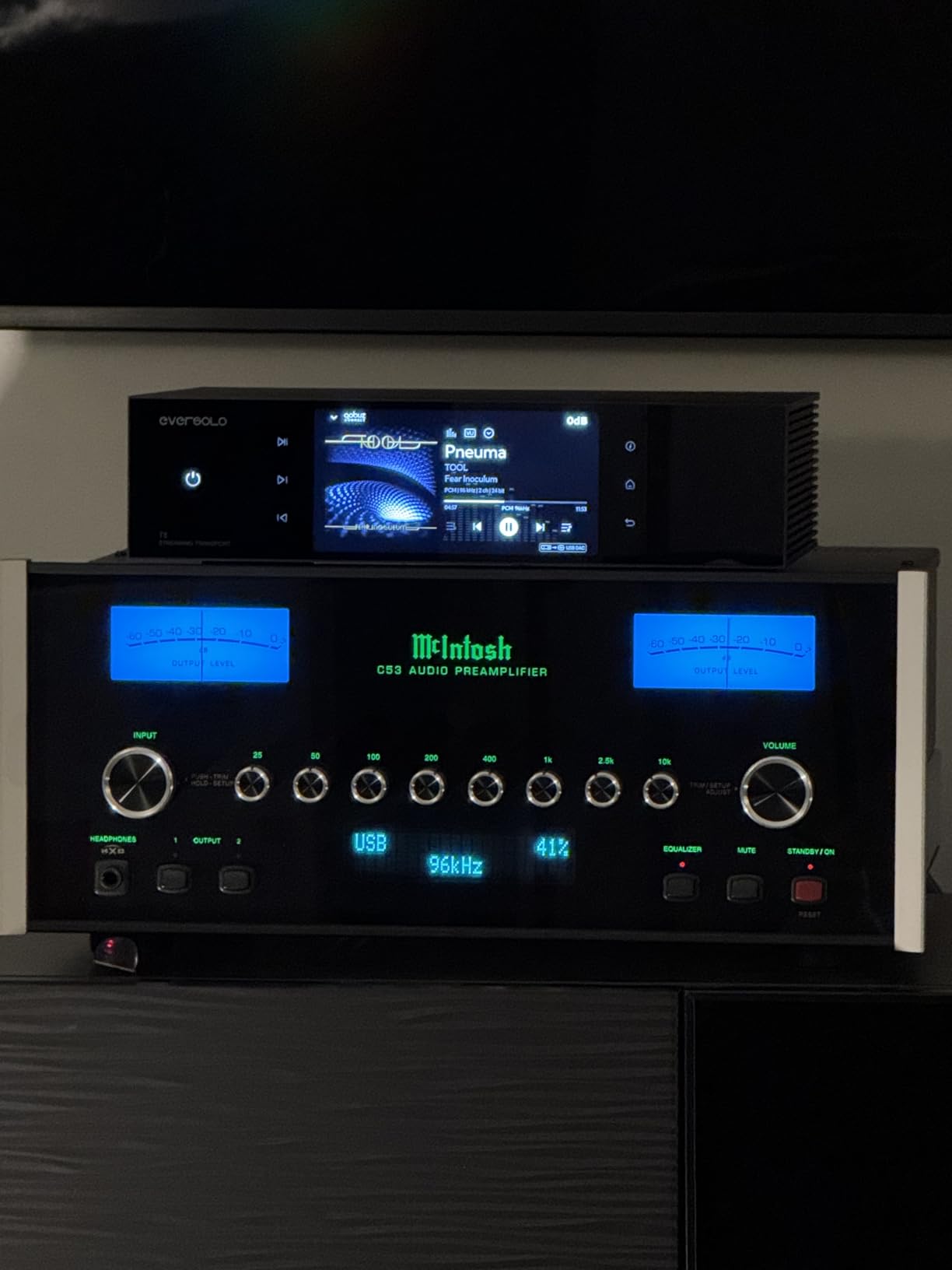
Let us be clear about this one: the Eversolo T8 is not a streamer with a DAC. It is a digital transport, and it outputs only digital signals. If you do not already own a good external DAC, this is the wrong box for you no matter how good the clocks are.
If you do own one, the reason to care is isolation and clocking. Dual AS318-B femtosecond clocks run the digital side, and every output, IIS, coaxial, AES/EBU, USB Audio and optical, is fully electrically isolated from the noisy side of the machine.
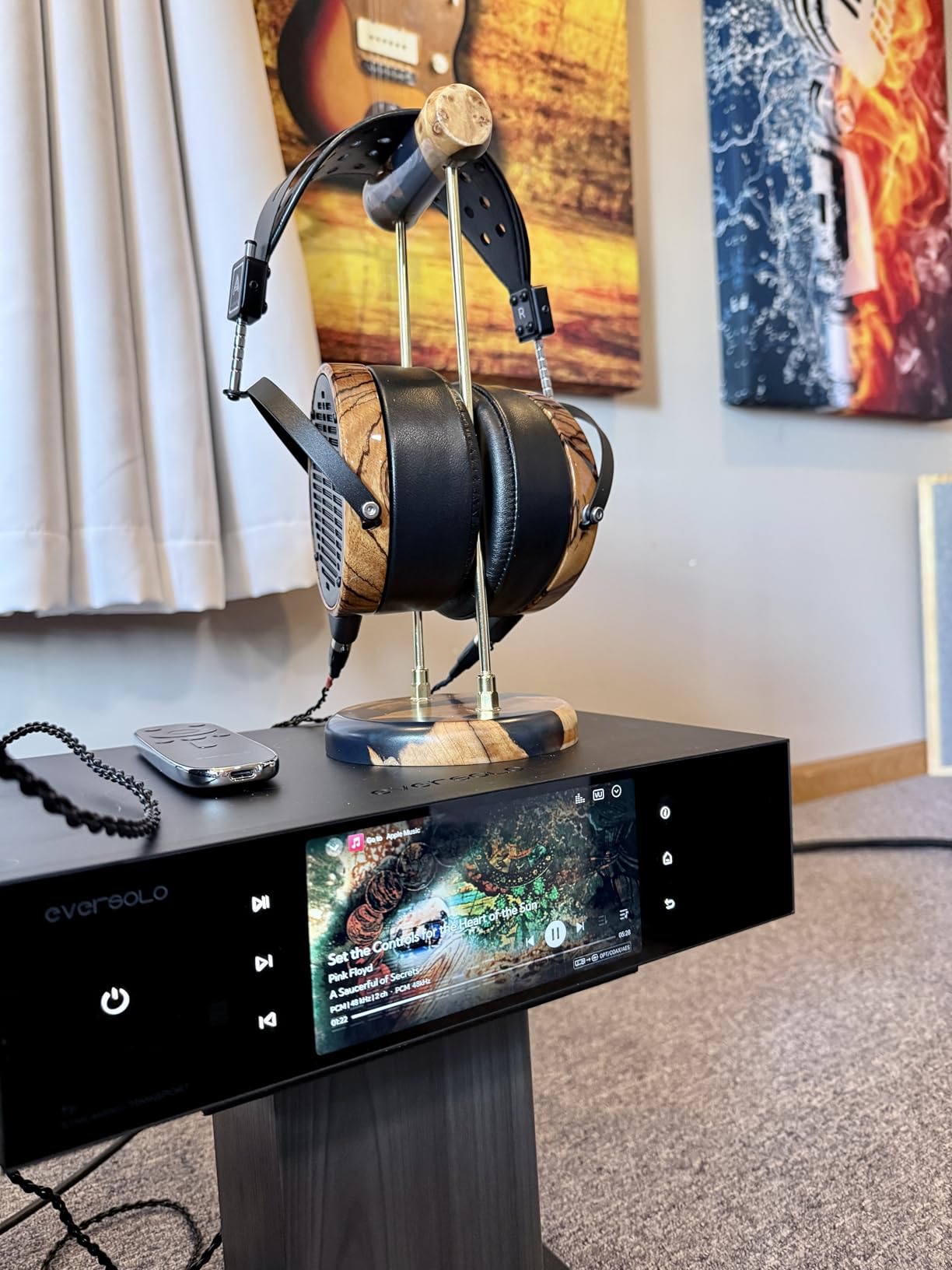
The output list is unusually complete. AES/EBU on balanced XLR for a professional DAC, IIS with eight pinout configurations, USB Audio for DSD512 native and PCM 32-bit/768kHz, and coaxial, AES/EBU and optical limited to PCM 24/192 plus DoP64. The SFP fibre network module is the piece that solves ground loops in tricky installations, though the module is a separate purchase.
A 6 inch touchscreen with VU meters, a remote, the app, Wi-Fi 6, Bluetooth and Gigabit Ethernet handle control, and evoTune gives you a professional acoustic calibration system with a 10-band parametric EQ. Roon Ready, TIDAL Connect and Qobuz Connect are all supported.
Who should buy the Eversolo T8
It is for someone with a serious outboard DAC who wants the cleanest possible digital feed, or for an installation where ground loops and interference are a real problem and fibre is the answer. At 4.5 kg, it is designed for a shelf that can carry it.
Where the T8 falls short
There are no analog outputs and no DAC, so it does nothing at all without another box. The setup is more involved than a typical streamer, the SFP modules are extra, and with roughly seventy reviews the ownership history is thin for a component at this level.
10. NAD CS1 Endpoint – the best network music streamer for MQA and AirPlay 2 together
NAD CS1 Endpoint Network Streamer – Hi-Res Audio Streamer with AirPlay 2, Chromecast, Spotify Connect, Tidal Connect & Bluetooth
TI PCM5141 DAC
MQA decoding, 24-bit/192kHz
AirPlay 2 and Chromecast
RCA, optical and coax out
Pros
- AirPlay 2 and Chromecast in the same compact unit
- Full MQA decoding for Tidal Masters
- RCA analog plus optical and coaxial digital out
- Dual-band Wi-Fi and Ethernet
Cons
- No display
- no HDMI and no XLR
- No subwoofer output
- Smallest review base of the ten
The CS1 Endpoint is the smallest, simplest box here, and it exists to cover one specific gap: AirPlay 2 and Chromecast in the same unit, at a size that disappears into a cabinet.
The DAC is a Texas Instruments PCM5141, rated for 24-bit/192kHz with full MQA decoding on Tidal Masters. NAD heritage sits behind the choice, and the output stage gives you stereo RCA alongside optical and coaxial digital, so it feeds either an amplifier or an external DAC.
Dual-band Wi-Fi and a wired Ethernet option handle the connection, and Bluetooth covers quick playback from a phone. Spotify Connect, Tidal Connect, DLNA and Roon support are all listed alongside the two casting protocols.
In practice it is the minimal answer to a minimal need. There is no display, no HDMI, no balanced output and no subwoofer out, so it is not a system hub. It is a reliable way to get a small pair of speakers or a secondary room onto the network with the right protocols.
Who should buy the NAD CS1 Endpoint
It suits a second room, a small office system, or anyone who wants casting protocols and MQA in a box without a large footprint. The coaxial output means it can drive a decent outboard DAC when the built-in one is not the final word.
Where the CS1 falls short
The 4.0 rating from around forty reviews is the thinnest evidence base in this roundup, so treat the long-term software story as unproven. The lack of a display, HDMI and balanced output rules it out as a main-room hub, and the PCM5141 is a step below the flagship chips used elsewhere on this list.
How to Choose a Network Music Streamer
Start from your amplifier, not the streamer. Every decision below follows from one question: what does this box need to connect to, and what does that connection actually need to do?
Decide between a streamer, a transport, a DAC and an all-in-one
Most people need a streamer with a DAC and a preamp. It plays from the network, converts to analog, and gives you a volume control, which covers an amplifier that has none.
A transport outputs only digital signals and needs an external DAC. That is the right choice if you already own a good one, and the Eversolo T8 is built this way. A standalone DAC goes the other direction, taking a digital source and improving it.
An all-in-one speaker system includes the amplification and the speakers, so it is a different purchase entirely and cannot be combined with your existing hi-fi. Buyers who own an integrated amplifier should ignore all-in-ones and think about streamer plus preamp.
Check the outputs before the inputs
RCA alone is the minimum. XLR balanced output matters if your amplifier or active speakers take it, and the Fosi Audio S3 provides it without stepping up a tier. Optical and coaxial digital out are essential if you own an outboard DAC, and they are the feature most often missing from ecosystem boxes.
A headphone output is worth checking if you listen at a desk, and only the Bluesound Node Icon has a serious one. HDMI eARC matters only if you want a television involved, and a 12V trigger is the detail that stops an amplifier from being switched on by hand every time.
Treat the DAC chip as a starting point, not a finish line
ESS Sabre ES9038 and ES9039 chips, and the AKM AK4493SEQ, are strong performers that appear in this roundup at very different price levels. The chip does not decide the sound, because the analog stage, the power supply and the casework matter just as much.
Published THD+N and SNR figures are useful for spotting a weak design, not for ranking a good one. Most of these units measure well beyond what a room can resolve. Judge the DAC by what you can actually hear, and by whether the digital output lets you bypass it.
Set up bit-perfect playback properly
In Roon, set the audio device to the streamer, choose the sample rate matching the file, and leave the engine in its default signal path. In the vendor apps, use the service’s own Connect feature such as TIDAL Connect or Spotify Connect, which avoids the Bluetooth layer entirely.
Avoid Bluetooth and any Bluetooth adapter on the audio path, because it re-encodes the file. If your streamer is Roon Ready, the device appears in Roon and is controlled there, which is a large part of what enthusiasts pay a subscription for.
Use Ethernet whenever you can
Wi-Fi is fine for most listening, and a good dual-band connection will deliver a stable stream. Ethernet removes the variable entirely, avoids dropouts in a busy house, and gives a wired path for hi-res on units that support it.
That is why the models here with Gigabit Ethernet, including the WiiM Pro and the Bluesound Node Nano, are safer long-term choices. Some owners who started on Wi-Fi switched to Ethernet specifically to stop intermittent dropouts.
Count the cost of ecosystem lock-in
If your house already runs Sonos, the Port is the lowest-friction addition. If you run BluOS speakers, either Bluesound box drops straight in. Elsewhere, AirPlay 2, Google Cast and the Connect protocols are what let the box join an existing multi-room setup.
Buying two boxes from competing ecosystems means you cannot group them. That single frustration comes up more than any other in owner threads, and it is the reason to check ecosystem membership before anything else.
Match the streamer to the rest of the system
Feeding a power amplifier with no preamp means you need volume control, either from the streamer or a preamp. The WiiM Ultra, the WiiM Pro and the Fosi Audio S3 all handle that. Owners who overpay for a streamer whose preamp is the weakest link in the chain regret it quickly.
For a desktop, weight and display matter more than for a rack. A 4.5 kg transport is not a desk object, and a 6 inch touchscreen is wasted in a cabinet. If you also stream video, a look at the Elgato gear bundles for streamers covers the capture side of a combined setup.
Frequently Asked Questions
What is the best audio network streamer?
The WiiM Mini is the best audio network streamer for most people in 2026. It plays TIDAL, Qobuz, Spotify Connect and Amazon Music, runs gapless playback up to 24-bit/192kHz, and offers both RCA analog and optical digital outputs, so you can use its DAC or bypass it. Thousands of owners use it as the first streaming component in a separates system.
Which music streamer is best?
It depends on your amplifier and your ecosystem. The WiiM Mini suits almost any stereo, the WiiM Ultra adds a touchscreen, HDMI ARC, a phono input and Roon Ready, and the WiiM Pro covers AirPlay 2 plus Google Cast with wired Ethernet. If you own Sonos or Bluesound speakers, the matching box from those brands integrates more cleanly than any third-party streamer.
What is the best music streamer for audiophiles?
A Roon Ready streamer with a strong DAC and a bit-perfect path fits the bill. The WiiM Ultra, the Fosi Audio S3 and the Eversolo DMP-A6 Gen 2 all support Roon Ready, and the Node Icon adds a THX AAA headphone amplifier. Outboard DAC owners should look at a digital transport such as the Eversolo T8 rather than another box with a built-in converter.
Do network streamers have built-in DACs?
Most do, including nine of the ten streamers in this roundup. They take the digital stream, run it through an internal digital-to-analog converter and output analog audio to your amplifier. The exception is the Eversolo T8, which is a digital transport with isolated digital outputs only and requires a separate external DAC to make sound.
Do I use Wi-Fi or Ethernet for a network music streamer?
Ethernet is the safer choice where you can run a cable. A wired gigabit connection removes the main source of dropouts, keeps hi-res streams stable in a busy household and stops you troubleshooting router placement later. Wi-Fi works well on modern dual-band or Wi-Fi 6 networks, which is what the WiiM Ultra, the Fosi Audio S3 and the Eversolo T8 use.
Is Wi-Fi streaming better than Bluetooth?
Wi-Fi streaming is far better than Bluetooth for music. Bluetooth re-encodes the audio and throws away the original file, so you lose hi-res detail, and it adds latency that makes video lip sync difficult. Wi-Fi carries the untouched stream, which is what allows a streamer to be bit-perfect and pass audio to an external DAC without loss.
How do I control a network music streamer?
Every streamer here is controlled from a phone app, with some adding a screen or a remote. Larger models such as the Eversolo DMP-A6 Gen 2, the WiiM Ultra and the Node Icon can be operated from a touchscreen, while the WiiM Mini, the WiiM Pro and the Node Nano rely on the app. TIDAL Connect, Spotify Connect and Qobuz Connect let you start playback from the service app instead.
What is the best audiophile streaming service?
Qobuz and TIDAL both offer lossless hi-res streaming and are supported by most streamers in this roundup. Spotify Connect is the most convenient but not the highest resolution. If you run a NAS, a local library through Squeezelite or a network share gives you the same files at their original quality with no subscription attached.
Final Verdict on the Best Network Music Streamers
The WiiM Mini is the best network music streamer for 2026 because it does the job completely, hands you both analog and digital outputs, and has more owners running it daily than anything else on this list. Everything else in the roundup is a specialist answer to a specific need, and that is a fair way to shop.
If you want a screen, HDMI ARC, a phono input and Roon Ready, move up to the WiiM Ultra. If you want balanced XLR output on a budget, the Fosi Audio S3 is hard to argue with. If your speakers are Sonos or Bluesound, buy the matching box and skip the rest. Our advice is to buy the simplest streamer that covers your outputs and your ecosystem, then stop reading spec sheets.