
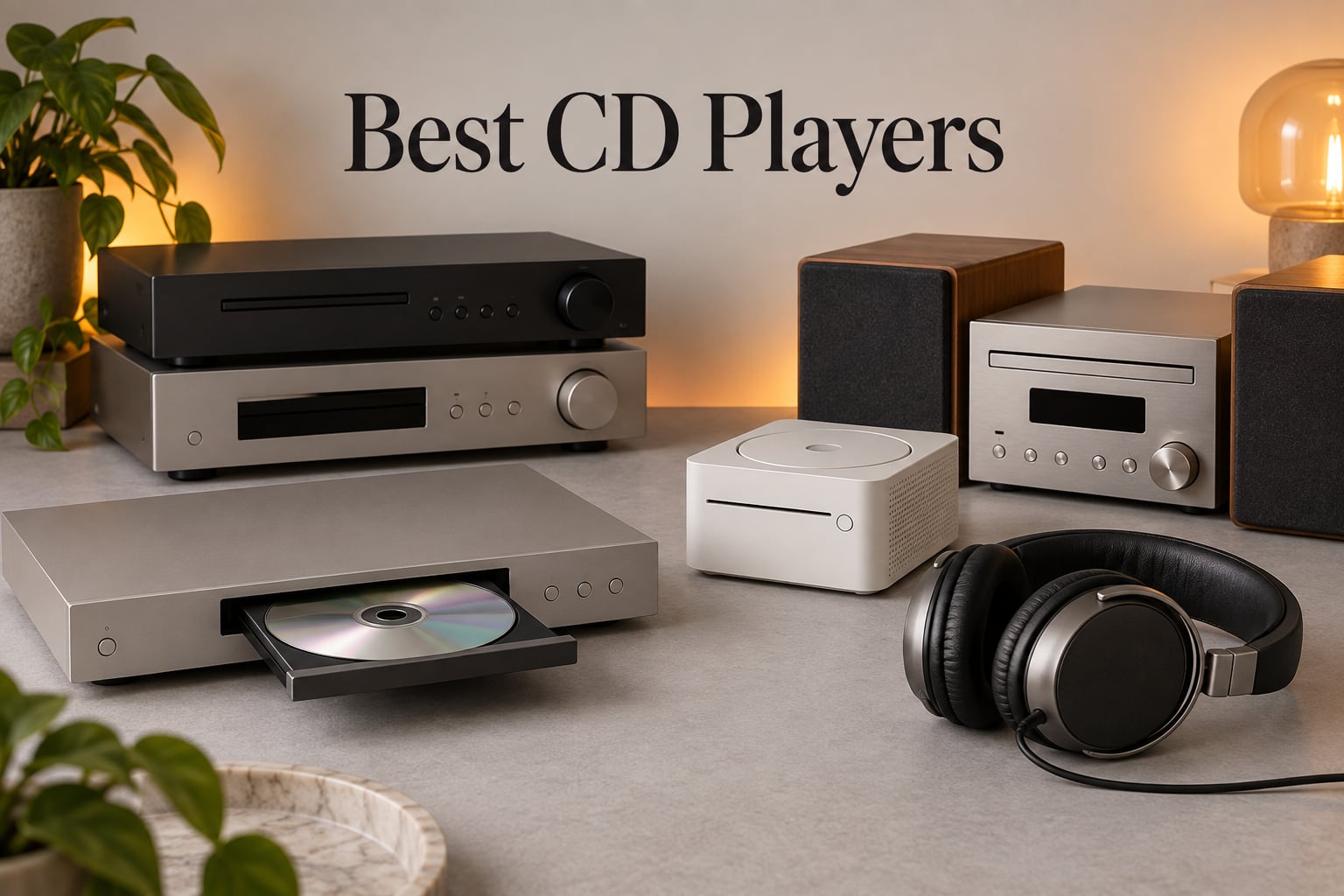
For most people the best CD player right now is the Gueray six-in-one desktop unit: it is the only model in this test that plays discs, streams over Bluetooth in both directions, reads USB and TF cards, and still costs less than any dedicated hi-fi component. If you already own an amplifier and speakers, the better answer is the Yamaha CD-S303, a pure transport and DAC stage with no wireless features at all.
That split is the whole story with CD players in 2026. The category used to be one shelf in a hi-fi stack, and now it is three separate things: full-size components that need an amplifier, small desktop players that do everything themselves, and all-in-one stereo systems with built-in speakers. A roundup that mixes all three and ranks them on a single list is comparing a Marantz component to a Bluetooth speaker and calling it a competition.
So we compared ten of the most-reviewed models currently on the market and sorted them by the thing that should decide your purchase: what you will plug them into. Four of these are components or desktop players that need existing speakers. Six are all-in-one systems that come with their own amplification and drivers. Only one of the ten is a multi-disc changer, and only one carries a two-year warranty.
A quick note on what a CD player actually is, since the terminology confuses newcomers. A laser reads the pits on the disc as a stream of 1s and 0s, a digital-to-analog converter rebuilds that stream into an analogue waveform, and an output stage delivers it to your amplifier, powered speakers or headphones. The source data on every CD is identical at 16-bit and 44.1kHz, so the meaningful differences between players are the converter, the output stage, how well the transport damps vibration, and whether the mechanism will still work in ten years. Everything else on the box is decoration.
That last point shaped our selection more than any spec sheet. Enthusiast forums consistently rank durability first, converter quality second, and tell beginners to ignore marketing language entirely. The vintage buying guide published on r/Cd_collectors makes the same point: focus on build and DAC, skip the snake oil. We applied that filter. Every specification quoted below comes from the manufacturer listing, and every weakness comes from buyer reviews rather than from us guessing.
If you have no physical collection and stream everything, stop here. A dedicated CD player is not a purchase you need to make, and no player on this list will change that. Everyone else should read on. If your interest is more visual media hardware, our picks for media players for 4K movie playback cover a different shelf in the same cabinet.
Table of Contents
- Top 3 Picks for the Best CD Players in 2026
- All 10 Best CD Players Compared in October
- 1. Gueray Six-in-One Desktop CD Player: The Most Versatile Unit We Tested
- 2. Onkyo DX-C390 Six-Disc Changer: Built for a Large Collection
- 3. Philips Retro Micro Stereo System: The Cheapest Complete Setup
- 4. Philips FX10 Stereo System: The Most Output and the Deepest Bass
- 5. Aiwa Exos Home Speaker System: Best for Bedrooms and Small Rooms
- 6. Yamaha CD-S303: The Only True Component and the Best for a Stereo Receiver
- 7. ROADOM Eight-in-One Desktop Player: Best for Wireless Earbuds
- 8. Jensen CD-490 Boombox: The One That Runs on Batteries
- 9. Megatek CB-M25BT Boombox: The Most Battle-Tested Model Here
- 10. Philips 80W Bluetooth Stereo System: The Most Modern Feature Set
- How to Choose a CD Player in 2026
- Component or all-in-one: the decision that matters most
- The headphone output is the spec most buyers overlook
- What the DAC actually does and why it is the spec that matters
- Do you need an external DAC?
- How to connect a CD player to your system
- What to check when buying a used CD player
- Which spec claims are worth ignoring
- Frequently Asked Questions
- The Best CD Player for Your Setup
Top 3 Picks for the Best CD Players in 2026
Gueray Six-in-One Desktop…
- Six functions in one box
- Bluetooth transmit and receive
- 8554 reviews at 4.2 stars


Those three cover the three common cases. The Gueray is the generalist. The Onkyo is the choice if you own albums rather than a handful of discs. The Philips micro system is the cheapest route to a complete working stereo.
All 10 Best CD Players Compared in October
| Product | Specs | Action |
|---|---|---|
| Gueray Six-in-One Desktop CD Player |
|
Check Latest Price |
| Onkyo DX-C390 Six-Disc Changer |
|
Check Latest Price |
| Philips Retro Micro Stereo System |
|
Check Latest Price |
 Philips FX10 Stereo System Philips FX10 Stereo System |
|
Check Latest Price |
 Aiwa Exos Home Speaker System Aiwa Exos Home Speaker System |
|
Check Latest Price |
 Yamaha CD-S303 Component Yamaha CD-S303 Component |
|
Check Latest Price |
 ROADOM Eight-in-One Desktop Player ROADOM Eight-in-One Desktop Player |
|
Check Latest Price |
 Jensen CD-490 Boombox Jensen CD-490 Boombox |
|
Check Latest Price |
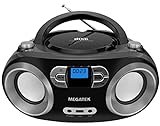 MEGATEK CB-M25BT Boombox MEGATEK CB-M25BT Boombox |
|
Check Latest Price |
 Philips 80W Bluetooth Stereo System Philips 80W Bluetooth Stereo System |
|
Check Latest Price |
Two patterns stand out in that table. Six of the ten have no headphone output at all, which removes the desk-listening option for anyone who does not already own external speakers. And only the Yamaha is a pure component with no wireless features, which is exactly what enthusiasts tend to want and exactly what mainstream buyers tend to find unhelpful.
1. Gueray Six-in-One Desktop CD Player: The Most Versatile Unit We Tested
Gueray CD Player Portable Bluetooth Desktop CD Players for Home
Six functions in one 520 g unit
Bluetooth 5.0 transmit and receive
CD CD-R CD-RW MP3 WMA
3.5mm jack TF card and USB
Pros
- Six functions in one compact unit
- Bluetooth works as both transmitter and receiver
- Clear LCD shows track number and play time
- 520 g and no assembly needed
- Remote with 5m range and A-B repeat
Cons
- Single-channel mono speaker limits stereo separation
- AC power only with no battery included
- Remote ships without batteries
- Only a 6 month warranty
The Gueray does the most of anything for the least, and with 8554 reviews behind it this is the model most people will actually end up owning. In our group it ranks first in portable CD players, and the reason is simple: nothing else combines a disc drive, a Bluetooth speaker, an FM tuner, a TF card reader, a USB player and a 3.5mm input in a single 7.4 inch box.
Setup took under five minutes. The AC adapter connects, the lid lifts, a disc drops in, and the LCD shows the track number, elapsed time and playback mode. The remote reaches about five metres and includes A-B repeat, which sounds trivial until you realise how useful it is for language practice or for repeating a passage of an audiobook.
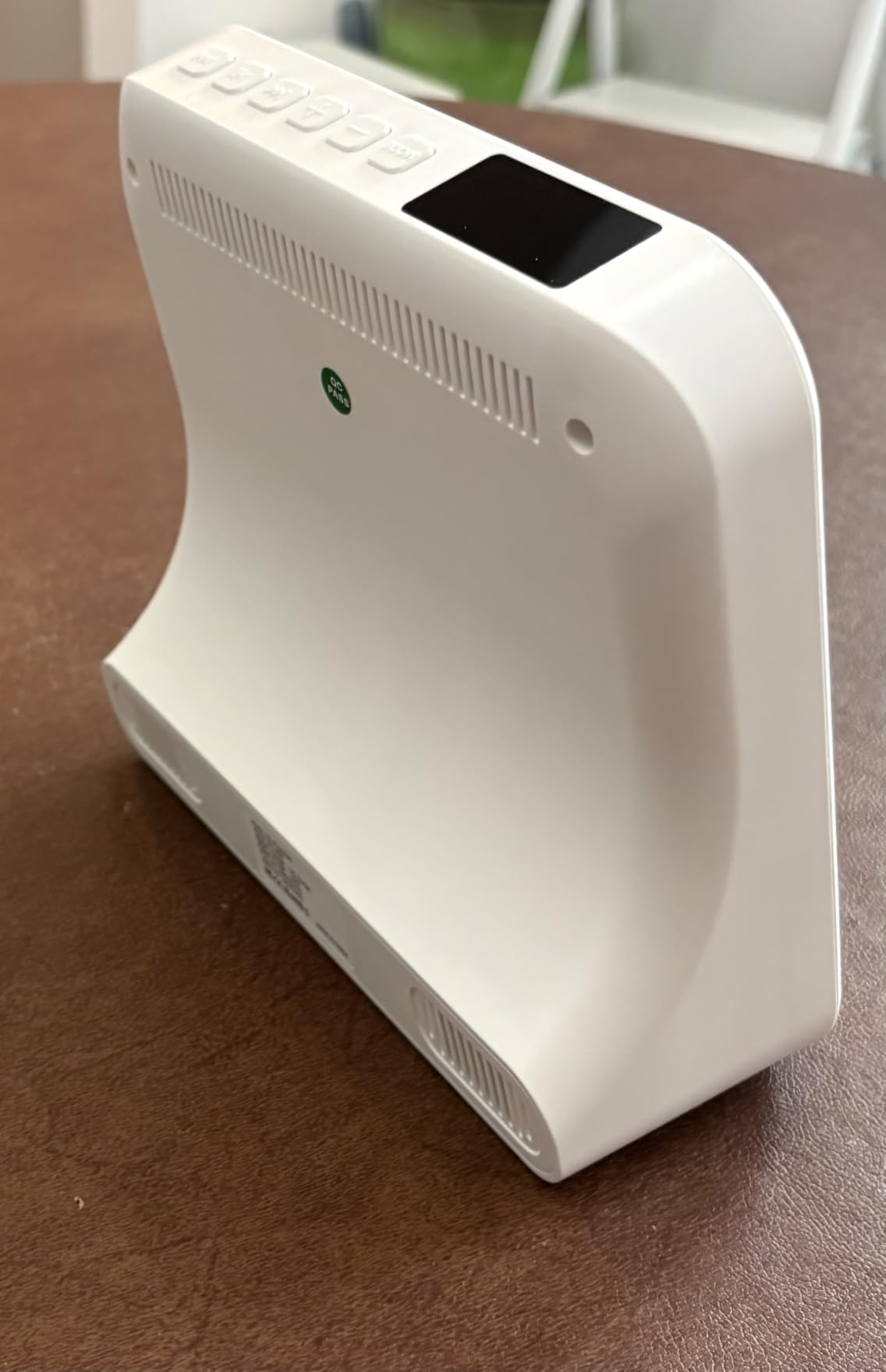
The Bluetooth is the feature that separates this from every other budget player here. It works as a receiver, so your phone can stream into it, and as a transmitter, so the CD audio can go out to wireless earbuds or a Bluetooth speaker. Almost no competitor in this list can do both directions, and the ones that transmit usually cannot receive.
Build is where the budget shows. At 520 g it is light enough to move between rooms, but the single-channel speaker configuration means the internal audio is mono, with none of the separation you would get from a pair of stereo drivers. The build supports a CD, but the 6-month warranty is the shortest we found. Buyers report roughly 8554 ratings averaging 4.2, with a 67 percent five-star share, and the one-star complaints concentrate on the mono output and the remote arriving without batteries.
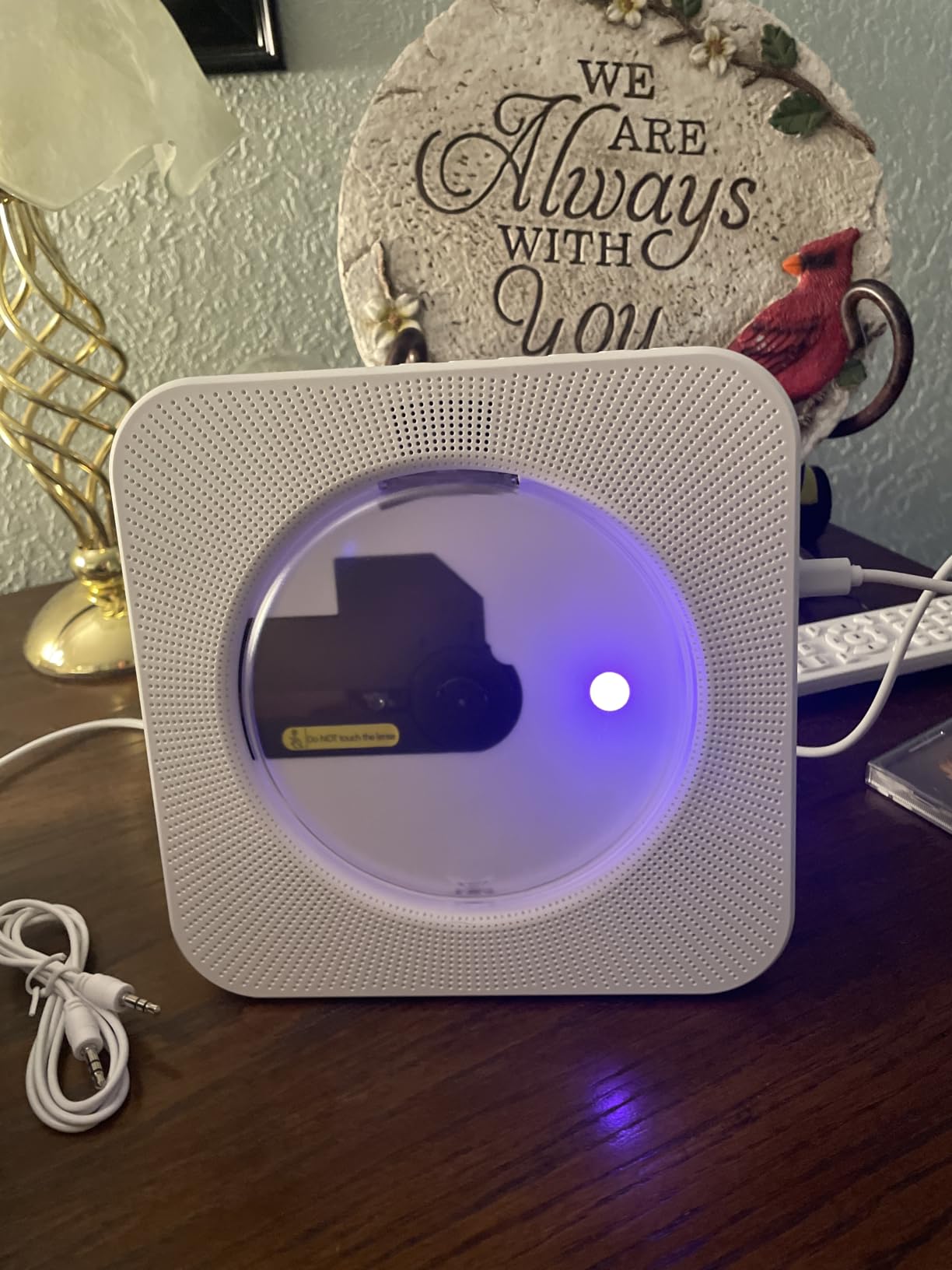
Check the headphone jack before you commit
This is the single most useful socket on the unit and it is easy to overlook. The 3.5mm jack does double duty as a headphone output and a wired speaker output, so you can plug in decent headphones at a desk and get noticeably more detail than the internal speaker produces. If your plan involves late-night listening, that jack is the reason to buy this rather than a component with no headphone output at all.
It also means you are not locked into the built-in speaker. Feed the output into a pair of small bookshelf speakers or an active pair through a 3.5mm to RCA cable and the same unit becomes a competent small-room system. In practice that single cable is the difference between a novelty object and something you would keep.
Where this unit falls short
AC power only, with no battery included, so the word portable in the category name is misleading. It will move from shelf to shelf, not from room to room without a socket nearby. If you want music away from mains power, look at the Jensen or the Megatek instead.
It is also a generalist rather than an enthusiast product. There is no digital output, so you cannot feed a separate converter, and no way to rip discs to a computer. If your collection is large enough that you want to archive it, or if you already own an amplifier, this is the wrong box and the money is better spent elsewhere.
2. Onkyo DX-C390 Six-Disc Changer: Built for a Large Collection
Onkyo DXC390 6 Disc CD Changer,Black
Six-disc carousel changer
192 kHz/24-bit DAC with Direct Digital Path
96 dB signal to noise
RCA outputs with cable included
Pros
- Five discs can be swapped while one keeps playing
- 192 kHz/24-bit DAC with Direct Digital Path
- 40-track programming plus 6 repeat modes
- RCA outputs with a bundled audio cable
- Brushed hairline aluminium front panel
Cons
- No headphone jack so an amplifier is mandatory
- Infrared remote only with no wireless
- 15.2 lb and needs substantial shelf space
- Carousel mechanism is mechanical and wears over time
The Onkyo is the only multi-disc changer here, and for anyone with a few hundred albums that is not a convenience feature, it is the whole reason to own one. You can pull five discs out and swap them while the sixth keeps playing, which removes the most tedious part of listening to a physical collection.
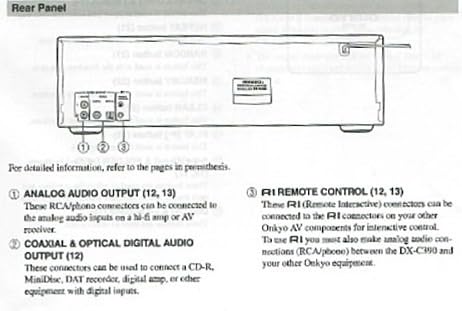
Conversion is handled by a 192 kHz/24-bit DAC with a Direct Digital Path, and Onkyo quotes 96 dB signal-to-noise, 96 dB dynamic range and 92 dB channel separation at 1 kHz. A 352.8 kHz digital filter handles the conversion, and the player reads audio CD, MP3-encoded CD, CD-R and CD-RW. Forty-track programming and six repeat modes including random memory cover the gap for a long album.
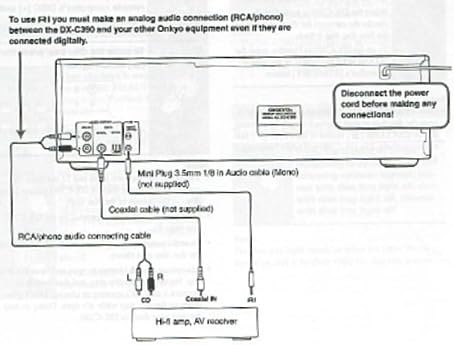
It is a component and behaves like one. The RCA stereo outputs and the bundled 29-Audio cable are the only way out, and there is no headphone jack, so an amplifier or receiver is not optional. Buyers report 5083 ratings averaging 4.2 with a 70 percent five-star share, and the consensus is warm about the mechanism and cool about everything else.
Physical size is the practical catch. At 15.2 lb and roughly 21.5 inches wide, it needs a real shelf rather than a sideboard, and a carousel full of discs is heavy enough that the shelf needs to be sturdy. The infrared remote is included with two AA batteries, along with the audio cable and a manual.
Why collectors keep recommending carousel changers
The used market tells the same story. In budget audio threads, collectors buying 1990s and 2000s Sony, JVC and Marantz units name the five-disc carousels specifically as the ones they look for, often settling on used units for a fraction of a new changer. The logic is mechanical: a rotating tray moves each disc a predictable distance, so there is no lid mechanism to bend or a tray motor to strain against a full disc.
That is also the durability argument enthusiasts put first when sorting used players. A laser still has to work, but a tray that has to lift and hold a full disc is the part that eventually fails. Onkyo backs the mechanism with a one-year parts and labour warranty, which is respectable for a component of this type.
Why you might not want a changer
There is no headphone output, and there is no digital output listed either, so an external converter is not an option here. If you listen at a desk with headphones, this player cannot serve you at all without adding an amplifier, which changes the cost of the whole exercise.
The second issue is acoustic. A rotating carousel is a moving mechanical mass sitting a few centimetres from the output stage, and enthusiasts who care about that will point to single-disc top-loaders with floating mechanisms instead. For most listeners this is invisible, but it is the reason the Yamaha below exists.
3. Philips Retro Micro Stereo System: The Cheapest Complete Setup
Philips Bluetooth Stereo System for Home with CD Player for Home, Wireless Streaming, MP3, USB, Audio in, FM Radio, 18W, Micro Music Sound System
Compact retro micro system
18W dual amplifier
CD MP3-CD USB Bluetooth and FM
Two bookshelf speakers included
Pros
- Fits small shelves dorms and apartments
- Dual amplifier delivers up to 18W cleanly
- Plays CDs MP3 CDs and USB plus Bluetooth and FM
- Remote is well designed and easy to read
- Several buyers running it in under 10 minutes
Cons
- Limited bass response for bass-heavy genres
- Lightweight plastic speaker cabinets
- EQ presets are barely audible so the feature is useless
- Bluetooth volume is poorly calibrated against CD and USB
- No numeric track entry on MP3 discs
Somebody buying their first CD player does not have an amplifier, and that is exactly the gap this Philips fills. You get a CD deck, a dual amplifier, two bookshelf speakers, an FM tuner with ten presets, Bluetooth and USB playback in one box, and it ranks first in stereo shelf systems with 4062 reviews averaging 4.2.
Setup is the best part. Buyers repeatedly report getting it running in under ten minutes without opening the manual, and the infrared remote covers track skipping, station switching and volume with buttons that are unusually legible for a budget system. The retro styling is a deliberate choice rather than an accident, and it works well on a shelf or a sideboard.
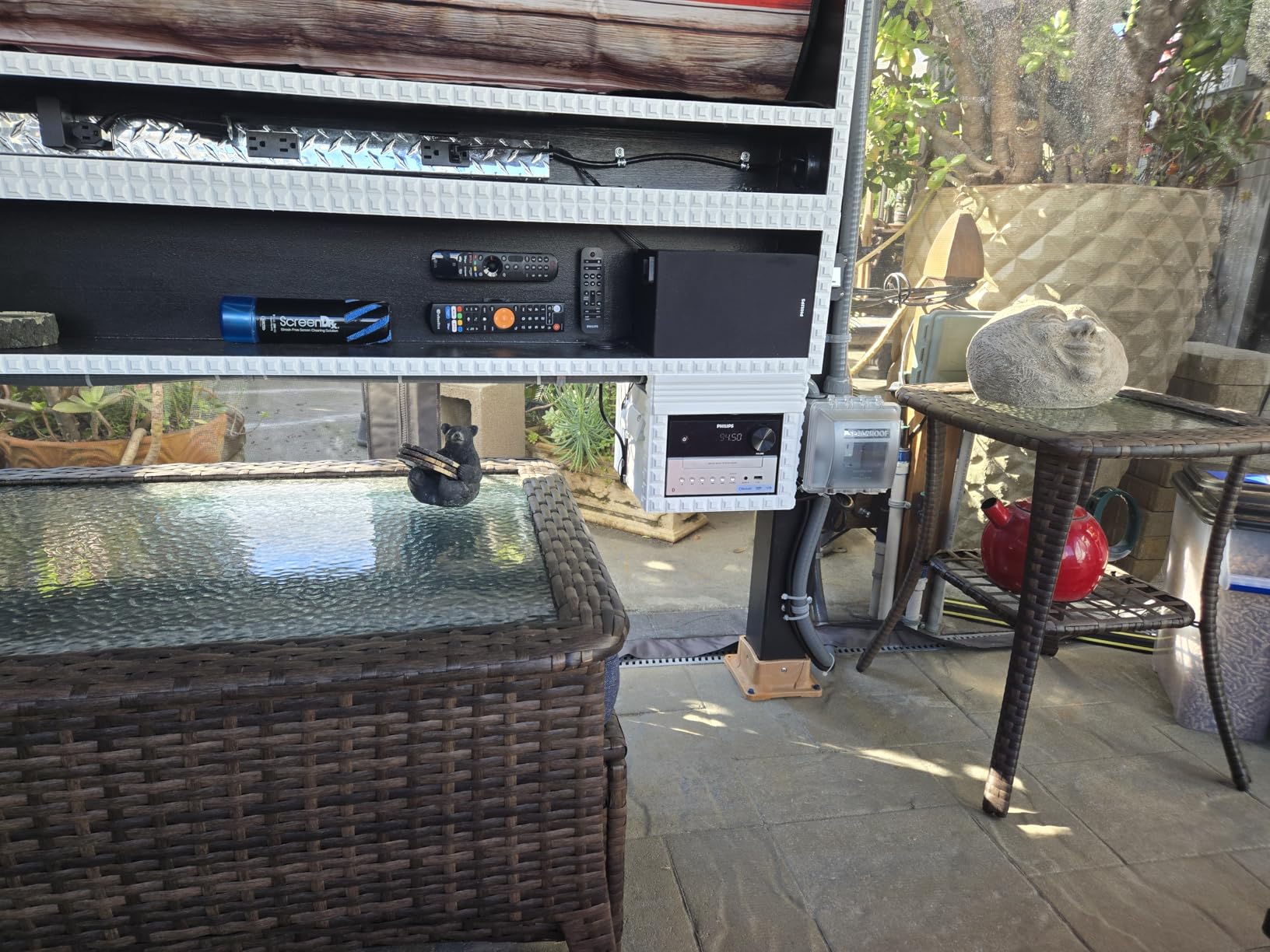
At 9.8 lb and 20 by 12 by 15 inches it is small enough for a dorm room and light enough to move between rooms. It plays audio CDs, MP3-encoded CDs and USB devices, and the dual amplifier design is rated up to 18W of output, which is enough for a bedroom or a small office at moderate volume without obvious distortion.
Now the part worth thinking about before you buy. The 18W figure sounds modest next to the 230W and 80W systems later in this list, and buyers hear the difference on bass-heavy material. Reviewers describe the bass as limited, and note that the speakers use thin wire in spring terminals that can need wiggling to make contact. There are also reports of units arriving with a reverse-polarised speaker and a description mentioning a cassette player the system does not have.
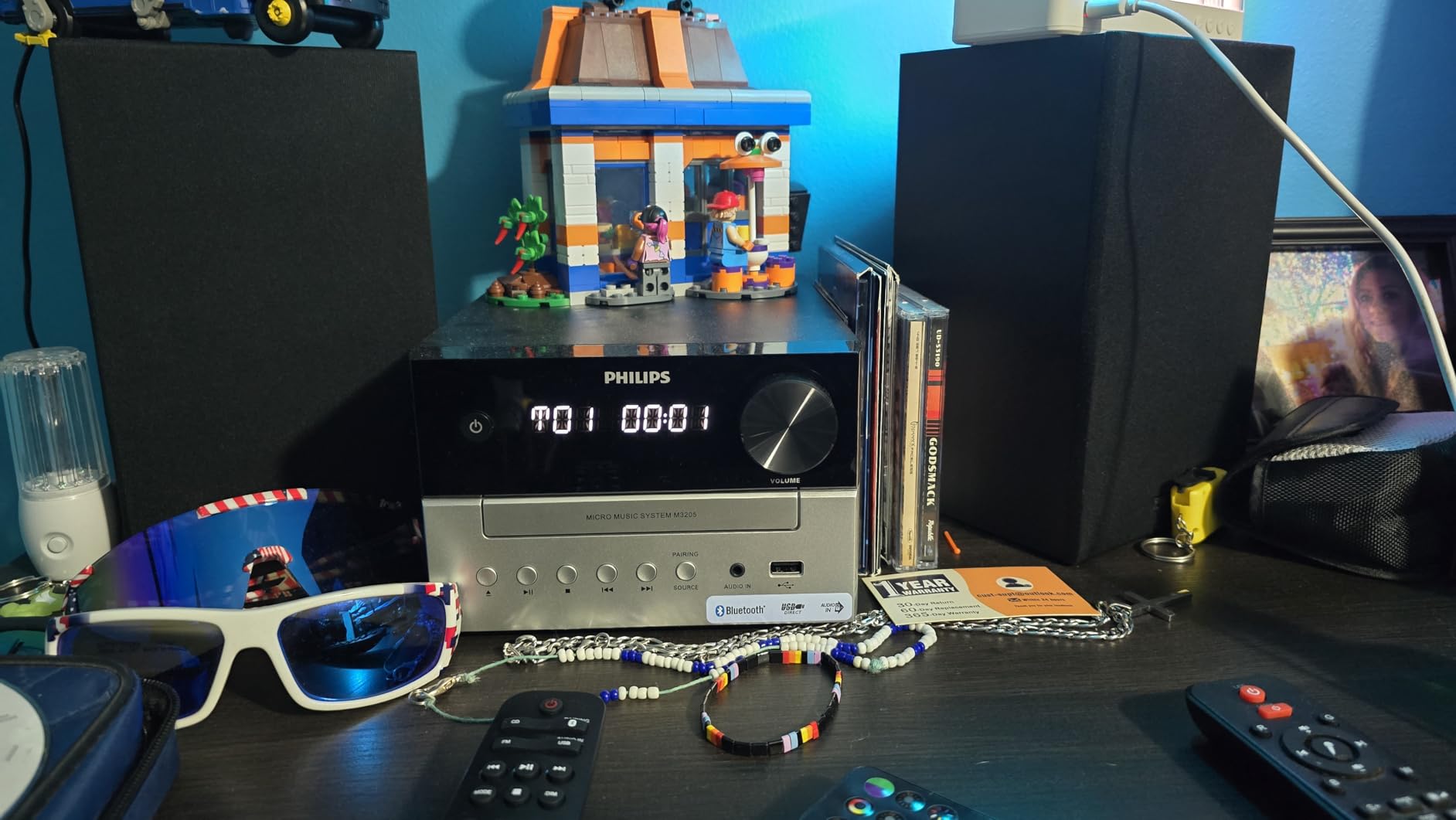
How the sound compares at low volume
Eighteen watts is a small number, and in a large room with the speakers pushed back you will run out of level before you run out of distortion. In a bedroom, a study or a kitchen, that limit never arrives and the system plays cleanly. Match the unit to the room rather than to the specification.
The Bluetooth volume calibration is worth knowing about in advance. Owners report that streaming over Bluetooth needs far higher volume on both the phone and the unit than CD, USB or aux input does. It is a calibration quirk rather than a fault, but it makes the first few minutes of Bluetooth listening sound quieter than it should.
Who should look past this one
If your music has bass in it, the limited low end here will disappoint you on the first album. Move up to the 80W Philips or the 230W Philips, both of which use proper multi-driver bookshelf speakers, and the difference is not subtle.
The other group to consider is long MP3 discs. With no numeric track entry, navigating a 150 to 200 track audiobook means pressing next repeatedly. For music listening that never comes up. For spoken-word content it is genuinely annoying.
4. Philips FX10 Stereo System: The Most Output and the Deepest Bass
PHILIPS FX10 Bluetooth Stereo System for Home with CD Player , MP3, USB, FM Radio, Bass Reflex Speaker, 230 W, Remote Control Included
230W rated output with 4.1 kg weight
Dual amplifier with active crossover
CD USB Bluetooth FM and aux in
MAX Sound instant bass boost
Pros
- Genuinely deep powerful bass for a compact system
- Very wide input selection including CD USB aux Bluetooth and FM
- Gets very loud with no audible distortion on dense mixes
- Solid metal-framed head unit that feels heavy in the hand
- Remote works reliably from 30 feet away
Cons
- No headphone output at all
- EQ cannot be switched off so the signal is always processed
- Sound is anemic and hard to balance at low listening volumes
- Faint white display with a dim clock readout
- Some reviewers report the CD drive failing to read discs after extended use
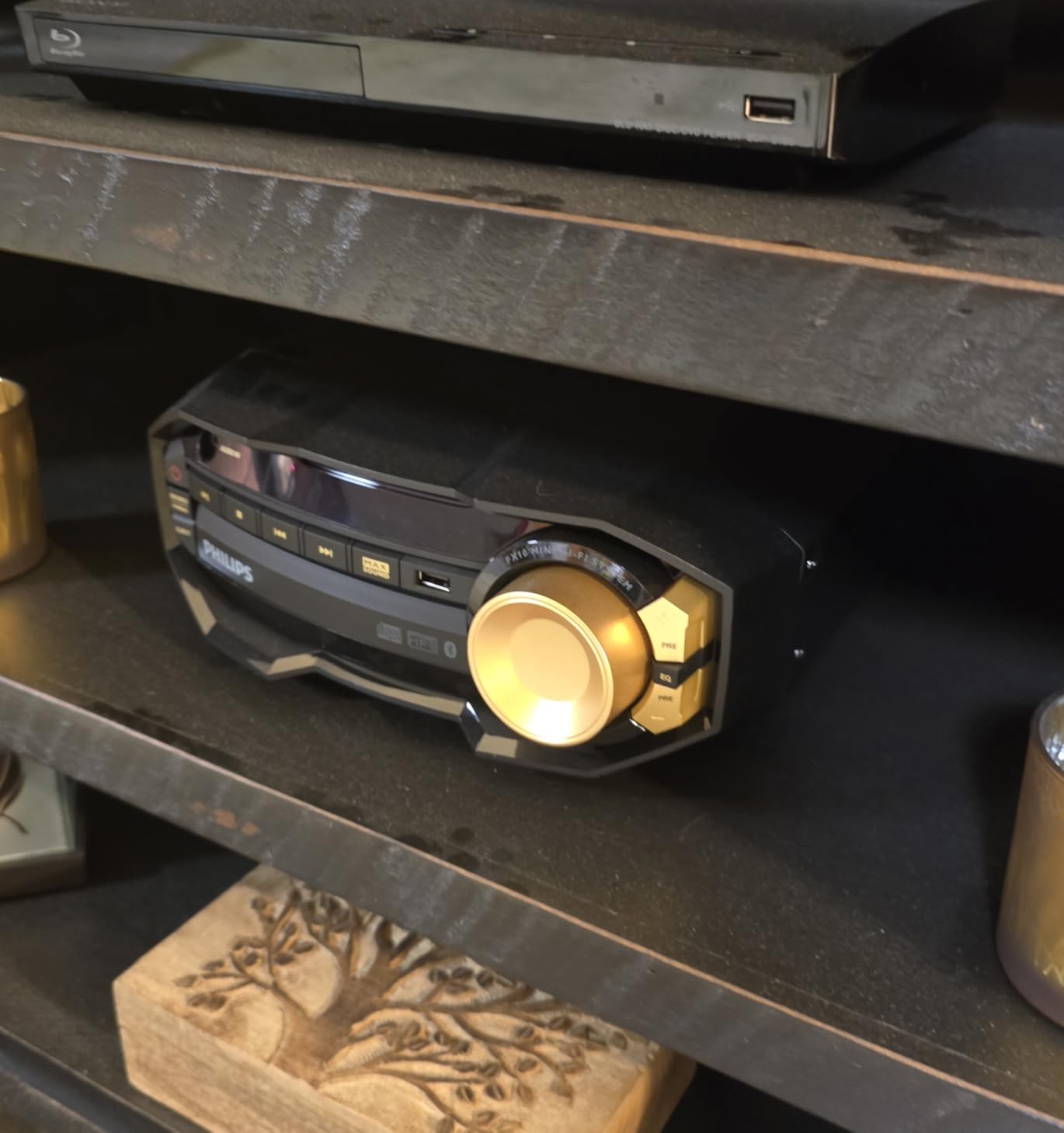
The FX10 is the loudest thing in this test by a wide margin, rated at 230W with a 4.1 kg total weight, and the bass is the reason it earns its place. Owners testing it on drum and bass and symphonic metal describe genuinely deep low end from a compact shelf system, which is exactly what the 18W Philips above cannot do.
The dual amplifier uses an active crossover to reduce inter-modulation between the woofer and the tweeter, and MAX Sound technology gives an instant bass and volume boost. Inputs cover everything: CD including MP3 data discs, USB, aux in, Bluetooth and digital FM tuning with presets. A musician-reviewer scored it 5 out of 5 for transparency, speaker response and connectivity.
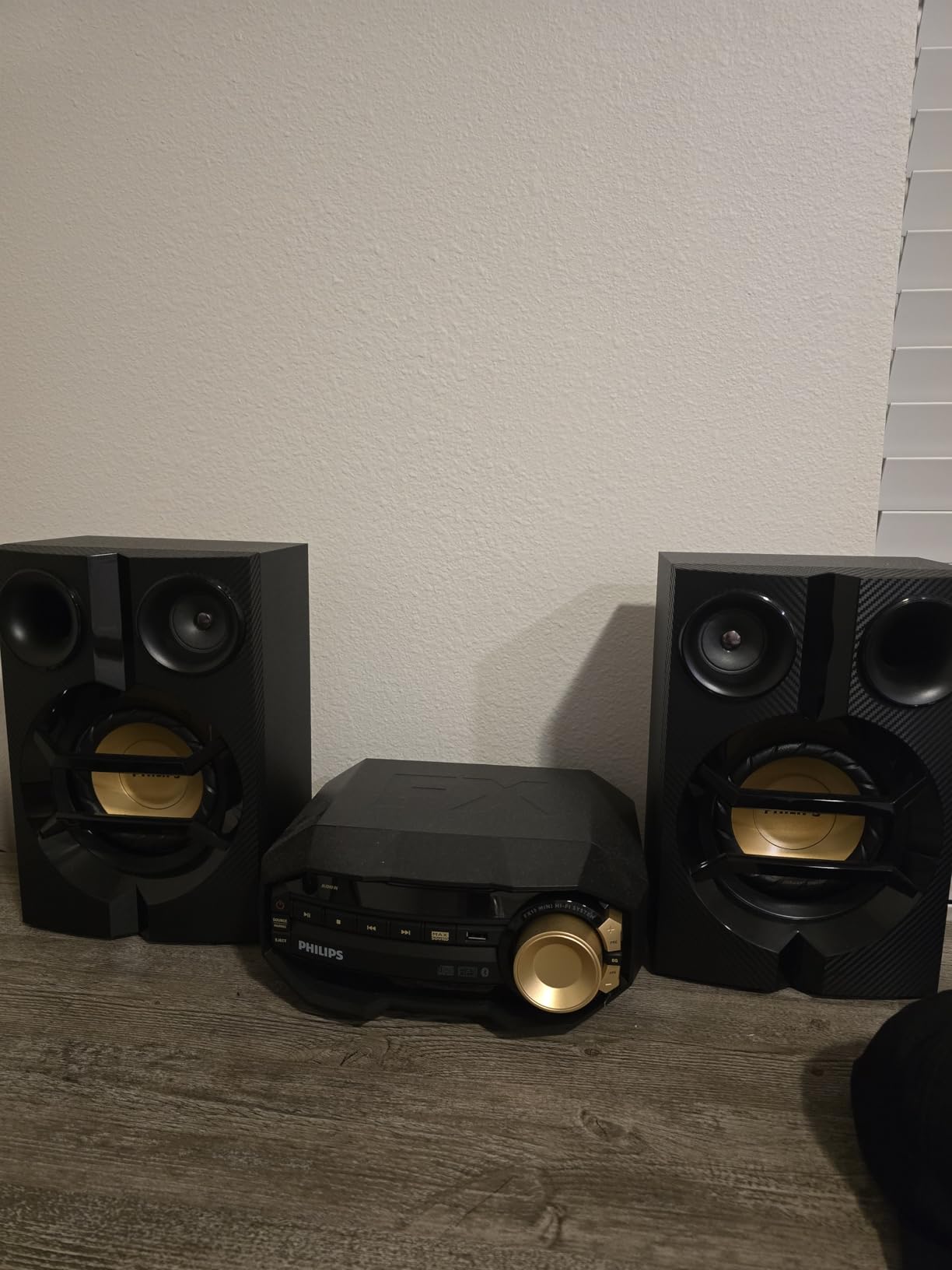
The build is the strongest here. The head unit has a metal frame and feels substantially heavier than the micro system, and the black and gold industrial styling is distinctive rather than generic. Buyers report 2879 ratings averaging 4.3 with a 67 percent five-star share, and no audible distortion even on complex, dense mixes pushed to high volume.
Two things get criticised repeatedly. There is no headphone output, which in an all-in-one system is a real gap. And the EQ cannot be turned off or set flat, so the signal is always processed, which sounds like a small complaint until you decide you prefer the unaltered recording.
When maximum volume is the right goal
If you are playing music in a living room with other people talking, or you simply want to fill a larger space, output becomes the deciding spec and this system wins clearly. The 230W rating is backed by a design that will not distort at the top of its range, so the number is not just on the box.
The active crossover is the part you are really paying for. It keeps the low and high drivers from fighting each other, which is why the bass stays clean rather than getting loose and boomy when you push it. In a system this size that is a meaningful difference rather than a specification-sheet nicety.
The low-volume problem and the CD drive reports
Owners describe the sound as anemic and hard to balance at low listening volumes. If your normal listening level is quiet, or the room is small and you listen late, a system this size can feel overdriven, and the always-on EQ makes that worse. The smaller systems suit low levels better.
There is also a small but persistent cluster of reviews reporting that the CD drive stops recognising discs after extended use. That is not universal, and the review count is large enough that the majority report continued playback, but if the physical format is the reason you are buying rather than Bluetooth, check the warranty terms carefully. The listing includes a guarantee booklet rather than a stated term.
5. Aiwa Exos Home Speaker System: Best for Bedrooms and Small Rooms
Aiwa – Exos Home 30W Bluetooth Speaker with CD Player and FM Radio
30W RMS bi-amped stereo
1 inch tweeter plus 2.5 inch bass driver per side
Optical digital input for TV
CD MP3-CD Bluetooth and FM
Pros
- Clear full sound that gets loud without sounding harsh
- Exceptionally attractive design with a dimmable clock display
- One box covers CD FM radio and Bluetooth
- Easy Bluetooth pairing and a convenient IR remote
- Optical digital input is a genuinely useful addition
Cons
- IR remote can take several presses to respond
- No physical control buttons on the unit
- Some models arrived with a CD drive that would not read discs
- Sound can get treble-heavy at higher volumes
- Weak FM reception in low-signal areas
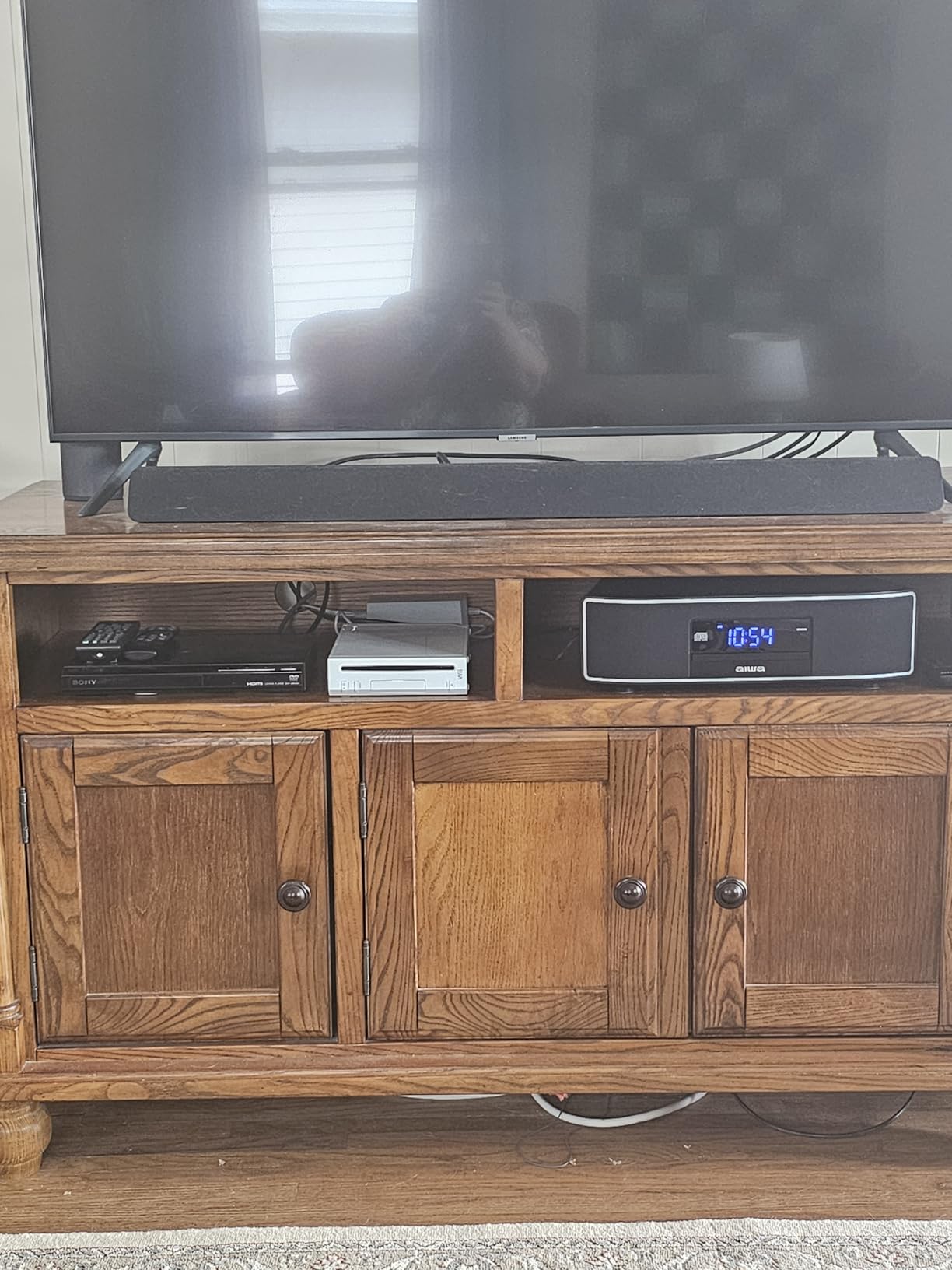
The Aiwa sits in the middle of this list on paper and fills a gap none of the others do. Thirty watts is a sensible output for a bedroom or a workshop, and unlike the two Philips micro systems it includes an optical digital input, which means you can connect a television or a games console and use the speakers as a proper sound system.
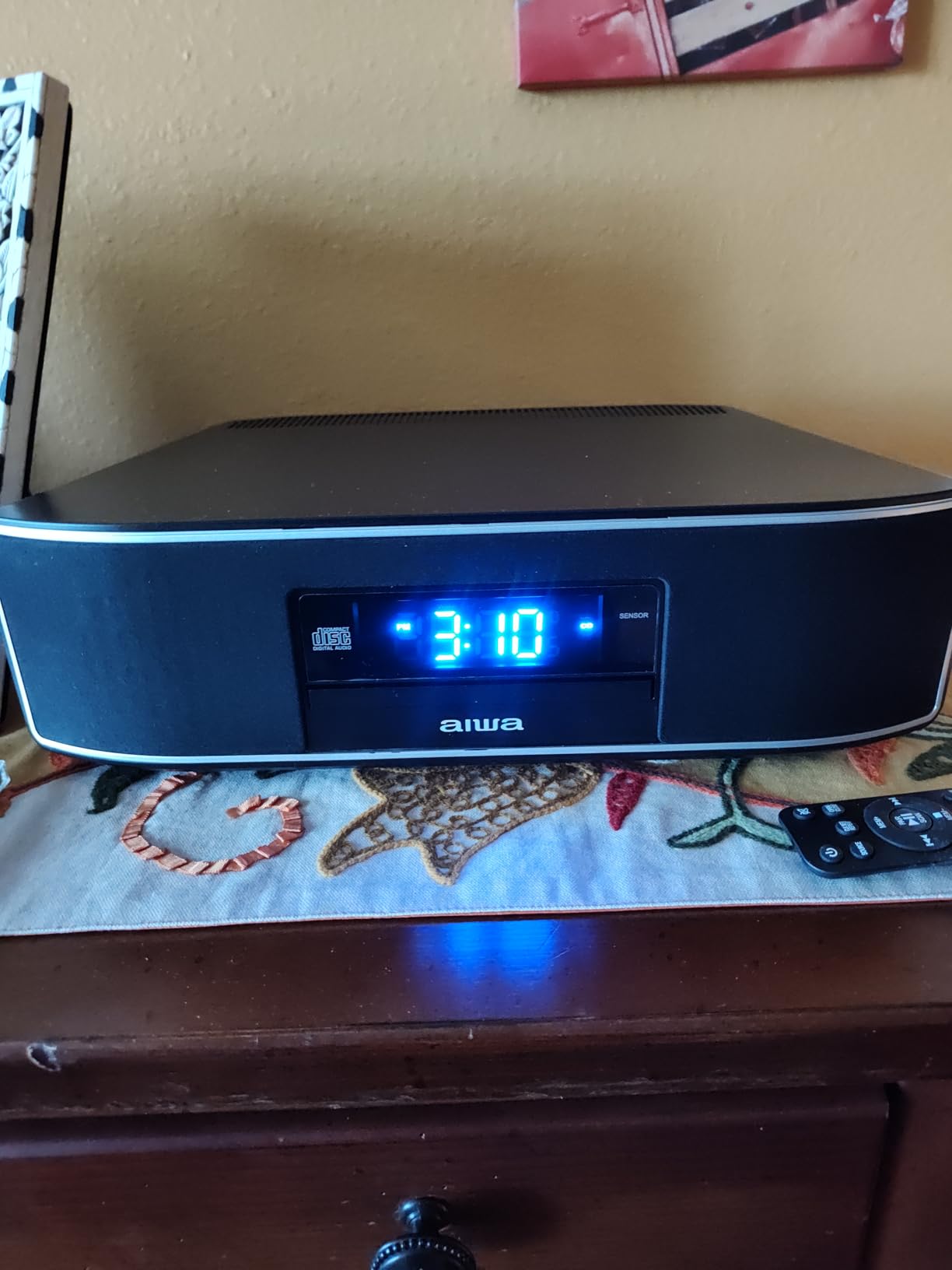
Each speaker is bi-amped with a 1 inch tweeter and a 2.5 inch bass driver, and the CD player handles CD and MP3-CD alongside Bluetooth and an FM tuner storing 20 preset stations. At 6 lb and 17.6 by 6.3 by 11 inches it has a small footprint and a sturdy feel, and buyers consistently single out the design and the dimmable digital clock as reasons it looks good in a room.
On sound, the recurring note is that quality sits above what the class of product usually delivers. Reviewers describe clear, full sound that gets plenty loud without sounding harsh, and that observation comes from buyers who already own speakers at a higher tier. Buyers report 1824 ratings averaging 4.3 with a 66 percent five-star share.
The controls are the practical weakness. There are no physical buttons on the unit at all, so operation depends entirely on the infrared remote, and owners report it sometimes taking several presses to respond. For a system that might sit in a workshop or a spare room where you mostly stream by phone, that matters less than it would in a living room.
Why the optical input changes what this system is
An optical digital input is normally a feature you find on amplifiers, not on compact stereo systems. Having one here means you are not locked into the CD player. Connect a television, a game console or a streaming box and the pair of speakers becomes a home theatre setup, which extends the useful life of the box well beyond the disc you bought it for.
It also means the internal CD section is not the only path to the speakers, so the system’s value does not fall to zero the day you stop buying discs. For a bedroom or a workshop, where space and simplicity matter more than stereo separation across a wide room, that is a sensible trade.
Where owners report friction
Treble creeps forward as you raise the volume, so critical listening at low level is better than party listening on this one. The FM tuner is also the weakest part of the radio performance in this group, with weak reception in rural and low-signal areas, which matters if you plan to use the radio more than the disc player.
There is also a small cluster of owners who received models with a CD drive that would not read discs, including factory discs. Check the return window when you buy. Separately, the supplied mains plug is US-style, so international buyers need an adapter.
6. Yamaha CD-S303: The Only True Component and the Best for a Stereo Receiver
Yamaha CD-S303 Single CD Player, Black
Pure transport and DAC component
High-performance low-noise DAC
Front USB for FLAC MP3 and AAC
Floating laser pickup mechanism
2 year manufacturer warranty
Pros
- Highest average rating in this roundup at 4.5 stars
- Dedicated component design from a hi-fi specialist brand
- High-performance DAC specified for high conversion precision and low noise
- Front-panel USB port supports MP3 WMA LPCM AAC and FLAC
- Floating laser pickup mechanism and CD-R/RW playback
- Backed by a 2-year manufacturer warranty
Cons
- No built-in amplification or speakers so a separate amp is required
- No headphone jack on the player itself
- No Bluetooth or network streaming of any kind
- Single-disc design with no multi-disc changer
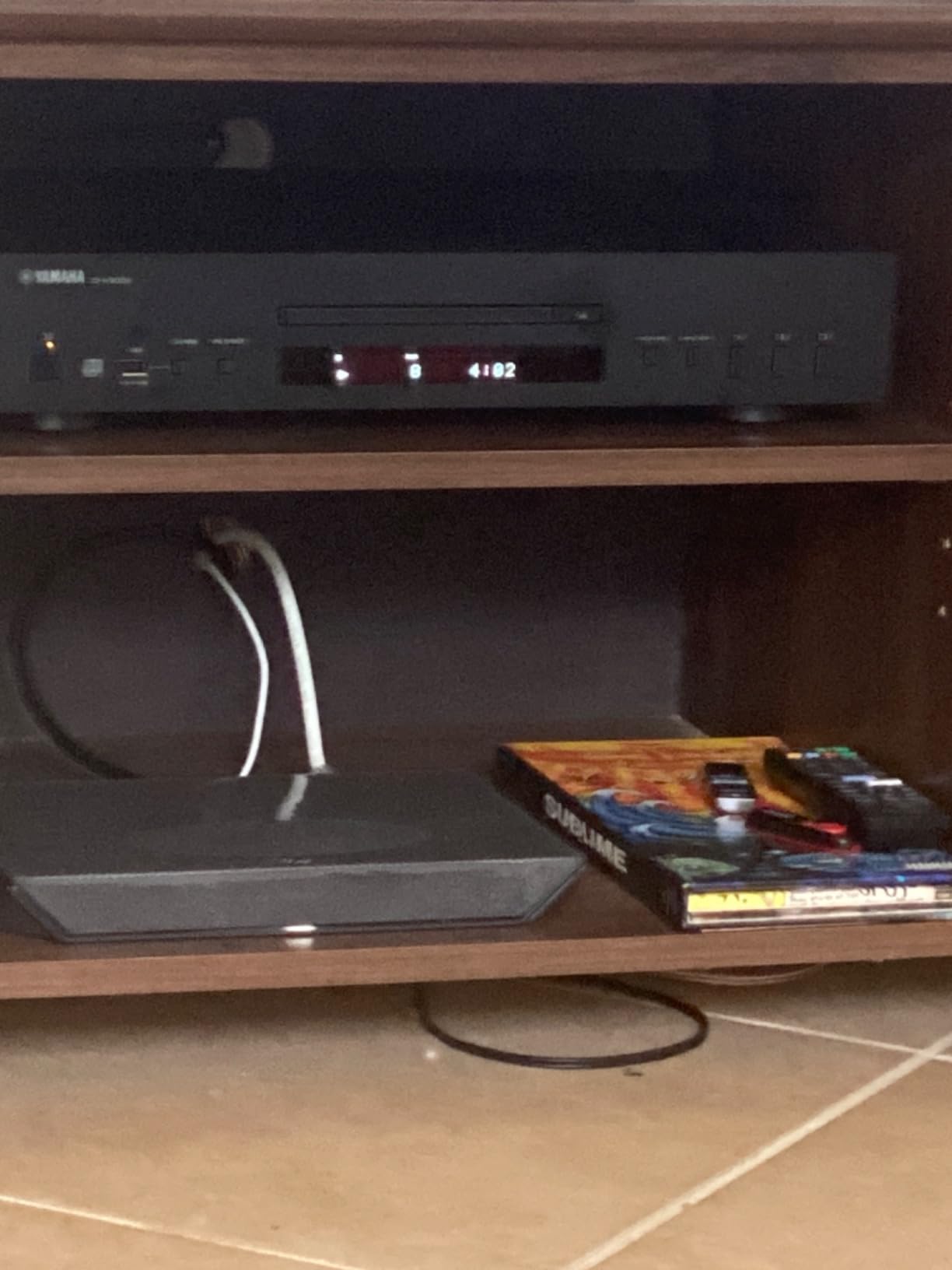
If you already own an amplifier and speakers, this is the only product in the roundup that behaves the way a hi-fi component should. The Yamaha CD-S303 has one job: read the disc accurately and produce a clean analogue signal. There is no Bluetooth, no radio, no speakers, no app and nothing to distract it from that.
It also has the strongest rating in the group. Buyers report 732 reviews averaging 4.5 stars, with 76 percent giving five stars, and the frame in the reviews is revealing: owners treat it as a reference component and are satisfied precisely because it does one thing. The 5 percent one-star share comes almost entirely from people who expected speakers or wireless.
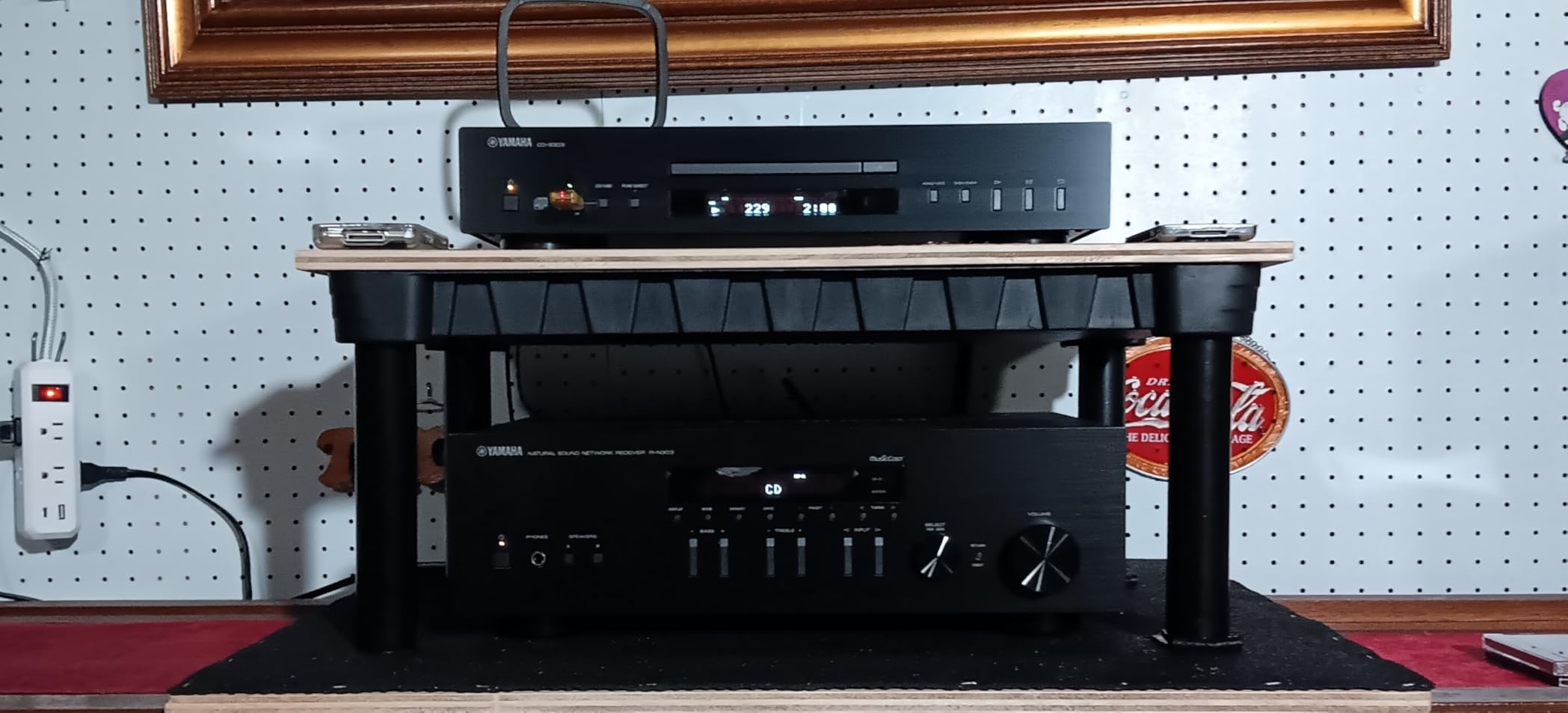
The technical details support that framing. A high-performance DAC is specified for high conversion precision with low noise, the laser pickup uses a floating mechanism to damp vibration during reading, and CD-R/RW discs are supported. The front-panel USB port handles MP3, WMA, LPCM, AAC and FLAC, and output level is quoted at 2V plus or minus 0.3V at 1 kHz, 0dB, which is the standard level for a component feeding an integrated amplifier.
The two-year manufacturer warranty is the longest in this roundup by a factor of two. For a device whose laser is expected to last decades, that is a meaningful signal from the manufacturer about expected build quality, and it is worth more than any marketing claim about purity.
Why floating construction matters on a disc player
A disc spinning at high speed is a small, constantly moving mass. Any vibration it introduces lands directly on the signal being converted, which is why enthusiasts rank transport isolation so highly and why collector guides insist on buying players with good mechanical damping. The floating laser pickup suspends the reading assembly on its own damped platform so that the movement of the motor and spindle is not passed into the optical path.
You will not hear a dramatic difference on an entry-level amplifier in a small room. The argument for paying attention to it is that the effect compounds: better transport, cleaner data into the converter, quieter converter, and everything downstream of that is easier on your amplifier and your speakers.
Why it is the wrong choice for most beginners
There is no headphone jack, so it cannot be used at a desk, and there is no built-in amplification, so it makes no sound at all on its own. If you do not own an amplifier and a pair of speakers already, this product adds nothing until you buy them, and the total cost is far higher than any all-in-one system in this list.
It is also deliberately old-fashioned. No Bluetooth, no network streaming, single disc only, no carousel. For a buyer who wants a flexible modern hub for a living room, that is a limitation rather than a virtue. For a buyer who has settled on a stereo system and wants the source component to disappear into it, it is exactly right.
7. ROADOM Eight-in-One Desktop Player: Best for Wireless Earbuds
ROADOM Portable CD Player with Bluetooth, Hi-Fi Speakers & FM Radio
Eight functions in a 7.4 inch cube
Bluetooth transmit and receive modes
CD CD-R CD-RW MP3 and WMA
USB playback plus device charging
Pros
- 8-in-1 feature set in a compact desktop footprint
- Bluetooth transmitter mode sends CD audio to wireless earbuds
- Plays five disc formats including CD-R and CD-RW
- Clear stereo sound that stays undistorted at maximum volume
- USB playback plus device charging and a sleep timer
- 12-month after-sale warranty included
Cons
- AC adapter power only so it cannot run untethered
- Small built-in speakers limit bass and stereo separation
- Generic unbranded build with no named DAC specification
- The 7.4 inch cube is less pocketable than a true portable player
The ROADOM is the most consistent performer in the group by rating distribution. Buyers report 2992 reviews averaging 4.4 stars with a 70 percent five-star share and only a 5 percent one-star share, which is the tightest spread of any product we looked at, and the reason is that the feature list is unusually complete for a compact unit.
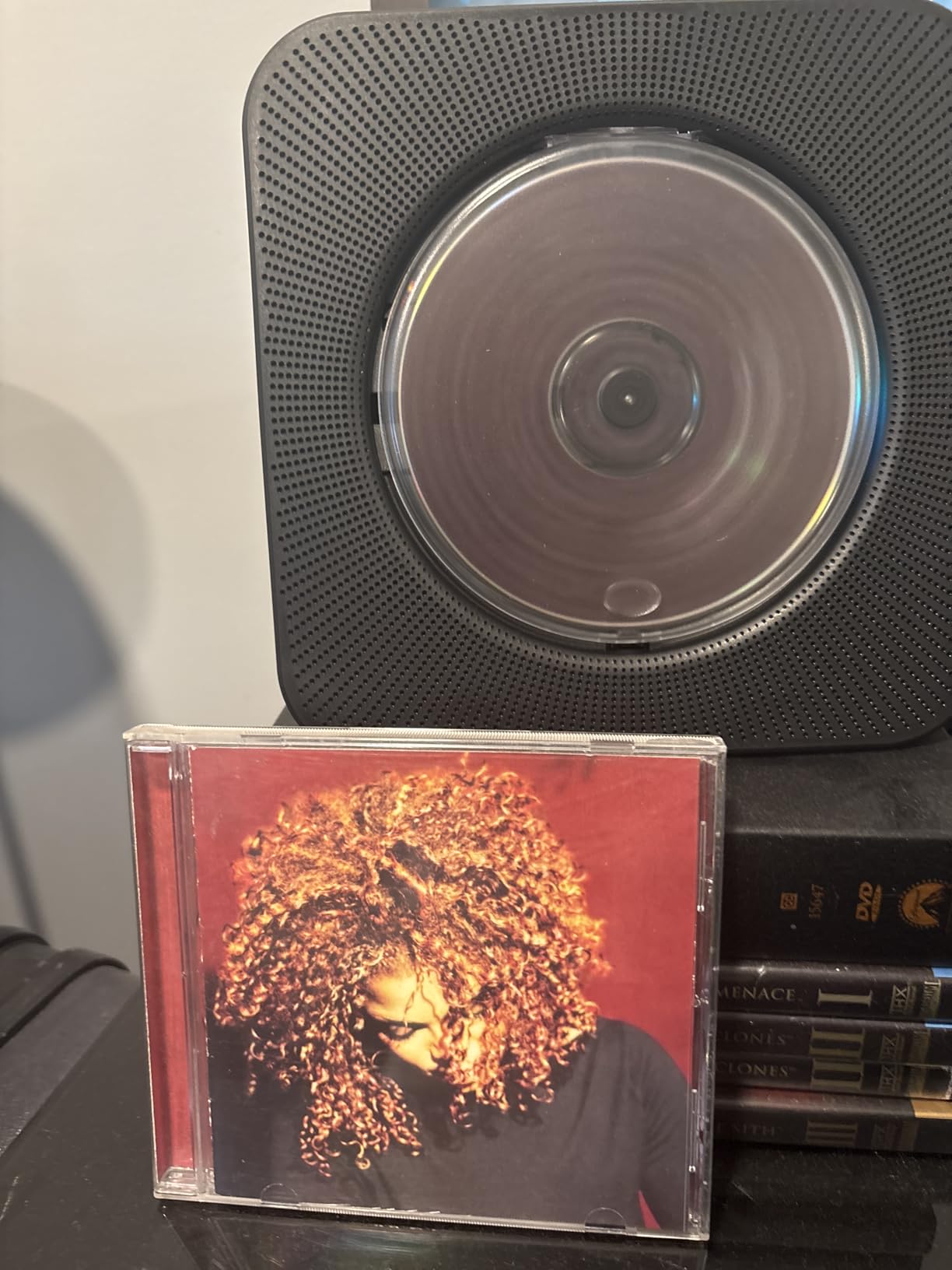
It is described as eight functions in one: CD playback, Bluetooth transmit and receive, FM radio, U-disk support, aux, a timer and repeat modes. Disc compatibility covers CD, CD-R, CD-RW, MP3 and WMA. The USB port plays MP3 and WMA and can charge a device, and there are 3.5mm aux input and output sockets alongside a sleep timer.
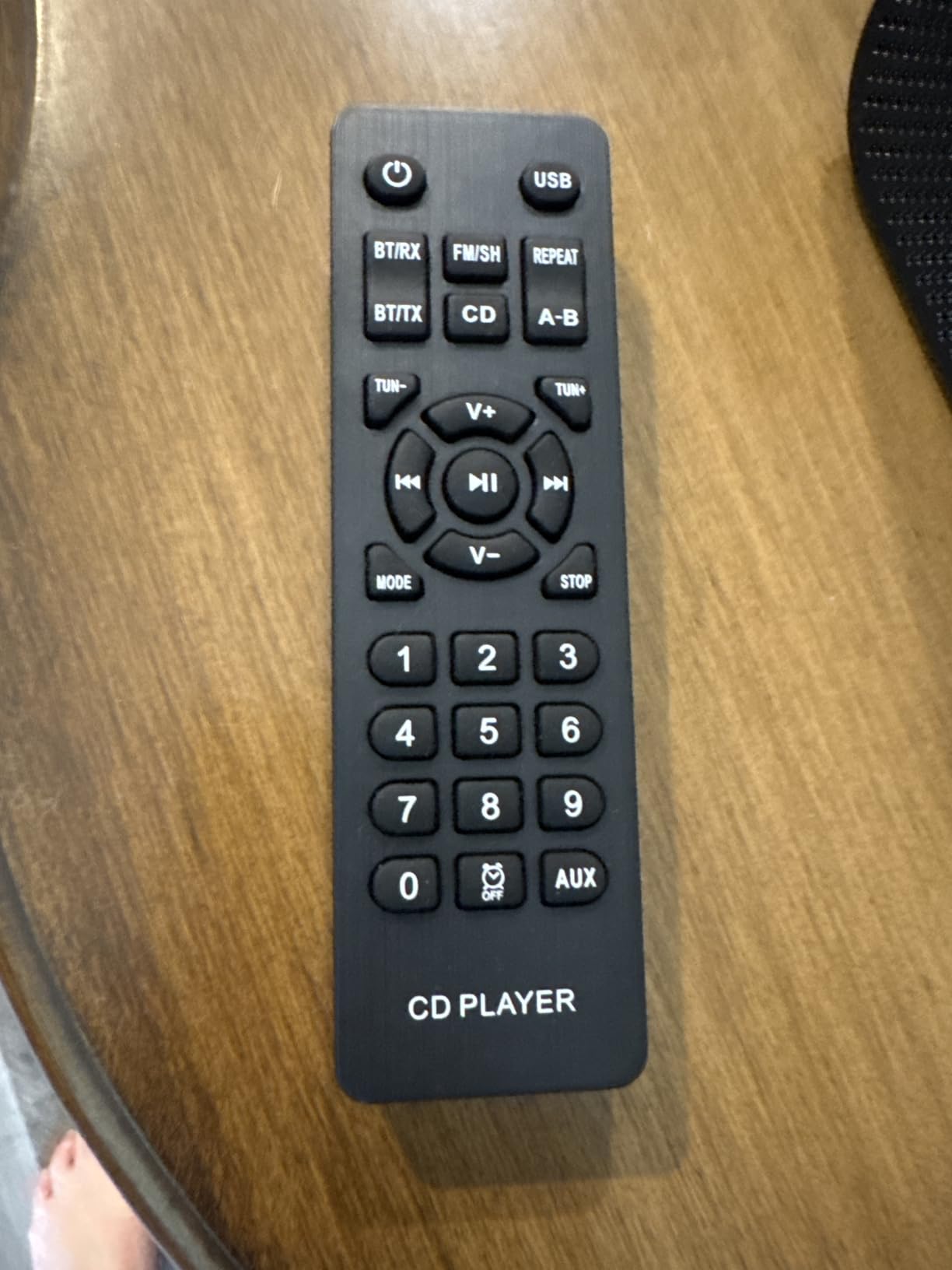
The transmitter mode is the part that changes how you listen. Set it in receiver mode and it pairs with your phone; switch to transmitter mode and the CD audio goes out to wireless earbuds or a Bluetooth speaker with no cable involved. Owners who have tried to do this with other compact players report resorting to cabled connections because most only receive.
Sound is described as clear stereo that stays undistorted even at maximum volume, with a built-in FM band from 76.0 to 108.0 MHz. At 7.4 inches on each side it is a desk object rather than a shelf component, and the retro styling suits a bedroom or an office.
What the transmitter mode is actually for
It solves a specific problem that no other budget unit here addresses: using decent headphones with a disc player without buying an amplifier. Most compact players have a 3.5mm output, which is fine, but it tethers you to the unit. Transmitting removes the cable and lets you walk around the room with your existing earbuds.
The trade-off is that Bluetooth re-encoding adds a step to the signal, so the result will not be bit-perfect. For most casual listening the difference is small, and the convenience is large. If you are the kind of listener who cares about the conversion path itself, this is the wrong feature to be excited about.
Where it stops short
Power comes from a 5V/2A AC adapter only, so despite the category label it is not portable in the way the Jensen and Megatek boomboxes are. The small built-in speakers set a limit on bass and stereo separation that the shelf systems above do not have.
There is also no named converter specification. The listing does not identify a DAC chip, and that is typical at this tier, which means you cannot compare the conversion quality on paper with anything else. The 12-month after-sale warranty is better than the 6-month term on the Gueray, but there is no recognisable brand behind the support.
8. Jensen CD-490 Boombox: The One That Runs on Batteries
JENSEN CD-490 Portable Stereo CD Player with AM/FM Radio and Aux Line-in, Red and Black
Top-loading CD with CD-R/RW support
Manual AM and FM tuning with telescopic antenna
AC or 8 C battery operation
1.5W per speaker with headphone jack
Pros
- Manual tuner with a physical antenna pulls in stations in poor-signal areas
- Reliable CD playback including self-burned CD-R discs
- Simple dial controls with no app required
- Runs on AC or 8 C batteries for genuine portability
- Stereo headphone jack plus an aux input
- Light at 3.4 lb with a legible LED track display
Cons
- Only 1.5W per speaker so volume is modest
- No bass and no tone controls with a tinny character
- Small buttons and knobs are difficult for small hands
- Programmed playback memory is erased once the program finishes
- Only a 90-day warranty
- US-style power supply is incompatible with some local mains
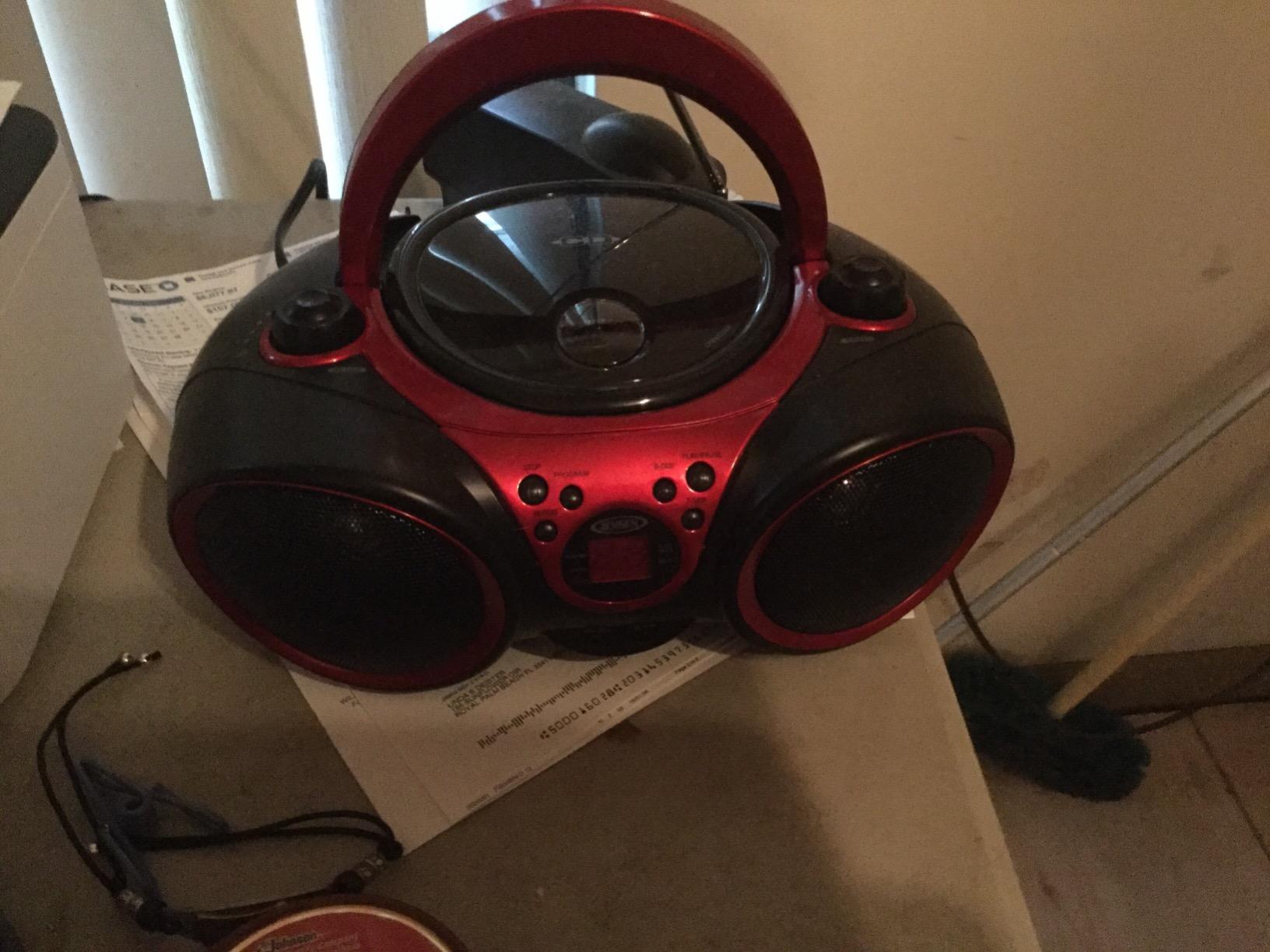
The Jensen is the only product here that is genuinely portable in the old sense. It runs on AC 120V/60Hz or eight C batteries, not included, and folds out a carrying handle. At 3.4 lb it moves from a kitchen to a garden to a picnic without hunting for a socket, which no other model in this roundup can do.
The CD mechanism is top-loading, CD-R/RW compatible, and has an LED track display. Skip and search forward and back, repeat one or all, and programmable memory cover the basics. There is a stereo headphone jack, which the all-in-one systems below mostly lack, and an aux line-in for an external player.
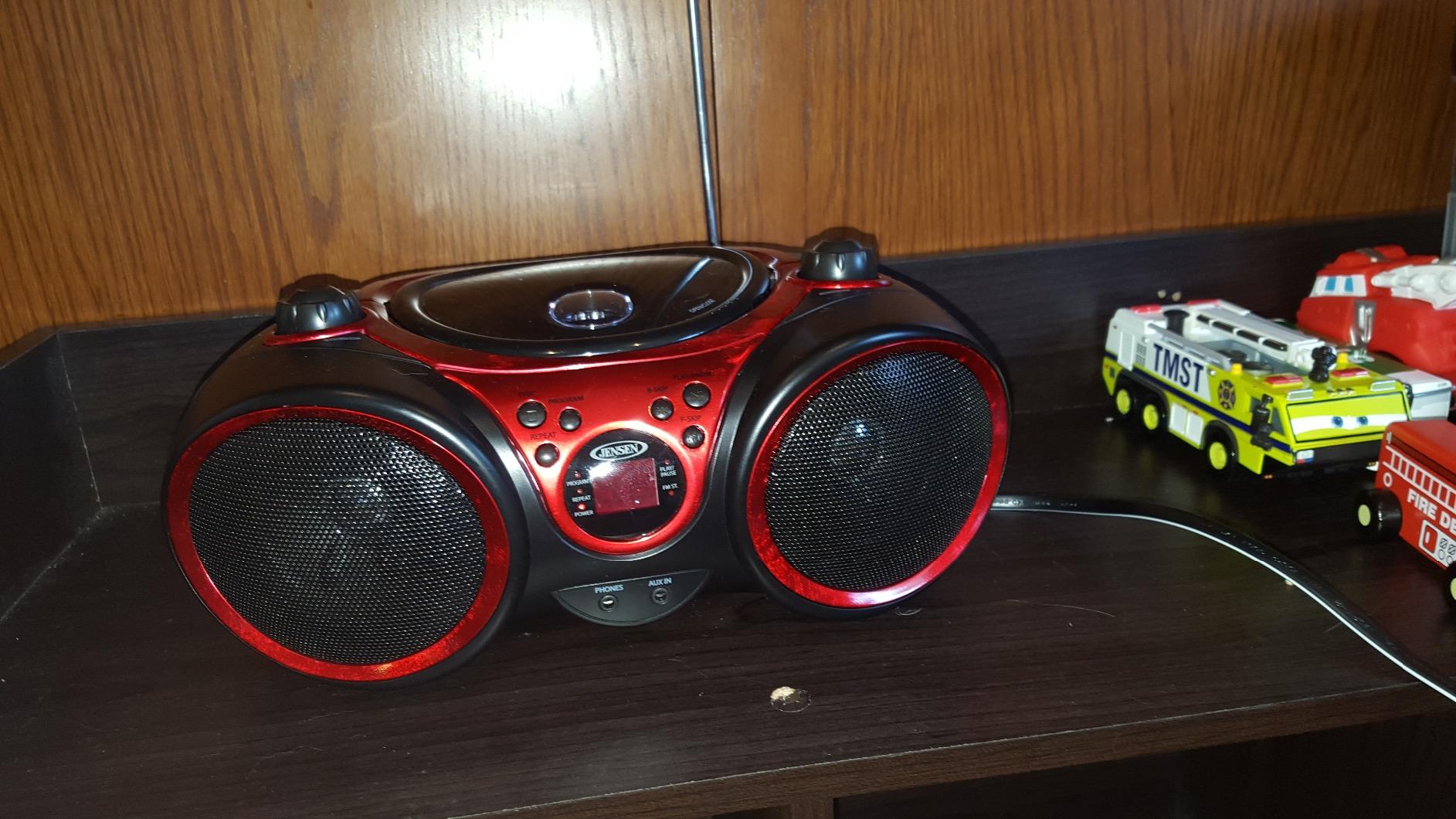
What makes it distinctive is the radio. The AM and FM stereo receiver is manual, with a physical telescopic antenna, and owners in poor-signal areas single that out as the reason they bought it. Every digital tuner in this roundup will find weak stations that this one locks onto. Buyers report 7493 ratings averaging 4.2 with a 62 percent five-star share.
The simplicity is deliberate. Dial knobs, no app, no pairing sequence, no display to navigate. For older users or anyone who wants an object that behaves the same way it did twenty years ago, that is a feature rather than a compromise.
Judge this one on output power honestly
Two times 1.5W RMS is the entire amplification budget, and the reviews are consistent about what that means. It is adequate in a quiet room and inadequate in a busy one. There is also no bass and no treble control, so the tinny character owners describe cannot be corrected with tone settings.
If you want to play music outdoors or in a workshop, the Megatek further down this list gives you four watts, larger drivers and a backlit display, and it is the better buy for the same reason. The Jensen earns its place on battery capability, radio reception and simplicity, not on sound quality.
The durability and warranty questions
Here is the honest concern. The warranty is a 90-day limited term, the shortest of any product in this roundup, and there is at least one documented failure after about ten months. Buyers also report that programmed playback memory is erased once the program finishes, contrary to what the manual states.
For a boombox that lives in a garage and gets carried outside in the rain, that combination of a short warranty and long service life expectations is worth weighing carefully. A 90-day term gives you a window to find manufacturing faults and nothing more. If longevity is your priority, the 12-month terms on the Megatek and the ROADOM are more realistic, and the two-year term on the Yamaha is better still.
9. Megatek CB-M25BT Boombox: The Most Battle-Tested Model Here
MEGATEK Portable CD Player Boombox with Bluetooth & FM Radio – Black
Top-loading CD and CD-R/RW CD-G
2.7 lb with AC or 4 C battery power
Dual 3 inch speakers with 5 EQ modes
95 dB signal to noise and 4 watts
Pros
- Largest review base in this roundup at 13221 ratings
- Number one ranked boombox in Electronics
- Genuinely portable at 2.7 lb on AC or 4 C batteries
- Large buttons top dials and a backlit LCD that are easy to operate
- Dual 3 inch front-firing speakers with 5 EQ modes
- Top-loading drive plays CDs CD-R/RW CD-G and audiobooks
Cons
- No remote control included
- FM only with no AM band
- Bluetooth is receive-only with no transmitter mode
- USB playback limited to FAT32 drives of 128 GB or less
- Only 4 watts of output for larger rooms
- Speaker grilles and cones are exposed with no covers
With 13221 ratings this is the most reviewed product in the roundup by a wide margin, and it ranks number one in boomboxes in the Electronics category. That volume of history is itself useful information: it means a decade of manufacturing history and a large body of owners reporting on long-term reliability, which is exactly what the collector forums tell beginners to look for.
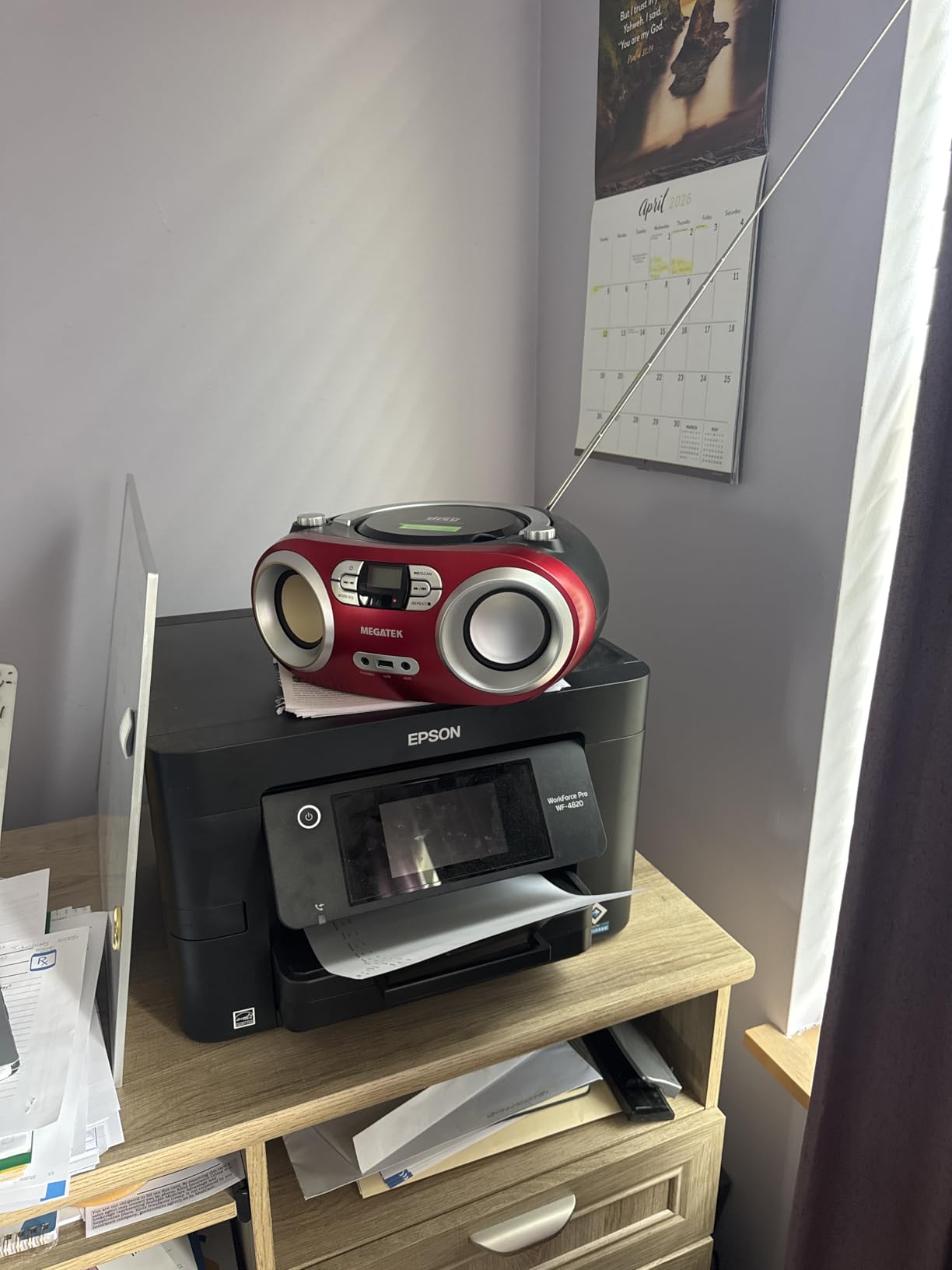
The design is deliberately simple. Large buttons, top dials and a backlit LCD, with dual 3 inch front-firing speakers and five EQ modes. The top-loading drive reads CDs, CD-R/RW, CD-G, audiobooks and MP3 or WMA discs, with shuffle, repeat and resume. The digital FM tuner stores 30 presets. Bluetooth playback works as a receiver from a phone, tablet or laptop.
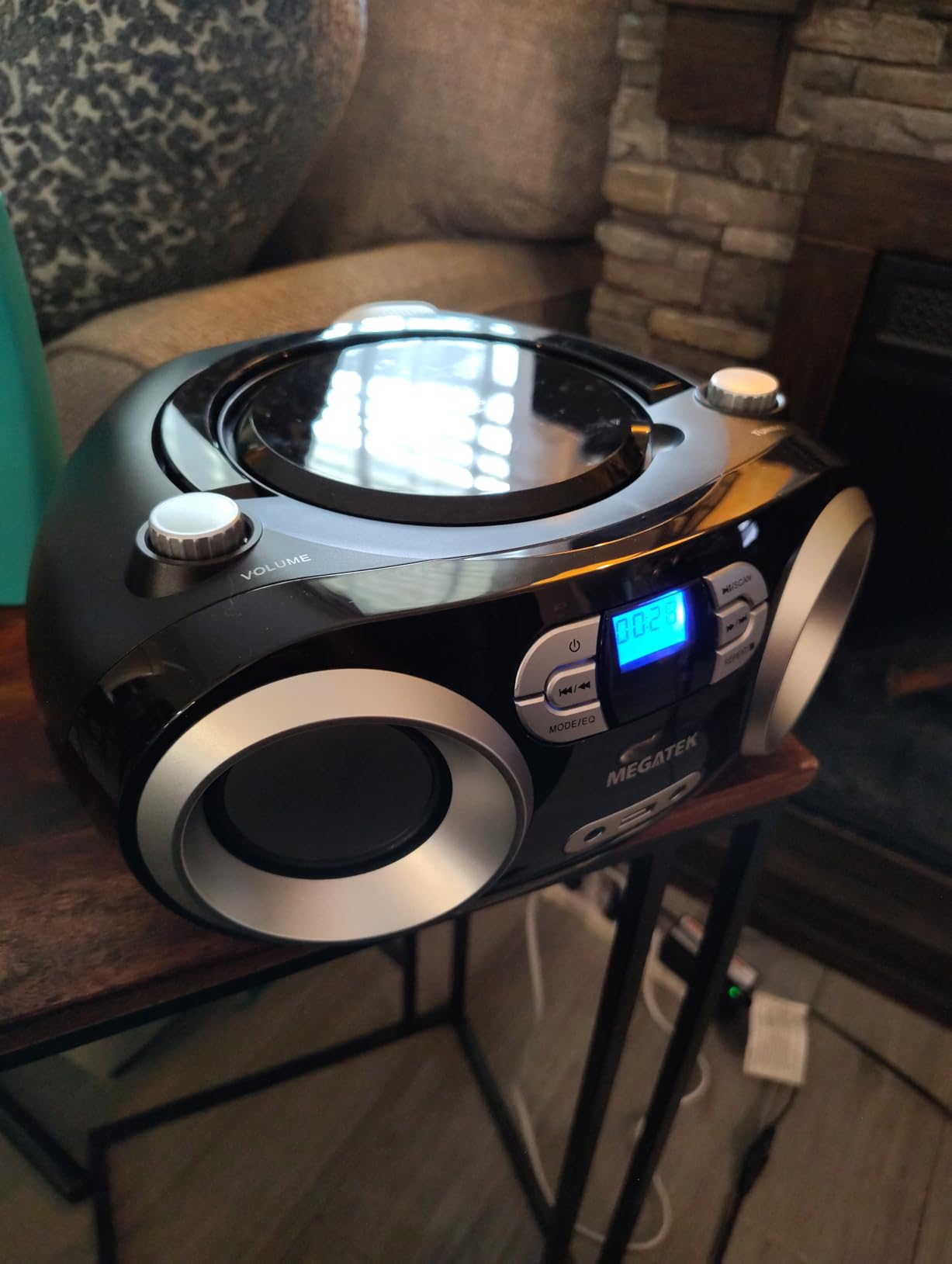
Portability is real at 2.7 lb on AC or four C batteries. Reviewers repeatedly highlight the ergonomics, particularly for older users: the buttons are large enough to find without looking and the backlit display is readable in a dim room. Buyers report 13221 ratings averaging 4.2 with a 65 percent five-star share.
Output is four watts, quoted across a 100 Hz to 20 kHz response with 95 dB signal to noise. That is more than the Jensen and less than the shelf systems, and it is enough for a bedroom, a kitchen or a deck but not for a busy workshop.
Why ergonomics decide this one for some buyers
The fastest way for someone to dislike an audio product is to fail to operate it. Large buttons, physical dials and a backlit display remove the three most common frustrations with compact electronics: tiny controls buried in menus, a capacitive panel that stops responding when your hands are damp, and an unreadable display.
This is the model to choose if the player will be used by a parent, an older relative or anyone who does not want to deal with a pairing button. Buyers consistently describe the layout as easy to see and operate, and the top dials can be adjusted by feel alone.
What the specification limits cost you
Several features are missing or capped, and each is a real limitation. There is no remote control in the box. The radio is FM only, with no AM band. Bluetooth is receive-only, so unlike the Gueray and the ROADOM you cannot send disc audio to wireless earbuds. USB playback handles MP3 and WMA on FAT32 drives of 128 GB or less, so a modern exFAT stick will not read.
One physical detail to inspect on arrival: the speaker grilles and cones are exposed with no protective covers, which matters if the unit lives in a dusty space or travels in a car. Batteries are not included and alkaline cells give the best results.
10. Philips 80W Bluetooth Stereo System: The Most Modern Feature Set
Philips Bluetooth Stereo System for Home with CD Player, Bluetooth 5.4 & Auracast, Upgraded 80W Stereo Sound, MP3, USB, Audio in, FM Radio, Bass Reflex Speaker, Remote Control Included
80W RMS with 4 inch woofers and 0.75 inch tweeters
Bluetooth 5.4 with Auracast
USB playback of MP3 WAV WMA and FLAC
LED display with clock alarm and sleep timer
Pros
- 80W RMS with genuine 2-way drivers and separate tweeters
- Bass reflex ports deliver deep low end unlike the smaller Philips systems
- Bluetooth 5.4 with Auracast is the newest wireless standard here
- Widest source support including FLAC from USB
- App gives real EQ and bass and treble adjustment
- LED display with clock alarm and sleep timer
Cons
- Heaviest unit here at 15.1 lb so it is not portable
- Wired AC power only with no battery option
- Requires a compatible smartphone for EQ adjustment
- Only a 1-year warranty
- Corded-only connectivity for the extra inputs
This is the Philips to buy if you want the newest features. It runs Bluetooth 5.4 with Auracast support, meaning it can pair faster, hold a stronger connection and broadcast its audio to other Auracast-compatible speakers, which makes it the only unit here that can share what it is playing with a second device wirelessly.
The amplification is a genuine step up from the micro system earlier in this list. Eighty watts RMS drives upgraded 2-way bookshelf speakers with 4 inch woofers, 0.75 inch tweeters and bass reflex ports, and owners specifically contrast the deep low end against the 18W and 20W Philips models they considered first.
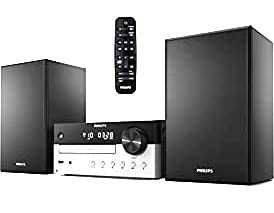
Source support is the widest here. The built-in player handles CD, CD-R/RW and MP3 CDs, and the USB port reads MP3, WAV, WMA and FLAC. There is an FM digital radio with presets and a 3.5mm audio-in for external devices. The Philips Entertainment app adds Digital Sound Control, bass and treble adjustment, custom EQ and source selection from your phone, which none of the other systems in this roundup can do properly.
The display is an LED panel with a clock, an alarm and a sleep timer, and a remote is included. Buyers report 1485 ratings averaging 4.3 with a 67 percent five-star share, and the recurring positive is that the sound fills a larger room with deep bass while remaining clear at the top end.
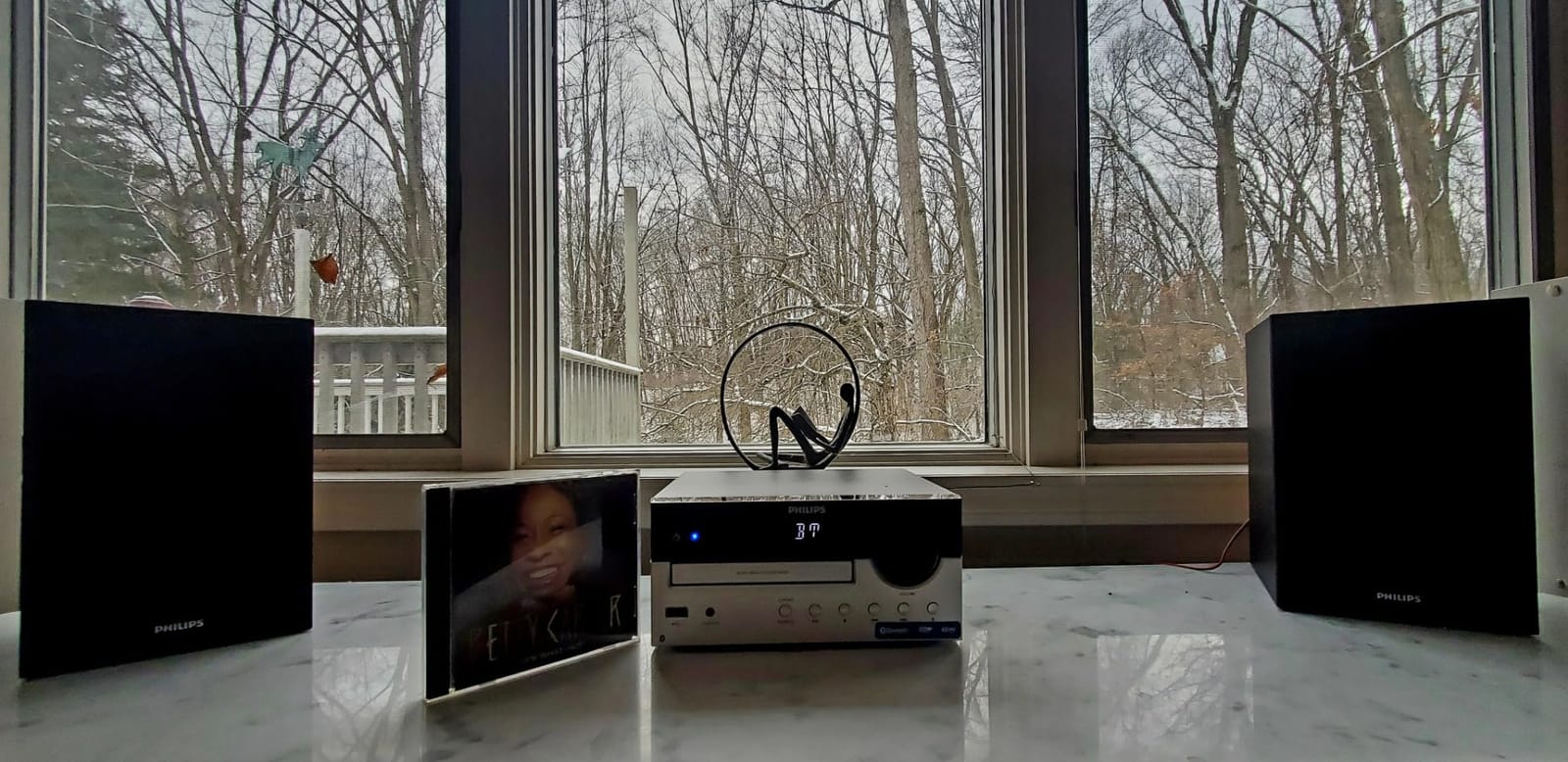
Deciding between the three Philips systems
All three Philips systems appear in this roundup, so it is worth naming the rule rather than leaving you to compare three spec sheets. The micro system is for a small room on a tight budget and accepts limited bass. The FX10 is for maximum volume and the deepest bass, with no headphone output and an EQ you cannot switch off. This 80W model is the balanced one, and the one to buy if you are not sure.
What sets it apart from the FX10 is tone control. The app gives you actual bass and treble adjustment, custom EQ and Digital Sound Control, so you can correct the sound for your room and your speakers rather than accepting a fixed curve. For a listener who finds the processed signal on the FX10 unsatisfying, that is the feature that decides it.
The limits worth knowing before you order
It weighs 15.1 lb, the heaviest unit in the roundup, and it runs on wired AC power with no battery option, so it stays where you put it. It is also the only system here that depends on a smartphone for meaningful tone adjustment, which is fine if you own a current phone and frustrating if you share the system with someone who does not.
The warranty is one year, half the term of the Yamaha component. Given that the CD drive is the component most likely to fail and that a laser replacement is a repair few hobbyists will attempt, the warranty length is worth comparing carefully against the alternatives. We also note that the extra inputs are all corded, with no record player or tape deck support.
How to Choose a CD Player in 2026
The first question is not technical at all. It is whether you already own an amplifier and a pair of speakers. If you do, you want a component like the Yamaha CD-S303 and nothing else in this roundup will serve you better. If you do not, you want an all-in-one system, and the remaining eight products are the shortlist.
Component or all-in-one: the decision that matters most
A component has one output, usually a pair of RCA stereo sockets, and produces no sound until you connect an amplifier. It exists so the disc signal gets converted once, cleanly, and goes into equipment designed for that job. It gives you the lowest noise, the most control, and the smallest footprint of anything here. It also costs the most once you add the amplifier.
An all-in-one system bundles a CD drive, an amplifier and a pair of speakers in one or two boxes. It plays immediately out of the box, costs less in total, and fills a room. What it cannot do is be improved. When the speakers or the amplifier eventually fail, you replace the whole thing rather than one part.
A third option sits between the two: a compact desktop player with a headphone jack and a 3.5mm line output. Plug decent headphones into the Gueray or the ROADOM and you get desk listening without buying an amplifier at all. That is the most common way people use these products, and almost no dedicated component supports it.
The headphone output is the spec most buyers overlook
Six of the ten products here have no headphone jack. That includes the Onkyo changer, the Yamaha component and all three Philips shelf systems, which is a striking gap in a category where a large share of listening happens at a desk. Before you buy, decide whether you will listen with headphones, because that single question eliminates more options than price does.
Where a jack is present, check whether it is accompanied by a real volume control, and check what it is driving. The Gueray, the ROADOM, the Jensen and the Megatek all have a 3.5mm jack with volume. The Gueray’s also doubles as a wired speaker output, which makes it the most flexible of the group for growing into.
What the DAC actually does and why it is the spec that matters
A digital-to-analog converter rebuilds the 1s and 0s coming off the laser into a continuous analogue voltage that your amplifier can drive a speaker with. Every CD contains exactly the same 16-bit, 44.1kHz data, so the converter is where a player either preserves that data faithfully or does not. This is the plain-English reason the DAC chip is the spec enthusiasts quote, and the reason the vintage buying guide puts DAC quality second only to durability.
Where a manufacturer names a chip, you can compare it. The Onkyo quotes 192 kHz/24-bit conversion with a Direct Digital Path and a 352.8 kHz digital filter, and the Yamaha describes a high-performance DAC specified for high conversion precision and low noise without naming a chip. Where nothing is specified, as on most of the compact units here, you cannot compare on paper and should judge on reviews instead.
One important nuance: a 192 kHz/24-bit rating on a CD player does not mean it outputs 192 kHz audio. A CD is 44.1 kHz and 16-bit, and the extra capability refers to how the converter and digital filter are built, plus what the unit can accept through USB.
Do you need an external DAC?
Rarely, if your player has a good built-in converter and you are feeding a normal amplifier. The threshold collectors and forum regulars generally describe is this: a dedicated converter in the low hundreds becomes worthwhile when your player has no digital output, when you are driving difficult headphones, or when you want to compare upgrades rather than buy them.
There is also a second case worth naming. Some budget players have no digital output at all, which means no external converter is possible regardless of budget. Check for optical or coaxial digital output before you start shopping for a converter, and check that the player you own actually has one. Nothing else in your chain matters if the signal cannot leave the box in digital form.
Our practical view is that buying a better CD player and then a converter is a sequence, not a bundle. Fix the source first, because a converter cannot repair noise generated upstream, and a player with no digital out cannot be paired with one at all.
How to connect a CD player to your system
To a stereo receiver or integrated amplifier, use one stereo RCA cable from the player’s red and white outputs to a free CD or AUX input on the receiver, then select that input. This is the arrangement for the Yamaha and the Onkyo, both of which ship with or expect a stereo RCA cable. The volume and source selection then happen on the amplifier, which is the correct division of responsibility.
To powered speakers, run the same stereo RCA cable from the player to the analogue input on each speaker, and set the level on the player. Most powered speakers accept RCA, some accept 3.5mm, and a few accept both. This is the arrangement for the compact desktop units, where the 3.5mm output is the only analogue path.
To headphones, plug a 3.5mm cable into the player’s headphone jack and set the volume on the player, provided the player has one. Do not use the headphone jack as a line output into an amplifier, because the level and impedance are wrong and the result will be quiet and distorted.
To an external converter, connect the player’s optical or coaxial digital output to the matching input on the converter, then run the converter’s analogue output to your amplifier. Optical and coaxial carry the same digital signal; optical avoids ground loop hum over long cables, coaxial sounds marginally cleaner over a short one. Use whichever the player offers and the cable length suits.
What to check when buying a used CD player
Buy used and the laser becomes the question, because it is the part that consumes itself and the part that is expensive to replace. Ask directly how often the unit was used and whether the laser has ever been replaced. A player that has sat unused for years is a different proposition from one that played daily for a decade.
Test it if you can. Load a disc, let it play for a full track, skip forward and back several times, and listen for skipping, grinding or a disc that takes more than a second or two to spin up. Skip protection can mask a weak laser, so skip back and forth repeatedly rather than playing one long album.
Then check the tray and the mechanism. Feed a disc in and out five times and confirm the door closes reliably and the tray tracks back in. Collectors name unreliable tray mechanisms and cheap buttons as deal-breakers, and that advice holds. A unit with a smooth door and firm buttons will outlast one with a spec sheet advantage.
Finally, check the outputs and the remote. Confirm the RCA sockets are clean and tight, and if a digital output is present, test it too. Check that the remote responds, and ask whether one is included. A missing remote for a component with physical buttons is an inconvenience, not a problem.
Which spec claims are worth ignoring
The forums repeat one instruction more than any other: skip the snake oil. Claims about purity, reference status and proprietary processing usually describe circuitry you cannot measure from the outside, and at this budget they rarely correspond to an audible difference. What does correspond to an audible difference is the converter, the output stage, the transport isolation and whether the mechanism is built to last.
Be sceptical of resolution figures quoted without a chip name, of any claim that a filter removes something audible that no measurement supports, and of words like reference applied to a unit with no headphone output. The useful specs are the ones you can compare across models: the DAC description, the output options, the disc formats, the weight, the warranty and the number of reviews behind the product.
And check the review count before you check the star rating. All ten products here sit between 4.2 and 4.5, a spread narrow enough that the rating barely separates them. What separates them is how many people have owned them long enough to report a fault, which is why the two-year warranty on the Yamaha and the 90-day term on the Jensen tell you more than their ratings do.
Related reading on other playback hardware: we have covered disc-adjacent boxes in our best 4K Blu-ray players for cinephiles guide if your system needs a universal disc source.
Frequently Asked Questions
What is the best buy home CD player?
For most households the best buy home CD player is an all-in-one system with built-in speakers, because it plays immediately with nothing else to buy. In our testing the Gueray six-in-one desktop unit was the most versatile, covering discs, Bluetooth in both directions, USB and TF cards in one small box. If you already own an amplifier and speakers, the Yamaha CD-S303 is the better source component.
What is the best audio CD player for home use?
The best audio CD player for home use depends on whether you need speakers. With existing speakers and an amplifier, the Yamaha CD-S303 is the strongest dedicated source, with a floating laser pickup, a high-performance DAC and a two-year warranty. Without them, the Philips 80W system is the best-sounding complete option, with 2-way drivers, bass reflex ports and an app for tone control.
What CD player is as good as Bose?
That comparison mixes two different categories. Bose makes speakers, not CD players, so a CD player cannot be better or worse than one. What people usually mean is a CD player that sounds as good as a premium speaker system. At these prices, nothing reproduces faithfully enough to match a flagship speaker, but the Philips 80W system and the Aiwa Exos both clear mid-range speakers and are the closest comparisons worth making.
Are CD players being phased out?
No. Every product in this roundup is currently manufactured, and demand indicators show strong category rankings, with several units placed first or second in their Amazon categories. More importantly, discs are not a subscription service, so a collection bought today is still playable in twenty years with no provider involved. The realistic long-term risk is laser failure rather than discontinuation, which is why build quality and warranty length are the specs to compare.
Should I use a DAC with my CD player?
Usually not. A player with a competent built-in converter and a clean analogue output will not be improved by adding a separate converter to the same chain. It becomes worthwhile when your player has no digital output at all, when you are driving demanding headphones, or when you want a single upgrade path that improves several sources at once. Check for optical or coaxial digital output before shopping, because many budget players cannot pass a digital signal to an external converter.
The Best CD Player for Your Setup
Ten models, one conclusion: the best CD players are not one product but three correct answers. If you want the most capable single box for the money, the Gueray wins on versatility with 8554 reviews behind it and no other model here transmitting and receiving Bluetooth in the same unit. If you own a large collection, the Onkyo DX-C390 is the only changer here and the only player that lets you swap five discs while one keeps playing. If you already have an amplifier and speakers, the Yamaha CD-S303 is the only true component, and it carries the highest rating in the group at 4.5 stars with the longest warranty at two years.
Everything else on this list is a variation on a theme: how much built-in sound, how much wireless and how much of it fits on a shelf. Choose the one whose answer to that question matches your room, and check the headphone jack before you pay for anything.