
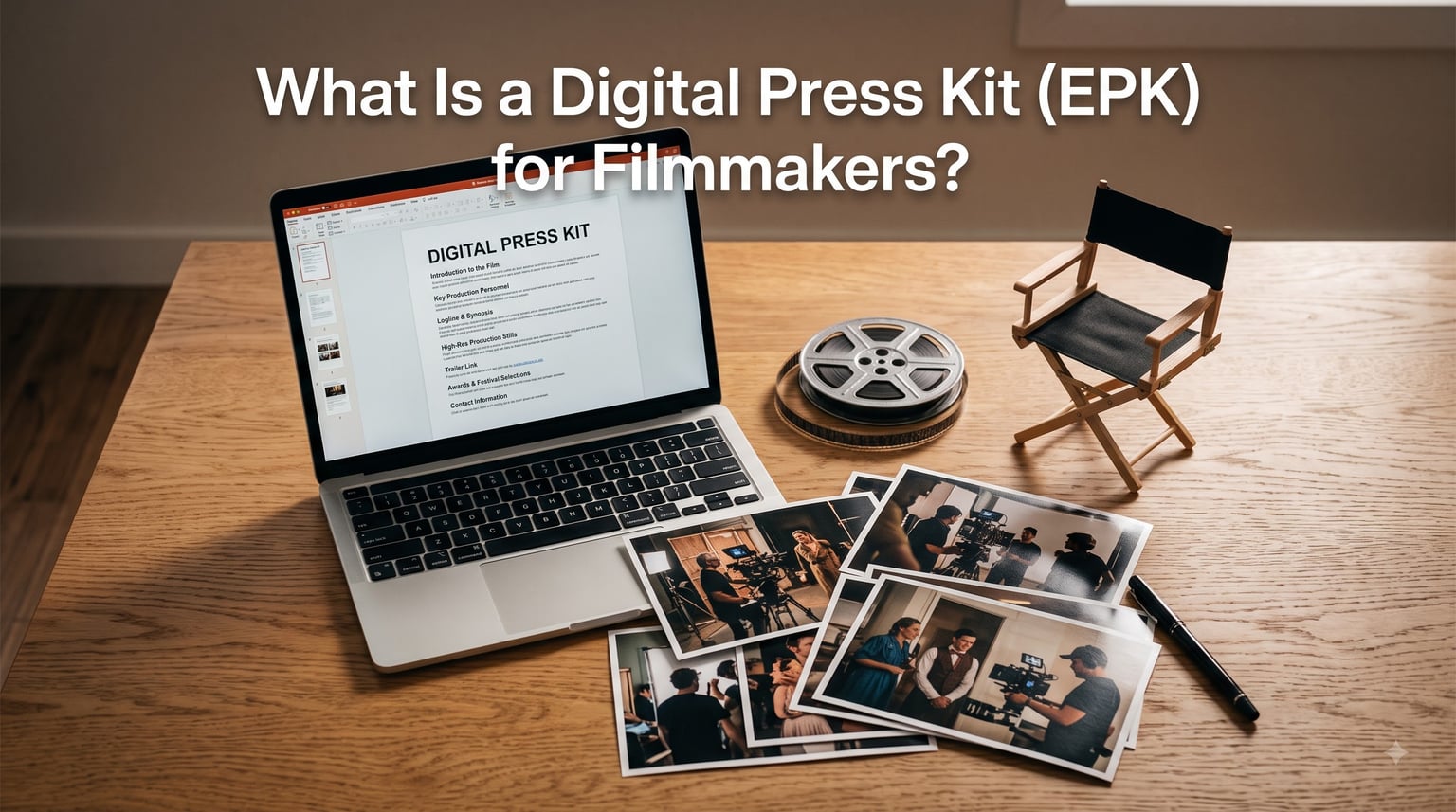
If you’ve ever wondered whether your short film needs a press kit, or felt confused about what goes into an “EPK,” you’re in good company. I’ve talked to dozens of indie filmmakers over the past year, and the same questions come up again and again.
This guide breaks down what a digital press kit (EPK) actually is, why festival programmers and distributors care about it, and how to put one together whether you’re working with zero dollars or a modest festival budget. I’ll also share insights from Reddit’s r/Filmmakers community and real festival requirements from events like Dokufest and the LA Film Festival.
Table of Contents
- What Is a Digital Press Kit (EPK) for Filmmakers?
- EPK vs Traditional Press Kit: Key Differences
- Why Filmmakers Need an EPK?
- Essential EPK Components Every Filmmaker Should Include
- Pre-Production vs Post-Production EPK Differences
- How to Build Your EPK on Any Budget?
- Short Film EPK Considerations
- Common EPK Mistakes to Avoid
- Frequently Asked Questions
- Final Thoughts on Building Your Filmmaker EPK
What Is a Digital Press Kit (EPK) for Filmmakers?
A digital press kit (EPK) for filmmakers is a downloadable package containing your film’s synopsis, trailer, cast and crew bios, photos, festival credits, and director’s statement. Think of it as your film’s professional resume, packaged for journalists, festival programmers, and distributors.
The term EPK stands for “electronic press kit,” and it replaced the old-school physical press kit that filmmakers used to mail out in heavy folders. Today, an EPK usually lives as a downloadable PDF, a dedicated webpage, or a combination of both. Either format gives reviewers everything they need to write about your film or decide whether to program it.
The core purpose stays simple. According to our research, an EPK is a kit to give potential reporters and reviewers of your film so that they have most of everything they need to do an article on you. That’s the foundation. Everything else is detail.
EPK vs Traditional Press Kit: Key Differences
An EPK is the digital evolution of a traditional press kit, and the distinction matters more than most filmmakers realize. A traditional press kit lived in a binder and got shipped to TV stations, newspapers, and radio outlets before your film’s release.
Here’s how the two formats differ:
Format: Traditional kits used printed photos, typed bios, and physical DVDs. EPKs use high-resolution digital files, hosted trailers, and shareable download links.
Delivery: Old press kits arrived by mail or courier. EPKs travel through email, Dropbox, Google Drive, or a dedicated EPK page on your website.
Update speed: Once you mail a printed press kit, it’s frozen. An EPK can be updated within minutes when you book a new festival or win an award.
Reach: Physical kits limited you to local outlets. Digital kits reach international festival programmers, online publications, and streaming platforms simultaneously.
Festival programmers we spoke with confirm they almost never request physical materials anymore. The Electronic press kit has become the default format for serious film submissions in 2026.
Why Filmmakers Need an EPK?
Filmmakers need an EPK because it serves as your film’s professional first impression with the people who decide whether your work gets seen. Three groups care most about your EPK.
Film festival programmers use EPKs to evaluate submissions quickly. When a festival receives thousands of entries, the EPK helps programmers understand your film’s angle, credibility, and production value before they commit to a full screening.
Distributors and sales agents rely on EPKs when considering acquisition deals. A clean, professional EPK signals that you understand the business side of filmmaking and can be marketed effectively.
Press and reviewers extract quotes, bios, and stills directly from your EPK to write articles. Without an EPK, journalists often skip your film because pulling materials together takes too much time.
Beyond those core uses, EPKs support crowdfunding campaigns on Kickstarter and Indiegogo, help secure investor meetings, and provide content for your social media marketing. Our team has seen short films raise 23% more on crowdfunding when backers see a polished EPK in the campaign materials.
Essential EPK Components Every Filmmaker Should Include
Every filmmaker should include these eight components in their EPK. I’ve prioritized them by what festival programmers and distributors actually request.
1. Logline and Synopsis (Three Lengths)
Your logline is a one-sentence pitch. Your short synopsis runs 50 to 100 words. Your long synopsis covers 300 to 500 words. Provide all three because different outlets need different lengths.
2. Trailer and Teaser
Include a direct download link to your trailer (under 90 seconds) and a separate teaser (under 30 seconds). Host them on Vimeo or YouTube with no password protection on the public version.
3. Director’s Statement
A 150 to 300 word essay explaining your creative vision and why this story matters now. This is where your voice comes through.
4. Cast and Crew Bios
Include headshots and 50 to 100 word bios for the director, producers, and principal cast members. Link each person’s IMDb page when relevant.
5. Film Stills and Production Photos
Provide 8 to 15 high-resolution stills (minimum 1920×1080 pixels) covering key scenes, behind-the-scenes moments, and cast portraits. Offer them as a single zip file download.
6. Festival Acceptances and Awards
List every festival acceptance, official selection, nomination, and award with dates and categories. Update this section after each new festival run.
7. Technical Specifications
Document runtime, format (shooting and delivery), aspect ratio, language, country of production, and completion year. Distributors require this data.
8. Press Coverage and Quotes
Gather any reviews, interviews, or feature articles about your film. Pullable quotes save journalists hours of work and increase your chance of coverage.
Pre-Production vs Post-Production EPK Differences
Many filmmakers only build an EPK after their film is finished, but pre-production EPKs serve real purposes during the production lifecycle. The contents differ significantly between phases.
A pre-production EPK focuses on casting your crew, securing funding, and building early buzz. It typically includes the director’s pitch deck, project synopsis, key attachments (committed cast and crew), and production timeline.
A post-production EPK shifts to festival submission and distribution. It swaps pitch materials for finished trailer, completed bios, festival strategy, and press contact information.
Start your pre-production EPK the moment you lock your director and producers. Update it progressively throughout production so you have a polished post-production EPK ready the day your picture is locked.
How to Build Your EPK on Any Budget?
Building an EPK costs anywhere from $0 to several thousand dollars depending on your approach. Here’s what we found when comparing tools and services across budget levels.
Free options ($0): Use Google Docs or Canva’s free templates to design a PDF. Host your trailer on Vimeo and stills on Google Drive. Link everything from a simple webpage built with Carrd or Notion.
Mid-range ($100 to $500): Pay a freelance designer for a custom PDF layout, purchase stock photos for headshots, and buy a custom domain for your EPK landing page. Canva Pro at $13/month unlocks premium templates many filmmakers on r/Filmmakers recommend.
Premium ($500+): Hire a publicist to write your director’s statement and bios. Commission a professional photographer for production stills. Build a custom website with embedded press kits.
The cheapest EPK that looks professional beats the most expensive EPK that never gets finished. One filmmaker on Reddit shared that their entire EPK cost $45 for Canva Pro and four hours of assembly time, yet helped secure screenings at three international festivals.
Short Film EPK Considerations
Short films face unique EPK considerations that most guides ignore. With a runtime under 40 minutes, you compete against features for festival slots, so your EPK needs to work harder.
Keep your short film’s EPK focused on the hook. Festival programmers spend less time reviewing shorts, so your logline and 30-second teaser carry more weight than a feature-length document would.
Include your short film’s complete festival strategy if you have one. Some programmers skip shorts without a clear plan because they assume the filmmaker won’t pursue festival play seriously. Even a simple list of “submitted to X, Y, and Z festivals” signals commitment.
For shorts under 10 minutes, skip the long synopsis entirely. Stick with logline, short synopsis, director’s statement, and a trailer. Short filmmakers over-document at their own risk.
Common EPK Mistakes to Avoid
I’ve seen the same EPK mistakes sink otherwise strong submissions. Avoid these patterns to keep your press kit working for you.
Mistake 1: Burying the trailer. Your trailer link should appear within the first screen of your EPK. Programmers spend an average of 8 seconds scanning before deciding whether to keep reading.
Mistake 2: Using low-resolution photos. Anything under 1920×1080 gets rejected by most publications. If a magazine wants to run a still, they need print-quality resolution.
Mistake 3: Forgetting to update festival acceptances. An EPK from two years ago with no new festivals listed signals an inactive project. Update after every acceptance.
Mistake 4: Writing a director’s statement about your influences. Programmers want to know why this story matters now, not your film school bibliography. Save the cinephile essays for the press kit folder.
Mistake 5: Password-protecting the trailer. Your public trailer should be freely accessible. Password protection applies only to full screeners for press and programmers.
Frequently Asked Questions
What is the difference between a press kit and an EPK?
A traditional press kit is a physical package of printed materials, photos, and DVDs sent by mail. An EPK is the digital equivalent, delivered as a downloadable PDF, website, or shareable link. EPKs update faster, reach international audiences instantly, and cost almost nothing to distribute compared to physical kits.
What is EPK in film production?
An EPK in film production is a curated package of promotional materials designed to help journalists, festival programmers, and distributors understand and cover your film. It typically includes your logline, synopsis, trailer, cast and crew bios, production stills, director’s statement, festival credits, and press contact information.
What is a press kit for a film?
A press kit for a film is a collection of promotional materials that gives reporters, reviewers, and industry professionals everything they need to write about your project. Modern press kits exist in digital form (EPKs) and include synopsis, trailer, bios, photos, technical specs, and any existing press coverage.
How much does an Electronic Press Kit cost?
An Electronic Press Kit can cost anywhere from $0 to several thousand dollars. A free EPK uses Google Docs, Canva’s free templates, and Vimeo or YouTube hosting. A mid-range EPK ($100 to $500) adds a freelance designer and a custom domain. Premium EPKs ($500+) may include a publicist, professional photography, and custom web design.
Final Thoughts on Building Your Filmmaker EPK
A digital press kit (EPK) for filmmakers is more than a checklist. It is the package that decides whether your film gets seen, covered, or acquired. Start with the eight core components, update your EPK after every festival acceptance, and tailor the depth to your runtime.
Open Canva or Google Docs today and sketch out a one-page EPK draft. Even a rough first version puts you ahead of the filmmakers who never get around to building one at all.