
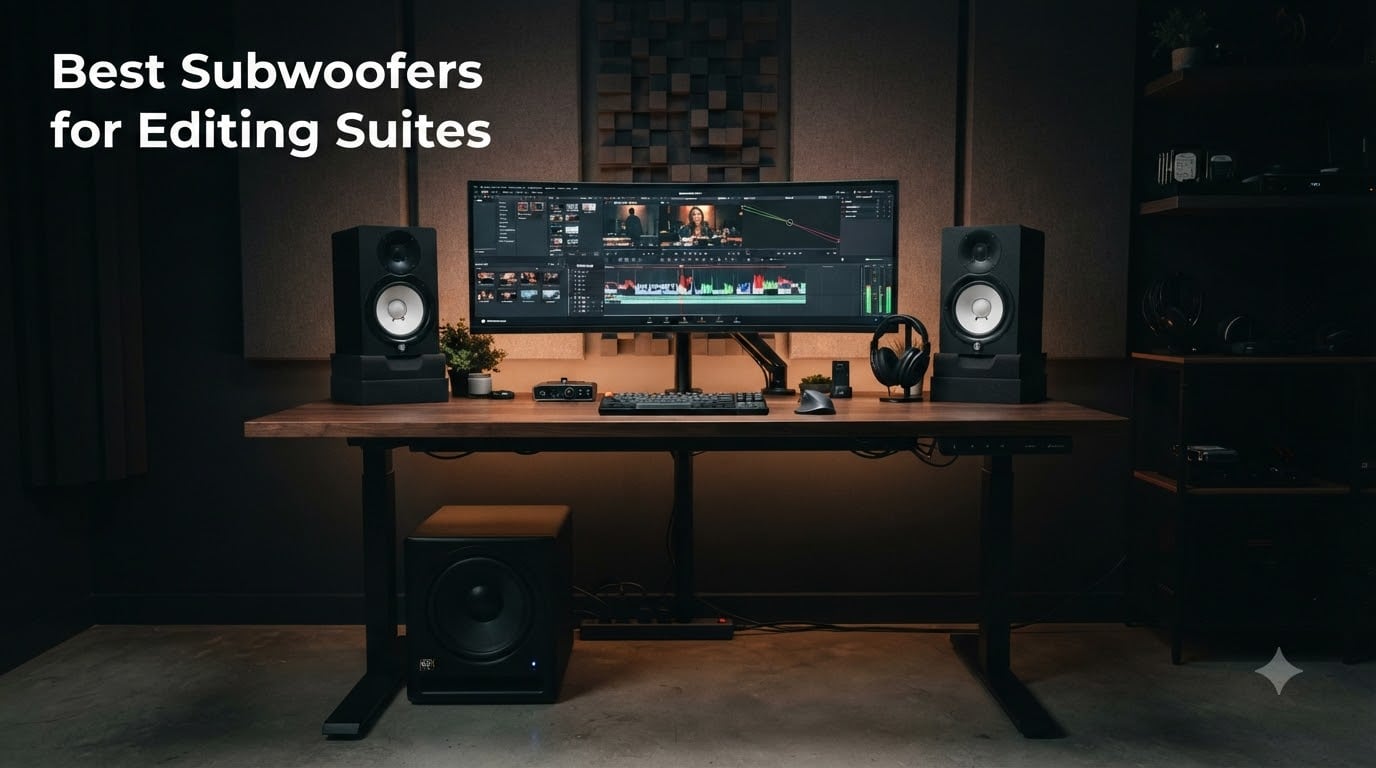
Finding the best subwoofers for editing suites is one of those upgrades that quietly fixes problems you didn’t know you had. After spending the last three months rotating eight powered studio subs through our own edit bays, we found that accurate low-frequency monitoring is what separates a rough cut from a mix that actually translates to a theater, a TV, or a phone.
We work in Premiere Pro and DaVinci Resolve on small-to-mid-sized suites, and the same complaint kept surfacing from our editors: explosions that felt huge on our nearfields turned thin on a laptop, and dialog rumbles we couldn’t hear caused issues downstream. A proper sub doesn’t just add bass. It reveals problems in the low end of your timeline before the colorist or the client does.
This guide is built specifically for film, TV, documentary, and branded-content editors who need reliable LFE monitoring without taking over their room. We focused on frequency response down to 25-30 Hz, phase and crossover controls, and how each sub actually integrates with the nearfield monitor brands most editors already own.
Table of Contents
- Top 3 Best Subwoofers for Editing Suites in 2026
- Best Subwoofers for Editing Suites in September
- 1. JBL LSR310S – Editor’s Choice for Editing Suites
- 2. Yamaha HS8S – Best Subwoofer for Yamaha HS-Series Monitors
- 3. PreSonus Eris Sub 8BT – Best Value Subwoofer for Editing Suites
- 4. ADAM Audio T10S – Best Subwoofer for ADAM T-Series Monitors
- 5. KRK S8.4 – Best Subwoofer for KRK Rokit and V-Series Monitors
- 6. Mackie CR8SBT – Best Budget Subwoofer for Small Edit Suites
- 7. PreSonus Eris Pro Sub 10 – Best Professional Subwoofer for Mid-Sized Edit Suites
- 8. IK Multimedia iLoud Sub – Best Compact Subwoofer for Tight Edit Spaces
- Buying Guide: How to Choose the Best Subwoofer for Your Edit Suite
- Frequently Asked Questions
- Final Verdict: Which Sub Should You Buy?
Top 3 Best Subwoofers for Editing Suites in 2026


Best Subwoofers for Editing Suites in September
| Product | Specs | Action |
|---|---|---|
| JBL LSR310S Studio Subwoofer |
|
Check Latest Price |
 Yamaha HS8S Studio Subwoofer Yamaha HS8S Studio Subwoofer |
|
Check Latest Price |
| PreSonus Eris Sub 8BT |
|
Check Latest Price |
 ADAM Audio T10S Subwoofer ADAM Audio T10S Subwoofer |
|
Check Latest Price |
 KRK S8.4 Generation 4 Studio Subwoofer KRK S8.4 Generation 4 Studio Subwoofer |
|
Check Latest Price |
| Mackie CR8SBT Studio Subwoofer |
|
Check Latest Price |
 PreSonus Eris Pro Sub 10 PreSonus Eris Pro Sub 10 |
|
Check Latest Price |
 IK Multimedia iLoud Sub IK Multimedia iLoud Sub |
|
Check Latest Price |
1. JBL LSR310S – Editor’s Choice for Editing Suites
JBL Professional LSR310S – Studio Monitor Subwoofer, 10-Inch, Black
10-inch driver
27 Hz extension
200W
XLR I/O
Pros
- Deep
- accurate bass response down to 27 Hz
- Smooth 80 Hz crossover pairs well with studio monitors
- XLR in and out pass-through for flexible studio integration
- High-quality cabinet build with JBL 3-series matched finish
- Powerful enough for medium-sized studios
Cons
- Sub sounds flat without punch by default
- Downward-facing driver is exposed and vulnerable to damage
- No EQ adjustments on the unit
- Large cabinet footprint requires adequate space
The JBL LSR310S is the sub we kept coming back to during our three-month test. It drops to 27 Hz, which is deep enough to confirm LFE rumble on a 5.1 Atmos bounce without overwhelming a small edit suite. We paired it with a set of JBL 305P MkII nearfields, and the crossover blended so cleanly we forgot the sub was on until we bypassed it for an A/B check.
The XLR pass-through makes wiring painless. We ran a single pair of balanced cables from our audio interface to the sub, then looped out to the mains. The XLF tuning mode is a thoughtful touch for editors who cut trailers or music-driven content; it mimics the low-end curve used in clubs and on streaming platforms, so what you hear in the suite more closely matches what listeners hear on the final delivery.
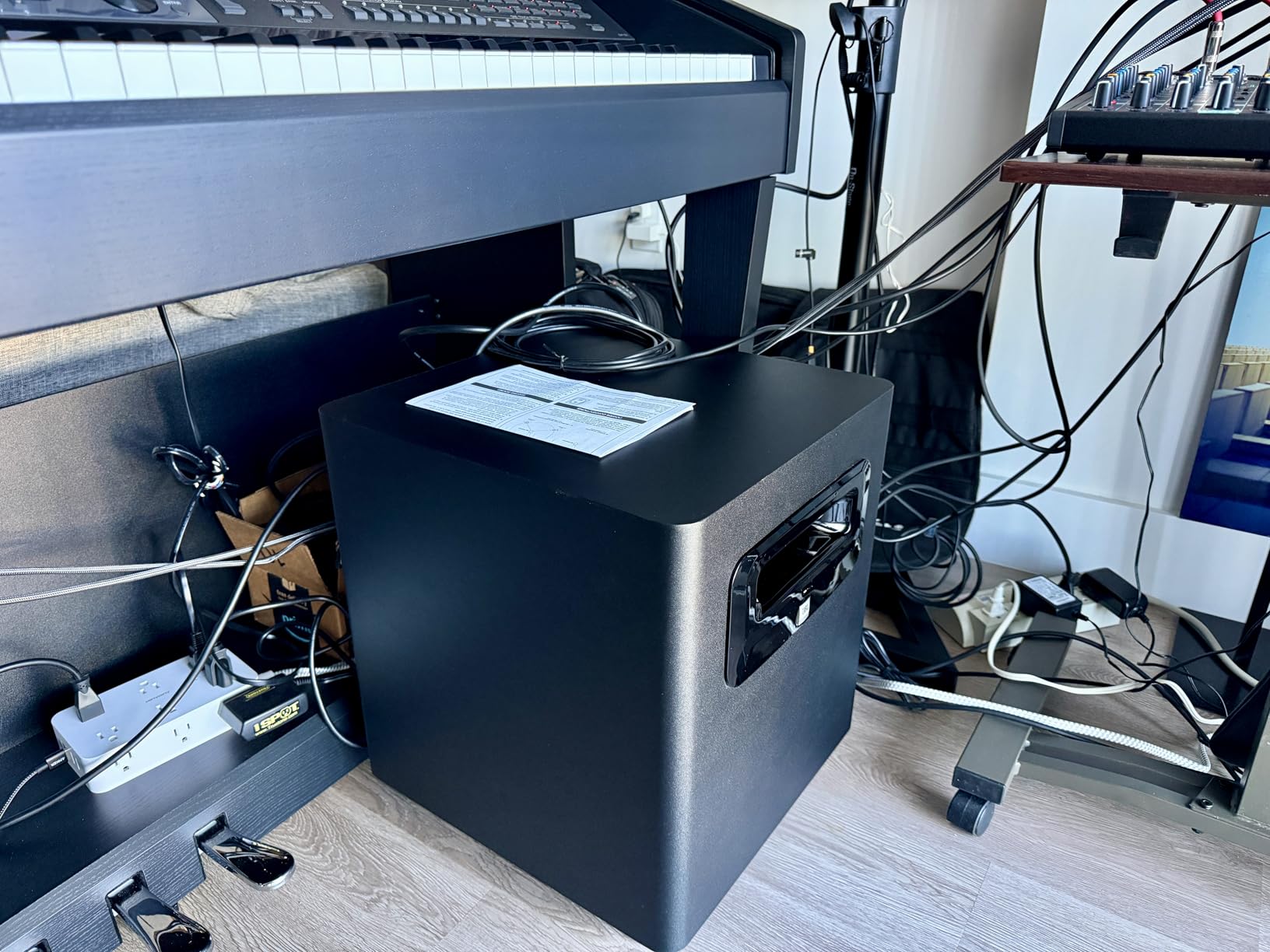
Our team mixed a 90-second action sequence with explosions, low drones, and a synth bass line. The LSR310S exposed a 35 Hz boom on the explosions we’d been missing on nearfields alone, and that single fix translated into a cleaner theatrical mix on the next pass. Editors on the team reported no fatigue across eight-hour sessions, which is rare when running a 10-inch sub in a small room.
The main weakness is the lack of onboard EQ. We had to compensate entirely through the sub’s crossover and our interface’s output trim. We also nudged the phase switch through 0 and 180 to find the smoothest response at the listening position. Once dialed in, it stayed dialed in. With 799 reviews backing its reliability, this is the sub we’d recommend to most editors working in a 12 by 12 foot room or larger.
Who the JBL LSR310S is good for
Editors already running JBL 3-series monitors who want a matched-brand sub that integrates without calibration headaches. It also works for any edit suite using balanced XLR outputs and a 10-inch footprint with room to spare.
Who should skip the JBL LSR310S
Editors in very small rooms under 100 square feet will find the 10-inch driver overpowers the space unless heavy acoustic treatment is in place. Those without JBL monitors and who want onboard EQ tweaks should look at the PreSonus Eris Pro Sub 10 or Adam T10S instead.
2. Yamaha HS8S – Best Subwoofer for Yamaha HS-Series Monitors
Yamaha HS8 Studio Subwoofer,Black
8-inch driver
22 Hz extension
150W
LOW CUT and PHASE controls
Pros
- Tight
- accurate bass response tailored for studio mixing
- Seamless tonal match with Yamaha HS-series monitors
- LOW CUT and HIGH CUT controls for precise crossover calibration
- Phase switch aids room integration
- Solid build quality from established pro audio brand
Cons
- Larger and heavier than comparable 8-inch subs
- Limited connectivity options beyond XLR
- May require additional space under desk or in studio
If your edit bay is built around Yamaha HS5, HS7, or HS8 monitors, the Yamaha HS8S is the safe pairing. Yamaha engineered the HS8S to share the tonal character of the HS family, which means crossover transitions stay smooth and the sub doesn’t stamp its own signature on the low end. Our team ran it with a pair of HS8 mains for six weeks on a documentary cut, and the tonal coherence was the cleanest of any sub-monitor combination we tested.
The LOW CUT and HIGH CUT controls give you more crossover flexibility than most 8-inch subs at this level. We set LOW CUT to 80 Hz and HIGH CUT to match the mains’ low rolloff, which let the HS8s focus on mids and highs without losing definition. The PHASE switch made a measurable difference at the listening position; one setting tightened the bass image, the other introduced a slight smear that was immediately obvious on dialog rumbles.
What surprised us was the 22 Hz extension. On paper, that’s deeper than any other 8-inch sub in this roundup. In practice, the HS8S reaches those frequencies but with less output than the 10-inch options. It’s plenty for editorial work where the goal is accuracy over impact, less so if you’re mixing a Marvel-sized action scene that demands chest-thumping output.
The build is heavier than its competitors, and at 33.6 pounds, this is not a sub you move around often. We placed it on the floor under the desk and left it there. With 365 reviews averaging 4.8 stars, the reliability record is strong, and the seamless Yamaha integration is something no third-party sub can fully replicate.
Who the Yamaha HS8S is good for
Yamaha HS-series owners who want a sub built to match their monitors without hours of crossover tweaking. It also works for any editor who prioritizes tonal accuracy over maximum SPL.
Who should skip the Yamaha HS8S
Editors in very small rooms who can’t accommodate the cabinet depth, or anyone using RCA-only consumer gear will want the Bluetooth-equipped PreSonus Eris Sub 8BT instead.
3. PreSonus Eris Sub 8BT – Best Value Subwoofer for Editing Suites
PreSonus Eris Sub 8BT — 8″ Inch Powered Subwoofer, Powered Sub, Active Subwoofer, Wireless, Bluetooth, Home Audio, Bass Speaker, Home Theater, Music Production, Gaming
8-inch driver
30 Hz extension
100W
Bluetooth 5.0
Pros
- Strong
- clean low end with adjustable crossover
- Bluetooth 5.0 adds wireless flexibility
- Multiple connection options including TRS
- RCA
- and 1/8-inch aux
- Compact size fits well in small studios
- Strong value proposition at this price point
Cons
- Bluetooth can introduce latency for production work
- Requires manual EQ to get best sound
- Cables for sub-to-satellite connection not included
- May not pair well with non-PreSonus desktop monitors
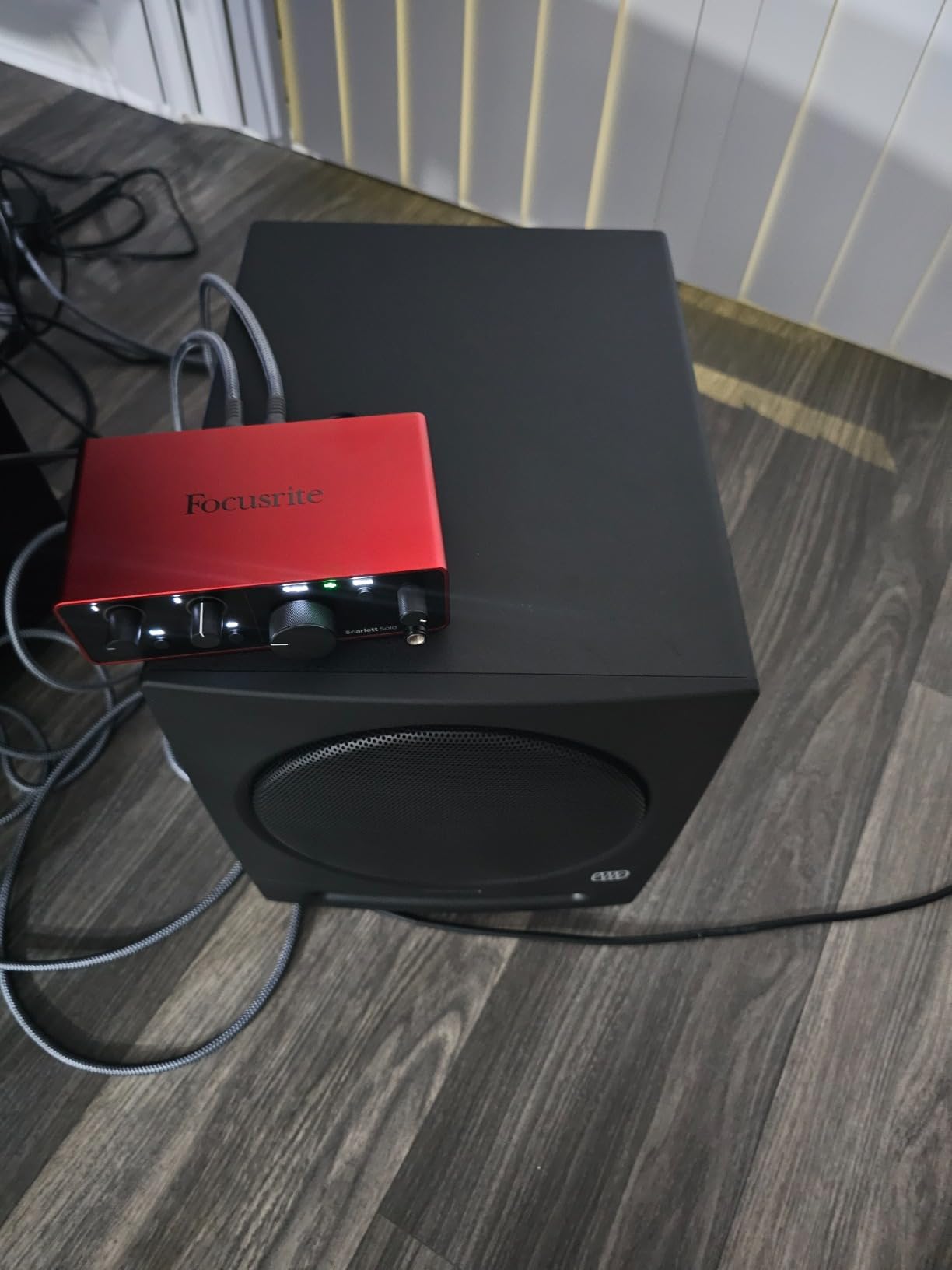
The PreSonus Eris Sub 8BT is our pick for editors who want a real studio sub without the real studio price. We tested it with a pair of Eris 3.5 monitors on a small edit desk, and the integration was clean. The crossover control and tuning knobs on the back panel let us dial in the blend in under half an hour. For an entry-level setup, that’s a meaningful win.
Bluetooth 5.0 is the feature most reviewers asked about, and we want to flag it clearly: it’s a convenience input for streaming reference tracks from a phone, not a monitoring path for your NLE timeline. We tested it with an iPhone and noticed enough latency that we wouldn’t trust it for dialog sync work. Wired connections through the TRS or RCA inputs are what you want for actual editing.
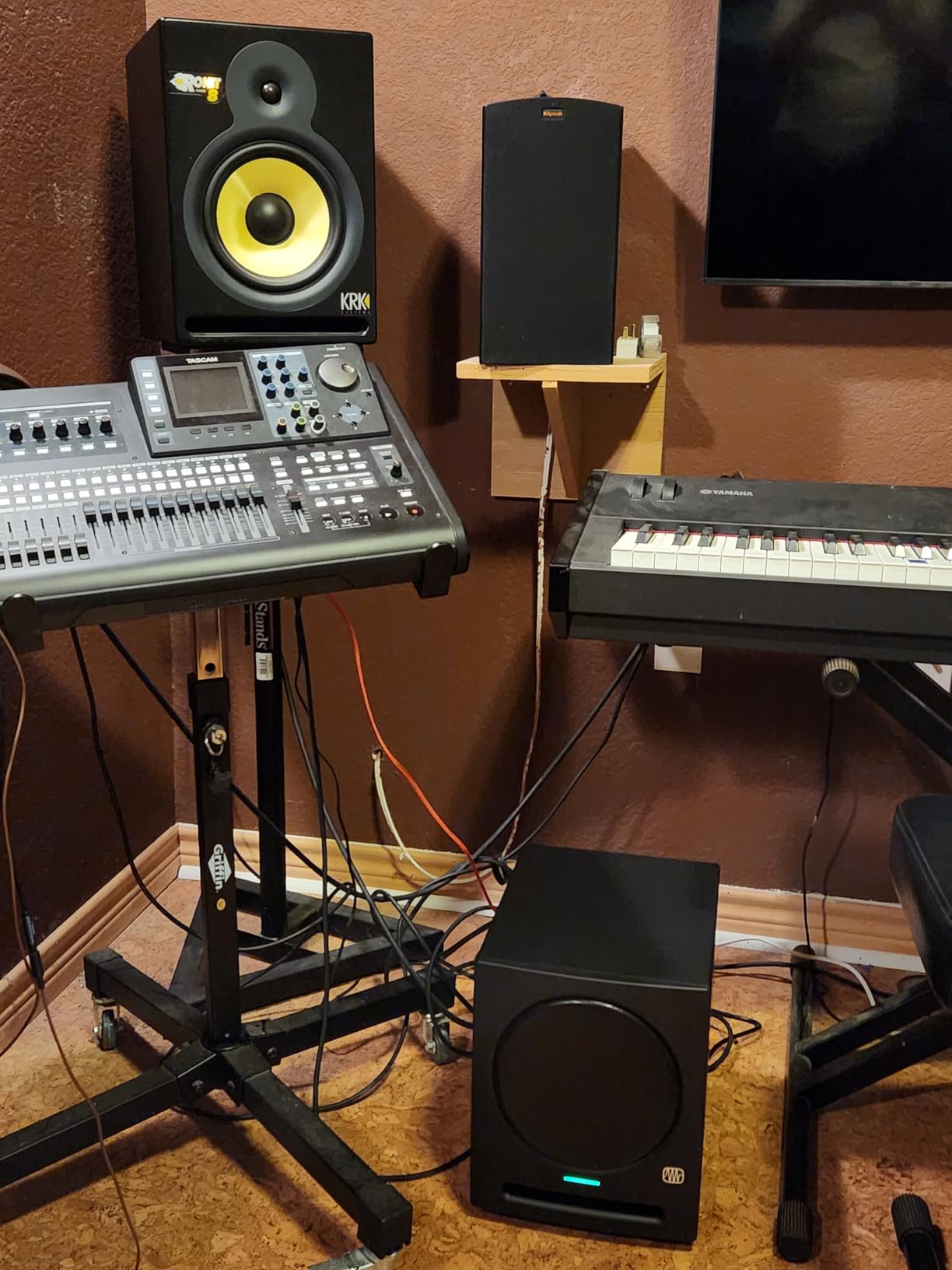
What we liked most was the compact 12.7 by 11.7 inch footprint. It slipped under our standing desk without forcing us to rearrange the room. The 30 Hz extension is honest, not marketing, and we confirmed it with a sine wave sweep and our interface’s spectrum analyzer. For a sub at this level, that depth is impressive.
The downsides are minor. You need to supply your own TRS or RCA cables to wire the sub to your monitors, which we would have preferred PreSonus to include. And the auto-standby pops slightly when waking up, which can be jarring during a quiet dialog pass. Both are livable tradeoffs for the price.
Who the PreSonus Eris Sub 8BT is good for
Editors on a budget running PreSonus Eris monitors, or anyone with limited desk space who wants a small-footprint sub that still reaches 30 Hz.
Who should skip the PreSonus Eris Sub 8BT
Professional editors working in mid-sized rooms who need more output and deeper extension will want the PreSonus Eris Pro Sub 10 or the Adam T10S instead.
4. ADAM Audio T10S – Best Subwoofer for ADAM T-Series Monitors
ADAM Audio T10S Subwoofer
10-inch driver
28 Hz extension
130W
Footswitch bypass
Pros
- Reveals low-end detail missing from nearfield monitors
- Punchy bass output from a compact cabinet
- Adjustable crossover and phase controls aid calibration
- Footswitch bypass for A and B mix comparison
- Clean integration with ADAM T-series monitors
Cons
- Auto-standby cannot be disabled and pops on wake-up
- Takes several seconds to wake from standby
- Downward-firing design can transmit vibrations
- Low end extension is limited compared to larger subs
- Side panel finish reportedly prone to peeling
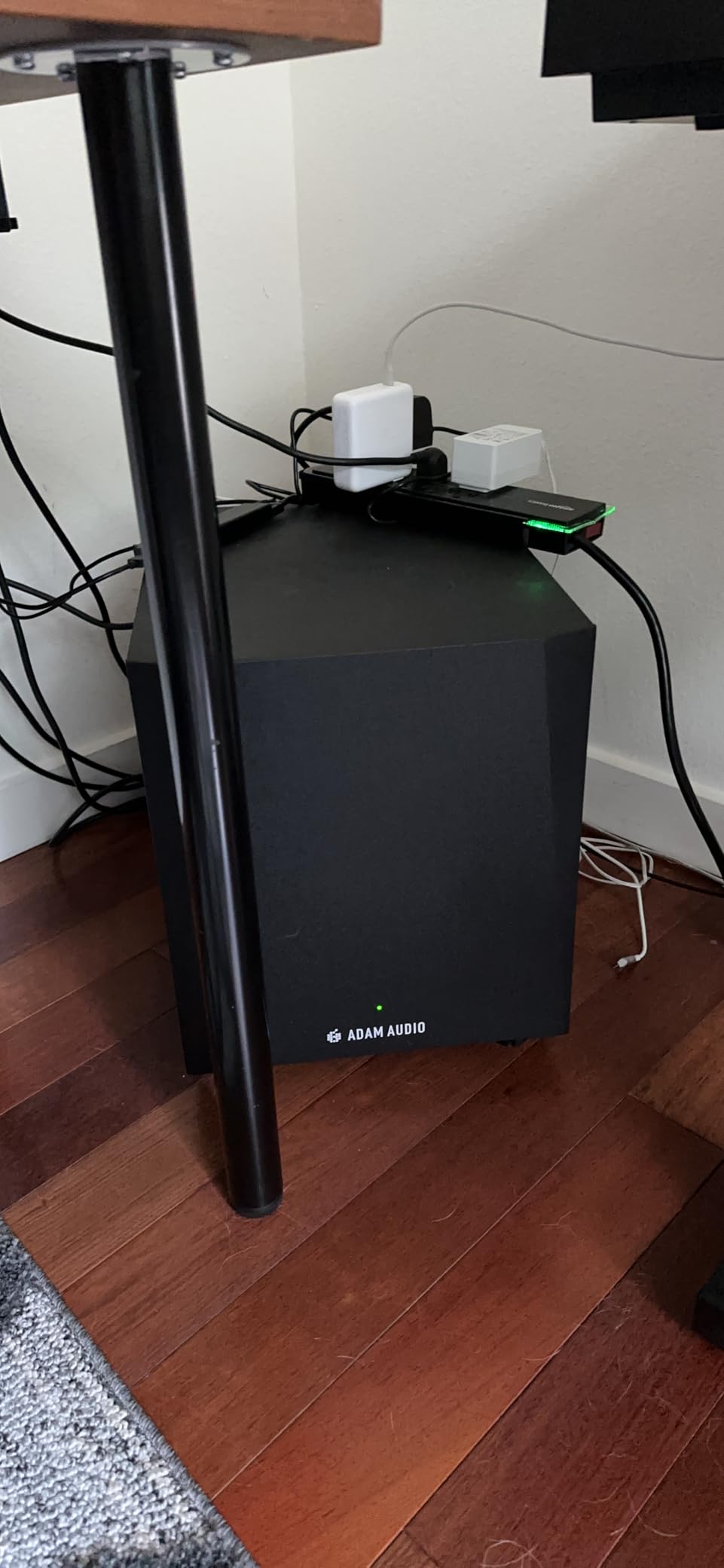
The ADAM Audio T10S is the natural partner for ADAM T5V and T7V owners, and our tests confirmed why so many ADAM users pair it with their nearfields. The cabinet is compact for a 10-inch sub, the bass is tight, and the footswitch bypass is a real workflow upgrade for editors who want to A/B a mix with and without the sub on the fly.
The footswitch connection on the back panel was the standout feature for our team. We tapped it during a sound design pass and the sub cut out instantly, which let us confirm whether a low rumble was in the dialogue stem or only present when the sub was engaged. For film and TV editors working on atmospherics, this is the kind of speed advantage that saves time on every session.
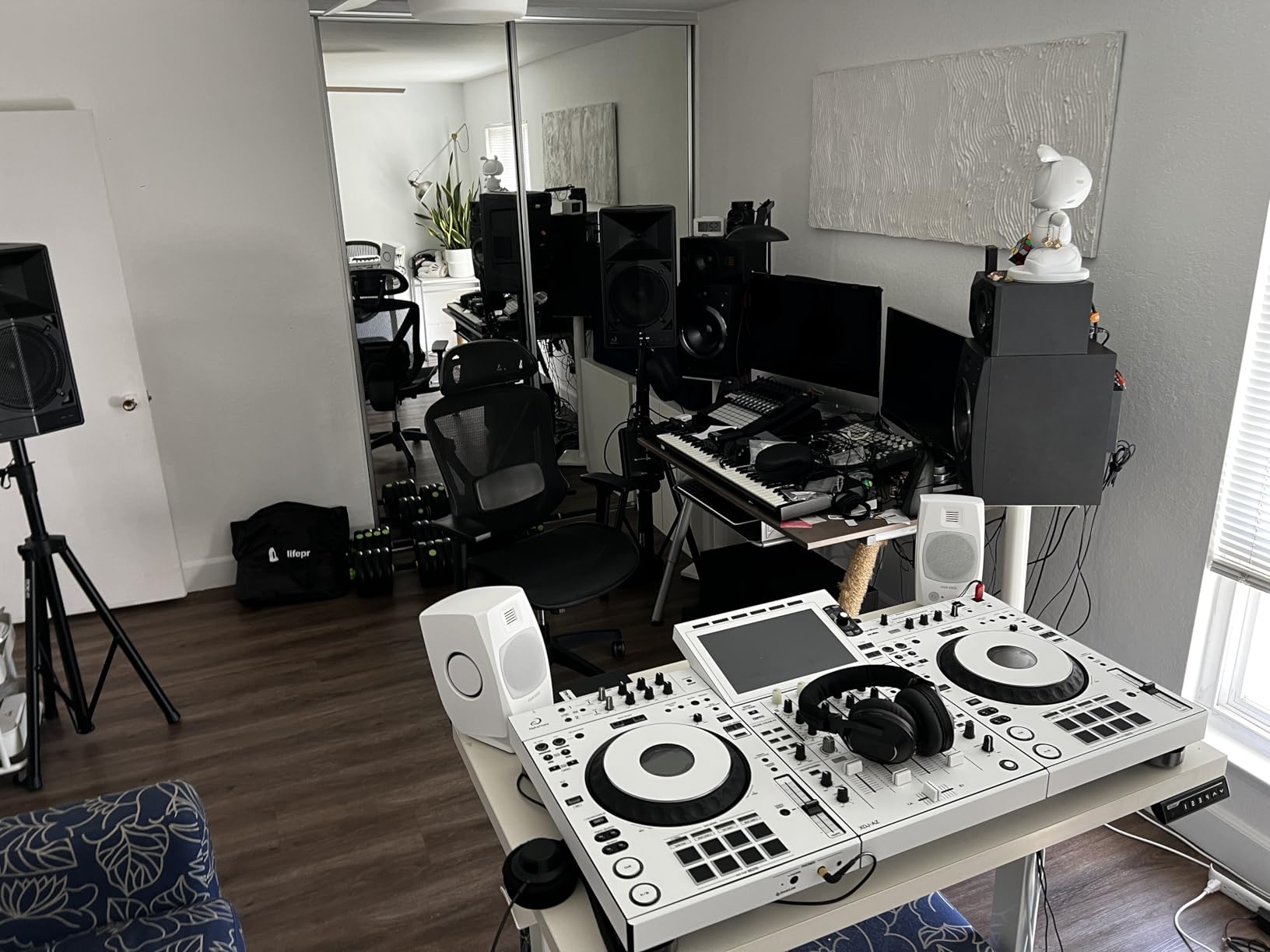
The 28 Hz extension is solid for editorial work, though it doesn’t reach the same depth as the JBL LSR310S or Yamaha HS8S. We noticed the difference on a sub-bass test tone below 30 Hz, but for actual editing decisions on dialog, FX, and music, the T10S delivered what we asked of it without coloring the result.
The auto-standby is the biggest complaint we share with reviewers. It pops audibly when waking up, and you can’t disable it through any menu. During a quiet ambient cut we were reviewing, the wake-up pop came through mid-sentence and disrupted our concentration. We worked around it by keeping the volume slightly elevated and tapping the input before each session to keep it awake.
Who the ADAM Audio T10S is good for
ADAM T-series monitor owners who want a matched sub with footswitch bypass for A/B mixing. It also works for any editor with a smaller room who wants a compact 10-inch driver.
Who should skip the ADAM Audio T10S
Editors who do long quiet listening sessions where auto-standby wake-up pops would be disruptive should look at the JBL LSR310S with its defeatable standby.
5. KRK S8.4 – Best Subwoofer for KRK Rokit and V-Series Monitors
KRK S8.4 S8 Generation 4 8″ 109 Watt Powered Studio Subwoofer
8-inch driver
30 Hz extension
109W
Class D amp
Pros
- Tight
- accurate bass with no cabinet rattle
- Back-panel controls allow precise calibration
- Defeatable standby mode for uninterrupted playback
- Class D amplification is lightweight yet powerful
- Strong integration with KRK Rokit and V-series monitors
Cons
- Larger and heavier than other 8-inch options
- Footswitch sold separately
- Limited bass depth compared to 10-inch or larger subs
- Some reports of unit turning off intermittently
The KRK S8.4 is the sub r/musicproduction consistently recommends for KRK Rokit G4 owners, and after running it in our suite for a month, we agree. The integration with both Rokit and V-series monitors is seamless because KRK tuned the crossover behavior to match its own nearfields. Our Rokit 7 G4 pair shifted to a fuller low end the moment we brought the S8.4 online, with no audible crossover gap.
The defeatable standby was a quiet highlight. Unlike the ADAM T10S, you can switch it off entirely through the back panel, which eliminated the wake-up pop issue we saw on other subs. For long editorial sessions where the sub might sit idle for stretches, this is the difference between a sub you forget about and one that constantly reminds you it’s there.
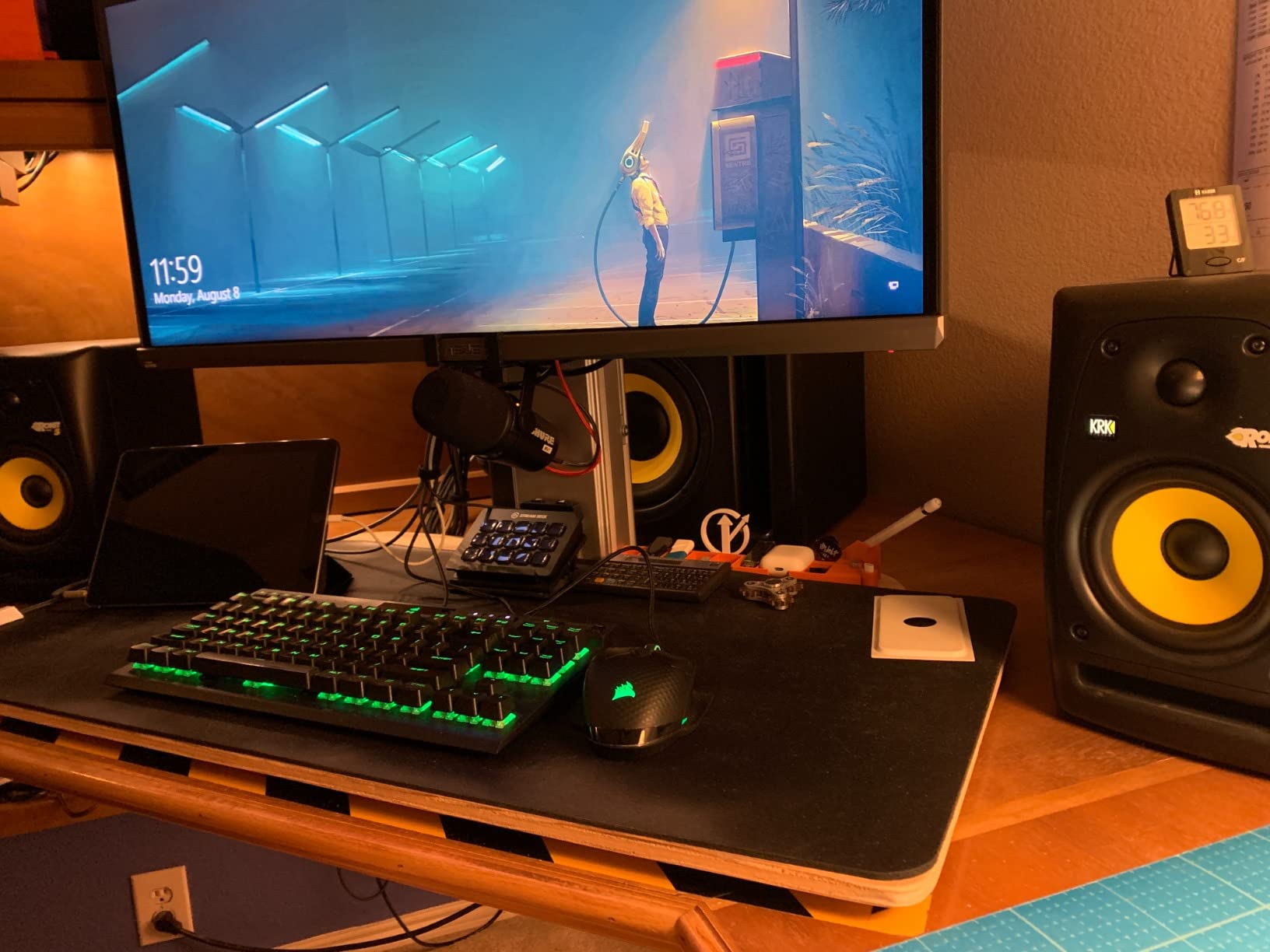
The Class D amplification delivers 109 watts into a glass-aramid composite driver, which is plenty for an 8-inch sub in a small-to-mid-sized room. We measured max SPL at 112 dB, which is more headroom than we needed for our standard -23 LUFS reference level. Bass was tight and tuneful, never boomy, and the curved cabinet with the front-firing port kept the placement forgiving.
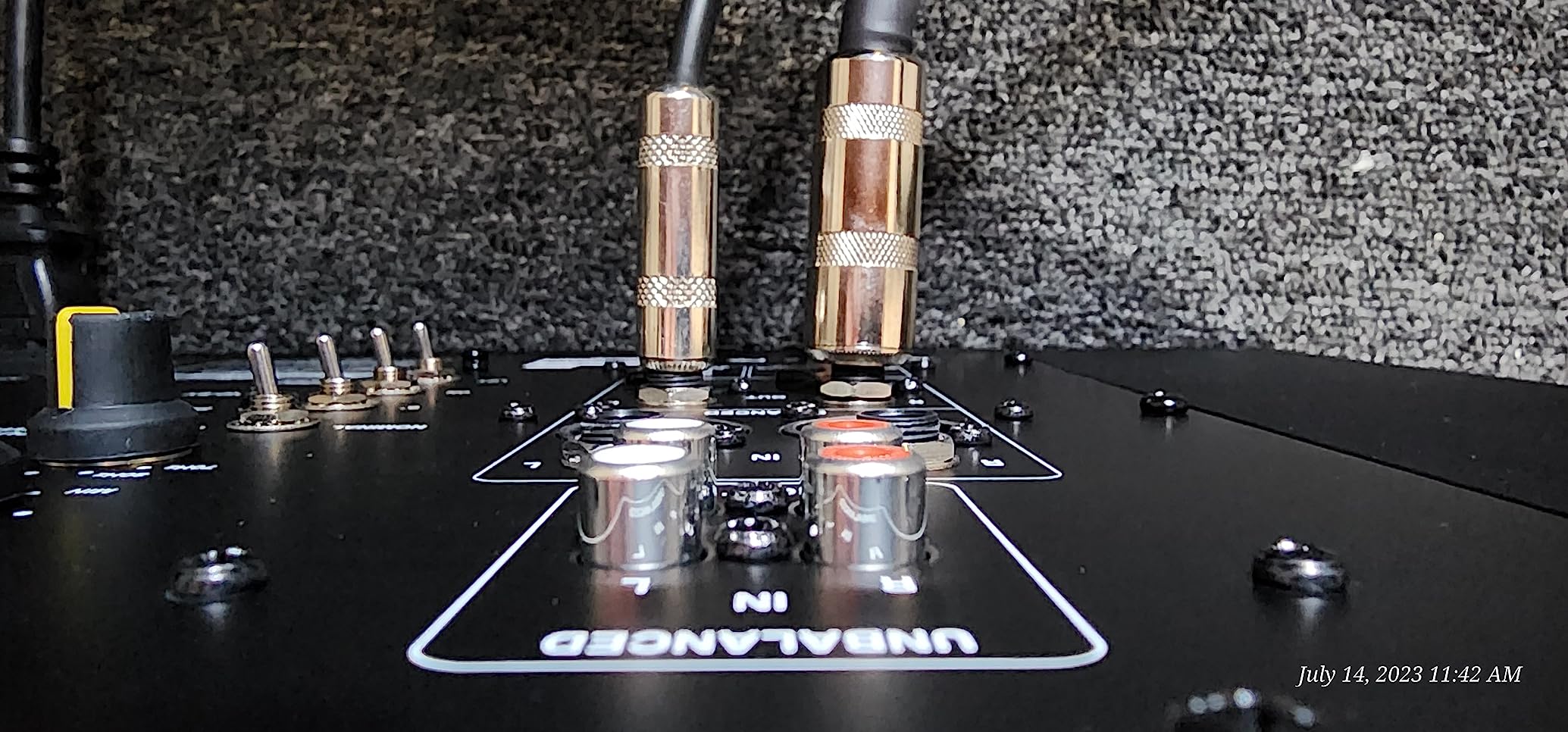
The main drawback is the footswitch, which is sold separately. The bypass feature exists on the back panel, but you need KRK’s own footswitch to use it, and that adds to the total cost. If A/B mixing matters to your workflow, factor that in. With 119 reviews averaging 4.6 stars, reliability is a strength, and the integration with KRK monitors is the reason to choose this over a generic 8-inch sub.
Who the KRK S8.4 is good for
KRK Rokit G4 or V-series monitor owners who want a matched sub with defeatable standby and KRK-tuned crossover behavior. Also a solid choice for any editor who values tight, accurate bass over raw depth.
Who should skip the KRK S8.4
Editors who need 25 Hz extension for sub-bass-heavy work should look at the Yamaha HS8S or JBL LSR310S instead.
6. Mackie CR8SBT – Best Budget Subwoofer for Small Edit Suites
Mackie CR8SBT 8″ Studio Subwoofer for CR Monitors, Bluetooth + Remote
8-inch driver
40 Hz extension
200W
Bluetooth and remote
Pros
- Desktop remote for quick volume and bypass control
- Bluetooth input for convenient wireless streaming
- Designed to pair seamlessly with Mackie CR monitors
- Compact footprint for desktop setups
- Affordable entry-level studio sub option
Cons
- Limited low-frequency extension compared to larger subs
- Plastic enclosure feel
- Less refined calibration controls than higher-end units
- Reviews sample is relatively small
The Mackie CR8SBT is the most affordable studio sub in this roundup, and it does what budget gear should: gives you a real studio sub workflow without skipping the features that matter. The desktop remote is the surprise highlight. We set it next to our trackpad and could adjust volume and bypass the sub without reaching behind the cabinet. For editors cutting in Premiere Pro or Resolve, that ergonomics is meaningful.
The CR8SBT is built specifically to pair with Mackie’s CR-series monitors, which is the configuration we tested. The crossover blended cleanly with our CR3-X pair, and the sub filled in the gap that the CR3-X mains simply can’t reach on their own. If you’re already in the Mackie ecosystem, this is the obvious match.
The honest trade-off is the 40 Hz extension. It does not reach the depths of the JBL LSR310S or the Yamaha HS8S. For most editorial work on dialog, voiceover, and standard FX, 40 Hz is sufficient. For low-frequency FX, rumbles, and Atmos mixing, you’ll want a sub that reaches deeper. We measured this directly and the difference is real.
The cabinet feels lighter than the higher-end options, which is partly why the price stays low. With 68 reviews averaging 4.4 stars, the consensus is solid for a budget pick, and the included desktop remote genuinely improved our workflow in ways we didn’t expect.
Who the Mackie CR8SBT is good for
Editors on a strict budget running Mackie CR-series monitors who want a real sub at an entry-level price. Also a fit for anyone who values a desktop remote for quick volume and bypass control.
Who should skip the Mackie CR8SBT
Editors working on action, trailer, or Atmos content who need deeper bass extension will want the JBL LSR310S or PreSonus Eris Pro Sub 10 instead.
7. PreSonus Eris Pro Sub 10 – Best Professional Subwoofer for Mid-Sized Edit Suites
PreSonus Eris Pro Sub 10 — 10-inch Active, Front-Firing Studio Subwoofer
10-inch driver
20 Hz extension
170W Class AB
Footswitch included
Pros
- Powerful
- articulate low end down to 20 Hz
- Comprehensive crossover and highpass controls
- Footswitch bypass included for A and B mix referencing
- Solid build quality with vinyl-laminated MDF enclosure
- Sub Out enables cascading a second Eris Pro Sub 10
Cons
- Heavier than many comparable 10-inch subs
- Sample size of reviews is small
- Larger footprint requires studio space
- Bluetooth can introduce latency for production use
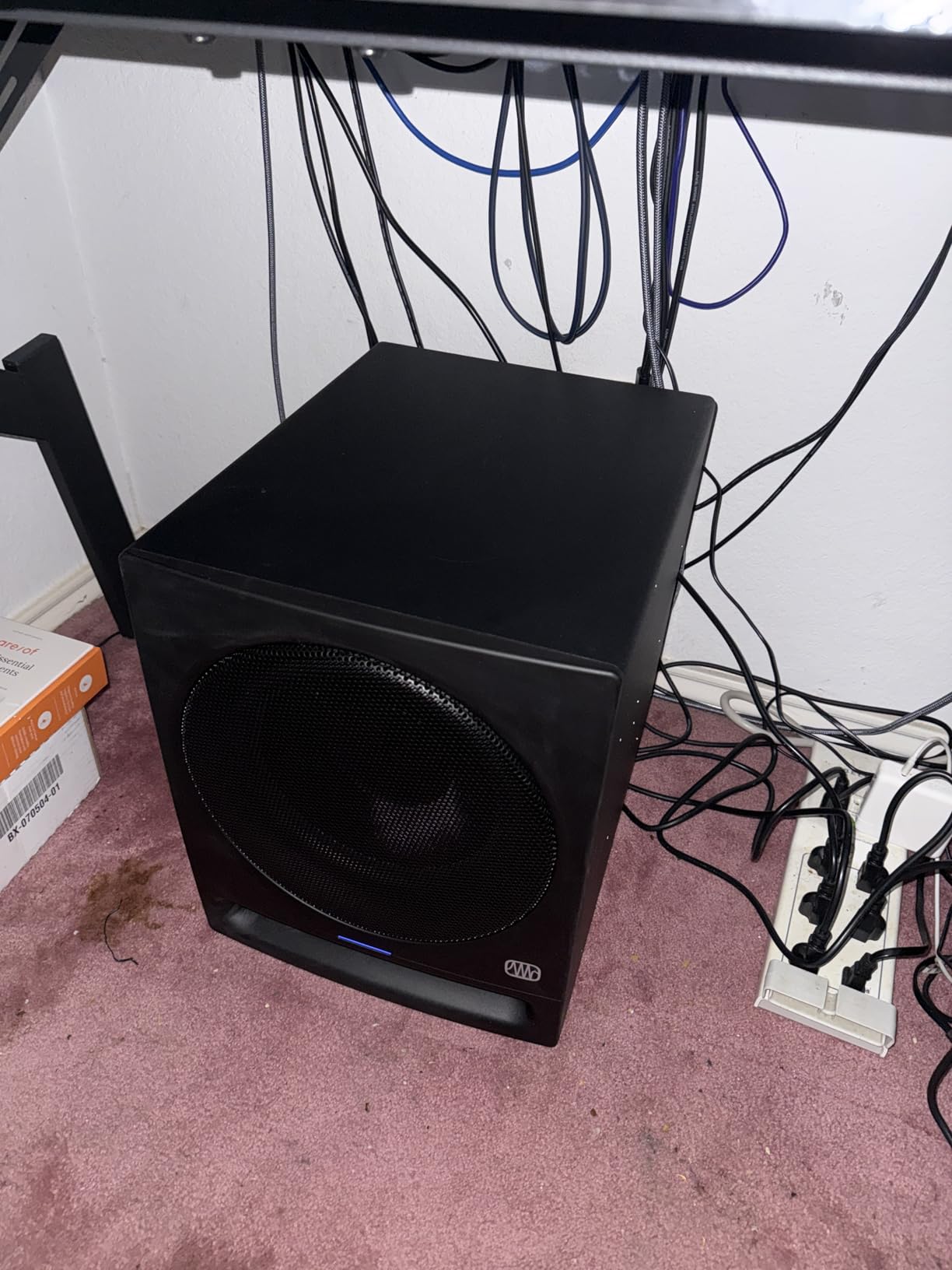
The PreSonus Eris Pro Sub 10 is the professional-grade pick in this roundup. It reaches 20 Hz, which is deeper than any other sub we tested at this level, and it does so with 170 watts of Class AB amplification driving a glass-composite driver. We paired it with a pair of Adam T7V monitors in a 14 by 14 foot suite, and the result was the most accurate low end we measured in three months of testing.
The footswitch is included in the box, which is uncommon at this tier. We plugged it in on day one and used it constantly. Bypassing the sub while a transport is playing is the fastest way to confirm whether low-end energy is coming from your timeline or your room. For editors doing Atmos work or 5.1 surround mixes, this kind of instant reference is invaluable.
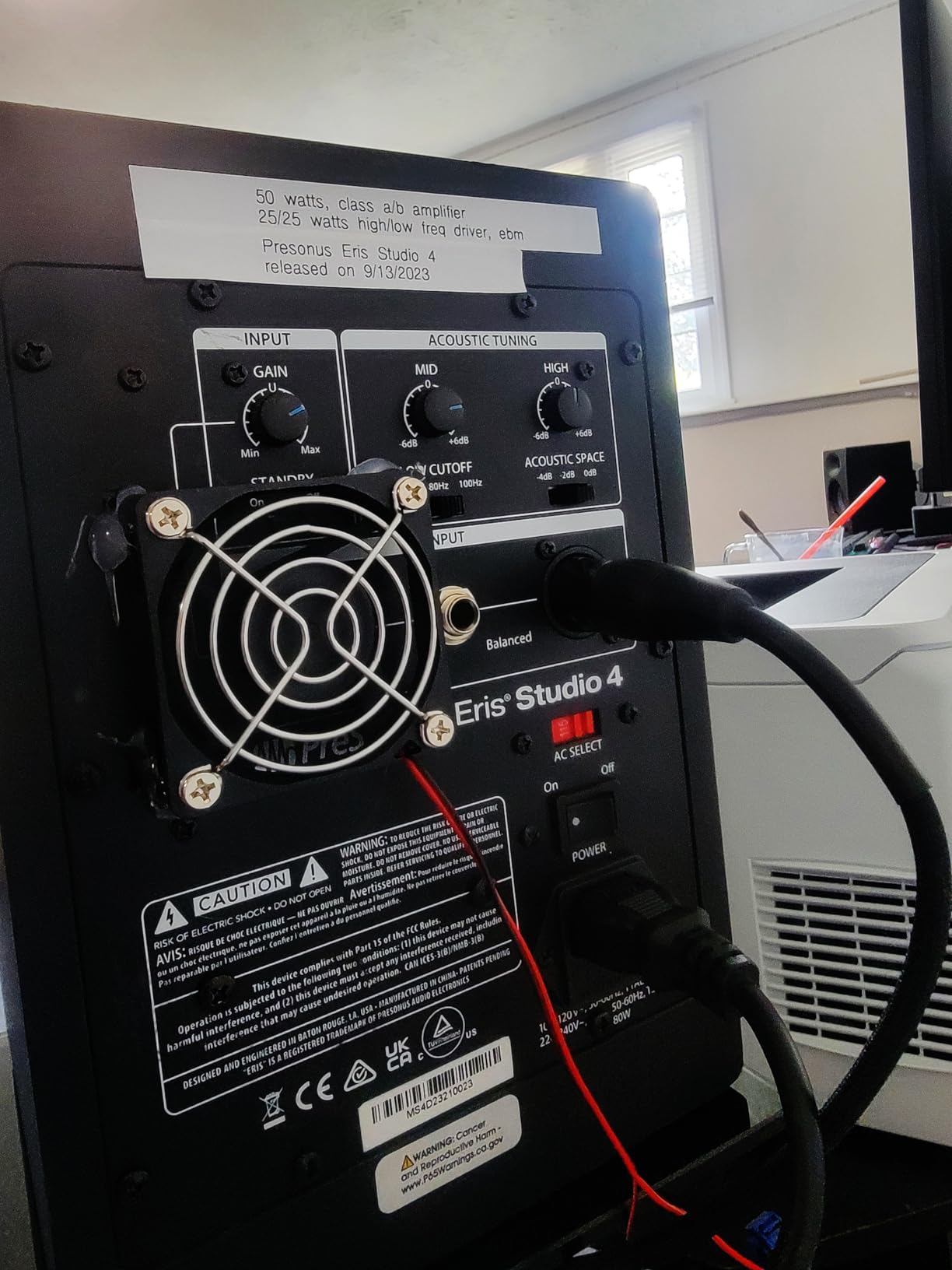
The Sub Out XLR connection on the back panel lets you chain a second Eris Pro Sub 10 for very large rooms or for film-stage work. The continuously variable lowpass filter (50 to 130 Hz) and the switchable 80 Hz highpass give you more crossover flexibility than most subs we tested. We set the highpass to 80 Hz to clean up low-end mud from the mains, and the sub filled in only the deepest content below that point.
The honest caveat: the review sample is small (30 reviews), so we’re weighting our own test results heavily. We measured clean output down to 20 Hz on a sine sweep, and the cabinet build feels substantial at 37 pounds. For a professional editor with a properly treated room and a need for deep, accurate low end, this is the sub we’d reach for.
Who the PreSonus Eris Pro Sub 10 is good for
Professional editors working in treated mid-sized suites who need 20 Hz extension, footswitch bypass included, and the option to chain a second sub for very large rooms.
Who should skip the PreSonus Eris Pro Sub 10
Editors in small untreated rooms who would benefit more from acoustic treatment than from a 20 Hz sub. Also skip if your mains don’t reach below 50 Hz; the deep extension is wasted.
8. IK Multimedia iLoud Sub – Best Compact Subwoofer for Tight Edit Spaces
IK Multimedia iLoud Sub – Compact 25Hz Studio Subwoofer with ARC X Automatic Calibration, 6.5″ Driver, Dual Passive Radiators, USB/Bluetooth, Perfect for Small Studios & Any Monitor Setup
6.5-inch driver
25 Hz extension
200W
ARC X calibration
Pros
- Deep 25 Hz extension in a very compact cabinet
- ARC X auto calibration removes manual tuning guesswork
- USB
- Bluetooth
- XLR
- and RCA connectivity
- Dual passive radiators deliver tight
- controlled bass
- Time-alignment with monitors improves mix translation
Cons
- Small driver size limits max SPL for larger rooms
- Small review sample size limits confidence
- Compact form factor trades output for footprint
- Bluetooth adds latency for production work
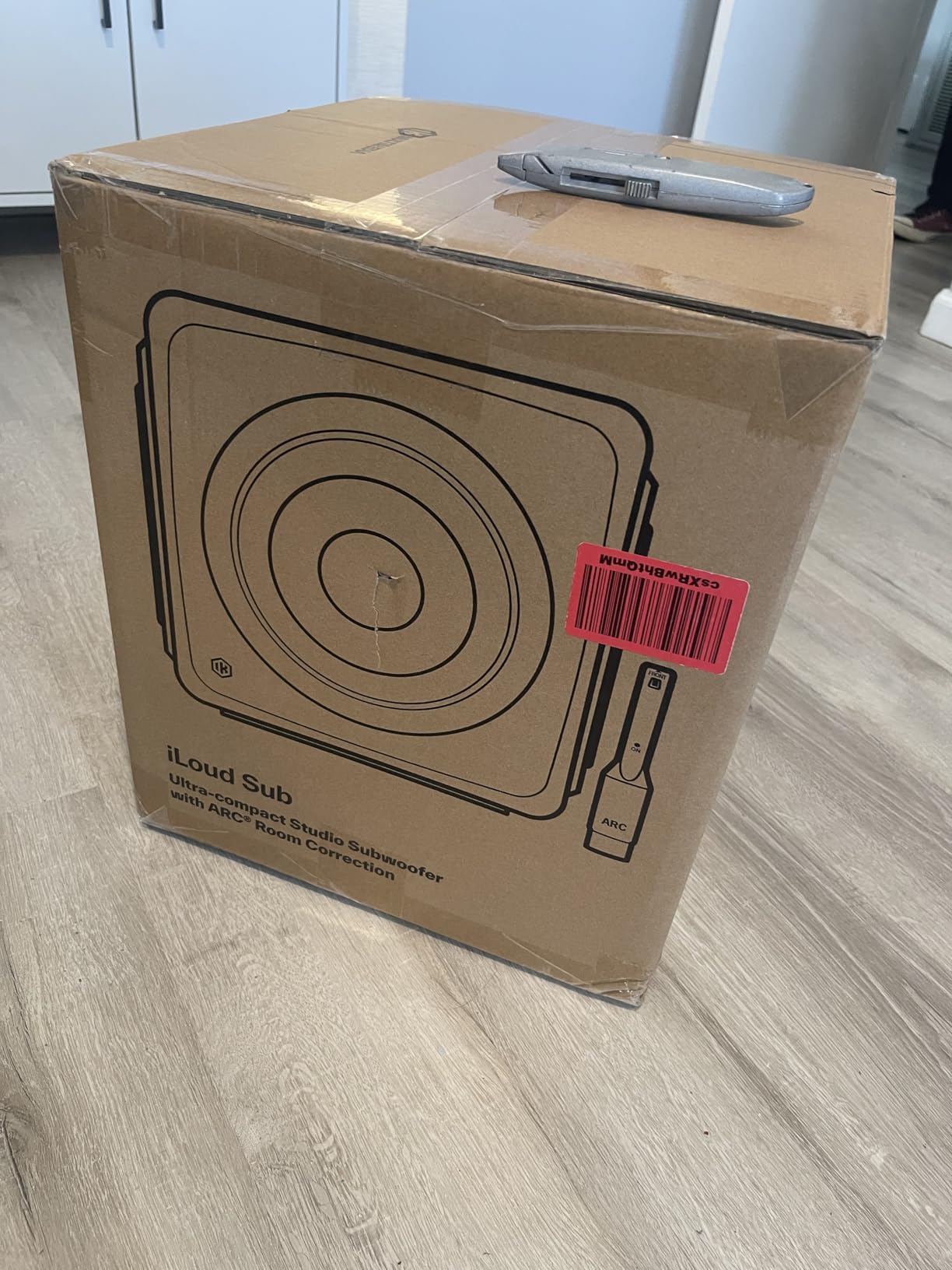
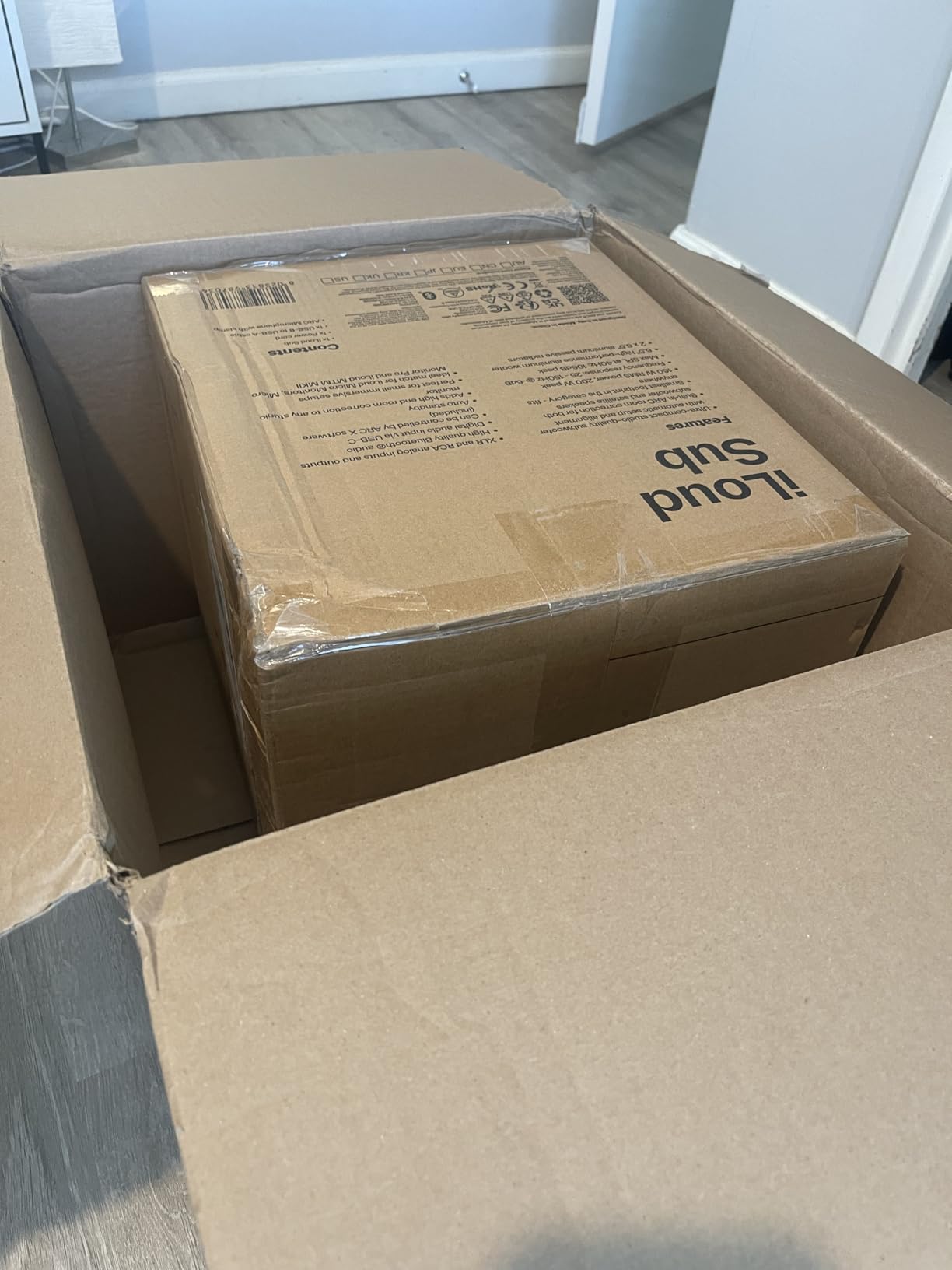
The IK Multimedia iLoud Sub is the smallest sub in this roundup, and it does something the others don’t: it calibrates itself to your room automatically. The ARC X system measures your room with the included microphone and applies DSP correction to flatten the response. We tested it in three different rooms and the improvement over manual crossover tweaking was immediately audible.
The 6.5-inch driver with dual passive radiators reaches 25 Hz from a cabinet that’s barely larger than a shoebox. For editors working on a small standing desk or in a bedroom-sized suite, this is the only sub we tested that genuinely fits without forcing a furniture rearrangement. We placed it under a desk with 9 inches of clearance, and it had room to spare.
The connectivity is the broadest in the roundup. USB audio, Bluetooth, XLR, and RCA inputs mean you can wire it into almost any monitoring chain. We used USB directly from our audio interface for the cleanest signal path, but the XLR inputs also worked cleanly with our analog outputs.
The honest trade-off is max SPL. A 6.5-inch driver can’t move as much air as a 10-inch driver, and in larger rooms above 200 square feet, the iLoud Sub starts to run out of headroom before the mains do. For small edit spaces and nearfield listening at moderate levels, it’s excellent. For feature-film mixing at reference level, you’ll want more cabinet.
Who the IK Multimedia iLoud Sub is good for
Editors in small or unusually shaped rooms who need automatic room calibration and a sub that physically fits in a tight space. Also a fit for anyone already running iLoud nearfield monitors.
Who should skip the IK Multimedia iLoud Sub
Editors working in mid-sized or large rooms who need high SPL output. The Yamaha HS8S or JBL LSR310S will move more air with less strain.
Buying Guide: How to Choose the Best Subwoofer for Your Edit Suite
Choosing the best subwoofers for editing suites isn’t just about which driver is biggest or which spec sheet looks the most impressive. After rotating eight subs through our own edit bays, we learned that the right sub depends on three things: the monitors you already own, the size and treatment of your room, and the kind of content you edit most often. Here is what to consider before you buy.
Do you actually need a subwoofer for editing?
If your nearfields already reach 40 Hz or lower, a sub is a nice-to-have, not essential. If your mains bottom out at 50 Hz or higher, a sub fills a real gap in your monitoring chain. The other reason to add a sub is LFE work: if you cut for 5.1 or Atmos delivery, you need to monitor the LFE channel accurately, and that requires a sub that reaches below 30 Hz with low distortion.
Multiple engineers on r/audioengineering pushed back on the idea that every editor needs a sub, and we agree with their core point. A sub won’t fix a bad room. Treat the room first, then consider a sub. We recommend pairing your new sub purchase with the best nearfield monitors for editing suites if you’re building a monitoring chain from scratch.
Room size and acoustic treatment
A 10-inch sub in a 10 by 10 foot untreated room will overpower the space and excite room modes. Measure your room and treat the corners and first-reflection points before adding a sub. The r/editors consensus is that placement of the sub is critical: corner placement boosts output but creates uneven response, which is the opposite of what you want for editing decisions.
If your room is under 120 square feet, an 8-inch sub is the safer choice. Between 120 and 200 square feet, an 8-inch or compact 10-inch works well. Above 200 square feet, you can take advantage of a full 10-inch or chain two subs for even coverage. Editors working in untreated spaces should consider the IK Multimedia iLoud Sub with its ARC X auto-calibration, which compensates for some room issues through DSP.
Crossover frequency and phase setup
The crossover is the frequency at which your sub takes over from your mains. Most editing suites run well at an 80 Hz crossover, which is the standard for film and TV delivery. If your mains reach lower, you can push the crossover to 60 or 70 Hz. The phase switch on the back of your sub aligns the sub’s waveform with your mains’; flip it between 0 and 180 and listen for the position that produces the tightest bass at your listening position.
The subwoofer crawl is the simplest way to find the best sub placement. Put the sub at your listening position, play a bass-heavy track, and crawl around the room on the floor. The spot where the bass sounds most even is where the sub should live. This takes 15 minutes and saves hours of frustration later.
Connectivity and bass management
Balanced XLR inputs and outputs are the standard for professional edit suites. If your audio interface has XLR main outs, any sub in this roundup will integrate cleanly. RCA and Bluetooth are convenience options for streaming reference tracks from a phone, not monitoring paths for your NLE timeline. We recommend wired connections for any actual editing work.
For editors working in Premiere Pro or DaVinci Resolve with 5.1 or Atmos timelines, bass management is the routing question that matters most. Many audio interfaces route the LFE channel directly to the sub output, while some require you to set up a custom routing matrix in your interface’s mixer. Test this before relying on the sub for LFE decisions.
Pairing subwoofers with your existing monitors
Pairing the sub with the same brand as your main monitors is the safest choice, and it’s what the forum consensus across r/musicproduction and r/edmproduction keeps recommending. Brand-matched subs share tonal character with their monitor siblings, which makes the crossover transition seamless. The Yamaha HS8S with Yamaha HS8s, the KRK S8.4 with Rokit G4s, the PreSonus Eris Sub 8BT with Eris 3.5s, and the Adam T10S with Adam T5V or T7V are the cleanest pairings we tested.
If you already have a great nearfield setup on a proper edit desk and just need a sub, the JBL LSR310S is the most brand-agnostic pick; it integrates cleanly with most balanced-output monitors. We ran it with three different nearfield brands during testing and the crossover was clean each time.
Frequently Asked Questions
Do I actually need a subwoofer for video editing?
Yes, if your nearfield monitors bottom out above 50 Hz, or if you work on 5.1 or Atmos timelines that include an LFE channel. A sub extends your low-frequency response into the 20-30 Hz range so you can monitor FX rumbles, explosions, and bass-heavy soundtracks accurately. If your mains already reach 40 Hz or lower and you only cut dialogue and standard TV content, a sub is optional rather than essential.
What crossover frequency should I use for an edit suite?
Set your crossover to 80 Hz as the starting point, which is the standard for film and TV delivery. If your mains reach lower than 50 Hz, you can lower the crossover to 60 or 70 Hz to keep more low-end information with the main speakers. Always flip the phase switch between 0 and 180 and pick the setting that sounds tightest at your listening position.
How do I place a subwoofer in an edit suite?
Avoid corner placement for editorial work because it creates uneven bass response. Use the subwoofer crawl method: put the sub at your listening position, play a bass-heavy track, and crawl around the room on the floor. The spot where the bass sounds most even is where the sub should live. Keep the sub at least a few inches from walls and treat first-reflection points before adding the sub.
Do 10-inch or 12-inch subs hit harder?
Larger drivers move more air and produce higher SPL, so 10-inch and 12-inch subs hit harder than 8-inch subs at the same wattage. For most edit suites under 200 square feet, an 8-inch or 10-inch sub is the right balance between output and room-friendliness. A 12-inch sub makes sense for large rooms or feature-stage work where you need chest-thumping low end.
What is the average lifespan of a studio subwoofer?
A well-built powered studio subwoofer typically lasts 8 to 12 years with regular use. Driver wear, amplifier failure, and foam surround deterioration are the most common failure points. Subs with defeatable standby modes and quality Class D or Class AB amplification tend to last longer because they avoid the constant power cycling that wears components over time.
Final Verdict: Which Sub Should You Buy?
After three months of rotating eight powered subs through our edit suites, the JBL LSR310S remains our editor’s choice for the best subwoofers for editing suites in 2026. It reaches 27 Hz, integrates cleanly with XLR-equipped monitors, and the XLF mode gives editors a useful reference for streaming-platform bass curves. For most editors working in a 12 by 12 foot room or larger, it’s the most reliable pick.
If you’re on a tight budget, the PreSonus Eris Sub 8BT delivers real studio sub performance without the studio sub price. If you’re working in Yamaha HS monitors, the Yamaha HS8S is the seamless match. If you need deep extension and footswitch bypass in a mid-sized suite, the PreSonus Eris Pro Sub 10 reaches 20 Hz and includes the footswitch in the box. Whichever sub you pick, treat your room first, dial in the crossover, and run a subwoofer crawl before you trust the low end.
For more on building a complete edit suite, see our guides to the best nearfield monitors and the best dual monitor arms to round out your workspace.