
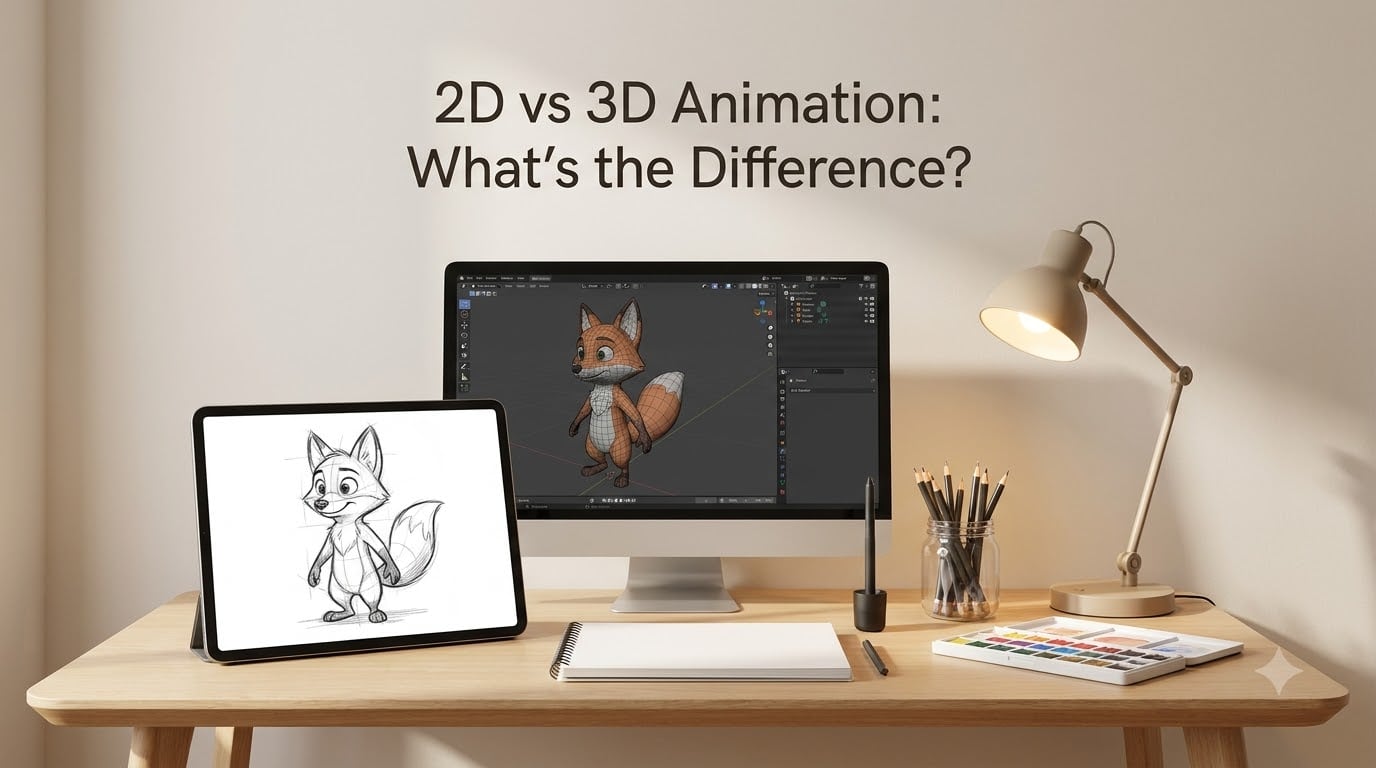
2D animation creates movement in a flat, two-dimensional space using drawings or vector art, while 3D animation builds digital models in a three-dimensional environment with depth, rotation, and realistic lighting. Both styles tell stories, but they use different tools, pipelines, and creative languages. If you’re a short film creator trying to choose between them, this guide breaks down exactly what separates the two, where each one shines, and how to decide for your next project.
I’ve spent years working with both 2D and 3D animation in short film production, and I can tell you the debate is less about which is “better” and more about which fits your story, budget, and timeline. We’ll walk through definitions, techniques, software, real pros and cons, and how AI is reshaping both fields. By the end, you’ll have a clear framework for picking the right style.
Table of Contents
- What Is 2D Animation?
- What Is 3D Animation?
- Core Differences Between 2D and 3D Animation
- Pros and Cons of 2D Animation
- Pros and Cons of 3D Animation
- Software and Tools for Each Style
- Which Animation Style Should You Learn First?
- Choosing Between 2D and 3D for Your Short Film
- Combining 2D and 3D: Hybrid Workflows
- The Impact of AI on 2D and 3D Animation
- Frequently Asked Questions
- Final Thoughts on 2D vs 3D Animation
What Is 2D Animation?
2D animation is the art of creating movement in a flat, two-dimensional space using drawn or digitally rendered images. Think of it as a digital flipbook, where each frame is a separate illustration that, played in sequence, simulates motion. It works on two axes, width and height, with no perceived depth from the viewer’s perspective.
Traditional 2D animation began with hand-drawn cels, like the classic Disney films of the 1930s through the 1990s. Animators drew every frame on transparent sheets, painted them, and layered them over painted backgrounds. Today, most 2D animation is digital, using software to draw, tween, and composite frames. Some studios still use scanned paper drawings for that hand-drawn look.
Modern 2D animation falls into two main categories. Frame-by-frame animation draws each frame individually, giving you full artistic control and that classic “boil” or imperfect feel. Vector-based animation uses software like Adobe Animate or Toon Boom, where you draw characters and let the computer interpolate frames between keyframes. Both are valid 2D approaches. You can see frame-by-frame in shows like Primal, while vector workflows power much of anime and modern TV series.
Examples of 2D animation include Studio Ghibli films, classic Looney Tunes, Avatar: The Last Airbender, and countless indie short films you’ll find on the festival circuit. In short films specifically, 2D remains popular because it allows a single artist to produce a complete piece with relatively low overhead.
What Is 3D Animation?
3D animation is the art of animating digital models that exist in a three-dimensional digital space, with width, height, and depth. Animators create or import 3D objects, rig them with digital skeletons, and then manipulate them through keyframes to produce movement. The final output looks like a virtual puppet moving through a fully realized volume.
Unlike 2D, where you’re drawing flat images, 3D animation treats characters and environments as objects you can rotate, view from any angle, and light realistically. The illusion of depth is mathematical, not painted. The software calculates what each pixel should look like based on the camera position, lighting, and surface properties.
The 3D animation pipeline has several stages. Modeling creates the digital geometry of characters and props. Texturing adds surface detail like skin, fabric, or metal. Rigging builds a digital skeleton inside the model so animators can pose it. Animation brings the rigged model to life through keyframes. Lighting sets mood and realism. Rendering is the final calculation that produces the polished image or video.
Examples of 3D animation include every Pixar film, Toy Story, Frozen, video games like Fortnite, and the 3D elements inside films like Spider-Man: Into the Spider-Verse. In short films, 3D is increasingly common as tools like Blender make the technology accessible to independent creators.
Core Differences Between 2D and 3D Animation
The core difference between 2D and 3D animation is dimensionality. 2D animation operates on a flat plane with width and height, while 3D animation adds depth, allowing characters and objects to be rotated, viewed from any angle, and integrated with realistic lighting. This single difference cascades through every aspect of production, from how you design characters to how you set up scenes.
Here’s how the two styles compare across key dimensions:
- Visual style: 2D tends toward stylized, flat, and graphic looks. 3D leans toward volumetric, realistic, and physically accurate visuals, though both can be stylized.
- Creation process: 2D is drawn frame-by-frame or tweened in vector software. 3D requires modeling, rigging, and animating digital puppets.
- Frame rate: 2D often animates “on twos” (drawing 12 unique frames per second) to save effort. 3D typically fills every frame at 24fps for smoother motion.
- Camera flexibility: 2D cameras are usually locked or fake-pan across painted backgrounds. 3D cameras can move freely through space with real parallax.
- Revisions: 2D revisions often mean re-drawing frames. 3D revisions can update a rig or pose and re-render, sometimes faster.
- Learning curve: 2D is generally easier to start but harder to master. 3D has a steeper initial technical barrier.
There’s also a perceptual difference. 2D animation often feels more expressive and graphic because every frame is a deliberate drawing. 3D animation can feel more immersive because of the depth and realistic motion. Neither is objectively superior. They’re different storytelling tools.
Pros and Cons of 2D Animation
2D animation has unique strengths that make it the right choice for many projects, especially short films with limited resources. Let me walk through the main advantages and disadvantages I see when working in 2D.
Pros of 2D animation:
- Artistic expression: Every frame is a drawing, giving you unlimited stylistic range. You can mimic watercolor, ink, cutout, or any visual style you can imagine.
- Lower hardware requirements: A laptop and a drawing tablet are usually enough. You don’t need a powerful GPU or rendering farm.
- Faster initial learning: Drawing fundamentals translate directly. You can start producing simple animations within weeks.
- Indie-friendly: One artist can produce a complete short film without a team. No rigging, modeling, or rendering setup required.
- Distinctive aesthetic: 2D has a recognizable charm that 3D often struggles to replicate. The “drawn” quality feels personal.
Cons of 2D animation:
- Labor-intensive: Drawing every frame is time-consuming. A 5-minute short can take months of full-time work.
- Harder to achieve realism: Photorealistic 3D-style visuals are nearly impossible in 2D without painting techniques.
- Limited camera movement: True 3D camera moves require faking in 2D, which can look flat without careful parallax work.
- Industry decline perception: Mainstream 2D theatrical features have shrunk, which can make career planning feel uncertain.
For short film creators, 2D remains one of the most accessible paths to producing a finished piece. I’ve seen solo filmmakers complete award-winning shorts in 2D with a laptop and a tablet, no studio required.
Pros and Cons of 3D Animation
3D animation opens up possibilities that 2D simply cannot match, but it comes with its own set of trade-offs. Here’s what I’ve learned from producing 3D short films.
Pros of 3D animation:
- Realistic visuals: 3D can achieve photorealism when needed, with proper lighting, materials, and rendering.
- Camera freedom: You can place a virtual camera anywhere. Sweeping crane shots, dramatic angles, and parallax come naturally.
- Scalable assets: Once a character is rigged, you can reuse it across scenes, projects, and even sequels. The work compounds.
- Easier revisions: Need to change a character’s expression? Adjust a pose? Fix a camera move? Often a few clicks and re-render.
- Industry demand: 3D is the dominant format in gaming, VFX, advertising, and feature films. Job prospects are wider.
Cons of 3D animation:
- Steeper learning curve: You need to understand modeling, rigging, lighting, and rendering pipelines before producing anything polished.
- Higher hardware costs: Rendering 3D scenes requires powerful GPUs and often long render times. Some studios rent render farms.
- Software costs: Professional tools like Maya or Cinema 4D require subscriptions. Blender is a notable free exception.
- “Uncanny valley” risk: Poorly executed 3D can look stiff or plastic. Achieving a natural feel requires skill and time.
For short films aiming for high production value or working with realistic subjects, 3D is often the smarter choice. I’ve shipped 3D shorts that would have been impossible in 2D within the same budget. The deciding factor is usually the story you’re telling.
Software and Tools for Each Style
The right software makes a major difference in your animation workflow. For 2D animation, the most common professional tools include Toon Boom Harmony, which dominates the TV animation industry, Adobe Animate (formerly Flash) for vector-based work, Krita and Procreate for hand-drawn digital work, and OpenToonz, the free open-source tool used by Studio Ghibli. For frame-by-frame work, many artists still use Photoshop with custom frame management.
For 3D animation, Blender has become the dominant free option and now powers everything from indie shorts to professional studio work. Maya remains the industry standard for film and games, with a steeper price and learning curve. Cinema 4D is popular for motion graphics. ZBrush specializes in high-detail sculpting, often used alongside other 3D packages. For rigging and animation specifically, Maya and Blender are the workhorses.
My recommendation for beginners: start with Krita or Procreate for 2D, and Blender for 3D. Both are free, well-documented, and have thriving communities. You can produce a complete short film in either without spending a cent on software.
Which Animation Style Should You Learn First?
If you’re new to animation, the choice between 2D and 3D as your first style depends on your goals and background. From my experience teaching animation workshops, here’s how I think about it. 2D is easier to start because the only prerequisite is being able to draw to some degree. You can produce a moving character within a week of opening Krita or Procreate. The fundamentals you learn, like timing, spacing, anticipation, and squash and stretch, transfer directly to 3D animation later.
3D has a steeper initial barrier because you need to learn the software interface, navigation in 3D space, and the rigging process before you can animate anything. However, once you pass that barrier, 3D can be faster to produce polished work because the computer handles in-between frames, lighting calculations, and camera moves that would take hours in 2D.
Career switchers often benefit from starting with 2D fundamentals. Understanding the 12 principles of animation through drawing cements them in your mind in a way that manipulating a 3D rig does not. Once you have those fundamentals, transitioning to 3D is much smoother. Reddit users in r/animationcareer frequently confirm this pattern.
If you’re aiming for a specific industry, learn the style that industry uses. Gaming and VFX are heavily 3D. Anime-style and many indie projects are 2D. Web and social media content can be either. Match your learning path to where you want to end up.
Choosing Between 2D and 3D for Your Short Film
As a short film creator, you have a unique advantage: nobody is telling you which style to use. That’s also a disadvantage because the choice is yours. Here’s the framework I use when advising filmmakers on this decision.
First, consider your story. Is it dialogue-heavy and emotional, or action-heavy and visual? 2D excels at intimate, expressive character work. 3D excels at scope, environments, and physical spectacle. Think about what visual language best serves your script.
Second, consider your resources. Are you solo or working with a small team? Do you have a render farm or a laptop? 2D is more forgiving of limited resources. One artist with a tablet can complete a 2D short. 3D often requires more technical setup and longer production timelines.
Third, consider your timeline. If you have 6 months to deliver a 5-minute short, 2D is realistic. 3D is often too unless you keep your shots simple and your render times short. With 12 months and a small team, 3D becomes feasible.
Fourth, consider your festival ambitions. Some festivals lean toward specific styles. Most accept everything, but if you’re submitting to a strictly 2D or strictly 3D festival, that decision is made for you. Generally, Short Film Central’s festival listings accept both styles equally.
Combining 2D and 3D: Hybrid Workflows
Hybrid workflows combine 2D and 3D animation in a single project, and they’re becoming more common every year. The most famous example is Spider-Man: Into the Spider-Verse, which uses 3D models but renders them with 2D-style shading, line work, and frame-by-frame imperfections. The result is something that feels both modern and hand-drawn.
Hybrid workflows let you use the best of both styles. You might build a 3D environment, then animate 2D characters on top. Or you might render 3D scenes, then add 2D effects, lighting, or textures in post. Tools like Adobe After Effects, Blender’s Grease Pencil, and Toon Boom’s integrations make hybrid pipelines more accessible than ever.
For short films, hybrid workflows are a smart way to differentiate your piece. Many festival programmers see hundreds of pure 2D or pure 3D shorts. A hybrid approach can stand out. If you’re comfortable in both styles, experiment with combining them. The unique visual identity you create can become your signature as a filmmaker.
The Impact of AI on 2D and 3D Animation
AI is reshaping both 2D and 3D animation, but it’s augmenting rather than replacing human animators, at least for now. In 2D, AI tools can generate in-between frames, upscale line art, and even produce rough animation from reference videos. In 3D, AI assists with motion capture cleanup, automatic rigging, texture generation, and even lighting suggestions.
For short film creators, AI tools can dramatically speed up production. Tools like Runway, Pika, and Adobe Firefly are already being used by independent animators to flesh out backgrounds, generate reference, and accelerate rough passes. The finished animation still requires a human touch, but the grunt work is shifting.
The consensus from working animators on Reddit and industry forums is that AI changes the workflow but doesn’t replace the creativity, timing, and storytelling that humans bring. Portfolio quality and directorial vision still matter more than which style or tools you use. If anything, AI lowers the barrier to entry, which means more people can produce short films, which benefits the entire ecosystem.
Frequently Asked Questions
What is the difference between 2D and 3D animation?
2D animation creates movement in a flat, two-dimensional space using drawings or vector art, working on width and height only. 3D animation builds and animates digital models in a three-dimensional environment with depth, rotation, and realistic lighting. The core distinction is dimensionality, which affects every stage of production.
What’s better, 2D animation or 3D animation?
Neither is objectively better. 2D animation offers more artistic expression and lower hardware costs, while 3D animation provides realistic visuals, scalable assets, and broader industry demand. The right choice depends on your story, budget, timeline, and personal skill set. Many of the most successful projects use hybrid approaches.
Is it harder to animate in 2D or 3D?
2D is generally easier to start because you only need drawing fundamentals to produce simple work. 3D has a steeper initial barrier because you must learn modeling, rigging, and software. However, 2D is harder to master at professional levels because every frame must be drawn. Both require years of practice to reach senior skill levels.
Why did Disney stop using 2D animation?
Disney slowed 2D theatrical production in the early 2000s because 3D animation proved more commercially successful at the box office and allowed for bigger spectacle. The studio occasionally returns to 2D with films like The Princess and the Frog and Wish, but 3D remains the dominant format for major releases. Independent 2D production continues to thrive globally.
Will 2D animation be replaced by AI?
AI is unlikely to replace 2D animation entirely. AI tools can generate in-between frames, upscale art, and assist with rough animation, but the creative decisions, timing, and storytelling still require human input. Most working animators see AI as a productivity tool that accelerates work rather than a replacement for skilled artists.
Final Thoughts on 2D vs 3D Animation
The 2D vs 3D animation choice comes down to your story, your resources, and your vision, not which style is objectively superior. Both 2D and 3D animation offer distinct creative advantages, and the best short films are the ones that pick the style that serves the narrative. If you’re starting out, I recommend trying both. Spend a month with Krita and a month with Blender. See which workflow feels more natural to you, and which one you want to keep practicing at midnight.
The short film world has room for both styles and everything in between. Hybrid approaches are opening up new visual languages that neither pure 2D nor pure 3D can achieve alone. Whatever you choose, the most important thing is to finish your project. The animation industry values people who can deliver, regardless of the tools they use. Start your next short film with the style that excites you most, and don’t be afraid to switch mid-project if your story demands it.
For more resources on short film production, animation techniques, and festival submissions, keep exploring Short Film Central. We’ve got guides, interviews, and submission tips for animators at every level.