
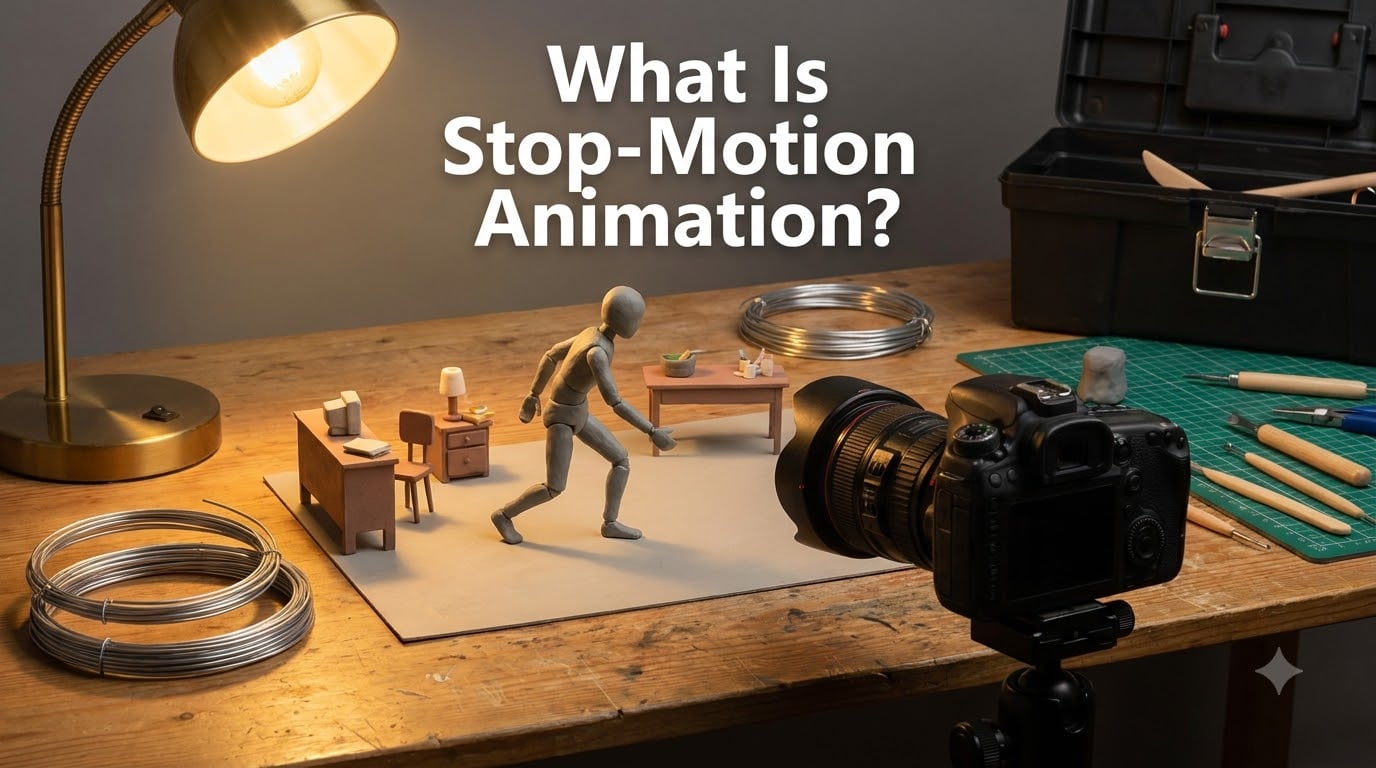
Stop motion animation is a filmmaking technique in which physical objects are photographed one frame at a time, then moved in tiny increments between each photograph. When the resulting sequence is played back at normal speed, the objects appear to move on their own, creating the illusion of life from real, tangible materials.
I have spent countless weekends hunched over a tiny set with a camera and a fistful of modeling clay, and the magic never wears off. Every animator I know describes that first successful shot the same way: it feels like performing a small miracle. In this guide I will walk you through exactly what stop motion animation is, how the frame-by-frame process works, the six main styles you will encounter, and what you need to start animating today.
Table of Contents
- Stop Motion Animation Is Frame-by-Frame Filmmaking With Physical Objects
- The Six Main Types of Stop Motion Animation
- A Brief History of Stop Motion Animation
- How the Stop Motion Process Actually Works
- Equipment and Software You Need to Start Animating
- Why Stop Motion Feels So Different From CGI
- Famous Stop Motion Films Every Animation Fan Should Know
- Is Stop Motion Still Used Today? Modern Applications
- Frequently Asked Questions About Stop Motion Animation
- The Bottom Line on Stop Motion Animation
Stop Motion Animation Is Frame-by-Frame Filmmaking With Physical Objects
At its core, stop motion animation is photography in service of motion. A camera captures a still image, the animator nudges an object a fraction of an inch, then captures the next still image. Repeat that process hundreds or thousands of times and you have a film.
The technique is sometimes called stop frame animation for the same reason: each frame is a single, frozen moment captured while everything else stays still. Unlike traditional hand-drawn animation, stop motion exists in the physical world. The light that hits the camera sensor bounced off real materials held in real hands.
The 24 Frames Per Second Standard
Most stop motion is produced for playback at 24 frames per second (fps), the same standard used for theatrical film. That means a single one-minute shot requires 1,440 individually photographed frames. Animators often shoot on twos, capturing one frame for every two final frames, which cuts the workload in half to 720 unique photographs per minute.
This frame rate is why stop motion looks the way it does. Each tiny movement has to be visible enough to read as motion when 24 separate images flash past per second. A movement of one millimeter per frame becomes a perceptible gesture. A movement of three millimeters becomes a fast action.
The Six Main Types of Stop Motion Animation
Stop motion is not a single art form. It is a family of techniques, each with its own materials, challenges, and visual signature. Understanding the six main types helps you pick the right one for your project.
1. Claymation
Claymation uses modeling clay, often plasticine, shaped into characters and props. Animators reshape the clay between frames to create movement. The classic example is Wallace and Gromit, whose expressive faces and squashy bodies are made possible only because clay holds fingerprints, dents, and emotion.
Claymation is forgiving for beginners because clay can be repositioned endlessly, but it is also unstable. Sets have to be kept cool, and animators often spend more time fixing collapsed features than animating them.
2. Puppet Animation
Puppet animation uses characters built around a metal or plastic armature, a wire skeleton that holds a pose. Because the pose is locked in, animators can move a puppet more precisely and reliably than clay. Films like Coraline and Kubo and the Two Strings rely on puppet animation.
Armatures are expensive, often costing thousands of dollars for a single character, which is why small studios rent them or build their own from aluminum wire and ball-and-socket joints.
3. Cutout Animation
Cutout animation uses flat characters, props, and backgrounds cut from paper, fabric, or photographs. Pieces are moved and rotated between frames. South Park began as cutout animation in 1997 before switching to computer software.
This style is the cheapest entry point. A pair of scissors, paper, and a phone camera are enough to begin. The trade-off is that cutout characters move with a stylized, slightly jerky quality that does not suit every story.
4. Pixilation
Pixilation is stop motion animation where the actors are real, live humans, repositioned in tiny increments between frames. Norman McLaren’s 1952 short Neighbours is the canonical example, featuring two men in a slow, surreal fistfight. Modern pixilation appears in commercials and music videos, often combined with live action for comic effect.
Pixilation blurs the line between stop motion and live action. Because the actors cannot truly freeze between frames, animators shoot in very short bursts and rely on careful staging.
5. Object Animation
Object animation uses everyday items, toys, food, office supplies, as the moving subjects. Think of a coffee cup that climbs a staircase, or a desk lamp that becomes a character. The technique is popular on YouTube and TikTok because it requires almost no custom assets.
The appeal is conceptual. Finding the right object and the right camera angle is the entire job. Many animators start here before graduating to claymation or puppet animation.
6. Silhouette Animation
Silhouette animation tells stories through backlit cutout figures, visible only as dark shapes against a bright background. The earliest surviving stop motion films, made in the early 1900s by pioneers like Arthur Melbourne-Cooper, used silhouette animation because it hid crude edges and let animators focus on motion.
Today the style is a niche aesthetic choice, often used for art films and title sequences. The limited visual information forces animators to communicate story through movement alone.
Claymation Versus Puppet Animation
The most common question newcomers ask is the difference between claymation and puppet animation, since both produce rounded, character-driven films. The short answer is structure. Claymation characters are held together only by the stickiness of the clay, which allows them to deform and squash freely but makes them fragile. Puppet characters have an internal armature that holds shape, allowing precise posing but limiting deformation.
Choose claymation when you want a handcrafted, expressive look and do not mind occasional repairs. Choose puppet animation when your story requires repeatable, exact poses, especially for dialogue scenes.
A Brief History of Stop Motion Animation
Stop motion is older than feature cinema. In 1898, Albert Smith and James Stuart Blackton created The Humpty Dumpty Circus, widely considered the first stop motion film, by photographing toy circus performers one frame at a time. By 1906, Blackton’s Humorous Phases of Funny Faces had blended stop motion with hand-drawn animation on screen.
The technique found its most famous early advocate in Willis O’Brien, who animated the original King Kong in 1933. O’Brien’s assistant, Ray Harryhausen, carried the craft forward through the 1950s and 60s, animating Jason and the Argonauts and creating the skeletal fight sequence that remains a benchmark of the art.
From Tricks to a Recognized Art Form
For decades, stop motion was treated as a special effect, useful for bringing monsters to life but rarely considered a standalone medium. That changed in the late 1980s when Nick Park began work on Wallace and Gromit at Aardman Animations in Bristol. Creature Comforts won the Academy Award for Best Animated Short Film in 1990, and Aardman proved stop motion could carry a feature, with Chicken Run arriving in 2000.
American studio Laika followed in 2009 with Coraline, the first stop motion film to be entirely shot in stereoscopic 3D. Since then, stop motion has secured a permanent seat at the feature-film table, with ParaNorman, The Boxtrolls, Kubo and the Two Strings, and Missing Link all earning Oscar nominations.
How the Stop Motion Process Actually Works
The production pipeline for stop motion has not changed in over a century, although the tools have. Here is how a typical short project moves from idea to finished film.
Step 1: Storyboard and animatic. Every project begins with drawings that plan each shot. An animatic is a rough video assembled from those drawings, sometimes with temporary sound, used to test pacing before any sets are built.
Step 2: Build the set and characters. Sets range from a tabletop for a hobbyist to a fully enclosed miniature room for a feature. Characters are sculpted, clothed, and posed.
Step 3: Frame-by-frame capture. The animator moves the character in tiny increments, photographing each pose. This is the longest stage. A single animator may shoot only two to five seconds of finished footage per week.
Step 4: Cleanup and post-production. Software is used to remove rigs, fix small mistakes, add effects, and combine the animation with sound and music.
Onionskinning and Video Assist Tools
Two modern digital aids have changed stop motion more than any other development. Onionskinning superimposes a translucent ghost of the previous frame over the live camera view, so animators can see exactly how far the character has moved and adjust the next pose accordingly. Video assist streams the live camera feed to a monitor or tablet, so the animator does not have to keep looking through a tiny viewfinder.
Software like Dragonframe and Dragonframe Lite puts both tools on the same screen, automatically advancing the frame number, saving each image, and letting the animator scrub through the previous frames like a video. Cloud Stop Motion does the same job in a web browser for free, which has made it popular in schools.
Equipment and Software You Need to Start Animating
The good news about stop motion is that the entry cost is low. You can shoot a complete short with nothing more than a smartphone, a flat surface, and a free app. The bad news is that quality scales quickly with gear, and most serious animators eventually invest in a dedicated setup.
The core kit list looks like this:
- Camera: A modern smartphone is fine for beginners. Mid-range and serious work uses a DSLR or mirrorless camera with manual exposure and focus controls.
- Tripod: Stability is non-negotiable. Any vibration between frames ruins the shot.
- Lighting: Consistent, controllable light is more important than expensive cameras. Two LED panels with adjustable brightness work well.
- Software: Dragonframe is the industry standard for paid software. Cloud Stop Motion is the best free option for browsers. Stop Motion Studio is a popular mobile app.
- Rigging: Armature wire, tacky glue, and small props hold characters in place between frames.
Beginner Setups vs Professional Studios
A beginner setup using a phone, a desk lamp, and Stop Motion Studio can produce a respectable two-minute short. Laika’s feature films, by contrast, use a combination of high-resolution DSLRs, motion-control camera rigs, and custom Dragonframe integrations. The studio animates on miniature sets inside light-controlled rooms that allow a single frame to take 30 seconds to expose.
You do not need a Laika budget to learn. The craft is the same at every scale. What changes is the polish, the speed, and the size of the team.
Why Stop Motion Feels So Different From CGI
Stop motion animation has an emotional quality that computer-generated imagery rarely matches. Part of it is the visible texture of real materials: fingerprints in clay, the weave of a fabric costume, the slight wobble of foam latex. Part of it is the pacing: because each frame takes deliberate human effort, the motion tends to be slower, more thoughtful, more deliberate.
This is also why some viewers find stop motion unsettling. The animation feels almost real, but the figures clearly are not. Our brains register a near-human movement attached to an obviously artificial body, and that mismatch produces a low-level tension. Films like Coraline and ParaNorman use that tension deliberately, leaning into the uncanny to tell ghost stories.
The Tangible, Handcrafted Aesthetic
Where CGI can simulate any material and any lighting, stop motion commits to the materials it can actually hold. That commitment shows. A clay face lit by tungsten light carries a warmth and a grain that no computer shader has quite replicated. That is the aesthetic hook for both filmmakers and audiences, and it is why stop motion has survived every technical disruption in cinema over the last 120 years.
Famous Stop Motion Films Every Animation Fan Should Know
A short tour of the canon is the best way to see how varied stop motion can be. Each of these films is widely available and showcases a different style.
- Wallace and Gromit: The Wrong Trousers (1993): Nick Park’s iconic short featuring a penguin villain, widely regarded as a masterpiece of claymation timing.
- Chicken Run (2000): Aardman’s first feature, a comedic prison-break story starring clay chickens.
- The Nightmare Before Christmas (1993): Tim Burton’s musical fantasy, built on puppet animation with replaceable faces for expression.
- Coraline (2009): Laika’s first feature and the first stop motion film shot entirely in 3D.
- Kubo and the Two Strings (2016): Laika’s most ambitious film, mixing stop motion with CGI environments.
- Anomalisa (2015): Charlie Kaufman and Duke Johnson’s adult drama, proof that stop motion can carry quiet, literary stories.
Is Stop Motion Still Used Today? Modern Applications
Stop motion is alive and well. Aardman continues to release Wallace and Gromit shorts on the BBC, Laika is building its fifth feature film, and adult-skewing stop motion series like Guillermo del Toro’s Cabinet of Curiosities have appeared on Netflix. Advertising agencies still book stop motion directors because the aesthetic photographs beautifully and reads as authentic in a feed full of CGI. Music videos, particularly in indie and folk scenes, often use stop motion to match a handcrafted album aesthetic.
On the hobbyist side, the r/stopmotion subreddit and the Brickfilms community for LEGO stop motion are both active and welcoming. New animators share their first attempts, get feedback, and learn from working professionals who post behind-the-scenes material.
Frequently Asked Questions About Stop Motion Animation
Why is stop motion so unsettling?
Stop motion feels unsettling because the motion is close to real but the materials clearly are not. Our brains register near-human movement attached to obviously artificial figures, and that mismatch creates a low-level tension. Films like Coraline and ParaNorman lean into the effect deliberately.
Is stop motion animation still used today?
Yes. Aardman continues to release Wallace and Gromit shorts, Laika is building its fifth feature film, and Netflix series such as Guillermo del Toro’s Cabinet of Curiosities use stop motion for adult-skewing horror. Commercials and music videos frequently commission stop motion because the aesthetic reads as authentic and tactile.
What is the most famous stop motion movie?
The most famous stop motion feature films include Wallace and Gromit: The Wrong Trousers, Chicken Run, The Nightmare Before Christmas, Coraline, and Kubo and the Two Strings. The most awarded stop motion studio is Aardman, with four Academy Awards for animated short film.
What is the difference between claymation and stop motion?
Claymation is a specific type of stop motion animation. Stop motion is the broad family of techniques that photograph physical objects one frame at a time. Claymation uses plasticine or modeling clay as the primary material. All claymation is stop motion, but stop motion also includes puppet animation, cutout animation, pixilation, object animation, and silhouette animation.
How many frames do I need for one second of stop motion?
For film-standard playback at 24 frames per second, you need 24 unique photographs per second of finished animation. Many animators shoot on twos, capturing one frame for every two final frames, which reduces the workload to 12 unique photographs per second and still looks smooth.
Can I make stop motion animation with my phone?
Yes. Modern smartphones have more than enough resolution for short stop motion films. Apps like Stop Motion Studio, iStopMotion, and the free Stop Motion Studio for Android handle frame capture, onionskinning, and basic editing. A phone on a small tripod with a single desk lamp is a complete beginner setup.
The Bottom Line on Stop Motion Animation
Stop motion animation is a filmmaking technique where physical objects are photographed one frame at a time and moved slightly between shots, creating the illusion of movement when played at standard speed. It includes claymation, puppet animation, cutout animation, pixilation, object animation, and silhouette animation, each with its own materials and visual signature.
If you have been curious about stop motion animation, the best way to learn is to shoot ten frames today. Pick up a piece of clay, put your phone on a stack of books, and move the clay between each shot. Ten frames will not make a movie, but they will teach you more about the art form than any article, including this one. The craft is patient, physical, and quietly addictive, and 2026 is a perfect time to start.