
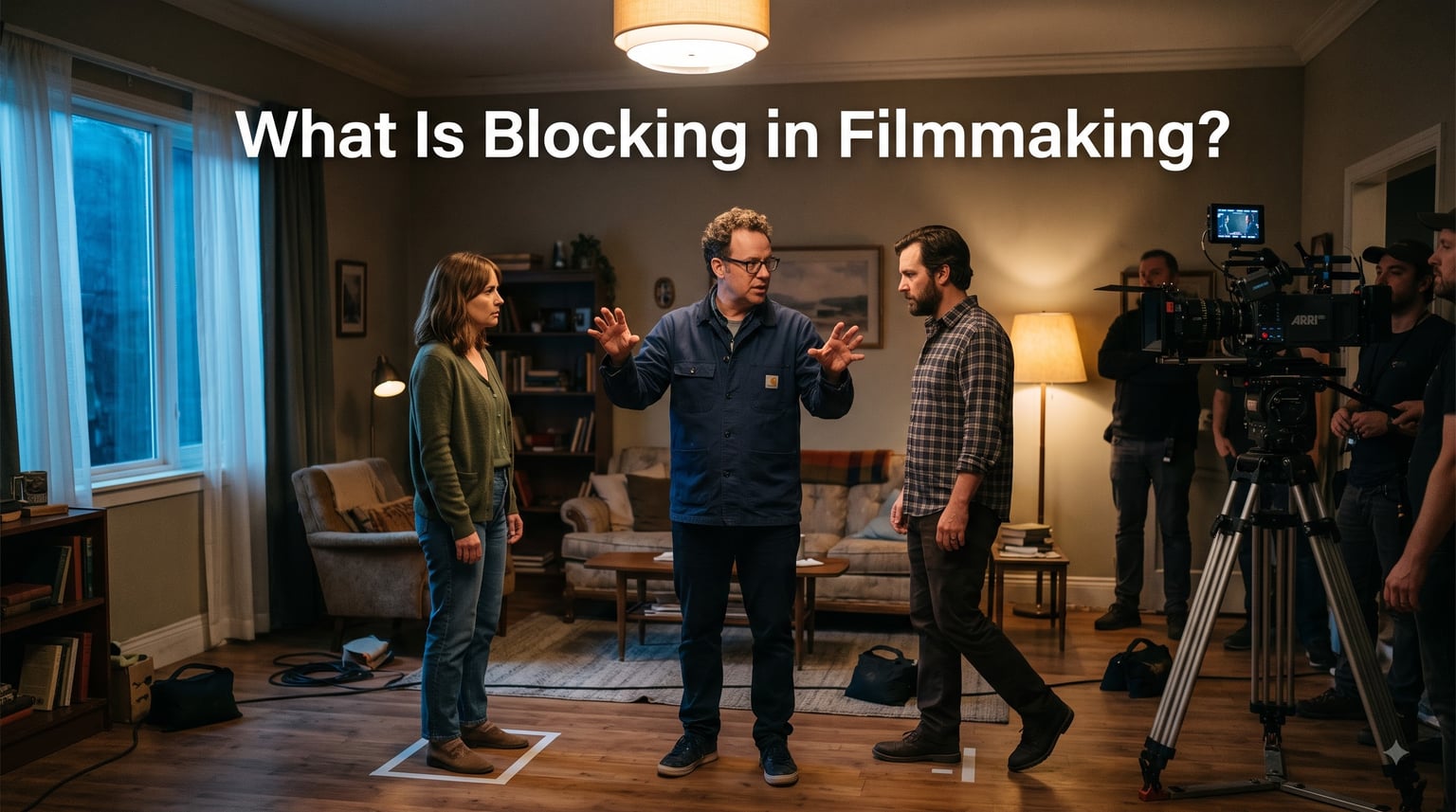
Every great film scene you remember, the ones that made you lean forward or hold your breath, started with a decision about where actors would stand and how they would move. That decision is called blocking, and it is one of the most powerful tools a director has. If you have ever wondered what is blocking in filmmaking, this guide breaks it down from definition to practical technique, with real film examples and tips specifically for short film and low-budget creators.
Table of Contents
- What Is Blocking in Filmmaking?
- Why Blocking Matters?
- Macroblocking vs Microblocking: The Two Types of Blocking
- How to Block a Scene: The Blocking Process
- How Blocking Works With the Camera?
- Blocking vs Staging vs Framing
- Three Principles of Effective Blocking
- Blocking Examples From Famous Films
- Blocking for Short Films and Low-Budget Productions
- Common Blocking Mistakes to Avoid
- FAQs
- Conclusion
What Is Blocking in Filmmaking?
Blocking in filmmaking is the precise staging, positioning, and movement of actors, props, and the camera within a scene’s physical space. Often called the choreography of a scene, it dictates where actors stand, how they move, and how the camera captures those actions to tell a visual story.
Directors work out the details of an actor’s moves in relation to the camera during rehearsals. They determine where actors stand, sit, cross, and pause, then coordinate those movements with camera placement, framing, and lighting. The result is a unified visual plan that serves the story without needing a single line of dialogue to explain it.
Blocking covers two layers of movement. The first is the broad path actors travel across the set. The second is the subtle stuff: a turned shoulder, a shifted weight, a hand on a doorframe. Both layers work together to communicate character, emotion, and subtext.
Why Blocking Matters?
Blocking is where directing becomes visual rather than verbal. It is how a director tells the audience where to look, what to feel, and who matters in a given moment. Here are the five core reasons blocking matters.
1. Visual storytelling. Blocking communicates character relationships and power dynamics through physical distance, height, and orientation. Two characters standing far apart can signal tension without a word of script.
2. Narrative clarity. Good blocking makes a scene instantly readable. The audience always knows who is in focus, who is entering, and where everyone is in relation to each other.
3. Emotional impact. An actor stepping closer to another can shift a scene from casual to intimate. Movement carries feeling that dialogue alone cannot deliver.
4. Audience attention. Directors use blocking to guide the viewer’s eye. Movement, contrast in positioning, and spatial relationships direct attention toward what matters in each beat.
5. Pacing and rhythm. The pace at which actors move and the frequency of position changes control the energy of a scene. Fast, sharp blocking creates urgency. Slow, deliberate movement creates weight and tension.
Macroblocking vs Microblocking: The Two Types of Blocking
FilmSkills breaks blocking into two distinct stages, and understanding the difference is one of the fastest ways to level up your directing. Most resources skip this framework entirely, but it maps perfectly onto how scenes actually get built on set.
Macroblocking covers the large-scale movements within a scene. This includes actors crossing a room, moving from one mark to another, sitting down, standing up, or entering and exiting frame. Macroblocking is the skeleton of a scene. It determines the overall spatial choreography and how characters navigate the physical environment.
Microblocking covers the subtle, small-scale movements that happen within a single position. A weight shift, a head turn, a hand gesture, the angle of a shoulder, a lean forward. These micro-movements are what make a performance feel alive rather than robotic. They often carry more subtext than the macro moves.
The two layers work together. A director might decide in macroblocking that a character crosses from the window to the sofa. In microblocking, they decide the character drags their feet, turns their back to the other actor halfway across, and sits down heavily. The macro move creates structure. The micro moves create meaning.
How to Block a Scene: The Blocking Process
Blocking a scene follows a practical workflow that keeps a set efficient and a cast confident. The NYFA model, drawn from veteran directing coach Peter D. Marshall, breaks it into five stages.
Step 1: Block. The director walks through the scene with the actors, determining where everyone starts, moves, and ends up. This happens before cameras or lighting are involved. The goal is to find the emotional and physical logic of the scene through movement.
Step 2: Light. Once the blocking is set, the cinematographer and lighting team design the lighting around where actors will actually be. This is why blocking must come first. Lighting decisions depend entirely on actor positions and camera angles.
Step 3: Rehearse. Actors run the scene with the full blocking in place, on the actual set, with props and camera present. This is where the blocking gets tested against reality. Do the marks work? Does the movement feel natural? Can the camera follow?
Step 4: Adjust. The director tweaks anything that is not working. An actor might need to take a different path. A camera angle might need to shift. A lighting fixture might need to move. This is the problem-solving stage.
Step 5: Shoot. With blocking locked, lighting set, and rehearsals done, the scene is ready to film. This staged process is especially important on low-budget productions where every minute on set costs money.
How Blocking Works With the Camera?
Blocking never exists in isolation from the camera. Every actor position implies a camera position, and every camera position changes how blocking reads on screen. This is why directors and cinematographers must collaborate from the earliest stages of scene planning.
Camera blocking refers to the coordinated plan for how the camera moves in relation to the actors. A static wide shot requires different blocking than a handheld tracking shot or a slow dolly push. The director and the director of photography work together to build a shot list that captures the blocking from the right angles.
Blocking also affects lighting and setup time. Every time actors move to a new part of the set, the lighting may need to change. On tight schedules, directors plan blocking that minimizes lighting resets and camera repositioning. This is a skill experienced directors develop over time: creating blocking that is visually dynamic but logistically efficient.
Blocking vs Staging vs Framing
These three terms get confused constantly, and none of the top search results bother to separate them clearly. Here is the distinction.
Blocking refers to the movement and positioning of actors within a scene. It is about the people: where they stand, how they cross the space, and what they do physically.
Staging is the broader term that encompasses blocking but also includes the arrangement of everything in the scene: props, furniture, set elements, and camera position. Staging is the overall spatial design. Blocking is the actor-specific part of that design.
Framing refers to what the camera sees. It is determined by lens choice, camera distance, and composition. Framing is how the staged scene is captured in the rectangular frame of the image. You can stage a scene beautifully and still frame it poorly.
Think of it this way: staging is the room arrangement, blocking is the actor choreography within that arrangement, and framing is the window through which the audience views it all.
Three Principles of Effective Blocking
StudioBinder organizes effective blocking around three principles: space, shapes, and lines. These give directors a practical framework for making decisions that go beyond instinct.
1. Space. The distance between actors communicates relationship. Close proximity suggests intimacy or tension. Distance suggests separation, conflict, or hierarchy. Directors use the physical space between characters to say something about their emotional connection without dialogue.
2. Shapes. How actors are arranged creates visual shapes in the frame. Triangles between three characters create balance and stability. Diagonal lines create energy and imbalance. Circles suggest intimacy or confrontation. The shapes your actors form on screen affect how the audience reads the scene emotionally.
3. Lines. Lines of sight, movement paths, and physical orientation guide the audience’s eye. An actor pointing or looking in a direction pulls the viewer’s attention. Movement along a strong diagonal creates momentum. Blocking that uses lines intentionally keeps the audience focused on what matters in each moment.
Blocking Examples From Famous Films
If you want to understand blocking, study the masters. Reddit users on r/Filmmakers and r/TrueFilm consistently recommend the same directors and films for learning how movement tells a story. Here are five to watch.
Alfred Hitchcock’s Rope (1948). The entire film plays out in what appears to be a single continuous take. Hitchcock’s blocking is a masterclass in managing a large cast within a confined apartment set. Every actor is precisely positioned so the camera can glide through the space without missing a beat of tension.
Alfred Hitchcock’s Rear Window (1954). This film teaches spatial relationships. Jimmy Stewart is confined to a wheelchair while the action unfolds across the courtyard. The blocking makes the audience feel his helplessness and voyeurism through where characters move in relation to his fixed position.
Akira Kurosawa’s films. Users on the Roger Deakins forum recommend Kurosawa for camera blocking mastery. His use of telephoto lenses with deep blocking, where multiple actors occupy different planes of depth, creates layered compositions that keep the eye moving.
Robert Bresson and Andrei Tarkovsky. These directors demonstrate how minimal, deliberate blocking creates maximum emotional weight. Characters move slowly, purposefully, and the restraint itself becomes the storytelling device.
The Coen Brothers. For a modern masterclass, study any Coen brothers film. Their blocking is tight, choreographed, and every movement has a purpose. Watch the conversation scenes in No Country for Old Men or Fargo to see how stillness and sudden movement create dread.
Blocking for Short Films and Low-Budget Productions
If you are making short films or working with a micro budget, blocking becomes even more critical. You likely have fewer locations, fewer takes, and less time. Smart blocking can make a small production look far more professional than its budget suggests.
The single most valuable rule for low-budget blocking is to minimize lighting changes. Every time actors move to a new area, your lighting team needs to adjust, and that takes time. Plan blocking that keeps actors within established lighting zones as much as possible. This is a technique that television directors use daily to stay on schedule.
Pre-production is where low-budget blocking saves you. Build a storyboard or shot list that maps every actor position and camera angle before you reach set. Walk through the blocking in the actual location if you can. Indie filmmakers on Reddit stress that the biggest time waster on set is figuring out blocking on the fly with a full crew standing around.
Use what you have. A single room with creative blocking can feel like multiple locations. Position actors at different depths, use doorways and windows as framing devices, and let movement between foreground and background create visual variety without needing new sets.
Finally, rehearse with your actors before the shoot. Community theater directors note that actors often appear lost without guided blocking. A rehearsal where you walk through the physical movements together builds confidence and saves precious set time.
Common Blocking Mistakes to Avoid
No competitor covers this, but beginners make predictable mistakes that undercut their scenes. Here are the most common ones and how to fix them.
Mistake 1: Actors stand still and talk. The number one complaint from Reddit filmmakers is that conversation scenes become flat when actors just face each other and recite lines. Give actors a reason to move: a task, a prop, a reason to cross the room. Movement keeps dialogue scenes visually alive.
Mistake 2: Overcomplicating the blocking. Some directors try to choreograph every gesture and cross. Over-blocked scenes feel stiff and theatrical. Find the key moments that need movement and let the actors fill the rest naturally.
Mistake 3: Ignoring the camera. Blocking actors without considering camera angles leads to shots where faces are hidden, eye lines are wrong, or key action falls outside the frame. Always block with the camera in mind.
Mistake 4: Not communicating blocking to actors. Directors often have a clear vision but fail to communicate it clearly. Use the rehearsal stage to walk through blocking with actors, explain the motivation behind movements, and listen to their input. Actors perform blocking better when they understand why they are moving.
Mistake 5: Blocking that does not serve the story. Movement for movement’s sake is distracting. Every blocking decision should support the character, the emotion, or the narrative beat. If a movement does not add meaning, cut it.
FAQs
What is an example of blocking?
A classic example of blocking is in Hitchcock’s Rear Window (1954), where Jimmy Stewart is confined to a wheelchair while action unfolds across the courtyard. The director positions Stewart as a stationary observer while other characters move through the visible apartment windows, using physical distance and fixed positioning to create tension and tell the audience where to look.
What is the difference between blocking and framing in filmmaking?
Blocking refers to the positioning and movement of actors within a scene. Framing refers to what the camera captures through lens choice, distance, and composition. You can block a scene well and still frame it poorly. Blocking is about actor choreography; framing is about how that choreography appears in the camera’s rectangular image.
What is the difference between staging and blocking?
Staging is the broader term that encompasses the arrangement of everything in a scene including actors, props, furniture, set elements, and camera position. Blocking is the actor-specific part of staging, focusing on where actors stand, sit, and move. Staging is the overall spatial design; blocking is the actor choreography within that design.
What are the three principles of blocking?
The three principles of blocking are space, shapes, and lines. Space refers to the distance between actors and what it communicates about their relationship. Shapes are the visual formations actors create in the frame, such as triangles or diagonals. Lines are the movement paths, sight lines, and physical orientations that guide the audience’s eye.
Conclusion
Understanding what is blocking in filmmaking gives you one of the most practical and creative tools a director can develop. It is the choreography of a scene, the physical language that communicates character, emotion, and story without relying on dialogue. Whether you are planning your first short film or refining your directing skills on set, the way you position and move your actors shapes everything the audience feels.
Start with the basics. Learn the difference between macroblocking and microblocking. Practice the five-stage workflow. Study the masters like Hitchcock, Kurosawa, and the Coen Brothers. Then grab a camera, work with actors, and start blocking your own scenes. The only real way to improve is by doing.