
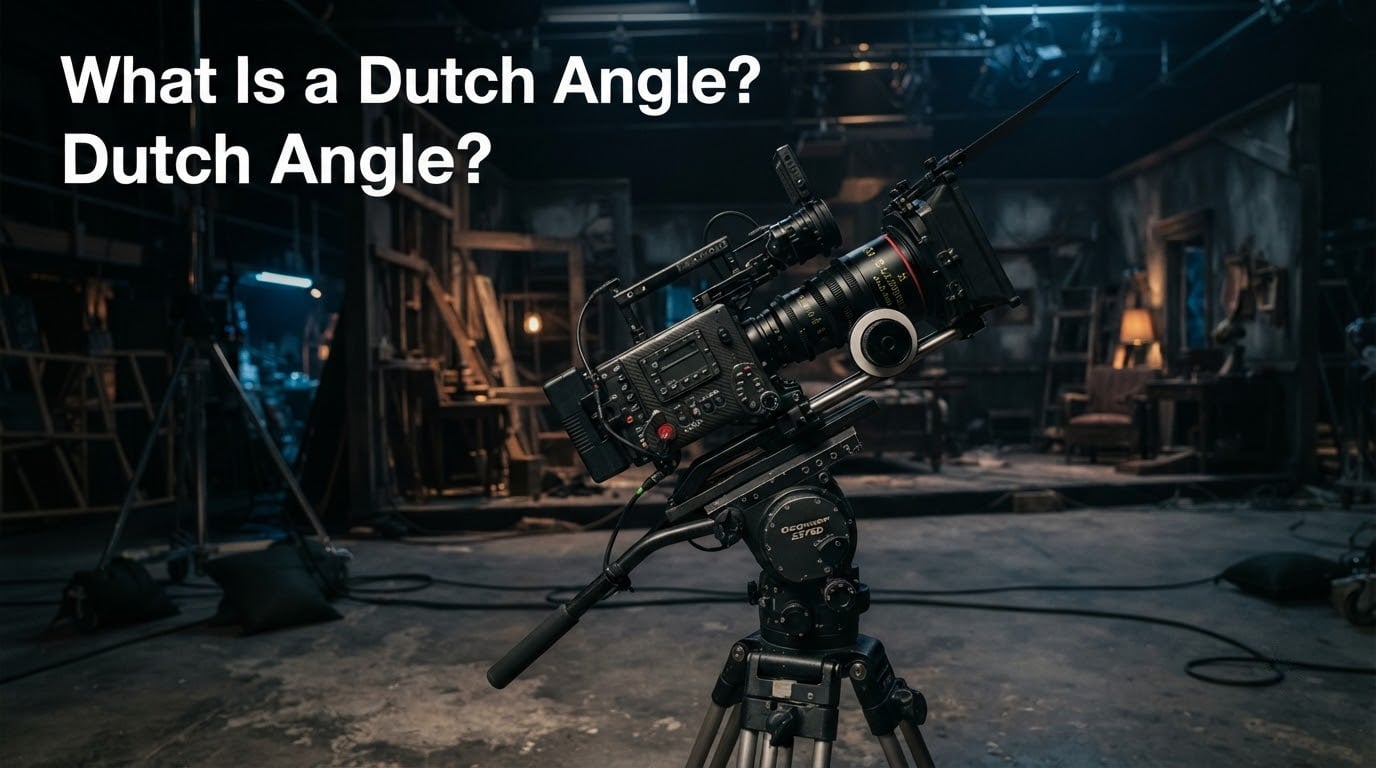
A Dutch angle (also called a Dutch tilt, canted angle, or oblique angle) is a camera shot where the camera is rotated on its horizontal x-axis so the horizon line is no longer parallel to the bottom of the frame. Filmmakers use this tilted framing to inject psychological unease, disorientation, or instability into a scene, and the technique traces its roots back to the German Expressionist movement of the 1920s. In this guide, our team breaks down the definition, etymology, history, famous film examples, and the technical steps to shoot one yourself.
Table of Contents
- What Is a Dutch Angle? Definition and Core Effect
- Why Is It Called a Dutch Angle? The Deutsch Confusion
- History and Origins: From German Expressionism to Hollywood Noir
- Famous Dutch Angle Examples in Film
- Modern Auteur Directors Who Use the Dutch Angle
- How to Execute a Dutch Angle: Technical Setup
- Dutch Angles in Short Films: A Cheat Sheet for Indie Filmmakers
- Common Dutch Angle Mistakes and When to Avoid It
- Dutch Angle Beyond Cinema: TV, Photography, and Games
- Frequently Asked Questions
- Final Thoughts on the Dutch Angle
What Is a Dutch Angle? Definition and Core Effect
A Dutch angle is a camera shot in which the camera is tilted on its x-axis, breaking the level horizon so vertical lines run diagonally through the frame. The tilt can be subtle (around 10 degrees) or extreme (45 degrees or more), and the technique is also known as a Dutch tilt, canted angle, or oblique angle.
Our team uses the technique whenever a scene needs to feel off-balance, and the effect is immediate: the human brain is wired to expect a level horizon, so a tilted frame triggers a low-level stress response that reads as unease, instability, or wrongness. That is why filmmakers reach for it during horror, thriller, and psychological-drama moments when a character’s world is slipping.
Here is a quick reference for the synonyms you will see in scripts and shot lists.
- Dutch angle – Most common in American and British film vocabulary.
- Dutch tilt – Preferred by camera operators and grips.
- Canted angle – Formal cinematographic term used in textbooks.
- Oblique angle – General term in photography and still imagery.
- Vortex plane – Rare, mostly academic usage.
- Deutsch tilt – Historically accurate term, from the German Expressionist roots.
If you are matching the look in post, our guide to the best wide-angle lens for filmmaking covers the optics that exaggerate the tilt for the strongest effect.
Why Is It Called a Dutch Angle? The Deutsch Confusion
The shot is called a Dutch angle because of a translation mix-up between Deutsch (German) and Dutch (Netherlandish). The technique was popularized by German Expressionist filmmakers in the 1920s, and English-speaking crews picked up the term from German crews who referred to their own style as “Deutsch.”
Over decades “Deutsch tilt” was misheard and shortened into “Dutch tilt,” and the misnomer stuck. Director Carol Reed once joked about William Wyler carrying a spirit level on set so he could spot anyone filming a Deutsch tilt and call it out. The same naming confusion shows up in “Dutch uncle,” “Dutch auction,” and “Dutch roll,” all of which actually trace back to Deutsch roots.
You will see both terms used interchangeably today, but if you want to be historically accurate, “Deutsch angle” or “canted angle” is closer to the original.
History and Origins: From German Expressionism to Hollywood Noir
The Dutch angle is older than most people think. The earliest known use on film dates to 1906, when Edwin S. Porter tilted the camera in the short Dream of a Rarebit Fiend to show a character’s disoriented, drunken state.
By the 1920s the technique had become a visual signature of German Expressionism, the artistic movement that used distorted sets, harsh shadows, and skewed camera angles to externalize inner turmoil. The Cabinet of Dr. Caligari (1920) is the canonical example, with its painted, jagged sets that already implied a tilted world, followed by F.W. Murnau’s Nosferatu (1922), where every shadow was a threat.
Soviet filmmaker Dziga Vertov pushed the technique further in Man with a Movie Camera (1929), using a tilted frame to make a city feel alive and unstable at the same time. When German Expressionists fled to Hollywood in the 1930s and 1940s, they brought the Dutch tilt with them, and it became a hallmark of film noir. Carol Reed’s The Third Man (1949), shot by Robert Krasker, is the textbook noir example, with its crooked Vienna streets mirroring a postwar moral rot.
Famous Dutch Angle Examples in Film
Most modern genre films borrow the Dutch tilt directly from noir, and the best examples use it once or twice per film, then return to level. Here are the scenes most cited by cinematographers when teaching the technique.
Mission: Impossible (1996) – Prague restaurant: Brian De Palma tilts the frame during the entire Ethan Hunt and Kittridge meet, letting the audience feel the trap closing before any dialogue does.
Inception (2010) – hotel corridor fight: Christopher Nolan rotates the entire hotel set while the camera holds level, which produces the opposite effect and shows how the technique’s power comes from breaking expectation.
Vertigo (1958) – bell tower climax: Alfred Hitchcock and cinematographer Robert Burks tilt the camera with Jimmy Stewart’s vertigo, putting the audience inside the character’s dizziness.
The Third Man (1949) – sewer reveal: Carol Reed uses the tilt during Harry Lime’s shadow on the wall, signaling moral corruption in a single frame.
Pulp Fiction (1994) – opening diner robbery: Quentin Tarantino tilts during the opening standoff to make a mundane breakfast feel like a heist.
Batman (1966 TV series) – fight scenes: The 1960s Batman show leaned on the Dutch tilt as a stylistic signature, which is also the case in Joel Schumacher’s Batman Forever.
Do the Right Thing (1989) – Radio Raheem sequence: Spike Lee tilts during the Radio Raheem scenes to heighten racial tension and signal an escalating threat.
The Shining (1980) – Danny on tricycle: Stanley Kubrick uses restrained tilts in the Overlook hallways, signalling that the architecture itself is wrong.
Se7en (1995) – first appearance of John Doe: David Fincher tilts the frame the moment the killer is identified, marking him as something outside the world of the detectives.
Modern Auteur Directors Who Use the Dutch Angle
Several living directors have made the Dutch tilt part of their visual identity. Quentin Tarantino uses it selectively, most notably in Inglourious Basterds during the basement tavern scene and in Reservoir Dogs’ warehouse standoff, which is one reason reddit threads asking “Does Tarantino use Dutch angles?” consistently come back to yes.
Christopher Nolan deploys it sparingly, mostly during action set-pieces. Tim Burton uses the tilt to underline Gothic unease, and Danny Boyle uses it as a signature energy in 28 Days Later and Slumdog Millionaire. Reddit users in r/cinematography often cite Boyle’s run as a positive example of the technique used as a deliberate through-line rather than decoration. Spike Lee, Brian De Palma, and Sam Raimi round out the list of modern directors who treat the tilt as a storytelling tool, not a trick.
How to Execute a Dutch Angle: Technical Setup
Shooting a Dutch angle is straightforward once you understand the mechanics. Our team uses the following five-step setup on every shoot that calls for the tilt.
Step 1: Mount the camera on a stable head. A fluid tripod head with a clearly marked tilt scale is the easiest way to lock in a repeatable angle. For low-angle work, our mini tripod for low-angle cinematic shots guide covers the small rigs that handle ground-level tilts without drift.
Step 2: Set your tilt degree to match the emotional beat. Subtle 10 to 15 degree tilts read as mild unease. Moderate 20 to 30 degree tilts register as clear tension. Extreme 45 degree or more tilts signal psychological break, dream logic, or possession. Use sparingly.
Step 3: Choose your lens. Wide-angle lenses exaggerate the tilt and add motion sickness if you combine them with camera movement. Our best wide-angle lenses for video guide breaks down the focal lengths that work best for tilts in tight interiors. For low tilts near the floor, a high-hat tripod for low-angle shots gives you the clearance to keep the frame clean.
Step 4: Mind your depth of field. A shallow depth of field isolates your subject and keeps the tilt from feeling cluttered. Stop down for wide shots where you want the whole crooked world visible.
Step 5: Plan your transitions. The entry and exit of a tilt matter as much as the tilt itself. Match action, eyeline, or sound design when crossing into and out of the angled frame, so the audience understands why the world has just shifted.
Post-production option: If you cannot tilt in camera, you can rotate the frame in your edit software to fake the angle. This works best for static shots and is a common trick in music videos and short films where the schedule does not allow a reshoot.
Dutch Angles in Short Films: A Cheat Sheet for Indie Filmmakers
Short films are where the Dutch tilt pays off most. A single tilted frame in a three-minute film does the work of three pages of dialogue, which matters when you are telling an entire story in a festival-friendly runtime. The catch is that short films live or die on perceived intent, so the tilt has to feel motivated.
Our team follows three rules when using the Dutch tilt in short-form work.
Rule 1: Motivate the tilt by story. Reddit users in r/cinematography consistently say the technique works “if it fits the story, setting, or characters.” A character in withdrawal, a haunted house, a job interview that is going sideways, any of these earn the tilt. A coffee shop chat does not.
Rule 2: Pair the tilt with sound design. A subtle low-frequency drone or a slight pitch shift on the score multiplies the unease of the visual tilt. Pairing the two is one of the cheapest, highest-leverage moves you can make in post.
Rule 3: Choose one tilt per scene. Hold the tilt for a single beat, then return to level. The audience registers the shift as a story event instead of a stylistic flourish, which is the difference between effective and gimmicky.
For short films that get the tilt right, look at festival circuits like Clermont-Ferrand and SXSW, where restrained use of camera angles is consistently rewarded over flashy ones.
Common Dutch Angle Mistakes and When to Avoid It
The Dutch tilt is one of the easiest techniques to overuse, and beginner photographers and filmmakers lean into it heavily before they learn restraint. The most common pitfalls, drawn from forum feedback and editor reviews, are the following.
Unmotivated tilt: Tilting “because it looks cool” reads as a stylistic crutch. Tie every tilt to a story beat.
Continuous tilt across an entire film: The cautionary case is Battlefield Earth, where roughly 90 percent of the film’s shots were canted, and the result was widely panned as nauseating and distracting.
Jarring transitions: Cutting from a level shot to a 45 degree tilt in the middle of a calm scene jolts the audience out of the story. Match action, eyeline, or sound when entering or exiting the tilt.
Ignoring depth of field: A tilt with a flat, cluttered background looks messy. Use shallow focus or careful blocking to keep the composition clean.
Reddit photographers note that beginners often grow out of the heavy tilt phase within their first year, and the technique lands harder when it is used sparingly. Treat the Dutch angle as a punctuation mark, not a paragraph.
Dutch Angle Beyond Cinema: TV, Photography, and Games
The Dutch tilt has expanded well past cinema. Television series use it during moments of psychological shock, and one reddit thread cited Stranger Things Season 3 Episode 4, where an abrupt tilt when Tom kicks his chair lands as an effective shock beat.
In photography, fashion and street photographers use the tilt to inject attitude into otherwise static compositions, which is why wedding photographers and editorial shooters reach for it when the standard level frame feels too polite. Horror video games like Resident Evil and Silent Hill use the tilt as a diegetic signal that the player’s world has gone wrong, often paired with skewed geometry in the level design itself.
Frequently Asked Questions
Does Tarantino use Dutch angles?
Yes. Quentin Tarantino uses the Dutch tilt as a storytelling accent in films like Inglourious Basterds, Reservoir Dogs, and Pulp Fiction, most notably in the basement tavern sequence in Inglourious Basterds and the warehouse standoff in Reservoir Dogs. He deploys it selectively rather than across an entire film, which is why it lands.
What does a Dutch angle convey?
A Dutch angle conveys psychological unease, tension, disorientation, or instability. The tilted horizon signals to the viewer that something in the world or the character’s mind is off, which is why the technique is so common in horror, thriller, and noir.
What movie has the most Dutch angles?
Battlefield Earth is widely cited as the most extreme example, with around 90 percent of its shots canted. It is generally referenced as a cautionary tale about overuse rather than as a recommended example.
Can you give me an example of Dutch angle filming?
The restaurant scene in Mission: Impossible (1996) is a textbook example, where Brian De Palma tilts the camera during the Ethan Hunt and Kittridge meet to mirror the trap closing. Other strong examples include the hotel fight in Inception, the bell tower climax in Vertigo, and the sewer reveal in The Third Man.
Why is it called a Dutch angle?
It is called a Dutch angle because of a translation mix-up. The technique comes from German (Deutsch) Expressionist filmmakers, and ‘Deutsch tilt’ was misheard and shortened to ‘Dutch tilt’ by English-speaking crews. The misnomer has stuck for nearly a century.
Is Dutch angle overused in modern film?
Yes, in the wrong hands. When every shot is tilted, the technique loses its meaning and can feel headache-inducing, which is exactly the criticism leveled at Battlefield Earth. Used sparingly, with motivation from story, character, or setting, the Dutch angle remains one of cinema’s most efficient visual shorthand tools.
Final Thoughts on the Dutch Angle
So what is a Dutch angle? It is one of cinema’s oldest and most efficient visual shorthand tools: a single tilt on the x-axis that can communicate madness, threat, paranoia, or moral ambiguity without a line of dialogue. It bridges German Expressionism, Hollywood noir, and modern blockbuster cinema, and it works just as well in a short film as in a feature.
Our team’s rule of thumb for 2026 and beyond is to treat the Dutch angle as a punctuation mark rather than a paragraph. One motivated tilt per scene, paired with strong sound design and clean depth of field, will outperform a film that tilts every shot. If you are building a shot list for your next short, storyboard the tilt the same way you would storyboard a key light, and the technique will land every time.