
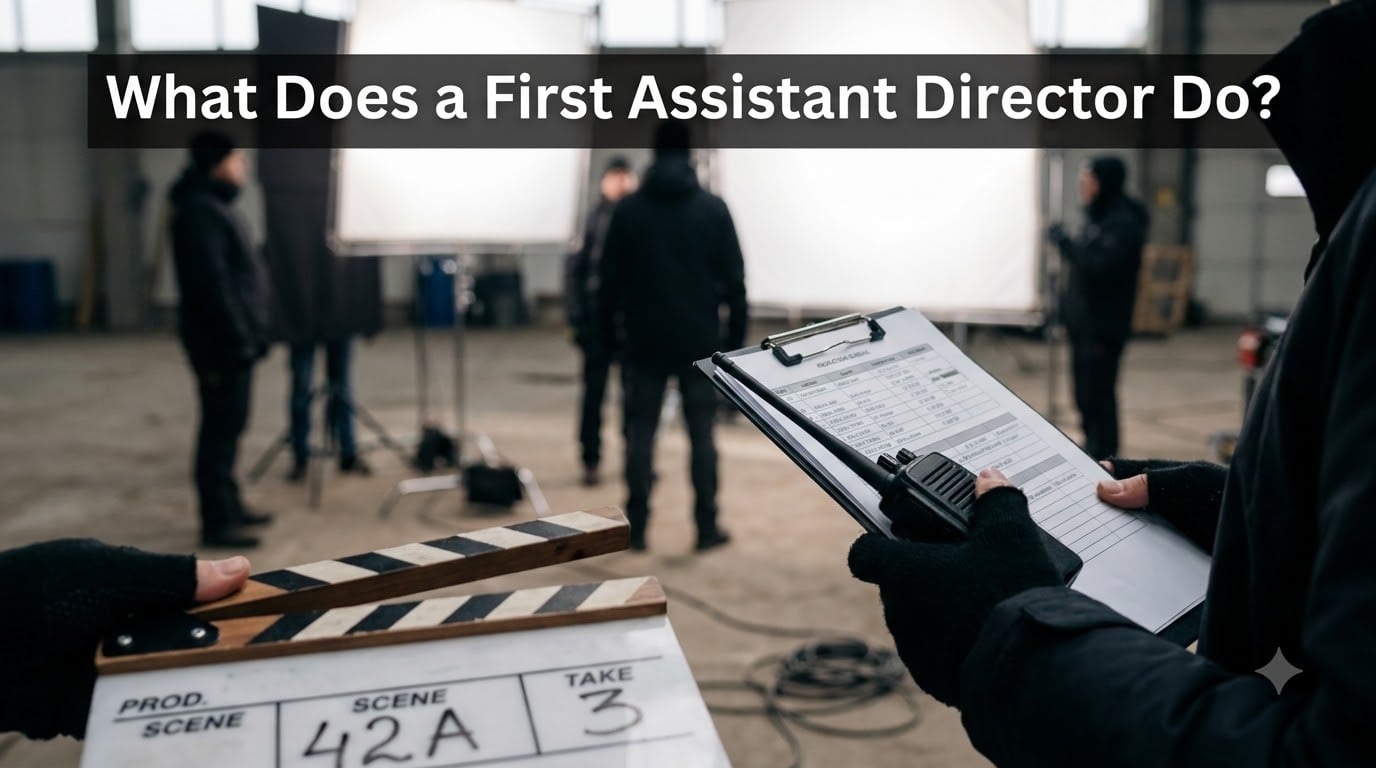
A first assistant director (1st AD) is the director’s right hand on a film or TV set. They manage overall logistics, build the shooting schedule, prepare daily call sheets, and keep the cast and crew moving on time. When a director is focused on performance and framing, the 1st AD is the person tracking the clock and making sure every department has what it needs.
If you have ever wondered what does a first assistant director do on a film set, this guide breaks down the role from pre-production through wrap. I have spent time working alongside 1st ADs on short films and indie features, and the short answer is this: they run the set so the director does not have to. Below I walk through every part of that job, including the AD hierarchy, the calling the roll protocol, salary expectations, and how to break into the role yourself.
Table of Contents
- Quick Summary: What Does a First Assistant Director Do?
- What Does a First Assistant Director Do on a Film Set?
- Pre-Production Responsibilities of a 1st AD
- On-Set Responsibilities: Running the Set Day-to-Day
- The Calling the Roll Protocol: Exact AD Phrases
- The Director Trifecta: 1st AD, Director, and Director of Photography
- 1st AD vs 2nd AD vs 3rd AD: Hierarchy and Duties Comparison
- Key Skills and Qualities of a Great 1st AD
- How to Become a First Assistant Director?
- 1st AD Salary and Career Outlook
- FAQs
- Conclusion
Quick Summary: What Does a First Assistant Director Do?
Role in one sentence: The 1st AD plans the production schedule, prepares daily call sheets, runs the set during filming, and keeps the production on time and on budget.
Pre-production focus: Script breakdown, scheduling, location scout coordination, call sheet preparation, storyboard review.
On-set focus: Time management, calling the roll for each take, communication between director and crew, health and safety enforcement.
Key traits: Organized communicator, clock-watcher, calm multitasker, and trusted lieutenant to the director.
AD hierarchy: 1st AD runs the set, 2nd AD manages the schedule and paperwork, 3rd AD handles talent and extras on the ground.
What Does a First Assistant Director Do on a Film Set?
What does a first assistant director do on a film set is one of the most searched questions about film crew roles, and the answer is layered. At its core, the 1st AD is responsible for the logistics of running the set during production. They are the liaison between the director and the rest of the crew, and they own the daily progress of the shoot.
The 1st AD sits below the line in the crew hierarchy, which means they are part of the technical team rather than the creative principals (the director, producers, and lead actors are above the line). Even so, the 1st AD often has more direct authority on set than anyone except the director, because they decide when cameras roll, when actors move, and when lunch happens.
On a typical day, the 1st AD arrives on set before anyone else, walks the location with the unit production manager, confirms the day’s plan with the director, briefs the 2nd AD and 3rd AD, and then runs the morning safety meeting. From that moment until wrap, they are the one calling the roll, timing rehearsals, and pushing the production forward. When the schedule slips, the 1st AD decides whether to cut a shot, delay a setup, or extend the day. That is real power, and it is why the role is sometimes called the director’s right hand.
Pre-Production Responsibilities of a 1st AD
Most of the 1st AD’s hardest work happens before a single frame is shot. Pre-production is where the 1st AD shapes the production schedule that the entire shoot will follow, and that document will either save the production or sink it.
Perform a Script Breakdown
The first major pre-production task is the script breakdown. The 1st AD reads the screenplay scene by scene and tags every element the production needs: cast, extras, props, vehicles, special effects, wardrobe, animals, sound, and locations. This breakdown becomes the raw data for the shooting schedule.
Modern ADs use software like Movie Magic Scheduling or StudioBinder to do this digitally, but the principle is the same as it was in the 1930s. Identify everything the production must juggle, then group shots by location, cast availability, and lighting needs so the schedule flows logically.
Build the Shooting Schedule
Once the breakdown is complete, the 1st AD builds the shooting schedule in collaboration with the director and the director of photography (DoP). The goal is to maximize shooting efficiency while protecting the director’s creative priorities.
For a 25-day indie feature, the 1st AD might spend two to three weeks on the schedule alone. They will pull in location information from the location scout, factor in cast availability (especially if actors are only available on certain days), and structure the shoot so interiors happen in clusters, exteriors shoot around weather windows, and complex effects shots are scheduled early when the budget has more room.
Coordinate with the Location Scout
The 1st AD works closely with the location scout and location manager to confirm that every scheduled location actually works for the day’s plan. This includes checking access, parking, power, noise, and any restrictions that might affect the schedule. If a permit only allows filming until 6 p.m., the 1st AD builds that constraint into the day’s call sheet.
Prepare the Daily Call Sheet
The call sheet is the 1st AD’s signature document. It is distributed the evening before each shooting day and tells every crew member and cast member where to be, when to be there, what to bring, and what scenes are being shot. A good call sheet includes:
General call times for cast and crew (with staggered calls for different departments)
Location address, parking instructions, and a site map
Scenes scheduled for the day with script page counts
Cast call times and any special wardrobe or makeup notes
Weather forecast and sunset time
Emergency contacts and the day’s safety notes
The call sheet is the production’s daily operating system. When something goes wrong, the 1st AD issues a revised call sheet and everyone adjusts. When everything goes right, the 1st AD gets credit for a smooth day, which is exactly how they want it.
Review Storyboards and Shot Lists
The 1st AD also reviews the storyboard and shot list with the director and DoP during pre-production. They do not draw the storyboard or write the shot list, but they flag anything that will be difficult to shoot within the time budget and suggest adjustments. If the director wants 18 setups for a 2-page scene, the 1st AD is the one who gently raises the schedule concern before shooting day arrives.
On-Set Responsibilities: Running the Set Day-to-Day
Once cameras roll, the 1st AD becomes the operational lead on set. The director focuses on performance, framing, and creative choices. The 1st AD focuses on everything else.
Calling the Roll
The most visible 1st AD duty is calling the roll before each take. This is the moment when the 1st AD stands at the monitor, asks for quiet, and walks the set to confirm every department is ready. Once the set is locked, the 1st AD gives the director the cue to begin rehearsing or shooting.
Calling the roll is partly tradition and partly safety. It is the 1st AD’s way of confirming that sound is rolling, camera is set, lights are in place, actors are in position, and no one is standing in a hazard zone. The full protocol is detailed in the next section.
Time Management and Schedule Tracking
The 1st AD watches the clock on every shot. If the director wants to spend 45 minutes getting a perfect take, the 1st AD quietly tracks the time and surfaces concerns when the day’s plan is at risk. They do not overrule the director’s creative call, but they will say things like, “We have two more setups before lunch and we are 20 minutes behind. Want me to hold the wide shot for the afternoon?” That kind of conversation is the 1st AD’s bread and butter.
Health and Safety Enforcement
The 1st AD owns health and safety on set. They run the safety meeting at the start of every day, brief the crew on any hazards (stunts, pyrotechnics, water work, height, traffic), and have the authority to halt production if something is unsafe. On union productions, the 1st AD is also the person who signs off on risk assessments and incident reports.
Communication Between Director and Crew
The 1st AD is the messenger between the director and the rest of the crew. When the DoP needs to know if they should change a lens, the 1st AD relays the question and the answer. When the sound mixer needs 30 seconds of quiet for a wild line, the 1st AD makes the call. This communication role is why the 1st AD is sometimes called the communicator-in-chief on a movie set.
Blocking and Rehearsal Coordination
During rehearsal, the 1st AD times how long each setup takes and relays that information to the director. If a blocking pattern is taking too long to reset, the 1st AD will suggest a simpler version. They also coordinate with the script supervisor to mark each take and with the DoP to confirm lighting holds between takes.
The Calling the Roll Protocol: Exact AD Phrases
The calling the roll is one of the oldest rituals in film production. It originated on stage, where the stage manager called actors to their marks. On a modern film set, the 1st AD performs the call before every take. Here is the standard sequence, with the exact phrases used on most professional sets.
Picture is up: The 1st AD confirms the camera is rolling. Common phrase: “Picture is up.”
Sound is rolling: The sound mixer confirms the recorder is running. Common phrase: “Speed.”
Roll sound (if separate): For productions recording sound separately, the 1st AD calls: “Roll sound.” The sound mixer replies: “Speed.”
Roll camera: The 1st AD calls: “Roll camera.” The camera operator replies: “Rolling.” The 1st AD follows with: “Action.”
Quiet on set: Before the roll, the 1st AD may call: “Quiet on set,” “Settle down,” or “Places everyone.”
Turning over: Some sets use “Turning over” instead of “Picture is up.”
Cut and check the gate: After the take, the 1st AD calls: “Cut.” The camera operator checks the gate for hairs or debris before the next take.
Going again: If the director wants another take, the 1st AD resets the set and repeats the call.
Once the take is in the can, the 2nd AD typically takes over by noting the take number, calling “Next setup” if the crew is moving, and managing the talent release schedule. The 1st AD stays at the monitor or in earshot of the director for the next creative decision.
The Director Trifecta: 1st AD, Director, and Director of Photography
On a well-run set, three people form what is sometimes called the director trifecta: the director, the 1st AD, and the director of photography (DoP). Each one owns a distinct part of the production.
The director owns creative decisions. The DoP owns visual decisions. The 1st AD owns time and logistics. When the three of them communicate clearly and trust each other, the production moves fast without sacrificing quality. When any one of them is absent or overwhelmed, the set slows down.
The 1st AD’s role in this trifecta is to translate the director’s creative goals into a schedule the DoP can execute. If the director wants a complex tracking shot, the 1st AD works with the DoP to figure out how much setup time it requires and when in the day to shoot it. If the DoP needs an extra 20 minutes for a lighting change, the 1st AD adjusts the day’s plan and informs the director.
SetHero puts it well: the 1st AD’s job is to track production progress, watch the clock, and say when it is time to move on. That single responsibility frees the director to focus on the actors and the DoP to focus on the image.
1st AD vs 2nd AD vs 3rd AD: Hierarchy and Duties Comparison
Most productions have at least three ADs: a 1st AD, a 2nd AD, and a 3rd AD. On big feature films, there may also be a trainee AD, additional 2nd ADs, and an additional AD for the second unit. Here is how the main three roles compare.
| Role | Main Focus | Key Duties | Reports To |
|---|---|---|---|
| 1st AD | Running the set | Builds the shooting schedule, runs the set during filming, calls the roll, enforces health and safety, leads the AD team | Director and producer |
| 2nd AD | Schedule and paperwork | Creates and distributes the daily call sheet, manages the shooting schedule day-to-day, coordinates cast moves, runs the second unit when needed | 1st AD |
| 3rd AD | Talent and extras on the ground | Walks principal actors to set, manages background extras, holds the walkie, handles talent releases and paperwork on set | 2nd AD (or 1st AD on small productions) |
The 1st AD sits at the top of this hierarchy and is ultimately responsible for everything the AD team does. The 2nd AD is the engine of the daily paperwork and schedule, and the 3rd AD is the on-the-ground support for actors and extras. On smaller short film sets, one person may fill all three roles, which is exhausting and not recommended.
Key Skills and Qualities of a Great 1st AD
Becoming a great 1st AD takes more than knowing the job description. It takes a specific mix of temperament, communication skill, and technical knowledge. Here are the qualities that separate the good from the great.
Organized communicator: The 1st AD is the person every department talks to first. They must be clear, calm, and concise on the radio, in person, and in writing.
Calm under pressure: Productions go wrong daily. A great 1st AD does not panic, does not yell, and does not blame. They assess, communicate, and adjust.
Time management: Watching the clock without making the director feel rushed is an art. The 1st AD has to balance the day’s plan against the director’s creative process.
Leadership: The 1st AD leads the AD team, the PAs, and often the broader set through example and clear direction.
Technical knowledge: They need to understand camera, sound, lighting, grip, and electrics well enough to make smart scheduling and logistics calls.
Discretion and diplomacy: The 1st AD hears sensitive information from every department. They must keep confidences and avoid gossip on a pressurized set.
ScreenSkills, the UK film industry training body, describes the 1st AD as the director’s right hand. That phrasing captures something important: the role is built on trust. The director must trust the 1st AD to manage the set so they can focus on the work that only they can do.
How to Become a First Assistant Director?
Most working 1st ADs got into the role through a long, hands-on progression rather than a film school shortcut. Here is the typical career path.
Start as a production assistant (PA): PAs do the unglamorous work that teaches you how a set actually runs. You will fetch coffee, hold signs, lock up locations, and watch the 1st AD up close.
Move up to 3rd AD: After a year or two as a PA, you can usually get onto a production as a 3rd AD. This is where you learn to manage talent and extras on the ground.
Become a 2nd AD: With more experience, you will start generating call sheets and managing the day-to-day schedule. Many 2nd ADs spend years in this role before stepping up.
Step up to 1st AD: The leap from 2nd to 1st AD usually happens when a producer trusts you to run the set. Your track record, reputation, and network matter more than any single qualification.
Keep training: Working 1st ADs often take workshops through their local film guild, attend industry events, and stay sharp on new scheduling software and safety protocols.
Formal training helps. A film school degree, a ScreenSkills course, or a MasterClass-style online program can give you the vocabulary and the foundation. But the real education happens on set, one day at a time.
1st AD Salary and Career Outlook
Pay for 1st ADs varies widely by production type, region, and experience. On a low-budget indie short, a 1st AD might work for a small day rate or even deferred pay. On a union feature film or a streaming series, the day rate can be substantial.
In the United States, union 1st ADs working under the Directors Guild of America (DGA) scale can earn a daily rate in the low four figures on a feature, plus overtime. On a streaming series or a tentpole feature, the weekly rate is significantly higher. In the UK, ScreenSkills notes that 1st ADs on mid-budget productions earn a competitive day rate, with the top end of the market paying well into five figures for a weekly rate on a major production.
Geography matters too. 1st ADs working in Los Angeles, New York, Atlanta, London, and Vancouver have the most consistent work, while those in smaller markets tend to mix film work with commercials, corporate videos, and other gigs.
The career outlook is steady. As long as film and TV productions continue to need someone to run the set, the 1st AD role will exist. Demand is particularly strong in the streaming era, where content production volumes are higher than ever.
FAQs
How much do first assistant directors get paid?
Pay varies widely by production type, region, and experience. On a low-budget indie production, a 1st AD may earn a modest day rate or deferred pay. On union productions in the United States under the DGA scale, 1st ADs can earn a daily rate in the low four figures on a feature, with significantly higher weekly rates on streaming series and tentpole films. In the UK, mid-budget productions offer competitive day rates, and top-tier projects pay well into five figures weekly.
What is the difference between first and second assistant director?
The 1st AD runs the set day-to-day, builds the shooting schedule, calls the roll for each take, enforces health and safety, and leads the AD team. The 2nd AD focuses on paperwork and schedule coordination: creating and distributing the daily call sheet, managing cast moves, tracking the day’s progress, and running the second unit when needed. The 1st AD reports to the director and producer, while the 2nd AD reports to the 1st AD.
Do assistant directors get paid well?
Assistant directors are generally well-compensated compared to other below-the-line crew roles, particularly on union productions. A 1st AD on a union feature or streaming series can earn a strong day or weekly rate, and 2nd and 3rd ADs also earn competitive pay relative to grips, electrics, and sound mixers at similar levels. Pay is highest on major features, series, and commercials, and lowest on low-budget independent shorts and passion projects.
What skills does a first assistant director need?
A great 1st AD needs strong communication skills, calm leadership under pressure, sharp time management, solid technical knowledge of camera and lighting departments, and the diplomacy to navigate competing priorities on a busy set. They must also be highly organized, discreet with sensitive information, and comfortable making fast decisions when the schedule is at risk.
Conclusion
So what does a first assistant director do? They plan the shoot, build the schedule, prepare the call sheets, run the set, call the roll, enforce safety, manage time, communicate across every department, and lead the AD team. They are the director’s right hand, the communicator-in-chief, and the reason the production actually finishes on schedule.
If you are an aspiring 1st AD, start as a PA, learn the rhythm of a set from the ground up, and work your way through the 3rd and 2nd AD roles before stepping into the big chair. If you are a filmmaker hiring for your next project, invest in a strong 1st AD. The role is one of the highest-leverage hires you will make on any production, and the difference between a good 1st AD and a great one is the difference between a chaotic shoot and a memorable one.
For more on film crew roles, the production process, and the work that happens behind the camera, explore the rest of Short Film Central.