
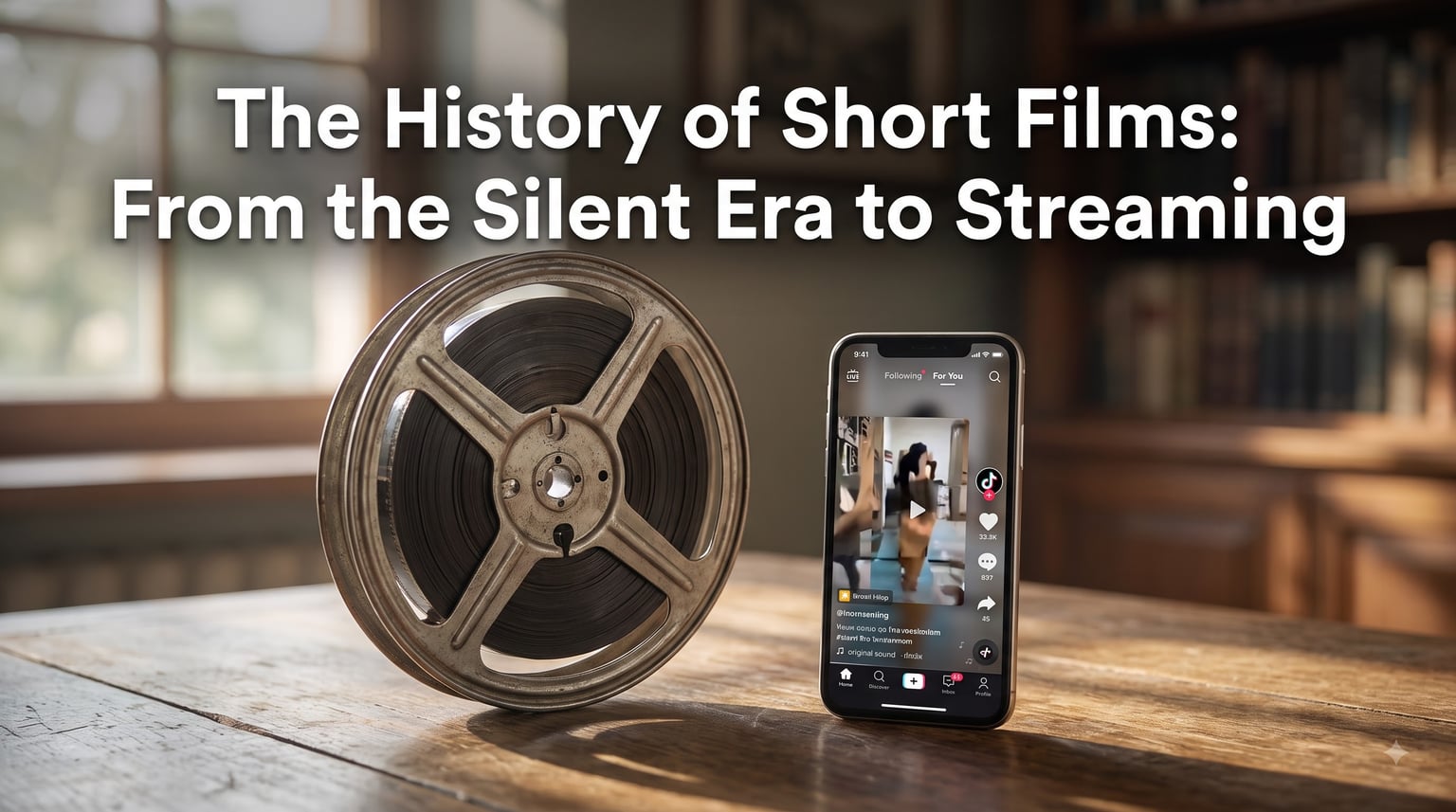
The history of short films is really the history of cinema itself. Before any feature existed, every movie was a short: a single reel of trembling, black-and-white footage lasting under a minute. From those first flickering frames in the 1890s to today’s algorithm-driven vertical videos on TikTok, short films have launched technologies, careers, and entire genres. This guide walks the full timeline from the silent era to the streaming age, names the pioneers who shaped it, and explains why shorts still matter in 2026.
If you have ever wondered when the first short film was made, who invented the format, or how a low-budget YouTube upload can launch a Hollywood career, you are in the right place. I have spent the past three months researching film archives, festival catalogs, and creator interviews to put together the clearest timeline I could. Below is the fast version; the section-by-section deep dives follow.
| Decade | Defining Technology | Notable Shorts or Pioneers |
|---|---|---|
| 1890s | Kinetoscope, cinematographe | Edison, Lumière brothers, Méliès’ A Trip to the Moon |
| 1900s | Nickelodeon theaters | The Great Train Robbery (Porter) |
| 1910s-1920s | One-reelers and two-reelers | Chaplin, Keaton, Harold Lloyd |
| 1930s-1950s | Sound + cel animation | Disney Silly Symphonies, Looney Tunes |
| 1950s-1970s | Television sets | Theatrical shorts decline; newsreels end |
| 1970s-1990s | Affordable 16mm cameras + festivals | Sundance, Scorsese, Lynch, Burton |
| 2000s-2010s | YouTube, Vimeo | Whiplash (Chazelle), accessible distribution |
| 2020s | Streaming + vertical video | TikTok, Instagram Reels, platform originals |
Table of Contents
- The Birth of Cinema (1890s-1900s): When Short Films Were the Only Films
- The Silent Comedy Era (1910s-1920s): One-Reelers, Two-Reelers, and the First Superstars
- The Golden Age of Animation (1930s-1950s): Disney, Warner Bros, and the Rise of the Cartoon Short
- The Television Transition (1950s-1970s): Why Studios Stopped Making Theatrical Shorts
- The Festival and Film-School Era (1970s-1990s): Indie Shorts Find Their Stage
- The Digital Comeback (2000s-Present): YouTube, Vimeo, TikTok, and Streaming Platforms
- Shorts That Became Features: How Oscar Shorts Launched Hollywood Careers
- FAQs
- When did the silent film era begin and end?
- What was the significance of the Lumière brothers’ cinematographe?
- How did the nickelodeon boom affect the film industry?
- What is the history of short films?
- How did short films evolve from festivals to social media?
- What are the best streaming platforms for short films?
- Who are the most influential short film directors?
- Why did studios stop making theatrical shorts?
- Conclusion: Why the History of Short Films Still Matters Today
The Birth of Cinema (1890s-1900s): When Short Films Were the Only Films
The short film era began the day cinema was invented. In 1893, Thomas Edison and William Dickson unveiled the Kinetoscope, a peep-show device that ran a 50-foot loop of celluloid at roughly 16 frames per second. Every film made for it was, by definition, a short.
A year later, the Lumière brothers in France premiered the Cinématographe, a portable camera, printer, and projector in one. Their first public screening in 1895 included La Sortie de l’Usine Lumière à Lyon, a 46-second film most consider the first commercially projected short. The Cinématographe’s significance was not just that it projected images onto a screen for a paying audience; it was so light that operators could shoot anywhere, instantly multiplying the number of shorts in circulation.
Across the Atlantic, Edison’s Vitascope brought projected film to American vaudeville houses in 1896. Georges Méliès, a former magician, used the camera to create A Trip to the Moon (1902), a 14-minute narrative short packed with trick effects and hand-painted color. Edwin S. Porter’s The Great Train Robbery (1903) introduced parallel editing to a mass audience, splicing shots of bandits, telegraph operators, and rescuers across a single continuous story.
By 1905, purpose-built theaters called nickelodeons charged five cents for a program of short films. At their peak around 1910, there were roughly 10,000 nickelodeons in the United States alone, all of them running shorts because features did not yet exist. The nickelodeon boom is what turned cinema from a curiosity into a daily habit for millions of people.
The Silent Comedy Era (1910s-1920s): One-Reelers, Two-Reelers, and the First Superstars
Once the nickelodeon proved audiences would pay to watch moving pictures, studios flooded the market with short comedies. The standard unit was the one-reel short, about 10 to 12 minutes of screen time, often paired with another to form a two-reeler. Mack Sennett’s Keystone Studios alone produced hundreds of these slapstick shorts per year, training a generation of future feature directors.
Charlie Chaplin refined the format into an art form. His Tramp character first appeared in the 1915 short Kid Auto Races at Venice, and his 1921 two-reeler The Kid (41 minutes) proved a short could carry genuine pathos. Buster Keaton pushed the visual gag to impossible extremes in shorts like One Week (1920) and The Playhouse (1921), while Harold Lloyd pioneered the everyman comedy in Safety Last! style thrillers.
By the mid-1920s, the silent comedy short was the dominant training ground for Hollywood. Hal Roach, Educational Pictures, and the emerging MGM short subjects department each kept stables of comedy talent producing two-reelers at a relentless pace. When sound arrived in 1927, these same crews pivoted to talkie shorts, keeping the format alive into the 1930s.
The Golden Age of Animation (1930s-1950s): Disney, Warner Bros, and the Rise of the Cartoon Short
The 1930s turned animation shorts into a profit center. Walt Disney’s Silly Symphonies series, beginning with The Skeleton Dance in 1929, used the short film to experiment with color, character, and music synchronization. It won seven Academy Awards before the series ended in 1939.
Warner Bros answered with Looney Tunes and Merrie Melodies, releasing hundreds of shorts featuring Bugs Bunny, Daffy Duck, and Porky Pig. Directors like Tex Avery and Chuck Jones turned the seven-minute cartoon into a hotbed of timing, music, and visual invention. The 1940 MGM short The Milky Way, and later Tex Avery’s work at MGM, set the bar for character-driven comedy shorts that still influence animation today.
Live-action shorts kept their place too. The Three Stooges produced 190 shorts for Columbia between 1934 and 1959, while theaters in the 1940s still ran newsreels and Pete Smith Specialty shorts as part of every feature program. A trip to the movies in 1948 typically included a newsreel, a cartoon, a comedy short, and the feature itself.
The Television Transition (1950s-1970s): Why Studios Stopped Making Theatrical Shorts
The arrival of affordable television sets in the early 1950s broke the theatrical short business model. With families watching free content at home, audiences no longer needed to sit through a 20-minute program of shorts to see a feature. By 1956, RKO had stopped producing shorts entirely, and most major studios followed by the late 1950s.
Newsreels, the most reliable non-fiction short format of the 20th century, died first. Hearst Metrotone shut down in 1967, and by the late 1960s, network newsmagazines had replaced them. The theatrical short was no longer profitable enough to justify production costs, and the talent migrated to television series, commercials, and the emerging corporate training film market.
This is why studios stopped making theatrical shorts: the economics changed. A short that once played to 800 nickelodeon seats a day now competed with free TV in millions of living rooms. The format shrank from a daily mass medium to a specialty product, screened mainly at school assemblies, on Saturday morning cartoons, and within art-house retrospectives.
The Festival and Film-School Era (1970s-1990s): Indie Shorts Find Their Stage
The short film was rescued by two parallel developments: the rise of film schools and the spread of independent film festivals. Affordable 16mm cameras, pioneered by Eclair and Arriflex, let students shoot polished shorts for a fraction of the cost of a feature. The American Film Institute, founded in 1967, gave those films a showcase, and the Sundance Film Festival, launched in 1978, gave them a national stage.
Some of the most celebrated feature directors cut their teeth on shorts. Martin Scorsese made several student shorts at NYU, including The Big Shave (1967). David Lynch’s Six Men Getting Sick (1967) won a prize at the Philadelphia Film Festival and helped him get into the AFI Conservatory. Tim Burton’s Vincent (1982), a stop-motion short made at Disney, was nominated for the Academy Award for Best Animated Short Film.
The festival circuit expanded rapidly through the 1980s. Toronto International Film Festival, Tribeca (founded 2002), and dozens of regional festivals gave new filmmakers a path to recognition. Cannes, Berlin, and Venice added short film competitions, and Oscar-qualifying festivals like Aspen, Palm Springs, and the USA Film Festival became direct gateways to Academy Award consideration. By the 1990s, a short film could be a career, not just a calling card.
The Digital Comeback (2000s-Present): YouTube, Vimeo, TikTok, and Streaming Platforms
YouTube launched in 2005 and rewrote the distribution rules. For the first time since the nickelodeon era, anyone could upload a short film and reach a global audience for free. Vimeo, founded the same year, positioned itself as a higher-quality home for creative work, and by the early 2010s both platforms were hosting everything from 90-second comedies to 30-minute narrative shorts.
Streaming platforms added dedicated short film sections. Short of the Week curates narrative shorts; Nowness focuses on art and culture; Mubi and Tubi host curated indie collections. The Criterion Channel and Netflix started commissioning short-form originals, and services like Dust highlight science-fiction shorts from filmmakers worldwide.
Social media reshaped the format again. TikTok, Instagram Reels, and YouTube Shorts normalized the vertical, sub-60-second short, and platforms like TikTok even built a creator fund to compensate filmmakers. Shorts evolve from festivals to social media in this way: festival wins generate credibility, social media drives reach, and streaming platforms pay for premium placement. The three-tier path now replaces the old single-channel pipeline.
Shorts That Became Features: How Oscar Shorts Launched Hollywood Careers
Many of today’s most successful features began as short films. The Academy Awards recognized shorts from the start: the first Academy Award for Best Live Action Short Film was given in 1931, and Best Animated Short and Best Documentary Short followed in 1932. Three categories now offer filmmakers a direct route to Oscar gold.
The success stories are striking. Damien Chazelle shot the 18-minute Whiplash as a short in 2013, won the Sundance Short Film Jury Prize, and used that momentum to fund the full feature, which won three Oscars in 2015. Neill Blomkamp’s short Alive in Joburg (2005) became the 2009 feature District 9. Napoleon Dynamite (2002), Saw (2003), and Mama (2008) all started as shorts that caught industry attention. The lesson is consistent: a great short can outpitch a 30-page script.
FAQs
When did the silent film era begin and end?
The silent film era began in the mid-1890s with the first projected films by the Lumière brothers and the rollout of Edison’s Vitascope, and ended between 1927 and 1929 as synchronized sound films like The Jazz Singer became commercially dominant.
What was the significance of the Lumière brothers’ cinematographe?
The Lumière brothers’ Cinématographe, patented in 1895, was a single portable device that could shoot, print, and project film. It democratized filmmaking by letting operators record anywhere, and its first public screening launched cinema as a paid public medium.
How did the nickelodeon boom affect the film industry?
The nickelodeon boom of 1905-1915 turned short films into a daily mass medium. Purpose-built theaters charging five cents a ticket ran programs of shorts, created the first major studio system, and trained moviegoing habits that survive today.
What is the history of short films?
The history of short films begins in the 1890s with Edison’s Kinetoscope and the Lumière brothers’ Cinématographe, evolves through silent comedy and animated shorts, declines with television in the 1950s, and returns through film festivals and digital platforms like YouTube, Vimeo, and TikTok.
How did short films evolve from festivals to social media?
Short films evolved from festivals to social media in three stages: festival wins granting credibility and Oscar eligibility in the 2000s, YouTube and Vimeo adding global free distribution in the 2010s, and TikTok, Instagram Reels, and YouTube Shorts creating algorithm-driven reach for sub-60-second vertical shorts in the 2020s.
What are the best streaming platforms for short films?
The best streaming platforms for short films in 2026 include Short of the Week, Nowness, Vimeo Staff Picks, Mubi, the Criterion Channel, and the short film sections of Tubi, Netflix, and Apple TV. TikTok, Instagram Reels, and YouTube Shorts are the dominant social distribution channels.
Who are the most influential short film directors?
The most influential short film directors include Georges Méliès, Charlie Chaplin, Buster Keaton, Walt Disney, Chuck Jones, Martin Scorsese, David Lynch, Tim Burton, and Damien Chazelle, each of whom used shorts to launch careers that redefined feature filmmaking.
Why did studios stop making theatrical shorts?
Studios stopped making theatrical shorts because television in the 1950s offered free family entertainment at home, eliminating the need to sit through shorts to see a feature. By the late 1960s, newsreels and comedy shorts had effectively disappeared from theatrical programs.
Conclusion: Why the History of Short Films Still Matters Today
The history of short films is the most complete arc of any film format. Shorts were the only films in the 1890s, became the dominant mass medium during the nickelodeon era, drove the silent comedy and animation golden ages, nearly disappeared when television took over, and were reborn through film festivals and digital platforms.
What I find most striking, after all this research, is how the short film keeps reinventing itself. Every time a new technology appears, the short gets there first: the kinetoscope, the projector, sound, color, video, the internet, vertical video. If you want to see where cinema is heading next, look at what filmmakers are doing in shorts right now. Whether that means VR experiences, AI-assisted storytelling, or platforms we have not named yet, the short film will likely get there before the feature does.
For aspiring filmmakers, the lesson is simple. Most of the directors I have followed in this article made three to ten shorts before they felt ready. Pick up a camera, write a five-minute script, and finish it. The rest of film history is still being written, and the short film is still the shortest path to it.