
Learning how to make a short film starts with one decision: finishing it. I know that sounds anticlimactic, but after talking with dozens of first-time directors and watching hundreds of beginner shorts, the single biggest predictor of success is whether the film gets completed. This step-by-step guide walks you through the entire process, from your first idea on a napkin to submitting your film to festivals.
I’ve directed four short films myself, two of which made it across the finish line and two that died in post-production. I’ll share what I learned the hard way, plus the practical techniques working filmmakers use every day. By the end, you’ll have a clear roadmap for making your first short film on any budget, even if your budget is exactly zero.
Table of Contents
- What Counts as a Short Film (And Why Your First One Will Probably Be Bad)
- Step 1: Find Your Idea and Build a Story Skeleton
- Step 2: Write a 5 to 10 Page Script
- Step 3: Pre-Production Planning (The Step Most Beginners Skip)
- Step 4: Shoot Your Film on Production Day
- Step 5: Edit and Post-Produce Your Film
- Step 6: Distribute and Submit to Film Festivals
- Short Film Budget Breakdown: What Your First Film Actually Costs
- The 5 Mistakes That Kill First Short Films
- What I Wish Someone Had Told Me Before My First Short Film?
- Frequently Asked Questions
- Conclusion: Finish the Film, Then Make Another One
What Counts as a Short Film (And Why Your First One Will Probably Be Bad)
A short film is any narrative film under 40 minutes long, though most festival-circuit shorts run between 5 and 20 minutes. The Academy of Motion Picture Arts and Sciences defines an eligible short as 40 minutes or less, including credits. For your first film, aim shorter, between 5 and 10 minutes. That length is long enough to tell a real story but short enough to actually finish.
Here’s the truth nobody tells you when you’re starting out: your first short film will probably be bad. Not unwatchable, but not great. The dialogue will feel stiff in places, the lighting won’t be quite right, and you’ll watch the final cut and spot a hundred things you’d change. That is completely normal. Every working director I know has a first short film they consider a learning experience rather than a masterpiece.
Reddit’s filmmaking community is brutally honest about this. As one user put it, “Finishing your first film teaches you more than any tutorial ever will.” The goal of your first short isn’t to win an Oscar. The goal is to complete a project from blank page to final cut. Everything else is gravy.
If you accept this framing going in, you’ll be more willing to take creative risks, more forgiving of inevitable mistakes, and far less likely to abandon the project halfway through because it isn’t matching your imaginary perfect version.
Step 1: Find Your Idea and Build a Story Skeleton
Every short film starts with a question. StudioBinder’s guide nails this point. Good short films begin with a single “what if” or a clear emotional premise. Examples: “What if a man had to deliver a letter he never wrote?” or “What if someone could only tell the truth for one day?” Once you have a question, you have a story seed.
From that seed, write a logline. A logline is a one-sentence summary of your story, including the protagonist, the conflict, and the stakes. “A lonely toll booth attendant receives a mysterious phone call that forces her to choose between safety and connection.” That’s a logline. If you can’t pitch your film in one sentence, the idea isn’t ready yet.
The 4-Beat First Film Story Skeleton
Most beginners try to cram feature-film complexity into 10 minutes. It doesn’t fit. Instead, use this simple 4-beat skeleton designed for first short films:
Beat 1 – Setup (pages 1-2): Introduce your protagonist in their ordinary world. Establish the status quo.
Beat 2 – Inciting Incident (page 3): Something disrupts the protagonist’s world. The story now has stakes.
Beat 3 – Turning Point (pages 6-7): The protagonist makes a choice or faces a confrontation that changes everything.
Beat 4 – Resolution (pages 9-10): Show the new normal. End on an image or moment that lingers.
That’s it. Four beats. You don’t need subplots, you don’t need flashbacks, and you don’t need an ensemble cast. You need one person, one problem, and one choice. Some of the best short films ever made follow exactly this structure.
When you’re brainstorming, write down 10 ideas before evaluating any of them. Quantity leads to quality. The first three ideas will be obvious. The good stuff usually shows up around idea number seven or eight.
Step 2: Write a 5 to 10 Page Script
Short film scripts run about one page per minute of screen time. A 10-page script produces a 10-minute film. For your first short, write between 5 and 10 pages. Anything longer and you’re biting off more than you can chew for a debut project.
Use proper screenplay format. Industry-standard screenwriting software handles this for free. WriterDuet and StudioBinder’s screenwriting tool both offer free online options. Celtx has a free tier too. Don’t write your script in Microsoft Word; the formatting will fight you the entire time.
Screenplay Format Basics
Every script uses three building blocks. Scene headings (called sluglines) tell us where and when, like “INT. COFFEE SHOP – DAY.” Action lines describe what we see on screen in present tense. Dialogue is what characters say. Keep action lines visual. Don’t write “Sarah feels sad.” Write “Sarah stares at her untouched coffee.”
Read your script out loud before you shoot anything. If a line of dialogue feels awkward to say, it will feel awkward to hear. Rewrite until it flows naturally. This is the single cheapest way to improve your film.
Once your script feels solid, write a one-paragraph synopsis. If you can’t summarize your story in a paragraph, the structure needs more work. Show the synopsis to a friend who hasn’t read the script. If they can repeat the story back to you accurately, you’re ready for pre-production.
Step 3: Pre-Production Planning (The Step Most Beginners Skip)
Pre-production is everything that happens before you roll camera. This is where most first-time filmmakers fail. They skip planning, show up to set without a shot list, and then wonder why the shoot takes 14 hours instead of 4.
Reddit filmmakers are unanimous on one piece of advice: give yourself more time than you think you need for pre-production. The more you can do ahead, the better shoot day goes. Triple your planning time estimate.
Casting Your Film
For your first short, start with friends, family, or local theater students. Acting schools often have bulletin boards where you can post casting calls for free. Backstage and Casting Networks have free tiers for low-budget productions.
When you audition, give actors a side (a short piece of the script) and watch what they do with it. You’re looking for someone who brings their own interpretation, not someone who waits to be directed. Directing actors is a skill in itself, and good actors make first-time directors look way better than they deserve.
Locations and Permits
Pick one or two locations. Three is the practical maximum for a one-day shoot. Public spaces often require film permits, which cost money and time, so private locations like a friend’s apartment usually work best for first shorts. Always get a location release form signed, even for friends’ homes. It protects everyone if the film ends up distributed somewhere.
Equipment for Your First Short
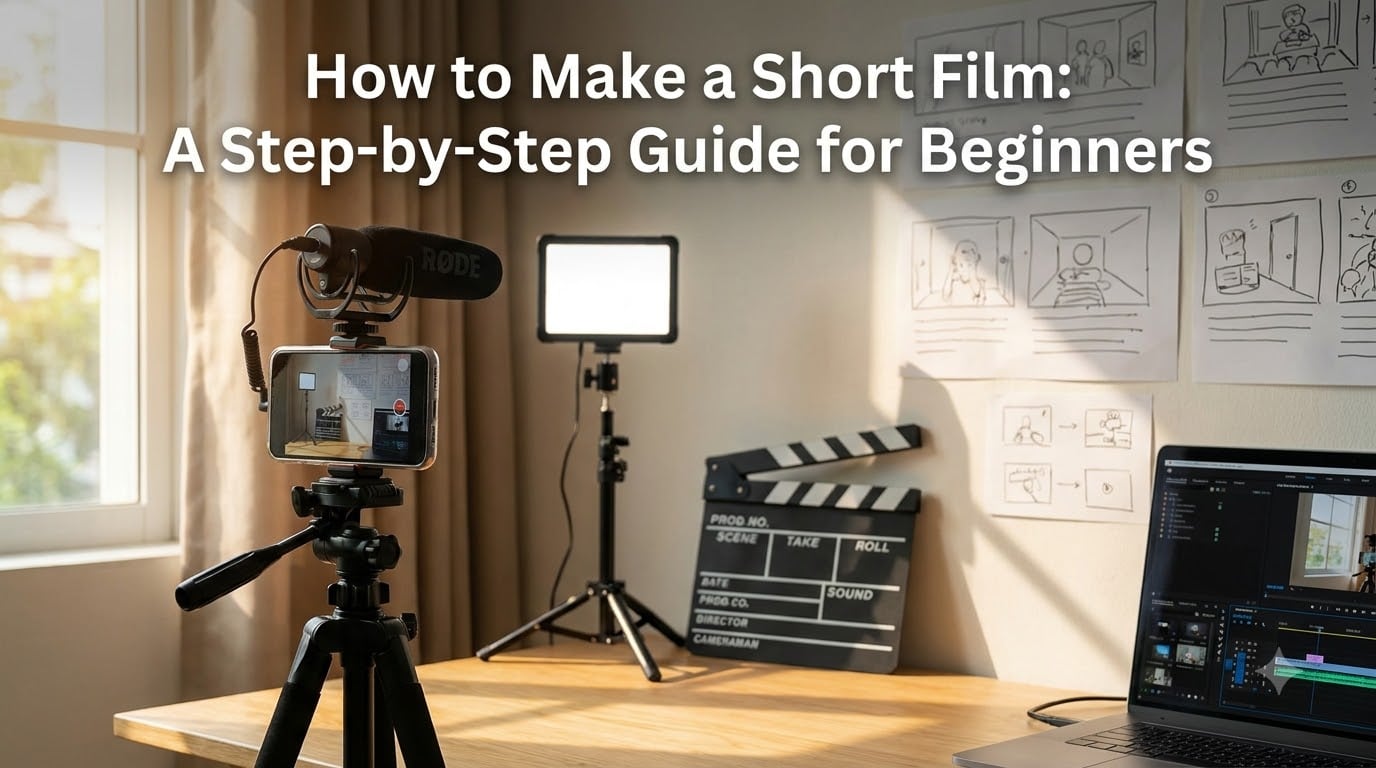
You need four things: a camera, a microphone, a tripod, and a light source. That’s it. Your smartphone is a legitimate camera for a first short, as long as you shoot horizontal, lock focus and exposure, and use good lighting. Audio matters more than video quality, so spend your money on a decent external microphone before upgrading your camera.
A used DSLR or mirrorless camera in the $200 to $500 range is plenty. Pair it with a shotgun microphone (about $50 to $150) and a basic LED light panel ($30 to $80). That’s your entire gear list for under $1,000.
Storyboards and Shot Lists
You don’t need artistic storyboards. Stick figures work. The point of a storyboard is to plan the visual flow before you arrive on set. A shot list is a numbered list of every shot you’ll capture, organized by scene.
Here’s a hard lesson most beginners learn the hard way: if a shot isn’t on your shot list, it probably won’t get shot. Production days move fast, decisions pile up, and you forget the “creative” shots you thought you’d improvise. Write it down or it doesn’t exist.
Pre-Production Hard Lessons
The table below summarizes the painful lessons that show up in almost every first-time filmmaker’s shoot:
| Lesson | What Usually Happens | How to Avoid It |
|---|---|---|
| Schedule too tight | Shoot runs 12+ hours, actors leave exhausted | Add 50% buffer to your time estimate |
| No backup plan for weather | Rain ruins exterior scenes | Scout a backup indoor location in advance |
| Prop left behind | Key prop missing, half-day wasted | Pack and check props the night before |
| Forgot to slate | Editor can’t sync audio and video | Use a clapperboard or audible slate every take |
| No meal breaks | Cast and crew get grumpy by hour 6 | Schedule a proper lunch, plus snacks |
| Audio check skipped | Dialogue is unusable in post | Record 30 seconds of room tone per location |
Every filmmaker has at least three of these stories. Plan for the day to go sideways and you’ll be the calm one when it does.
Step 4: Shoot Your Film on Production Day
The day you shoot is called production day. Everything in pre-production exists to make this one day go smoothly. Here’s the practical shooting strategy that works.
Directing Actors
Talk to your actors before the camera rolls. Walk them through the scene, explain what the character wants in this moment, and let them play with the beats. Then shoot coverage, meaning multiple angles of the same action. Get a wide shot, a medium shot, and close-ups of each actor’s face.
Coverage gives your editor options. Without it, you’re locked into whatever angle you happened to shoot. Most first-time directors shoot too little coverage and regret it during editing.
The 30-Degree Rule and Continuity
When you cut between two shots of the same subject, the camera position must shift at least 30 degrees. Otherwise the cut looks like a mistake. Continuity means keeping things consistent between takes. If the actor holds a coffee cup in their right hand in take one, they must hold it in their right hand in every take.
Assign someone to be script supervisor if you have the crew. Their only job is to catch continuity errors between takes. On tiny productions, the director has to do this themselves.
Getting Good Audio
Audio quality is where amateur films live or die. Viewers forgive shaky camera work. They will not forgive dialogue they can’t understand. Your built-in camera microphone is not enough for dialogue scenes.
Use an external microphone positioned as close to the actor’s mouth as possible without getting in the frame. A boom mic held just above frame works best. Lavalier mics clipped to clothing are a solid backup option. Always monitor audio with headphones while recording. If you don’t hear clean dialogue in your headphones, you won’t hear it in the edit.
Record 30 seconds of room tone at each location. Room tone is the ambient sound of a quiet room, and your editor uses it to smooth transitions between dialogue clips. It sounds trivial until you need it and don’t have it.
Coverage and Dailies
Dailies are the footage you shot each day, reviewed before moving on. Review dailies every night during a multi-day shoot. This lets you catch problems early, like a flubbed line or bad lighting, while you can still do pickup shots. Pickup shots are additional coverage captured after the main shoot to fix gaps.
Step 5: Edit and Post-Produce Your Film
Post-production is where your short film actually comes together. This phase includes editing, sound design, color grading, and adding music.
Choosing Editing Software
The table below compares the main editing tools beginners actually use:
| Software | Cost | Best For | Learning Curve |
|---|---|---|---|
| DaVinci Resolve | Free (paid Studio version available) | Color grading, professional workflows | Medium |
| iMovie | Free on Mac/iOS | Absolute beginners, simple cuts | Very easy |
| Adobe Premiere Pro | Subscription | Industry standard, broad features | Medium-high |
| Final Cut Pro | One-time purchase (Mac only) | Mac users who want pro features | Medium |
For most beginners, DaVinci Resolve is the right starting point. The free version is more powerful than what most first short films need, and it includes color grading tools that would otherwise cost extra. iMovie is fine if you’ve never edited before and want to focus purely on storytelling.
The Rough Cut to Final Cut Workflow
Start with a rough cut: assemble every scene in order, using the best take of each shot. Don’t worry about pacing yet. Just get the story on the timeline. Then trim. Cut anything that doesn’t move the story forward. First short films usually have 20% more footage than they need.
Once the rough cut feels solid, polish into a final cut. Tighten pacing, refine transitions, and lock the picture. Picture lock means the visual edit is done and won’t change anymore. After picture lock, you move into sound design and color.
Sound Design, Foley, and ADR
Sound design is the layer of ambient sounds that make a scene feel alive: footsteps, doors, traffic, breath. Foley is recreated sound effects performed in a studio, like footsteps in sync with the actor’s steps on screen. ADR stands for Automated Dialogue Replacement, which is re-recording dialogue in post when the original audio was unusable.
For a first short, focus on clean dialogue and natural room tone. Skip elaborate foley. Use royalty-free music from sites like Bensound, Free Music Archive, or the YouTube Audio Library. Always check the license terms before publishing.
Color Grading
Color grading means adjusting the look of your footage for consistency and mood. Match the colors between shots taken at different times of day, then apply a look that supports the story. DaVinci Resolve is the industry-standard color tool. For a first short, basic correction is enough.
Step 6: Distribute and Submit to Film Festivals
A finished short film that nobody sees is a missed opportunity. Distribution is part of the filmmaking process, not an afterthought.
Film Festival Submission
FilmFreeway is the standard platform for festival submissions. Create a free filmmaker profile, fill out your project details, upload a press kit (poster, stills, director’s statement), and start submitting. Festival entry fees range from free to $75, with most major festivals charging $30 to $50.
Submit to tier-appropriate festivals. As a first-time filmmaker, don’t burn your budget on Sundance. Look at regional festivals, genre-specific festivals, and student festivals first. Many cities have local short film festivals with low fees and friendly programmers. Getting accepted to a small festival and getting an audience reaction is more valuable for your career than a rejection email from a top-tier event.
Online Distribution
Once your festival run winds down, upload your film to Vimeo (preferred for short films) and YouTube. Vimeo lets you control the player and disable downloads. YouTube gives you discoverability. Submit to short film aggregators like Short of the Week and Film Shortage, which curate quality shorts for film-loving audiences.
Use the film as a portfolio piece. Whether you’re applying to film school, pitching investors, or applying for jobs, a finished short film demonstrates skills in a way a resume never can.
Short Film Budget Breakdown: What Your First Film Actually Costs
Most guides inflate budget numbers. Here’s the honest breakdown of what your first short film actually costs at three realistic tiers.
| Tier | Total Budget | What’s Covered | What You Sacrifice |
|---|---|---|---|
| Zero Budget | $0 | Smartphone camera, friends as cast and crew, free software, natural light, locations you already have access to | Higher production value, paid actors, professional gear, permits, craft services |
| Modest Budget | about $500 | Rent a camera and shotgun mic, feed the cast and crew, basic LED light, festival fees, gas and parking | Cinematographer, paid actors, multiple locations, custom props |
| Realistic First Film | about $2,000 | DP or rental package, sound recordist, paid actors, craft services, location fees, music licensing, festival submissions | Insurance, union crew, professional color grading, original score |
Zero-budget filmmaking is real and legitimate. The Dogme 95 movement proved that constraints force creative choices. Some of the most acclaimed short films ever made cost almost nothing to produce. What you spend doesn’t determine quality. What you do with what you have does.
If your budget is tight, allocate money to audio first, lighting second, and camera third. Viewers forgive almost any visual flaw if the story is clear and the dialogue is clean.
The 5 Mistakes That Kill First Short Films
After surveying dozens of forum posts, Reddit threads, and filmmaker interviews, the same five mistakes show up over and over. Avoid these and you’ll be ahead of most first-time directors.
Mistake 1: Cramming Too Many Ideas Into One Film
Beginners try to fit every story idea they’ve ever had into their first short. Resist this urge. Pick one idea, one location if possible, and two or three characters maximum. Some of the best short films just do one thing really well.
Mistake 2: Skipping Pre-Production
Showing up to set without a shot list, schedule, or backup plan is the single most common first-film mistake. The shoot becomes chaotic, decisions pile up, and you leave with unusable footage and an exhausted crew.
Mistake 3: Trusting the Built-In Microphone
Camera-mounted microphones pick up every air conditioner, fridge hum, and distant siren in your scene. Your dialogue will sound hollow and distant. Use an external microphone, monitor with headphones, and record room tone at every location.
Mistake 4: Falling for the Sunk Cost Fallacy
You’ve spent six months on a script that isn’t working. Every rewrite makes it slightly better, but the core story is broken. The sunk cost fallacy tells you to keep going because you’ve invested so much already. The rational move is to cut your losses and start fresh. A bad script, no matter how polished, produces a bad film.
Mistake 5: Not Finishing
The graveyard of abandoned first short films is enormous. Projects die in editing, color grading, or festival submission. Push through. A finished imperfect film beats an abandoned masterpiece every time.
What I Wish Someone Had Told Me Before My First Short Film?
My first short film took 14 months from idea to festival submission. Looking back, half of that time was avoidable. Here’s the honest advice I wish I’d heard earlier.
Finish a short film, then make another one. Your first film is practice. Your third film is where your voice starts to show. Don’t spend three years polishing your debut. Make it, submit it, learn from it, and start the next project while the lessons are still fresh.
Audio will ruin you if you let it. Spend more on sound than you think you should. A $100 external mic and 30 minutes of careful audio monitoring will save you 20 hours in post-production.
Your friends are not your audience. Your friends will say they love your film. Find one honest person who will tell you what’s actually wrong. Better to hear hard truths from a friend than polite rejections from festival programmers.
Finally, remember that every working director you admire made a first short film that was bad. The difference between them and the people who never make films is they finished theirs.
Frequently Asked Questions
How do you make a short film as a beginner?
Start with a simple 5 to 10 page script about one character facing one clear choice. Plan pre-production thoroughly (shot list, call sheet, location, casting). Shoot on one production day with one external microphone and one light source. Edit using free software like DaVinci Resolve. Submit to festivals via FilmFreeway and upload to Vimeo when done.
What are the main needs for making a short film?
You need a script (5 to 10 pages), one camera (smartphone is fine), one external microphone, basic lighting, a location, two to four actors, and editing software. Most importantly, you need a finished film, so plan for pre-production, the shoot, and post-production. Total budget can range from zero to a few thousand dollars.
Do I need a full crew for my first short?
No. You can shoot a short film with as few as two people, one operating the camera and one directing and recording audio. For larger casts or more complex shots, three to four crew members is comfortable. Many award-winning shorts were made by crews of two or three.
Is 25 minutes too long for a short film?
Twenty-five minutes is still technically a short film (anything under 40 minutes qualifies for the Academy). However, for a first short film, 5 to 15 minutes is the practical sweet spot. Longer films require more locations, more actors, more coverage, and a longer edit. Shorter films are easier to finish and more likely to be programmed at festivals.
How much should my first short film cost?
Your first short film can cost anywhere from zero to a few thousand dollars. Zero budget works if you use a smartphone, friends, and free software. A realistic first film with rented gear, paid actors, and festival fees runs $500 to $2,000. Avoid spending more than $5,000 on your first short, since the educational value is the same regardless of budget.
What length should my first short actually be?
Aim for 5 to 10 minutes for your first short film. That length gives you enough time to set up a character, present a conflict, and resolve it without padding. It also keeps your production day manageable (usually one to two locations, half day to full day shoot) and keeps your edit timeline realistic for a beginner.
Conclusion: Finish the Film, Then Make Another One
Learning how to make a short film is less about mastering cameras and more about building the discipline to finish creative projects. The process is straightforward: find an idea, write a tight script, plan thoroughly, shoot one day, edit for several weeks, and submit your film to festivals. None of the individual steps are that hard. Doing them all, in order, without quitting, is the actual challenge.
Your first short film will probably be bad. Make it anyway. Submit it anyway. Then make your second one, and your third, and keep going. The filmmakers you admire didn’t become great on their first project. They became great by finishing projects over and over until the work matched their taste.
Open your screenwriting software, write that logline, and start your first short film today.