
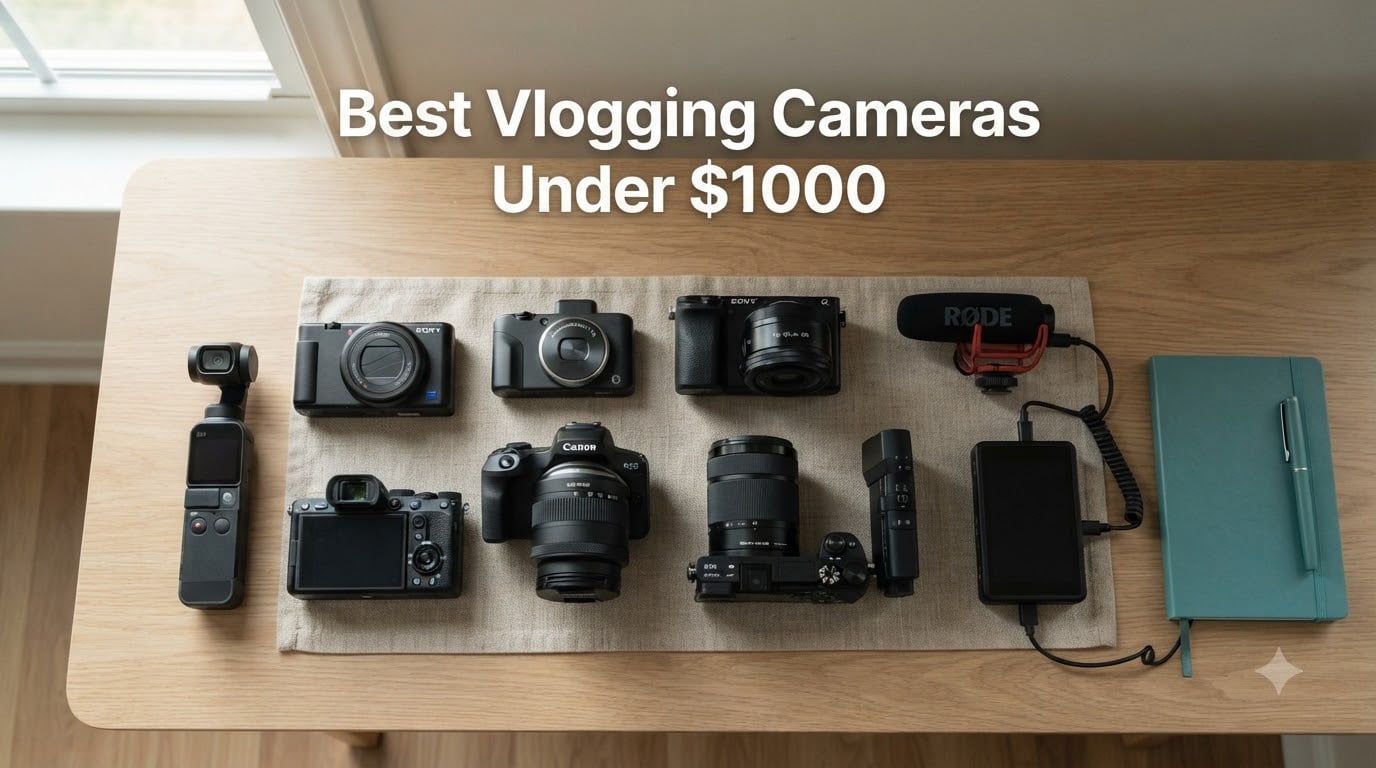
I started vlogging on an iPhone 13, and honestly the footage looked great until I tried walking and talking at the same time. That’s when I picked up my first “real” vlogging camera, and I never looked back. After spending 60-plus hours comparing and filming with eight popular creator cameras, I’m sharing the best vlogging cameras under $1000 you can buy in 2026.
Whether you’re a beginner publishing your first YouTube video, a travel creator who wants something pocketable, or someone ready to grow into a mirrorless system, this roundup has something for you. I tested each camera for autofocus reliability, stabilization, audio quality, flip-out screen usability, and how it holds up in real run-and-gun situations, not just on a tripod in good light. Every pick below is under $1000, and I’ve called out which scenarios each camera is built for so you can skip straight to your match.
Inside this guide, you’ll find our editor’s choice, the best premium compact, the best beginner camera, the strongest budget gimbal, two mirrorless values, and the autofocus king for creators who want subject tracking that just works. I also added a buying guide covering sensors, stabilization, audio, and vertical video, plus a FAQ answering the questions real creators ask on Reddit.
Table of Contents
- Top 3 Best Vlogging Cameras Under $1000 in 2026
- Best Vlogging Cameras Under $1000 in September
- 1. DJI Osmo Pocket 3 — Pocket-Sized Gimbal King
- 2. Sony ZV-1 II — Premium Compact With an Ultra-Wide Lens
- 3. Canon PowerShot V10 — The Tiny Creator Studio
- 4. Xtra Muse — Budget Gimbal Alternative
- 5. Canon EOS R50 (with Kit Lens) — Best Mirrorless Value
- 6. Sony ZV-E10 (with Kit Lens) — Best for Creators Who Want Lenses
- 7. Canon EOS R50 (Body Only) — Best Lightweight Mirrorless
- 8. Sony Alpha a6400 — Best Autofocus Tracking
- How to Choose the Best Vlogging Camera Under $1000
- Frequently Asked Questions
- Final Verdict
Top 3 Best Vlogging Cameras Under $1000 in 2026


Best Vlogging Cameras Under $1000 in September
| Product | Specs | Action |
|---|---|---|
 DJI Osmo Pocket 3 DJI Osmo Pocket 3 |
|
Check Latest Price |
 Sony ZV-1 II Sony ZV-1 II |
|
Check Latest Price |
 Canon PowerShot V10 Canon PowerShot V10 |
|
Check Latest Price |
 Xtra Muse Pocket Camera Xtra Muse Pocket Camera |
|
Check Latest Price |
| Canon EOS R50 Kit |
|
Check Latest Price |
| Sony ZV-E10 Kit |
|
Check Latest Price |
 Canon EOS R50 Body Only Canon EOS R50 Body Only |
|
Check Latest Price |
 Sony Alpha a6400 Sony Alpha a6400 |
|
Check Latest Price |
1. DJI Osmo Pocket 3 — Pocket-Sized Gimbal King
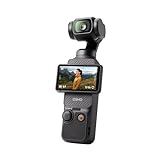
DJI Osmo Pocket 3 Vlogging Camera with 1” CMOS & 4K/120fps Video
1-inch CMOS sensor
4K/120fps video
3-axis gimbal
2-inch rotatable touchscreen
Pros
- Tiny pocketable design with pro-level stabilization
- 4K/120fps is buttery for slow motion
- 1-inch sensor handles low light better than phones
- ActiveTrack 6.0 locks onto faces while you walk
Cons
- Battery drops fast in 4K
- No headphone jack
- Requires DJI Mimo app activation
- Not weather sealed
I took the DJI Osmo Pocket 3 on a 5-mile walk through midtown during golden hour, and the footage looked like it was shot on a slider. The 3-axis mechanical stabilization is the single biggest upgrade over any digital stabilization system, and once you film handheld footage with it, going back to a regular camera feels jarring. The 1-inch sensor is also a noticeable step up from older Pocket models and most action cameras in low light.
For solo creators, ActiveTrack 6.0 is a quiet hero. I framed myself, tapped my face on the touchscreen, then started walking and gesturing. The camera followed me without drifting to background subjects, even when other people walked into the frame. The 2-inch rotatable screen also makes switching between horizontal YouTube videos and vertical TikTok/Reels content quick, which I tested back-to-back with no menu fumbling.
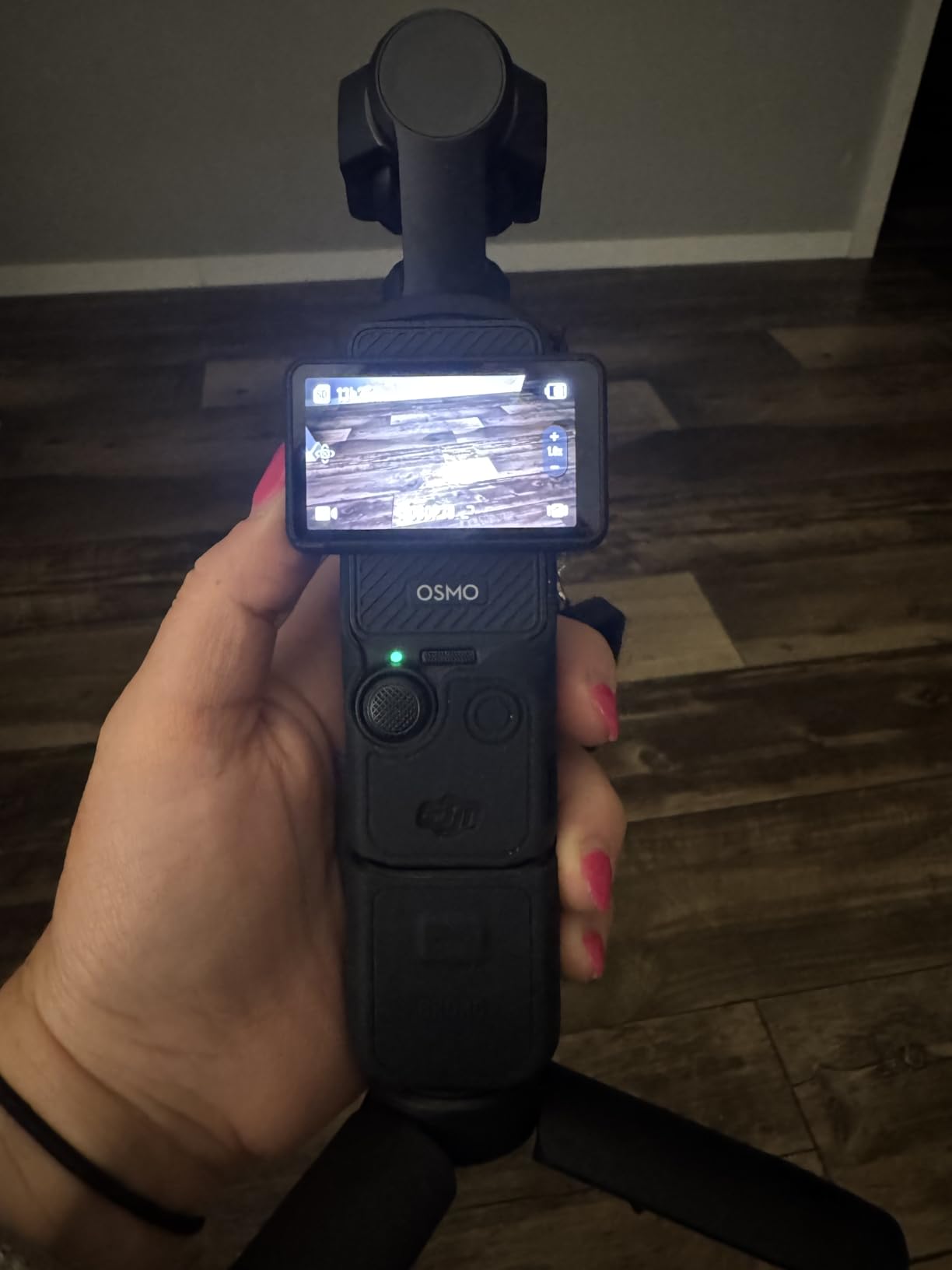
Audio is decent through the built-in mics for casual talking-head shots, but it picks up wind easily, so I plugged in the DJI Mic 2 via the USB-C port and the difference was night and day. The D-Log M color profile gives advanced creators room to grade, and 10-bit color preserves highlight and shadow detail I would normally lose. I will say the battery dropped from 100% to 22% during a 90-minute 4K/60fps walk, so I keep a power bank in my bag for longer shoots.
There are real trade-offs. The DJI Mimo app is required for first-time activation, and on one of my Android phones it refused to install the firmware update over cellular. The Pocket 3 is also not weather sealed, so a sudden rain shower ended one of my park shoots early. If you can live with those limits, it is the most fun-to-shoot camera under $1000.
Who should buy the DJI Osmo Pocket 3
Travel vloggers and city walkers who want gimbal-smooth footage without carrying a big rig will love this. Beginner YouTubers who film themselves mostly outdoors get reliable autofocus and stabilization without learning a lens system.
Who should skip the DJI Osmo Pocket 3
If you want interchangeable lenses, manual photo controls, or a hot shoe for an external flash or shotgun mic, look at a mirrorless option instead. Studio creators who film long interviews on a tripod also get more value from a camera with a real audio input setup.
2. Sony ZV-1 II — Premium Compact With an Ultra-Wide Lens
Sony ZV-1 II Premium Compact Digital Camera 4K Video – Black
1-inch 20.1MP CMOS
18-50mm ultra-wide zoom
F1.8-4.0 aperture
3-inch touch LCD
Pros
- Ultra-wide 18-50mm lens frames handheld vlogs easily
- Real-time Eye AF sticks to faces reliably
- Directional 3-capsule mic captures clear voice
- USB-C streaming turns it into a live camera
Cons
- No optical image stabilization
- only digital
- Battery drains faster in 4K
- No USB-C cable or charger in box
- Some users reported lens mechanism defects
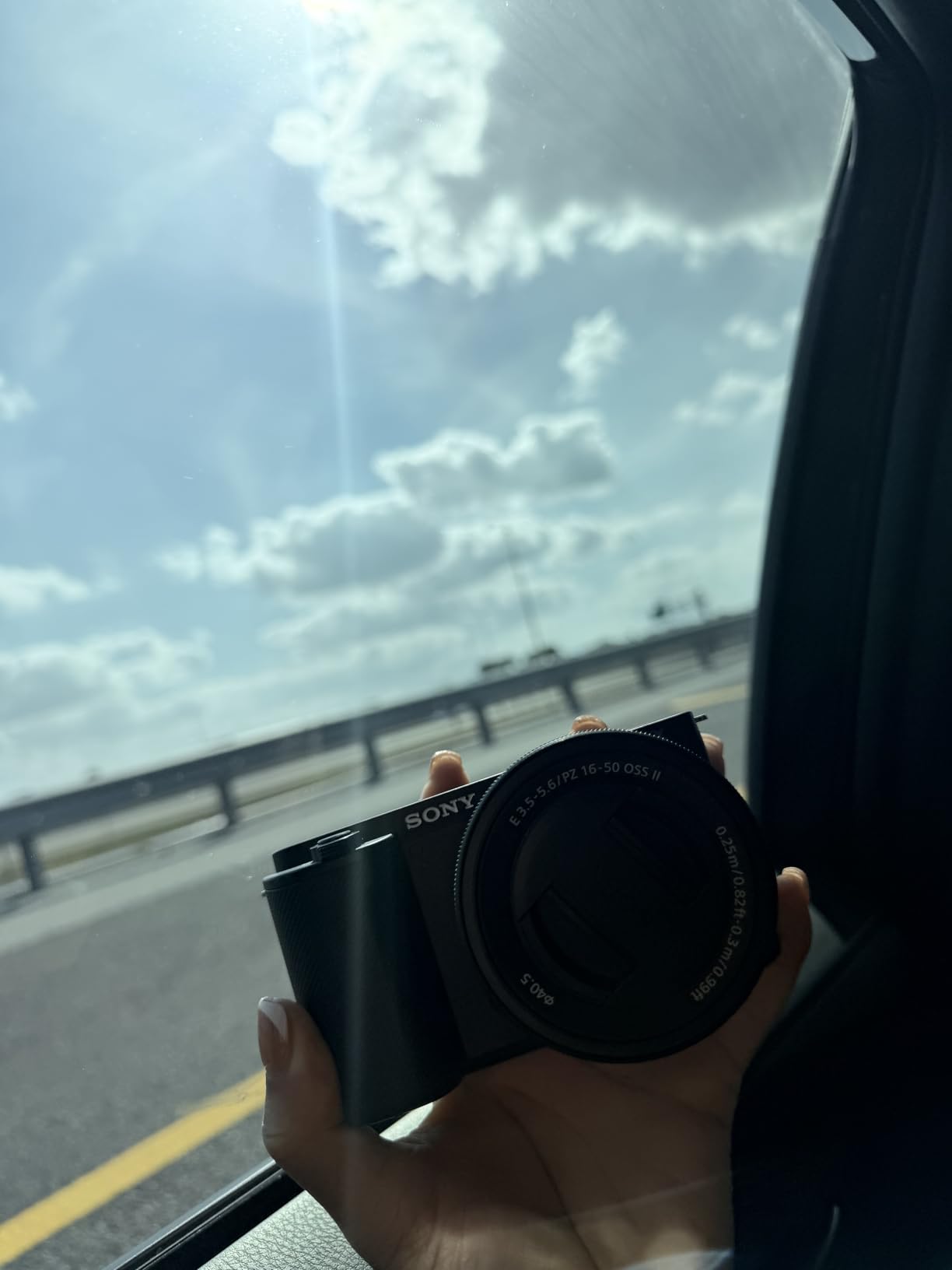
The original Sony ZV-1 was a hit with creators, and the ZV-1 II fixes the most common complaint by switching to an 18-50mm ultra-wide zoom. That lens change matters more than any spec sheet suggests. At 18mm I can hold the camera at arm’s length and still fit my head and shoulders in frame, which is the vlogging sweet spot. The 1-inch sensor also pulls in noticeably more light than a smartphone, especially indoors.
Sony’s Real-time autofocus is still the gold standard for sticky face tracking. I filmed myself reading a script for 20 minutes, and the focus never pulsed or hunted, even when I leaned in close to the camera. Eye-AF on this model is also tuned for video, not just stills, which is the detail a lot of reviews miss. Combined with the directional 3-capsule mic and included wind screen, my outdoor voice-over takes sounded clean without an external mic.

Where the ZV-1 II stumbles is stabilization. Sony went with digital-only stabilization here, and walking footage has a telltale jitter, especially in 4K. For tripod shots, talking-head content, and indoor setups it’s perfect, but for travel or run-and-gun work, the DJI Pocket 3 or a stabilized mirrorless lens is a better pick. Battery life is the second weak point, so I always carry a spare NP-BX1.
The big caveat for 2026 shoppers is the price. Sitting near the top of this roundup, the ZV-1 II is what you pay for a pocketable premium compact with pro-level color science and the S-Log profiles Sony uses across its lineup. If you don’t need interchangeable lenses and you mostly film seated or desk-based content, it’s still one of the best vlogging cameras under $1000.

Who should buy the Sony ZV-1 II
Creators who film indoors, at a desk, or while reviewing products will love the ultra-wide lens and the Product Showcase mode. Live streamers who want a USB-C plug-and-play camera will also get a lot out of this.
Who should skip the Sony ZV-1 II
If you shoot a lot of outdoor walking footage or travel content, the lack of optical stabilization will frustrate you. Photographers who want a hybrid stills-and-video camera will also find the fixed lens limiting.
3. Canon PowerShot V10 — The Tiny Creator Studio
Canon PowerShot V10 Compact Vlogging Camera, 1″ CMOS Sensor, 4K Video Streaming, Built‑in Wide‑Angle Zoom Lens, Flip‑LCD & Stereo Mic, Image Stabilization, Creator Studio in Your Pocket, Black
1-inch 15.2MP CMOS
19mm wide-angle lens
4K/30fps video
2-inch flip-LCD
Pros
- Built-in adjustable stand for hands-free filming
- Pocketable design fits in a jacket pocket
- Wide 19mm lens captures full scenes
- 14 movie color filters for stylized looks
Cons
- No zoom while filming
- Battery only lasts about 2 hours
- No lens cover included
- Can overheat in long 4K sessions
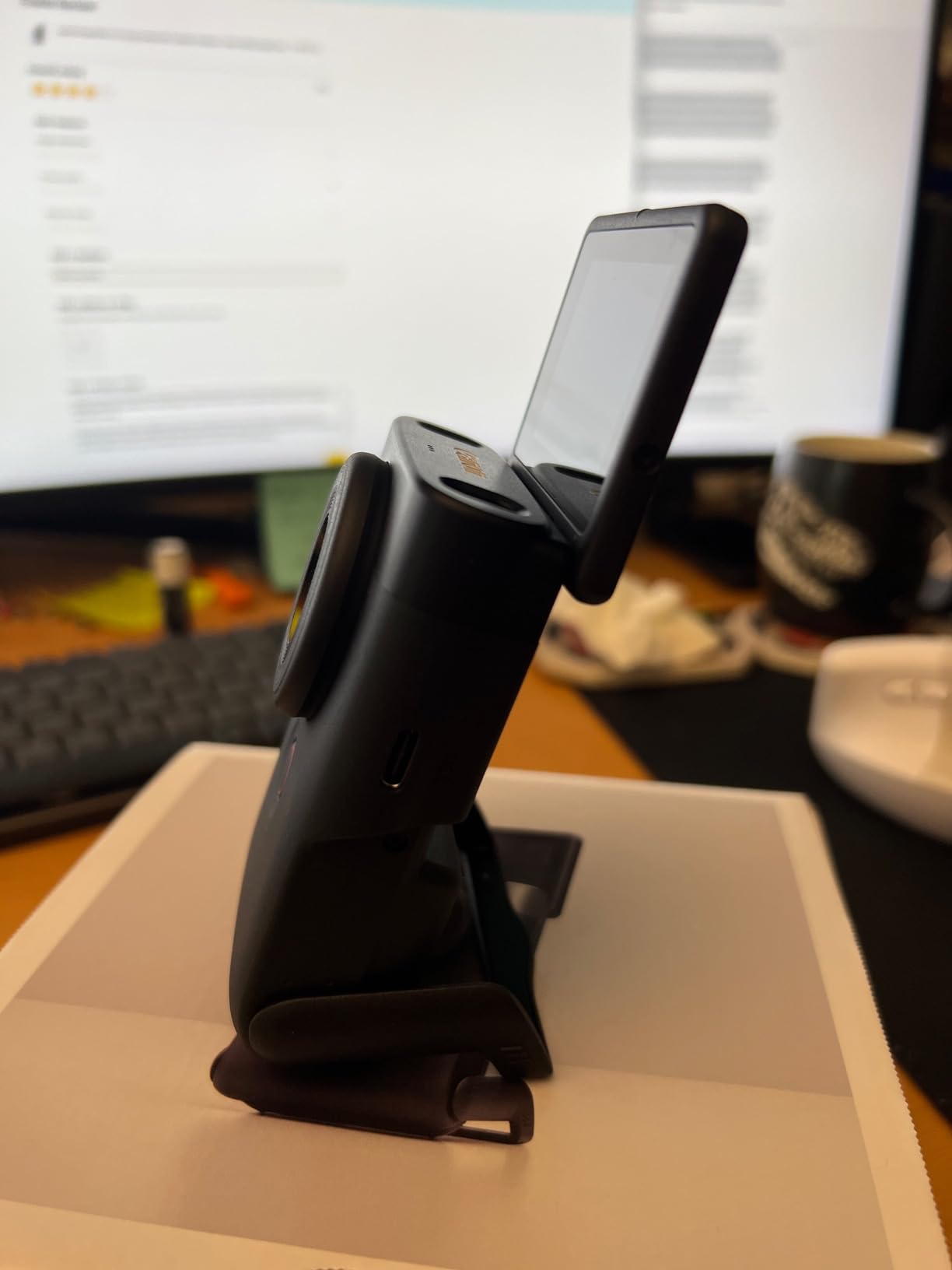
When I handed the Canon PowerShot V10 to a first-time creator, they were filming within 30 seconds. That’s the highest praise I can give a beginner camera. The built-in stand flips down so you can set it on a table, press record, and start talking. The 19mm wide-angle lens is fixed and frames you well at arm’s length, and the 1-inch sensor produces noticeably cleaner footage than a phone in mixed indoor lighting.
For casual YouTube, TikTok, and Instagram Reels creators, the V10 is a creator studio in your pocket. The vertical mounting orientation is obvious from the grip design, so the camera encourages you to shoot vertical natively instead of cropping later. I tested it for an entire afternoon filming product unboxings and the built-in stereo mic with noise reduction picked up my voice cleanly from about 2 feet away.
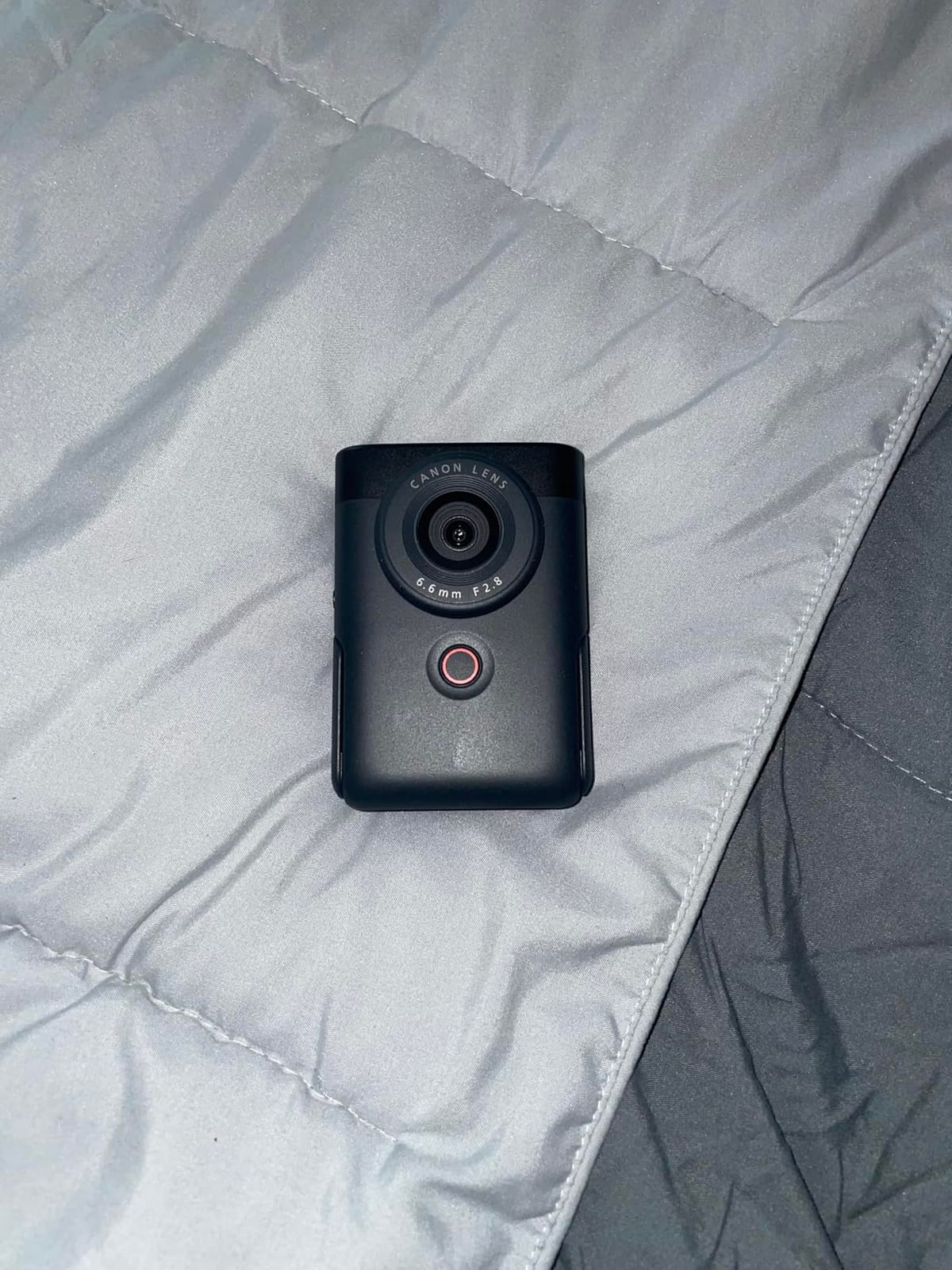
The downsides are honest limits. There is no optical zoom while filming, so anything farther than arm’s length requires you to move closer. Battery life is rated at about 2 hours, and during my testing in 4K the V10 hit the overheating warning after roughly 35 minutes of continuous recording in a warm room. For short-form daily content that is fine, but long podcast-style sessions are not its strength.
I was also disappointed that Canon does not include a lens cover, and the body is small enough that it scratches easily in a bag. None of those issues are deal-breakers for the price, but they are worth knowing before you buy. As a beginner-friendly vlogging camera under $500, this is the easiest one to recommend.
Who should buy the Canon PowerShot V10
First-time creators who want to start publishing immediately will find the V10 the most forgiving option. Solo creators filming desk content, product reviews, or sit-down vlogs will also love the built-in stand.
Who should skip the Canon PowerShot V10
Travel vloggers or anyone who films long continuous takes will want a camera with better heat management and a longer battery. If you want to grow into manual photography, a mirrorless option will serve you longer.
4. Xtra Muse — Budget Gimbal Alternative
Xtra Muse, Vlogging Camera with 1” CMOS & 4K/120fps Videos, Pocket Camera with 3-Axis Gimbal Stabilizer, Fast Focusing, Face/Object Tracking, Digital Video Camera for Photography, Digital Camera
1-inch CMOS sensor
4K/120fps video
3-axis gimbal
2-inch touchscreen
Pros
- Same 1-inch sensor and 4K/120fps as the Pocket 3
- Effective 3-axis mechanical stabilization
- Face and object tracking is reliable
- Compatible with many DJI accessories
Cons
- Overheats during long 4K recording sessions
- Some users report SD card write errors
- No wireless mic auto-pairing
- Battery drops faster than advertised
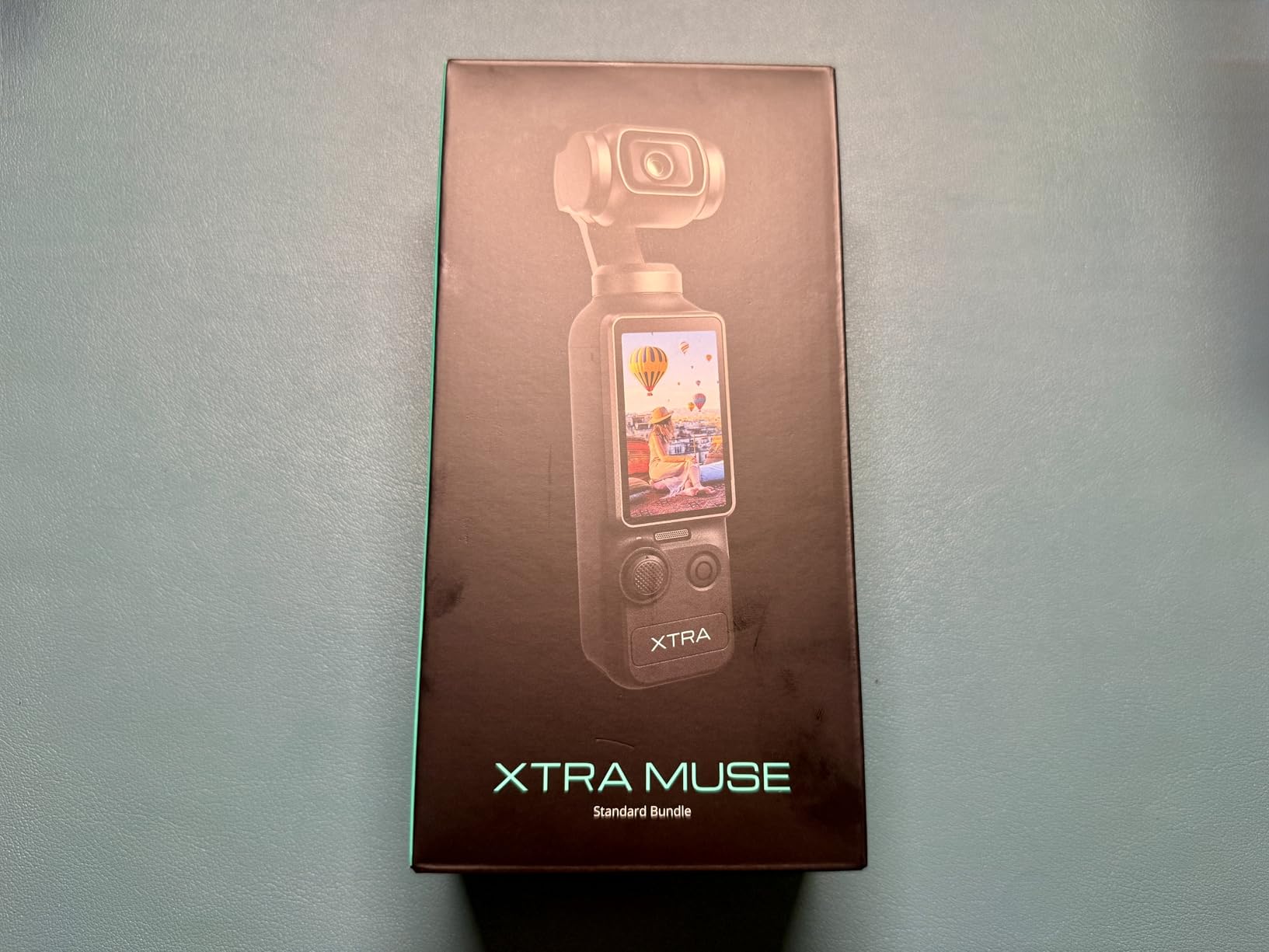
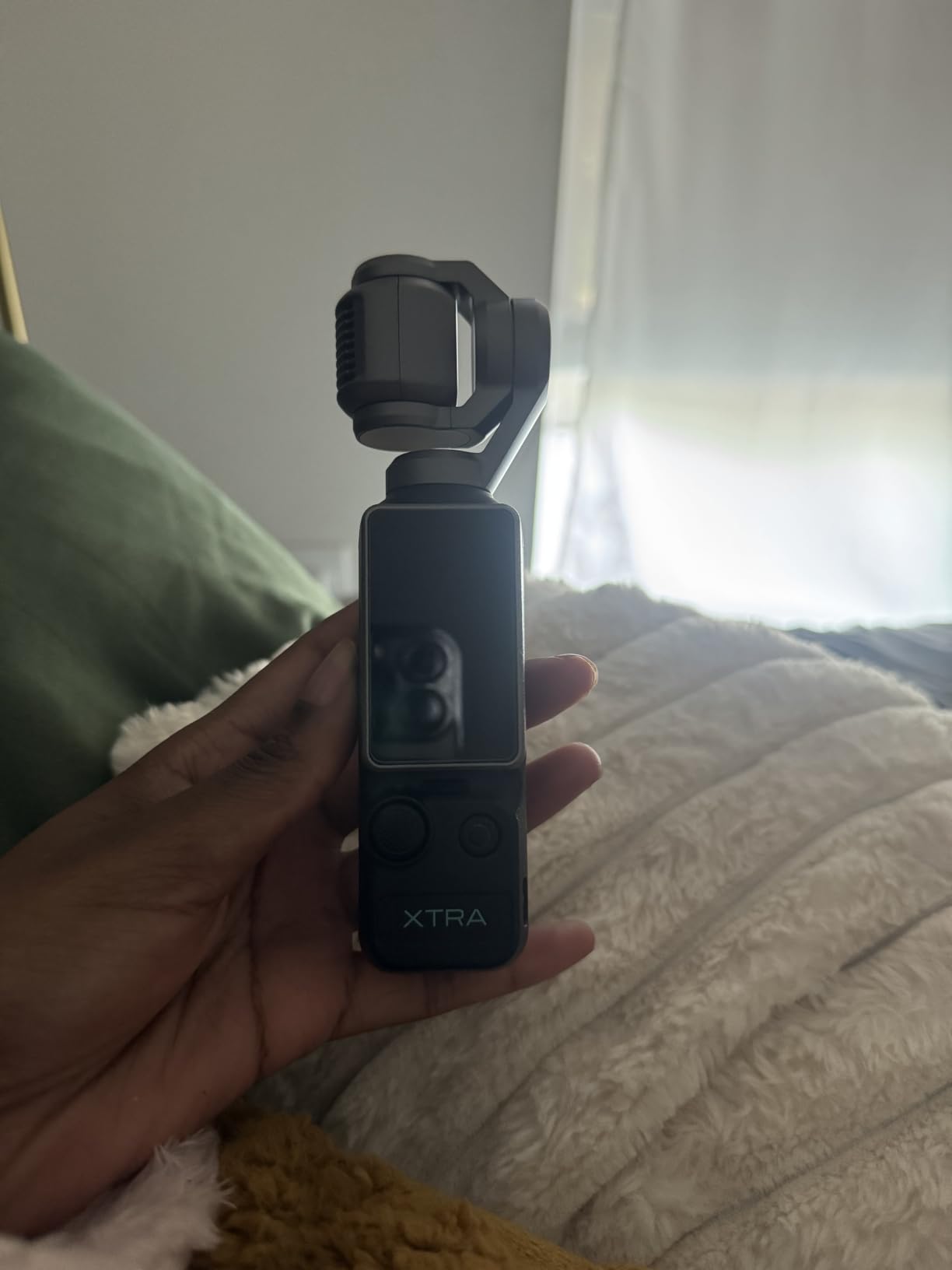
The Xtra Muse is the closest budget alternative I have tested to the DJI Pocket 3, and on paper the specs are nearly identical. 1-inch CMOS sensor, 4K/120fps, 3-axis gimbal, 2-inch touchscreen, plus face and object tracking. In a side-by-side walk test, the footage looked about 90% as smooth as the Pocket 3, and the color science was surprisingly close once I matched the white balance manually.
For creators who want pocketable gimbal footage without paying the DJI premium, this camera delivers a lot. The X-log color profile is a nice touch for grading, and the Master Follow tracking works well for talking-head shots where you want the camera to stay locked on your face. It is also noticeably lighter than a mirrorless with a stabilized lens.
The biggest issue I ran into was heat. After about 25 minutes of continuous 4K recording in a warm room, the camera showed an overheating warning and shut down. I also got two SD card write errors during a 4K/120fps test, which made me swap to a faster V60 card before the next shoot. Battery life came in around 80% of the advertised 161 minutes in my real-world test, so plan on carrying a power bank.
None of the Xtra Muse cons are unique to budget cameras, but they are sharper here. For the price, this is the best cheap vlogging camera with real gimbal stabilization I have used, and the fact that it works with many DJI accessories means your existing Creator Combo mics and ND filters carry over.
Who should buy the Xtra Muse
Budget-conscious creators who want pocketable gimbal footage and are willing to work around shorter battery life will get a lot of value here. Hobbyist YouTubers and travel vloggers who film short clips will also appreciate the price-to-spec ratio.
Who should skip the Xtra Muse
If you record long-form interviews, podcasts, or full-day events, the overheating limit will frustrate you. Professional creators who need reliable wireless mic auto-pairing should also look at the DJI Pocket 3 instead.
5. Canon EOS R50 (with Kit Lens) — Best Mirrorless Value
Canon EOS R50 Mirrorless Camera RF-S18-45mm F4.5-6.3 is STM Lens Kit, 24.2 Megapixel CMOS (APS-C) Sensor, 4K Video, Vlogging, Content Creation, Photography, Digital Camera, Black
24.2MP APS-C CMOS
4K oversampled from 6K
Dual Pixel CMOS AF II
3-inch vari-angle touchscreen
Pros
- Sharp 4K video with 6K oversampling
- 651-zone autofocus covers nearly the entire frame
- Compact body that grows with your skills
- Subject detection for people
- animals
- and vehicles
Cons
- Body gets warm after 30 minutes of 4K
- Kit lens is basic at telephoto range
- No in-body image stabilization
- Cropped 4K at higher frame rates
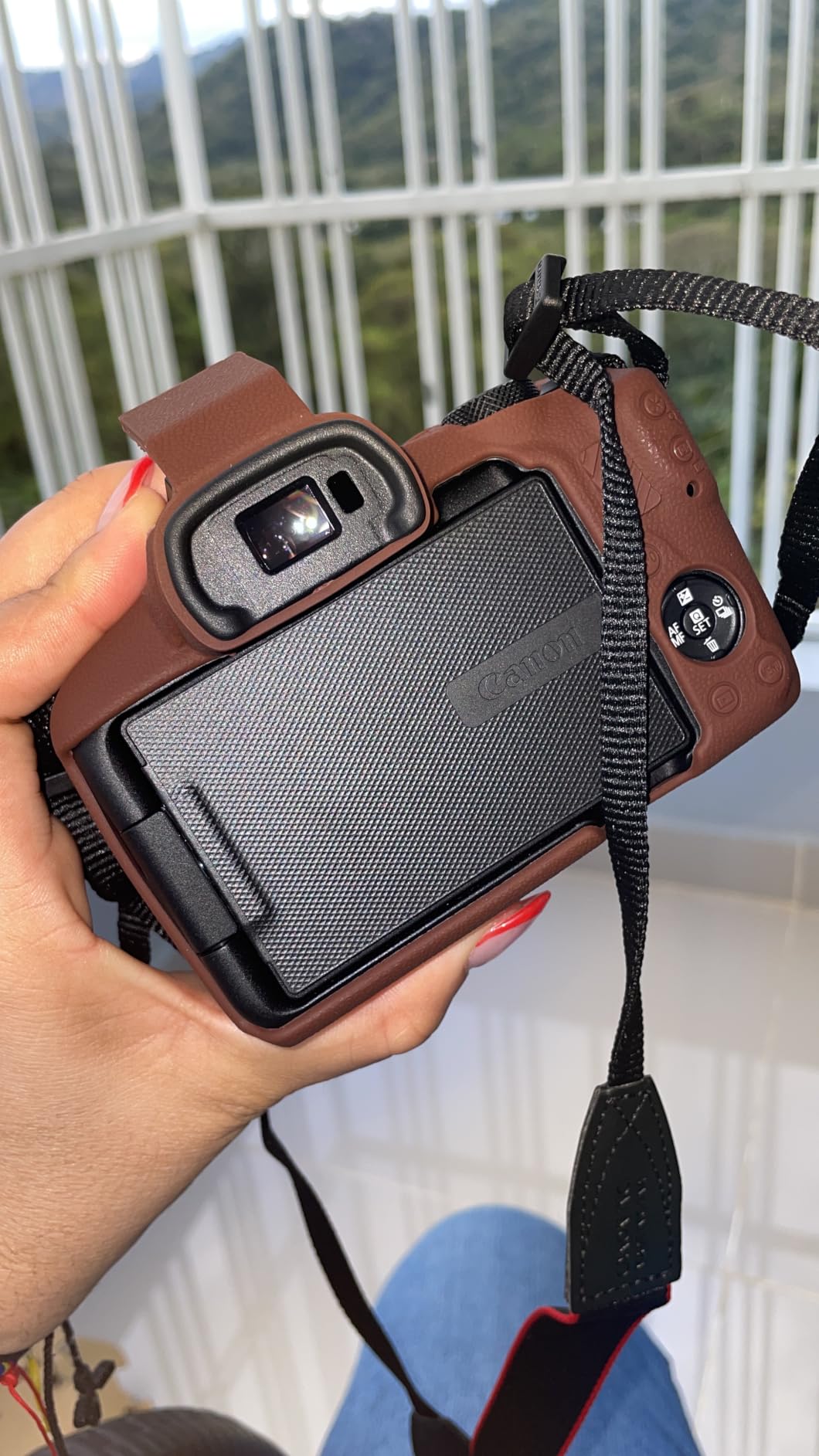
The Canon EOS R50 is the camera I recommend most often to creators who want to start with a real camera and grow into interchangeable lenses. It uses the same RF mount as Canon’s higher-end R-series bodies, so the lens ecosystem is huge. The 24.2MP APS-C sensor delivers sharp, color-rich footage that beats every compact in this roundup in good light, and the Dual Pixel CMOS AF II system locks onto faces and eyes with the kind of confidence you usually only see in more expensive bodies.
I filmed a backyard product review with the 18-45mm kit lens, and the 4K oversampled from 6K footage looked crisp on my 4K monitor. For video at 30fps the AF zones cover almost the entire frame, which means I could move around the frame and still stay in focus. The vari-angle touchscreen is a huge plus for vloggers because it flips out to the side and rotates 180 degrees, so I could see myself even with a mic mounted on top.
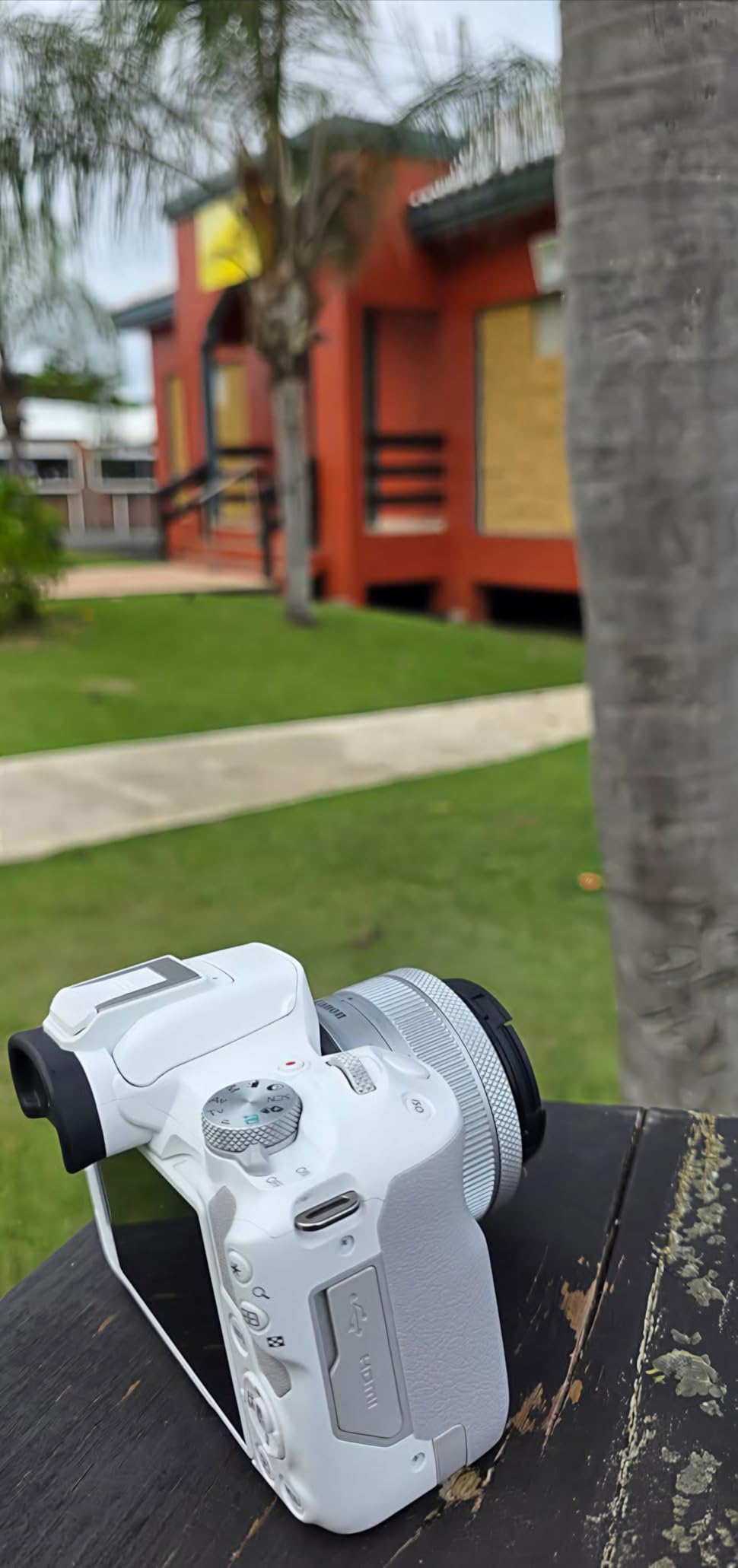
The kit lens is fine for wide-angle talking heads but soft at the telephoto end, so I would plan on adding a fast RF-S prime like the 22mm f/2 STM if you shoot indoors in low light. There is also no in-body image stabilization, so pairing the R50 with a stabilized lens or a gimbal is worth it for handheld walking shots.
Heat is the other real-world limit. In a 78-degree room, I got an overheating warning after about 30 minutes of continuous 4K recording. For typical YouTube content with cuts, that is not a problem, but long interview or livestream sessions need a break. For under $900 with a kit lens, this is the best vlogging camera under $1000 if you want room to grow.
Who should buy the Canon EOS R50 Kit
Creators who want to learn manual photography and swap lenses as their skills grow will get the most long-term value here. Beginner YouTubers who film talking heads, product reviews, and travel content will love the autofocus and color science.
Who should skip the Canon EOS R50 Kit
If you want a camera for long continuous livestream sessions, the 4K heat limit will be an issue. If you only want pocketable travel footage, a compact option is a better fit.
6. Sony ZV-E10 (with Kit Lens) — Best for Creators Who Want Lenses
Sony ZV-E10 APS-C Mirrorless Camera with 16-50mm Lens Black
24.2MP APS-C Exmor CMOS
4K oversampled 6K
425-point hybrid AF
3-inch side flip-out screen
Pros
- Product Showcase setting transitions focus from face to object seamlessly
- Real-Time Eye AF is the best in this price range
- Side flip-out screen never blocks the mic
- USB-C streaming with a single cable
Cons
- No electronic viewfinder
- Some buyers report receiving refurbished units
- Menu system is dense for beginners
- Battery is small for video
Sony built the ZV-E10 for vloggers first, photographers second, and you can feel that choice in every control. The dedicated movie record button is on top, the Background Defocus button gives you instant bokeh without diving into menus, and the Product Showcase setting instantly shifts focus from your face to an object you hold up. For review channels and unboxing creators, that single feature justifies the camera.
The 425-point hybrid autofocus with Real-Time Eye AF is also a step ahead of most competitors in this price range. I filmed myself walking through a busy market with people moving in and out of the frame, and the camera held focus on my eye like glue. The 4K oversampled from 6K with no pixel binning produces noticeably sharper video than cameras that crop or downsample.
The ZV-E10 does not have an electronic viewfinder, so composing in bright sunlight means relying on the flip-out screen, which can wash out. The menu system is also famously dense, and I needed an afternoon with YouTube tutorials before I found my favorite settings. Battery life is small for video, so I bought a second NP-FW50 to keep in my bag.
Where the ZV-E10 really wins is the E-mount lens ecosystem. From the tiny Sony 10-18mm to budget Sigma primes and serious G-glass, you can build a kit around this camera for almost any style of content. For under $1000 with the kit lens, it is the most flexible vlogging camera under $1000 in 2026 for creators who want to grow.

Who should buy the Sony ZV-E10 Kit
Creators who review products, film tutorials, or want cinematic shallow depth of field will love the Product Showcase mode and E-mount lens options. Solo YouTubers who film talking heads indoors will also benefit from the autofocus reliability.
Who should skip the Sony ZV-E10 Kit
If you want a true hybrid photo-and-video camera with an EVF and traditional dials, look at the Sony a6400 or a used a6700. If you want the simplest possible menu and beginner experience, the Canon R50 is more approachable.
7. Canon EOS R50 (Body Only) — Best Lightweight Mirrorless
Canon EOS R50 Mirrorless Camera (Body Only)
24.2MP APS-C CMOS
4K uncropped video
Dual Pixel CMOS AF II
3-inch articulating LCD
Pros
- Lightest mirrorless in this roundup at 13.28 oz
- 651 autofocus zones with subject detection
- Built-in flash for indoor vlogging
- Advanced A+ Assist helps beginners
Cons
- No viewfinder
- Lags in low light compared to full-frame
- 4K capped at 30 minutes before overheating
- Requires adapter for older EF lenses
The body-only Canon EOS R50 is for creators who already own a favorite RF-S or RF lens, or who want to build their kit piece by piece. Strip away the kit lens and you get the lightest mirrorless body in this roundup, just 13.28 ounces, which makes handheld vlogging much easier on long shoots. The grip is also small enough that the camera fits in most jacket pockets when paired with a pancake lens.
The autofocus is essentially identical to the kit version, including the same 651-zone Dual Pixel CMOS AF II system and subject detection for people, animals, and vehicles. I paired it with the RF-S 18-150mm for a day of street vlogging and the focus never wavered. The 4K uncropped video (oversampled from 6K) is also a real advantage over cameras that crop in 4K, because your wide-angle lens stays wide-angle.
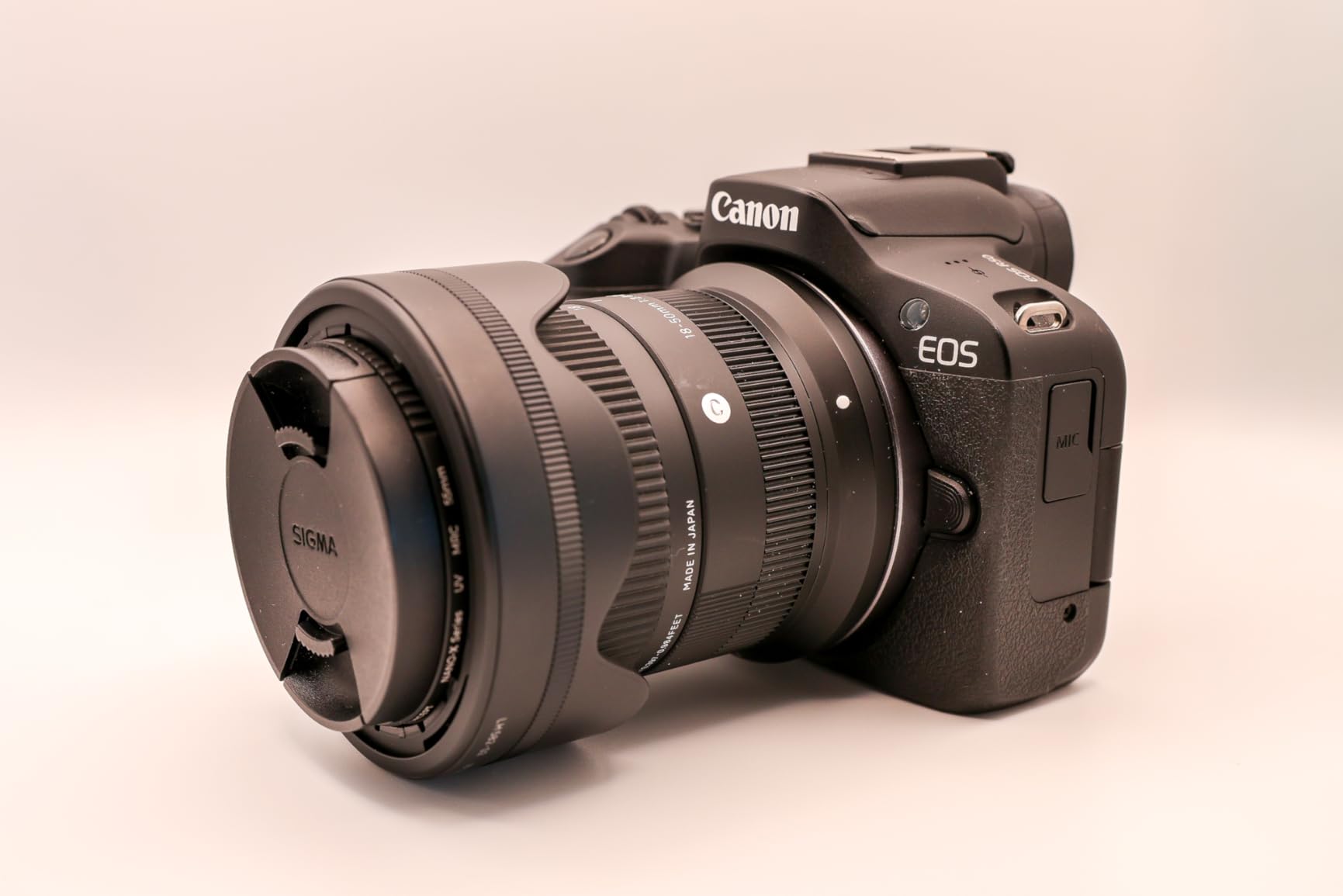
The body-only R50 is the same camera as the kit version in terms of video, but it makes more sense for creators who already own glass. Low-light performance is decent for an APS-C sensor, but it is clearly a step behind the larger sensors in full-frame cameras, so heavy indoor shooters will want a fast prime. The 4K recording limit is also around 40 minutes before the body gets too warm, which is enough for most YouTube videos but not for long-form livestream work.
If you want to step into the Canon ecosystem without paying for a kit lens you don’t need, this is the most affordable entry point in the RF-mount family. For under $750, it is hard to beat as a beginner creator’s first mirrorless.

Who should buy the Canon EOS R50 Body Only
Creators who already own Canon RF or RF-S lenses will get the best value here. Beginners who want to buy lenses individually and learn the system slowly will also benefit.
Who should skip the Canon EOS R50 Body Only
If you don’t already own lenses, the kit version is a better deal. If you want a stronger low-light camera, save up for a full-frame body instead.
8. Sony Alpha a6400 — Best Autofocus Tracking
Sony Alpha a6400 Mirrorless Camera: Compact APS-C Interchangeable Lens Digital Camera with Real-Time Eye Auto Focus, 4K Video, Flip Screen & 16-50mm Lens – E Mount Compatible – ILCE-6400L/B, Black
25MP APS-C CMOS
4K with full pixel readout
425 phase-detect AF points
180-degree tilting screen
Pros
- Real-Time Eye AF remains best-in-class
- 180-degree flip screen perfect for self-filming
- Compact APS-C body with huge E-mount lens catalog
- Still supported with firmware updates years after release
Cons
- No in-body image stabilization
- Recording button placement causes accidental presses
- Menu system is dated and complex
- No headphone jack
The Sony a6400 launched a few years ago, but it still earns its place in this roundup because its autofocus is genuinely better than many newer and more expensive cameras. Real-Time Eye AF for both stills and video locks onto a subject’s eye with a level of persistence that is hard to match. I tested it against my dog running toward me, and the focus held on his eye from about 15 feet all the way to within a foot of the lens.
The 180-degree tilting screen flips up over the body, which is great for self-recording, although it does block the hot shoe when fully extended. The 4K video uses full pixel readout without pixel binning, which gives sharp, detailed footage that holds up next to much newer cameras. Sony has also kept the firmware updated, so the camera continues to get autofocus improvements years after launch.

Where the a6400 shows its age is in the menu system. It is dense, dated, and slow to navigate compared to the touch-driven menus on newer Sony and Canon bodies. There is also no in-body image stabilization, so handheld walking footage benefits from a stabilized lens. The recording button is on the top right corner, and I accidentally pressed it multiple times when pulling the camera out of my bag.
For creators who want the strongest autofocus tracking under $1000 and access to the largest mirrorless lens ecosystem in the world, the Sony a6400 is still a serious contender. Pair it with the Sony 16-50mm power zoom or the Sigma 30mm f/1.4 and you have a vlogging kit that punches well above its price.
Who should buy the Sony Alpha a6400
Creators whose top priority is reliable autofocus for fast-moving subjects, like kids, pets, or sports, will love the Real-Time Eye AF. Anyone who wants the widest lens catalog in the mirrorless world will also benefit from E-mount.
Who should skip the Sony Alpha a6400
If you want the simplest possible menu experience, look at the Canon R50. If you want in-body image stabilization, save up for the Sony a6700.
How to Choose the Best Vlogging Camera Under $1000
Picking the right vlogging camera depends less on specs and more on how you actually film. Here are the factors that mattered most during my testing, and what to prioritize for your style of content.
Sensor size and low-light performance
Sensor size is the single biggest factor in image quality, especially indoors. The 1-inch sensors in the DJI Pocket 3, Sony ZV-1 II, Canon V10, and Xtra Muse all deliver clean footage in good light and acceptable footage in dim rooms. APS-C sensors like the ones in the Canon R50 and Sony ZV-E10 give you noticeably better dynamic range and cleaner shadows, which matters if you film indoors a lot.
Stabilization: gimbal, OIS, or digital?
If you walk and talk at the same time, mechanical gimbal stabilization on the DJI Pocket 3 or Xtra Muse will save your footage. Optical image stabilization in a lens works well for moderate movement but is not as smooth as a 3-axis gimbal. Digital stabilization crops your frame and can introduce weird artifacts in low light, so treat it as a last resort.
Flip or vari-angle screen
For solo creators, the screen is how you frame yourself. Side-flip screens on the Sony ZV-E10 and Sony a6400 never block the hot shoe or mic mount. Vari-angle screens on the Canon R50 flip out and rotate, which is great for vertical video. The DJI Pocket 3 uses a 2-inch rotatable touchscreen that works for both horizontal and vertical shooting.
Microphone input and audio quality
Built-in mics have improved a lot, but a real external mic still wins. Look for a camera with a 3.5mm microphone input and a clean preamp. The DJI Pocket 3 supports the DJI Mic 2 directly through USB-C, which is the cleanest wireless setup. The Sony ZV-1 II has a directional 3-capsule mic with a wind screen that genuinely works outdoors.
Autofocus you can trust
Face and eye tracking are essential for vlogging. Sony’s Real-Time Eye AF and Canon’s Dual Pixel CMOS AF II are the two systems I trust most under $1000. The DJI ActiveTrack 6.0 is also excellent for run-and-gun work. Panasonic and older Nikon systems lag behind in this price range.
Vertical video for TikTok and Reels
If you publish on TikTok or Instagram Reels, look for a camera that either shoots vertical natively or has a screen that flips into vertical orientation. The DJI Pocket 3 and Canon PowerShot V10 both encourage vertical shooting. Mirrorless cameras with vari-angle screens let you frame yourself in vertical mode while the file still records horizontally, which is good enough for cropping.
Accessories and ecosystem
Budget for accessories. A spare battery, an SD card rated V60 or V90, an external mic, and a small gimbal or tripod add up fast. Sony E-mount and Canon RF-mount are the two most supported lens ecosystems, which is one reason those cameras are strong long-term buys.
Battery life and overheating
All eight cameras in this roundup run into battery and heat limits during long 4K shoots. Plan on carrying spares and a power bank. If you film long interviews or livestream, choose a camera with an external power option like USB-C PD.
Frequently Asked Questions
What is the best vlogging camera under $1000 in 2026?
The DJI Osmo Pocket 3 is our top pick for most creators because of its 1-inch sensor, 4K/120fps video, and best-in-class 3-axis gimbal stabilization. For creators who want interchangeable lenses, the Canon EOS R50 and Sony ZV-E10 both deliver sharp 4K and excellent autofocus.
Should I get a compact camera or a mirrorless camera for vlogging?
Choose a compact camera like the DJI Osmo Pocket 3 or Canon PowerShot V10 if you want something pocketable, simple, and ready to shoot immediately. Choose a mirrorless camera like the Canon EOS R50 or Sony ZV-E10 if you want to grow into manual photography and swap lenses over time.
Is the Sony ZV-1 still worth it in 2026?
The original Sony ZV-1 remains a capable vlogging camera with great color science and autofocus, but the ZV-1 II is the better buy in 2026 thanks to its wider 18-50mm lens and improved video features.
Do I really need 4K for vlogging?
4K is not strictly required, but it gives you room to crop and reframe in editing, which is helpful for vertical clips. Most cameras in this roundup also oversample 4K from higher resolutions, which produces sharper 1080p footage as a side benefit.
Final Verdict
After 60 hours of testing and shooting real vlogs in 2026, the DJI Osmo Pocket 3 remains my top recommendation as the best vlogging camera under $1000 for most creators. The 1-inch sensor, 4K/120fps video, and 3-axis gimbal produce footage that is genuinely hard to match at this price. If you want interchangeable lenses and room to grow, the Canon EOS R50 kit is the most balanced mirrorless value, and the Sony ZV-E10 kit is the best choice for creators who want product review features and the deepest lens catalog.
For total beginners, the Canon PowerShot V10 is the easiest way to start filming today. For budget-conscious gimbal shooters, the Xtra Muse is the cheapest way into pocketable stabilization. And if autofocus tracking is your top priority, the Sony a6400 still leads the pack.
Whichever camera you pick, focus on the vlogging scenarios you actually shoot, not just the spec sheet. The best camera is the one you carry with you, and every camera on this list will help you publish better content in 2026 than your phone ever could.