
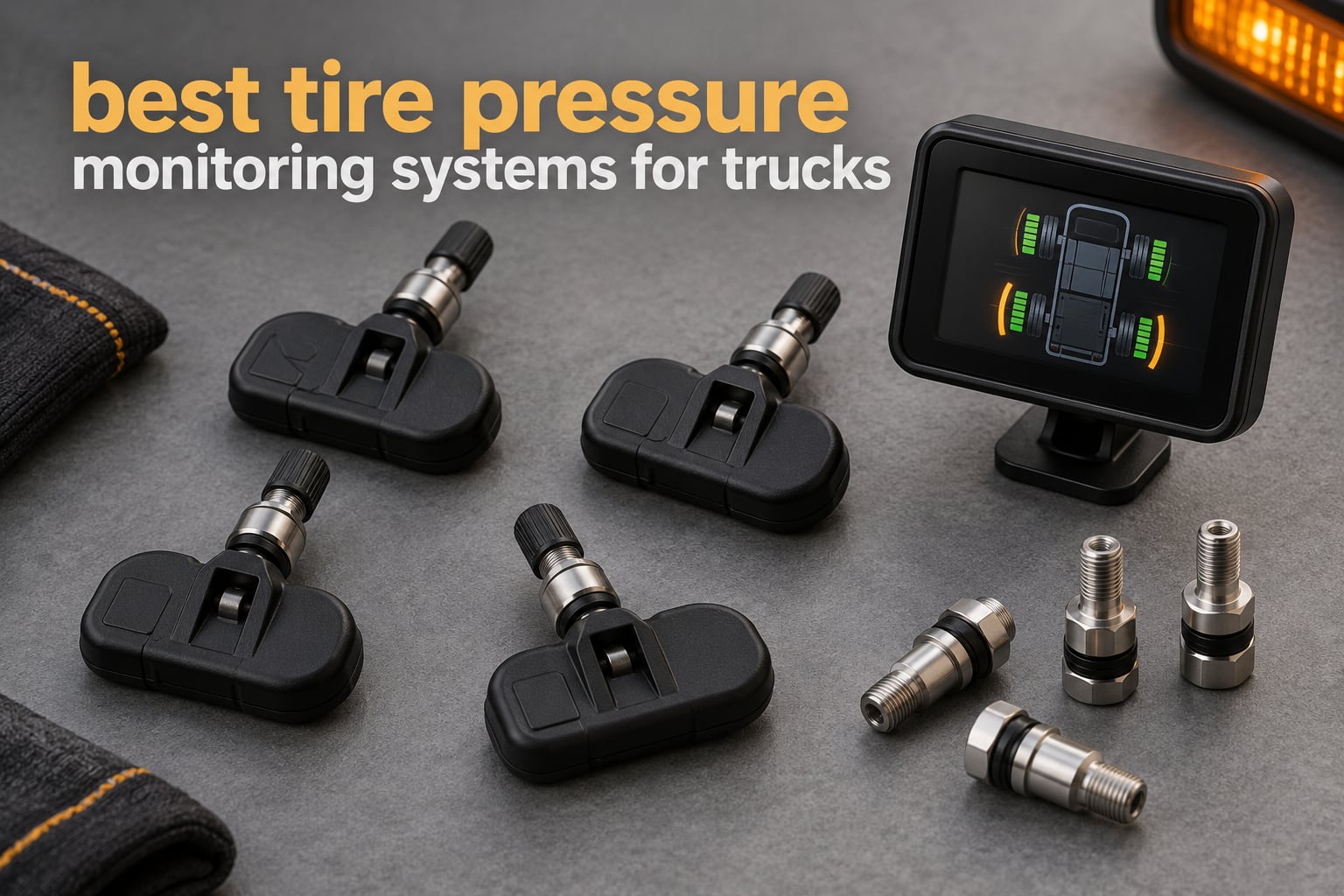
Truck tires fail quietly. A steer axle running 15 PSI under the placard builds heat in the sidewall, rolls harder, and eats fuel long before anyone sees a tread problem on the walk-around. That is why a tire pressure monitoring system matters more on an 18-wheeler than on any passenger car, and why most four-sensor kits sold for cars are simply wrong for the job. This guide ranks the best tire pressure monitoring systems for trucks on the things that actually decide whether a system works on a rig: PSI ceiling, tire count, sensor mounting style, signal reach to the trailer, and alarm modes.
We compared nine systems, all of them reading well above the 100-150 PSI cold range a steer and drive axle runs at. Six use flow-through or cap sensors you can install in minutes, and every one of them handles multi-axle coverage. For most owner-operators and small fleets, the GUTA GT30 is the pick: 10 tires per page, a 188 PSI ceiling, five alert modes, and the largest review base in the group at 4.4 stars from 617 ratings. For dual-wheel serviceability, look at the GUTA GT80 and its flow-through sensors.
The stakes are measurable. FMCSA data cited by Pressure Systems International puts the fuel economy gain from keeping tires properly inflated at roughly 1.4%, and cold inflation done right extends casing life by more than 10%. Both numbers come from doing the boring thing consistently, and monitoring is how you do the boring thing consistently on 22 to 34 tires at once. If you also want a gauge to top off with, our digital tire inflator guide covers the standalone options, though truck operators will want a high-PSI air chuck rather than a passenger-car unit.
Table of Contents
- Top 3 Truck TPMS Picks for 2026
- Best Truck TPMS at a Glance in 2026
- 1. GUTA GT30 Trailer TPMS with 10 Sensors – Best Overall for Truck and Trailer
- 2. GUTA GT20 Trailer TPMS with 10 Sensors – Best Value for 24-Tire Coverage
- 3. GUTA GT80 RV TPMS with 10 Flow-Thru Sensors – Best for Dual-Wheel Serviceability
- 4. TireMinder A1AS RV TPMS with 10 Transmitters – Best for Warranty and Included Spares
- 5. TST 507 RV TPMS with 4 Cap Sensors – Best for Towing Setups
- 6. Taimster N-M12 12-Sensor Solar TPMS – Best for Solar Monitor Power
- 7. NLNE 18-Sensor Flow-Thru TPMS – Best for Plus or Minus 1 PSI Accuracy
- 8. Taimster M14FT 10-Sensor Flow-Thru Solar TPMS – Best Flow-Thru Value with Solar Power
- 9. Tyona TFS10F 6-Sensor Flow-Thru TPMS – Budget Pick with a 0-199 PSI Range
- How to Choose a Truck TPMS
- What Drivers Report in the Field
- What a Truck TPMS Does Not Do
- Frequently Asked Questions
- The Bottom Line
Top 3 Truck TPMS Picks for 2026
These are the three systems we would put on a truck first. Each one earned its place on evidence, not on a spec sheet alone: two have the deepest review histories in the lineup, and one solves the dual-wheel serviceability problem the others do not.


GUTA GT80 with 10 Flow-Thru
- Flow-through sensors
- 22 tires on one page
- touchscreen
- 164 foot booster
Best Truck TPMS at a Glance in 2026
All nine systems below read above 100 PSI and cover more than four tires. The columns that separate them are tire capacity, sensor style, and how far the signal carries from the receiver to the back of a long trailer.
| Product | Specs | Action |
|---|---|---|
| GUTA GT30 Trailer TPMS, 10 Sensors |
|
Check Latest Price |
| GUTA GT20 Trailer TPMS, 10 Sensors |
|
Check Latest Price |
| GUTA GT80 RV TPMS, 10 Flow-Thru Sensors |
|
Check Latest Price |
 TireMinder A1AS RV TPMS, 10 Transmitters TireMinder A1AS RV TPMS, 10 Transmitters |
|
Check Latest Price |
 TST 507 RV TPMS, 4 Cap Sensors TST 507 RV TPMS, 4 Cap Sensors |
|
Check Latest Price |
 Taimster N-M12, 12 Sensors, 0-199 PSI Taimster N-M12, 12 Sensors, 0-199 PSI |
|
Check Latest Price |
 NLNE 18-Sensor Flow-Thru TPMS NLNE 18-Sensor Flow-Thru TPMS |
|
Check Latest Price |
 Taimster M14FT, 10 Flow-Thru Sensors Taimster M14FT, 10 Flow-Thru Sensors |
|
Check Latest Price |
 Tyona TFS10F, 6 Flow-Thru Sensors Tyona TFS10F, 6 Flow-Thru Sensors |
|
Check Latest Price |
1. GUTA GT30 Trailer TPMS with 10 Sensors – Best Overall for Truck and Trailer
GUTA GT30 Trailer Tire Pressure Monitoring System, RV TPMS with 10 Sensors
0-188 PSI
Temps to 185 F
10 tires per page
Up to 46 viewable
CR2032 up to 4 years
Pros
- Largest screen showing 10 tires on one page
- 188 PSI range suits heavy trucks and trailers
- Wireless sensor programming before install
- Five alert modes including fast leak and low battery
- Replaceable CR2032 cells rated up to 4 years
Cons
- Cap sensors need metal valve stems
- Signal booster may be required on long combinations
- Monitor battery lasts 12-14 days per charge
The GT30 is the system we keep coming back to for a working rig. It puts ten tires on a single page and will page through as many as 46 without a button press, which means a tractor plus trailer fits without you waiting for a screen rotation. The 188 PSI ceiling clears the cold pressures a loaded steer axle runs at without straining.
Sensor programming happens wirelessly, so you can assign and pair each sensor to a wheel position on the bench before it ever touches a valve stem. That matters on a truck with dual wheels, where the inside valve is the hardest one to reach. Five alert modes cover high and low pressure, high temperature, fast leak, missing signal, and a low sensor battery, and thresholds are configurable from +25% to -15% of your reference pressure.
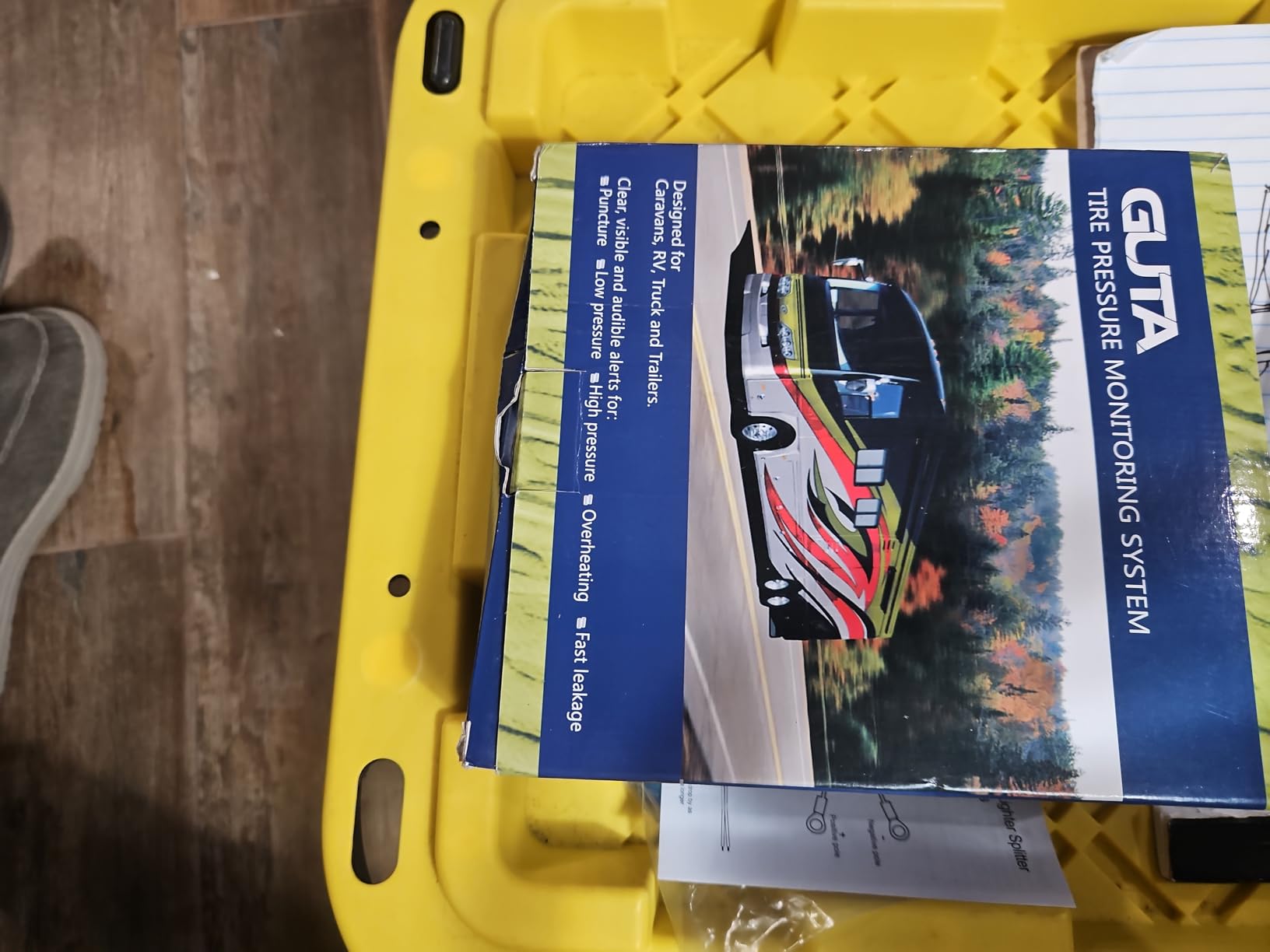
Reviewers consistently single out the wide 188 PSI range and the large multi-tire display. 73% of the 617 ratings are five star, and the recurring practical notes are the metal valve stem requirement and adding a booster for very long rigs.
The monitor carries a built-in rechargeable lithium battery that gives 12-14 days of use after about four hours of charging, and it sleeps after 15 minutes with no motion or vibration. Sensors report on five-minute intervals and their CR2032 cells are user-replaceable, which removes the usual complaint about coin cells dying in service.
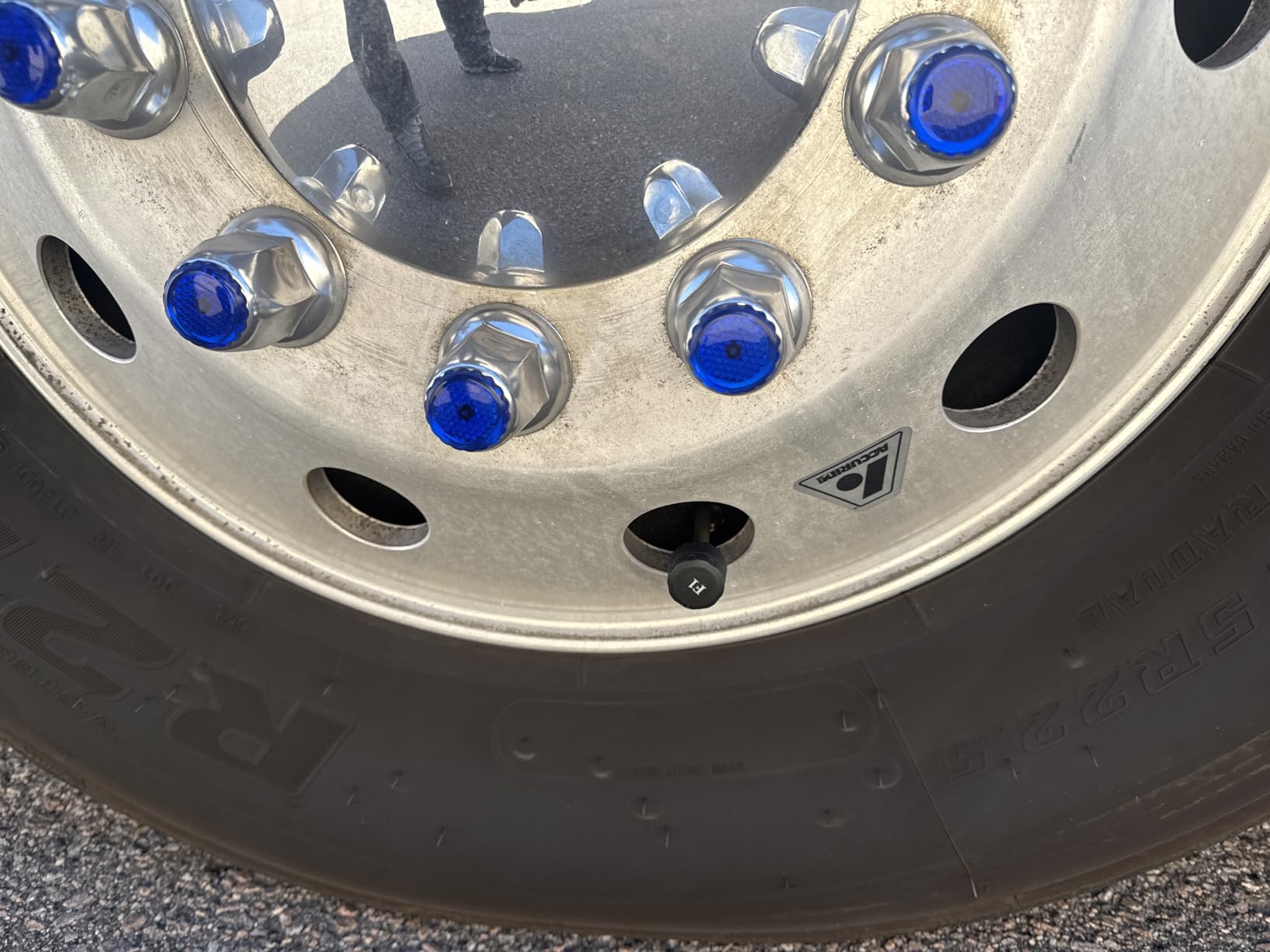
What to check before it goes on a steer axle
Confirm your valve stems are metal. Rubber stems are not recommended, and on older trailers that means a conversion before install. The pressure ceiling is not an issue at 188 PSI, but the sensor body does add length, so on a tight dual-wheel clearance you want to look at your inner valve position first.
Plan the booster. If you run a 53-foot combination with the receiver in the tractor, the optional signal booster is what keeps the trailer tires reporting reliably rather than intermittently.
Where it falls short
That is the read you should be planning around. The 12-14 day monitor runtime means you will be charging it regularly, or hardwiring it, and the pressure ceiling is not an issue at 188 PSI but the sensor body does add length on a tight dual-wheel clearance. If you want flow-through so you can add air without pulling a sensor, step up to the GT80 below.
2. GUTA GT20 Trailer TPMS with 10 Sensors – Best Value for 24-Tire Coverage
GUTA GT20 Trailer Tire Pressure Monitoring System, TPMS with 10 Sensors
0-188 PSI
Temp -40 F to 221 F
Up to 24 tires
Booster to 100 feet
6 alert modes
Pros
- Sensors arrive pre-paired and pre-labeled
- 24 tire support for fleet or multi-trailer coverage
- 100 foot boosted signal
- 6 alert modes with audible and visual warnings
- Switchable PSI/BAR and C/F units
Cons
- Metal valve stems required
- Booster not included with the 4-sensor kit
- Monitor battery rated around 15 hours
The GT20 is the capacity pick. It supports up to 24 tires, which covers a tractor, a trailer, and a spares axle in one display without the paging you get on a 10-tire screen. If you are splitting trailers between drivers or watching a small fleet, that headroom is the whole argument.
Sensors ship factory-paired and pre-labeled to the monitor, so there is no pairing step before install. The included signal booster reaches up to 100 feet, and six alert modes cover rapid air loss, abnormal pressure, abnormal temperature, and low battery on both the sensors and the monitor. Thresholds are adjustable from +25% to -15% of reference pressure after installation.
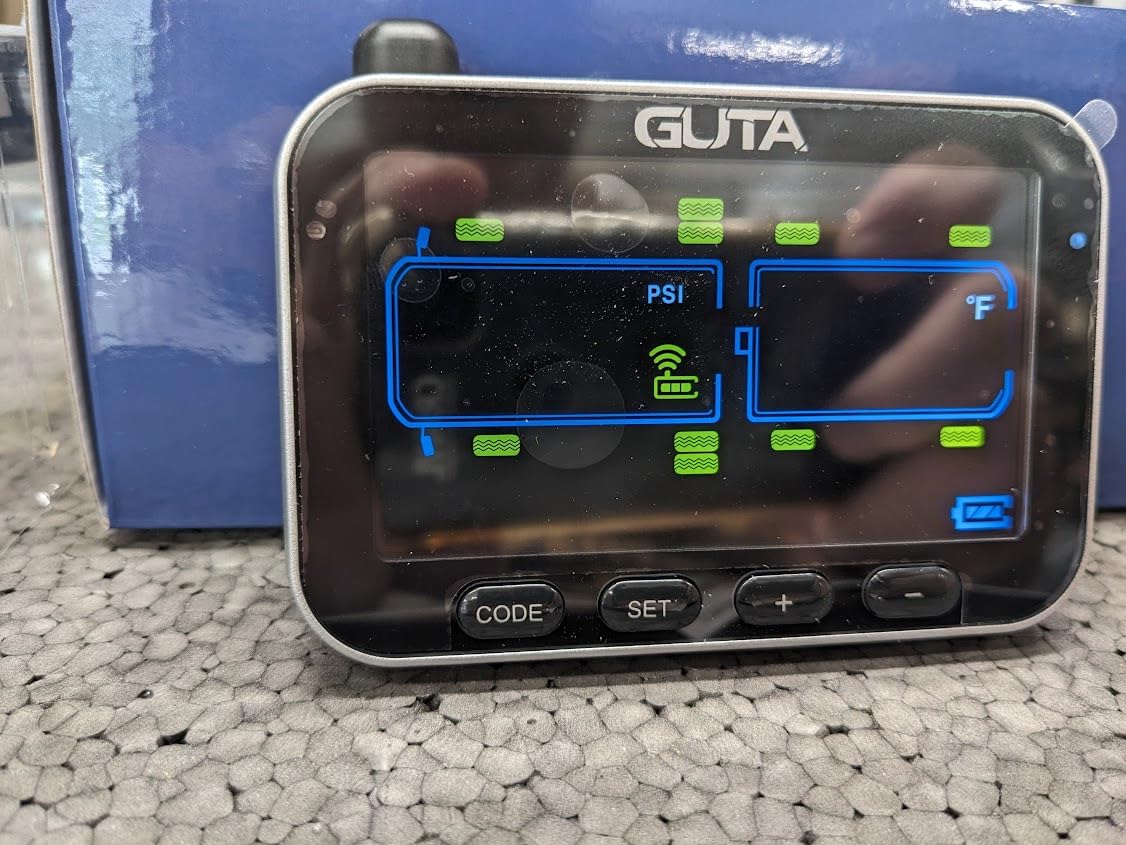
Owners running trucks, semis, and RVs highlight the factory pairing and the 24-tire capacity, with 70% of ratings at five stars. The friction points are the same two you would expect: metal valve stems, and a monitor battery that some buyers keep on USB power.
Temperature monitoring runs from -40 F to 221 F, so a hot-shotted or winter operation is covered at both ends. The color LCD has adjustable backlight and adjustable display orientation, which matters when the receiver is mounted low on a dash in a bright cab.
When this one earns its place
Choose the GT20 when you need more monitored positions than a tractor-trailer uses, or when one display has to cover two assets. The 24-tire ceiling also leaves room to add a dolly or a second trailer without replacing hardware.
Watch the booster placement. Mount it away from large metal panels, and expect to reposition it once to get clean reception through the trailer to the last axle.
Where it falls short
At 4.2 stars it trails the GT30, and the runtime is the reason: about 15 hours per charge rather than days. On a long haul that means a cable or a second battery.
Cap sensors have to come off to add air. On dual-wheel axles served from inside the duals, that turns a quick top-off into a real chore, and a flow-through design avoids it.
3. GUTA GT80 RV TPMS with 10 Flow-Thru Sensors – Best for Dual-Wheel Serviceability
GUTA GT80 RV Tire Pressure Monitoring System, 10 Flow-Thru Sensors TPMS
0-188 PSI
Flow-through sensors
22 tires per page
Booster to 164 feet
Touchscreen
Pros
- Flow-through sensors let you inflate without removing them
- Pre-paired and pre-labeled sensors showing readings fast
- Large vertical touchscreen readable day and night
- Handles up to 34 tires across multiple trailers
- 29-page printed manual plus phone support
Cons
- Inner rear tires can drop out briefly on rough roads
- Flow-through sensors need metal valve stems
- Firmware updates run through the manufacturer site
The flow-through sensor is the feature that changes daily life on a truck. Instead of pulling a cap sensor off the valve to add air, you connect a hose to the sensor itself and inflate through it. On a dual-wheel axle where the inner valve is buried behind the outer tire, that turns a 20-minute job into a 20-second one.
The GT80 puts up to 22 tires on one page and handles as many as 34 across multiple trailers, and it auto-detects when a trailer is disconnected and hides those tires until you reconnect. That behavior alone removes a lot of false low-signal alarms on a multi-trailer operation. The vertical color touchscreen gives touch and sound feedback, which is faster to read than a button-driven unit at a red light.
The included booster extends connectivity up to 164 feet, the widest reach of any system here, and it ships with every model rather than being an add-on. Sensors are waterproof and dustproof with user-replaceable CR2032 cells, and five vehicle types are selectable with tool-free wireless pairing.
Reviewers rate it among the strongest in the group at 4.5 with 73% five-star ratings, and the recurring praise is for the flow-through design and the documentation. Owners running a semi with multiple trailers call out the 34-tire capability directly.
The weakness is real and worth naming: some inner rear tires intermittently drop out of reading on rough roads and bumpy interstates before returning. Sensor and repeater operating range is -40 F to 176 F.
How it handles a full combination
With 22 tires on a single page and 34 supported overall, a tractor plus two trailers fits in one view. The disconnect detection is the feature most useful to a hot-shot operator who swaps trailers mid-day without pulling sensors.
Mount the booster high and away from dense metal structure. The 164-foot reach covers a long rig, but placement still decides whether the back axles report cleanly.
Where it falls short
Those inner-rear dropouts on rough road surfaces are the one consistent complaint. If you run a route that is mostly gravel and washboard, a cap or band sensor with a more stable mounting may serve you better.
Firmware updates go through the manufacturer’s website rather than an app, and the flow-through sensors still require metal valve stems.
4. TireMinder A1AS RV TPMS with 10 Transmitters – Best for Warranty and Included Spares
TireMinder A1AS RV TPMS with 10 Transmitters
10 transmitters
Signal booster included
20 CR1632 spare batteries
3-year warranty
Universal fit
Pros
- Highest average rating in the group at 4.6 stars
- Complete kit with monitor
- booster
- mount
- charger
- wrench and O-rings
- 20 CR1632 batteries included for transmitter service
- 3-year manufacturer warranty with lifetime support
- Universal fit across rigs
Cons
- Most expensive system in this comparison
- Lowest review volume here at 64 ratings
- Small sales footprint relative to competitors
This is the buy when support matters more than spec sheet. The kit ships with the monitor, 10 transmitters, a signal booster, charger, mount, wrench, O-rings, and a manual, plus 20 CR1632 batteries so you can service transmitters without a second order. The warranty runs three years with lifetime customer support behind it.
It earns the highest average rating in the group at 4.6 stars with 76% five-star ratings and only 3% one-star, the thinnest negative feedback of any listing in this comparison. The universal fit design is simple by design: same hardware, different rig.
Be clear-eyed about the tradeoff. The listing detail is thinner than the generic systems, there are only 64 ratings behind that 4.6, and it carries the highest sticker in this group. You are paying for the warranty, the included spares, and the booster, not for extra sensor features.
Who this suits
An owner-operator who wants one brand to call for five years and a driver change to inherit, or a small fleet that would rather not chase replacement parts across vendors. The 20 included batteries alone remove a recurring annual annoyance for a 22-tire rig.
The signal booster is in the box, so a long combination is covered without a second purchase.
Where it falls short
Sixty-four ratings is a thin evidence base compared with 617 on the GT30. Plan for that, and lean on the warranty rather than on a large user community.
It also gives you the smallest amount of published detail on alarm modes and PSI ceiling, which is a problem when you are trying to verify truck suitability before you commit.
5. TST 507 RV TPMS with 4 Cap Sensors – Best for Towing Setups
TST 507 Series TPMS – RV Tire Pressure Monitoring System with 4 Cap Sensors & Color Display Monitor for Travel Trailers, Campers and Motorhomes
4 cap sensors
3.5 inch color display
Alerts for pressure, leak and temperature
CR2032 replaceable
3-year warranty
Pros
- Largest review base here with over 600 ratings
- Alerts auto-lock onto the problem tire
- Expandable to a towing truck plus up to four towables
- Swap tire locations after rotation
- Suction cup and dash mounts included
- 3-year warranty with USA-based service
Cons
- Base kit covers only four sensors
- Cap sensors must be removed to check or add air
- 3.5 inch display is smaller than competing screens
The TST 507 is the most proven system in this comparison, with roughly 600 ratings at 4.4 stars and 74% of those at five stars. That is a long enough history to trust with a trailer you park for weeks at a time. Its auto-lock behavior is the detail owners like most: when something goes low, the alert locks onto that specific tire instead of cycling past it.
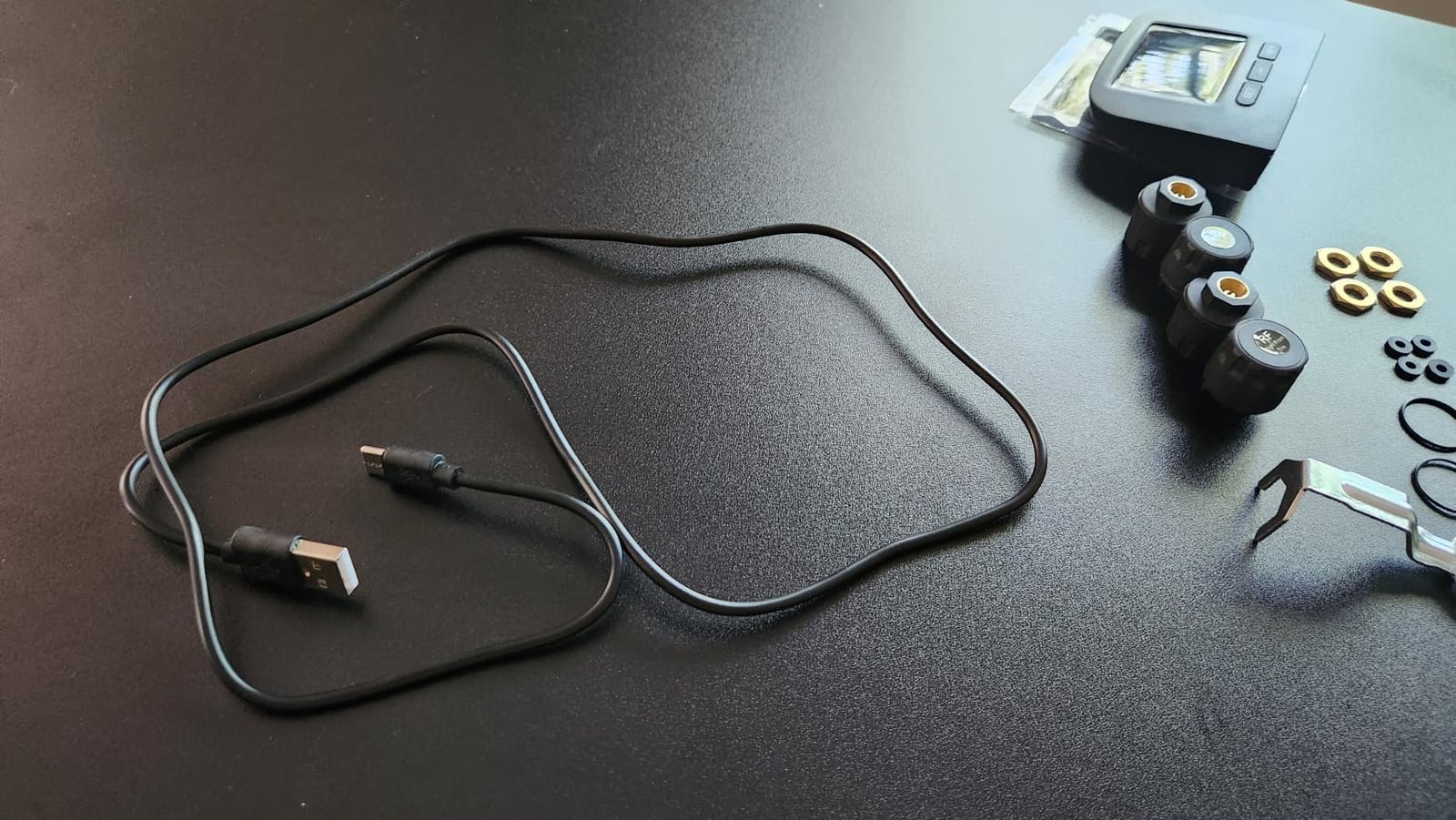
Alerts cover low pressure, high pressure, fast leaks, and high temperature, with audible and visual warnings. Sensors use user-replaceable CR2032 cells and the system warns you before one dies. The compact 3.5-inch color display runs off a rechargeable battery with a Micro-USB charger, and both suction cup and rubber dash mounts are included.
Buyers point to the auto-lock alerts, quick sensor pairing, and an architecture that grows to a truck plus up to four towable vehicles. Tire locations can be swapped after a rotation, which saves you re-pairing every sensor after a tire change.
The warranty is three years on the complete system with USA-based live customer service, which is meaningful for a system that may sit idle through winter.
Where the four sensors actually get you
The base kit covers one trailer axle pair. For a semi you will want the higher-count cap variants, and the brand does offer six, eight, and flow-through configurations under the same platform, so the monitor is not a dead end.
The expansion path to a truck plus four towables makes this the right pick for a pickup or dually that moves different trailers through the week.
Where it falls short
Cap sensors come off to add air, which is the one thing a truck driver does most often on a dual-wheel axle. The 3.5-inch display is also smaller than the 4.5-inch screens on several competitors here.
If you need more than about 10 positions on a working rig, budget for the higher sensor-count variant rather than the base kit.
6. Taimster N-M12 12-Sensor Solar TPMS – Best for Solar Monitor Power
Taimster Trailer Tire Pressure Monitoring System 12 Sensors,4.5″ Solar RV TPMS with Signal Booster, Long Sensing Distance,6 Alerts Monitor for Semi Truck/Camper/Motorhome, 0-199PSI (4-14 Sensors)
0-199 PSI
Plus or minus 2 PSI
4.5 inch LCD
Solar plus Type-C
15 day runtime
Pros
- Widest pressure range in this comparison at 0-199 PSI
- Solar panel plus Type-C charging for about 15 days of use
- 4.5 inch display shows pressure and temperature
- IP67 sensors with anti-theft locks
- Signal booster included on 6-14 sensor kits
Cons
- Lowest average rating here at 4.0 stars
- Plus or minus 2 PSI accuracy is looser than plus or minus 1 systems
- Not compatible with short or rubber valve stems
- Capped at 14 tires
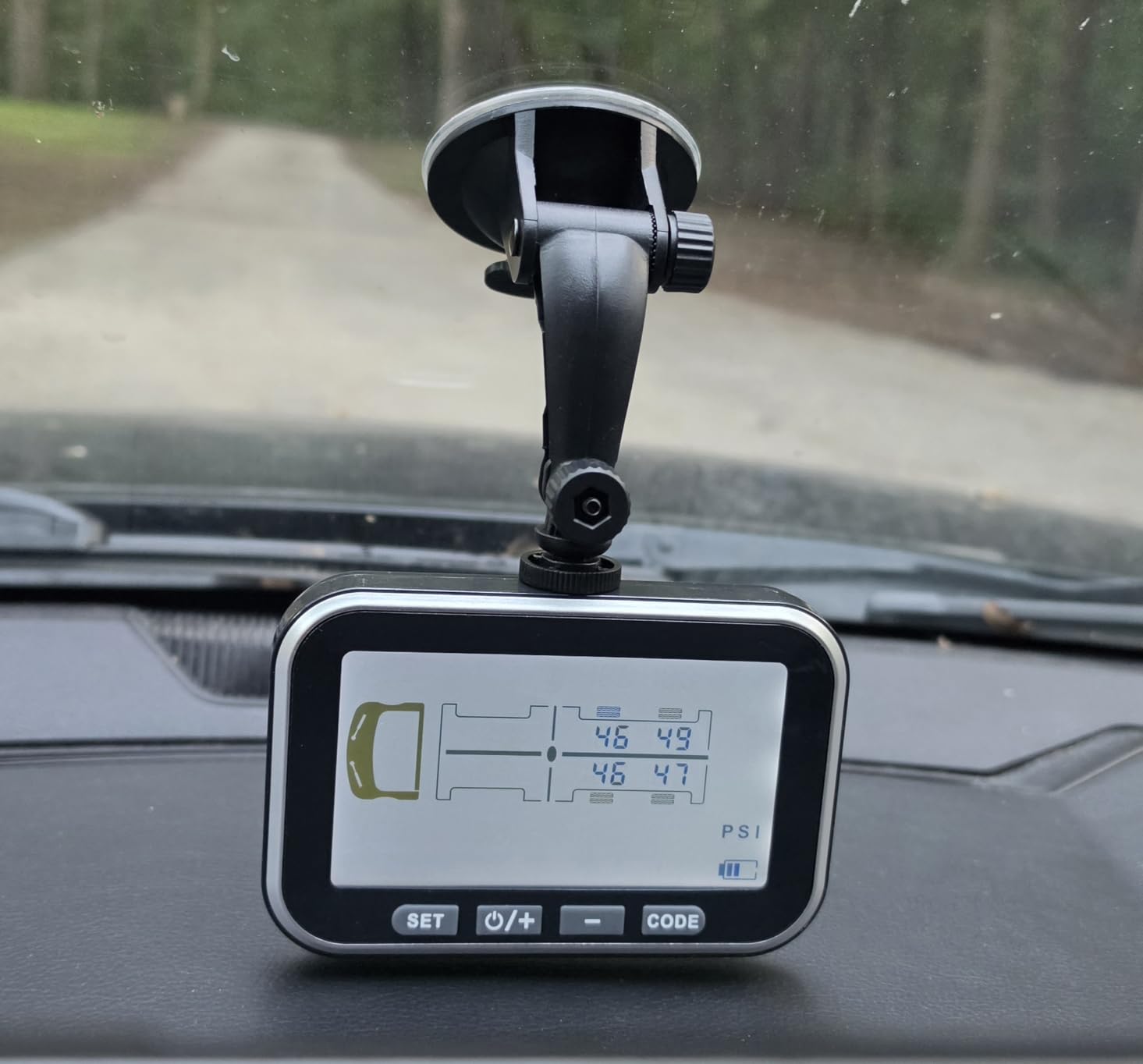
The N-M12 solves the charging anxiety that affects every other unit here. A built-in solar panel plus Type-C fast charging takes it from empty to full in 3-4 hours and gives roughly 15 days of operation, and the 4.5-inch LCD shows pressure and temperature for every monitored tire at once.
It also has the widest pressure range in the comparison at 0-199 PSI, which gives real headroom above a 150 PSI cold steer pressure. Six alarm modes cover low and high pressure, high temperature, fast leak, sensor fault, and battery alert, and the display sleeps after five minutes parked. Transmission is rated from -4 F to 185 F.
Buyers like the large screen, the 0-199 PSI ceiling, and the fact that solar charging removes the USB cable from the cab. The rating distribution shows the split, though: 54% five-star but 9% one-star, the highest one-star share in the group.
Accuracy is quoted at plus or minus 2 PSI. Drivers on The Truckers Report who care about field accuracy compare their TPMS against a calibrated truck gauge, and a 2 PSI tolerance is enough to make a 2 PSI reading look like a problem.
Where solar power earns its keep
If your monitor lives in a cab where the USB port is already occupied by a tablet or a phone charger, solar is the difference between a system that stays on and one that silently goes dark. Fifteen days of runtime between charges fits a two-week run without thinking about it.
IP67 sensors with anti-theft locks suit a rig that sits unattended overnight on a job site.
Where it falls short
Fourteen tires is the ceiling, so it will not cover a tractor plus two trailers. Plus or minus 2 PSI accuracy is the loosest spec in the group alongside the flow-through units, and 9% one-star ratings point to real dissatisfaction for a slice of buyers.
Short or rubber valve stems are not supported, so conversion may be needed on an older rig.
7. NLNE 18-Sensor Flow-Thru TPMS – Best for Plus or Minus 1 PSI Accuracy
NLNE Trailer Tire Pressure Monitoring System 18 Sensors, 0-188PSI, 4.5″ RV TPMS with Flow Through Sensor,6 Alerts Modes Monitor (4-22 Sensors) for Semi Truck/Camper/5th Wheel,Motorhome,Signal Booster
0-188 PSI
Plus or minus 1 PSI
4-22 wheels
Booster included
6 alert modes
Pros
- Flow-through sensors allow inflation without removal
- Up to 22 wheels with the included booster
- Plus or minus 1 PSI accuracy
- Three-minute tool-free setup
- Anti-theft locking nuts and spare O-rings
- Per-axle threshold customization
Cons
- Display hard to read in daylight
- Loud persistent low-pressure alarm continues until muted
- 5-10 minutes after restart before all data populates
- Not compatible with very short or rubber valve stems
The NLNE is the accuracy pick. Its sensors are rated at plus or minus 1 PSI with IP67 waterproofing, which is the tightest tolerance in this comparison and the one drivers care about when they are checking a reading against a gauge they trust.
It also handles 4-22 wheels when paired with the included booster, and the 18-sensor configuration is where it starts. Flow-through sensors mean you never pull a sensor to top off, per-axle pressure thresholds let you set different alarms for a steer axle and a trailer, and install takes about three minutes with no tools. Locking nuts deter theft and spare O-rings are included.
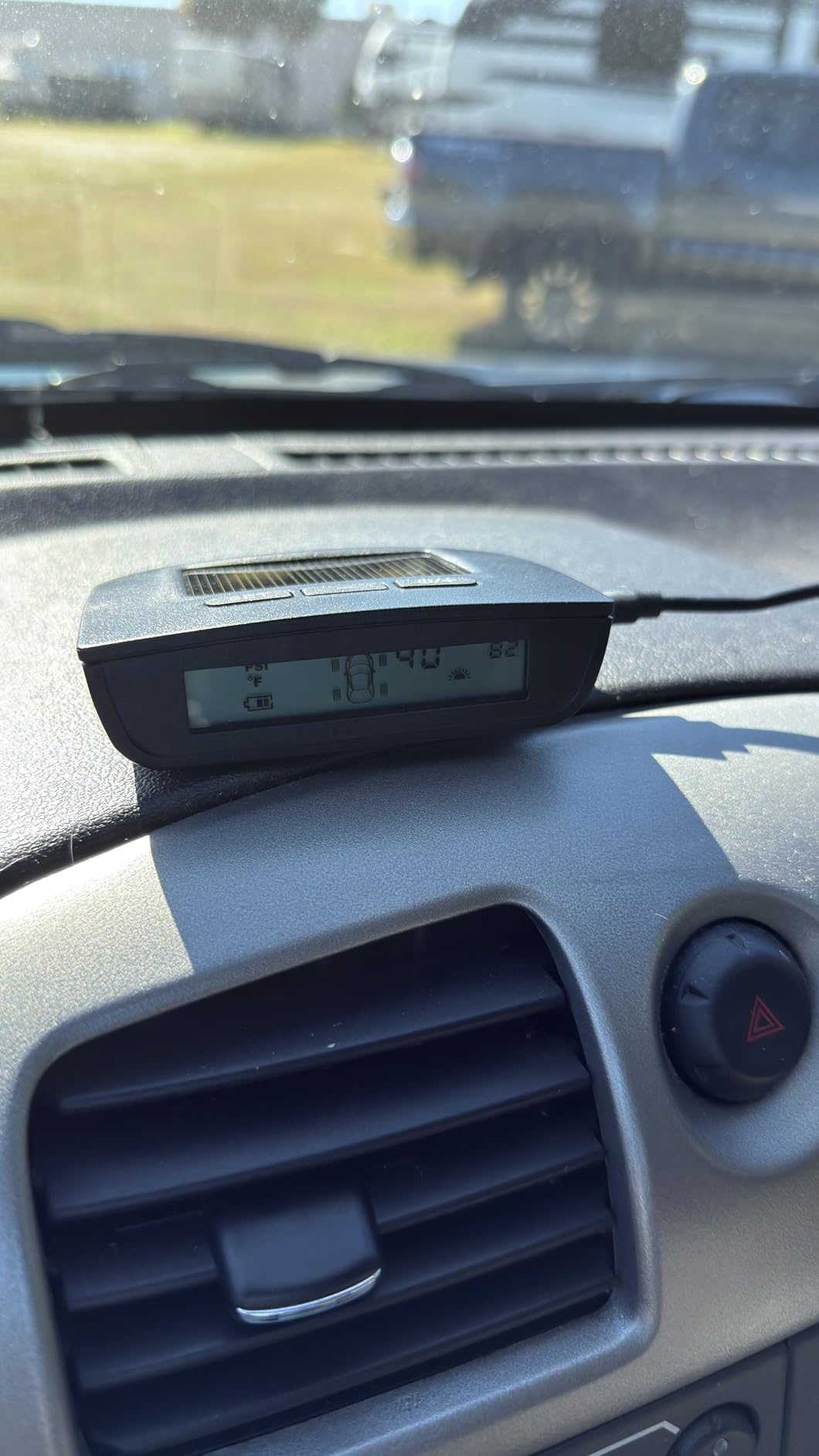
The review base is small, 34 ratings, but 61% are five star with no one-star ratings at all. Owners consistently favor the flow-through design for top-offs and the tight accuracy, and the most repeated criticism is the display in daylight.
Six alert modes cover low and high pressure, rapid leak, high temperature, sensor malfunction, and low battery. Operating range is -4 F to 185 F.
What plus or minus 1 PSI changes in practice
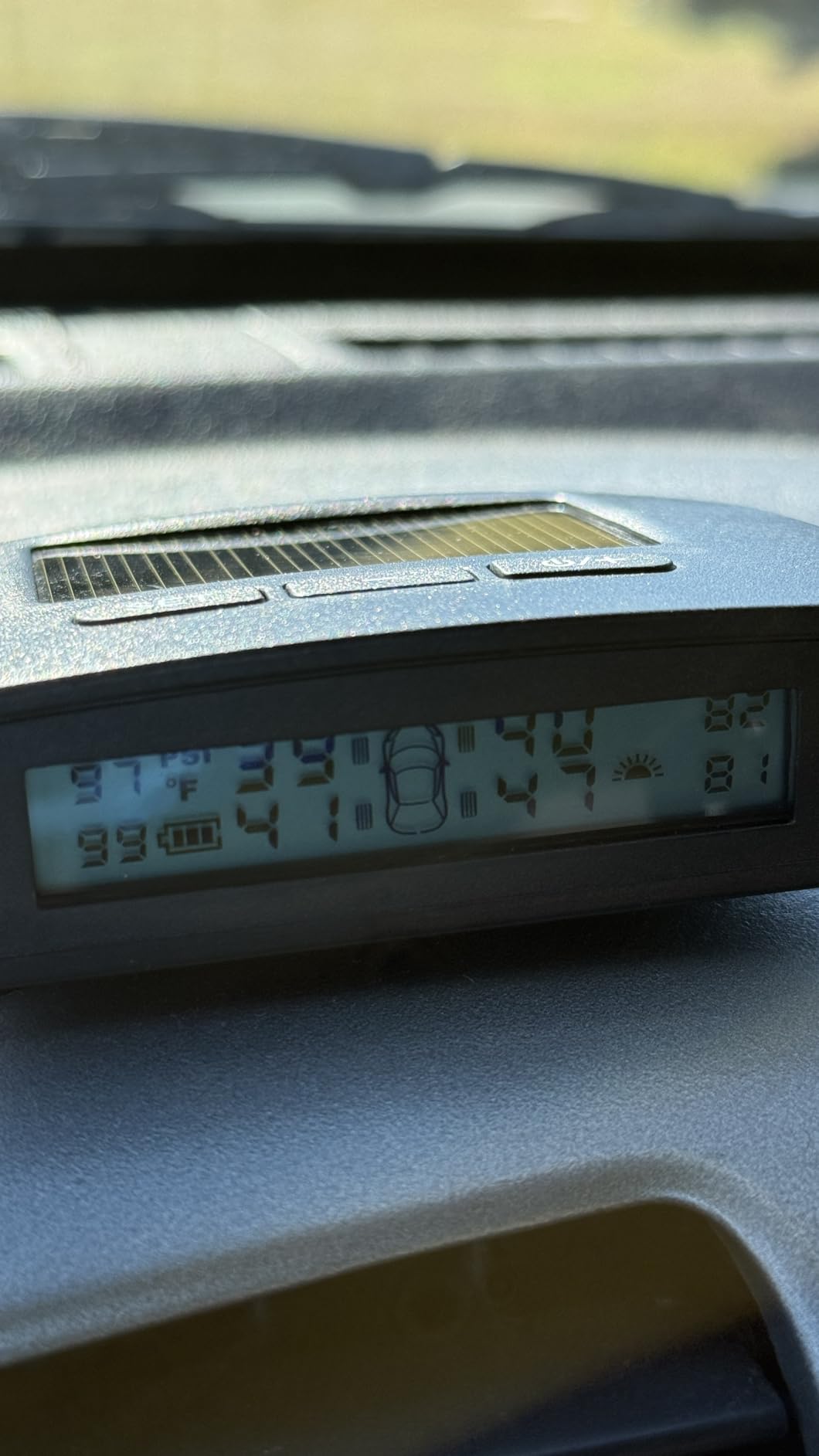
With a 2 PSI tolerance you are frequently a full alarm band away from a true reading, and you learn to ignore the alert. At 1 PSI the numbers line up with a calibrated truck gauge, which is exactly the comparison drivers describe making on The Truckers Report when they talk about whether a system works.
For a rig running at 100-150 PSI, that reliability is worth more than a larger screen.
Where it falls short
The display is hard to read in daylight and has no brightness adjustment, which is a genuine problem for a windshield-mounted unit. The low-pressure alarm is very loud and continues until you mute it manually, and it can fire when you remove a sensor to inflate.
Allow 5-10 minutes after a restart before all tire data populates, and note that flow-through sensors will not work on very short or rubber valve stems.
8. Taimster M14FT 10-Sensor Flow-Thru Solar TPMS – Best Flow-Thru Value with Solar Power
Taimster Trailer Tire Air Pressure Monitoring System, 4.5″ Solar TPMS w/ 10 Flow Thru Sensors and Signal Booster,Long Sensing Distance, 6 Alerts Monitor for Semi Truck/RV/Camper/RV,0-188PSI
0-188 PSI
Plus or minus 1 PSI
Solar plus Type-C
4.5 inch LCD
130 foot booster
Pros
- Flow-through sensors in a 10-sensor kit
- 4.5 inch LCD at plus or minus 1 PSI accuracy
- Solar plus Type-C charging for up to 15 days
- Built-in booster reaches 130 feet
- Per-axle high and low alarm settings
- IP67 sensors with anti-theft locknuts
Cons
- Smallest review base here at 18 ratings
- Not recommended for short or rubber valve stems
- 13% of reviews are 3-star with no 2-star ratings
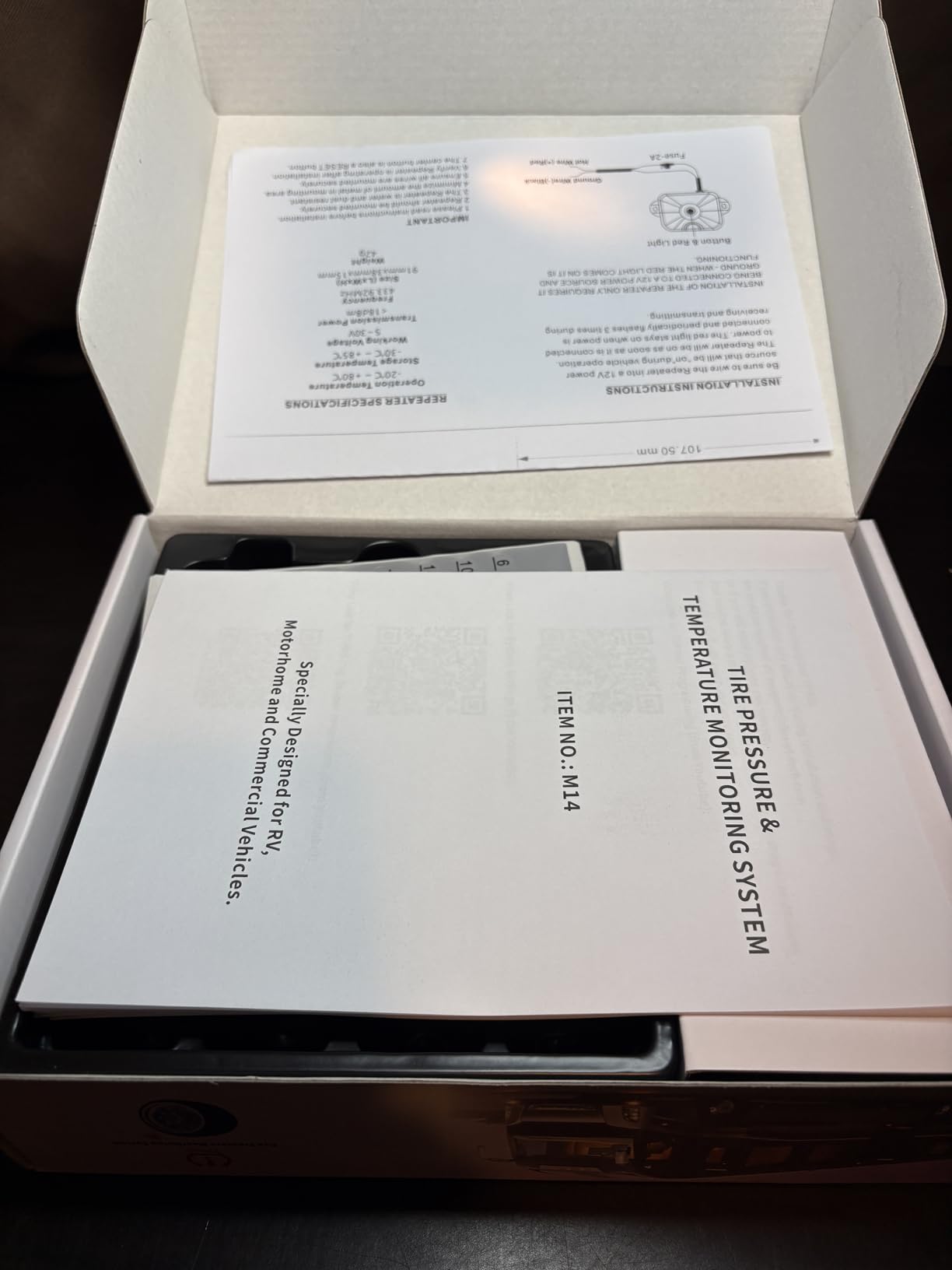
The M14FT is the combination few competitors offer: flow-through sensors, solar charging, and plus or minus 1 PSI accuracy in a 10-sensor kit. The 4.5-inch LCD reads 0-188 PSI with temperature, the booster holds transmission to 130 feet, and the display takes about three hours to four to charge and runs up to 15 days.
Independent high and low pressure alarm settings per axle mean you can set a tight band on the steer and a wider one on a lightly loaded trailer. The hidden trailer function lets you hide or restore trailer tire data without removing sensors, which keeps the screen readable when you are running light.
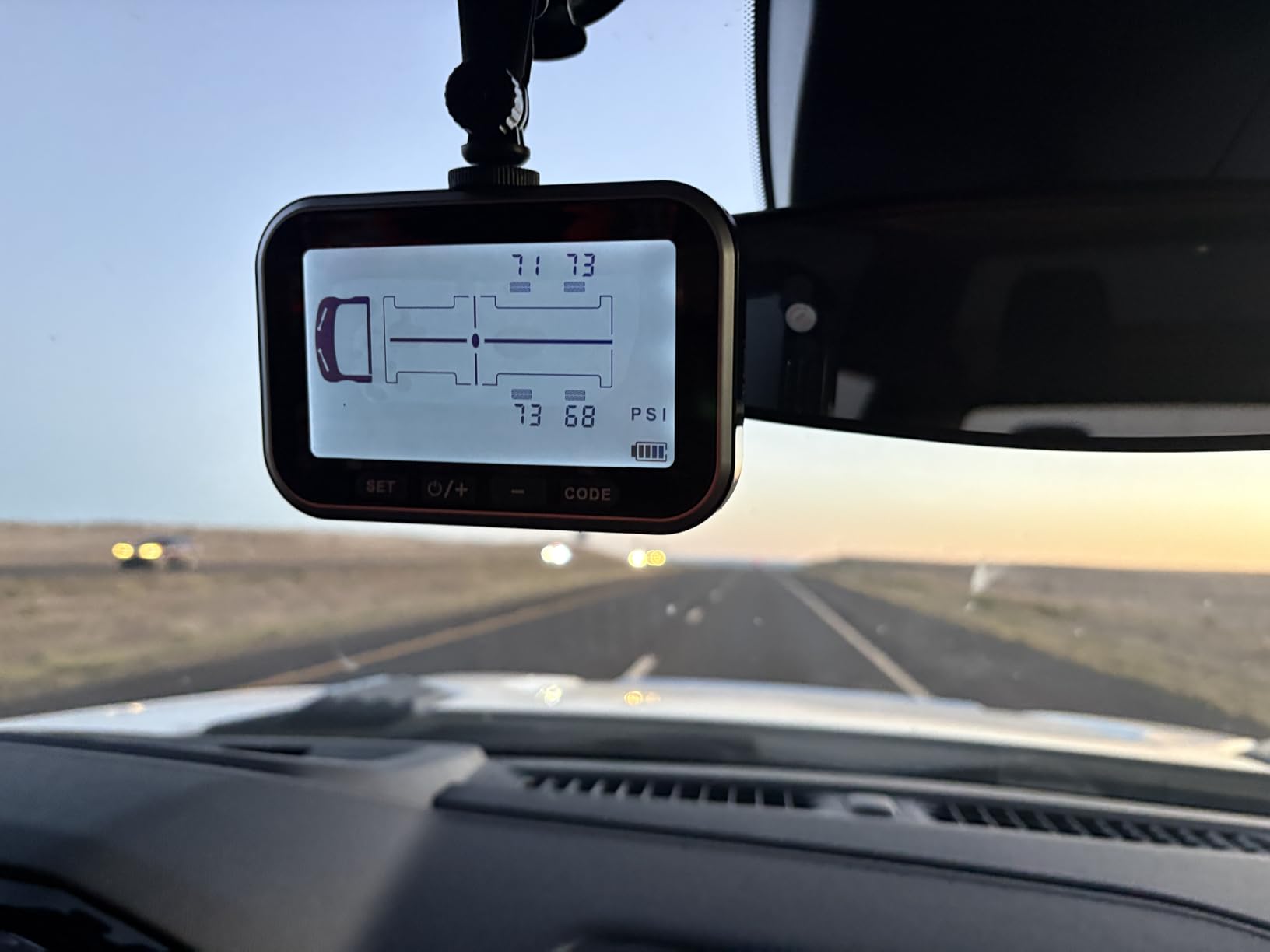
Eighteen ratings is a thin evidence base, and the distribution shows it: 69% five-star and 20% four-star with no 2-star ratings, but 13% three-star. Treat the 4.3 average as provisional rather than established.
What is documented is competitive on its face, with IP67 sensors, anti-theft locknuts, automatic pairing, and a sleep mode after five minutes parked. Operating range is -4 F to 185 F.
Where this fits the truck day
Per-axle thresholds are the quiet strength here. A tractor carrying a light trailer on a run does not need the same alarm band as a fully loaded rig, and adjusting by axle removes a lot of nuisance alarms.
Solar charging plus a 130-foot booster means the monitor can live in the cab without a cable and still read the back of a long trailer.
Where it falls short
Eighteen ratings is the smallest base in the comparison, so long-term reliability is not established. The 3-star share suggests mixed experiences that a larger sample would clarify.
Like the other flow-through designs here, it will not mount on very short or rubber valve stems.
9. Tyona TFS10F 6-Sensor Flow-Thru TPMS – Budget Pick with a 0-199 PSI Range
Tyona Tire Pressure Monitoring System, Truck TPMS RV Trailer tpms 0-199psi Thru Sensors 4.5-inch Color Screen, 6 Alarm Modes, Long-Distance Sensing, for Trucks, Motor Home (6 Flow Thru Sensors)
0-199 PSI
Under 1 PSI error
4.5 inch color screen
6 alarms
130 foot reach
Pros
- 4.6 average rating with no one-star reviews
- Flow-through sensors allow inflation through the sensor
- 0-199 PSI range among the widest here
- Auto-brightness screen readable in sunlight
- Per-axle alarm values set by vehicle load
- About 30 hours of use per 5-hour charge
Cons
- Flow-through sensors need metal valve stems
- Monitor finish reads as cheap to some buyers
- Screen layout suits a truck more than a trailer
- Bulky sensor bodies and awkward anti-theft wrench
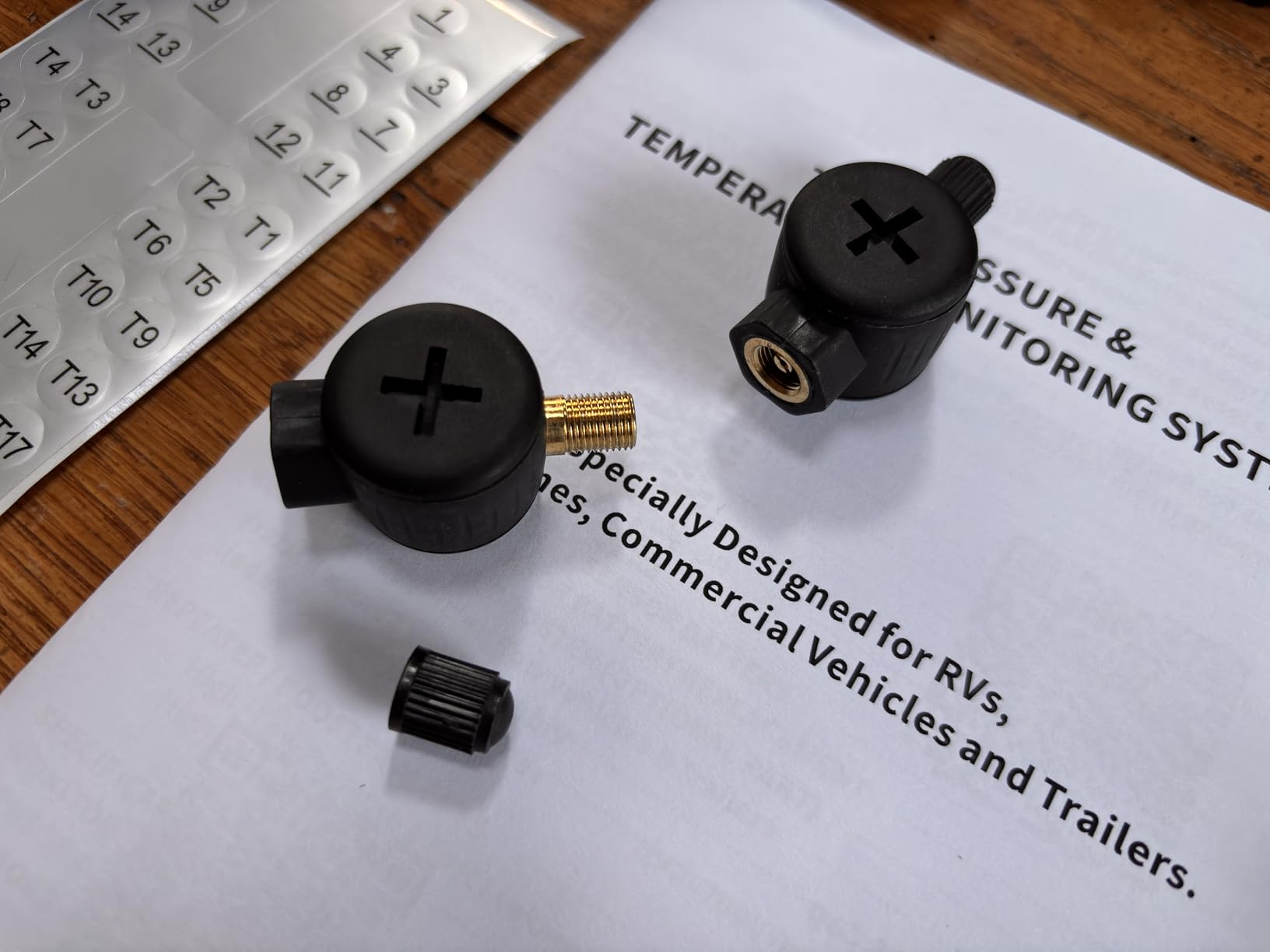
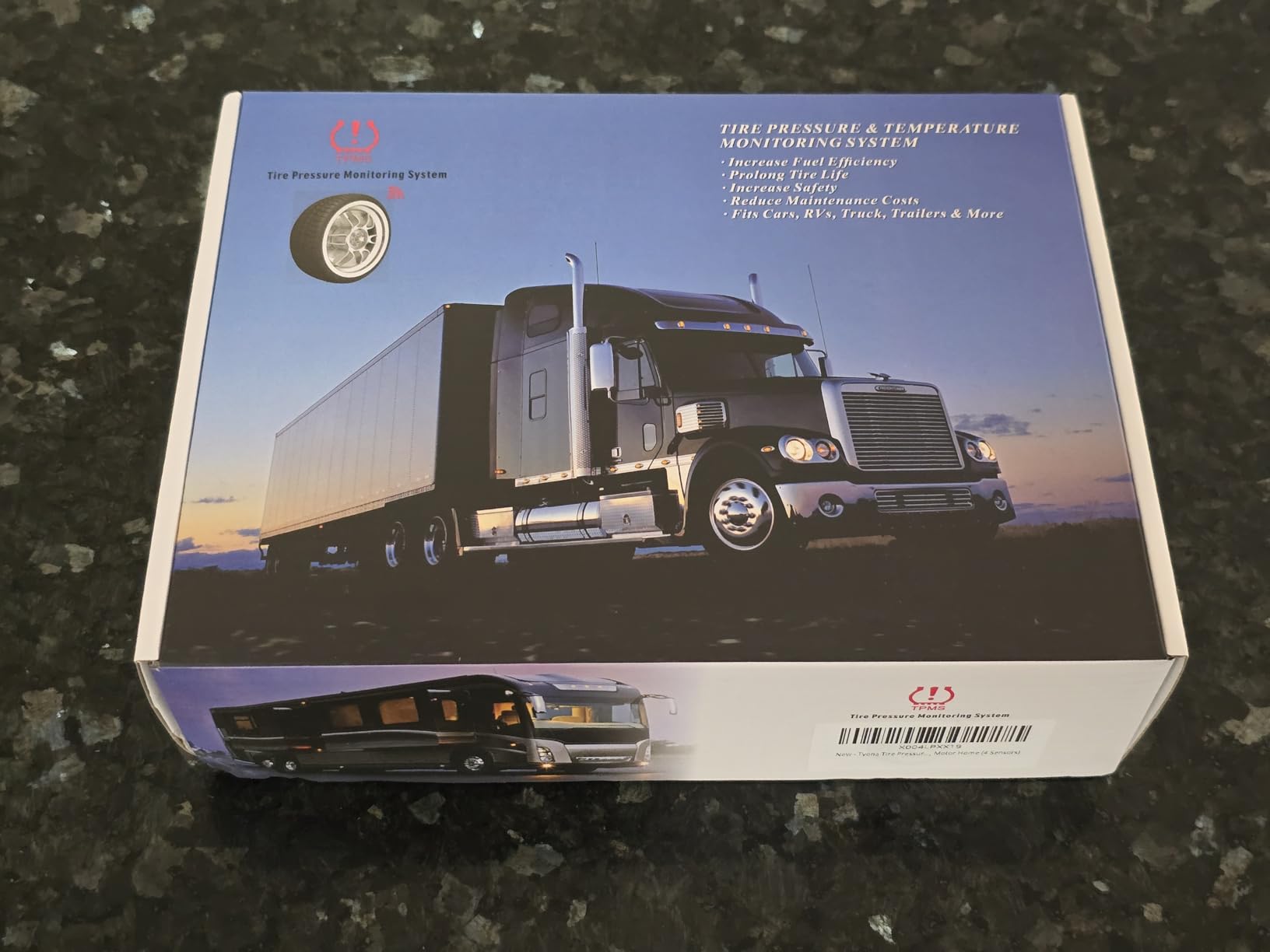
The Tyona is the entry point that still does the truck-specific things right. It reads 0-199 PSI with sensor measurement error under 1 PSI, works across vehicle bodies up to 130 feet, and runs six alarm modes covering high and low pressure, high temperature, rapid air leakage, sensor data loss, and low sensor power.
The 4.5-inch color screen has a photosensitive chip that auto-adjusts brightness to ambient light, which solves the daylight readability complaint that sinks several competitors. Separate high and low alarm values are settable per tire row according to vehicle load, and the rechargeable lithium battery gives about 30 hours of use after roughly five hours of Type-C charging.
Nineteen ratings, but a clean distribution: 4.6 average with 70% five-star and zero one-star. Truck and semi operators single out the 0-199 PSI range, the 130-foot reach, and the per-load alarm settings, and multiple owners confirm the flow-through sensors did not leak through heavy rain.
The warranty is two years, shorter than the three-year coverage on the TST 507 and the TireMinder A1AS.
What you get for the entry spend
The spec sheet here would look out of place on a mid-range unit: sub-1 PSI error, a 0-199 PSI ceiling, auto-brightness, and per-axle thresholds. If you are equipping a straight truck or a single trailer and want flow-through serviceability, this covers the essentials.
Flow-through sensors mean no pulling caps to add air, and the photosensitive screen is genuinely useful on a sunlit dashboard.
Where it falls short
The sensors require metal valve stems, and converting rubber stems on an older rig is a real added cost. The sensor bodies are bulky, and the supplied anti-theft wrench is awkward to work with.
The monitor finish reads as cheap to some buyers, the screen layout looks like a truck rather than a trailer, and the 2-year warranty is the shortest here.
How to Choose a Truck TPMS
Five decisions separate a system that works on a rig from one that frustrates you within a month. Go through them in this order and most of the wrong options eliminate themselves.
1. Count every tire you actually need to monitor
A tractor is 10 or 18 tires depending on the axle layout. A tri-axle trailer is six. A combination can be 16, 18, 22, or more positions, and a hot-shot operation splitting trailers between trucks can be higher. Count the tires on the rig, not the tires on one asset.
A four-sensor kit is a car kit. If your display tops out at 10 tires on one page, you are paging constantly on a full combination. Systems in this comparison range from 10 up to 34 monitored positions, and several run more sensors than the page shows, so you can expand without new hardware.
2. Check the PSI ceiling before anything else
Steer and drive axles on an 18-wheeler commonly run 100-150 PSI cold. Any kit capped at 87 PSI, which is common in passenger-car TPMS, is not merely inaccurate on a truck steer axle, it is dangerous. Read the ceiling on the sensor spec, not on the marketing description.
Systems here run 0-188 PSI or 0-199 PSI. Accuracy matters alongside the ceiling: plus or minus 1 PSI and plus or minus 2 PSI tolerances produce visibly different alarm behavior once you start setting thresholds at 5 PSI bands.
3. Pick a sensor mount for how your wheels are built
External cap sensors screw onto the valve stem and install in minutes, but they come off every time you add air, and they are exposed to theft. Internal band sensors are banded inside the wheel and need a tire shop, but they are theft-proof and survive rotation better. Flow-through sensors are the middle ground: you inflate through the sensor without removing it, and they still need metal valve stems.
On dual-wheel axles, the deciding factor is usually inside-valve access. If your inner valve is hard to reach, a flow-through design removes the most frequent task on the axle.
4. Plan for signal range across the combination
Whether a tractor-mounted receiver picks up trailer tire sensors is the single most cited doubt among drivers. The honest answer is that it depends on the receiver position, the metal around it, and the length of the rig. Boosters, the small repeater units included with most of these systems, are what close the gap on long combinations.
Check the published booster range, between 100 and 164 feet across the systems here, and follow the placement guidance. Mounting a booster directly against a large metal panel is the most common reason trailer tires report intermittently.
5. Match the display to your alerts
Pressure alarms are table stakes. Fast-leak and high-temperature alarms are what catch a failing retread casing before it lets go. Sensor low-battery and lost-signal warnings matter for a fleet, because a dead coin cell should be a scheduled swap rather than a roadside discovery.
Thresholds configurable per axle beat a single global setting, because a steer axle at 120 PSI and a lightly loaded trailer at 85 PSI should not share the same alarm band. Then decide between a standalone in-cab display and a cellular fleet platform, since the latter adds reporting across drivers and vehicles at a different cost structure.
What Drivers Report in the Field
Forums carry the field evidence that spec sheets do not. On The Truckers Report, a driver running WABCO IVTM integrated vehicle tire pressure monitoring on a PACCAR reports it works perfectly, which is the ceiling for an OEM-integrated system. Another driver installed a Doran 360HD a couple of months back, calls it a working device, and puts its field accuracy at plus or minus 2 PSI.
That plus or minus 2 PSI figure is worth sitting with. It is the number most drivers compare against their own truck gauge, and it is a useful benchmark when you read the accuracy claims in this comparison.
The most common thread across driver discussions is doubt about signal reach to trailer tires, plus the practical reality that coin-cell batteries on cheaper sensors usually last about a year, so drivers buy 10-packs and expect to re-pair. Small-fleet operators on r/HotShotTrucking, running roughly 10 trailers and about 15 drivers, specifically want one system that works across trucks and trailers rather than a different unit per asset. None of the nine systems here is a fleet telematics platform, which is the honest limit of this list.
What a Truck TPMS Does Not Do
A TPMS does not replace the pre-trip inspection. Several drivers on The Truckers Report still run a gauge, a tire hammer, and spoke-bolt checks every few hours, and the skeptics make a fair point: truck gauges can drift, and a sensor reading is a comparison against a threshold you set, not against the placard.
It also does not solve the measurement problem it appears to. Truck tire pressure should be read cold, because pressure rises with heat, and a hot reading is always higher than the cold placard value. A system that shows a steer tire climbing during a long climb is telling you something real, but it is not telling you the tire is overinflated.
What a TPMS genuinely does is watch every tire continuously instead of once per walk-around. That is how you catch a slow leak in an inside dual that never gets inspected, and a heat event on a retread casing before it becomes a roadside failure. Pair it with a calibrated truck gauge and the hammer routine, and it is the cheapest part of your safety equipment. For cab-facing coverage, our truck dash cam guide handles the other end of the windshield.
Frequently Asked Questions
What is the best tire pressure monitoring system for semi-trucks?
The GUTA GT30 is the best general choice for semi-trucks because it shows 10 tires per page, reads up to 188 PSI, and covers pressure, temperature, fast leak, missing signal, and low battery alerts. For dual-wheel axles where the inside valve is hard to reach, the GUTA GT80 flow-through sensors let you add air without removing them.
Which TPMS is better, internal or external?
For a truck, flow-through sensors are the best balance: they mount externally like cap sensors so you can install in minutes, but you inflate through them instead of pulling them off. Internal band sensors are theft-proof and survive tire rotation, but they need a tire shop to install. Cap sensors are the cheapest and fastest to fit, and the least convenient on dual wheels.
Do I need a signal repeater for a truck TPMS?
On a 53-foot combination, yes. A tractor-mounted receiver may reach the trailer tires, but drivers report intermittent readings, and the included booster is what closes that gap. Look for published booster range, which runs from 100 to 164 feet across these systems, and mount it away from large metal panels.
How many tires can one TPMS monitor?
It depends on the system. Display capacity and sensor capacity are different numbers, and the systems in this comparison range from 10 tires on one page up to 34 supported across multiple trailers. A tractor plus tri-axle trailer is 22 positions, so count every tire on the combination before choosing.
Does TPMS replace the pre-trip inspection?
No. A TPMS watches every tire continuously, but it compares against a threshold you set rather than the placard, and truck gauges can drift. Drivers still run a gauge, tire hammer, and spoke-bolt checks on a schedule. The system catches what a walk-around misses, such as a slow leak in an inside dual.
What PSI range do truck TPMS sensors need?
Steer and drive axles on an 18-wheeler commonly run 100-150 PSI cold, so a kit capped at 87 PSI, which is common in passenger-car TPMS, is unsafe on a truck. Look for a 0-150 PSI ceiling or better, and check the accuracy tolerance, because plus or minus 1 PSI and plus or minus 2 PSI behave very differently at narrow alarm bands.
The Bottom Line
The GUTA GT30 is the best tire pressure monitoring system for trucks overall, with a 10-tire page, a 188 PSI ceiling, five alert modes, and 617 ratings behind it at 4.4 stars. Dual-wheel operators should take the GT80 for flow-through serviceability, tight-tolerance readers should look at the NLNE, and anyone who values a warranty and included spare batteries gets the most from the TireMinder A1AS.
Whatever you pick, verify the metal valve stems, position the booster away from body panels, and keep the gauge and the tire hammer in the cab. Recheck thresholds after any load change, and treat 2026 as the year to stop debating whether a 2 PSI drop on an inside dual is worth catching.