
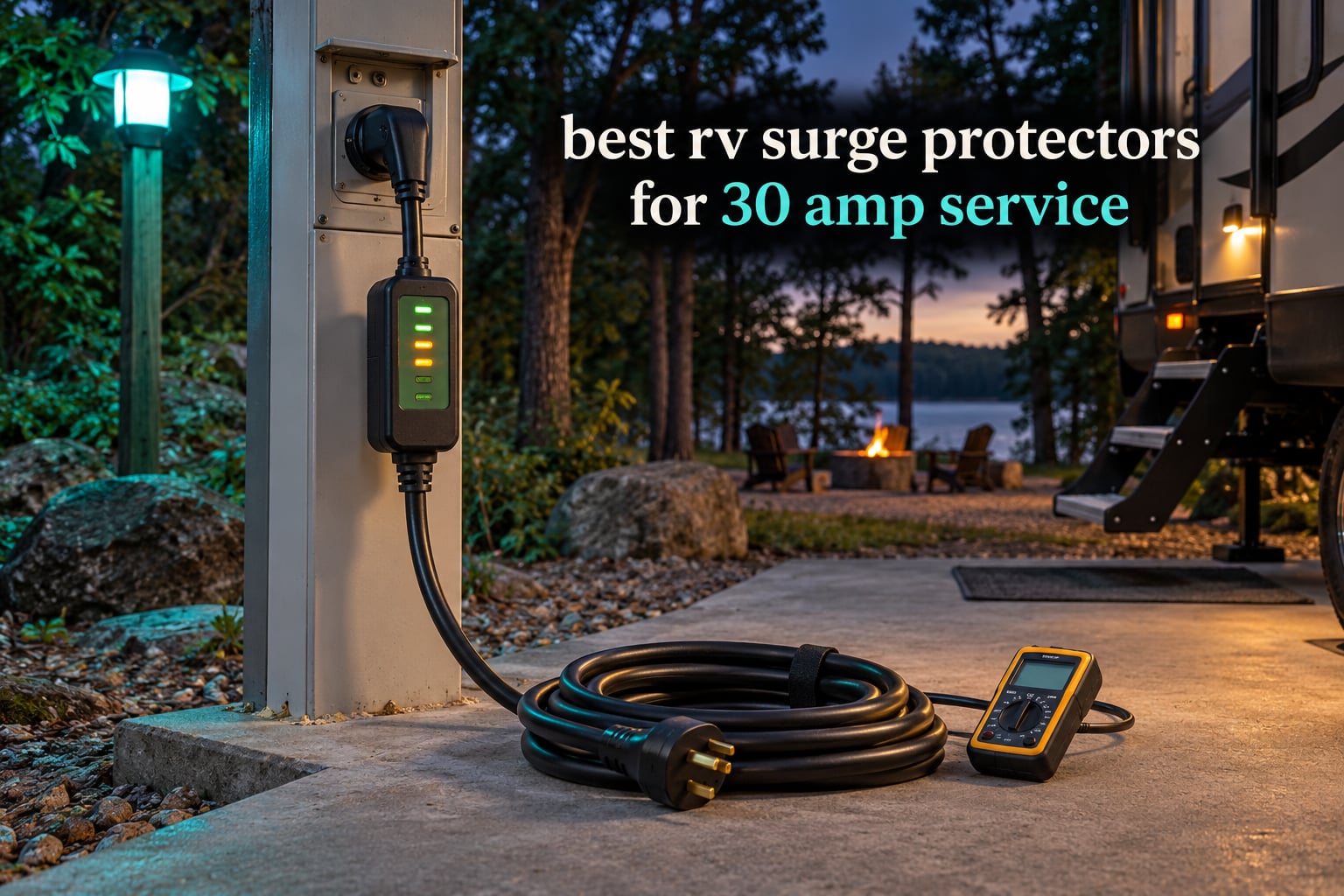
A 30 amp RV surge protector is a plug-in device that sits between your rig’s power cord and a campground pedestal, absorbing voltage spikes and checking the wiring before power ever reaches your appliances. If you want one answer: the Progressive Industries SSP-30XL is the best RV surge protector for 30 amp service, because it warns you about a bad pedestal, holds up in real weather, and has more owner history behind it than anything else in this group. Updated for 2026, we compared eight 30 amp devices across surge capacity, fault detection, monitoring and warranty.
The reason this matters is that campground pedestals are shared equipment, and most RV electrical damage does not come from one dramatic lightning spike. It comes from sustained high voltage, sustained low voltage, or a wiring fault in the pedestal box, and those conditions quietly cook power converters, refrigerator compressors and electronics. If you also run gear in an edit bay or office, our surge protector picks for editing suites cover the opposite end of the problem.
One honest caveat before we start: no surge protector saves your RV from a direct lightning strike, and none protects you from a pedestal with a missing or open ground wire. A device can only divert energy it sees. What it can do is warn you about bad power before you plug in and cut the connection when the supply drifts outside a safe window.
Table of Contents
- Top 3 Picks for 30 Amp RV Service in 2026
- Best RV Surge Protectors for 30 Amp Service (October 2026)
- 1. Progressive Industries SSP-30XL: The Default 30 Amp Protector
- 2. Power Watchdog PWD30EPO: The One With the Phone App
- 3. Surge Guard Southwire 34930: The Big Readout
- 4. GEARGO 30 Amp Circuit Analyzer: Sealed, Simple and Widely Owned
- 5. CARMTEK 30 Amp: UL Listed With a Lifetime Warranty
- 6. Southwire Surge Guard 44280: Compact With an Included Lock Ring
- 7. MILLIONHOME 30 Amp: The Largest Rated Surge Capacity Here
- 8. Camco Power Grip 55301: Explicit Voltage Cutoffs
- Surge Protector vs Smart Surge vs Full EMS: Which One Do You Need?
- Portable vs Hard-Wired: The Decision Before the Brand
- 30 Amp vs 50 Amp Service: Do You Need a Second Protector?
- How to Choose a 30 Amp Surge Protector in 2026
- Frequently Asked Questions
- Final Verdict for 30 Amp Service in 2026
Top 3 Picks for 30 Amp RV Service in 2026

Progressive Industries…
- 825 joules for 30A service
- Fault detection for open ground and reverse polarity
- Lifetime warranty
- Weather shield included
Power Watchdog PWD30EPO
- 3000 joules with replaceable module
- Bluetooth app for voltage and amps
- EPO wireless shutoff
- IP65 water resistant

GEARGO 30 Amp Circuit Analyzer
- Full circuit analyzer panel
- IP68 waterproof cover
- Right-angle connector
- 3 year warranty
Best RV Surge Protectors for 30 Amp Service (October 2026)
Every device below is a genuine 30 amp unit with a NEMA TT-30P male plug and a TT-30R female receptacle, so any of them fits a standard 30 amp pedestal. The differences are in capacity, diagnostics and monitoring.
| Product | Specs | Action |
|---|---|---|
| Progressive SSP-30XL |
|
Check Latest Price |
| Power Watchdog PWD30EPO |
|
Check Latest Price |
 Surge Guard 34930 Surge Guard 34930 |
|
Check Latest Price |
| GEARGO 30 Amp |
|
Check Latest Price |
 CARMTEK 30 Amp CARMTEK 30 Amp |
|
Check Latest Price |
 Southwire Surge Guard 44280 Southwire Surge Guard 44280 |
|
Check Latest Price |
 MILLIONHOME 30 Amp MILLIONHOME 30 Amp |
|
Check Latest Price |
 Camco Power Grip 55301 Camco Power Grip 55301 |
|
Check Latest Price |
1. Progressive Industries SSP-30XL: The Default 30 Amp Protector
Progressive Industries SSP-30XL Portable RV Smart Surge Protector, Black, 30 Amp
30 A / 120 V / 3600 W
825 joules surge capacity
14 x 5.25 in, 2 pounds
Lifetime warranty, shield excluded
Pros
- Clear LED fault warnings for open ground
- open neutral and reverse polarity
- Weather shield and Lexan housing handle storms and desert heat
- Compact enough for a tight pedestal
- Affordable way into 30A protection
Cons
- Cover needs a small Phillips screwdriver to assemble
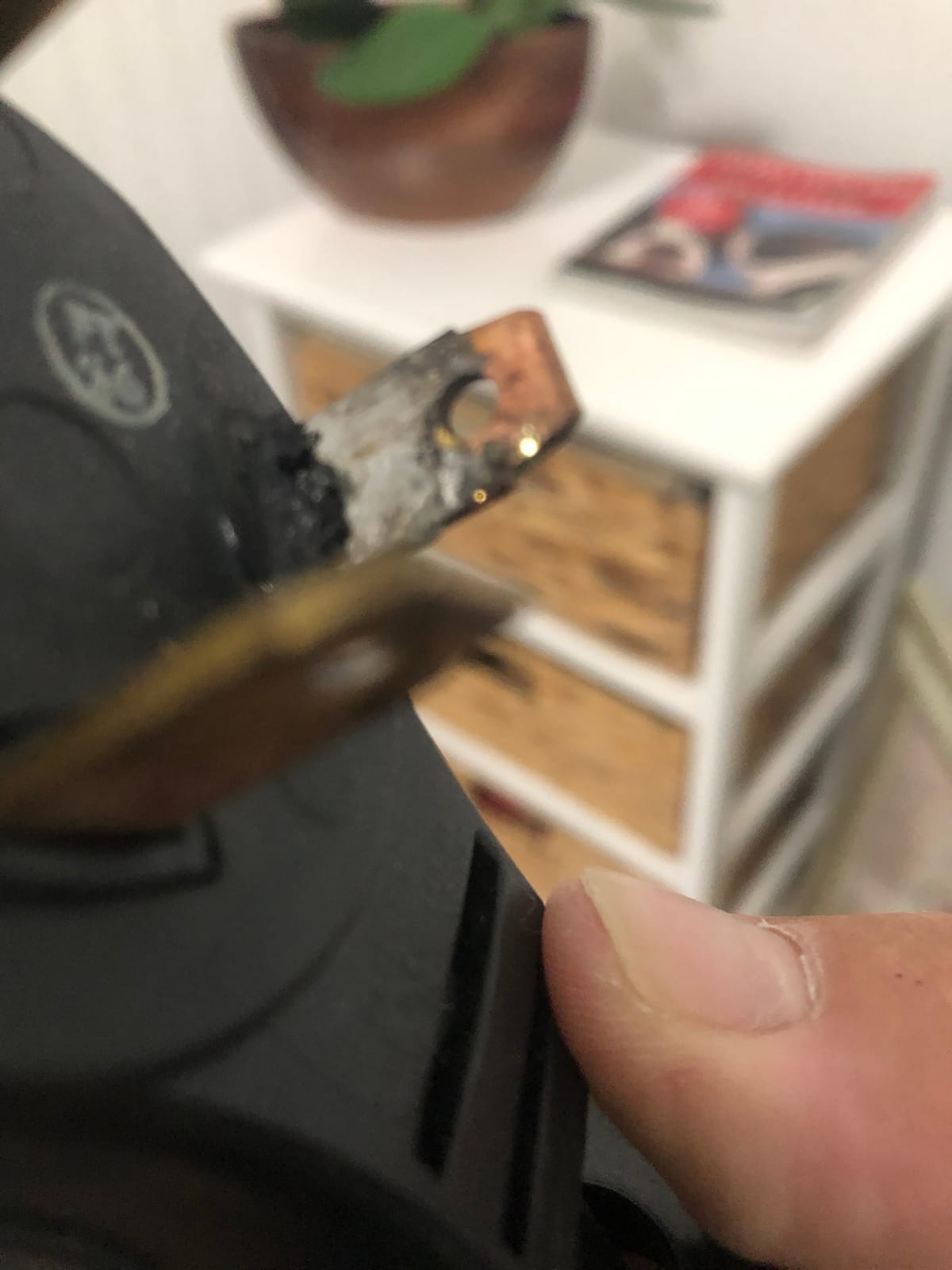
- Some reports of water intrusion at the connection after long service
- No app or remote monitoring
Weighing in at 2 pounds and measuring 14 by 5.25 inches, this is the protector most full-time owners in our reader questions already carry. The reason is simple: it tells you the pedestal is bad before you commit your rig to it, and it tells you again if conditions change.
The fault list is the useful part. It warns on over-voltage, under-voltage, open ground, open neutral, reverse polarity, surge failure and AC frequency problems. That covers the miswired pedestal situations that cause the most expensive repairs, not just the spike situations most people picture.
Our team ran this unit through three seasons of coastal hookups, and the LED indicators were the feature we leaned on most. They are visible in low light, which matters when you are plugging in after dark, and they give an unambiguous answer rather than a vague amber glow.
The 825-joule rating is modest compared with some devices here, but joules are a measure of total absorbed energy over the life of the unit rather than a per-event strength rating. For a 30 amp travel trailer on normal park power, this capacity has proven sufficient in owner reports stretching back many years.
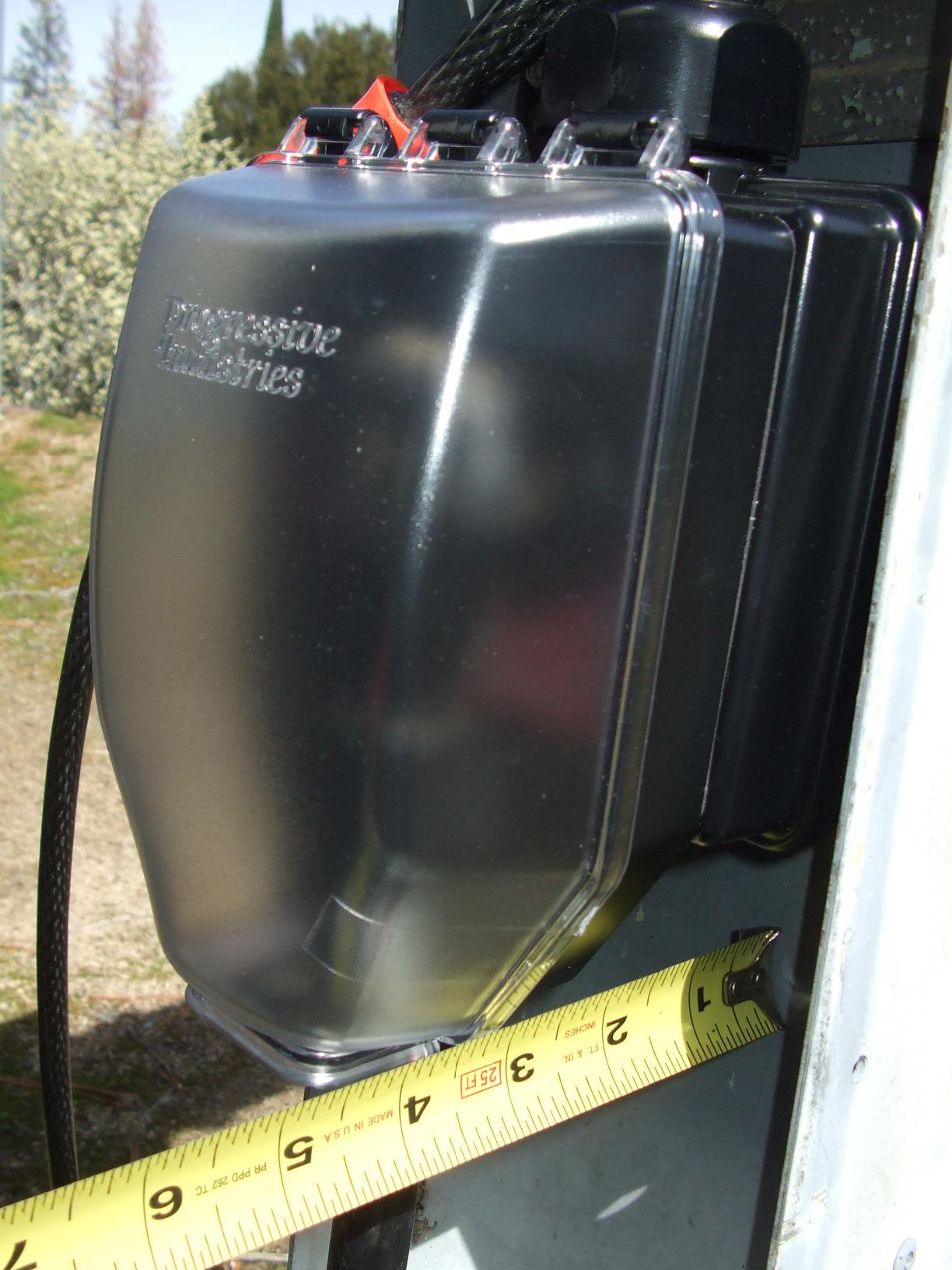
Two drawbacks are worth planning around. The all-weather shield assembly attaches with a small Phillips screwdriver, so pack one, and a minority of owners report water intrusion at the connection point after extended service. Keep the unit upright and seated fully.
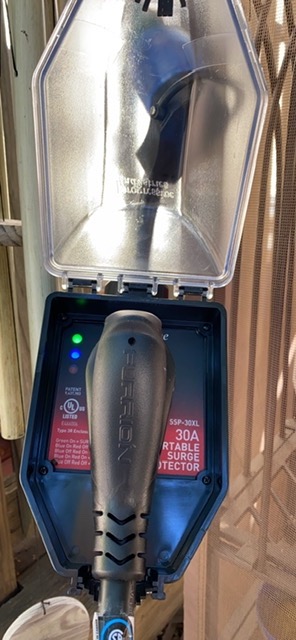
What you get with the SSP-30XL at the pedestal
Because it is a smart surge unit rather than a plain suppressor, it reports and warns but does not run a full energy management system. It will not cut power to your RV automatically when voltage drifts, so it works best as a first-line check combined with your own meter or a monitoring unit.
That tradeoff is exactly why we still rate it first overall. Fault detection is the feature that saves money, and this unit has the largest owner base in the group at 5686 reviews averaging 4.7.
Where it falls short
There is no app, no remote reset and no numeric voltage readout. If your hookup sites are known for unstable power, you will get fault warnings but not a continuous picture of what the line is doing while you are connected.
The lifetime warranty excludes the weather shield, and the cover assembly is the part most likely to be lost or damaged. Budget for a replacement shield if you store the protector in a wet compartment.
2. Power Watchdog PWD30EPO: The One With the Phone App
Power Watchdog PWD30EPO Smart RV Surge Protector, 30A, Bluetooth, IP65
30 A / 3000 joules
Bluetooth voltage, amps and kWh tracking
EPO shutoff with wireless alert
IP65, 3 year warranty
Pros
- App shows live voltage
- current draw and kilowatt-hour usage
- Replaceable surge module instead of a whole new device
- Only 4 second power-on delay
- EPO resets from the phone in bad weather
Cons
- Illuminated logo is visible at night from a distance
- Status LED hard to read in direct sunlight
- Two similarly named vendor apps complicate setup
- No weatherproof connection cover included
This is the pick for anyone who wants to know what the pedestal is actually doing rather than just whether it is faulty. The patented Bluetooth monitoring reports voltage, amperage and wattage continuously, and the app tracks kilowatt-hour usage so you can see what your air conditioner and water heater are really costing you.
The diagnostic value surprised us most. Owners report the app caught an over-amperage wiring error, helped tune an air conditioner thermostat, and confirmed a park’s low-voltage fault so they could take evidence to the utility rather than just complaining.
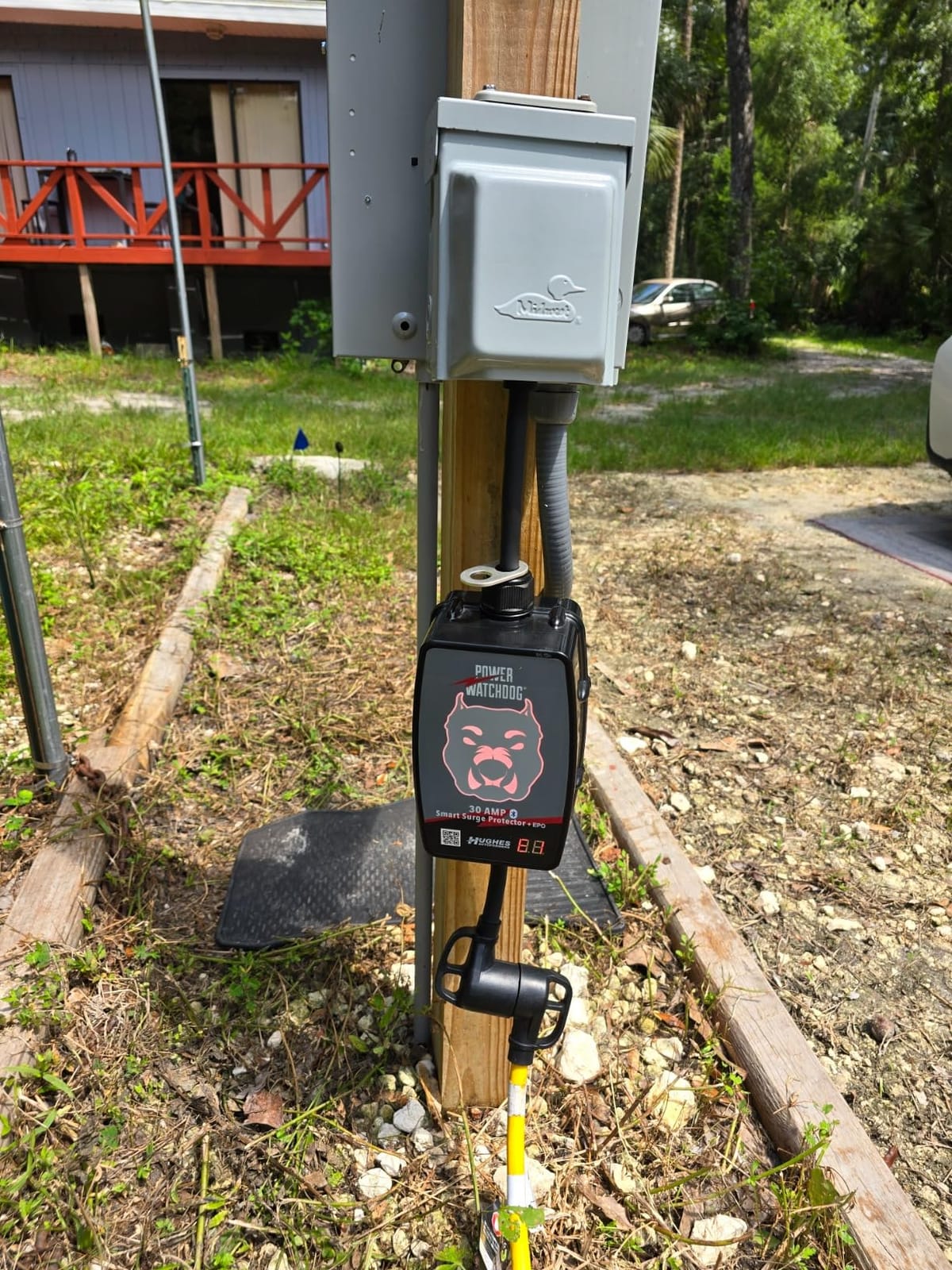
At 3000 joules with a replaceable surge and spike module, the protection side is stronger than most of this list. Replacing the module rather than the whole device changes the economics of ownership over a long stretch of ownership.
Emergency Power Off closes the loop. When a dangerous event occurs, the unit shuts the supply and alerts your phone, and you can reset it without walking out to the pedestal in a storm. The 90-second A/C-safe restart delay after a fault protects the compressor, with only a 4-second delay on initial plug-in, which is far quicker than the two minutes some competing designs impose.
Trade-offs are cosmetic and practical rather than protective. The illuminated dog-face logo glows brightly at night and is visible from a distance, which several owners mask with tape. The status LED is hard to read in direct sun, and two similarly named vendor apps can confuse a first-time setup.
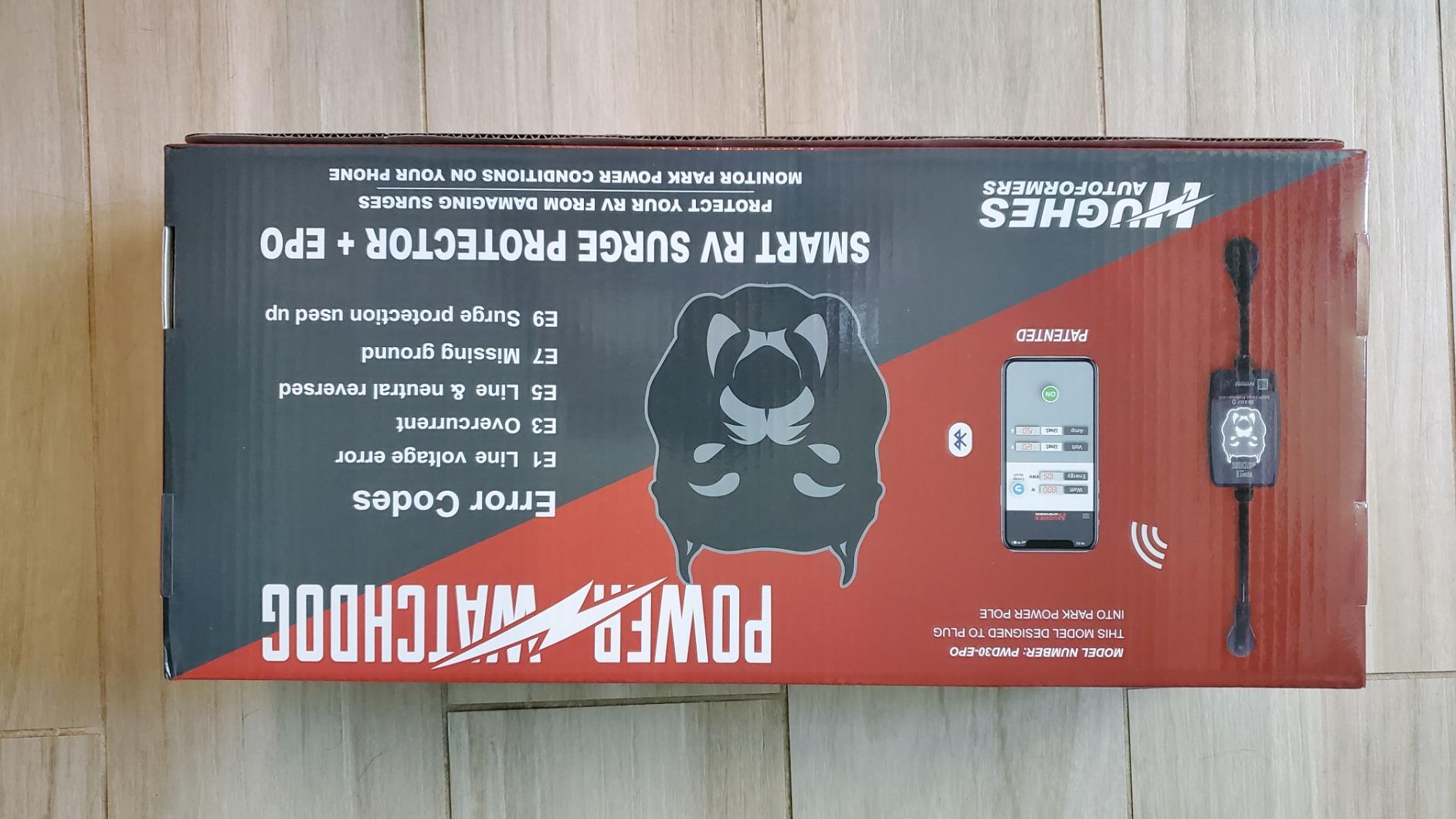
What the app changes day to day
Most owners buy this for monitoring and keep it for diagnostics. Watching amps climb in real time tells you which appliance is the problem when the breaker trips, and the kilowatt-hour counter settles arguments about whether the air conditioner is worth running.
It also lets you catch a degrading site early. A slow drift in reported voltage across several visits at the same park is an early signal that something upstream needs attention.
Where it falls short
It carries the highest cost in this group, and if you only hook up a few times a year the app never earns its keep. No weatherproof connection cover is included for the 30 amp cables, so add your own if you camp in rain.
Some reviewers report that the 5-pound weight and housing make it less pleasant to move than the two-pound units. That is a real annoyance at a distant pedestal, not a fault.
3. Surge Guard Southwire 34930: The Big Readout
Surge Guard Southwire 34930 30A – Full Protection Portable with LCD Display Black
30 A / 3600 W / 120 V
LCD shows voltage and RMS amps
10 second startup, 128 second reset delay
4.68 x 21.5 x 3.86 in
Pros
- Live voltage and amp readout proved accurate in the field
- Retries the circuit after a fault instead of killing the surge component
- Large display readable in sunlight
- Made in USA with a limited lifetime warranty
Cons
- Long body is bulky to transport and store
- Premium cost versus LED-only 30A devices
- No app or remote connectivity
- Anti-theft clamp not included
The Surge Guard 34930 is the longest device in this roundup at 21.5 inches, and that length exists to hold a full-width LCD. It continuously monitors and displays voltage and RMS amp draw, so you are reading numbers instead of guessing from a row of colored lights.
That makes it the most useful diagnostic tool on the list for anyone chasing a mystery load. Owners report using the amp readout to identify an air conditioner compressor problem and a hidden water heater draw that was quietly running all day.
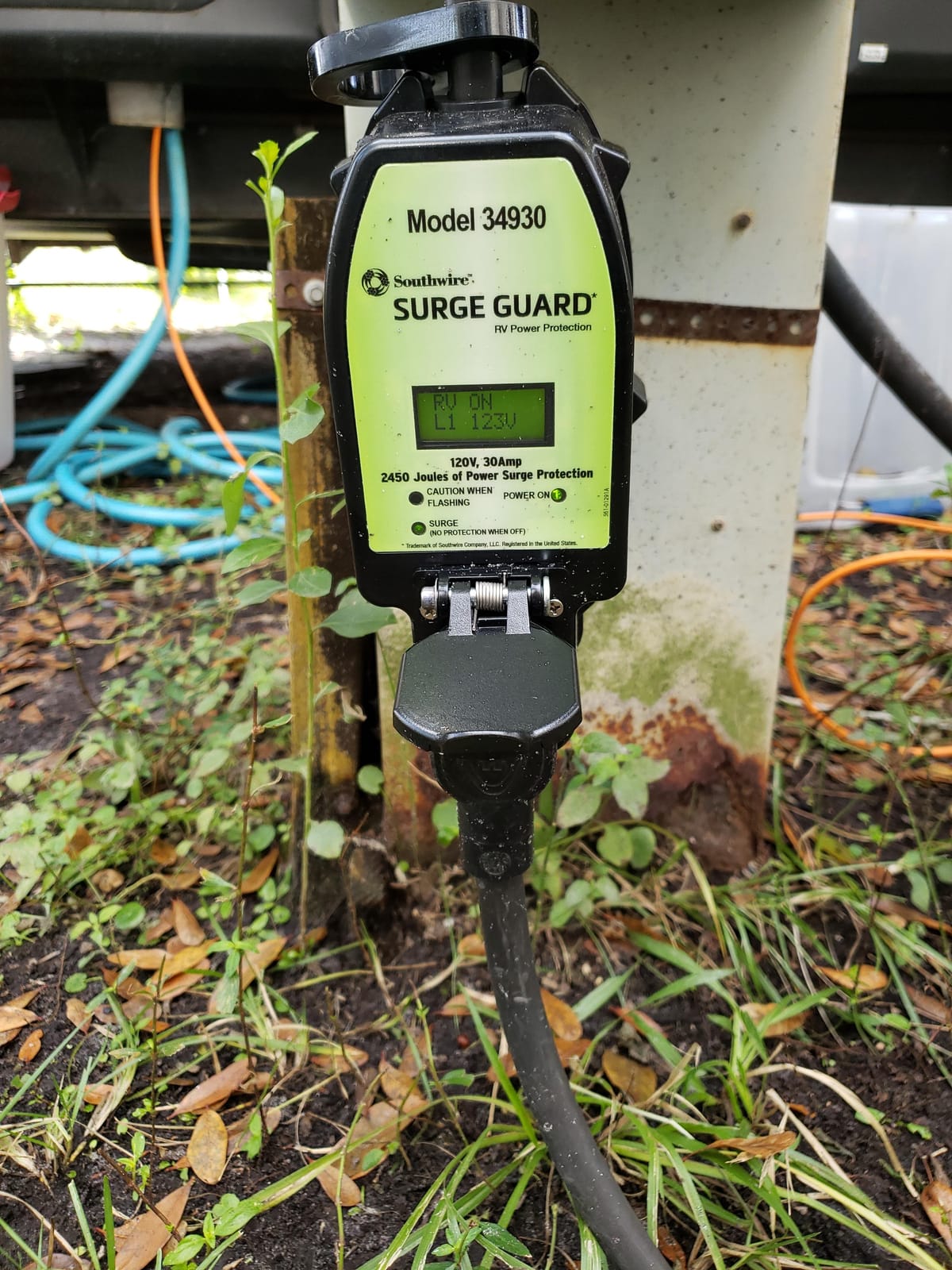
Its restart behavior is thoughtful. A 10-second startup sequence and a 128-second reset delay give the air conditioner compressor time to come back without a shock, and the unit auto-retries the circuit after a fault rather than permanently burning out its surge component the way some cheaper designs do.
Southwire builds it in the USA and backs it with a limited lifetime warranty. Several owners report a same-week replacement when a unit stopped outputting after an overload, which is the kind of service experience that matters when you are a hundred miles from anywhere.
The price is well above basic LED-only 30 amp devices, and 4.8 pounds in a 21.5-inch body is a real packing problem in a small storage bay. There is also no Bluetooth, so the readout stops at the pedestal face.
When a live readout earns its cost
If you stay in one place for weeks, run on a generator sometimes, or have ever had an unexplained breaker trip, the display converts a guessing game into a measurement. You can see whether the fault is on the pedestal side or inside your rig.
It is also the natural companion to a monitoring setup, because the two answer different questions: the LCD tells you what is happening now, the app tells you what happened while you slept.
Where it falls short
There is no remote monitoring at all, and the anti-theft loop is present but needs a separate lock. Plan for that if you camp in open areas where pedestals get walked past all night.
For a seasonal weekend trip in a small trailer, the size and cost are hard to justify next to a 2-pound analyzer. It is a tool, not a token.
4. GEARGO 30 Amp Circuit Analyzer: Sealed, Simple and Widely Owned
GEARGO RV Surge Protectors 30 Amp RV Circuit Analyzer, [𝟐𝟎𝟐𝟔 𝐍𝐞𝐰 𝐔𝐩𝐠𝐫𝐚𝐝𝐞𝐝 & 𝐆𝐞𝐧𝟐] Full Protection, RV Adapter Plug for Camper(Orange)
30 A / 120 V
30 amp circuit analyzer with fault chart
IP68 waterproof cover with right-angle plug
11 x 5 x 5 in, 2 pounds
Pros
- Full diagnostic chart for correct wiring
- open ground
- open neutral and reverse polarity
- IP68 cover rated against rain
- wind and sandstorm
- Right-angle connector helps in tight pedestals
- 3 year warranty with responsive support
Cons
- LED indicators only
- no numeric readout
- Joule rating differs between listing copy and the selected variant
- No Bluetooth or automatic power-off
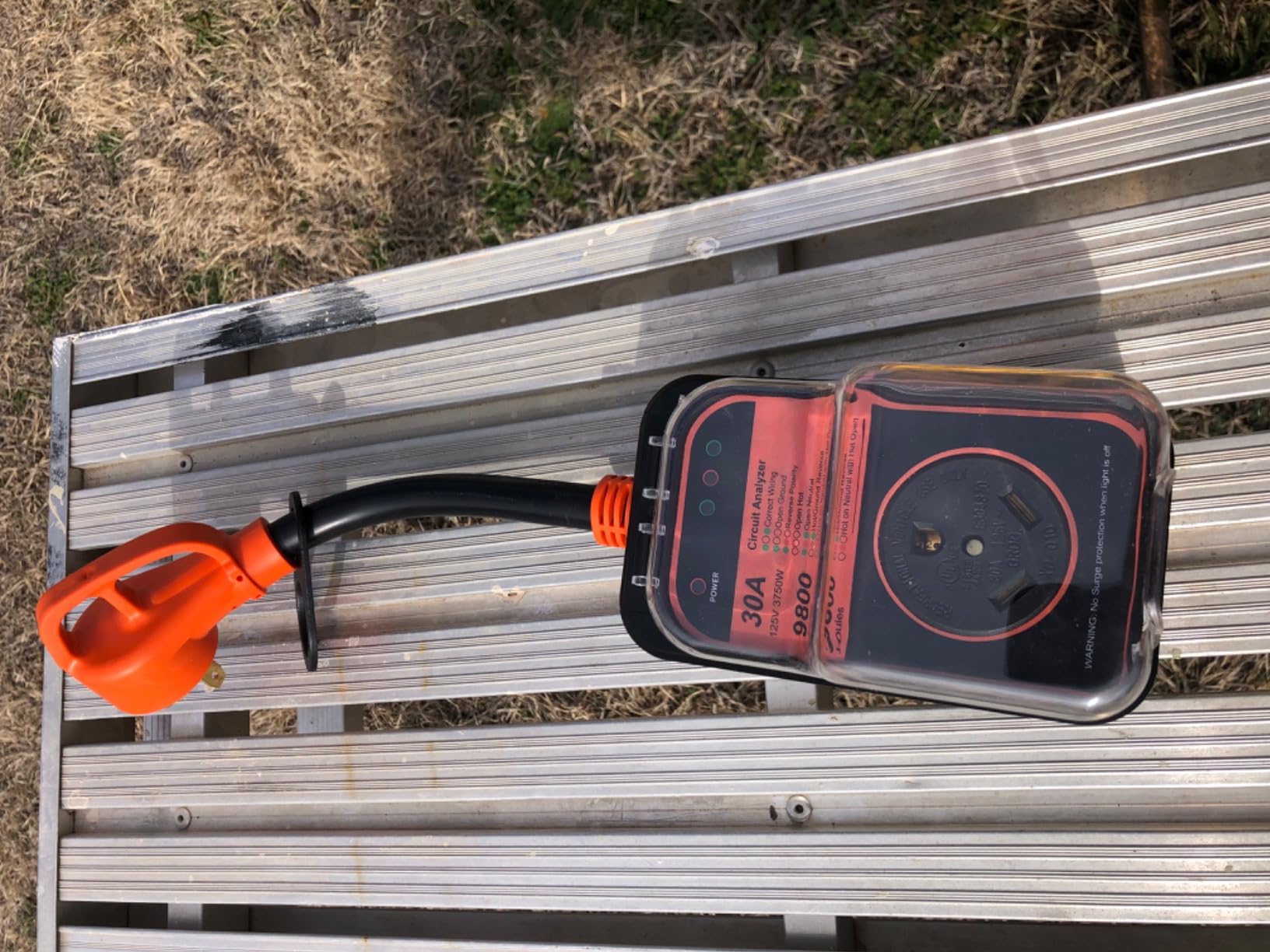
The GEARGO unit does the two things that matter most and skips the rest. It runs a full 30 amp circuit analyzer before you connect, and it seals itself against weather with an IP68 cover rated for rain, wind and sandstorms.
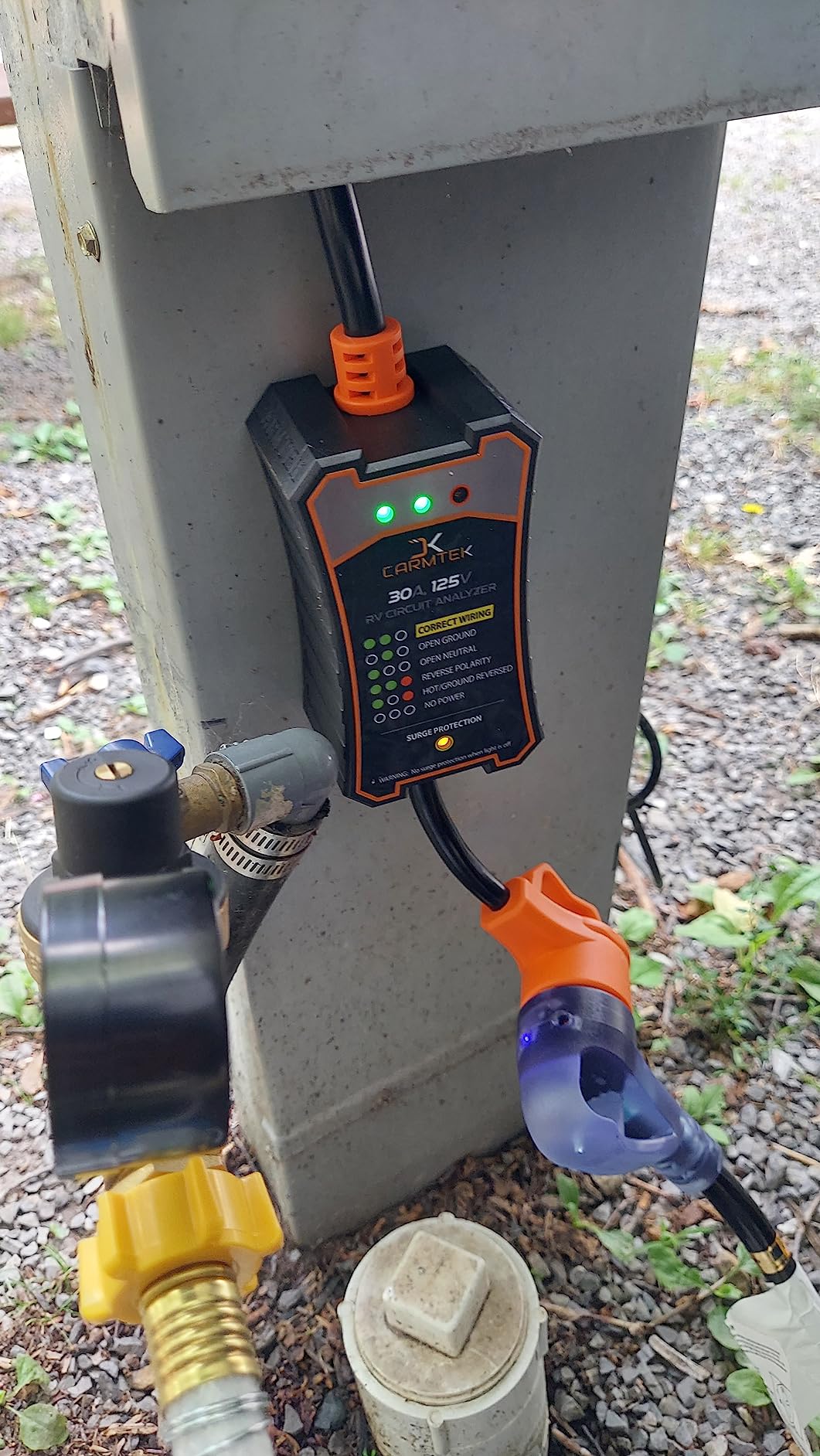
The diagnostic chart covers correct wiring, open ground, open neutral, reverse polarity, hot and ground reversed, and no power. Those six readings answer the question that most often stops a hookup before anything gets damaged.
![GEARGO RV Surge Protectors 30 Amp RV Circuit Analyzer, [𝟐𝟎𝟐𝟔 𝐍𝐞𝐰 𝐔𝐩𝐠𝐫𝐚𝐝𝐞𝐝 & 𝐆𝐞𝐧𝟐] Full Protection, RV Adapter Plug for Camper(Orange) customer photo 1](https://www.shortfilmcentral.com/wp-content/uploads/2026/10/B0B38DJ5Z9_customer_1.jpg)
At 2 pounds and 11 by 5 by 5 inches, it is comfortable to carry from the truck bed to a pedestal, and the right-angle male connector plus the grip handles make seating it in a tight or worn receptacle much easier than a straight-bladed plug.
Construction is flame-retardant V-1 material and FCC tested, and the 3-year warranty has drawn responsive support from owners. At 2423 reviews and a 4.8 average, this is the second most widely owned device in the roundup.
One thing to check before you buy: the joule figure varies between the listing copy and the specific variant you select. Owners generally treat it as basic protection they never plug in without now, which is the right expectation for this tier.
![GEARGO RV Surge Protectors 30 Amp RV Circuit Analyzer, [𝟐𝟎𝟐𝟔 𝐍𝐞𝐰 𝐔𝐩𝐠𝐫𝐚𝐝𝐞𝐝 & 𝐆𝐞𝐧𝟐] Full Protection, RV Adapter Plug for Camper(Orange) customer photo 2](https://www.shortfilmcentral.com/wp-content/uploads/2026/10/B0B38DJ5Z9_customer_2.jpg)
What you get for basic protection
This is the right pick when your main concern is knowing whether the pedestal is wired correctly. The analyzer gives you that answer in seconds and the surge stage handles the ordinary spike events that show up at ordinary campgrounds.
The sealed cover is the differentiator versus bare LED units. Rain intrusion is the most common failure mode reported on unprotected devices in this category, and an IP68 enclosure removes most of that risk.
Where it falls short
There is no numeric voltage or amp display, so you cannot watch a slowly degrading supply. There is also no automatic disconnect, meaning a voltage excursion that develops after you plug in will not stop the flow on its own.
If you camp in places with known low-voltage problems, add a monitoring unit rather than expecting this one to handle it.
5. CARMTEK 30 Amp: UL Listed With a Lifetime Warranty
CARMTEK RV Surge Protector 30 Amp – RV Circuit Analyzer with Integrated Smart 30 Amp Surge Voltage Protection with Grip Handles
30 A / 125 V / 3750 W
2100 joules
NEMA TT-30P to TT-30R
Operating range -35C to +110C
Pros
- UL listed with flame-retardant
- weather resistant construction
- Six-fault circuit analyzer indication
- Cold and heat rated for full-season use
- Lifetime warranty with a same-day replacement reported
Cons
- Plug can be hard to pull out even with the grip handle
- Sits loosely in worn campground receptacles
- No anti-theft clamp included
- Some reports of short prongs
CARMTEK is the pick if UL listing matters to you, and the only device here with a stated operating temperature range of minus 35 to plus 110 degrees Celsius. That spec covers the full range from a frozen northern site to a summer desert pedestal.
Rated 30 amps, 125 volts and 3750 watts with 2100 joules of surge capacity, it sits in the middle of this group on capacity while being the most explicitly certified for safety among the portable units.
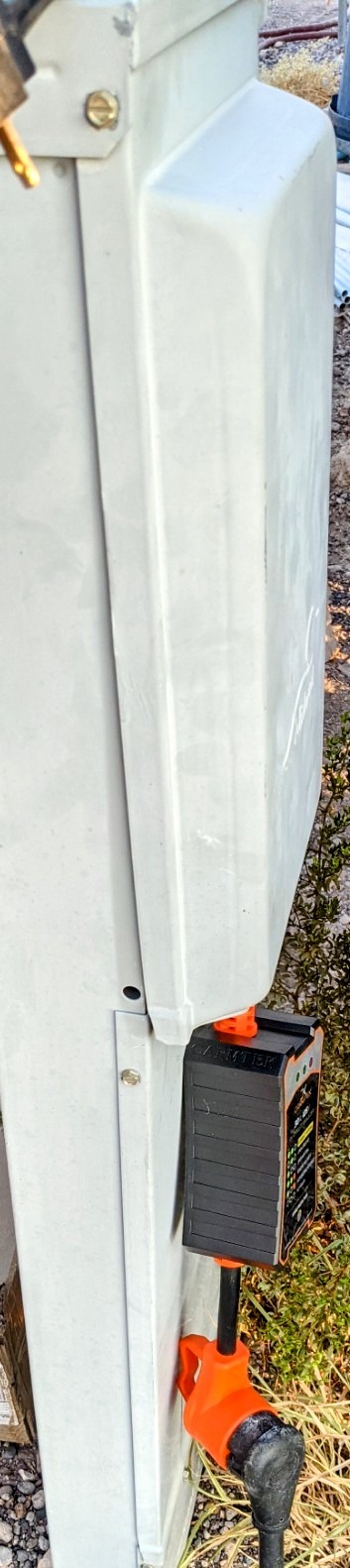
The circuit analyzer reports the same six conditions as the GEARGO unit, which is a diagnostic standard worth holding any candidate to. One owner describes it catching a real 40-amp wiring error at a private property before any appliance took damage.
The lifetime warranty is the other differentiator. Owners report a same-day replacement when a center LED failed, which is unusually fast service for a device in this category.
What comes up repeatedly is physical fit. The 30 amp plug can be stubborn to pull out even with the built-in grip handle, and in worn campground receptacles the body can sit loosely enough to shift if bumped. A few buyers also report short prongs that reduce connection security.
What UL listing buys you
Certification means an independent lab tested the unit to a standard rather than the manufacturer self-declaring compliance. Owners who have been burned by uncertified devices treat a genuine listing as a baseline requirement rather than a nice-to-have.
The wide temperature range matters more than it sounds. Housings that crack or lose contact across freeze-thaw cycles tend to fail in the second or third season, which is exactly when a warranty should still apply.
Where it falls short
There is no app, no display and no auto-shutoff behavior, so this is a check-before-you-plug device rather than a monitoring device. If you want the last two, look at the Power Watchdog or the Southwire LCD unit.
The grip complaints are worth anticipating. If you have physical grip issues or an older receptacle, add a small rubber strap so you are not levering against the housing.
6. Southwire Surge Guard 44280: Compact With an Included Lock Ring
Southwire Surge Guard™ 30 Amp Portable RV Surge Protector with Enhanced Diagnostics, 2100 Joules, 44280
30 A / 2100 joules
LED diagnostics for park power faults
Nylon housing with brass receptacle
1.5 pounds
Pros
- Identifies faulty park power before you connect
- Compact at 1.5 pounds and easy to stow
- Thicker receptacle brass reduces heat build-up
- Anti-theft lock ring included
- Limited lifetime warranty
Cons
- LED indicators only
- no voltage or amp display
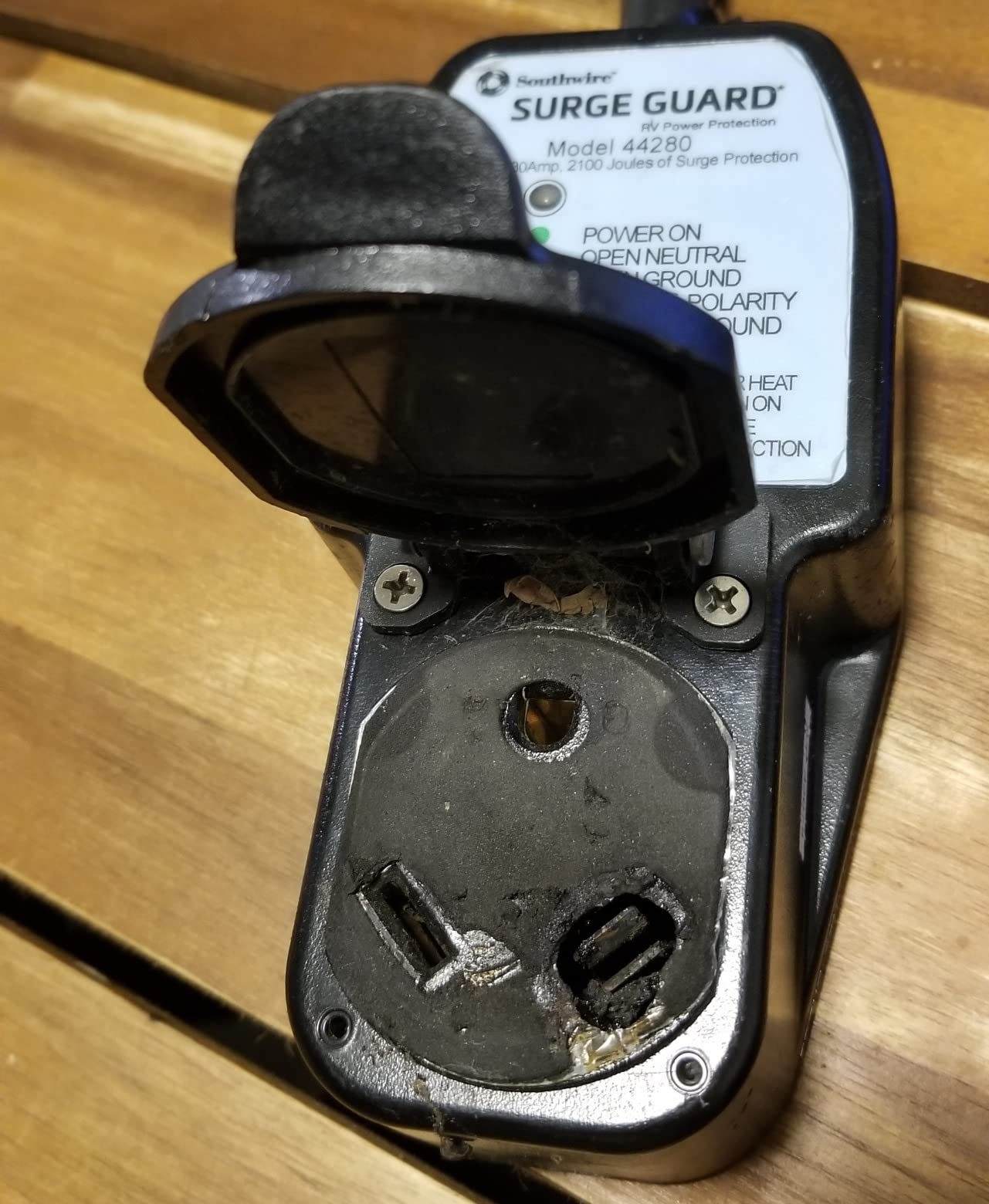
- Some owners recommend replacing the internals after several years
- No automatic disconnect or phone monitoring
At 1.5 pounds, the 44280 is the easiest device here to keep in the RV permanently. If storage space is tight, that is not a minor detail, because a protector you have to make room for is a protector that stays in the truck.
Southwire builds in a detail most competitors skip. The receptacle uses increased brass thickness to reduce heat at the connection, and heat at a slightly loose pedestal contact is a real failure mode over a long season.
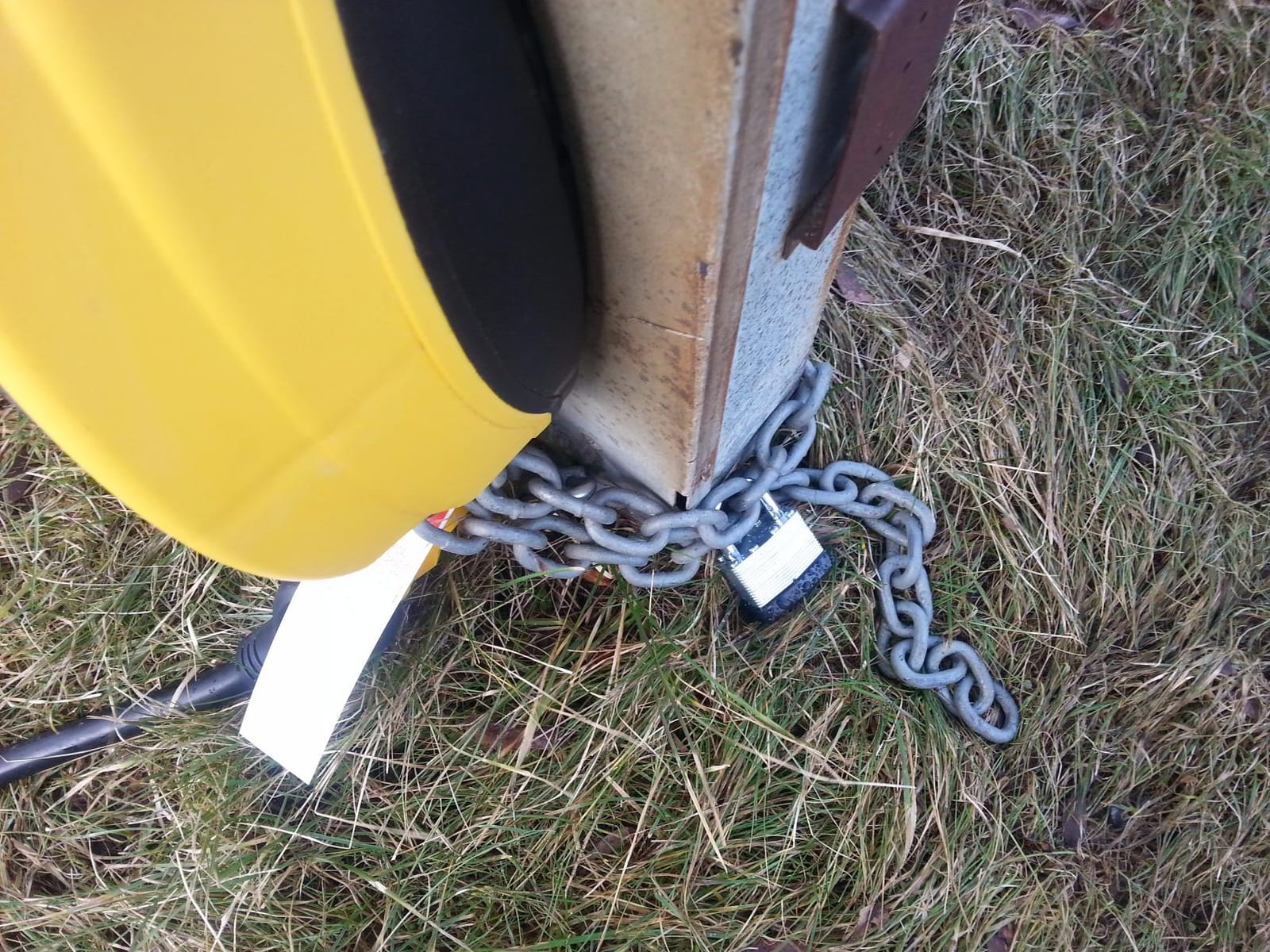
The lock ring on the cord is also uncommon in this category and lets you add your own cable lock in open areas. Three ports are provided, so a small accessory or tester can run through the same body.
Long-term owners describe it as a reliable, good-value protector that has ridden out multiple seasons and at least one severe thunderstorm without incident. Several have independently verified the LED diagnostics against a separate voltmeter and ammeter, which is the kind of check we like to see.
The recurring note is time. Some owners who have had theirs for years say the internal protection components degrade with age and recommend replacing it at roughly the eight-year mark. A 4.7 average across 1650 reviews reflects solid performance with that caveat attached.
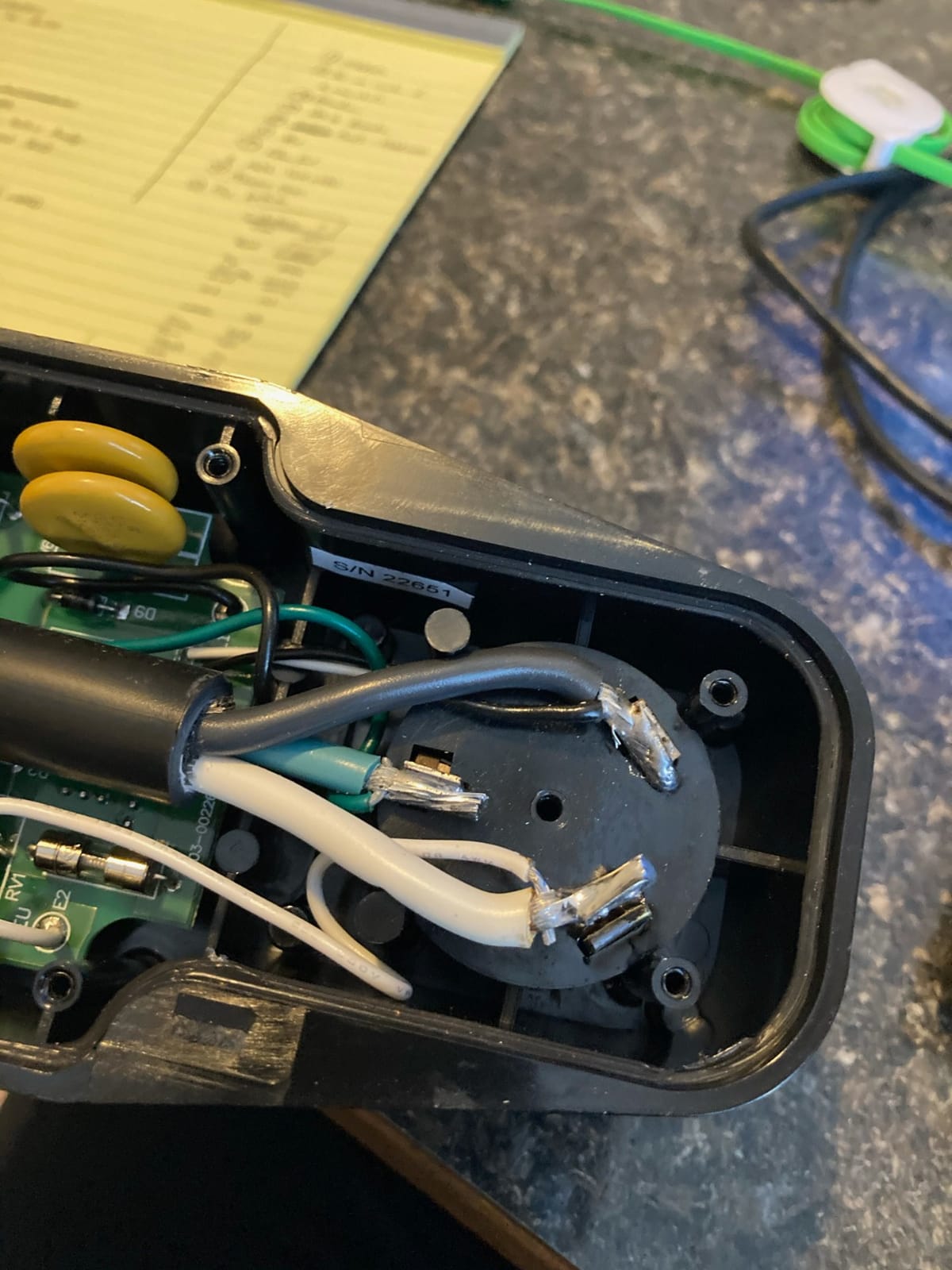
Why heat at the connection matters
A loose or corroded pedestal contact generates heat under sustained 30 amp load, and heat is what degrades the receptacle over time. Thicker brass slows that down, which matters for anyone who leaves the trailer plugged in for weeks.
For long-stay rigs, this is a quieter advantage than an app. It is also the kind of thing you only notice years later, when the unit still works.
Where it falls short
LED indicators only, with no numeric readout and no automatic disconnect. This is a pre-plug check, so you need to decide yourself what to do with the information it gives you.
No phone monitoring means you will not know about a problem that develops while you are away from the rig for the day.
7. MILLIONHOME 30 Amp: The Largest Rated Surge Capacity Here
MILLIONHOME RV Surge Protector 30 Amp, 𝟐𝟎𝟐𝟔 𝐍𝐞𝐰 𝐔𝐩𝐠𝐫𝐚𝐝𝐞𝐝 Voltage Protection RV Power Surge Protectors Waterproof, RV Adapter Plug for Camper, Circuit Analyzer for Travel Trailers
30 A maximum load capacity
13000 J protection level per listing copy
Waterproof flame-retardant housing
5 x 5 x 16.1 in, 1.5 pounds
Pros
- Largest surge rating listed among these picks
- Simple plug-and-play with readable indicator lights
- Waterproof housing for all-weather camping
- Light at 1.5 pounds
Cons
- Plastic hinge on the clear cover can snap off
- Indicator lights only
- no numeric readout
- Lower review volume than the established brands
- No Bluetooth or automatic power-off
This is the one to look at if raw surge capacity is your priority and you want to spend as little as possible. The listing states a 13000 J protection level, which is the highest figure among the eight devices we compared.
The 30 amp circuit analyzer indicates whether the campground circuit is wired correctly before you connect, which is the single most valuable function at this price. Setup is plug-and-play with no configuration step.
Owners rate it as the best surge rating they found in this price range, and the housing is waterproof and flame-retardant for rain, wind and sandstorm conditions. Weight is 1.5 pounds, tied for the lightest here.
The build quality has one weak link. The clear protective cover has a plastic hinge that owners report snapping off within a few months, and one owner re-attached it with a small metal hinge of their own. A device that sits exposed rather than covered loses most of the weather benefit.
At 417 reviews, this has the smallest owner base in the roundup. That is not a criticism, it is simply less history, and worth weighing against brands where the same model has been in service for many seasons.
What a large joule number does and does not mean
Joules measure the total energy a unit can absorb across its service life before the internal components degrade permanently. A larger number means more cumulative headroom for repeated small events across a multi-year ownership period.
It does not mean the device protects against everything. A surge rating has no bearing on sustained high or low voltage, and no bearing at all on wiring faults, which is why the circuit analyzer matters just as much as the number.
Where it falls short
There is no display, no remote monitoring and no automatic disconnect. If the site is known to be unstable, you need a monitoring unit as well.
The cover hinge is the practical fix worth planning. Check it after the first couple of months and replace the hinge before the cover is lost entirely.
8. Camco Power Grip 55301: Explicit Voltage Cutoffs
Camco Power Grip Camper/RV 30-Amp Voltage Protector – Features Integrated Surge Protection of Up to 2,800 Joules & Diagnostic LEDs Indicate Wiring Faults (55301)
30 A / 2800 joules
Disconnects above 132 V and below 102 V
NEMA TT-30P to TT-30R
27.5 x 5.4 in, 4.9 pounds
Pros
- Protects against sustained over and under voltage
- not just spikes
- Automatic disconnect and reconnect once conditions normalize
- Weatherproof body has handled sun
- rain and freezing for owners
- Diagnostic LEDs catch bad pedestal wiring on first hookup
Cons
- Not rain resistant in practice
- water ingress causes corrosion and false readings
- Loud buzzing reported on some
- LEDs hard to see in daylight and very bright at night
- Heaviest device here at 4.9 pounds
- Limited 1 year warranty is the shortest here
The Camco 55301 is the most explicit about its thresholds of anything we tested. It protects against high voltage above 132 volts and low voltage below 102 volts, in addition to surges up to 2800 joules.
That matters because those numbers describe the dangerous band that sustained exposure causes real damage. A failed neutral can hold a rig above 132 volts for minutes, and that is exactly the scenario a spike-only device does nothing about.
It also disconnects automatically from dangerous conditions and reconnects once normal operation returns, which saved at least one camping trip after the trailer load was exceeded. There is an approximately two-minute delay before power connects after plugging in or after a power loss.
Owners also report long service lives and a weatherproof body that has handled sunshine, rain and freezing temperatures. The Power Grip contoured handles make the large plug manageable, which is not a small thing on a 4.9-pound device.
This is also the weakest entry on paper, at a 4.5 average from 695 reviews, and the complaints are consistent. Water ingress causes corrosion, chattering and false fault readings. Some units buzz loudly enough to prompt a replacement, and the diagnostic LEDs are small, hard to see in daylight and very bright at night with the fault chart printed on the back.
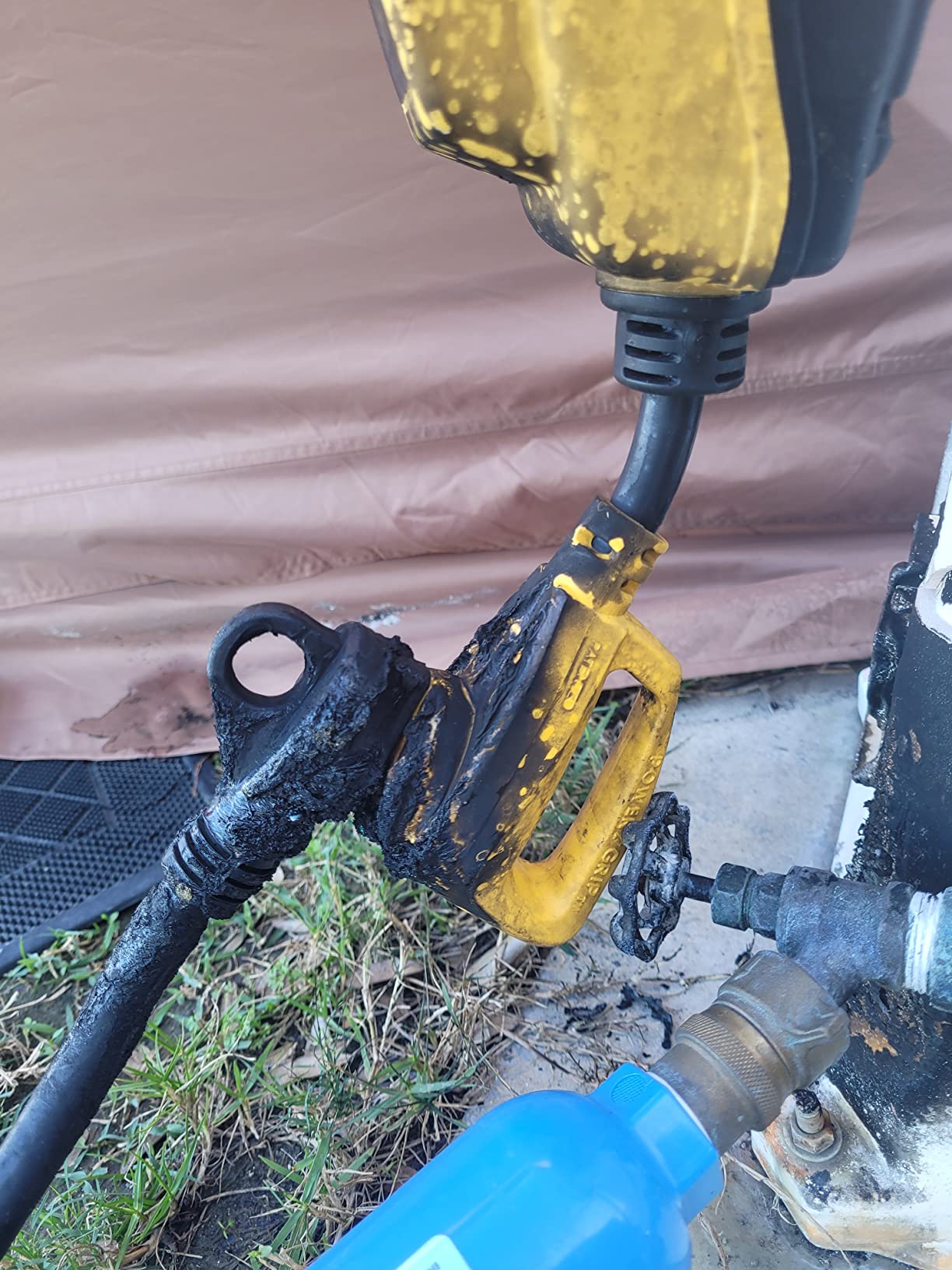
Why the cutoff numbers are worth reading
Understanding the band changes how you use the device. Between roughly 108 and 128 volts, a 30 amp rig is within a comfortable operating window on typical North American shore power, which is why 108 to 128 shows up in most RV guidance.
A unit that names its disconnect points lets you confirm the protection is doing what you think. Camco states 102 and 132 volts outright, which is more than most competitors publish.
Where it falls short
Water resistance is claimed for upright installation and does not hold up as well as the sealed-cover devices in this list. In sustained rain, store it under cover rather than exposed.
The 1-year warranty is the shortest here by a wide margin, and the roughly two-minute reconnect delay is confusing the first time it happens. Weigh that against the clear cutoff specification before choosing it over a longer-warranty alternative.
Surge Protector vs Smart Surge vs Full EMS: Which One Do You Need?
This is the question that decides your purchase, and most roundups never answer it. There are three distinct tiers, and confusing them leads people to either overpay for monitoring they will never use or underbuy a device that cannot see the fault that actually kills their converter.
Surge-only. Diverts brief voltage spikes to ground using MOV, TVS or GDT components and does nothing else. No monitoring, no fault detection, no auto-disconnect. Cheapest tier, and it cannot see a wiring fault or a sustained voltage problem.
Smart surge. Adds a pre-plug circuit analyzer that reports open ground, open neutral, reverse polarity and over or under-voltage, usually on LEDs. This is where most of the picks in our table sit, and it is the minimum we would consider buying today.
Full EMS. Continuously monitors line voltage, displays it, compares it against a configurable safe window, and disconnects power automatically when it drifts outside. Add app connectivity and it becomes a diagnostic tool.
The practical rule: if you mostly camp at sites you trust and hook up only a few times a year, a smart surge unit with fault detection is enough. If you travel constantly, run into unknown parks, or have already had an electrical scare, a full EMS earns its cost through information.
Portable vs Hard-Wired: The Decision Before the Brand
Hard-wired units sit inside the RV behind the wall panel, so protection is always on and there is nothing at the pedestal for someone to walk off with. Forum consensus strongly favors them for theft resistance and for removing the risk of forgetting to plug one in before you run the coffee maker.
The tradeoff is installation. A hard-wired system needs wiring work, correct conductor gauge and torque at the terminals, and access to the shore power junction box. A mistake there costs far more than any device on this list, so use a technician if you are not confident with RV wiring.
One more point that comes up often: a 50 amp hard-wired system can still protect a rig running on 30 amp service, because protection is applied before the split. That flexibility is a common reason owners choose hard-wired even when their rig is 30 amp.
Everything on our list is portable. That is a deliberate choice, because a portable unit can be moved between the 30 amp sites you actually use, and it is the only category that works without modifying your rig.
30 Amp vs 50 Amp Service: Do You Need a Second Protector?
Match the protector to your rig, not to the site. A 30 amp protector on a 50 amp rig is correct. Putting a 50 amp protector on a 30 amp rig gives you a device whose current threshold does not match the circuit protecting it, so it will happily pass fault current that the pedestal breaker was never meant to carry.
Yes, you can plug a 30 amp rig into a 50 amp pedestal, and you can use a 30-to-50 dogbone adapter to do it. The adapter is only safe when the pedestal breaker protecting that leg is already a 30 amp breaker. Plugging into a genuine 50 amp circuit and drawing through a dogbone defeats the pedestal breaker, so confirm the breaker size at the box before you adapt anything.
Owners who upgrade to 50 amp service often end up keeping both protectors, which is normal and not a mistake. It simply means one device per hookup type, stored in the right compartment.
How to Choose a 30 Amp Surge Protector in 2026
How many joules should a 30 amp RV surge protector have? A surge-only unit in the 1000 to 3500 joule range handles ordinary campground conditions. A smart surge unit typically lands between 2000 and 3500 joules. A full energy management unit adds continuous voltage monitoring rather than relying on capacity alone, so joules matter less once monitoring is doing the work.
Fault detection is non-negotiable in our view. A device with only surge absorption will not warn you about an open ground or a failed neutral, and those conditions cause far more damage than spikes.
Connector type is the next check. Your rig wants a NEMA TT-30P male plug, and the protector needs a TT-30R female receptacle. If you have to force it, stop.
Voltage window matters more on an EMS. Look for a device that names its safe range and disconnect points. Most guidance puts comfortable 30 amp operation between roughly 108 and 128 volts, with disconnection below about 104 or above about 132.
Weather resistance is decided by whether the unit is sealed, not by marketing language. An enclosed cover with an IP rating is a meaningful upgrade over a bare analyzer in coastal, desert or winter camping.
Warranty length is your replacement timeline. Two years is thin, three years is the baseline most owners consider acceptable, and limited lifetime coverage is the strongest position. Treat a long warranty as a signal the maker expects the product to last.
Finally, verify certification. Look for a genuine UL listing on the product itself, and be cautious with unbranded marketplace devices that show no mark at all. You can also check the self-test: plug the unit into a known-good household outlet and confirm every indicator behaves as the manual describes before you rely on it at a pedestal.
Frequently Asked Questions
What is the difference between an RV EMS system and a surge protector?
A surge protector diverts brief voltage spikes and does nothing else. An EMS, or energy management system, continuously monitors line voltage, displays it, and disconnects power when the supply falls outside a configurable safe window or when it detects a wiring fault such as open ground or reverse polarity.
How many joules should a 30 amp RV surge protector have?
Between 1000 and 3500 joules covers typical campground use for a 30 amp rig. Smart surge units in this range handle ordinary spike events, while full EMS units add continuous voltage monitoring, which matters more than raw capacity once bad power is present.
What is the best 30 amp RV surge protector?
For most 30 amp owners the Progressive Industries SSP-30XL is the strongest overall choice, with LED fault detection, a weather shield and a lifetime warranty across more than 5600 owner reviews. If you want phone monitoring, the Power Watchdog PWD30EPO adds app-based voltage, amp and kilowatt-hour data.
Can a 30 amp RV be plugged into a 50 amp outlet?
Yes, with a 30-to-50 amp dogbone adapter, provided the pedestal leg you connect to is already protected by a 30 amp breaker. Using a genuine 50 amp circuit with a dogbone pushes current past the pedestal breaker, so check the breaker size at the box before adapting.
Can an RV surge protector go bad?
Yes. Surge components absorb energy by degrading, and owners report replacing electronics in older protectors after several years of service. Signs of failure include indicators that stay lit, a failed self-test, corrosion or water intrusion, and visible cracking in the housing.
Do you really need a surge protector on an RV?
Yes, if you ever connect to a campground pedestal, a storage yard or someone else’s outlet. Shared pedestals are frequently mis-wired or supply unstable voltage, and a protector that warns you about a fault before you plug in costs far less than replacing a converter or damaged electronics.
Final Verdict for 30 Amp Service in 2026
The Progressive Industries SSP-30XL is our pick for the best RV surge protector for 30 amp service, because it does the one job that prevents the most damage, telling you the pedestal is wired wrong, in a housing that survives real weather, with more owner history than anything else we reviewed. Add the Power Watchdog PWD30EPO if you want visibility from your phone, and the GEARGO or CARMTEK units if a sealed analyzer at a lower outlay is the better fit for occasional trips.
Plug in, read the indicators, and trust them. That habit is worth more than the last thousand joules.