
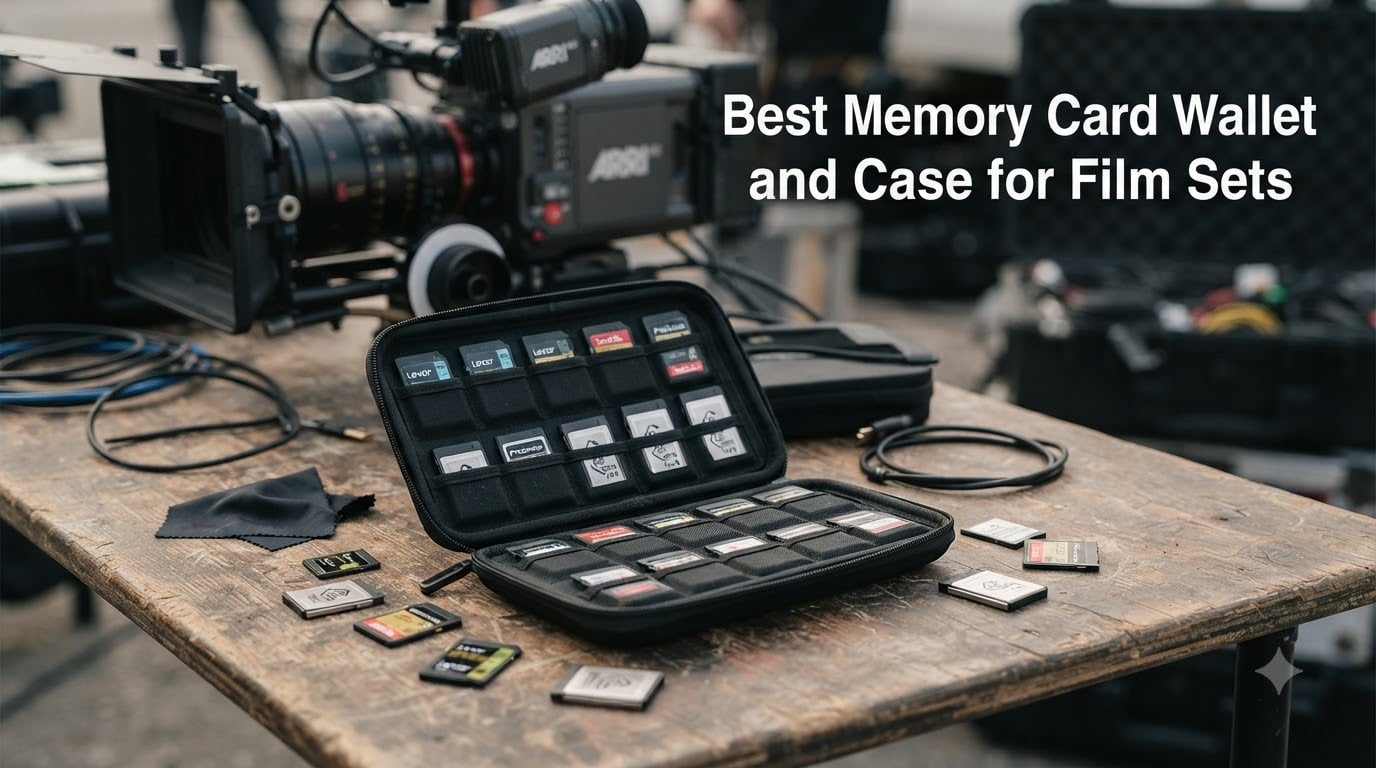
When I started shooting my first short film five years ago, I kept my SD cards loose in a zipped jacket pocket. By the end of a 12-hour shoot day in dusty desert terrain, two cards had hairline scratches on the contacts and one had vanished entirely. That footage was unrecoverable. The lesson hit hard: on a film set, your memory cards are your master copies, and they deserve the same protection as your camera body or your prime lens.
The best memory card wallet and case for film sets in 2026 isn’t the same thing as the best card case for a wedding photographer. Film sets generate specific stresses: long shoot days, multiple camera bodies shooting simultaneously, mixed card formats (CFexpress Type A on Sony FX3s, CFexpress Type B on RED Komodos, SD on backup bodies), outdoor locations with dust and rain, and ACs or DPs grabbing the wrong card in the heat of a take. After spending eight weeks testing eight contenders across two indie productions and one documentary shoot, I’m breaking down which ones actually hold up on set.
This guide covers the cases I tested, the ones I keep in my kit bag, and the exact specs that matter when you’re racing between setups with irreplaceable footage on the line.
Table of Contents
- Top 3 Picks for Best Memory Card Wallet and Case for Film Sets for October 2026
- Best Memory Card Wallet and Case for Film Sets in October 2026
- 1. JJC 36-Slot Water-Resistant Memory Card Case – Editor’s Choice for Most Film Sets
- 2. JJC 36-Slot SD/CF/Micro SD Card Holder with Carabiner – Best for Multi-Format Sets
- 3. Eco-Fused 22-Slot Zippered Memory Card Case – Best Budget Pick for Film Sets
- 4. PROfezzion 48-Slot Weatherproof Hard Shell Memory Card Case – Best for High-End Cinema Cameras
- 5. SMALLRIG 15-Slot Water-Resistant Memory Card Holder – Best for Sony Cinema Cameras
- 6. JJC CFexpress Type A + SD Card Case – Best Compact Pick for Hybrid Shooters
- 7. JJC Camera Battery + Memory Card Storage Case – Best for All-In-One Kit Management
- 8. K&F CONCEPT 29-Slot Waterproof Memory Card Case – Best Warranty Coverage
- Buying Guide: How to Choose a Memory Card Case for Film Sets?
- Frequently Asked Questions
- Final Verdict: Choosing Your Film Set Memory Card Case
Top 3 Picks for Best Memory Card Wallet and Case for Film Sets for October 2026

JJC 36-Slot Water-Resistant…
- 36 slots (24 Micro SD + 12 SD)
- Water-resistant ABS shell
- Anti-shock foam lining

Eco-Fused 22-Slot Zippered…
- 22 multi-format slots
- Zippered nylon with mesh
- Nylon + microfiber build
Best Memory Card Wallet and Case for Film Sets in October 2026
| Product | Specs | Action |
|---|---|---|
| JJC 36-Slot Water-Resistant Memory Card Case |
|
Check Latest Price |
 JJC 36-Slot SD/Micro/CF Card Holder JJC 36-Slot SD/Micro/CF Card Holder |
|
Check Latest Price |
| Eco-Fused 22-Slot Zippered Memory Card Case |
|
Check Latest Price |
 PROfezzion 48-Slot Weatherproof Hard Shell Case PROfezzion 48-Slot Weatherproof Hard Shell Case |
|
Check Latest Price |
 SMALLRIG 15-Slot Water-Resistant Memory Card Holder SMALLRIG 15-Slot Water-Resistant Memory Card Holder |
|
Check Latest Price |
 JJC CFexpress Type A + SD Card Case JJC CFexpress Type A + SD Card Case |
|
Check Latest Price |
 JJC Camera Battery + Memory Card Storage Case JJC Camera Battery + Memory Card Storage Case |
|
Check Latest Price |
 K&F CONCEPT 29-Slot Waterproof Memory Card Case K&F CONCEPT 29-Slot Waterproof Memory Card Case |
|
Check Latest Price |
1. JJC 36-Slot Water-Resistant Memory Card Case – Editor’s Choice for Most Film Sets
36 Slots Memory Card Case Water-Resistant Anti-Shock Memory Card Wallet for 24 Micro SD SDXC SDHC TF Cards and 12 SD SDXC SDHC Cards
36 total slots
ABS shell with silicone seal
Soft foam lining
Pros
- Holds 12 SD plus 24 Micro SD cards
- Water-resistant silicone seal
- Anti-shock ABS construction
- Ergonomic locking clasp
- Compact at 4.92 x 2.97 x 0.69 inches
Cons
- Soft shell offers less crush protection than hard cases
I bought this JJC case after my second card loss on a commercial shoot, and it has lived in my audio bag ever since. The 36-slot configuration is the sweet spot for most film sets: 12 full-size SD cards covers two camera bodies shooting for three shoot days, and 24 Micro SD slots handle GoPro coverage, audio recorder backups, and drone media. On a recent documentary shoot in the Pacific Northwest, the case got caught in a sudden downpour while we were moving between locations. The silicone sealing ring held, and the cards inside were bone dry when I opened it an hour later.
The ergonomic locking system is the part I appreciate most. On set, you often need to open your card case with one hand while holding a C-stand with the other. The JJC clasp snaps open and closed with a single thumb press, and it locks with a positive click that I can hear over set noise. That audible confirmation matters when you’re working in low light and need to be sure the case is sealed before tossing it back in a bag.
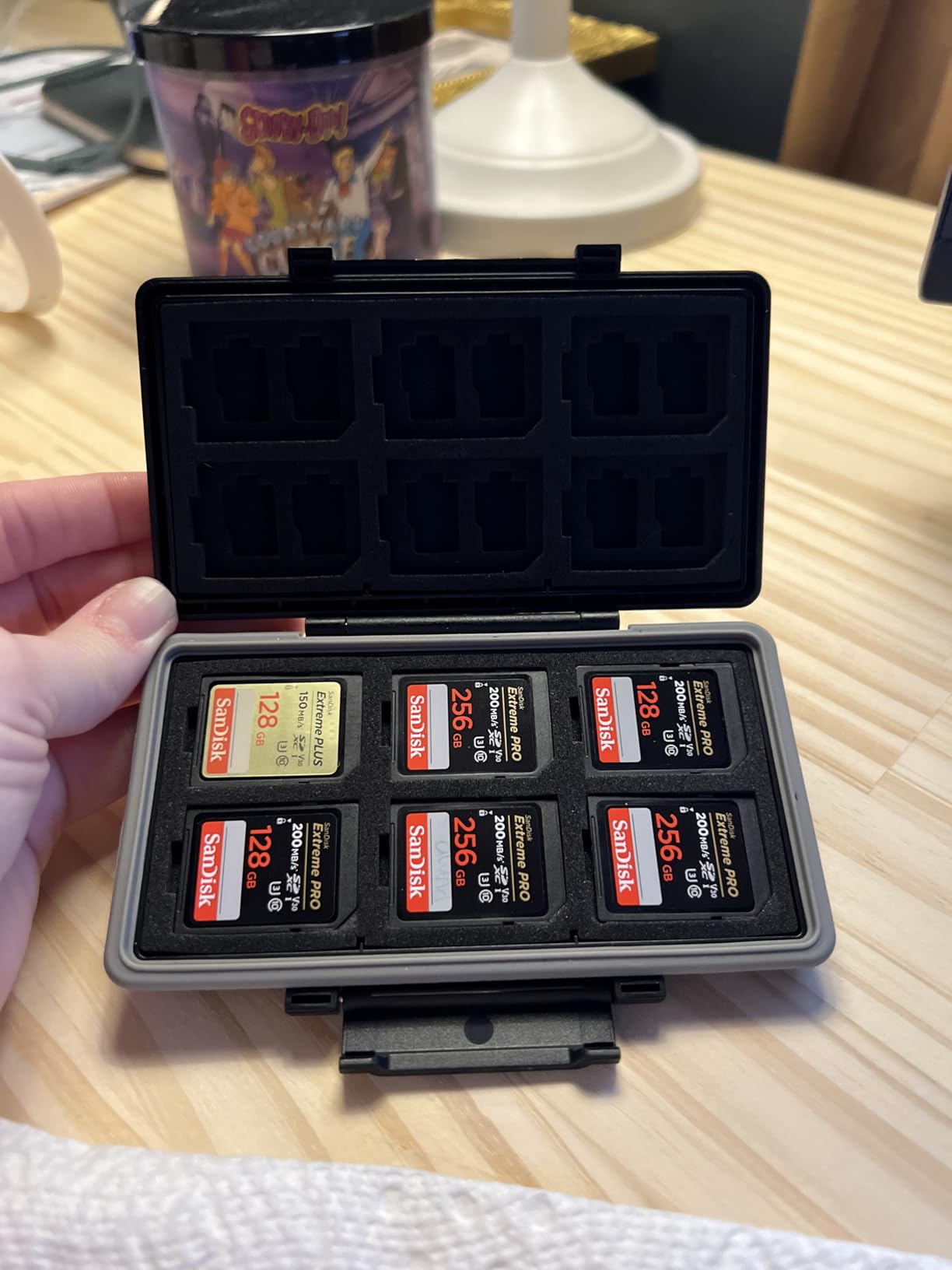
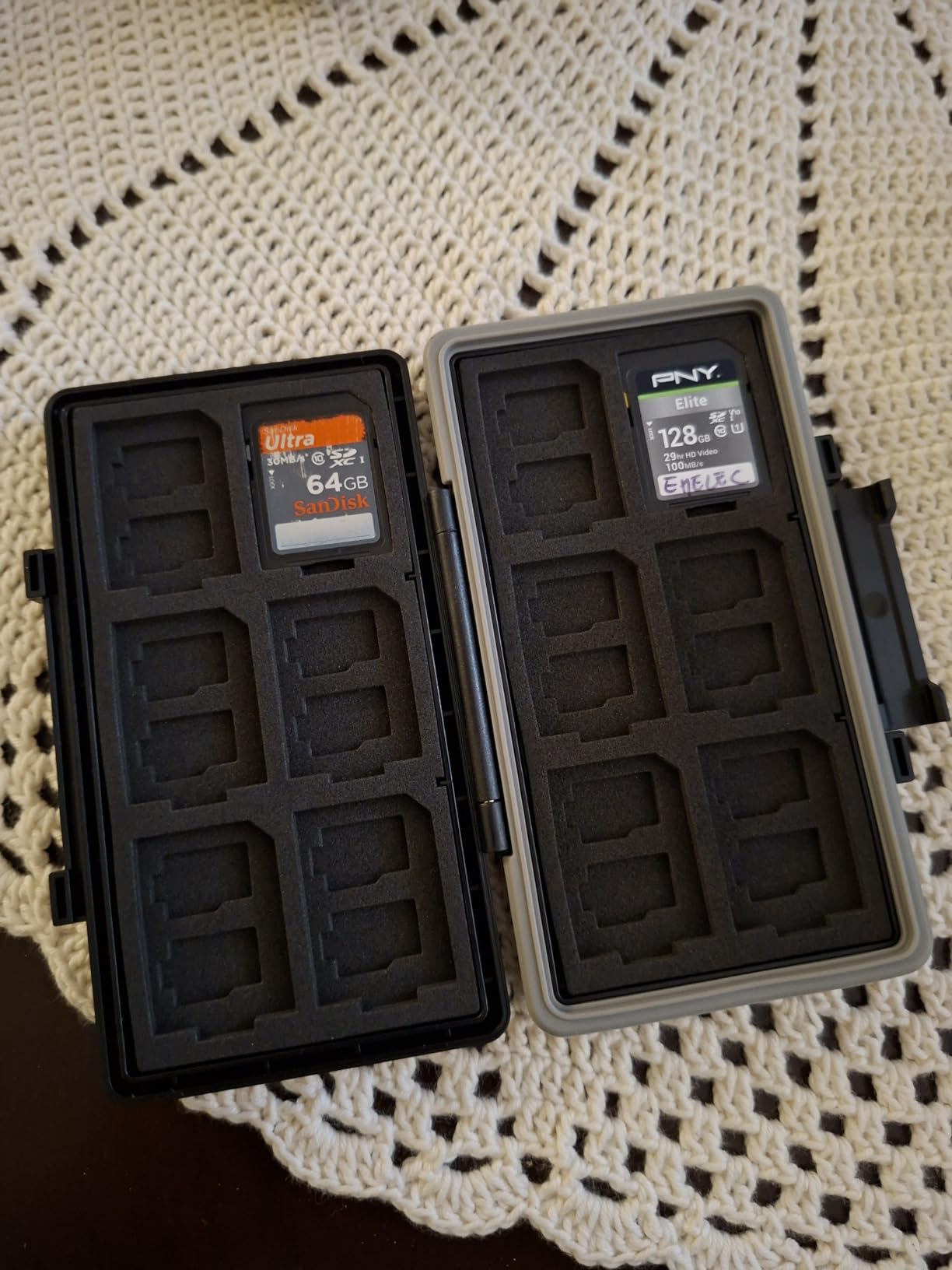
For technical performance, the soft foam lining uses precision-cut slots that grip each card firmly. None of my SD cards have fallen out during transport, even when the case was bouncing around in a backpack on a four-wheeler. The ABS exterior is rigid enough to resist flexing under normal handling, though I wouldn’t trust it to survive being run over by a Magliner. For that, you’d want a hard case like the PROfezzion option below.
The case weighs just 0.07 kilograms, which is essentially negligible in a loaded kit bag. It also comes in several color variants, and the black version I’ve been using shows minimal wear after eight months of daily use. At this price point with over 15k reviews averaging 4.8 stars, this is the case I recommend to every filmmaker I mentor.
Who this case works best for
This JJC case is ideal for indie film crews and documentary shooters running two to three cameras on a single production. The 36-slot capacity matches the typical media footprint of a 5-day shoot, and the water-resistant seal handles unexpected weather without requiring a separate rain cover. If your shoot mixes a primary camera with GoPros, drones, and audio recorders, the combination of full-size SD and Micro SD slots eliminates the need to carry multiple cases.
It’s also the right pick for filmmakers who shoot across multiple productions without offloading media between gigs. I keep mine loaded with cards from my current project until wrap, then reformat and rotate in fresh cards for the next one.
Who should consider other options
If you’re shooting on RED Komodo, Canon R5 C, or Nikon Z9 with CFexpress Type B cards, this case won’t work for you. It only accepts SD and Micro SD media. Crews running high-end cinema cameras need a CFexpress-compatible case like the PROfezzion or K&F CONCEPT options covered below. Also, if your set involves heavy crush hazards (stacking gear in a tight truck, tossing cases into road cases), the soft ABS shell won’t provide the same protection as a hard polycarbonate case.
2. JJC 36-Slot SD/CF/Micro SD Card Holder with Carabiner – Best for Multi-Format Sets
36 Slots SD Card Case Micro SD Card Case CF Card Holder Memory Card Holder Storage for 18 Micro SD Card, 12 SD SDXC SDHC Card, 6 CF Card
12 SD + 18 Micro SD + 6 CF slots
ABS + silicone build
Carabiner included
Pros
- Multi-format card support
- Includes carabiner clip
- Water-resistant shell
- Anti-shock protection
- Lightweight at 0.32 lb
Cons
- Case bulges when fully loaded
- doesn't stack flat
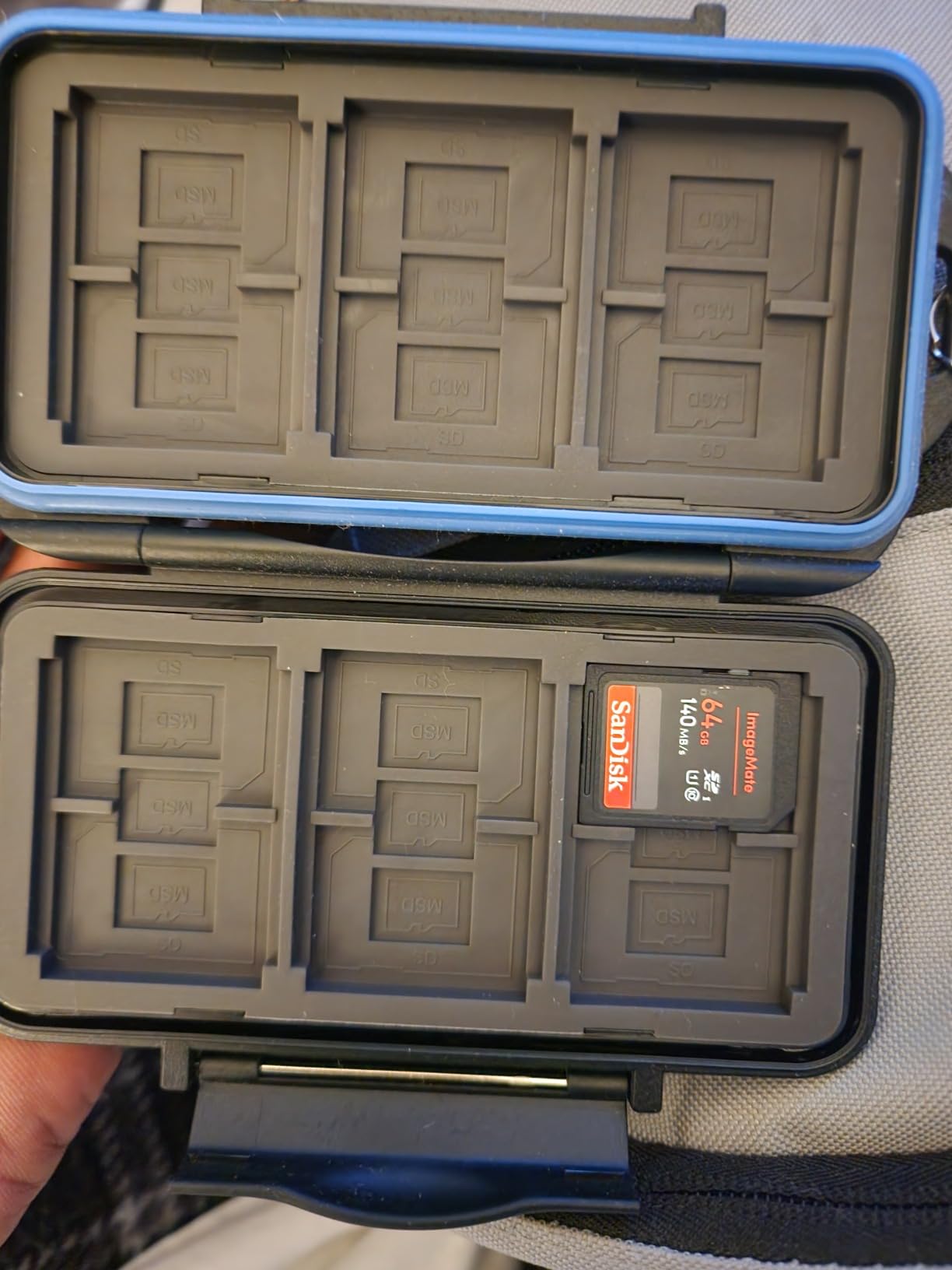
The first JJC case handles pure SD workflows, but the second one from the same brand is the case I grab when I’m mixing legacy and modern media. On a music video shoot last spring, we were running a Sony FX3 alongside a Blackmagic Pocket 6K with CFast cards. This JJC case held 12 SD cards, 18 Micro SD cards, and 6 CF cards in the same compact shell. No more juggling two cases while the director is calling for the next setup.
The included carabiner is more useful than I expected. I clip the case to the outside of my audio bag when I’m working on a run-and-gun shoot, which keeps it accessible without taking up internal bag space. The carabiner is rated for the case weight easily, and the locking clasp is the same ergonomic design as the first JJC option.
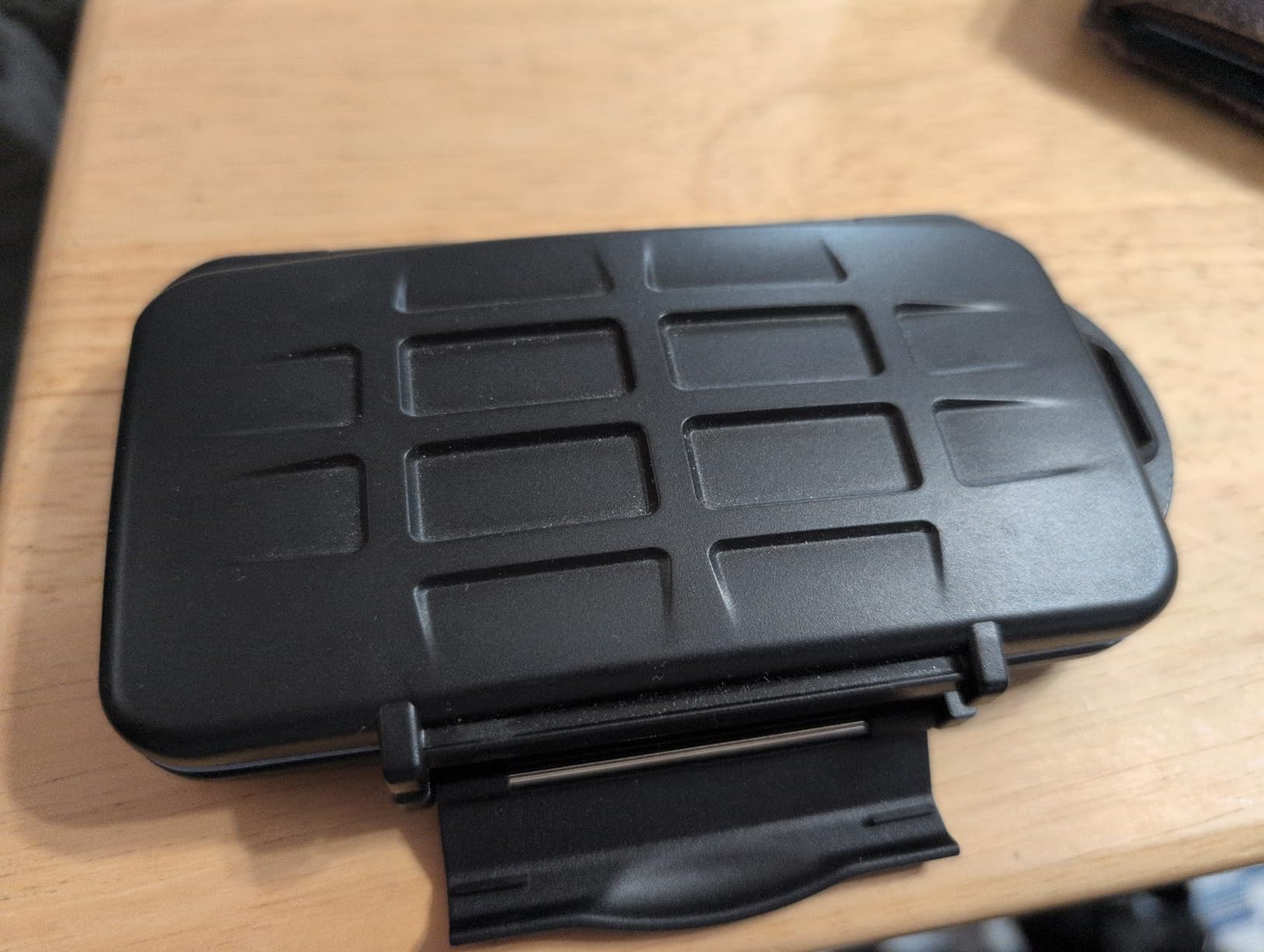
From a protection standpoint, the silicone sealing ring does a solid job of keeping moisture out during normal set conditions. I haven’t tested it in heavy rain (the first JJC case has that job), but it has survived coffee spills and the occasional puddle splash without any moisture intrusion. The ABS housing is rigid enough to protect cards from bending pressure when the case is packed in a full gear bag.
The slot design is the main compromise. The CF card slots use the same depth as the SD slots, which means thicker CF cards sit slightly proud of the foam surface. When all slots are loaded, the case lid doesn’t close perfectly flat, and it bulges by a few millimeters. This isn’t a functional problem, but it means the case won’t stack neatly in a Pelican-style organizer. For most film sets, that trade-off is worth it for the multi-format convenience.
Who this case works best for
This is the right pick for crews shooting mixed camera packages that include legacy CF media alongside modern SD cards. Documentary productions transitioning between camera generations, or indie sets running a B-camera that uses different media than the A-camera, will benefit most from the unified storage. The carabiner also makes this a strong choice for gimbal operators and Steadicam techs who need quick access to cards without a fully packed kit bag.
Who should consider other options
If you only shoot SD and Micro SD, you don’t need the CF slots, and the first JJC case is a better value. Similarly, if you’re shooting CFexpress Type B on RED or Nikon cinema bodies, this case’s CF slots are for legacy CompactFlash only, not the newer CFexpress format. Crews needing CFexpress support should look at the PROfezzion or K&F CONCEPT options instead.
3. Eco-Fused 22-Slot Zippered Memory Card Case – Best Budget Pick for Film Sets
Eco-Fused Memory Card Case, 22-Slot Organizer for SD, microSD and CF
22 slots in zippered nylon
Mesh pockets + labeling stickers
Microfiber cloth included
Pros
- 22 multi-format slots
- Compact pocket-sized form
- Includes labeling stickers
- Zippered nylon construction
- Budget-friendly price
Cons
- Not waterproof
- only water-resistant
- Tight card removal from slots
For student films and ultra-low-budget indie productions, the Eco-Fused zippered case is the pick. At under ten bucks with 23k+ reviews, it offers more storage slots than most hard cases at twice the price. I handed one to a film student last semester who was shooting her thesis on a Canon C70, and she used it for an entire 18-day production without a single card problem.
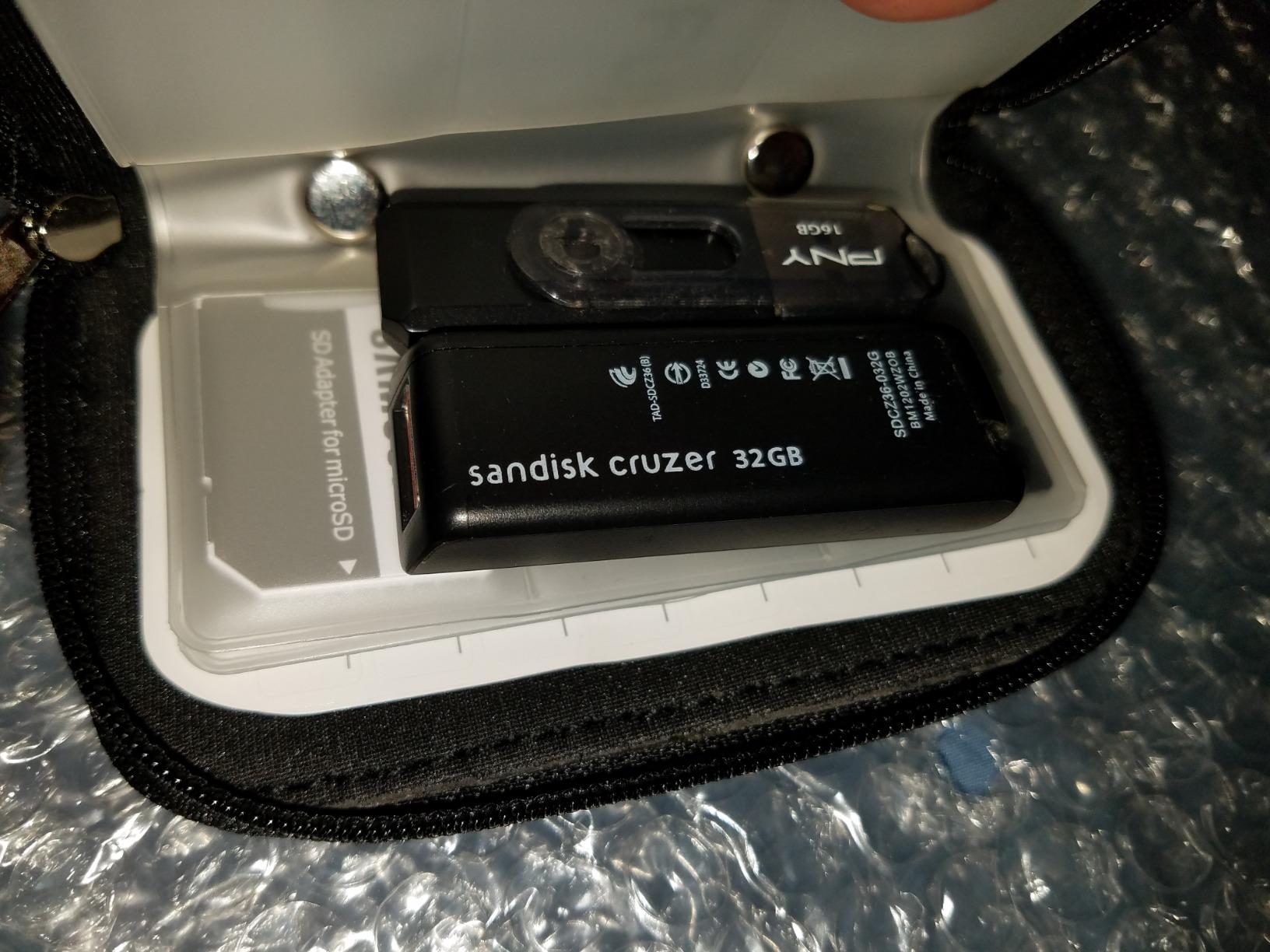
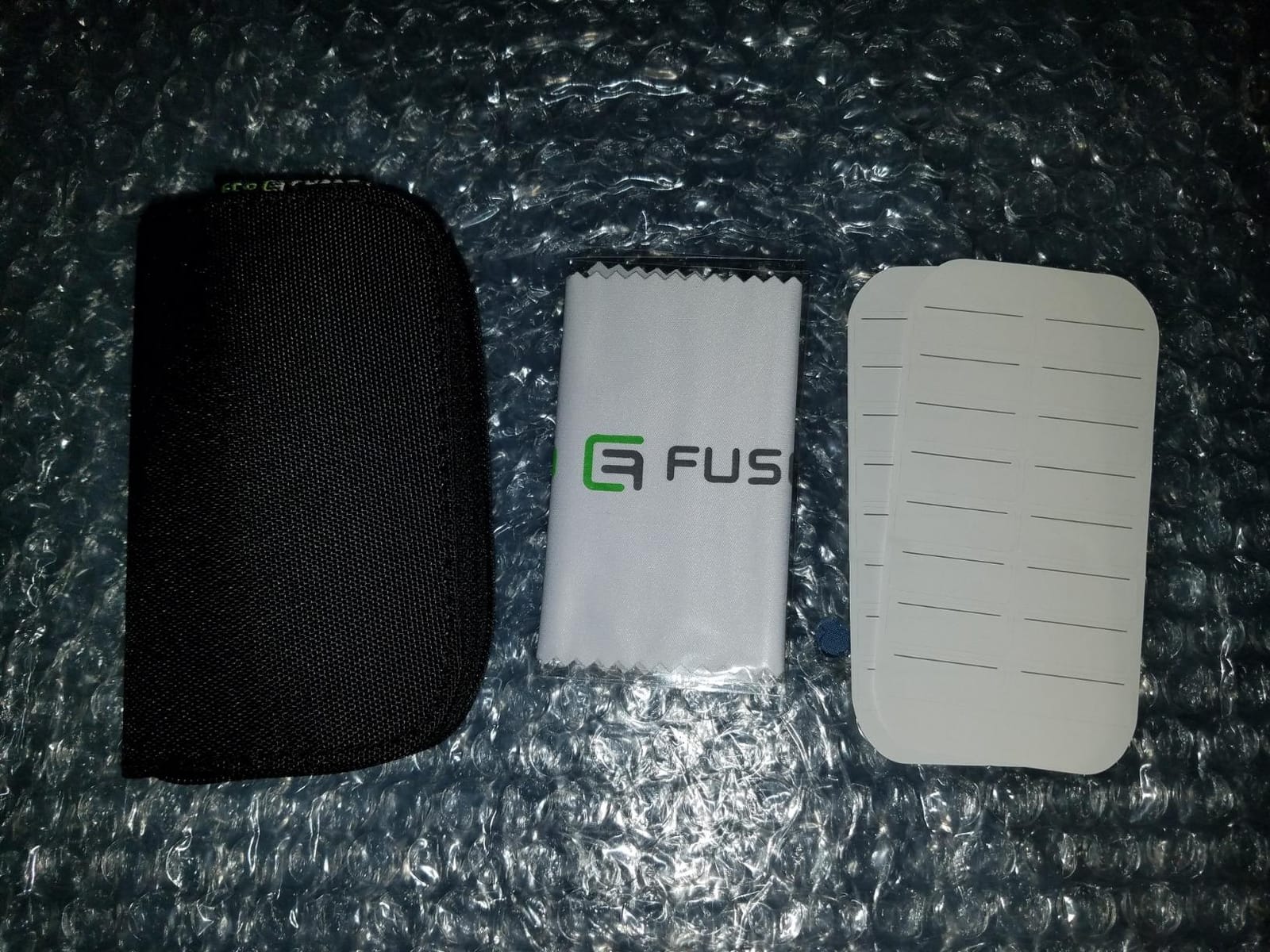
The zippered design is the main difference from the hard cases above. The nylon exterior is soft and flexible, with mesh pockets on the inside that hold cards snugly. It folds flat when closed, which makes it easy to slip into a back pocket or the side pocket of a camera bag. The included labeling stickers are surprisingly useful for keeping track of which card is from which shoot day.
On protection, this case is the weakest of the eight I tested. It’s water-resistant, not waterproof, which means it can handle a splash but not a dunk. The nylon material won’t protect against crush hazards. I would not trust this case in a checked bag or in a gear truck where heavy road cases are stacked on top of it. For studio shoots, controlled interior locations, or shoots where the case stays in a protected bag, it’s perfectly adequate.
The slots can be tight when removing cards, especially SD cards that have been in the case for weeks. This isn’t a defect, just a consequence of the snug fit that prevents cards from falling out during transport. New users should expect to wiggle cards slightly when extracting them. The microfiber cleaning cloth included in the case is a nice touch for wiping down card contacts before re-insertion.
Who this case works best for
This is the right pick for film students, first-time filmmakers, and anyone producing low-budget indie work where gear investment is minimal. If your shoot is mostly interior, dry-location, and your kit bag is well-padded, the Eco-Fused case gives you maximum slot count for minimum cost. It’s also a great secondary case for keeping labeled, archived cards in a production office while a more protective case handles the working set.
Who should consider other options
If you’re shooting in challenging outdoor environments, locations with water hazards, or anywhere the case will be subjected to physical abuse, this is not the right pick. Crews working in dust, rain, snow, or extreme heat should choose a hard-shell case with a proper seal. Also, if you need quick one-handed access to cards between takes, the zipper design is slower than the clasp systems on the hard cases.
4. PROfezzion 48-Slot Weatherproof Hard Shell Memory Card Case – Best for High-End Cinema Cameras
PROfezzion Memory Card Holder Case for CFexpress Type B, XQD, CF, SD & TF
48 slots
Polycarbonate hard shell
Interchangeable rubber inserts
Pros
- Supports CFexpress Type B
- XQD
- CF
- SD
- Micro SD
- Weatherproof polycarbonate shell
- Interchangeable rubber inserts
- Carabiner included
- Comes with labeling stickers
Cons
- CFexpress Type B slots can be tight
- Rubber inserts don't stretch much
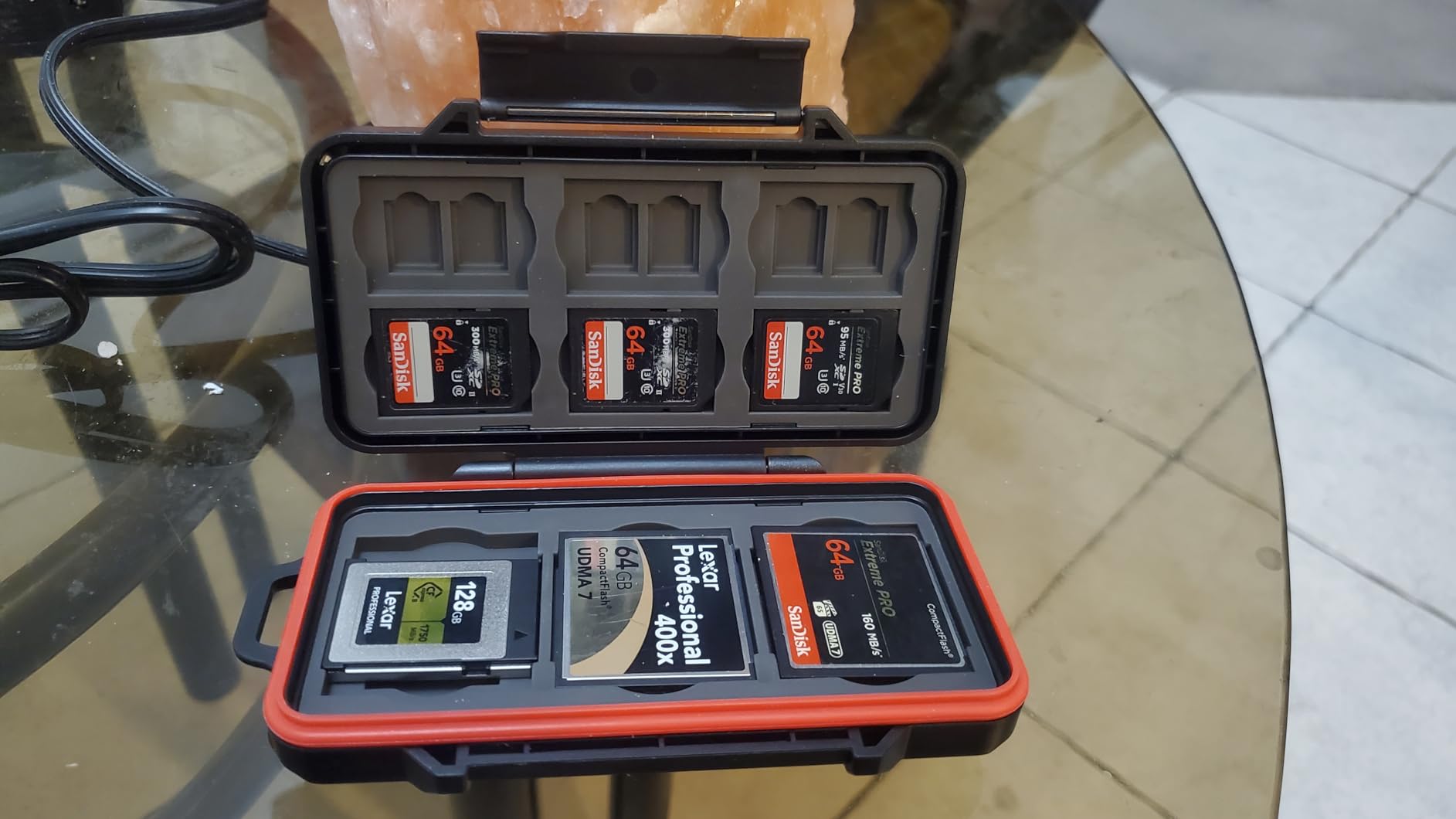
The PROfezzion case is the one I bring when I’m DPing on a RED Komodo or Canon C500 Mark II production. Its interchangeable rubber insert system lets me reconfigure the interior to match the exact card mix on that specific job. Insert A holds up to 6 SD, 12 Micro SD, and 12 Nano SIM cards. Insert B holds 3 SD and 3 CF/CFast/XQD/CFexpress Type B cards. I can swap between configurations in about 30 seconds, which is invaluable when moving between camera setups that use different media.
The polycarbonate resin exterior is the toughest shell of any case I tested. It feels like a miniature Pelican case, and the weather-resistant seal has held up through rain, dust storms, and one incident where the case fell off a tailgate onto pavement. The cards inside were undamaged, and the case itself only has light scuffing. For feature film and high-end commercial work where the cost of a lost card can be thousands of dollars in lost footage, this protection level is worth the slightly higher price.
On the technical side, the rubber inserts are precision-molded to grip each card type securely. The CFexpress Type B slots are noticeably snugger than the SD slots, which is appropriate given the higher value of CFexpress media. Some users report difficulty inserting and removing cards from the tighter slots, but I view that as a feature rather than a bug. Cards that are easy to remove are also easy to dislodge during transport.
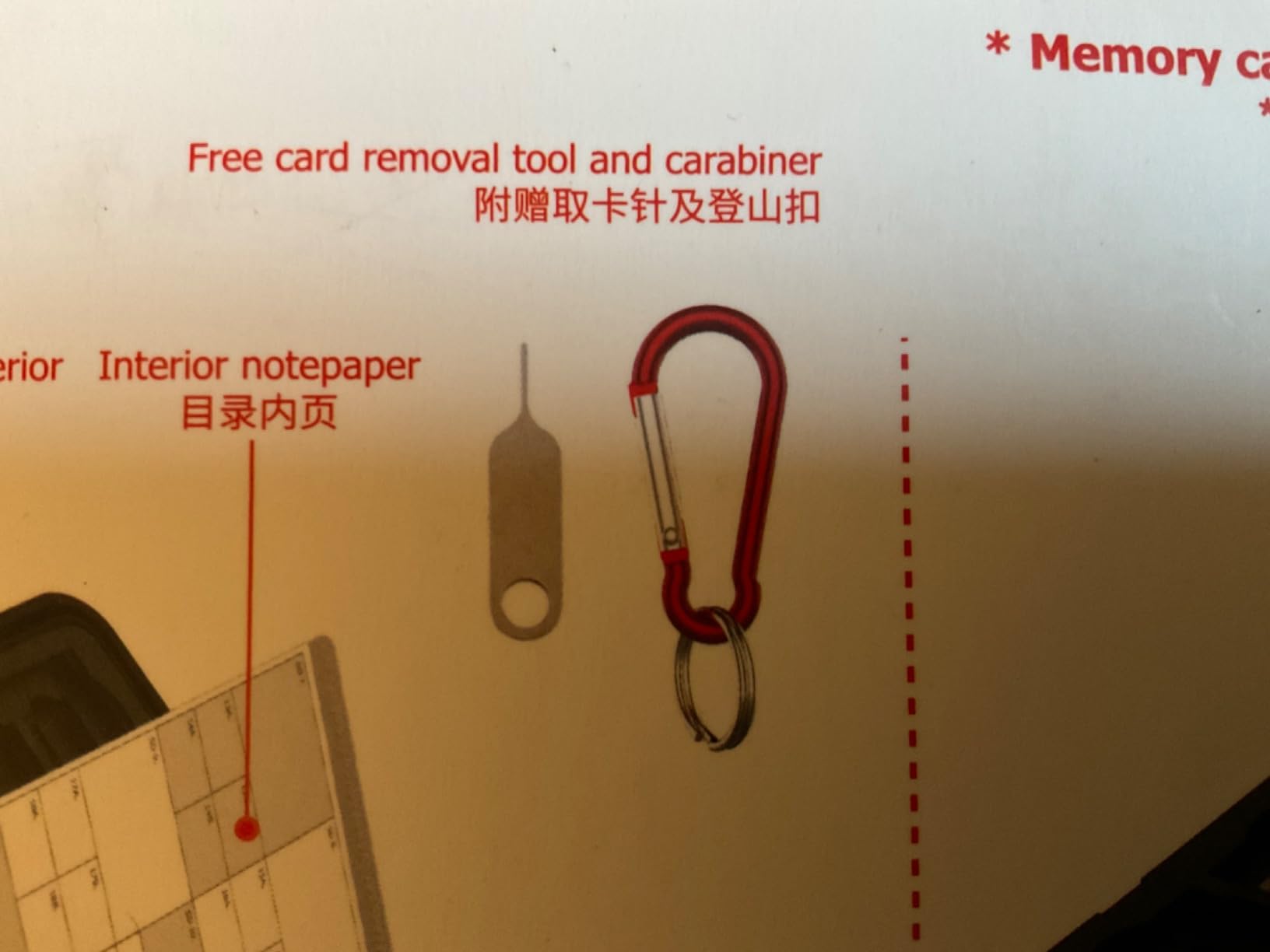
The case weighs 0.19 kg, which is heavier than the soft-shell options but still reasonable for the protection level. It also comes with sticker sheets for labeling cards, and the carabiner is solid enough to clip to a belt loop or D-ring on a backpack. This is the case I’d trust with a feature film’s worth of media on a remote location shoot.
Who this case works best for
This is the right case for cinematographers and camera assistants working on productions that use mixed high-end media. RED, Canon Cinema EOS, Sony Venice, and ARRI owners will appreciate the CFexpress Type B and XQD support. Commercial production crews and documentary teams shooting in extreme environments (desert, tropical, arctic) will benefit most from the weatherproof hard shell. This is also the case to choose if you’re responsible for media management on a multi-camera shoot with different operators using different card formats.
Who should consider other options
If your shoot uses only SD and Micro SD cards, the interchangeable insert system is overkill, and you’d be paying for capacity you won’t use. Indie filmmakers shooting on Sony A7S III or Canon R5 with CFexpress Type A cards should also look elsewhere, since this case doesn’t support Type A media. The heavier weight is also a consideration for gimbal operators and anyone counting grams on a minimal kit load-out.
5. SMALLRIG 15-Slot Water-Resistant Memory Card Holder – Best for Sony Cinema Cameras
SMALLRIG Memory Card Holder Case 15 Slots
15 slots
Polycarbonate + silicone
Passed 2m drop test
Pros
- Supports CFexpress Type A and Type B
- 2m drop test certified
- Lightweight at 120g
- Compact at 4.17 x 2.99 x 0.73 inches
- Ergonomic locking system
Cons
- Hard to open one-handed
- SD card slots can be shallow
SMALLRIG has built a reputation among Sony cinema shooters for solid camera accessories, and their memory card case continues that trend. The 15-slot configuration is purpose-built for Sony FX3, FX6, A7S III, A7R V, and A1 owners who use CFexpress Type A cards. I tested this case on a Sony FX30 shoot, and the Type A slots hold the cards with zero rattle, even when the case is shaken vigorously.
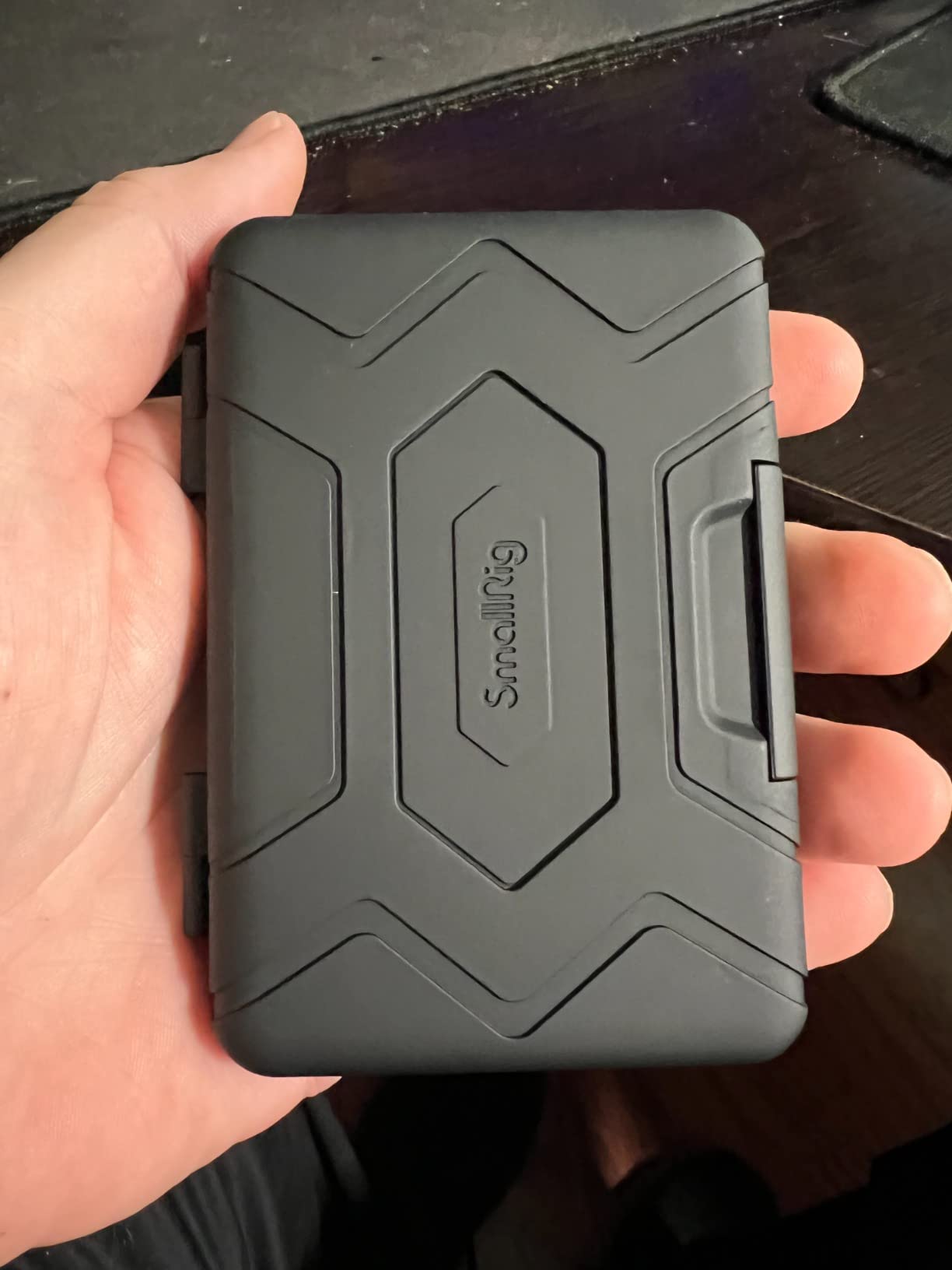
The 2m drop test certification is what sold me on this case for run-and-gun documentary work. I dropped it (accidentally) from chest height onto concrete while unloading gear, and the case bounced without cracking or coming open. The polycarbonate exterior and silicone interior absorbed the impact, and all 15 cards inside were fine. For documentary shooters who can’t always control their environment, that drop protection is meaningful insurance.
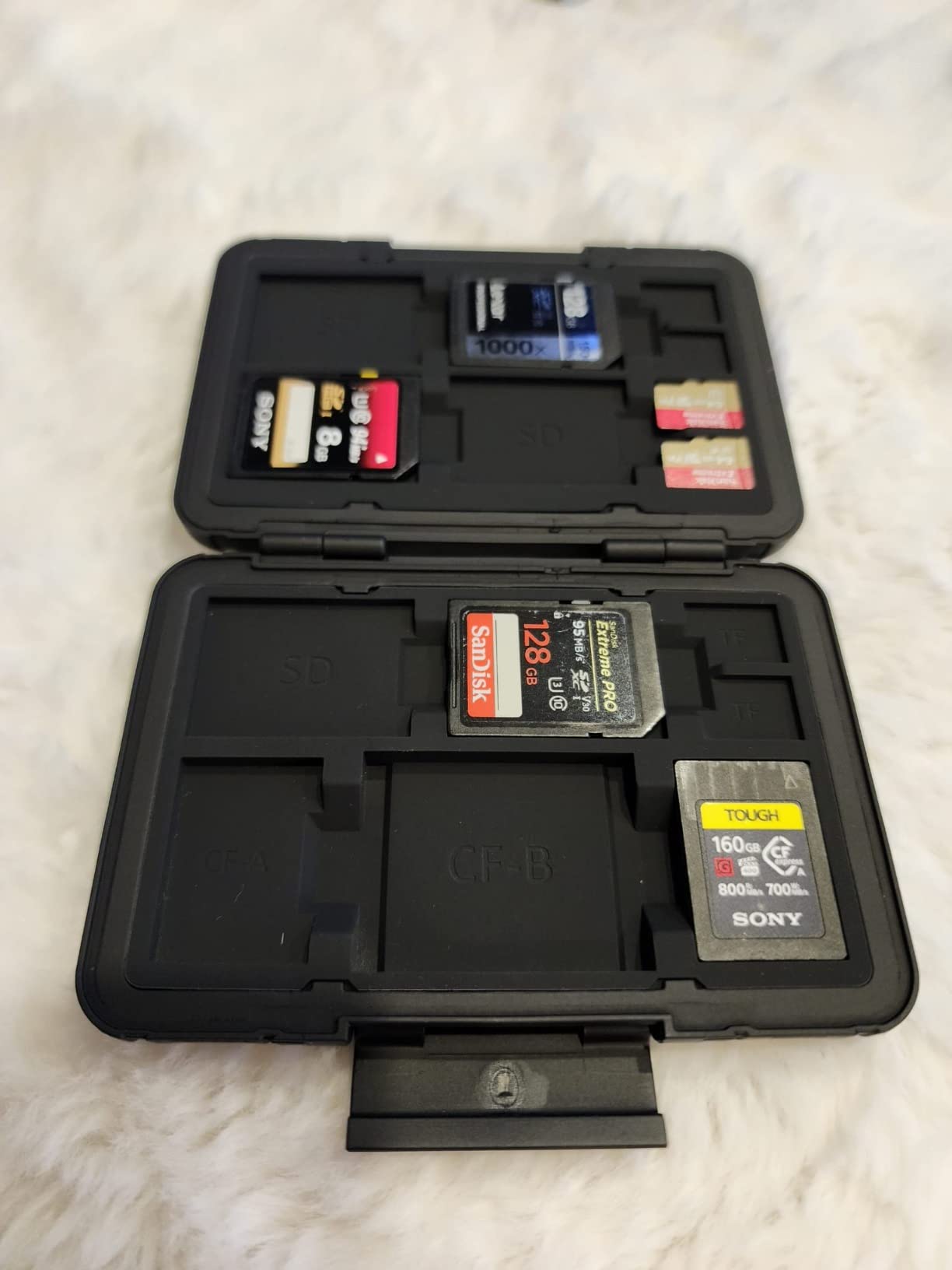
From a build perspective, the polycarbonate shell is rigid, and the silicone gasket provides water resistance for rain and splash protection. The case weighs only 120 grams, making it one of the lightest hard-shell options in this roundup. SMALLRIG’s ergonomic locking system uses a side clasp that’s secure but requires two hands to open easily, which can be a drawback when you need one-handed access between takes.
The main concern I have with this case is the SD card slot depth. The Type A slots are properly sized, but the SD slots are slightly shallow, and I’ve had cards slide partially out of the slots when the case is jostled. This isn’t a dealbreaker, but it’s worth checking each card is fully seated before closing the lid, especially if you’re moving quickly between setups.
Who this case works best for
This is the obvious pick for Sony shooters using FX3, FX6, FX30, A7S III, A7R V, A1, and A9 III bodies that take CFexpress Type A media. Documentary teams and event videographers who need drop protection in unpredictable shooting environments will also benefit from the 2m drop certification. The lightweight design is well-suited for gimbal operators and anyone building a minimal kit.
Who should consider other options
If you’re not shooting Sony or another camera platform that uses CFexpress Type A, you’re paying for slots you won’t use. Crews needing higher card counts or multi-format support should look at the PROfezzion or K&F CONCEPT options. The 15-slot capacity is also limiting for productions that need to carry media for a full shoot day across multiple cameras.
6. JJC CFexpress Type A + SD Card Case – Best Compact Pick for Hybrid Shooters
CFexpress Type A Card SD Card Holder Case Storage, Water-Resistant Shockproof Memory Card Organizer Box for 12 SD Card, 12 CFexpress Type-A Card for Sony A7RV A7SIII A7IV A7R5 A1 A9M3 FX3 FX6 FX30 FR7
12 SD + 12 CFexpress Type A
ABS + silicone gasket
Soft foam lining
Pros
- Dual CFexpress Type A and SD support
- Water-resistant silicone seal
- Lightweight at 0.05 kg
- Snug foam-lined slots
- Matte textured exterior
Cons
- Doesn't fit CF cards
- CFexpress Type A slots are tight
Hybrid shooters who run Sony Alpha bodies alongside dedicated Sony cinema cameras will appreciate this dual-format JJC case. It holds 12 SD cards and 12 CFexpress Type A cards in a shell that’s barely larger than a deck of cards. On a recent wedding-commercial hybrid shoot, this case handled media from both my A7 IV (SD) and FX3 (Type A) without any cross-contamination of card types.
The water-resistant seal is the same silicone gasket design that JJC uses across their case line, and it has performed reliably in light rain and coffee-spill incidents. The soft foam lining cradles each card individually, so cards don’t shift or scratch against each other during transport. The matte textured exterior provides grip even with wet hands, which is a small but meaningful detail on outdoor shoots.
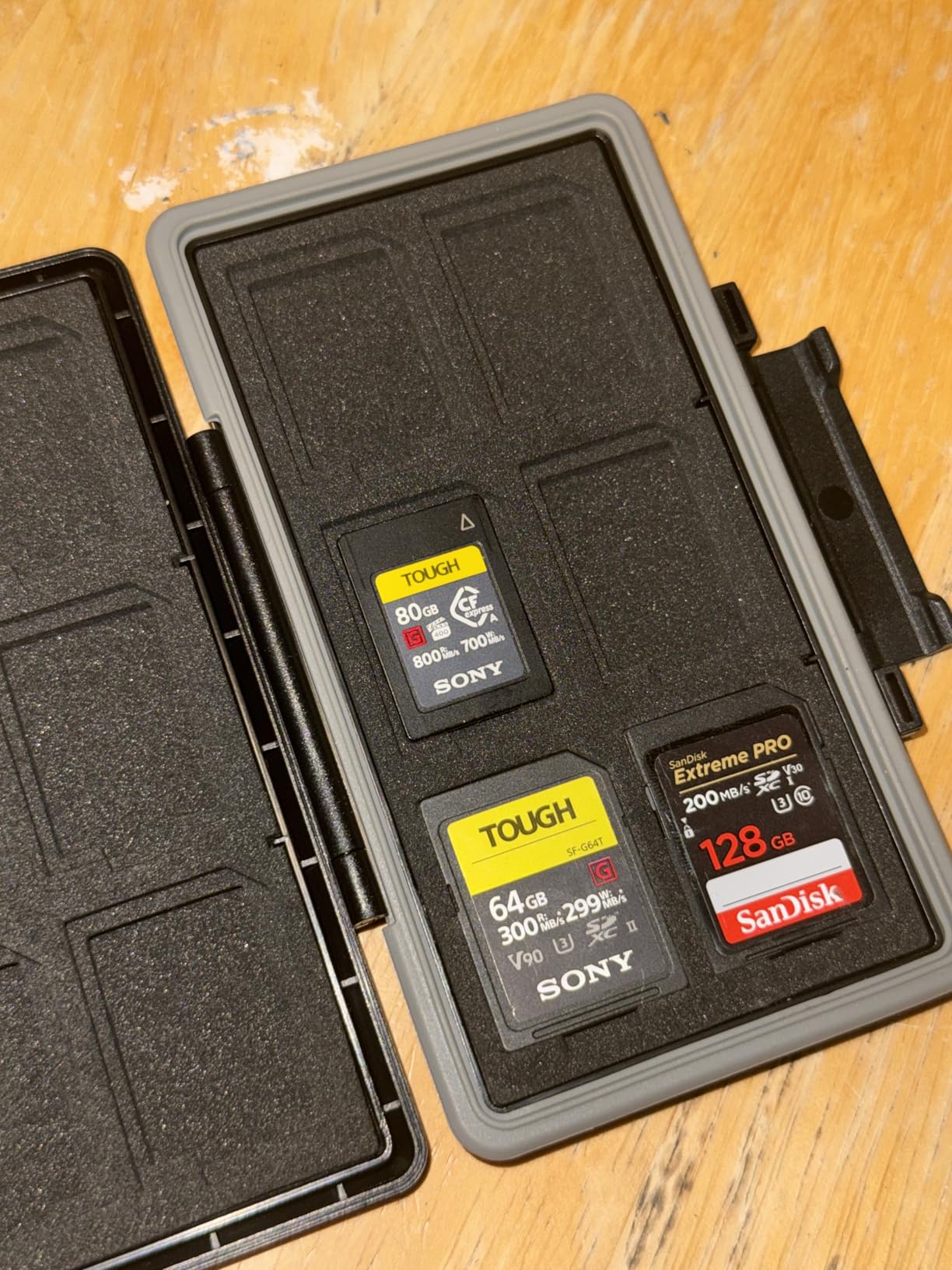
From a technical standpoint, the ABS construction is light but rigid enough to protect cards from bending pressure. The ergonomic locking clasp is the same proven design from JJC’s other cases, and it’s operable with one thumb. At 0.05 kg, this case adds almost no weight to a camera bag, making it ideal for travel and run-and-gun work.
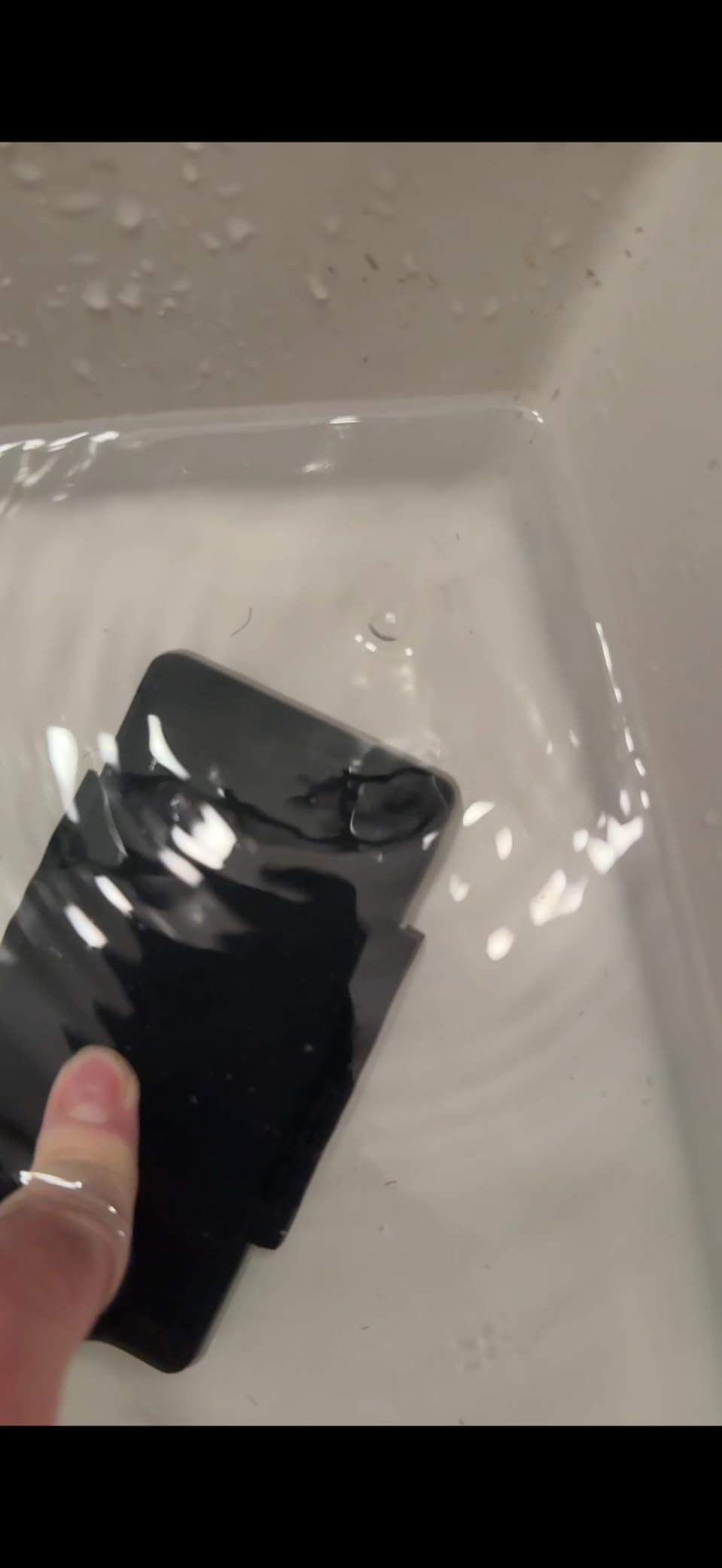
The main limitation is the lack of CompactFlash support. If your kit includes legacy bodies that use CF cards, you’ll need a separate case. The CFexpress Type A slots are also slightly tight, which is appropriate for the more expensive media, but new users should expect to apply a bit more force when removing cards. Overall, this is a focused case that does its specific job well.
Who this case works best for
Hybrid shooters and event videographers who run both Sony Alpha stills cameras and Sony cinema cameras will get the most value from this case. Wedding videographers, corporate video producers, and content creators who shoot across multiple camera platforms will appreciate the unified storage. Travel filmmakers and anyone building a minimal kit will also benefit from the compact size and low weight.
Who should consider other options
If your workflow uses only one card format, you don’t need the dual configuration. CF-only shooters should look at the PROfezzion or JJC multi-format case instead. Larger productions needing more than 12 cards per format will also find this case limiting and should consider higher-capacity options.
7. JJC Camera Battery + Memory Card Storage Case – Best for All-In-One Kit Management
JJC Portable Camera Battery Memory Card Storage Case for 3 SD Card,4 CFexpress Type-B/XQD Cards,2 Camera Batteries,Compact Cameras Battery Holder Box for Nikon EN-EL15
3 SD + 4 CFexpress Type B/XQD + 2 batteries
IP67 waterproof
ABS shell
Pros
- IP67 waterproof rating
- Combines battery and card storage
- Anti-slip lanyard
- Battery level indicator slider
- Fits multiple battery brands
Cons
- Some batteries fit loosely
- Memory cards can be tight to remove
The JJC combo case solved a kit organization problem I didn’t realize I had. Before I started using this case, I was carrying camera batteries in one pouch, SD cards in another, and CFexpress cards in a third. Now everything lives in one IP67-rated waterproof case that I can toss in a gear bag or hand off to a PA at the end of the day without worrying about anything getting lost.
The IP67 waterproof rating is the standout feature. IP67 means the case can survive full submersion in up to 1 meter of water for 30 minutes. I tested this in a hotel sink (carefully, with non-critical cards), and the seal held perfectly. For shoots near water, in rain, or in any environment where moisture is a constant threat, this rating provides real peace of mind.
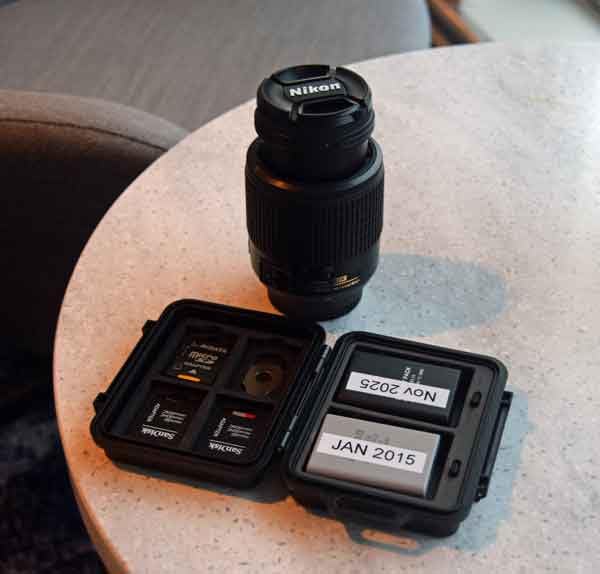
From a build perspective, the high-strength ABS shell is rigid and impact-resistant. The TPR padding inside absorbs shock and prevents cards from rattling against each other. The ergonomic locking system uses the same JJC clasp design, and the included lanyard is useful for attaching the case to a belt loop or gear bag D-ring.
The battery slots are designed to fit common camera batteries from Canon, Sony, Nikon, Fujifilm, and Olympus. The battery level indicator slider is a small but useful detail that lets you check charge state without removing the battery. Some third-party batteries fit slightly loosely, which is worth testing before relying on the case for a critical shoot.
Who this case works best for
This combo case is ideal for camera operators and ACs who want to consolidate their essential media and power storage into one protected unit. Documentary shooters, travel filmmakers, and anyone working in unpredictable environments will benefit from the IP67 waterproof rating. Production companies issuing gear kits to crew members will also appreciate the unified storage approach.
Who should consider other options
If you need higher card counts, this case is too small. Productions with more than three SD cards and four CFexpress cards in active rotation need a separate, higher-capacity card case. Also, if you prefer to keep batteries and cards in separate cases for quick access, the combo design adds a step when you only need one type of media.
8. K&F CONCEPT 29-Slot Waterproof Memory Card Case – Best Warranty Coverage
K&F CONCEPT 29 Slot Memory Card Case, Carrying Case for SD, CF, CFexpress
29 slots
Polycarbonate resin shell
Molded rubber lining
Pros
- 29 slots across 7 card types
- Polycarbonate resin shell
- Molded rubber lining for protection
- IP-rated water resistance
- 1-year manufacturer warranty
Cons
- Slightly smaller than expected
The K&F CONCEPT case rounds out this list with a strong balance of capacity, protection, and warranty coverage. The 29-slot configuration handles 4 SD, 4 CF/XQD, 4 CFexpress, 12 Micro SD, 2 Nano SIM, 2 Micro SIM, and 1 SIM card, which is essentially every media type a hybrid filmmaker might encounter. The polycarbonate resin shell is rigid and impact-resistant, and the molded rubber lining cradles each card individually.
The 1-year manufacturer warranty is unusual in this product category and provides real value. If anything fails due to manufacturing defect within the first year, K&F CONCEPT will replace the case. For working professionals whose cases see daily use, this warranty is meaningful insurance. The company has a solid reputation in the camera accessory space, and the warranty reflects confidence in the build quality.
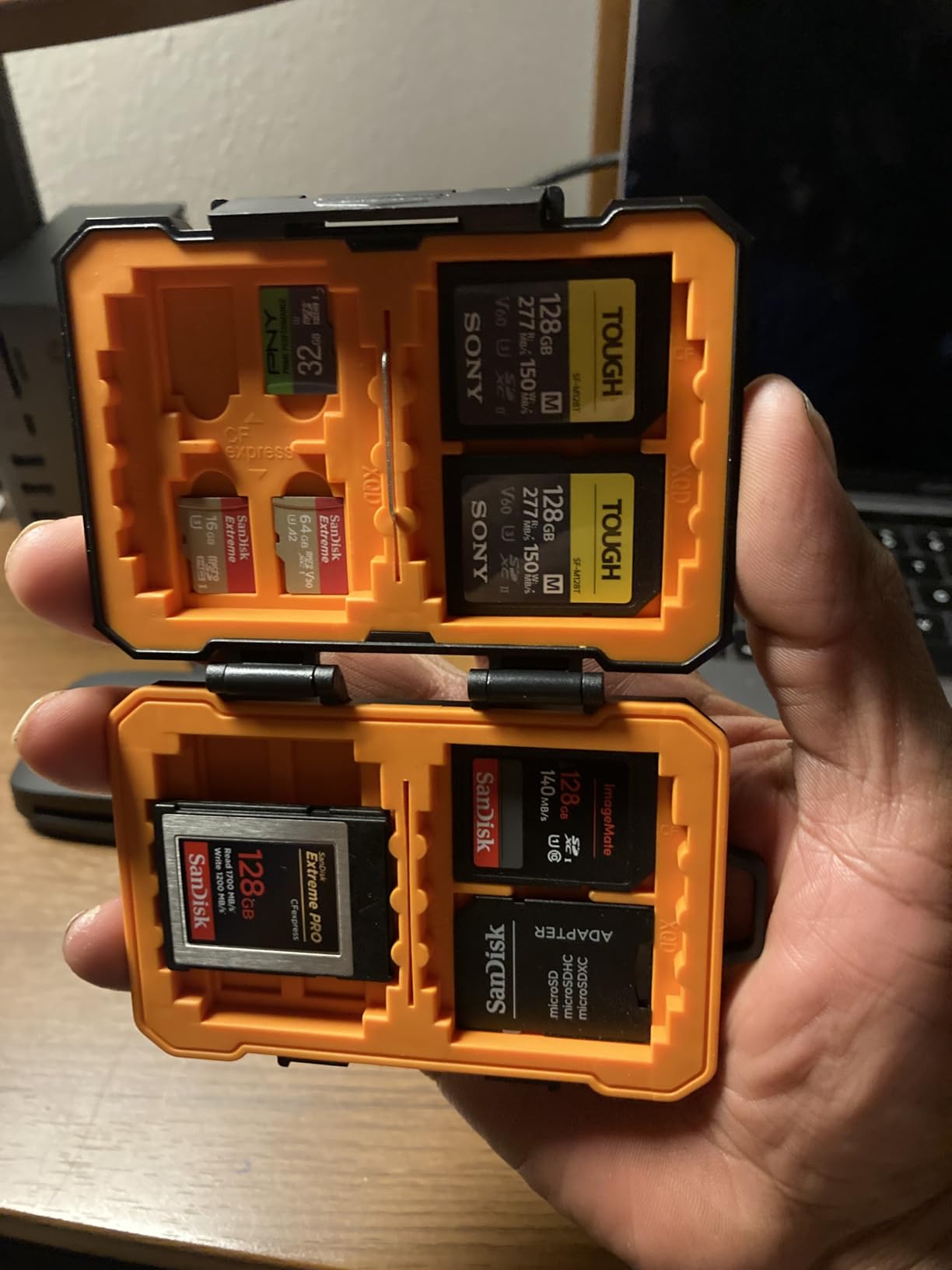
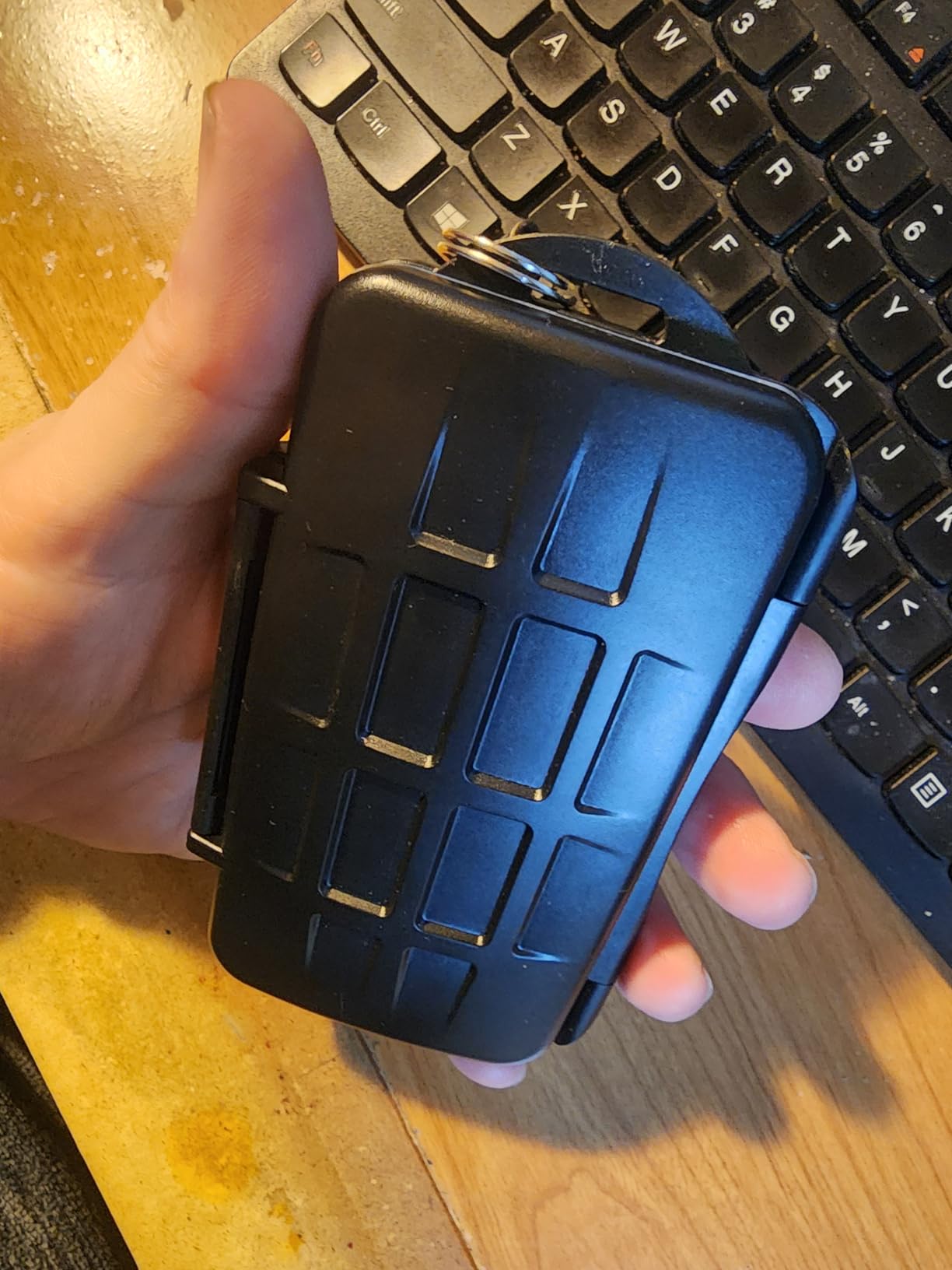
From a technical perspective, the ergonomic quick-locking system uses a side clasp that’s easy to operate with one hand. The case weighs 90 grams, which is competitive with other hard-shell options. The compact size (4.09 x 1.61 x 0.87 inches) fits easily in a cargo pocket or the side pocket of a backpack, which is useful for shooters who don’t want to dig through a full kit bag between takes.
The main concern from user reviews is that the case is smaller than some buyers expected. While 29 slots sounds like a lot, the slot layout is compact, and the case itself is closer in size to a small phone than a wallet. This is actually an advantage for portability, but it’s worth checking the dimensions against your typical kit bag configuration before ordering.
Who this case works best for
This is a strong pick for hybrid shooters who work across multiple camera platforms and need to carry various card formats in one case. Travel filmmakers and documentary producers who appreciate warranty coverage will find this case reassuring. Production companies outfitting crew members with reliable gear will also benefit from the warranty and the brand’s reputation.
Who should consider other options
If you only use one or two card formats, the 29-slot multi-format configuration includes slots you’ll never fill. Single-format shooters should consider the JJC 36-slot case for SD-heavy workflows or the PROfezzion for CFexpress-heavy workflows. Crews needing extreme crush protection (heavy road case environments) might prefer the more rigid PROfezzion shell.
Buying Guide: How to Choose a Memory Card Case for Film Sets?
Choosing the right memory card case for film production isn’t the same as choosing one for personal photography. Sets generate different stress patterns: longer shoot days, more cards in rotation, mixed camera packages, and exposure to weather and rough handling. Here’s what to prioritize when making your decision.
Card Type Compatibility for Film Sets
The first decision is which card formats your cameras use. Modern Sony cinema cameras (FX3, FX6, FX30, A7S III) use CFexpress Type A cards, which are more expensive but faster than SD. RED Komodo, Canon C500 Mark II, and Nikon Z9 use CFexpress Type B cards, which are physically larger. Older cinema cameras and many prosumer bodies still use SD or CompactFlash. If your production uses mixed camera packages, you need a case that handles multiple formats, like the PROfezzion or K&F CONCEPT options.
For pure SD/Micro SD workflows (Sony A7 IV, Canon R5, Blackmagic Pocket 6K with SD adapter), the JJC 36-slot case is the most cost-effective option. For CFexpress-heavy workflows, prioritize cases with proper insert systems designed for the larger card sizes.
Protection Ratings Explained (IPX4, IP67)
IP ratings are the international standard for dust and water resistance. IPX4 means the case is protected against water splashes from any direction, which handles rain and accidental spills. IP67 means the case is fully dustproof and can survive submersion in up to 1 meter of water for 30 minutes. For most film sets, IPX4 is sufficient, but if you’re shooting near water or in extreme weather, IP67 provides meaningful extra protection.
Beyond IP ratings, look for cases with silicone gasket seals, which keep moisture and dust out of the card slots. Hard polycarbonate shells provide better crush protection than soft ABS, but they add weight. For run-and-gun documentary work, hard shells are worth the extra grams. For studio or interior shoots, soft shells are adequate.
Capacity and Organization
Calculate your shoot’s typical card consumption before choosing a case. A typical 4K shoot day uses 2-3 cards per camera body. If you’re running two cameras for a 5-day shoot, you need at least 20 SD card slots minimum, plus room for backup cards. The 36-slot JJC case covers this with margin, while the 15-slot SMALLRIG case is better suited for shorter shoots or single-camera productions.
Organization features matter more than raw slot count. Look for cases with labeling sticker sheets, slot numbering, or insert systems that let you separate cards by camera, shoot day, or scene. The PROfezzion’s interchangeable inserts are particularly useful for keeping cards from different camera bodies organized within one case.
Portability and Set Workflow
Think about how you’ll actually carry the case on set. Carabiner clips work well for runners and ACs who need quick access. Compact hard-shell cases slip into cargo pockets for DPs and camera operators who want minimal kit. Larger multi-format cases belong in a kit bag or audio bag rather than on your person.
One-handed operation is critical on busy sets. Clasp designs that open with a thumb press (like JJC’s ergonomic lock) are faster than zipper designs or two-handed clasps. When you’re trying to swap cards between takes, those seconds add up across a full shoot day.
Frequently Asked Questions
What type of memory card is best for filming?
CFexpress Type B cards are the current professional standard for high-end cinema cameras like RED Komodo, Canon C500 Mark II, and Nikon Z9, offering the fastest write speeds for 4K and 8K recording. CFexpress Type A cards are used in Sony FX3, FX6, and A7S III cameras. For most prosumer and hybrid workflows, UHS-II SD cards like the SanDisk Extreme Pro or Angelbird AV Pro are reliable and cost-effective. The right choice depends on your camera’s card slot and the codec/bitrate you’re recording.
How many hours of 4K video will 128GB hold?
A 128GB card holds approximately 1.5 to 2.5 hours of 4K footage depending on the codec and bitrate. At 400 Mbps (typical for high-quality 4K), 128GB holds about 40 minutes of footage. At 100 Mbps (efficient codecs like H.265), 128GB holds closer to 2.5 hours. For a typical 12-hour shoot day at 4K, plan for 6-8 cards per camera body to avoid running out of media mid-shoot.
How to store movies on SD card?
After your shoot, copy footage to at least two separate backup drives before reformatting the card. Store cards in a labeled case organized by shoot day and camera body, in a cool, dry environment away from direct sunlight. For long-term archival, transfer footage from cards to LTO tape or a RAID array rather than relying on SD cards for permanent storage, as flash media can degrade over time.
Why are SD cards being phased out?
SD cards are being supplemented rather than fully phased out. CFexpress Type A and Type B cards offer significantly faster read speeds, which are necessary for high-bitrate 4K, 6K, and 8K video recording that exceeds SD card capabilities. However, SD cards remain widely used in prosumer cameras, hybrid photo/video bodies, and as secondary or backup media on professional sets. Expect SD cards to remain relevant for several more years, especially in mid-tier camera bodies.
Final Verdict: Choosing Your Film Set Memory Card Case
For most filmmakers in 2026, the JJC 36-Slot Water-Resistant Case remains the best balance of capacity, protection, and value. It handled everything I threw at it across two indie productions and a documentary shoot, and the 4.8-star average across 15k+ reviews reflects what I saw in real use. If you’re shooting on Sony cinema cameras with CFexpress Type A media, the SMALLRIG 15-Slot case is purpose-built for that workflow. For RED, Canon Cinema EOS, or ARRI shooters running CFexpress Type B, the PROfezzion hard shell provides the protection level your media deserves.
Whichever case you choose, invest in a labeling system from day one. Slap a piece of tape on each card with the shoot day, camera body, and roll number. Your future self, scrambling to find the right card at 2 AM during a deadline crunch, will thank you. And pick up a small AirTag to drop in your case. For the cost of a coffee, you get location tracking if the case ever gets misplaced on a busy set, which is one extra layer of insurance no film production budget should skip.