
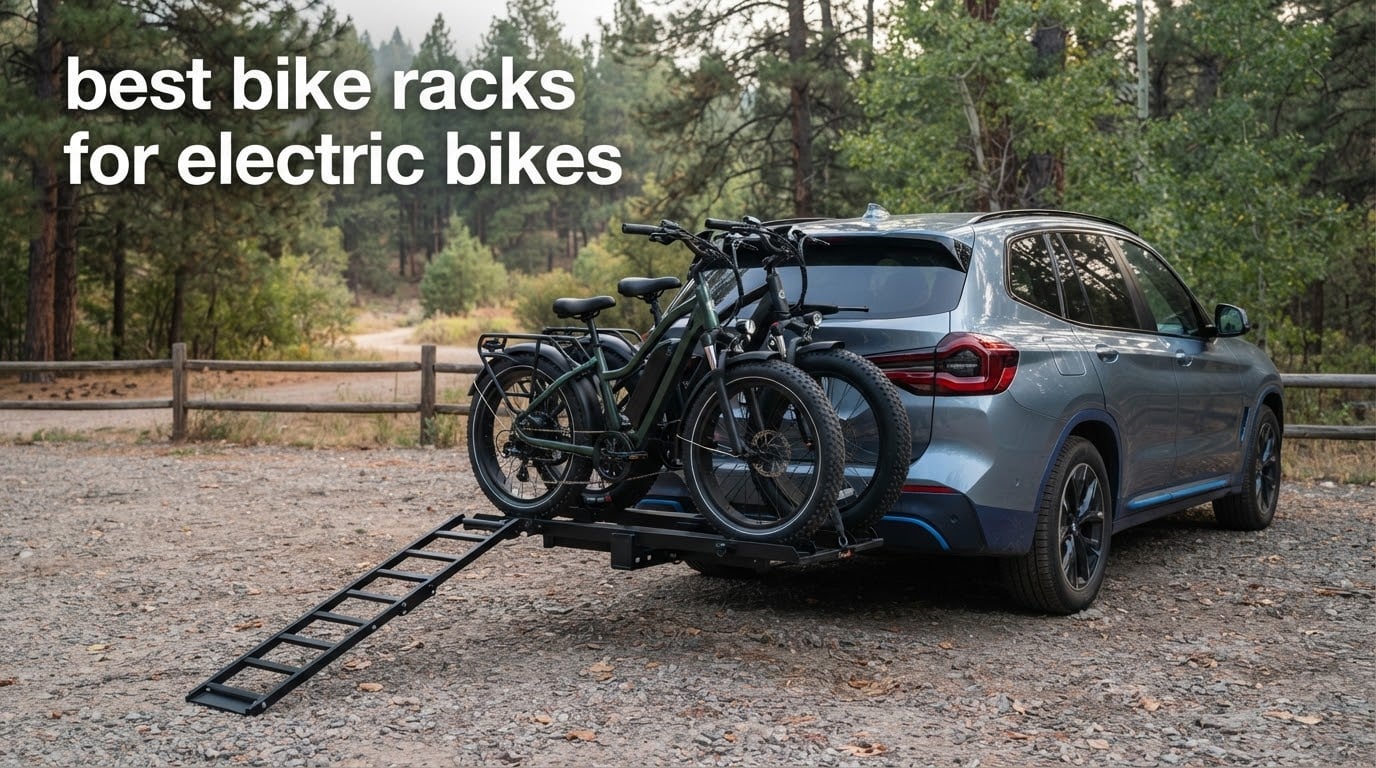
Yes, e-bikes need a purpose-built rack, and the difference is not subtle. A standard hanging rack is usually rated around 35 to 40 lbs per bike, while most electric bikes land somewhere between 50 and 100 lbs before you add anything to the basket. Put a 90 lb e-bike on a rack built for 40 and you are asking for bent wheel trays, stripped threads and a bike that shifts every time you touch the brakes.
That is why the best bike racks for electric bikes are almost all platform-style hitch carriers. They hold the bike by the wheels in adjustable trays rather than by the frame, they are rated per bike instead of by total load alone, and the wheel trays are wide enough for the fatter tires and lower frame geometry that e-bikes tend to have. After spending several weeks comparing the eight racks below, checking the published ratings against the real weights owners report, and reading hundreds of owner reviews, we can tell you which ones hold up and which ones only look heavy-duty on a spec sheet.
We kept the list focused on 2-inch hitch platform racks, because that is the format that actually works for e-bikes. Trunk racks are not an option for a 70 lb bike, roof racks ask you to lift that same 70 lb over your head, and hanging hitch racks run into the same weight ceiling that rules out the trunk-mounted versions. Within the hitch platform group, the real differences come down to per-bike weight rating, tray width, whether a ramp is included, and how much you are being asked to lift.
We also spent time on the details that rarely make it into roundups: tongue weight limits, what happens to your hitch pin clearance on a short bumper, whether the rack blocks your taillights, and what the assembly actually feels like at midnight in a driveway. If you want the short answer first, the Young Electric 2-Bike Rack with Ramp is the one we would buy, and the rest of this guide explains why the alternatives exist at all.
Table of Contents
- Top 3 E-Bike Racks for Heavy Bikes
- Quick Overview: 8 Best Bike Racks for Electric Bikes in 2026
- 1. Young Electric 2-Bike Hitch Rack with Ramp – Best Overall for Heavy E-Bikes
- 2. TANX 2-Bike Fat Tire Hitch Rack – Budget Pick That Folds Flat
- 3. Wildroad Convertible Cargo Carrier and Bike Rack Set – Best for Camping and Trail Gear
- 4. Young Electric Single Bike Rack with Ramp – Best for a Single 100 LB E-Bike
- 5. CRAVOT CyberRack E2 Plus – Best for Fat Tire and Step-Through Pairs
- 6. Young Electric 2-Bike Smart Tilt Platform Rack – Best Value for Two Heavy Bikes
- 7. RokRack S One Single E-Bike Rack – Best Lightweight Single-Bike Setup
- 8. Tow Tuff Hitch Cargo Carrier with Bike Rack – Best for Multi-Bike and Cargo Hauling
- How to Choose an E-Bike Rack: Weight, Hitch, Tires and Loading
- Frequently Asked Questions
- Conclusion: Our Best Bike Racks for Electric Bikes in 2026
Top 3 E-Bike Racks for Heavy Bikes

Young Electric 2-Bike Rack with Ramp
- 200 lb total capacity
- 100 lb per bike
- Loading ramp included
- Anti-wobble wheel cradles

TANX Fat Tire 2-Bike Hitch Rack
- 160 lb total capacity
- Tires up to 5 inch wide
- Tilts back for trunk access
- 33.4 lb rack

Young Electric 2-Bike Smart Tilt Rack
- 200 lb total capacity
- Fits 58 inch wheelbase
- Quick-release tilt lever
- Rear safety reflector
Those three cover most people. The first handles the heaviest pairs with a ramp in the box, the second is the lightest rack here and folds down to almost nothing when empty, and the third is the cheapest way to carry two heavy e-bikes with tilt-down trunk access.
Quick Overview: 8 Best Bike Racks for Electric Bikes in 2026
| Product | Specs | Action |
|---|---|---|
| Young Electric 2-Bike Hitch Rack with Ramp |
|
Check Latest Price |
| TANX 2-Bike Fat Tire Hitch Rack |
|
Check Latest Price |
 Wildroad Cargo Carrier and Bike Rack Set Wildroad Cargo Carrier and Bike Rack Set |
|
Check Latest Price |
 Young Electric Single Bike Rack with Ramp Young Electric Single Bike Rack with Ramp |
|
Check Latest Price |
 CRAVOT CyberRack E2 2-Bike Rack CRAVOT CyberRack E2 2-Bike Rack |
|
Check Latest Price |
| Young Electric 2-Bike Smart Tilt Rack |
|
Check Latest Price |
 RokRack S One Single E-Bike Rack RokRack S One Single E-Bike Rack |
|
Check Latest Price |
 Tow Tuff Cargo Carrier with Bike Rack Tow Tuff Cargo Carrier with Bike Rack |
|
Check Latest Price |
Two things jump out immediately. First, every rack here needs a 2-inch receiver, so if your hitch is the smaller 1.25-inch style you are looking at an adapter hunt before anything else. Second, the per-bike numbers are the ones that matter: 200 lb total across two bikes is only useful if the manufacturer also sanctions 100 lb on each tray.
1. Young Electric 2-Bike Hitch Rack with Ramp – Best Overall for Heavy E-Bikes
Young 2-Bike Ebike Hitch Rack with Ramp, 200 lbs Capacity for Car, SUV
200 lb total
100 lb per bike
2-inch receiver
Ramp included
RV approved
Pros
- Rated 100 lb per bike
- Handles the heaviest e-bikes
- Integrated ramp stows on the frame
- Anti-wobble wheel cradles
- Mostly pre-assembled
Cons
- 2-inch receiver only
- 56 lb rack is heavy to lift
- Pre-installed parts can confuse assembly
This is the rack we ended up recommending to friends. The published rating is 200 lb total, and the manufacturer splits that as two bikes up to 100 lb each, which puts it in the same territory as the racks people on electric bike forums describe as the only ones that never worried them.
Loading is the part that usually decides the purchase. The integrated ramp slides into a slot on the frame and stays there when you are not using it, so you roll a 90 lb bike up a slope instead of lifting it chest-high. Reviewers consistently single out the ramp as the reason the rack is manageable, and the anti-wobble structure with the patented wheel cradles is what keeps the bikes from shifting against the bodywork over long drives.
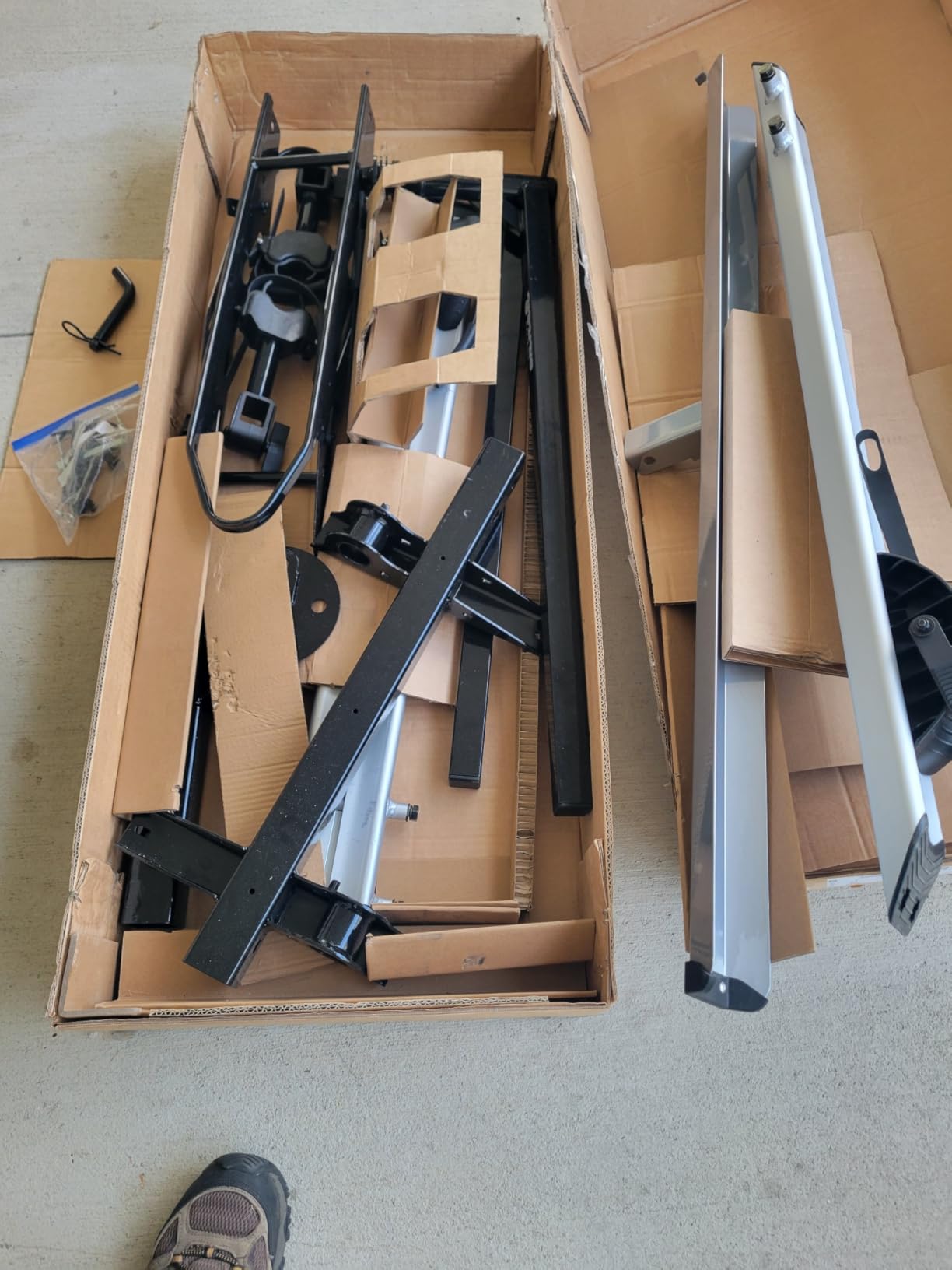
Construction is a mix of reinforced steel and aluminum, which explains the 56 lb shipping weight. That weight is the main drawback: lifting it into a receiver is a two-person job for a lot of people, and it is heavier than the TANX in the next section by more than 20 lbs. If you already have a ball mount on a low-hanging receiver, budget an extra set of hands for the install.
The rack is RV approved, which matters if you tow a motorhome and want a rack on the back rather than a rack on the car. Buyers also note that most of the assembly arrives done, so the actual install is more about aligning the shims and torquing the bolts than building the frame from scratch. One common confusion: some pieces in the accessory pack are already installed when it arrives.
What to check before you buy it
Confirm you have a genuine 2-inch receiver. This rack will not fit 1.25-inch hitches, and it is the single most common reason owners return racks in this category. Also check the depth of your receiver tube, because a deep hitch on a short-overhang bumper can leave the rack projecting well behind the tailgate.
Then measure your bikes. The 100 lb per-bike figure covers nearly everything on the road today, but a dual-battery fat tire build can push past it, and exceeding a rating is how frames crack and straps snap. Take the actual weight from your manufacturer spec sheet rather than guessing.
Who should skip it
Skip it if you only carry one bike, or if lifting 56 lbs into a high receiver is a problem for your body or your setup. The single-bike version later in this roundup is lighter and does the same job for half the pair. Skip it too if you need to fold the rack flat when empty, since this one does not fold.
It is also a two-bike-only design with a fixed tray layout, so there is no way to add a third bike later. Plan around that before you buy rather than after.
2. TANX 2-Bike Fat Tire Hitch Rack – Budget Pick That Folds Flat
TANX Bike Racks for Ebikes,Fat Tire Bike Rack for Tow Hitch 2-Bike 160 lbs Capacity,Hitch Bike Rack for Heavy E Bike, Wobble Free Smart Tilting Folding Bicycle Car Racks for Standard, 2 inch Receiver
160 lb total
2-inch receiver
Tires to 5 inch
Tilts and folds
Pros
- Lightest rack here at 33.4 lb
- Tilts back with bikes loaded
- Folds to about 14 inch empty
- Fits 5 inch wide tires
- Chrome vanadium tools included
Cons
- U-shaped clamps are not interchangeable
- Locking hitch bolt can be short
- Basic locks deter only opportunists
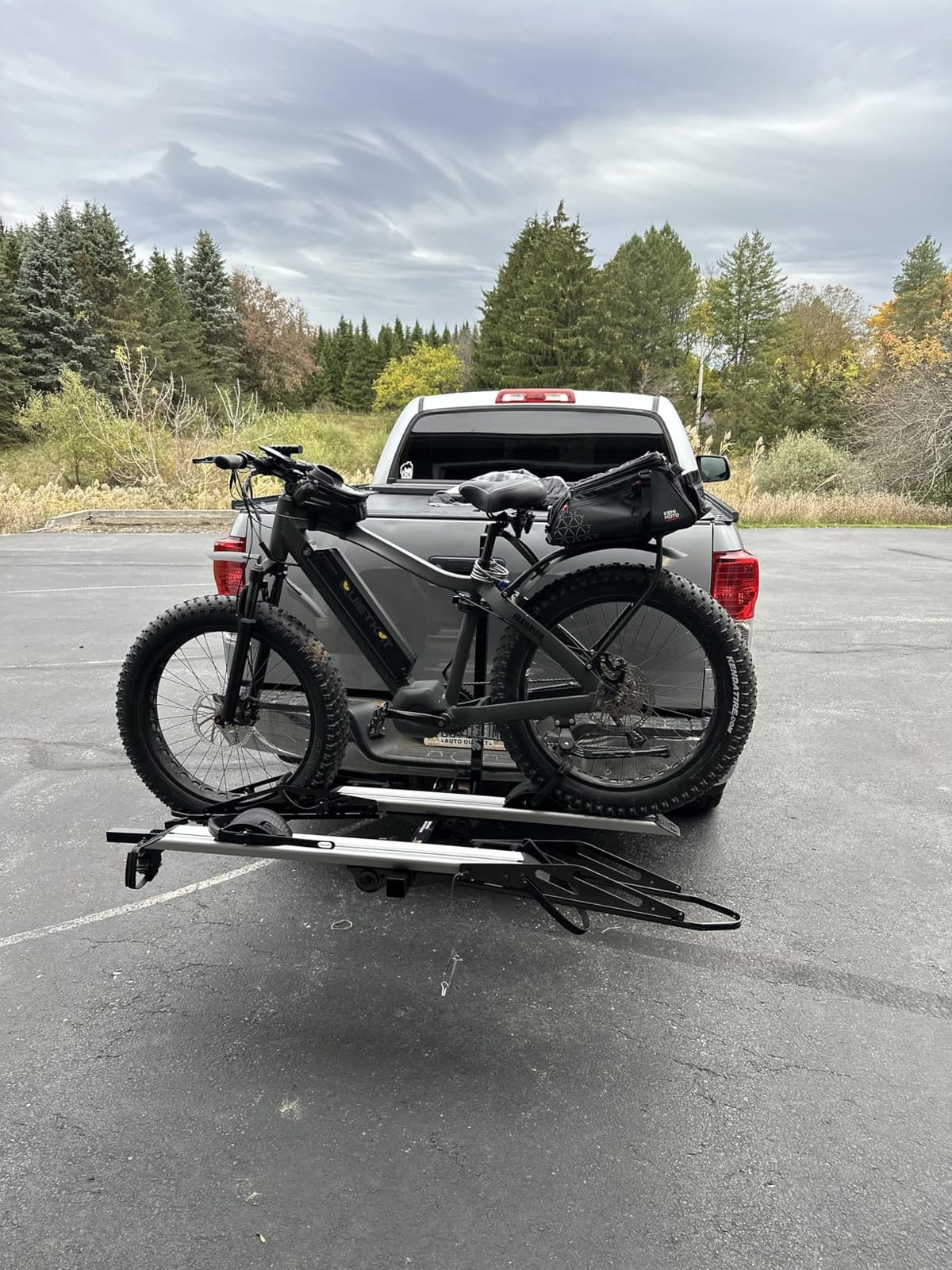
Where the first rack is built like a brick, this one is built like a folding ladder. At 33.4 lbs it is the easiest to lift into a hitch of the eight we looked at, and the folded depth of roughly 14 inch off the bumper makes it practical for people with tight garages, tight budgets for storage, or a sedan where a permanently extended rack is a problem.
Capacity is 160 lb for two bikes, which works for a pair of midweight commuters but is not the same claim as 100 lb per bike. Owners running heavier builds should subtract the total from the rating and see how much headroom is left. Tires up to 5 inches wide and frames up to 59 inches long are accepted, so fat tire e-bikes fit without an adapter.

The tilt-back function is genuinely useful. You release the lever, the loaded rack leans back, and you can open a trunk or tailgate without removing a single bike. That is the feature most people discover they need only after the first trip, and having it on a lighter rack makes it more useful, not less, because the combined load stays manageable.
Owners praise the weld finishing and the included chrome vanadium wrenches, which is a small thing that tells you the packing list was considered. The padded adjustable cradles with quick-lock straps keep bike finishes clean, and the anti-wobble hitch tightener plus locking pin kills the movement at the receiver once it is properly torqued.
What to check before you buy it
Look at the length of the included locking hitch bolt. Some owners on stock Subaru hitches report it runs too short to fully engage. Measure your hitch depth and confirm the bolt threads home with a few threads showing before you rely on it as your anti-theft point.
Read the clamp diagram carefully. The U-shaped clamps on the center post are not interchangeable, and fitting the wrong one prevents the locking mechanism from engaging at all, which is a confusing failure rather than an obvious one.
Who should skip it
Skip it if your two e-bikes together weigh more than 160 lb, because the total rating is the hard ceiling and this is not a 100 lb per bike design. Skip it if the bicycles themselves are extremely heavy and you have no ramp plan, since no ramp is included and you will be lifting them by hand.
The locks are basic and only deter opportunistic theft, so do not treat the hitch pin as security for a bike left overnight in a public place. If overnight security matters, look at racks with a rack-to-bike lock built in.
3. Wildroad Convertible Cargo Carrier and Bike Rack Set – Best for Camping and Trail Gear
Wildroad 60″x24″x14″ Hitch Cargo Carrier, Fits 2″ Receiver – Bike Rack Set
500 lb total
Switchable cargo or bike
2-inch receiver
Folds flat
Pros
- Converts between cargo basket and bike rack
- 500 lb load capacity
- 14 inch rails contain bulky loads
- 5 degree tilt adds clearance
- Very stable multi-hole spindle
Cons
- 82 lb rack is the heaviest here
- Cannot carry cargo with bikes loaded
- Two people needed to load
This one earns its place for a different reason. With two bolts it switches between a 500 lb cargo carrier with 14-inch tubular fence sides and a two-bike rack whose attachment adjusts for standard, fat tire and electric bike frames. If your trips are half riding and half hauling firewood, coolers and camp gear, that dual function is worth more than a dedicated bike rack.
When it is in bike mode, the multi-hole spindle design combined with the included no-wobble fastener produces one of the most stable connections in this roundup. Reviewers describe the ride as solid even with heavy bikes loaded, and the 5-degree upward tilt gives ground clearance while keeping the load away from exhaust fumes.
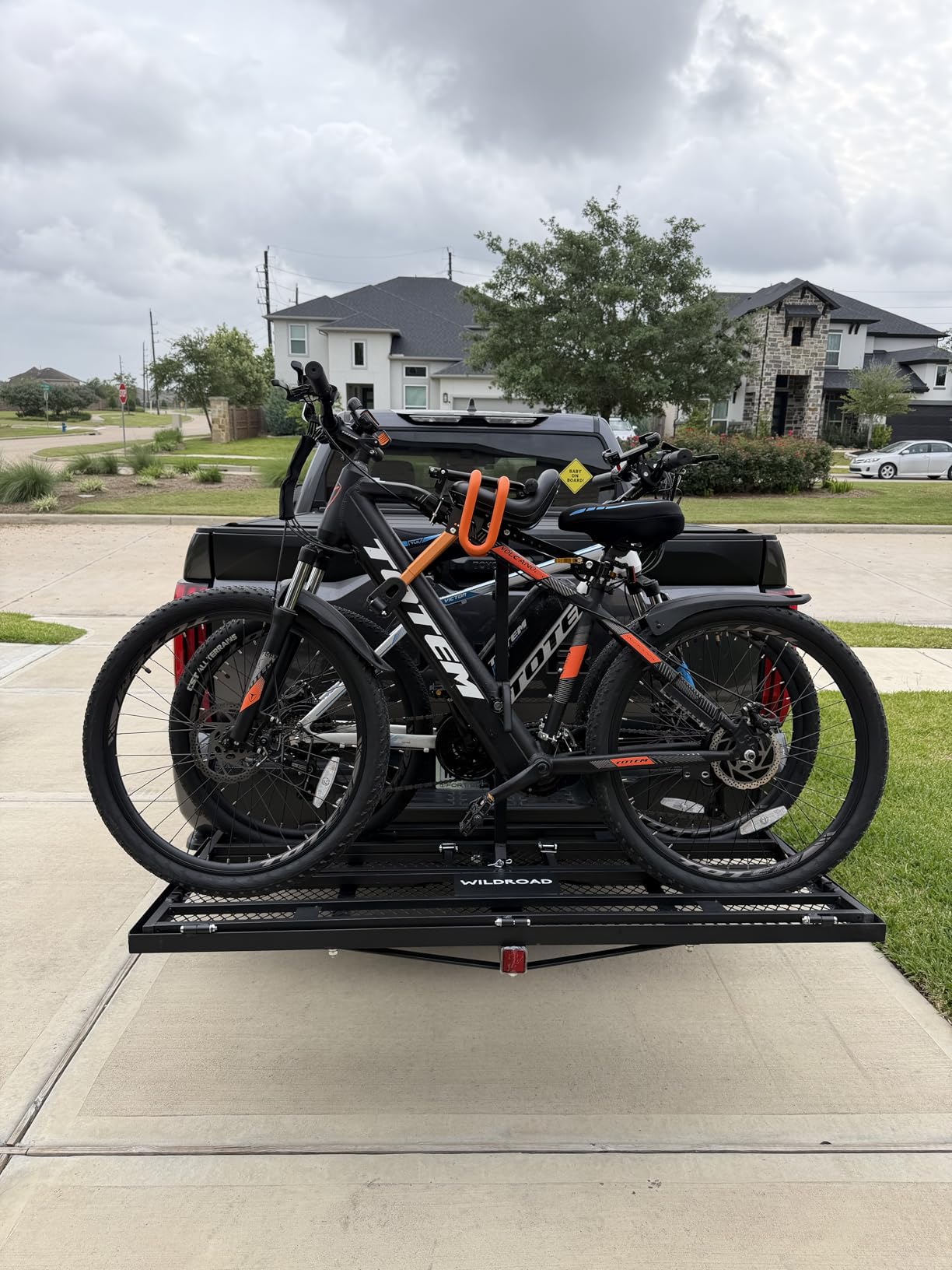
The finish is a dual e-coat and carbide black powder coat, which is why it does not look like a raw steel carrier after a season of mud. It also folds flat when you are not using it, so it is not permanently in the way of a rear hatch or a garage door.
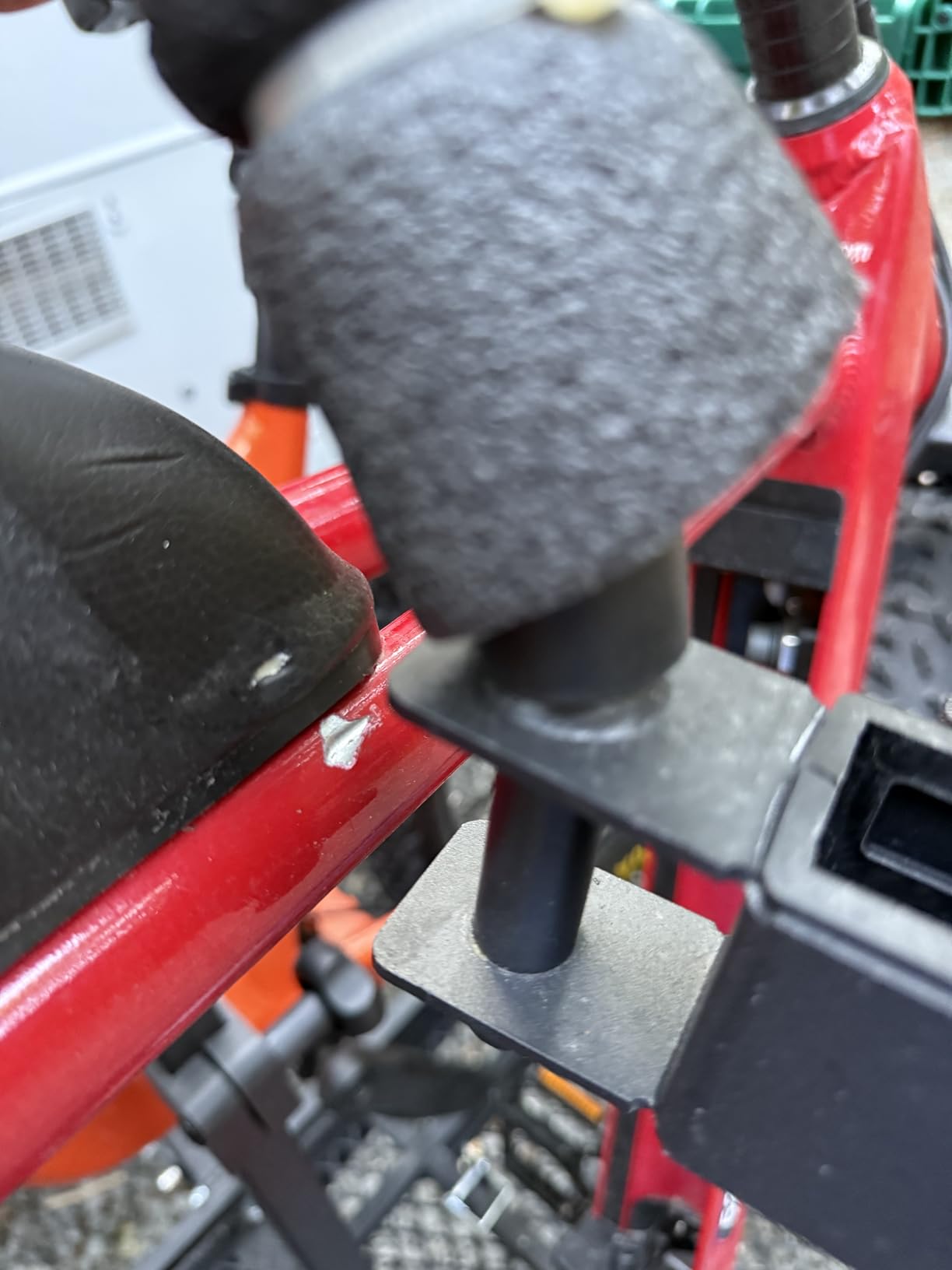
The catch is weight. At 82 lbs this is the heaviest rack in the roundup by a wide margin, and reviewers are blunt about needing two people to get it into the hitch. It is also a one-way switch: with the bike rack installed, you lose the cargo function entirely, so you are choosing a configuration rather than combining two.
What to check before you buy it
Be honest about the weight. If your receiver is high on a crossover or you tow this behind an RV with a small ball mount, a two-person lift every time you swap modes is going to get old fast. Measure your hitch height and think about whether you will be swapping configurations often.
Also note the e-bike accommodation is in the bike rack attachment, not in the platform dimensions, so check the tray width against your fat tires before you commit. The listing is compatible with standard 2-inch square receivers.
Who should skip it
Skip it if you only ever carry bikes, since you are paying for cargo capability you will not use and carrying 82 lbs you will resent. Skip it if you plan to load both bikes and gear at the same time, which this design cannot do.
It is also not the choice for someone who wants a ramp. There is no ramp, so bikes get lifted manually, and on an 82 lb rack that is harder than it sounds.
4. Young Electric Single Bike Rack with Ramp – Best for a Single 100 LB E-Bike
Young Hitch Mount Single Bike Rack with Ramp, 100 lbs Capacity
100 lb for one bike
Integrated ramp
2-inch receiver
RV approved
Pros
- 100 lb single-bike capacity
- Integrated ramp reduces lifting strain
- Anti-wobble bolt stops frame contact
- RV approved
- Quick pre-assembled install
Cons
- Carries only one bike
- 2-inch receiver only
- Some parts arrive pre-installed
Not everyone needs two trays. If you ride solo with one very heavy e-bike, this single-bike version is the more honest purchase: 100 lb capacity, a 100 lb capable ramp, and a 35.3 lb rack that one person can lift into a receiver without recruiting help.
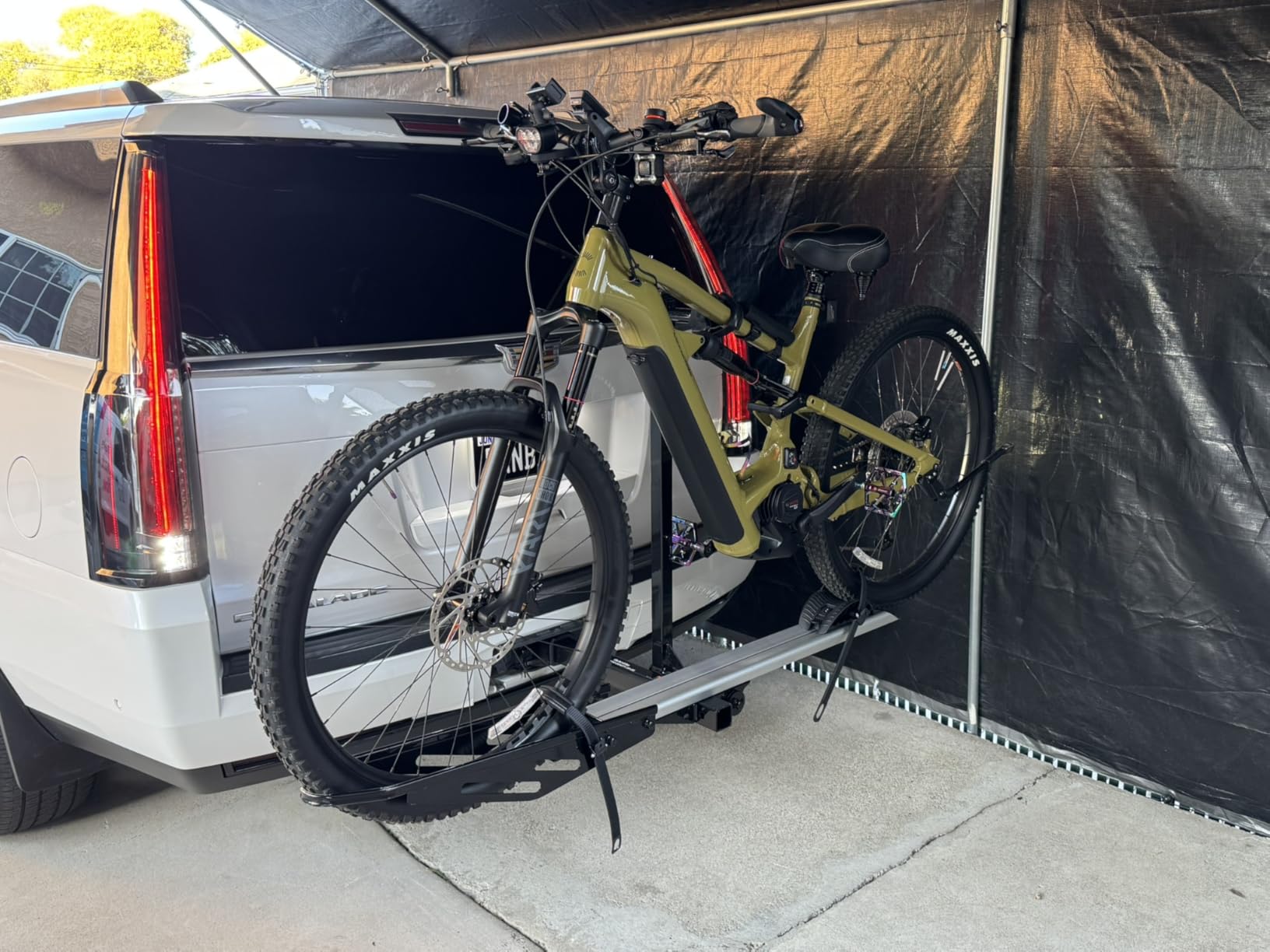
The patent secure wheel cradles and anti-wobble structure mean the bike is held by the wheels with no frame contact, which is the part that keeps paint intact over thousands of miles. The M16 anti-wobble locking bolt secures the rack to the hitch, and owners report a tight, wobble-free fit once it is torqued properly.
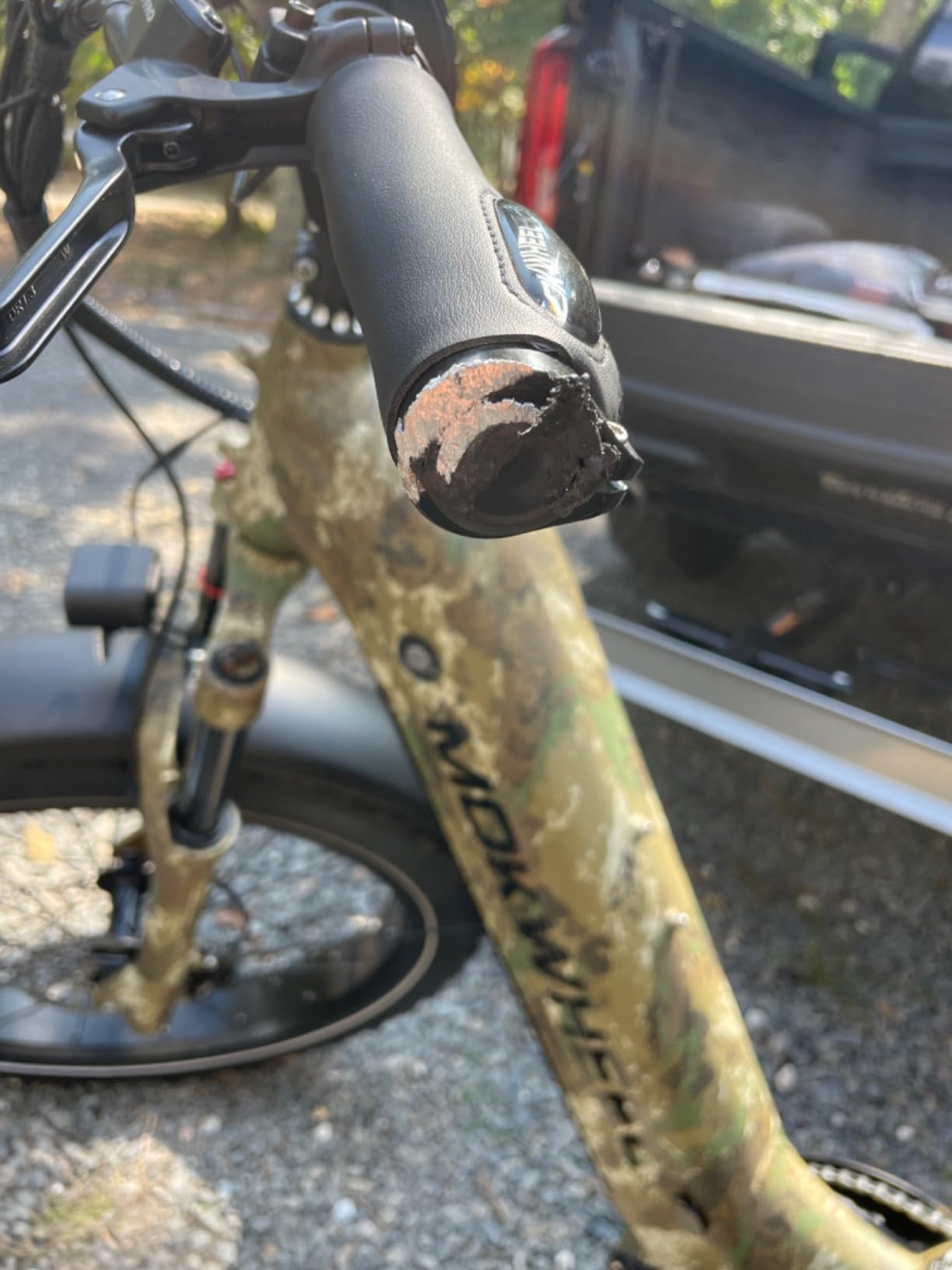
Like its two-bike sibling, the ramp integrates into the frame and stows there, so the same hardware handles a 90 lb bike whether you are rolling it up or carrying it. That is the difference between this class of rack and a trunk carrier, where every trip starts with a lift you will feel in your shoulders the next morning.
Riders using it behind an RV have the same RV approval as the two-bike model, and the mostly pre-assembled arrival means the install is short. One recurring note across reviews: parts in the accessory pack may already be fitted, so inventory the hardware before you start.
What to check before you buy it
Check that you genuinely only need one bike. This is not expandable, and if a second e-bike is a likely addition within a year, buying the two-bike version now usually costs less than replacing this later.
Also verify the 2-inch receiver requirement and confirm your hitch pin hole lines up without leaving the tray projecting far behind a short bumper. The published dimensions are larger than the folded footprint, so measure the overhang you have available.
Who should skip it
Skip it if you ever carry two bikes, ride with a partner, or plan to bring a guest e-bike on a trip. Skip it if your single bike is a dual-battery build that exceeds 100 lb, because there is no margin left at the top of the range.
Skip it if you want a rack that folds flat when empty, since this one does not fold and stays extended behind the vehicle.
5. CRAVOT CyberRack E2 Plus – Best for Fat Tire and Step-Through Pairs
CRAVOT CyberRack E2 Hitch 2 E-Bike Rack with Ramp,200 lbs Capacity
200 lb total
100 lb per bike
50 inch wheelbase
Ratchet straps
Pros
- Three-point ratchet straps avoid frame hooks
- Handles 5 inch wide fat tire e-bikes
- Adjustable arms fit step-through frames
- Ramp included
- 1000 hour salt spray coating
Cons
- 75 lb rack needs two people
- Shim installation is awkward
- Bikes can tilt front to back
- Ramp clip is fiddly
This is the most thoughtfully designed bike-to-bike attachment system in the roundup. Instead of the frame hooks that most racks use and that leave a hard metal edge against your paint, it uses three-point ratchet strap tightening, with soft padding and rubber covers at every rack-to-bike contact point. Owners running expensive frames care about this more than any other feature on the list.
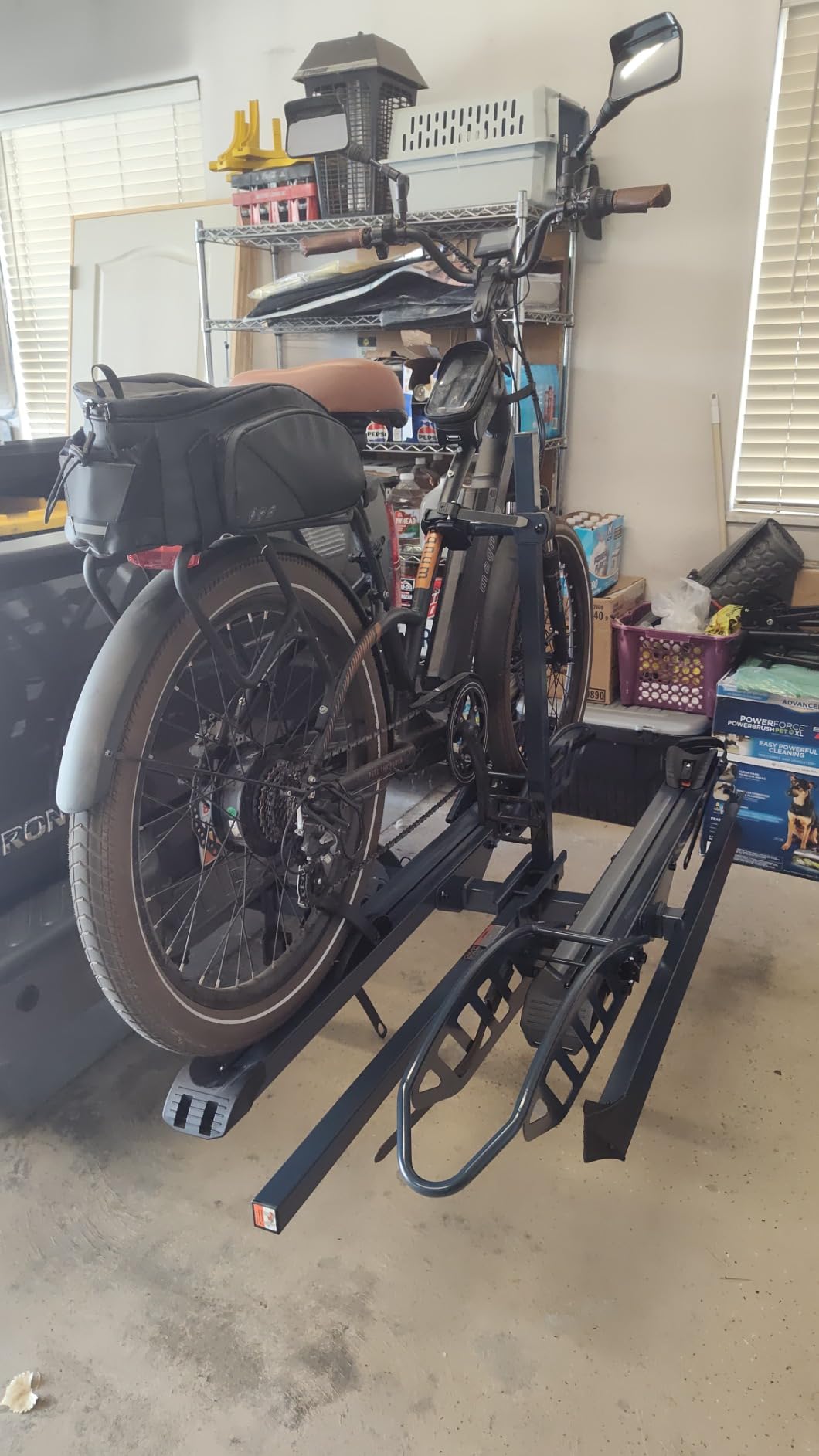
The geometry numbers are where it earns its badge. It fits e-bikes up to 5 inches wide with a wheelbase up to 50 inches, and the V-shaped front wheel cradle accommodates a range of tire sizes, which is how it handles fat tire models. The adjustable arms clamp to the seat post, a detail that works well with step-through frames where a top-tube clamp would have nothing to grab.
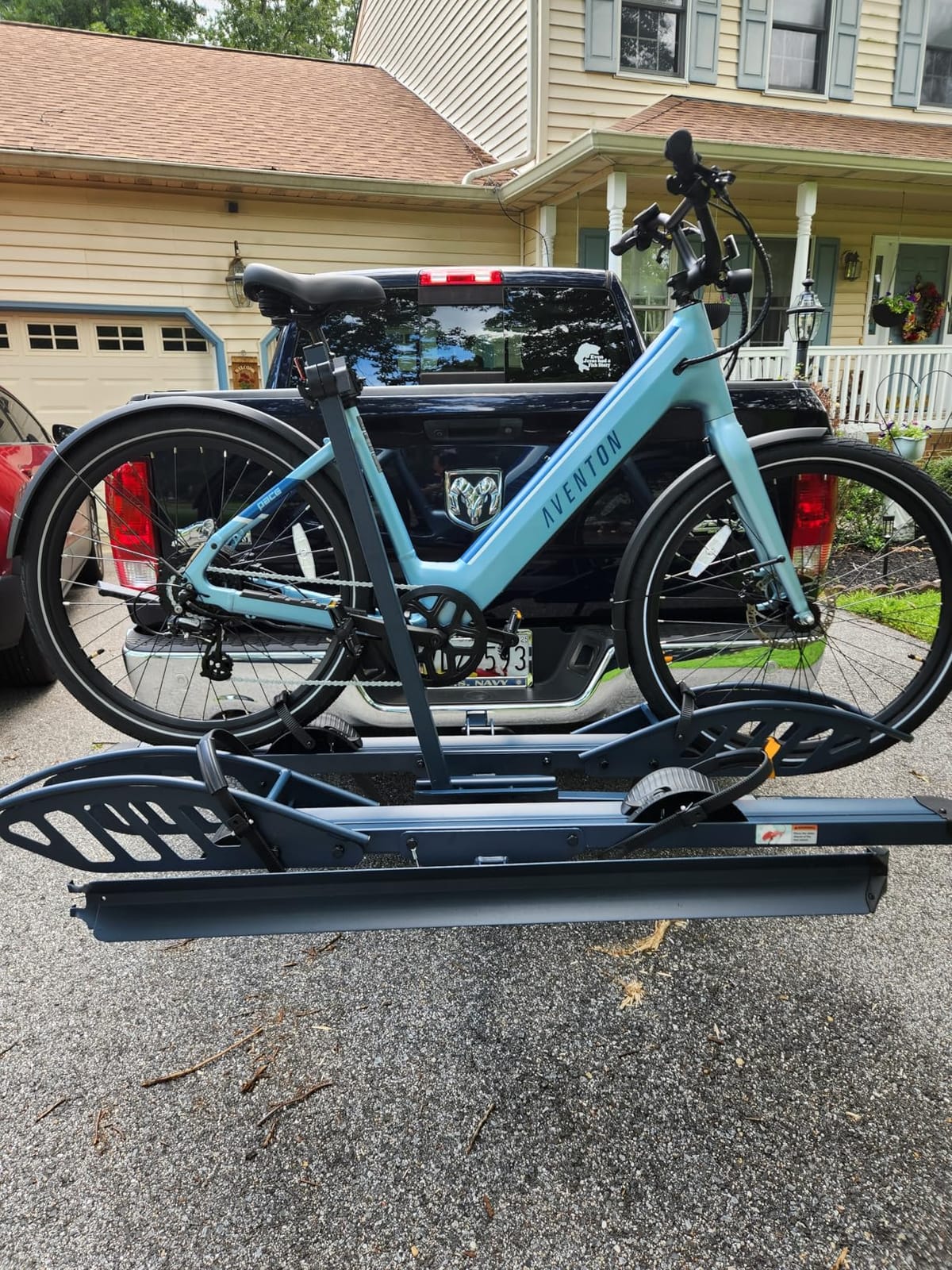
Capacity is 200 lb total, 100 lb per e-bike, and the included ramp makes rolling a 75 to 90 lb bike up onto the carrier straightforward. Reviewers mention holding two fat tire e-bikes steady over hundreds of miles with no rattling, and the folding aluminum and steel frame carries a 1000-hour salt spray resistant coating for coastal climates.
The semi-enclosed connecting block with a shock-absorbing threaded rod is what softens the ride over expansion joints, and the 1-year warranty comes with spare parts support. Customer service responsiveness is something buyers mention repeatedly.
What to check before you buy it
Measure your wheelbase. The 50-inch limit is real, and a long-wheelbase fat tire bike can exceed it. Check tire width against the 5-inch figure too, and look at whether the seat post clamp position on a step-through frame leaves you enough post to grip.
Plan the install with a second person. At 75 lbs it is the second-heaviest rack here, and the reported awkward step is fitting shims onto both vertical support bars, which some users have to modify to clear.
Who should skip it
Skip it if you have a long-wheelbase bike, a lightweight commuter that does not need a 100 lb tray, or if you cannot get help lifting 75 lbs. Also skip it if you are fussy about the front-to-back movement some riders notice around the center pole, or if a fiddly ramp clip will annoy you every time you unload.
One more caution: a clamp can shift on the rack if it is not tightened down before driving, so make that part of your pre-trip routine rather than a one-time setup step.
6. Young Electric 2-Bike Smart Tilt Platform Rack – Best Value for Two Heavy Bikes
Young 200 lbs 2-Bike Rack Hitch Mount for Car SUV, 2″ Receiver, Easy Fold
200 lb total
Tires to 5 inch
58 inch wheelbase
Smart tilt lever
Pros
- Most owner reviews in the group
- Handles two 85 lb e-bikes
- Quick-release tilt lever for trunk access
- Folds up when empty
- Rear safety reflector
- Tool-free install
Cons
- 41.6 lb steel rack is heavy
- Plastic wing nut knobs can crack
- Some rust at joints
- No safety pin on wheel holder
This is the most widely owned rack in the group, with well over 1,300 owner reviews, and that volume is useful in itself. When a product has that many owners, the failure patterns are well documented rather than hypothetical, and the picture here is consistent: solid stability on a 2-inch hitch, easy folding and tilting, and good carrying capacity for the money.
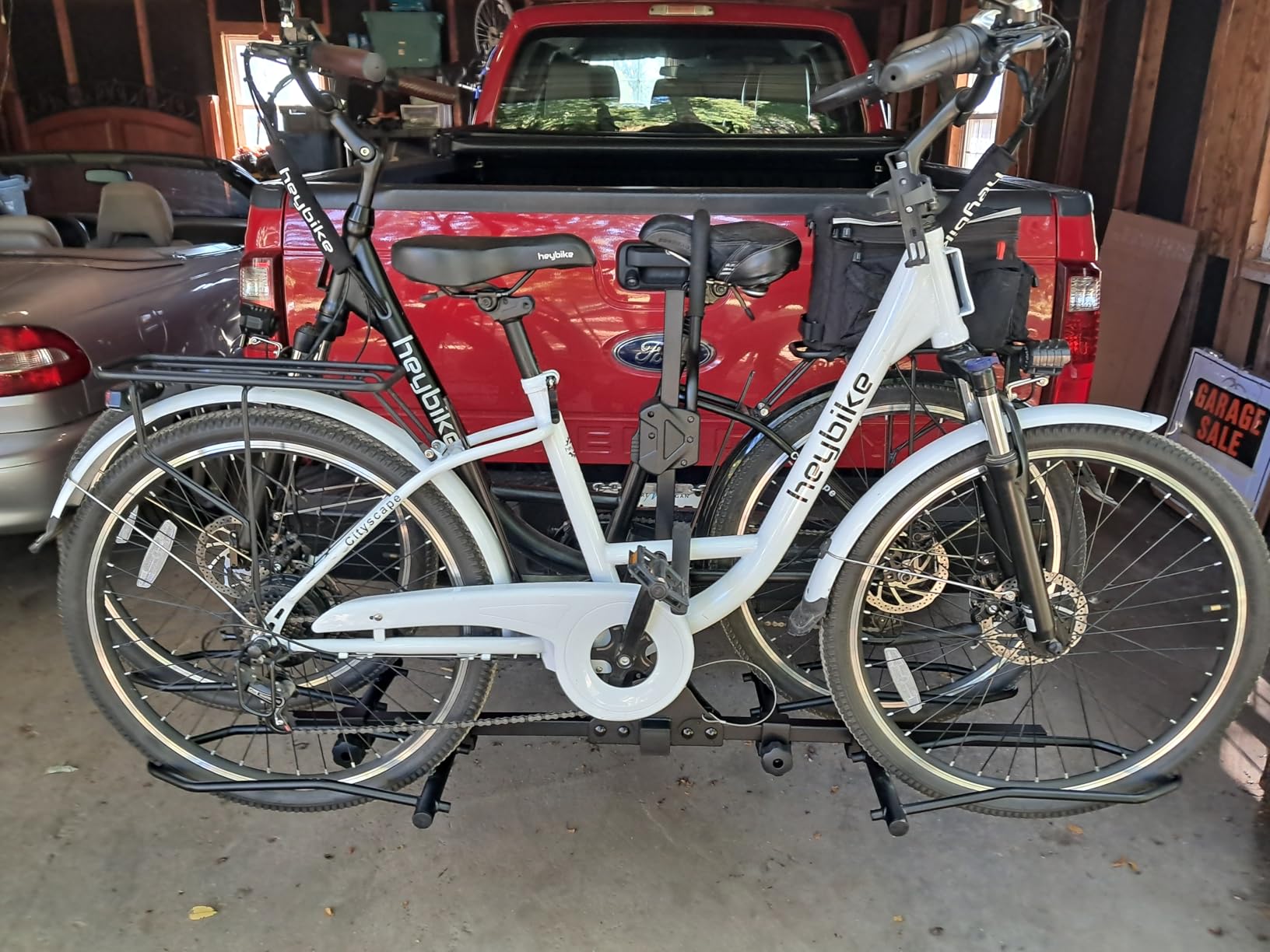
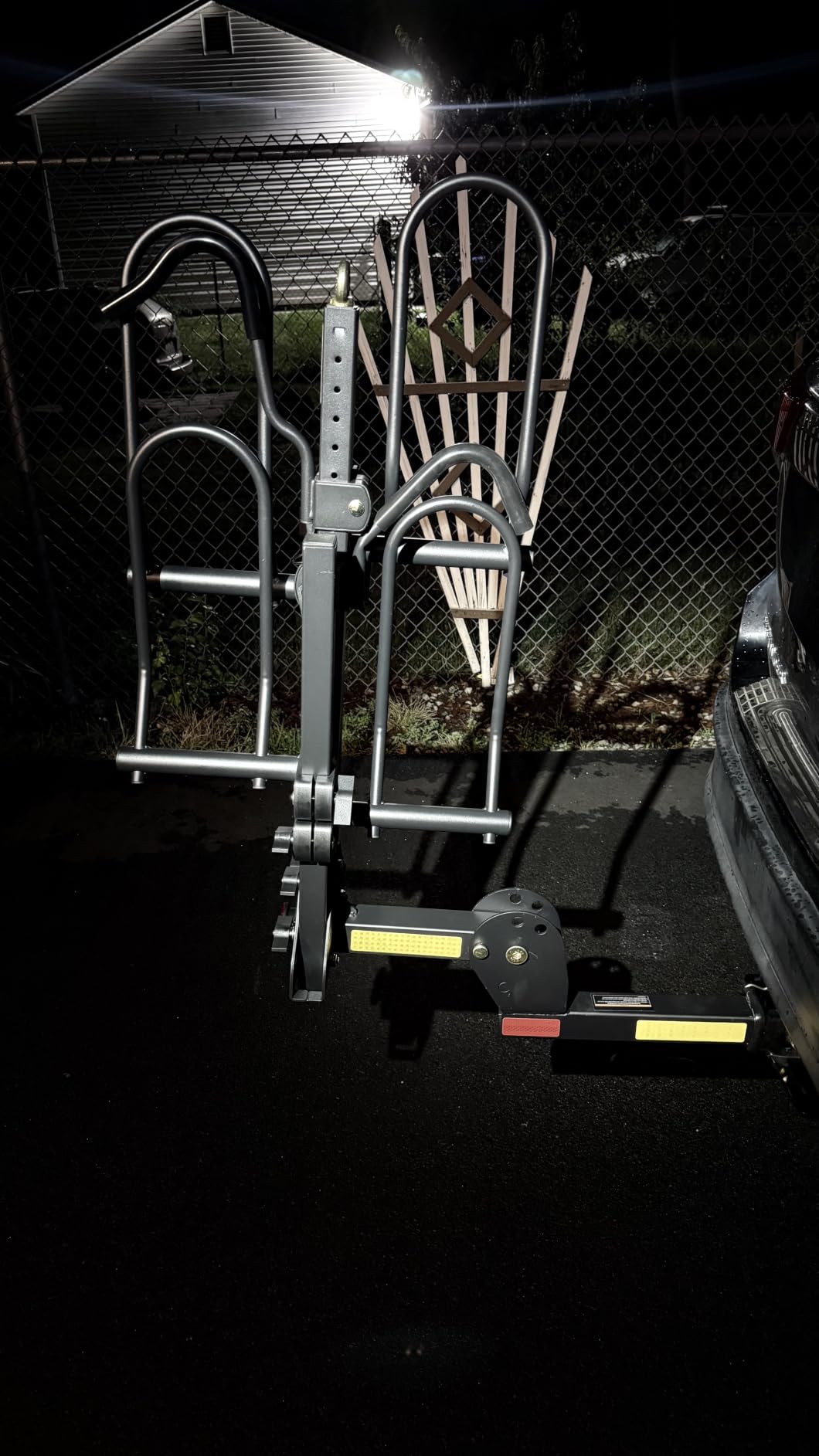
Specific owner reports include holding two 85 lb e-bikes and 75 lb fat tire bikes securely, and fitting a Jeep Wrangler without needing a hitch extender. The quick-release tilt lever lowers the loaded rack for trunk access, and the soft padded hooks with a hitch tightener give a wobble-free connection once everything is snug.
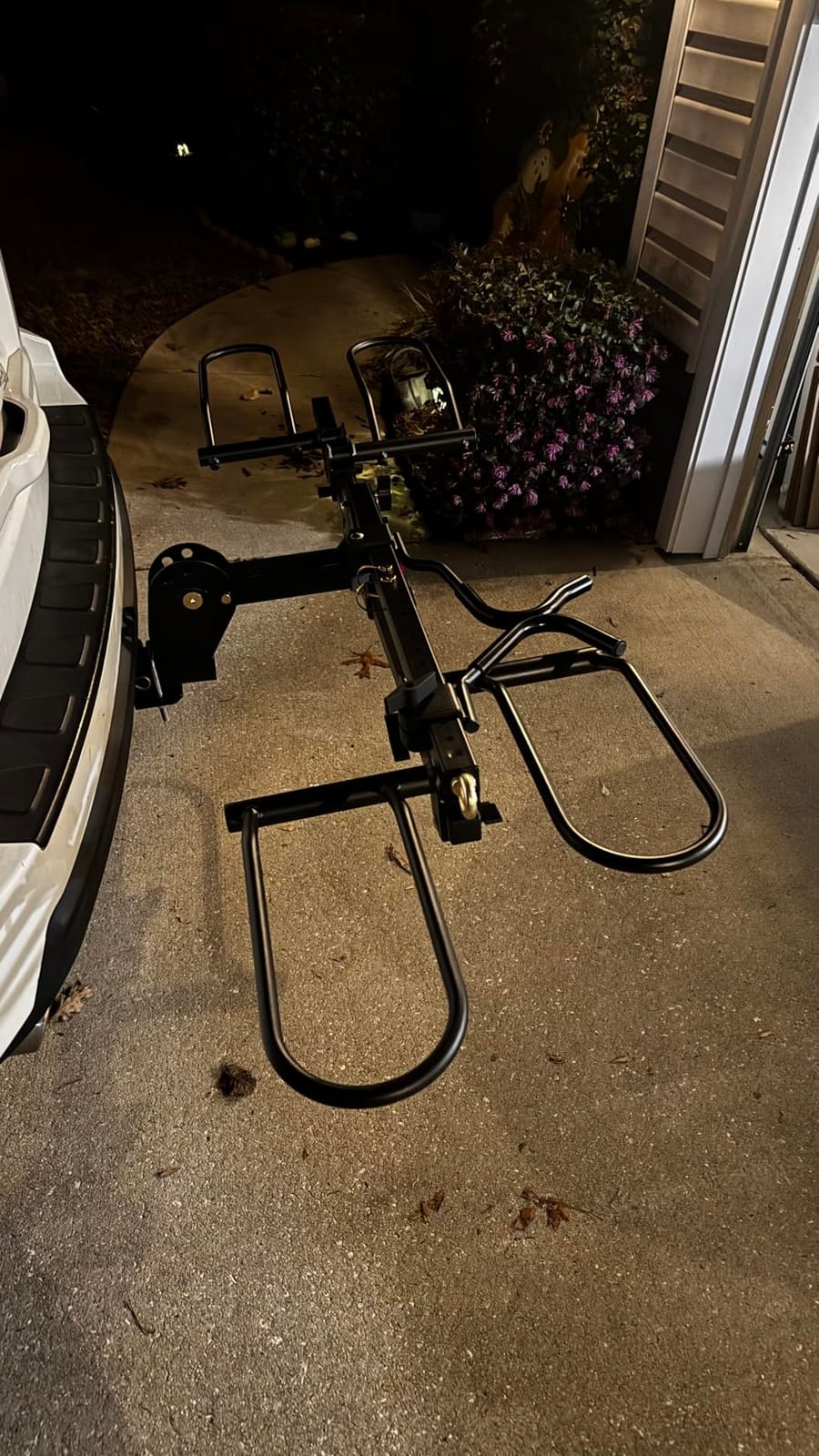
It also takes 5-inch-wide tires, 20 to 29 inch wheels and up to a 58-inch wheelbase, which is the widest wheelbase allowance of the racks here. Assembly takes about 15 to 20 minutes for most owners, and the rack folds up compactly when you are not using it.
The recurring complaints are about build rather than capability. At 41.6 lbs in all-steel construction it is heavy to lift, the wing nut hold-down system is slower than click-lock arms, and the plastic knobs can crack. Some units show rust at the joints after a few rainy days, and a few owners report a wheel holder detaching in transit because it lacks a safety pin.
What to check before you buy it
Check pin hole length against your bumper. Owners on short overhangs report the rack projecting far behind the vehicle, and bikes positioned at that distance can block your taillights, which is a legal and safety problem, not just an inconvenience.
Inspect the hold-down knobs on arrival. Cracked plastic knobs are a known issue, and replacing them with metal equivalents is a small fix that prevents the problem mid-trip. Add a small safety pin to the wheel holder if yours lacks one.
Who should skip it
Skip it if you live somewhere wet and salty and want a finish that does not spot-rust at the joints, and skip it if you care about refined hardware, because plastic knobs and minimal welding at stress points are consistent complaints. Buyers chasing a premium feel should step up to the CRAVOT.
Skip it if you need a ramp, because none is included. That means lifting 85 lb bikes by hand every time, which is exactly the job the top pick was designed to remove.
7. RokRack S One Single E-Bike Rack – Best Lightweight Single-Bike Setup
RokRack S One EBike Rack with Ramp for 1 Bike, 100 lbs Capacity
100 lb for one bike
Ramp rated to 100 lb
2-inch receiver
Pros
- Ramp makes 80 to 90 lb bikes easy to load
- Ratchet straps hold bike still
- Light at 35.3 lb for one-person install
- Quick simple assembly
- Adjustable tray fits step-through
Cons
- Front strap lock reported unreliable
- Instructions omit key details
- Some step-through frames suit it poorly
- Single bike only
Another single-bike option, and the reason to choose this one over the other single-bike rack is the loading experience. The included ramp is rated to 100 lbs and hooks onto the rack through a slot and buckle, and owners consistently describe rolling an 80 to 90 lb e-bike up as effortless. The ratcheting safety straps then hold the bike completely still with no rattles on the road.
At 35.3 lbs it is light enough for a single person to install, and the assembly takes only minutes once you know what you are doing. The adjustable tray is the key detail: it fits step-through and standard frames alike, which matters for the many riders on low-step commuters.
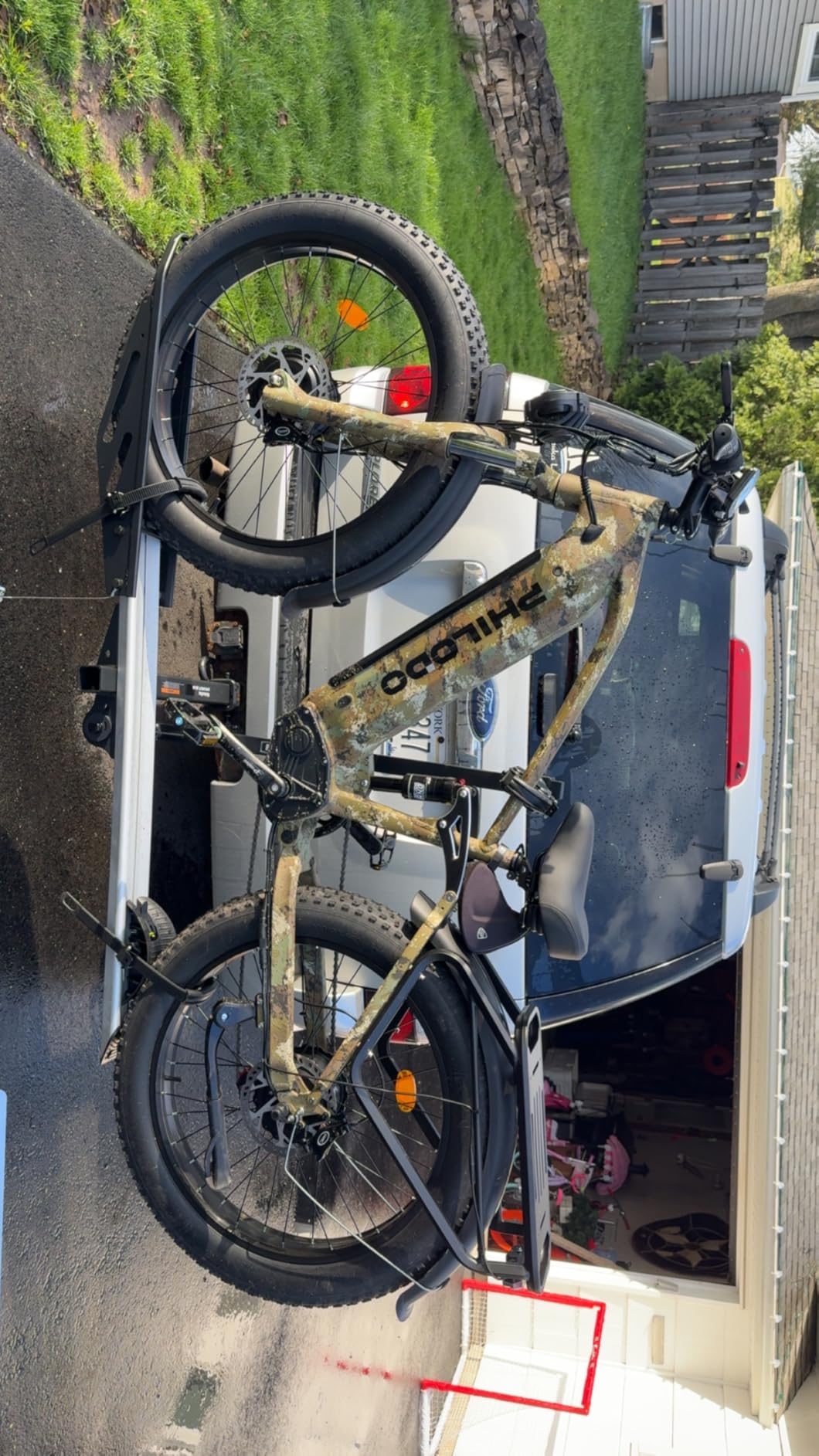
It accepts e-bikes up to 5 inches wide with a 50-inch wheelbase, the same geometry limits as the CRAVOT, so check both numbers against your bike before ordering. The high-strength alloy steel and aluminum construction carries an anti-corrosion tested coating, and velcro straps for engaging front and rear brakes are included, which is a small safety detail many racks skip.
No-scratch design is consistent throughout: ratcheting straps, soft padding and rubber covers at contact points. That is the same protective approach as the two-bike CRAVOT, at a lighter weight and with a smaller review history to learn from.
What to check before you buy it
Inspect the front wheel strap lock as soon as it arrives. A small number of owners report the locking mechanism not holding in place, which matters a great deal when the load is 90 lbs. Test it with the bike loaded before you leave home.
Read the assembly notes carefully because they omit key details, including sliding the tray fully to the metal stop and using the included velcro brake straps. Missing those two steps is the most common cause of a bike shifting on the rack.
Who should skip it
Skip it if you have a step-through mountain e-bike with an unusual frame profile, since some buyers report the design not suiting those frames. Skip it if you need to carry two bikes, or if your bike exceeds a 50-inch wheelbase.
With 104 reviews, this is the thinnest evidence base in the roundup. If you prefer a single-bike rack backed by a much larger owner history, the Young Electric single-bike model is the safer read.
8. Tow Tuff Hitch Cargo Carrier with Bike Rack – Best for Multi-Bike and Cargo Hauling
Tow Tuff Hitch Cargo Carrier with Bike Rack, 500 lb Capacity, Black
500 lb total
Up to 4 bikes
2-inch receiver
Convertible
Pros
- Switches from 4 bike rack to cargo carrier
- 500 lb capacity for gear
- Adjustable wheel holders and tie-down holes
- Universal 2 inch fit with no tools
- Tie-down strap included
Cons
- No ramp for heavy e-bikes
- Listed item weight looks inconsistent
- Basic all-steel design
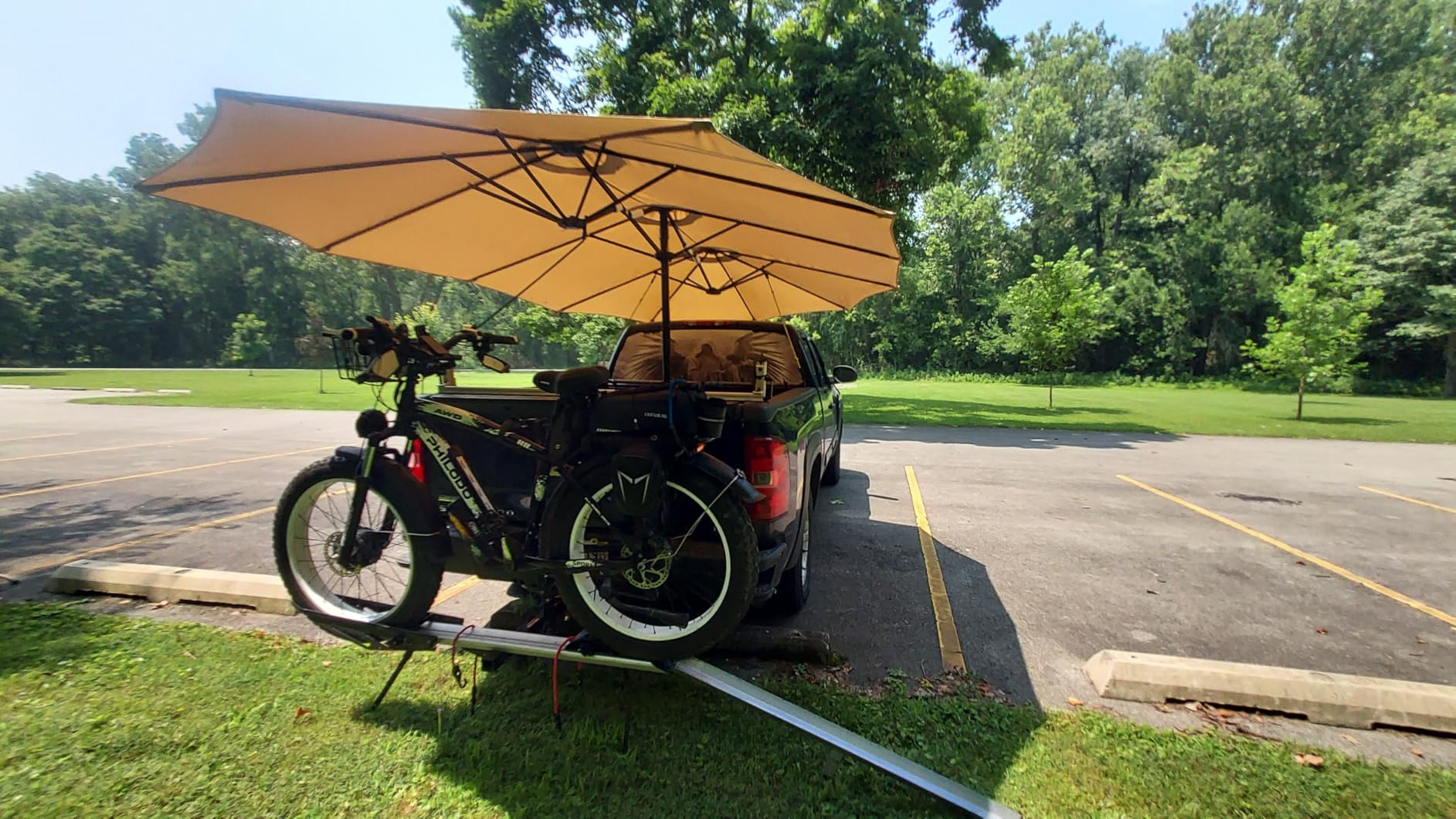
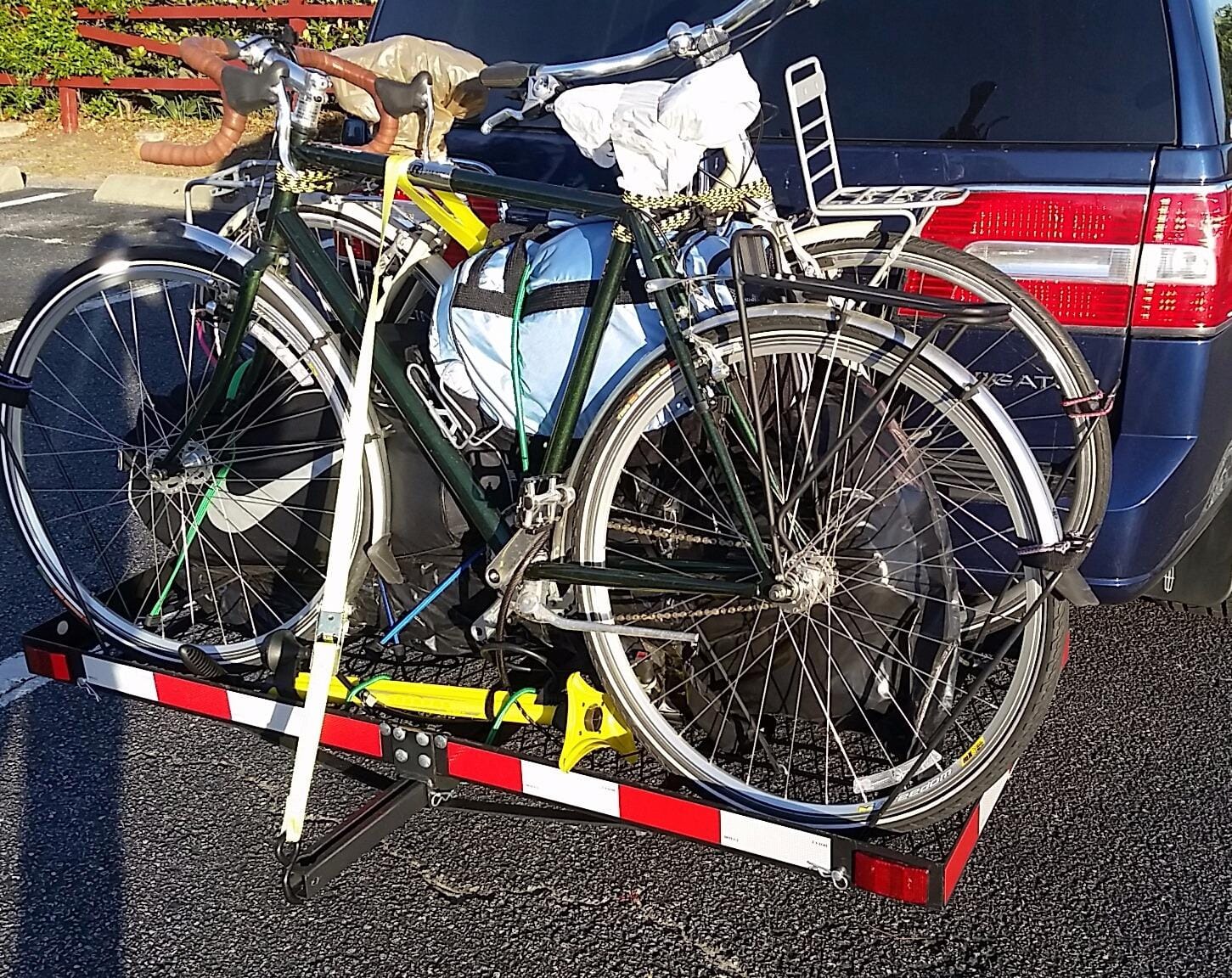
This is the outlier of the group, and it earns a place for capacity rather than for e-bike specialization. It converts between a general cargo carrier and a bike rack by removing pins, and in bike mode it carries up to four bicycles. The 500 lb total capacity handles camping gear, luggage, firewood and tools with room to spare.
The fit is refreshingly simple: it mounts to all standard 2-inch hitch receivers without adapters or extra tools. Adjustable wheel holders and built-in tie-down holes keep bikes stable, and a durable tie-down strap is included for securing bulky cargo in carrier mode.
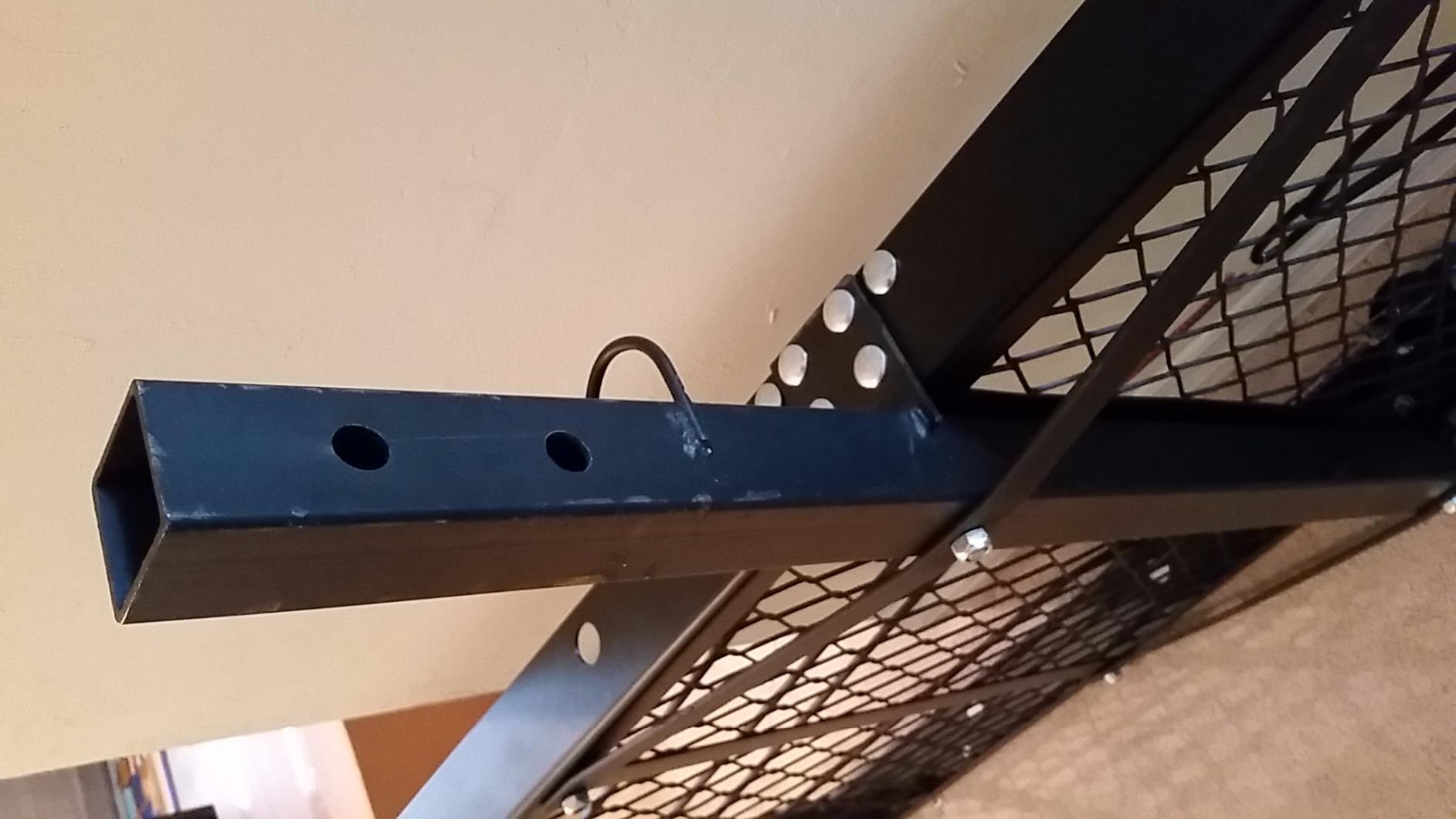
With more than 1,200 reviews, the owner picture is clear and consistent. Buyers rely on it mainly as a cargo carrier and treat the bike rack attachment as a bonus, which tells you exactly what it is good at. The steel construction is rugged and the pin-changeover is quick enough to do in a parking lot.
There are two things to keep in mind. There is no dedicated ramp, so heavy e-bikes have to be lifted on manually, which is a serious drawback for the 80 lb bikes this roundup is about. And the listed item weight of 10.24 ounces does not match a steel carrier of this size, so treat the weight specification as unreliable and confirm the real figure before you plan your lift.
What to check before you buy it
Decide whether you are buying a bike rack or a cargo carrier. The bike attachment is a bonus function, not a purpose-built tray system, and there is no per-bike weight rating published for it. If e-bikes are your primary cargo, this is the wrong tool.
Check your hitch class and tongue weight budget if you plan to load it heavily. A 500 lb capacity is meaningless if your receiver is not rated for that much tongue weight, which is the single most misunderstood number in this whole category.
Who should skip it
Skip it if you carry e-bikes regularly, especially heavy ones, because manual lifting with no ramp is exactly the failure mode people buy a hitch rack to avoid. Skip it if you need per-bike weight ratings or wide tray accommodation for fat tires.
If you want one product that does everything and your bikes are lightweight folding or pedal-assist models, this is a reasonable two-purpose tool. For heavy e-bikes, pick a dedicated platform rack from earlier in the list.
How to Choose an E-Bike Rack: Weight, Hitch, Tires and Loading
Check the per-bike weight limit, not the total number
The most important number on any e-bike rack is the per-bike rating, and marketing pages are built to lead you toward the bigger-looking total. A rack rated 200 lb total is only as useful as its per-bike figure. If it says 100 lb per bike, you have real headroom for a 70 lb e-bike. If it says 160 lb total for two bikes, you have 80 lb each, which is fine for a midweight commuter and marginal for a fat tire build with a second battery.
Get the actual weight of your bike from the manufacturer rather than estimating. Then subtract to see your margin. Overloading a tray is how frames crack at the bottom bracket, straps snap in transit, and welds fail at the stress points. It is a real failure mode, not a theoretical one, and it is why so many owner reviews in this roundup mention that the rack never moved or that it started shifting after a few months.
One habit worth adopting regardless of rack: remove the battery before loading when your bike allows it. It is commonly recommended in owner communities and it takes five minutes, and it can shave 7 to 10 lbs off the number you are asking your rack to hold. It also means you can lift the bike more easily on the way back down.
Match your hitch receiver and tongue weight limit
Every rack in this roundup requires a 2-inch receiver. Most modern crossovers, SUVs and trucks have one, but plenty of sedans and smaller wagons ship with a 1.25-inch receiver, and a few vehicles have none at all. Check before you buy, because an adapter is an extra part, an extra cost and another failure point between you and 200 lb of bike.
Tongue weight is the number that keeps this safe, and almost no roundup explains it. The tongue weight is the downward force the loaded rack puts on the hitch ball. Your vehicle has a rated maximum, and it is usually much lower than the vehicle’s towing capacity. A Class 1 receiver commonly carries a 200 lb tongue weight rating, and once you subtract the rack’s own weight, a 56 lb rack plus two 80 lb bikes leaves you close to or past the line.
Use a simple rule: add the rack weight, add the bikes, and compare the total to your receiver’s rated tongue weight. If the total exceeds it, you need a higher-rated hitch, a lighter rack, or fewer bikes. A rear hatch cover or a swing-away mechanism that lets the rack move out of the way can also reduce tongue weight on shorter trips, which is a trick some long-distance riders use.
Finally, check the pin hole position and the depth of your receiver tube. A short pin hole on a vehicle with a short rear overhang leaves the rack projecting behind the bumper, which can block taillights and reduce ground clearance on steep driveways.
Tire width, wheelbase and step-through frames
Fat tire e-bikes need trays that accept 4 to 5 inch wide tires. Most quality platform racks in this category specify a maximum tire width, and the ones here range from 5 inches down to no stated figure, so check before assuming. A tire that is too wide sits high in the cradle, shifts under load and stresses the wheel strap.
Wheelbase matters just as much and gets ignored more often. Longer bikes need longer trays. In this roundup the accepted wheelbases run up to 50 inches on the CRAVOT and RokRack S, 58 inches on the Young Electric 2-Bike Smart Tilt rack, and 59 inches on the TANX. Measure the distance between your wheel centers rather than the manufacturer’s frame size, which is not the same number.
Step-through frames need an attachment that grips the seat post or the wheel rather than the top tube, because there is no top tube to clamp. The CRAVOT CyberRack E2 Plus explicitly clamps the seat post and gets called out for working with step-through frames, and the RokRack S One uses an adjustable tray that reviewers say fits step-through and standard frames alike. Trunk racks and hanging racks are the worst option here, since a hanging rack’s top hook has nothing secure to grab on a low-step frame.
Ramp, tilt-down or lift: how you will actually load
Loading is where most e-bike rack decisions are really made. Lifting a 70 to 90 lb bike to chest height repeatedly is how people hurt their backs, and forum discussions about racks are full of people asking how to avoid it. Three approaches are available.
A ramp is the simplest. Four racks here include one, and it makes the difference between rolling a bike up a slope and dead-lifting it. The Young Electric 2-Bike rack, the Young Electric single-bike rack, the CRAVOT CyberRack E2 and the RokRack S One all ship with a ramp, with the two Young models stowing theirs inside the frame.
A tilt-down rack is the second option and it solves a different problem. The quick-release lever on the Young Electric 2-Bike Smart Tilt rack and the tilt-back frame on the TANX both let you reach the trunk or tailgate with the bikes still loaded, which is what you want on long trips when you do not want to unload in a parking lot. The TANX does this at 33.4 lbs, so the combined lean is far easier to manage.
Powered lift assist is the third and it is the premium answer, since a motor takes the weight out of the process entirely. Nothing in this roundup includes it, so if lifting 90 lbs is genuinely beyond your capability, plan on a rack with a powered lift or budget for a two-person load. Whichever route you pick, a free rear hatch light or a portable tail light solves the visibility problem when a loaded rack blocks the vehicle lights. And if the rest of your kit needs somewhere to live between trips, our guide to power racks for garage gyms covers the storage side of the setup.
Straps, locks, reflectors and anti-rattle hardware
The bike-to-rack attachment is where you feel quality most. Frame hooks are common and they put a hard metal edge on your paint. Ratchet straps with soft padding and rubber covers, as on the CRAVOT and the RokRack S One, are gentler and hold tension better, and they are the reason some riders choose those models for expensive frames.
Rack-to-car security comes down to the hitch pin and any locking mechanism on the trays. Basic locks, such as the ones on the TANX, deter opportunistic theft only. If you leave bikes overnight in a visible location, treat the lock as a deterrent rather than a solution and remove the battery when you leave the bike.
Anti-rattle hardware is unglamorous and important. A hitch tightener that clamps the rack snugly against the receiver, plus a locking hitch pin, is what stops the rack from clanging over expansion joints. Every rack here includes some version of it. The multi-hole spindle on the Wildroad carrier is the most refined implementation in the group.
Finally, look for a rear safety reflector or integrated light if you ride at night or tow at dusk. Only the Young Electric 2-Bike Smart Tilt rack in this roundup includes a reflector, and if your rack sits far enough back to block your taillights, you need a supplemental light to stay legal. If you are still working out what else your setup needs, our guides to equipment racks for your studio and dirt bike helmets for teen riders cover the other half of the gear equation.
Frequently Asked Questions
Do e-bikes need a special bike rack?
Yes. Most electric bikes weigh between 50 and 100 lbs, while standard hanging and trunk racks are typically rated around 35 to 40 lbs per bike. An e-bike rack is a platform-style hitch carrier rated per bike, with wide wheel trays that clear fat tires and step-through frames and hold the bike by the wheels instead of the frame. Trunk racks and roof racks are not suitable for heavy e-bikes because of the lifting and weight involved.
What kind of bike rack is suitable for electric bikes?
A platform-style hitch rack with a 2-inch receiver and a per-bike rating of at least 100 lb is the right format for e-bikes. Look for wheel trays that accept tires 4 to 5 inches wide, ratchet straps with padding instead of frame hooks, an anti-rattle hitch tightener, and a tilt-down function for trunk access. A loading ramp is the single feature that most reduces strain when handling a 70 to 90 lb bike.
How much weight can a hitch bike rack hold for e-bikes?
It depends on the per-bike rating, not the total. A rack rated 200 lb total for two bikes is usually 100 lb per bike, which covers nearly every e-bike on the road. A rack rated 160 lb total gives you 80 lb per bike, which is fine for midweight commuters but tight for fat tire models with a second battery. Check your bike weight against the per-bike figure and leave headroom, and remove the battery when possible to save 7 to 10 lbs.
What hitch size do I need for an e-bike rack?
Most e-bike racks require a 2-inch receiver, including every model in our roundup. If your vehicle has a 1.25-inch receiver you will need an adapter, and if it has no receiver at all you are looking at a trunk or roof alternative that will not work for heavy e-bikes. Also add the rack weight plus your bikes and compare the total to your receiver rated tongue weight, since that limit is often lower than your vehicle towing capacity.
Are platform racks better than hanging racks for e-bikes?
For heavy e-bikes, yes. Hanging racks clamp the frame by the top tube and typically max out around 35 to 40 lbs per bike, and their top hook has nothing secure to grip on a step-through frame. Platform racks hold the bike by the wheels in adjustable trays, are rated per bike at 80 to 100 lb, and use ratchet straps that avoid metal-on-paint contact. Trunk racks and roof racks are not viable options for heavy electric bikes.
Conclusion: Our Best Bike Racks for Electric Bikes in 2026
For most riders carrying two heavy e-bikes, the Young Electric 2-Bike Hitch Rack with Ramp is the pick, because 100 lb per bike plus a stowing ramp solves the weight and the loading problem at the same time. Solo riders with one very heavy bike should take the Young Electric single-bike version, and anyone who values the gentlest attachment to the frame should step up to the CRAVOT CyberRack E2 Plus. Lightweight and compact owners with midweight bikes will be happiest with the TANX, and the remaining three racks earn their place for hauling gear, carrying extra bikes or saving money.
Before you order, check three numbers: your bike weight against the per-bike rating, your receiver size against the 2-inch requirement, and your tongue weight limit against the loaded total. Get those right and the best bike racks for electric bikes in 2026 become the least interesting part of the trip.