
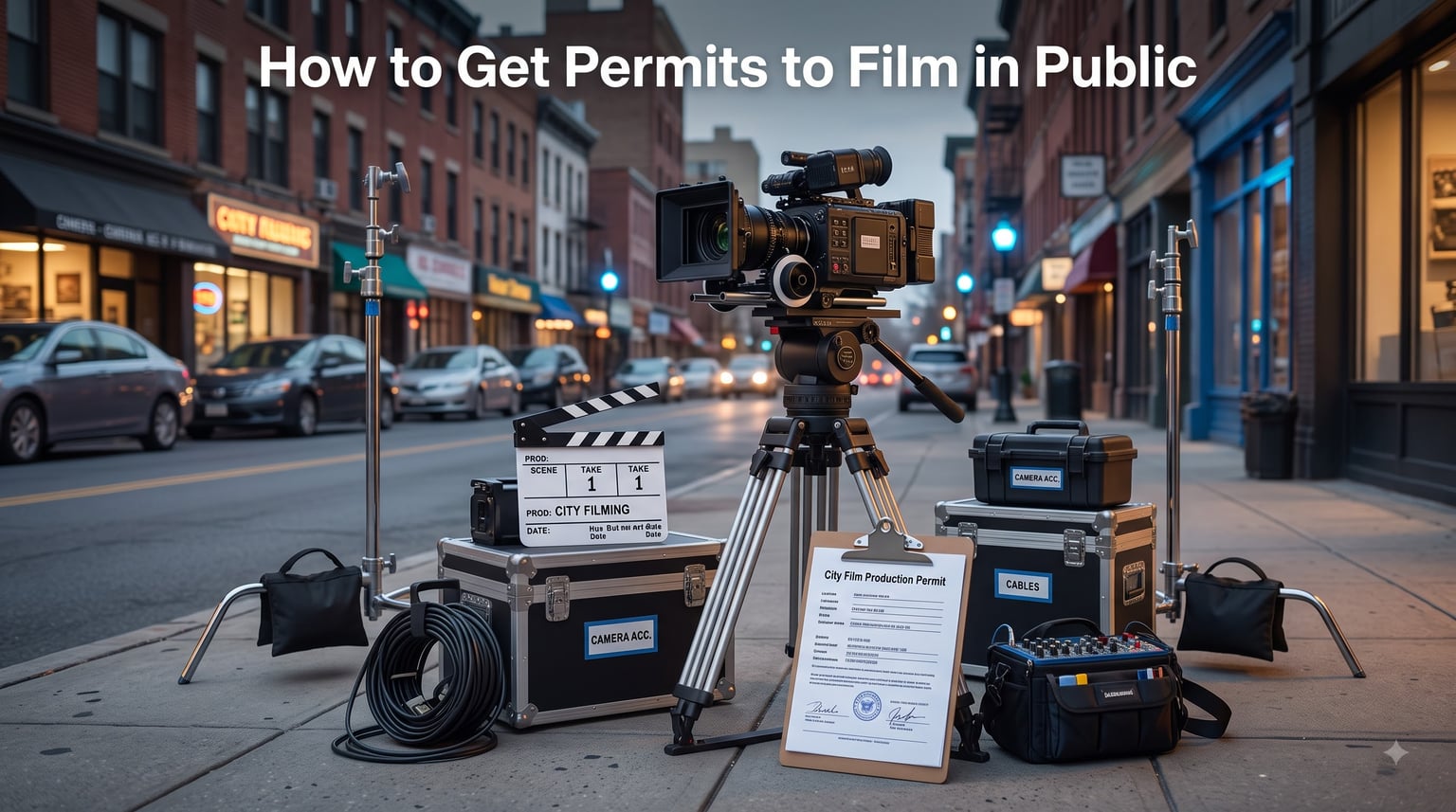
Yes, in most cases someone can legally film you in a public place in the United States, but the rules change the moment you set up lights, block a sidewalk, or ask a business owner to close their doors. If you are planning a production of any size, this guide on how to get permits to film in public will walk you through every step I have used on real shorts, music videos, and student projects over the last several years.
I have pulled permits in Los Angeles, New York, Austin, and on BLM land. I have also helped student filmmakers skip the fee entirely with a waiver. By the end of this article, you will know exactly which agency to contact, what insurance to buy, how much to budget, and how to avoid the most common mistakes that get productions shut down.
Table of Contents
- Do You Need a Film Permit? A Quick Decision Guide
- What Is a Film Permit and What Does It Cover?
- How to Get Permits to Film in Public: Step-by-Step Process
- Insurance Requirements for a Filming Permit Explained
- Film Permit Fees and Costs by Major City
- Public vs Private Property Filming: Rules That Change
- Student and Low-Budget Filmmaker Strategies
- Drone Filming Permits: Extra Rules You Should Know
- What Happens If You Film Without a Permit
- How to Find Your Local Film Office or Permitting Authority?
- FAQs
- Final Thoughts on Getting a Public Filming Permit
Do You Need a Film Permit? A Quick Decision Guide
You need a filming permit any time your production uses more than a hand-held camera and tripod on public property, claims exclusive use of a space, or relies on city services like police or parking. The hand-held camera exemption exists in most major jurisdictions, including New York City, and lets you shoot with a small crew using only portable gear. The moment you add a dolly, generator, or a light stand that needs power, the rules shift.
Ask yourself three questions before you call any film office. Will my gear block a sidewalk, road, or public space? Do I need the city to provide police assistance or close a street? Am I filming on private property I do not own? If you answered yes to any of those, you almost certainly need either a permit or a location agreement. When in doubt, call your local film office. The calls are free, and most are remarkably helpful.
What Is a Film Permit and What Does It Cover?
A film permit is an official authorization issued by a municipality, state agency, or federal body that grants your production the right to film on public property for a defined period. It is a permit to film, not a license to do anything you want. The permit typically bundles together several privileges: permission to use the location, access to free or low-cost police assistance for traffic control, parking privileges for production vehicles, and a clear framework for your liability insurance.
Most permits also include a community notice requirement. That means you must notify nearby businesses and residents before you start filming. Some cities, like New York, also offer a Letter in Lieu of Permit for projects that do not trigger the full permitting thresholds but still need official documentation. If you are wondering whether your production needs the full permit or just the lighter letter, the NYC Film Office has a clear online tool, and most other major cities do too.
How to Get Permits to Film in Public: Step-by-Step Process
The exact order varies by city, but every successful permit application I have filed follows the same five steps. Skip one, and you risk delays or a denied permit.
Gather intel on your location. Identify the exact address, the jurisdiction that controls it (city, county, state, or federal), and any nearby businesses that need community notice.
Purchase liability insurance. Most film offices require $1 million in general liability per occurrence, with the city or agency named as an additional insured. Your production insurance policy covers this.
Submit your application through the correct portal. In LA that means MyFilmLA, in NYC it is the MOME online system, and in Texas you start with the Texas Film Commission. Submit at least 10 business days before your shoot, longer for complex setups.
Pay the permit fees. Fees are usually non-refundable. Budget for them even if you are not sure you will keep the date.
Post community notice and confirm details. Walk or mail notices to nearby properties within the radius your jurisdiction requires. Save proof in case anyone complains on shoot day.
Processing time ranges from 48 hours for a simple still photography permit to several weeks for a full street closure. The average permit processing time across major US cities is about 5 to 10 business days, according to recent film commission data.
Insurance Requirements for a Filming Permit Explained
Liability insurance is the part that surprises first-time filmmakers the most. The city wants to know that if a passerby trips over your cable, your policy pays the bill, not the taxpayers. Most jurisdictions require a certificate of insurance showing $1 million in general liability coverage, with the municipality listed as an additional insured party.
Short-term production insurance policies are surprisingly affordable. For a one-day shoot with basic coverage, expect to pay around $150 to $400 through entertainment insurance brokers. The certificate usually arrives by email within an hour, and you upload it directly into your film permit application. Without the certificate, no permit, so do this step first.
Film Permit Fees and Costs by Major City
Permit fees vary wildly by location, and knowing the numbers upfront helps you budget honestly. The table below shows real published fees from major US film offices as of 2026.
| City / Agency | Administrative Fee | Daily Rate | Notes |
|---|---|---|---|
| New York City (MOME) | $3,200 | Included | Hand-held camera exemption available |
| Los Angeles (FilmLA) | No administrative fee | From $50 | MyFilmLA online portal |
| Chicago Film Office | Included | $250 per day per location | Streets, sidewalks, alleys |
| Texas (varies by city) | Set locally | $25 to $300 | Texas Film Commission routes applicants |
| BLM Public Land | Set by district | Starts at $0 for short, low-impact shoots | Special use permit for larger productions |
These are the base administrative fees. Most jurisdictions add per-day, per-location, and per-neighborhood charges, plus costs for police officers if you need street closures. Always ask for a full quote before committing to a location.
Public vs Private Property Filming: Rules That Change
Filming on public property means streets, sidewalks, parks, and government buildings, and almost always requires a film permit. Filming on private property is a completely different situation. If you own the building or have the owner’s permission through a signed location agreement, you usually do not need a government permit at all. You still need insurance and good relations with the neighbors, but the municipality stays out of it.
The line gets blurry in two common cases. First, when you film inside a private business like a cafe or shop, the owner can sign a location agreement and you typically avoid the permit process. Second, when you film on the exterior of a private building from a public sidewalk, some cities still require a permit because the activity affects public space. When in doubt, call the local film office and describe your exact setup. They will tell you in five minutes whether you need the permit.
Student and Low-Budget Filmmaker Strategies
If you are producing a short film, student project, or music video with little to no budget, you have more options than you think. Many film offices offer fee waivers for student productions and low-budget independent projects. New York City has a formal fee waiver process that requires proof of budget under $50,000 and supporting documents from your school or fiscal sponsor. Los Angeles and Chicago run similar programs through their local film offices.
The hand-held camera exemption is your fastest path to a free shoot. As long as your entire setup fits in a small bag, your crew stays under a certain size, and you do not block public access, most jurisdictions will not require a permit. The Reddit filmmaking community confirms this works in practice. One filmmaker put it bluntly: you can get away without a permit in public if you have basically no crew and equipment. For larger setups, call ahead and ask about a Letter in Lieu of Permit, which gives you official documentation without the full permit cost.
Drone Filming Permits: Extra Rules You Should Know
Drone filming adds a second layer of permitting. The FAA requires a Part 107 Remote Pilot Certificate for any commercial drone operation, and most cities require a separate drone permit on top of your film permit. New York City, for example, requires both the MOME film permit and approval from the Department of Transportation for drone flights over public property. National parks and many federal properties ban drone flights outright.
If you plan to fly, start the drone permit process early. Expect to submit your pilot certificate, insurance, flight plan, and equipment list at least 14 business days before your shoot. Skipping this step is one of the fastest ways to get your production grounded mid-shoot.
What Happens If You Film Without a Permit
The most common outcome of filming without a required permit is being asked to stop and leave the location. In practice, Reddit filmmakers report that police usually issue a warning first, especially for small crews. However, repeat offenses, large productions that block traffic, or uncooperative crews can result in fines, confiscation of footage, and in rare cases arrest for trespassing or obstruction. The production company, not the individual, usually absorbs the financial hit.
Permitless filming also exposes you to liability. Without the permit framework, your insurance company may deny a claim arising from the unsanctioned shoot. For a no-budget student film, that risk might feel acceptable. For a paying client, it almost never is.
How to Find Your Local Film Office or Permitting Authority?
Every state has at least one film commission, and most major cities have their own film office. Start with the state film commission, which acts as a free resource and can route you to the correct municipal agency. Los Angeles uses FilmLA, New York uses MOME, Chicago has the Chicago Film Office, and Texas runs the Texas Film Commission with regional film commissions in Austin, Dallas, Houston, and San Antonio. The Association of Film Commissioners International maintains a directory of every member office worldwide.
For federal land like national parks, forests, and BLM property, contact the specific district office where you want to film. BLM short-term filming permits often cost nothing for low-impact shoots. National Park Service permits run higher and require more lead time.
FAQs
Can someone legally film you in public?
Yes. In the United States, individuals have a First Amendment right to film in traditional public spaces like sidewalks, streets, and parks. However, property owners can restrict filming on their premises, and filming that blocks public access or interferes with city operations may require a permit.
How can I legally show a movie in public?
You need a public performance license from the rights holder, typically obtained through distributors like Swank Motion Pictures or Criterion Pictures. You also need permission from the venue, and if the screening affects public space, a film permit from your local municipality.
How to get permission to film at a location?
Identify the property owner, contact them directly to discuss your shoot dates and crew size, negotiate terms including insurance and restoration, and sign a written location agreement. For public property, contact your local film office to apply for a permit at least 10 business days before your shoot.
What happens if you get caught filming without a permit?
Most first-time offenders receive a warning and are asked to stop. Repeat offenses or productions that block traffic can result in fines, confiscation of footage, and trespassing charges. Your production insurance may also deny claims for incidents during unsanctioned shoots.
Final Thoughts on Getting a Public Filming Permit
Learning how to get permits to film in public is one of the most practical skills a filmmaker can build. The process looks intimidating on paper, but it follows the same five steps in every major city: gather intel, buy insurance, submit your application, pay the fee, and notify the community. Start your application early, lean on your local film office, and do not be afraid to ask for a fee waiver if your budget qualifies. The permit you file today is the shoot you protect tomorrow.