
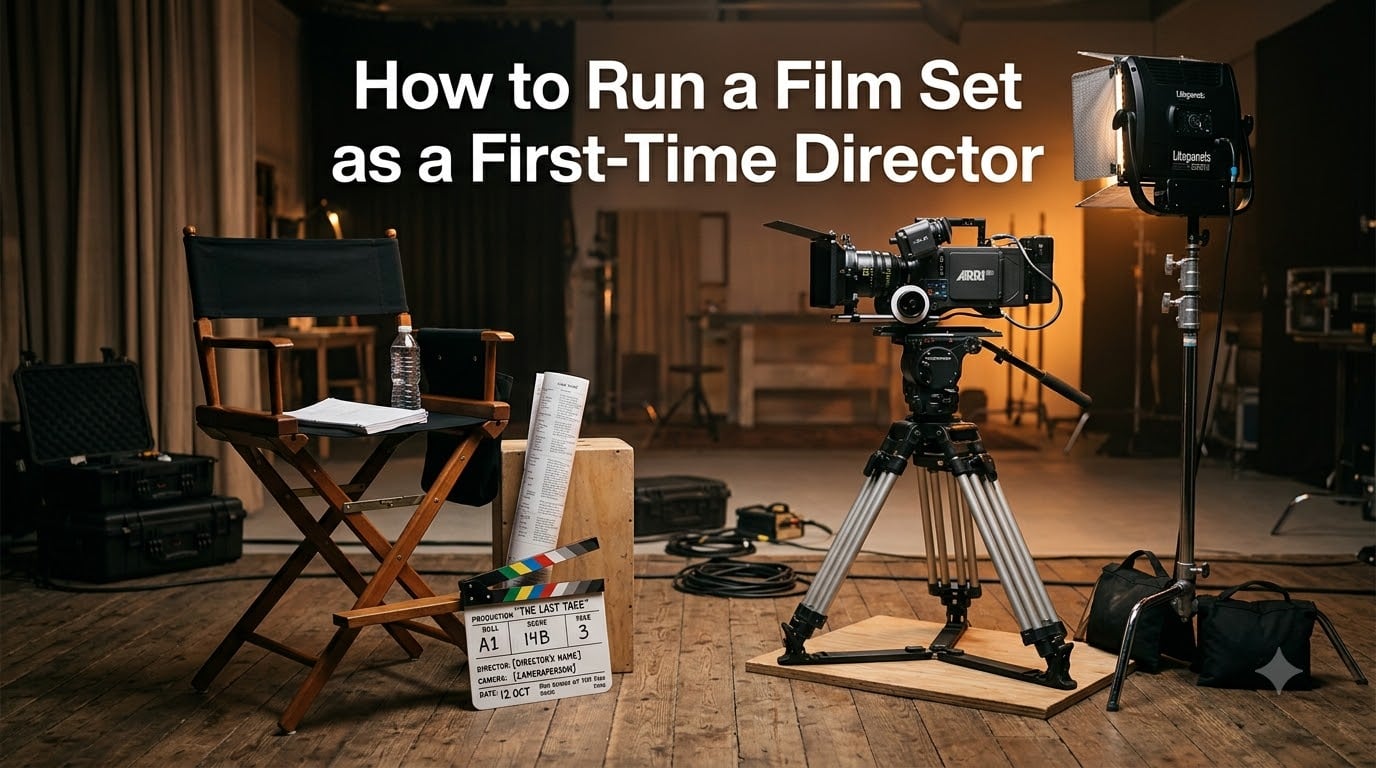
There is an old saying on film sets: the director is often the greenest person there. You wrote or chose the script, you raised or scraped together the money, and now twenty or thirty people are looking at you for every answer. If your palms are sweating just reading that, good. Every first-time director feels the same way.
Learning how to run a film set as a first-time director is less about talent and more about preparation, communication, and leadership. The crews that trust you are the crews that follow you, and trust comes from showing up organized and treating people well.
This guide walks through every phase: pre-production planning, understanding the film set hierarchy, day-of protocol, directing actors, and the part no competitor talks about enough — what to do when things go wrong. By the end, you will have a real plan for your first day of principal photography.
One spoiler before we start: the single best decision you can make is hiring a strong 1st AD. Reddit forums, working directors, and veteran crews all repeat this like a mantra. We will explain exactly why below.
Table of Contents
- The 10 Commandments of Set Leadership
- How to Run a Film Set as a First-Time Director: Pre-Production Foundation
- Understanding the Film Set Hierarchy
- Assembling and Interviewing Your Crew
- Day-of-Set Protocol: From Call Time to Wrap
- Directing Actors for the First Time
- Communication and Organization Systems
- What to Do When Things Go Wrong on Set
- What to Bring to Set Every Day (Your Director’s Kit)
- FAQs
- Conclusion
The 10 Commandments of Set Leadership
Before we get into the details, here is the quick-reference list. These ten principles show up in nearly every working director’s advice, and they are the foundation of a smooth shoot.
Hire an experienced 1st AD and trust them to run the schedule.
Prepare relentlessly — shot lists, storyboards, and call sheets are non-negotiable.
Interview every crew member yourself before hiring them.
Show up first and leave last; energy flows from the top.
Communicate through department heads, not around them.
Feed your crew real food, not just granola bars.
Know where to stand and stay off your phone on set.
Direct actors with kindness, then give specific, actionable notes.
Capture more B-roll than you think you need.
Keep a notebook on you all day, every day.
If you only remember ten things, remember those. Now let us break down the how behind each one.
How to Run a Film Set as a First-Time Director: Pre-Production Foundation
Pre-production is where you win or lose your film. By the time the camera rolls, roughly 80 percent of your creative decisions should already be locked. The set is for execution, not invention.
Build Your Shot List and Storyboard
A shot list is a document that describes every single camera setup you plan for every scene. It typically lists the shot number, scene, shot size (wide, medium, close-up), camera movement, lens, and any notes. The storyboard is the visual version of that, sketch by sketch.
Multiple first-time directors on filmmaking forums say the same thing in hindsight: they wish they had storyboarded more thoroughly. When you are standing on set with the clock ticking and the sun moving, a storyboard saves you from freezing up. It also gives your director of photography a clear blueprint instead of guessing your vision.
You do not need to draw well. Stick figures and arrows are enough. What matters is that you have thought through every cut before the crew is standing around waiting.
Cast for Performance, Not Just Look
Casting is the one decision you cannot fix in post. A great actor can elevate weak writing; a weak actor will sink a great script. Hold real auditions, record them, and watch the playback before deciding.
Shore Scripts, in their guide for first-time directors, emphasize that casting is step one for a reason. Chemistry reads between your leads are worth the extra day. A performer who takes direction well in the audition will take direction well on set.
Lock Your Locations, Permits, and Insurance
Nothing derails a shoot faster than a location falling through or a noise complaint shutting you down. Do your location scout early, sign a location release for every spot, and pull the proper film permits through your local film office.
Film insurance is not optional, even on a micro-budget short. A single damaged rental lens or injured extra can wipe out your budget. General liability and equipment coverage are the baseline. If you have a crew of more than five people, you also want workers’ compensation or a production policy that covers it.
Understanding the Film Set Hierarchy
One of the biggest sources of anxiety for a new director is not knowing who does what. Film sets run on a chain of command, and when everyone understands that chain, the day moves fast. No competitor publishes a clear hierarchy breakdown, so here it is.
Director, Producer, and 1st AD: The Power Triangle
The director owns the creative vision. You make the final call on performance, framing, and tone. You should not be chasing down cables or scheduling lunch breaks.
The producer owns the business side: budget, contracts, hiring, logistics, and problem-solving anything that threatens the production financially. On a short film, you and the producer might be the same person, which is exhausting but common.
The 1st AD (first assistant director) is your operational right hand. They create the call sheet, run the set during shooting, keep the schedule on time, and call for the next setup. A strong 1st AD is the number one thing that saves a first-time director, according to forum after forum of working filmmakers. If you spend money on one experienced role, make it this one.
Department Heads and Their Teams
Beneath the power triangle, each department has a head who reports to the director or 1st AD:
Director of Photography (DP) / Cinematographer: Owns the camera, lighting, and visual look. Your most important creative collaborator after your actors.
Production Manager / Production Manager: Handles the budget on a day-to-day level, deals with vendors, and supports the producer on logistics.
Production Designer: Owns the look of every set, prop, and location dressing.
Gaffer: Chief lighting technician; works under the DP.
Key Grip: Owns camera support gear, dollies, and rigging; also works under the DP.
Sound Recordist / Mixer: Captures clean production audio. Never let anyone rush or shortchange this department.
Script Supervisor: Tracks continuity, timing, and takes. This person is your safety net.
Costume, Hair, and Makeup: Owns actor presentation and continuity of appearance.
Production Assistants (PAs): The entry-level backbone. They run errands, lock up locations, and distribute call sheets.
The golden rule: communicate through department heads, not around them. If you want a light moved, you tell the DP or gaffer, not the electric standing by the truck. Bypassing the chain creates chaos and disrespects your own structure.
Assembling and Interviewing Your Crew
Budget constraints are real, and most first-time directors cannot afford a full crew of veterans. But that is exactly why hiring matters more, not less.
Interview Every Single Crew Member
Douglas Taurel, in his widely-shared lessons for first-time directors, makes one recommendation loud and clear: interview every single person you hire, even on a small short film. A quick twenty-minute conversation tells you whether someone shows up on time, takes direction, and fits your set culture.
Ask about the last set they worked on. Ask how they handle running behind schedule. Ask what kind of director they work best with. The answers tell you more than a reel ever will.
If you cannot afford an experienced crew across the board, invest in two roles: your 1st AD and your DP. Those two will carry the day when everything else gets shaky. Surround them with hungry, humble, on-time crew and you will be fine.
Day-of-Set Protocol: From Call Time to Wrap
The day of the shoot is where your preparation pays off — or exposes the gaps. Here is the protocol that keeps a set professional.
Read Your Call Sheet Before You Arrive
A call sheet is the single most important document on set. It lists the call time for every person, the scenes being shot that day, the location, the weather, sunrise and sunset times, the nearest hospital, and the meal break. Indie Film Hustle puts it bluntly: read your call sheet. As the director, you should read it the night before and arrive already knowing the plan.
Call time is the moment a person is expected on set and ready to work, not pulling into the parking lot. You set the tone by arriving at least fifteen minutes before your own call time. If the director is late, the entire day shifts.
Know Where to Stand on Set
This sounds trivial, but forum after forum lists it as a real anxiety point for beginners. The short version: stand near the monitor, behind or beside the DP, in what is sometimes called video village. That is where you watch the take and give notes.
Stay out of the lighting path. Stay off the dolly track. Never touch gear that is not yours — no adjusting cables, no moving C-stands, no fiddling with the camera. If something needs to move, ask the department head responsible. Respecting gear is a fast way to earn crew respect.
Come to Set with Energy Every Day
Energy flows from the top. If the director looks tired and defeated by lunch on day one, the whole crew feels it by day two. Get sleep, eat the craft services food you are paying for, and bring a positive presence even when the schedule slips.
Directors who treat crew with respect, buy a round at wrap, and say thank you by name build loyalty. Those are the crews who come back for your next project at a discount.
Directing Actors for the First Time
The technical side of directing can be leaned on. Your DP will help you with lenses. Your 1st AD will keep the schedule tight. But nobody can direct the performance for you. That is yours alone.
How to Give Notes Without Killing a Performance
Blocking is the physical staging of actors within a scene — where they enter, where they move, where they land. Block the scene first with your actors and DP before you light anything. Lighting a scene and then asking an actor to move ruins both.
When giving notes, be specific and never attack. Tell an actor what they are doing well first, then give one clear adjustment. Saying “do it sadder” does not work. Saying “in this line, I want you to almost smile because you are hiding something” gives them an actionable beat to play.
Private direction matters. If an actor is struggling, pull them aside between takes rather than correcting them in front of the crew. Public criticism shuts down a performance fast.
Say Action Quietly
This is one of those forum pain points that sounds funny until you live it: new directors are terrified of yelling “action” too loudly or too quietly. The working answer, repeated by Douglas Taurel and others, is to say it quietly and calmly. A screamed “ACTION” can startle actors and break the scene’s tone.
A simple, level “action, please” works. Same with “cut.” You are calling the cue, not announcing it to the county.
Leave room for improvisation when the actor is in the zone. If a take is alive and they go off-script in a way that serves the scene, let it run and discuss afterward. Some of the best moments in indie film were never in the script.
Communication and Organization Systems
A disorganized director is a stressed director. Two systems will keep you sane: a notebook and an email structure.
The Director’s Notebook
Carry a physical notebook on set every single day. Use it to track continuity questions, shot ideas that pop up between takes, notes for the editor, and reminders for tomorrow. The script supervisor is tracking continuity in their own way, but your notebook is your brain on paper.
Review it at the end of each shoot day. Half the notes will be irrelevant by morning. The other half will save a scene.
Keep Your Emails Organized
Before pre-production even starts, set up a dedicated folder structure in your email. A simple version looks like this:
Crew (one subfolder per department)
Cast (one subfolder per actor)
Locations and permits
Insurance and contracts
Equipment rentals
Budget and invoices
Marketing and distribution
When your sound recordist goes AWOL on day one — and this exact scenario shows up on Reddit — you will need to find your backup contact in under two minutes. A clean email folder turns a crisis into a phone call.
Use whatever communication tool your crew already lives in. Slack, a Facebook group, or a shared Google Drive all work. The point is one central channel, not scattered texts.
What to Do When Things Go Wrong on Set
Something will go wrong. Probably several things. The directors who survive their first shoot are the ones who planned for that.
When a Key Crew Member Does Not Show Up
One Reddit user had their sound person go AWOL on day one of their shoot. They scrambled through their email folder and found a backup within an hour. That backup only saved them because they had already interviewed a backup during pre-production.
The protocol is simple: for every key role — DP, sound, 1st AD, gaffer — have a second-choice person in your phone. Reach out to local film groups and Facebook production communities before you shoot. When the slot opens, you are not starting from zero.
If no replacement is available, triage. Move scenes that do not need that department to the top of the day. Better to shoot B-roll and insert shots than stand around burning daylight.
Handling Imposter Syndrome as a New Director
Imposter syndrome is the most common pain point in every filmmaking forum. You feel like the least experienced person on set because, often, you are. Crew members with years on real productions are looking to you for answers.
The fix is not fake confidence. The fix is preparation. When you walk on set with a finished shot list, a storyboard, and a clear plan, you earn the room’s respect in the first hour. Nobody expects you to know every lens. They expect you to know your story and what you need from each scene.
Lean on your DP and 1st AD for the technical and operational questions you do not know. Saying “I trust your call on the lens, here is the emotion I need” is a stronger answer than faking a focal length.
When Your Vision Conflicts with Your DP
This is a forum content gap that almost no competitor covers. DPs are opinionated because they have to be, and sometimes their vision for a shot will not match yours.
Handle it privately, never in front of the crew. Pull your DP aside and lead with the story reason for your choice: “I need the character to feel trapped here, so I want the tighter framing even though the wider shot looks beautiful.” Story reasons beat aesthetic arguments every time.
If the disagreement is persistent and the day is slipping, defer to the DP on execution and protect the performance. You can always reframe a shot. You cannot re-create an actor’s best take because you were arguing about a lens.
What to Bring to Set Every Day (Your Director’s Kit)
A prepared director carries a small kit every day. Here is what should be in it:
Your shot list and storyboard (printed, not just on a phone)
The day’s call sheet (printed copy)
The script with your scene notes
A notebook and two pens
A stopwatch or timer app for timing takes
Comfortable, weather-appropriate shoes you can stand in for twelve hours
Layers — sets are cold in the morning and hot by midday
Water bottle and snacks for yourself (you will forget to eat)
Phone on silent, kept in a pocket, not in your hand
Phone addiction is a real issue on set, and department heads notice. Crew members who sit on their phones between takes get quietly blacklisted. Stay present.
FAQs
How to be a film director with no experience?
Start by working on other people’s sets as a PA or production assistant to learn the hierarchy and protocol firsthand. In parallel, write or option a short script you can direct yourself, hire an experienced 1st AD and DP, storyboard every scene, and prepare relentlessly. Nobody expects a first-time director to know everything; they expect you to know your story and what you need from each scene.
What is the 20/30 rule in film?
The 20/30 rule is a general production guideline suggesting that roughly 20 percent of your footage will deliver 80 percent of your film’s value, and that you should plan for about 30 minutes of usable screen time per shoot day on a standard indie production. The exact ratio varies by project, but the principle holds: focus your energy on the scenes that matter most and do not spread your day too thin.
What is the 2.5 rule for movies?
The 2.5 rule refers to a pacing guideline used by some editors and directors: aim to cut a scene or shot before it runs longer than roughly 2.5 times the length of the key action or line within it. The idea is to hold on a moment long enough for the emotion to land, but not so long that the audience disengages. It is a feel-based rule, not a strict formula.
Is 27 too late to become a filmmaker?
No. Many working directors made their first feature in their thirties, forties, or later. The skills that make a strong director — life experience, emotional intelligence, patience, and the ability to lead people — compound with age. Focus on building on-set experience, networking within local film communities, and finishing a short film. Age is an advantage, not a deadline.
What should a first-time director know before day one of shooting?
Know your shot list cold, have storyboards for every tricky scene, lock your crew and backups, secure your permits and insurance, and rehearse your actors beforehand. Walk on set with a printed call sheet, a notebook, and a clear plan for the first three setups. Preparation is what earns a crew’s trust in the first hour.
Conclusion
Running a film set for the first time is equal parts preparation, leadership, and humility. The directors who succeed are not the ones with the most natural talent; they are the ones who storyboarded every scene, hired a strong 1st AD, fed their crew real food, and showed up early every morning with a notebook in hand.
Now you have a full picture of how to run a film set as a first-time director: the pre-production foundation, the film set hierarchy, day-of protocol, how to direct actors, and what to do when the inevitable problem hits. The next step is yours — lock your shot list, build your crew, and get on set. Your first film is waiting.
1 thought on “How to Run a Film Set as a First-Time Director (September 2026)? Guide”