
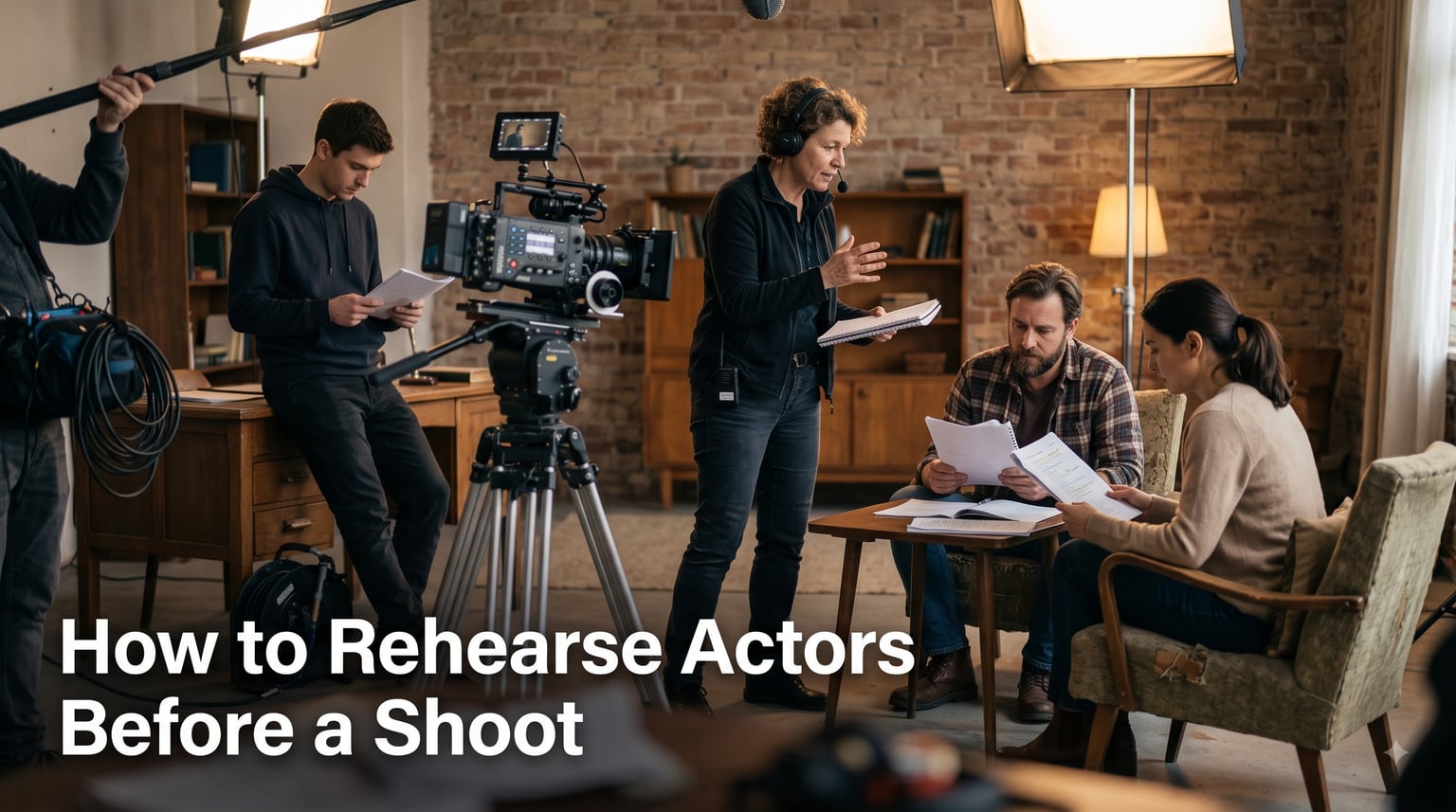
To rehearse actors before a shoot, run a structured five-step process: a table read to hear the dialogue, an objectives session to identify what each character wants, a blocking rehearsal to solve spatial problems, a technical rehearsal that accounts for camera and lens constraints, and a final emotional pass that protects spontaneity for the camera. Skip theatre-style line drilling and focus instead on building shared understanding, practical blocking, and trust, so actors walk onto set with clear intentions but enough freshness to deliver authentic performances when the lens rolls.
I’ve directed short films on budgets ranging from $200 to $200k, and the lesson that keeps repeating is simple: how you rehearse actors before a shoot determines everything that happens once the camera is on. The good news is that great rehearsal work doesn’t require weeks or money. It requires intention, structure, and respect for the actor’s process. This guide collects production-tested film rehearsal techniques I’ve used, watched, and learned from other directors, and it is built specifically for indie filmmakers, short film directors, film students, and first-time directors who cannot afford to waste a single shooting day.
By the end of this article, you will have a step-by-step rehearsal framework, a clear sense of how film rehearsal differs from theatre rehearsal, practical exercises you can run today, and answers to the questions filmmakers actually ask in forums like Reddit and Student Filmmakers. Whether you are prepping a 48-hour film festival entry or a multi-day short narrative, this is the rehearsal playbook I wish someone had handed me on my first set.
Table of Contents
- Why Rehearsal Matters Before a Film Shoot?
- How to Rehearse Actors Before a Shoot: The 5-Step Process
- Film Rehearsal vs Theatre Rehearsal: The Critical Differences
- Table Reads That Actually Work for Film
- Blocking Rehearsals for Camera: Technical Reality
- Advanced Rehearsal Techniques Directors Use
- Rehearsal Time Guidelines: How Long Should You Rehearse
- Common Director Mistakes During Rehearsal
- How to Preserve Spontaneity After Multiple Takes
- Protecting Actor Vulnerability on Set
- Rehearsal Exercises and Warm-Up Games for Actors
- Low-Budget Indie Film Rehearsal Workflow
- Working with Non-Actors in Rehearsal
- Virtual and Remote Rehearsal for Distributed Casts
- Signs Your Rehearsal Is Failing: A Checklist for Directors
- FAQs
- Do actors need to rehearse before filming?
- How long should film rehearsals last?
- Should actors memorize lines before rehearsal?
- How do you rehearse blocking for camera when you don’t have the camera yet?
- What is the difference between theatre and film rehearsal?
- How many takes before a film performance goes stale?
- How do you protect actor vulnerability on busy film sets?
- When should rehearsal happen in the production timeline?
- Conclusion: How to Rehearse Actors Before a Shoot, Final Word
Why Rehearsal Matters Before a Film Shoot?
Film scenes are shot out of sequence, often across multiple weeks, with actors performing the same emotional beat dozens of times under intense production pressure. Without structured rehearsal, actors cannot maintain the emotional continuity that a scene needs, and performances that read well in a quiet room collapse under the heat of lights, the gaze of a crew, and the mechanical demands of camera and lens. This is the core reason film rehearsal exists: it gives actors a private space to discover intention, build trust, and solve problems before the entire machinery of a film set is watching them.
Theatre rehearsal runs for weeks because the performance is live and must be repeatable. Film rehearsal is different. It is a short, intense preparation for a recorded moment that will only need to be captured once or twice. When directors treat film rehearsal like theatre rehearsal, they over-rehearse, exhaust their actors, and arrive on set with performances that feel mechanical and tired. When directors skip rehearsal entirely, they waste expensive shooting hours solving problems that should have been solved in a quiet room three days earlier.
The job of rehearsal is not to lock a perfect performance. The job of rehearsal is to identify the emotional logic of the scene, agree on blocking that works for the camera, build enough trust that actors can be vulnerable in front of strangers, and leave enough freshness in the actor’s body so the camera captures something alive. If you understand that simple priority order, every rehearsal decision becomes easier.
The Production Reality Nobody Warns You About
On a typical short film shoot, you might average four to six setups per scene, each requiring multiple takes, repeated lighting adjustments, and various lens and camera moves. An actor who has never blocked the scene will spend the first twenty minutes of every setup confused. An actor who has over-rehearsed will perform the same moment on take twelve with the same lack of presence they had on take one. The sweet spot is somewhere in the middle, and finding it is the director’s job.
Rehearsal is also where you discover the scene’s structural problems. If a beat is unclear, you find it here. If a character’s objective contradicts their action, you find it here. If two actors have read the same moment differently, you find it here. On set, you do not have time to find these problems. On set, you have a crew waiting for a direction.
How to Rehearse Actors Before a Shoot: The 5-Step Process
This is the rehearsal framework I use on every short film I direct. It is designed to be efficient, repeatable, and forgiving to first-time directors. The five steps do not have to happen in five separate sessions. Many indie productions collapse them into a single afternoon. What matters is that each step is addressed before the camera rolls.
Step 1: The Table Read
The table read is the first time the full cast hears the script performed aloud. Its purpose is to surface structural problems, identify tone, and let actors begin inhabiting the language. Do not use the table read to fix performance. Use it to find out where the script is unclear. If a line makes the actor stumble, that is information about your scene, not their talent.
Run the table read sitting down, with scripts in hand, in a quiet room. Read it straight through once. Then go back through the scenes that need attention. Take general notes the first time (“The transition between beat two and three is unclear”) and specific notes the second time (“This line is fighting this action”). A table read should not exceed 90 minutes for a short film script. If actors are leaving fatigued, you have over-used the table read. Save your energy for the next step.
Step 2: Identify Character Objectives
Before you can rehearse a scene effectively, you need to know what each character wants in the scene. In directing language, this is called the objective. The objective is the answer to the question “What does this character need from this other person in this moment?” Without a clear objective, the actor has nothing to play.
Ask each actor, in their own words, what their character wants from the scene. If they cannot answer, you have a writing problem and a rehearsal problem. Walk them through the script and identify the moments where the objective is unclear. Sometimes the objective is contradictory on purpose. That is fine. The actor should know what they want even if they cannot get it.
A useful exercise: ask the actor to boil their objective down to a single verb. “I want her to admit the affair.” “I want to be left alone.” “I want my father to see me.” The simpler the objective, the more options the actor has on set. Save the complex psychology for the camera. Use rehearsal to lock the action.
Step 3: Blocking Rehearsal
Blocking is the actor’s physical movement through the scene. In film, blocking is shaped by the camera, the lens, the marks, and the lighting. In theatre, blocking is shaped by sightlines and stage geography. This is where many directors who come from theatre go wrong. They block for the room. You need to block for the lens.
Run the blocking rehearsal standing up, in the actual location if possible. If you cannot access the location, use a stand-in space with roughly the same dimensions. Walk the scene through with the actors. Where do they enter? Where do they sit? Where do they move? What is the eye-line between them? Lay tape on the floor to mark where the camera will be, where the focus puller will stand, and where the actors will hit their marks.
Do not block for the master shot first. Block for the close-ups first, because the close-up is where the performance lives in film. The master shot is fallback. Once the close-ups are blocked, the master becomes obvious.
Step 4: Technical Rehearsal
This is where the camera and lens enter the rehearsal. Even if you do not have the real camera on set yet, use a stand-in (a phone on a tripod, a clapperboard, anything that approximates the camera’s footprint) and rehearse the setups you have planned. The actor needs to know what the camera will see, what it will not see, and how that affects their performance.
Walk the actor through the coverage. Show them where the lens will be. Show them where the marks will be. Show them where the focus puller will be sitting. If they are turning their head for a close-up, rehearse that turn. If they are crossing the room for a wide, rehearse that cross. The goal is to remove mechanical surprises on shoot day.
This is also where you rehearse the technical moments that often get missed: the actor picking up a prop, the actor moving through a doorway, the actor hitting a mark in time with a camera move. These are the moments that fall apart on shoot day if they have not been rehearsed.
Step 5: Emotional Preservation
The final step is the most counterintuitive. After all the technical work, you need to actively protect the actor’s emotional freshness for the camera. This is where many directors fail. They have spent four hours drilling the scene, and now they want one more run-through for safety. That run-through is often the take that kills the performance.
Tell the actor what you want for the camera. Do not run the scene again. Trust the work. Save the live, uninhibited run for the camera. If the actor needs to run an emotional peak, do it once, and only once. Save the rest for the lens. This is the difference between a director who protects the actor and a director who exhausts them.
A useful technique: end rehearsal with a brief, low-stakes run-through in character. Goodbye. The actor leaves the room in character, not in their own skin. This counterintuitive move keeps the emotional body warm without burning out the peak beats.
Film Rehearsal vs Theatre Rehearsal: The Critical Differences
Directors who trained in theatre often make the mistake of running film rehearsal like a stage rehearsal. The goalposts are different. In theatre, the audience must understand the story from one fixed vantage point, and the performance must be repeatable across many shows. In film, the camera chooses the vantage point, the performance is recorded once, and the audience consumes the result in fragments edited together. This single distinction changes how directors should rehearse actors before a shoot.
| Element | Theatre Rehearsal | Film Rehearsal |
|---|---|---|
| Primary goal | Build a repeatable, polished performance | Build shared intention and trust; preserve spontaneity |
| Performance location | Live, in front of an audience | Recorded, in fragments edited later |
| Audience perspective | Fixed, distant, full-body staging | Camera-controlled, often close-up, lens-shaped |
| Rehearsal length | Weeks (often 4-6 weeks) | Days (often 1-5 short sessions) |
| Blocking priority | Visible sightlines from the audience | Camera marks, eyelines, lens coverage |
| Energy management | Sustain energy across 2-3 hours | Preserve peak emotional beats for the camera |
| Technical constraints | Lighting, sound, set changes once | Camera, lens, marks, lighting per setup |
| Director’s role | Stage manager of consistent performance | Editor of moments, often in post |
| Failure mode | Under-rehearsal, missed beats | Over-rehearsal, mechanical performances |
The single most important phrase to internalize is this: film rehearsal is about preparing the actor for the camera, not preparing the actor for the audience. Every decision you make should be evaluated against that filter. If a rehearsal choice helps the camera capture a believable moment, keep it. If it exhausts the actor before the camera rolls, kill it.
Table Reads That Actually Work for Film
A bad table read sets the tone for a bad rehearsal process. A good table read surfaces problems and builds trust. The difference is structure and respect.
Schedule the table read at least one week before the shoot. This gives actors time to absorb the script without pressure. Do not cast the table read as a performance evaluation. The actors should not feel they are being judged for their first read. The table read is a diagnostic on the script, not a verdict on the actor.
Use the table read to identify four things: tone, rhythm, exposition problems, and casting chemistry. If two actors read together and the chemistry is wrong, you will hear it in the table read. If a scene is too exposition-heavy, you will hear it in the table read. If the tone is unclear, you will hear it in the table read. A table read that runs without any discoveries is a wasted table read.
When to Skip the Table Read
For ultra-low-budget productions (48-hour film festivals, no-budget shorts), the table read may be the only rehearsal you have. In that case, run the table read the day before the shoot, and follow it immediately with a brief blocking walk-through. Do not try to do a full rehearsal process. Focus on identifying the two or three moments that could derail the shoot and solve them in the table read itself.
Blocking Rehearsals for Camera: Technical Reality
Camera blocking is the most underestimated rehearsal skill for indie directors. Most directors block for the script they wrote. Professional directors block for the lens they are using. The difference is the difference between coverage that works and coverage that requires three extra setups.
Start by understanding the lens. A 50mm lens sees a wide field. A 85mm lens compresses the face. A 24mm lens distorts close objects. Each lens changes how the actor’s performance reads. If your actor is playing a quiet, intimate moment, the 85mm will flatter them. If your actor is playing a dynamic confrontation, the 35mm might capture it better. The actor needs to know which lens is on them, because their performance will adjust accordingly.
Rehearse the actor’s relationship to the camera. Show them where the lens will be. Show them where the marks will be. Show them where the focus puller will be. If the actor is playing a vulnerability scene, they need to know that the boom operator will be six feet away. If they are playing a high-energy scene, they need to know that the dolly track will be approaching them in the wide shot. Removing these mechanical surprises on shoot day is what rehearsal is for.
The Marks Conversation
Most actors are afraid of marks. They have heard stories about directors who forced them to hit a tape and broke the performance. They have heard stories about focus pullers who could not keep them in focus. The marks conversation is a trust conversation. Tell the actor why the marks exist. The marks exist so the focus puller can keep the actor sharp. The marks exist so the lighting can be planned. The marks exist so the coverage can be shot efficiently. The marks are not a cage. The marks are a collaboration.
For close-ups, marks matter less because the camera is forgiving. For wides, marks matter more because the editing needs the action to match. Plan the wide first, then the close-ups. Rehearse the wide until the actor is comfortable, then rehearse the close-ups. This is the inverse of what most directors do, and it makes the shoot day run faster.
Eyelines and Lens Coverage
Eyelines are the actor’s gaze toward the camera, another character, or an off-screen object. In a two-person scene, the eyelines are usually between the actors. In a single, the eyeline is to the camera. If the single is also a close-up, the eyeline must be precisely placed so the actor’s eye lights up. Rehearse the eyeline alone. Stand where the lens will be. Look at the actor’s eyes. Give them a target.
Lens compression is the final piece of camera blocking. A 100mm lens compresses a face. A 24mm lens exaggerates distance. The actor’s performance will change depending on the lens. If they are giving a quiet, intimate performance and you are using a 24mm lens, the performance will feel exposed. If they are giving a dramatic performance and you are using an 85mm lens, the performance will feel muted. Rehearse the lens options so the actor knows what to expect.
Advanced Rehearsal Techniques Directors Use
Once you have the basic framework in place, you can layer in advanced techniques that the best directors use to extract specific kinds of performance. These are not required for every scene. They are tools you pull out when you need a specific result.
Disposable Takes
The disposable take is a rehearsal take that the actor knows is throwaway. It removes the actor’s fear of failure. Tell the actor “this take is disposable. Do whatever you want. I am not going to use it.” Then roll the camera, or simulate a roll. The actor will take a risk they would never take on a “real” take. The disposable take often contains the best performance of the day. Pull it aside, and tell the actor afterwards. This is the technique that consistently delivers the most authentic moment in low-budget productions.
Silent Runs
The silent run is a blocking rehearsal with no dialogue. The actors move through the scene as if it were physical theater. They mouth the words but do not say them. This reveals the physical logic of the scene. If the blocking is wrong, the silent run will show it. If the actor is fighting the space, the silent run will show it. Silent runs are also useful for emotional scenes, because the actor can focus on the physical reality without the pressure of delivering lines.
Emotional Substitution
Emotional substitution is the technique of asking the actor to recall a real emotional experience and use it in place of the scripted emotion. If the scene requires grief, you ask the actor to recall a moment of real grief. If the scene requires anger, you ask the actor to recall a moment of real anger. This is a sensitive technique. It requires trust. Use it only with actors who have explicitly consented to emotional memory work. Never push an actor into emotional substitution if they are not comfortable.
Emotional substitution is most useful when the script asks for an emotion the actor cannot easily generate from imagination alone. It is also useful when the actor is technically skilled but emotionally flat. By giving them a real memory anchor, you give them a real physical response. The camera will see the difference.
Objective-Based Direction
Objective-based direction is the practice of giving the actor a single verb to play in every beat. “In this beat, you want to disarm him.” “In this beat, you want to escape.” “In this beat, you want to be believed.” The actor then plays the verb, and the dialogue takes care of itself. This is the opposite of line-by-line direction. It gives the actor ownership of the performance while keeping the scene on track.
Objective-based direction works especially well with experienced actors. It gives them room to make choices. It also works well with non-actors, because it simplifies the scene into a single intention. The actor always knows what they want in the moment. The dialogue becomes the vehicle for that want.
Rehearsal Time Guidelines: How Long Should You Rehearse
The single most common question filmmakers ask is how much rehearsal time to plan for. The answer depends on the production, but here are the rules I use on indie shoots.
For a five-page short film scene with two actors, plan for 90 minutes of rehearsal total. That 90 minutes should be split across two sessions: a 45-minute table read and objectives session, and a 45-minute blocking and technical session. For a single page of dialogue, plan for 30 minutes of rehearsal. For a single page of heavy emotional content, plan for 60 minutes. For a multi-page confrontation with multiple actors, plan for 2 hours.
For a feature-length film, plan for 5-10 rehearsal days with each principal actor, plus 2-3 ensemble rehearsals. These rehearsals are scheduled around the actor’s availability, often in the weeks leading up to principal photography. The rehearsal budget typically represents 5-10% of the total production budget. For indie features, that number is lower, but the structural principle holds: rehearsal is a real line item, not an afterthought.
For a 48-hour film festival, plan for 60 minutes of ensemble rehearsal on day one, 30 minutes of blocking rehearsal at the location on day two, and zero rehearsal on shoot day. Use the ensemble rehearsal to clarify objectives. Use the location rehearsal to solve blocking. Save the actor’s energy for the camera.
Common Director Mistakes During Rehearsal
Most rehearsal failures are not caused by actors. They are caused by directors who make predictable mistakes. Here are the most common ones, ranked by the damage they do.
1. Over-Directing
Over-directing is the habit of telling the actor exactly how to play every line. “Say this line softer.” “Pause here.” “Look down.” “Smile more.” Over-directing kills the actor’s ownership of the performance. The actor stops making choices and starts mimicking your choices. The result is mechanical, hollow, and shows up on camera immediately. As a rule, give the actor the objective and let them find the action. Save your specific choices for the camera, where the lens will tell you what works.
2. Over-Rehearsing
Over-rehearsing is the habit of running the scene until it is “perfect.” The problem is that perfect in rehearsal is often dead in front of the camera. The actor has burned through the emotional peak. The actor has done the scene 15 times and the camera is now the 16th. There is no more spontaneity to capture. Stop rehearsing before the scene is polished. Trust the actor. Save the polished takes for the lens.
3. Locking Performances Too Early
Locking performances too early means deciding exactly how the scene will be played in the first rehearsal and refusing to deviate. This is a confidence problem, not a craft problem. The director is afraid of losing control. The actor feels micromanaged. The performance is locked before the camera has given any input. Leave room for discovery. The camera will see things the room cannot. If you have locked the performance, you cannot adjust to what the camera shows you.
4. Skipping Rehearsal Entirely
Some directors skip rehearsal because they believe the camera will “find it.” The camera does not find anything. The camera records what is in front of it. If the actor is confused, the camera records confusion. If the blocking is wrong, the camera records the wrong blocking. If the chemistry is absent, the camera records absence. Rehearsal is not optional. It is the foundation that everything else is built on.
5. Ignoring Actor Input
Actors often have ideas about their characters that the director has not considered. Some of these ideas are bad. Most of them are good. Listening to actor input is not a sign of weakness. It is a sign of professionalism. The actor has spent more time with the character than you have. They know things about the character that you do not. Use the rehearsal to surface those things. If the input is bad, you can adjust on set. If the input is good, you have just improved your film.
How to Preserve Spontaneity After Multiple Takes
The most difficult challenge in film rehearsal is preserving the actor’s spontaneity across multiple takes. The actor gives a great performance on take three. By take seven, the performance is gone. By take twelve, the actor is exhausted. The director’s job is to keep the good take alive long enough to capture the coverage.
First, vary the rehearsal structure. Do not run the scene the same way every time. Change the entry. Change the energy. Change the camera angle. This forces the actor to play the scene fresh instead of repeating a memorized sequence.
Second, give the actor a reset ritual. Some actors use a physical gesture (a clap, a breath, a phrase) to mark the transition between their character and themselves. Encourage this. The ritual gives the actor a psychological off-ramp. Without it, the actor stays in character even when the camera is not rolling, which exhausts them.
Third, do not give the actor feedback after every take. If you give notes after every take, the actor will start adjusting to please you instead of staying in the scene. Give notes after every third take. Save the substantive notes for the wrap. Save the energy for the camera.
Fourth, schedule the close-ups first. The close-up is where the performance lives. If you have shot the wide and the medium and the actor is tired, the close-up will be tired. Shoot the close-up when the actor is freshest. The wide and the medium can survive a tired actor. The close-up cannot.
Protecting Actor Vulnerability on Set
Emotional scenes require the actor to be vulnerable. Vulnerability is a finite resource. Once exhausted, it cannot be reproduced on demand. The director’s job is to protect the actor’s vulnerability so the camera can capture it. This is a craft skill, not a soft skill.
Clear the set for vulnerable scenes. The less crew present, the safer the actor feels. A 1st AD, a cinematographer, a sound operator, and the actor are the maximum crew for an emotional close-up. Everyone else waits outside. This is a hard rule, not a polite suggestion.
Tell the actor what you are about to do. “I am going to roll the camera. Take your time. There is no rush.” Give the actor a long lead-in. Do not snap into record. Give the actor a countdown. Give the actor space to enter the emotional state.
Do not show the actor the playback of an emotional scene immediately. Some directors show the take as a reward. This is a mistake. The actor needs to stay in the emotional state for the next take. Showing playback breaks the state. Show playback after the emotional sequence is wrapped, not in the middle of it.
Check in with the actor between takes. “Are you okay?” Two words. That is the entire check-in. If the actor says no, give them a break. If the actor says yes, roll. Trust the actor’s self-assessment. They know what they need better than you do.
Rehearsal Exercises and Warm-Up Games for Actors
Directors often arrive at rehearsal without a warm-up plan. The actors arrive cold. The first 20 minutes are wasted on psyching up. Use these exercises to get actors into their bodies and into the scene efficiently.
The Three-Sentence Story
Before the table read, ask each actor to tell the story of their character in three sentences. “My character is a single mother who has just lost her job. She is angry at her ex-husband for not being present. She is desperate to keep her family together.” This exercise forces the actor to find the core of the character in their own words. It also surfaces any misunderstandings about the role before the read begins.
The Physical Warm-Up
Ten minutes of physical warm-up before the rehearsal. Shake out the limbs. Roll the shoulders. Shake the hands. Jump in place. The point is to release physical tension from the actor’s body. Tight actors give tight performances. Loose actors give loose performances. The warm-up is not optional.
The Eye Contact Exercise
For two-character scenes, the eye contact exercise is a powerful warm-up. Have the two actors stand facing each other, two feet apart, and look into each other’s eyes for 60 seconds with no speaking. This builds trust and familiarizes the actor with their scene partner’s face. When the scene begins, the actor will have an embodied sense of the other character, not just a memorized sense.
The Energy Walk
Walk the actor through the emotional arc of the scene physically. Have them walk the arc of the scene’s emotions in the rehearsal space. Start in one corner for the opening emotion. Walk to the opposite corner for the climax. End in the third corner for the resolution. This gives the actor a spatial sense of the emotional journey. When they walk the scene in the actual location, they will have a body-memory of the emotional arc.
The Verb Game
For advanced actors, the verb game is a useful exercise. You give the actor a single verb (“confront,” “seduce,” “deflect”) and a single line of dialogue. The actor must speak the line using the verb. This forces the actor to make choices. It is also useful for finding the right verb for a scene. If an actor is struggling with a beat, try the verb game. The right verb will often unlock the scene.
Low-Budget Indie Film Rehearsal Workflow
Indie productions cannot afford to waste rehearsal time. Every minute of rehearsal should map to a specific outcome. Here is a workflow designed for ultra-low-budget productions where time is the most constrained resource.
Day one (shoot day minus seven): Table read. Schedule a 90-minute table read with the full cast. Identify objectives, tone, and structural problems. Do not adjust performance. Make notes only.
Day two (shoot day minus three): Blocking rehearsal. Walk the cast through the blocking at the actual location. Use a stand-in camera (a phone on a tripod) for reference. Lay tape for marks. Resolve any blocking that requires physical changes.
Day three (shoot day minus one): Technical rehearsal. Walk the cast through the coverage. Identify which setups will be shot first. Confirm the lens choices. Walk the actor through the emotional peaks. Do not run the peaks. Save them for the camera.
Shoot day: No rehearsal. The actors arrive warmed up. The crew is ready. The director gives the actor a brief check-in, then rolls. Any rehearsal that happens on shoot day is a sign of pre-production failure.
For 48-hour film festivals, the entire rehearsal process is compressed into a single session. Use the table read format (90 minutes) for the first session. Use the blocking rehearsal format (60 minutes) for the second session. The third session is the camera roll. No exceptions.
Working with Non-Actors in Rehearsal
Not every short film has the budget to hire trained actors. Many indie productions use non-actors: friends, family, community members, real people playing versions of themselves. Rehearsal with non-actors requires a different approach.
First, lower the technical demands. Non-actors cannot hit marks consistently. They cannot repeat a performance take after take. They cannot hold a complex blocking sequence. Plan your coverage around their strengths. Use documentary-style shooting. Use longer lenses to forgive slight movement. Use fewer setups. Shoot with the actor’s natural rhythm, not the script’s ideal rhythm.
Second, focus on the emotional truth. Non-actors are often better at emotional truth than trained actors because they have not learned to perform emotion. They actually feel it. Use this advantage. Ask the non-actor to recall a real experience similar to the scene. Use emotional substitution. Give them a single objective to play. Do not ask them to repeat the performance. Shoot it as it happens.
Third, build trust slowly. Non-actors are often nervous in front of a camera. They do not know what is expected. They are afraid of making mistakes. Rehearsal is the place to address this. Run the scene with them in a low-stakes environment. Let them fail. Let them laugh. Let them be themselves. The camera will see the difference.
Virtual and Remote Rehearsal for Distributed Casts
Remote productions have become a fact of indie filmmaking. Actors in different cities, different countries, different time zones. Rehearsal still happens, but it happens differently.
Use video conferencing for the table read. Zoom, Google Meet, or a similar platform. The table read format works well over video. The actor can read the script. The director can take notes. The chemistry can be heard, even if the actors cannot see each other in three dimensions.
For blocking rehearsal, video conferencing has limits. The actor cannot walk the space. The director cannot see the blocking from the camera’s perspective. Use a hybrid approach. Send the actor a floor plan of the location. Have them walk the scene in their own space, on video, with their phone propped up to simulate the camera. This is not perfect, but it surfaces 80% of the blocking problems before the shoot day.
For emotional rehearsal, video conferencing can be powerful. The actor is in their own home, in comfortable clothes, with their own props. The intimacy is often greater than in a cold rehearsal room. Use this. Schedule the emotional rehearsal sessions over video. The actor will give you a more authentic performance than they would in a sterile studio.
For the technical rehearsal, video conferencing is least effective. The actor cannot see the camera, the lens, the marks. Compensate by sending the actor a video of the location, the lens, the marks. Ask them to rehearse in their own space with the same constraints. On shoot day, expect to spend extra time on the technical setup. This is the cost of remote production.
Signs Your Rehearsal Is Failing: A Checklist for Directors
Every director has been in a rehearsal that is not working. The actors are confused. The scene is unclear. The energy is wrong. Here are the warning signs, in order of severity.
The actors are repeating lines verbatim without emotional commitment. This is mechanical over-rehearsal. The performance is dead. Stop rehearsal and start over with a different verb.
The actors are looking at you for direction after every line. This is a sign of over-directing. Pull back. Give the actor the objective and let them find the action.
The blocking feels forced. The actors are hitting marks but the movement is not motivated. This is a sign of blocking that has not been linked to the emotional arc. Re-block the scene with the lens in mind.
The chemistry between actors is absent. The scene reads flat. This is a casting or writing problem. Rehearsal cannot fix it. Schedule a chemistry read with a different actor if possible.
The actor is exhausted before the shoot. The actor has given the emotional peak five times in rehearsal. This is the worst failure mode. Save the peak for the camera. Trust the actor. Stop rehearsal.
The director is exhausted. If you are exhausted, you cannot give good notes. Take a break. Come back fresh. The actor will thank you.
The actor is asking you what to feel. This is a sign that the actor does not understand the character’s objective. Go back to Step 2 of the rehearsal framework. Find the verb. Find the want.
The scene is taking longer than the script suggests. A 30-second scene should not take 90 minutes of rehearsal. This is a sign of over-rehearsal. Stop. Trust the actor. Save the work for the camera.
If you see three or more of these signs, stop rehearsal. Address the underlying problem. A bad rehearsal is worse than no rehearsal. A failed rehearsal exhausts the actor and locks bad performance choices. When in doubt, stop and start over.
FAQs
Do actors need to rehearse before filming?
Yes. Even short films benefit from at least one table read and one blocking rehearsal. The rehearsal does not need to be long, but it should happen. Without rehearsal, actors spend shoot day solving problems that should have been solved in private, and the camera records the confusion. Rehearsal is not a luxury; it is the foundation that lets the camera do its job.
How long should film rehearsals last?
For a short film, plan 90 minutes total rehearsal per 5-page scene. For a feature, plan 5-10 days with each principal actor plus 2-3 ensemble rehearsals. For 48-hour film festivals, plan 60 minutes of ensemble rehearsal and 30 minutes of location blocking. The exact number matters less than the structure: each rehearsal should have a clear goal and a clear ending.
Should actors memorize lines before rehearsal?
No. Actors should bring the script to the table read. Memorization comes after the table read identifies the important beats. Asking actors to memorize before rehearsal is a theatre convention. In film, the camera captures the take once or twice. Memorization should happen close to the shoot day, not weeks before.
How do you rehearse blocking for camera when you don’t have the camera yet?
Use a stand-in camera (a phone on a tripod or a clapperboard) and tape the floor to mark where the lens, focus puller, and boom operator will be. The actor needs to know where the camera will see them and where it will not. Block for the close-ups first, then the master shot. The lens shapes the performance, so the blocking must respect the lens.
What is the difference between theatre and film rehearsal?
Theatre rehearsal builds a repeatable performance for a live audience across many shows. Film rehearsal builds shared intention and trust for a recorded moment captured once or twice. Theatre rehearsal runs for weeks. Film rehearsal runs for days. Theatre blocking prioritizes sightlines. Film blocking prioritizes lens coverage, marks, and eyelines. The biggest mistake directors make is treating film rehearsal like theatre rehearsal.
How many takes before a film performance goes stale?
Most performances start to lose freshness around take 6-8 for emotional scenes. For technical scenes (walking, picking up props), the limit is higher. The director’s job is to capture the close-up early, before the actor is exhausted. Schedule the most demanding coverage first, then the easier coverage. Use disposable takes to keep the actor loose.
How do you protect actor vulnerability on busy film sets?
Clear the set for vulnerable scenes. Keep only the 1st AD, cinematographer, sound operator, and actor in the room. Give the actor a long lead-in before rolling. Do not show playback of emotional scenes immediately. Check in with the actor between takes. Vulnerability is a finite resource; the director’s job is to protect it for the camera.
When should rehearsal happen in the production timeline?
Schedule the table read one week before the shoot. Schedule the blocking rehearsal three days before. Schedule the technical rehearsal one day before. Do not rehearse on shoot day. The closer rehearsal gets to the shoot, the more the actor will protect their energy for the camera. The further rehearsal is from the shoot, the more energy the actor will burn in rehearsal.
Conclusion: How to Rehearse Actors Before a Shoot, Final Word
How to rehearse actors before a shoot comes down to five things: a table read that diagnoses the script, an objectives session that gives the actor a clear want, a blocking rehearsal that solves the camera’s geometry, a technical rehearsal that reveals the lens’s constraints, and a final emotional pass that protects the actor’s spontaneity for the camera. The framework is simple. The execution is the work. The reward is a shoot day where the actors walk onto set with clear intentions, the camera captures the coverage efficiently, and the performances have the freshness that brings a short film to life.
Your next step is to schedule the table read. Send the script to your cast today. Get the read on the calendar. Then work through the five steps in order. Save the polished takes for the camera. Trust the actor. Trust the framework. The film will be better for it.