
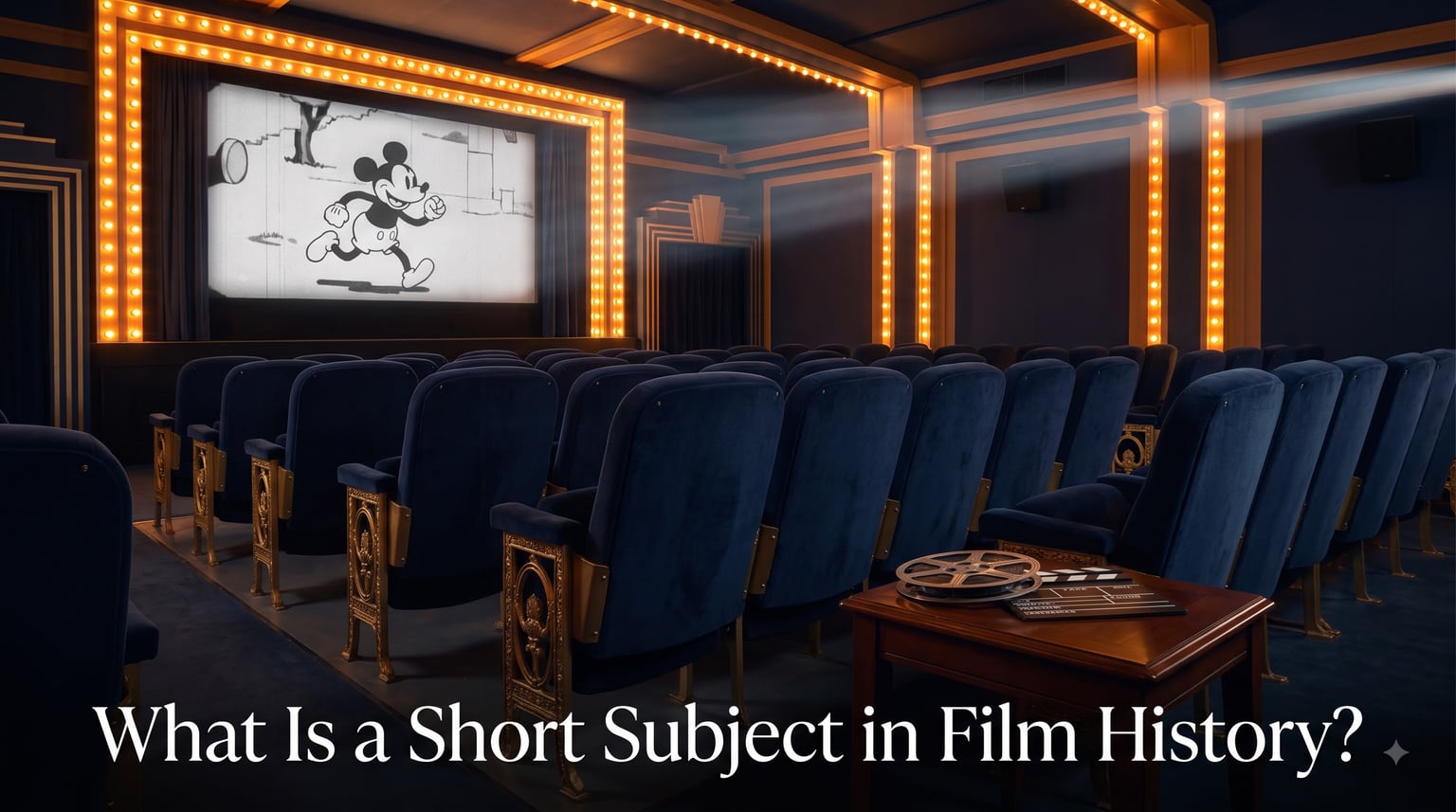
I still remember watching a black-and-white cartoon before the main feature at a small-town cinema when I was eight years old. The projectionist had spliced in a classic Tom and Jerry before whatever family film was showing, and that surprise opening reel made a bigger impression on me than the feature itself. Years later, when I started researching film history, I realized that this small ritual was the last gasp of a tradition that had shaped cinema for almost seventy years.
If you have ever wondered what a short subject in film history actually means, you are not alone. The term carries a specific historical weight that goes beyond simply describing any short movie. In this guide, I will walk you through the origins, golden age, decline, and modern revival of the theatrical short subject, drawing on the same sources and definitions used by film scholars and the Academy of Motion Picture Arts and Sciences.
By the end, you will understand how a one-reel comedy, an animated cartoon, and a Saturday serial chapter all belonged to the same family of films, and why that family matters more than most film lovers realize.
Table of Contents
- Quick Definition: What Is a Short Subject?
- Short Subject vs Featurette vs Short Film: Key Differences
- Origins in Late 19th Century Cinema
- The Golden Age of Short Subjects (1920s-1950s)
- Animated Shorts: A Studio Showcase
- Serials and Chapter Plays
- Decline and Transition: The Television Era
- The Modern Era: Short Film Revival
- Film Festivals and Distribution Today
- Frequently Asked Questions
- Conclusion
Quick Definition: What Is a Short Subject?
A short subject is a short film produced for theatrical exhibition, typically running 40 minutes or less and shown before the main feature at movie theaters. The term was used predominantly in the United States from the 1920s through the 1970s to describe one-reel or two-reel 35mm films that accompanied feature presentations.
AMPAS Official Definition
The Academy of Motion Picture Arts and Sciences defines a short film as an original motion picture that has a running time of 40 minutes or less, including all credits. Anything longer is classified as a feature film for Academy Award eligibility purposes.
The phrase “short subject” emerged because studios and exhibitors needed a clean label for the smaller films that filled out a theatrical program. A typical cinema bill in the 1930s might include a newsreel, an animated cartoon, a comedy two-reeler, a chapter from a serial, and a feature-length drama. Every one of those supporting items, except the feature itself, was called a short subject.
Three terms often get tangled together in this conversation: short subject, short film, and featurette. They overlap but they are not identical. Understanding the differences is the key to reading film history accurately.
Short Subject vs Featurette vs Short Film: Key Differences
The terminology evolved alongside the technology of projection. In the United States, exhibitors measured films by the number of 35mm reels they contained. A standard reel ran roughly 10 to 12 minutes, so the reel count gave every film a built-in runtime.
Here is how the three main terms compare.
| Term | Typical Runtime | Format | Era of Common Use | Exhibition Context |
|---|---|---|---|---|
| Short subject | 10 to 40 minutes | One or two 35mm reels | 1920s to 1970s (US terminology) | Shown before features in cinemas |
| Featurette | 30 to 45 minutes | Three or four 35mm reels | 1930s to 1950s (US industry term) | Mid-program filler; promotional companion to a feature |
| Short film | Under 40 minutes (AMPAS) | Any format; digital or film | 1970s to present (general term) | Festivals, streaming, online platforms |
A short subject is the historical US industry term, while “short film” is the broader modern label used everywhere from Cannes to YouTube. Featurettes occupied a peculiar middle ground during the studio era. They were too long to feel like filler but too short to anchor a full program, so they often appeared as part of a roadshow presentation or as a promotional companion to a major release.
Outside the United States, this reel-based vocabulary never took hold in the same way. British, French, and German filmmakers simply used their own words for short and medium-length films, which is one reason the phrase “short subject” feels distinctly American.
Origins in Late 19th Century Cinema
Cinema began with shorts. The very first films were short subjects by default, because the technology of the 1890s could not hold much more than a minute or two of footage on a single strip. Every pioneer of the medium was, technically, a short subject filmmaker.
The Lumière brothers held their first public screening in Paris on December 28, 1895. Films like Workers Leaving the Lumière Factory and Arrival of a Train at La Ciotat ran roughly 50 seconds each. Across the Atlantic, Thomas Edison and William Kennedy Laurie Dickson were developing the kinetoscope, a peep-show device that played short loops of celluloid for individual viewers. Both approaches treated the moving image as a novelty: short, repeatable, and built for curiosity rather than story.
Within a few years, filmmakers started pushing past the one-minute limit. Georges Méliès, a former stage magician, used stop tricks and painted sets to stretch his films into elaborate fantasies. His 1902 masterwork A Trip to the Moon ran about 14 minutes, an astonishing length for its time, and proved that short films could carry narrative weight.
Edwin S. Porter’s The Great Train Robbery (1903) marked another turning point. At roughly 12 minutes, it used cross-cutting, location shooting, and a clear story arc. Exhibitors could finally program a short film that felt like a complete experience rather than a single scene.
By the late 1900s, the nickelodeon boom had taken hold in the United States. Small storefront theaters charged five cents for admission and showed a continuous program of one-reel shorts, often five or six in a row. The entire film industry in 1908 was built on shorts. There were essentially no feature films yet.
The first cracks in that system appeared between 1912 and 1915, when ambitious directors like D.W. Griffith began producing longer works such as The Birth of a Nation (1915). These longer films reshaped exhibition, but they did not kill the short. For the next half century, shorts and features coexisted on the same bill.
The Golden Age of Short Subjects (1920s-1950s)
The 1920s through the 1950s are widely considered the golden age of the short subject. By the early 1920s, the major studios had organized dedicated short subject departments that produced comedies, cartoons, newsreels, serials, and travelogues on a reliable weekly schedule. These departments were profitable, factory-like operations that gave filmmakers a place to experiment and stars a way to build audience loyalty.
Vitaphone and the Coming of Sound
Warner Bros. launched its Vitaphone shorts in 1926, originally as sound-on-disc musical accompaniments to silent features. The famous 1927 feature The Jazz Singer used Vitaphone technology for its synchronized dialogue scenes, but the format also powered a flood of short musical performances and vaudeville acts that played alongside features throughout the late 1920s.
By the early 1930s, sound had become standard. Shorts adapted quickly. Comedy two-reelers, animated cartoons, and musical acts all switched to optical sound, and the short subject became a vital testing ground for new sound technologies and storytelling techniques.
Comedy Shorts and the Stars They Built
Hal Roach Studios produced some of the most beloved comedy short subjects of the era. Hal Roach’s Our Gang series, launched in 1922, ran for over 220 shorts and introduced generations of child actors to moviegoers. The series was later reissued as The Little Rascals for television syndication, where it found an even larger audience.
Charlie Chaplin’s Little Tramp character appeared in dozens of shorts and features between 1914 and the mid-1920s. Even after Chaplin moved to features, he continued producing occasional shorts, including the 1967 documentary-style work A King in New York.
The Three Stooges, originally called Ted Healy and His Stooges, started in shorts in the early 1930s and became one of the longest-running comedy short subjects in history. Between 1934 and 1959, Columbia Pictures released 190 shorts starring the trio, an output that made them a permanent fixture of mid-century moviegoing.
Newsreels, Travelogues, and Pete Smith
Every major studio produced a newsreel throughout the golden age. Fox Movietone News, Pathé News, and Universal Newsreel all produced weekly one-reel summaries of world events that audiences watched before the feature.
MGM’s Pete Smith Specialties offered a different kind of short subject. Hosted and narrated by Pete Smith, these comedic and instructional one-reelers ran from 1931 to 1955. They won several Academy Awards and helped popularize an offbeat, conversational style of short documentary. Warner Bros. produced a similar series called Joe McDoakes, starring George O’Hanlon as a bumbling everyman.
Travelogues offered audiences armchair journeys to distant places. Studios like Warner Bros., Paramount, and MGM produced dozens of these one-reel nature and culture films per year, often shot in lush Technicolor to contrast with the black-and-white features they accompanied.
Animated Shorts: A Studio Showcase
Animated short subjects were the crown jewels of studio shorts departments. They allowed for unlimited visual invention, ran on reliable production schedules, and consistently won Academy Awards. By the late 1930s, the animated short had become its own prestige category at the Oscars.
Walt Disney’s Silly Symphonies series, launched in 1932, ran for 75 shorts and introduced the Technicolor animation that became standard across the industry. Steamboat Willie (1928) introduced Mickey Mouse, and Flowers and Trees (1932) won the first Academy Award for Best Animated Short Film.
Warner Bros. built its Looney Tunes and Merie Melodies series into a satirical alternative to Disney. Directors like Tex Avery, Friz Freleng, Chuck Jones, and Bob Clampett created characters including Bugs Bunny, Daffy Duck, Porky Pig, and Tweety Bird. Many of these shorts ran under seven minutes but packed in more jokes per second than almost any feature.
MGM’s animation department, led by animators William Hanna and Joseph Barbera, produced the Tom and Jerry series starting in 1940. These shorts won seven Academy Awards before MGM shut down its cartoon studio in 1957, after which Hanna and Barbera moved to television and built the empire behind The Flintstones and Scooby-Doo.
By the late 1940s, the so-called “limited animation” technique, which used fewer drawings per second and relied on stronger storyboards, helped studios cut costs. This is the style that powered the golden age of theatrical cartoons, and it explains why so many classic shorts look noticeably different from later television animation.
Serials and Chapter Plays
Serials, also called chapter plays, were a distinctive branch of the short subject format. Each serial was released as a sequence of short chapters, typically 15 to 30 minutes long, screened one per week at Saturday matinees. Audiences followed cliffhanger storylines that could run for 12 to 15 chapters.
Famous serials include The Adventures of Captain Marvel (1941), Flash Gordon (1936), Buck Rogers (1939), Batman (1943), and The Three Mesquiteers (1936-1943). Republic Pictures and Columbia Pictures dominated the format.
Serials were cheap to produce, aimed at young audiences, and operated as their own small industry within the studio system. They fed straight into the comic book culture of the 1940s, and many of their visual conventions influenced later adventure filmmaking.
Decline and Transition: The Television Era
By the late 1950s, the short subject was in serious trouble. The rise of television had changed audience habits, studio economics, and theatrical programming in ways that made the format increasingly hard to justify.
The core problem was simple. Movie theaters in the 1930s needed short subjects because they ran continuous programs. A typical 1938 bill might include a newsreel, a cartoon, a comedy short, a chapter from a serial, and a feature, which meant seven hours of programming from a single showtime. Television, by contrast, offered free programming at home. Audiences stopped coming to theaters as often, and exhibitors cut programs to save on prints, projection time, and rental fees.
The double feature, which had been a Depression-era response to weak attendance, began to disappear in the 1950s. Without the need to fill a long program, exhibitors cut shorts first. By 1955, MGM, Paramount, and RKO had already wound down their short subject departments.
The final blow came when the major studios sold their theatrical short libraries to television syndicators in the late 1950s. Our Gang, the Three Stooges, Looney Tunes, and the Disney shorts all became staples of local afternoon TV programming, where they reached far more viewers than they ever had in theaters.
By around 1969-1970, the era of the theatrical short subject was effectively over. Some studios continued producing shorts into the early 1970s, but by then the term had begun to fade from the industry vocabulary. New filmmakers and audiences shifted to “short film” as the standard phrase.
The Modern Era: Short Film Revival
The short film never really disappeared. It just changed venues. Beginning in the 1970s, a new generation of filmmakers turned to short films as a calling card, festival entry, and creative laboratory. By the 1990s, the format was back on its feet, supported by dedicated festivals, cable channels, and eventually online platforms.
MTV, which launched in 1981, helped reawaken audience appetite for short-form video. Music videos borrowed many of the visual languages developed for animated shorts and serials, and they convinced a new generation that short-form storytelling could be commercially viable.
Independent filmmakers built entire careers out of short films. Directors including Spike Lee, Jane Campion, Martin McDonagh, and Andrea Arnold first gained recognition through shorts before moving to features. Shorts served as both portfolio pieces and proofs of concept.
Disney and Pixar revived the animated short as a theatrical attraction. Pixar’s Tin Toy (1988) won the Academy Award for Best Animated Short Film and helped launch the studio. Subsequent Pixar shorts like Geri’s Game (1997), For the Birds (2000), and Bao (2018) continued the tradition, often playing before Pixar features.
Streaming platforms made short films more accessible than at any point since the 1930s. YouTube and Vimeo turned distribution into a free, instant process. ShortsTV launched as a dedicated short film cable channel. MUBI built a curated library. Netflix and Amazon began commissioning animated shorts as part of their original content slates.
Short subjects also shaped the visual language of new media. The TikTok format, the YouTube Short, and the Instagram Reel all inherit the same DNA as the one-reel comedy and the seven-minute cartoon. They are short, repeatable, and built for repeat viewing. The differences are technical, but the cultural function is recognizably the same.
Film Festivals and Distribution Today
The modern short film ecosystem runs on festivals, online platforms, and niche broadcasters. Three festivals stand out as career-making events for short filmmakers: the Clermont-Ferrand Short Film Festival in France, the Sundance Film Festival’s short film program in the United States, and Tropfest in Australia.
Clermont-Ferrand, founded in 1979, is the largest short film festival in the world. It runs an international competition, a market, and a residency program. Sundance includes a dedicated shorts section that has launched dozens of notable careers. Tropfest, founded in 1993, became a cultural phenomenon in Australia and inspired similar festivals in other countries.
Beyond festivals, dedicated platforms keep short films discoverable. ShortsTV operates as a cable and streaming channel focused entirely on short films. MUBI curates a global library. Vimeo remains the preferred platform for filmmakers who want full control over how their work is presented.
For modern audiences, the easiest way to watch classic short subjects is through archives and curated collections. The Library of Congress, the Museum of Modern Art, and the Academy Film Archive have all digitized large portions of their short film holdings. YouTube hosts many of the Looney Tunes and Our Gang shorts in restored form. Archive.org preserves thousands of public-domain and orphaned shorts.
Frequently Asked Questions
What is a short subject in film?
A short subject is a short film produced for theatrical exhibition alongside a feature film, typically running 40 minutes or less. The term was used primarily in the United States from the 1920s through the 1970s to describe one-reel or two-reel 35mm films shown before the main feature.
What is the difference between a short subject and a featurette?
A short subject is generally two 35mm reels or less (under 40 minutes), while a featurette historically referred to a film of three or four reels (roughly 30-45 minutes). Featurettes occupied a middle ground between shorts and full features during Hollywood’s Golden Age.
When did short subjects stop being shown before features?
Short subjects largely disappeared from theatrical programs by the late 1960s. The rise of television, declining double-feature programming, and studio budget cuts ended the era of regularly scheduled theatrical shorts by around 1969-1970.
Who were the most famous short subject directors?
Notable short subject directors include Charlie Chaplin (The Little Tramp), Hal Roach (Our Gang), Pete Smith (Pete Smith Specialties), Friz Freleng and Chuck Jones (Looney Tunes), Tex Avery (MGM cartoons), and Walt Disney (Silly Symphonies and Mickey Mouse shorts).
How long were short subjects?
One-reel shorts ran about 10-12 minutes, while two-reelers ran about 20-22 minutes. The Academy of Motion Picture Arts and Sciences (AMPAS) defines a short film as anything 40 minutes or less, including runtime credits.
Conclusion
So what is a short subject in film history? It is the format that built the film industry in the first place. Before there were feature films, every movie was a short. When features arrived, shorts stayed on as the supporting cast that filled out a theatrical program, introduced stars, tested new ideas, and won Academy Awards of their own.
Understanding the short subject means understanding how the movies we watch today came to exist. The Pixar short before a feature film, the festival darling that launches a director’s career, the YouTube clip that goes viral, all of them trace their lineage back to the nickelodeon one-reelers and the Hal Roach two-reelers of the early twentieth century.
If you want to keep exploring, I recommend starting with a single restored Looney Tunes short, a chapter from Flash Gordon, and one of Pixar’s modern shorts. Watch them in that order and you will see, in under an hour, almost the entire history of the short subject unfold.