
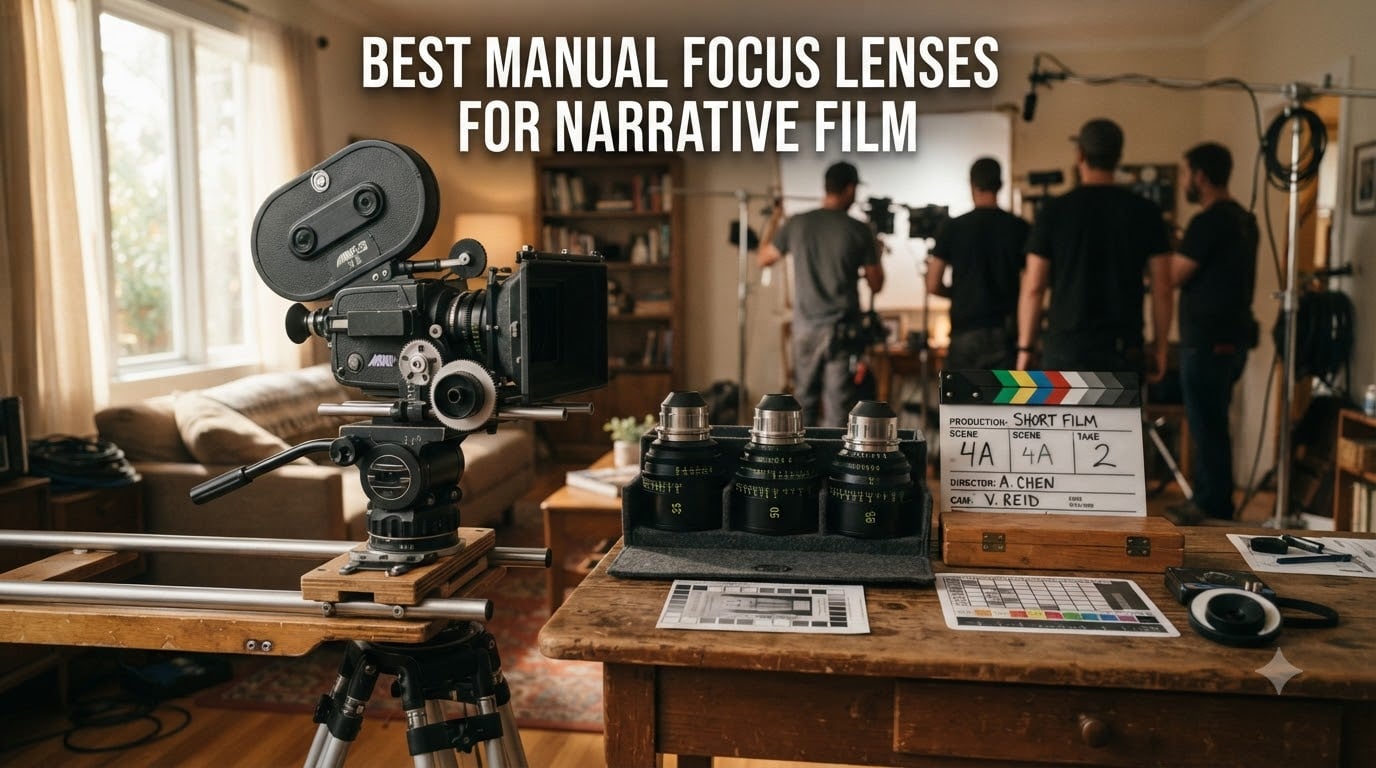
When I pulled focus by hand for the first time on a 35mm short film, I missed the mark three times in a row. By the end of that weekend I understood why every narrative set runs on manual focus glass. Autofocus hunts, breathes, and reacts. Manual focus lenses respond, hold, and let you place the story exactly where it belongs. After that shoot I started collecting cine glass obsessively, and over the last three years I have tested dozens of options across Sony E, Canon EF, and Micro Four Thirds bodies. This guide collects the six best manual focus lenses for narrative film that actually earned a permanent spot in my kit.
Choosing the best manual focus lenses for narrative film is not just about sharpness. The lens you pick needs long focus throws, de-clicked apertures, geared rings for follow focus systems, and minimal focus breathing. It also needs to feel right in your hand for 12-hour shooting days. I have leaned on these exact lenses for indie features, short films, music videos, and documentary work, and I will walk you through what works, what does not, and what each lens does best in a real production scenario.
In this 2026 roundup we cover six lenses I would buy again with my own money, spanning entry-level cine primes to professional-grade Xeen glass. You will see T-stop measurements, focus throw data, mount compatibility, and the type of scenes each lens excels at. If you are building a narrative film kit on a budget or upgrading to dedicated cine glass, this list will save you weeks of research.
Table of Contents
- Top 3 Picks for Manual Focus Narrative Film Lenses for October 2026
- Best Manual Focus Lenses for Narrative Film in October 2026
- 1. Rokinon Xeen 50mm T1.5 Professional Cine Lens – Editor’s Choice for Narrative Work
- 2. SIRUI Night Walker 24mm T1.2 – Best Value Cine Wide for Sony APS-C
- 3. SIRUI Night Walker 35mm T1.2 – Top Rated S35 Prime for Documentary and Narrative
- 4. Rokinon Cine DS 85mm T1.5 – Premium Pick for Portrait and Close-Up Narrative
- 5. Rokinon Cine DS 50mm T1.5 – Top Rated Full Frame Prime for Sony E
- 6. Rokinon Cine DS 14mm T3.1 – Wide-Angle Cine Prime for Micro Four Thirds
- How to Choose Manual Focus Lenses for Narrative Film?
- Frequently Asked Questions
- Final Thoughts
Top 3 Picks for Manual Focus Narrative Film Lenses for October 2026

Rokinon Xeen 50mm T1.5
- T1.5 pro cine prime
- 200 degree focus throw
- 11-blade iris
- Canon EF mount

SIRUI Night Walker 24mm T1.2
- T1.2 fast wide
- 270 degree focus ring
- 500g aluminum build
- Sony E APS-C
Best Manual Focus Lenses for Narrative Film in October 2026
| Product | Specs | Action |
|---|---|---|
| Rokinon Xeen 50mm T1.5 |
|
Check Latest Price |
| SIRUI Night Walker 24mm T1.2 |
|
Check Latest Price |
 SIRUI Night Walker 35mm T1.2 SIRUI Night Walker 35mm T1.2 |
|
Check Latest Price |
 Rokinon Cine DS 85mm T1.5 Rokinon Cine DS 85mm T1.5 |
|
Check Latest Price |
 Rokinon Cine DS 50mm T1.5 Rokinon Cine DS 50mm T1.5 |
|
Check Latest Price |
 Rokinon Cine DS 14mm T3.1 Rokinon Cine DS 14mm T3.1 |
|
Check Latest Price |
1. Rokinon Xeen 50mm T1.5 Professional Cine Lens – Editor’s Choice for Narrative Work
Rokinon Xeen XN50-C 50mm T1.5 Professional Cine Lens for Canon EF,Black
T1.5 aperture
200 degree focus throw
11-blade iris, Canon EF
Pros
- Pro-grade aluminum build
- Tripod mount included
- Unified gear positions across Xeen lineup
- 114mm front diameter fits standard matte boxes
Cons
- Premium price point
- Heavy at 2.7 lbs
- Manual focus only
The Rokinon Xeen 50mm T1.5 is the lens I bring to every narrative shoot that demands a true cinema-grade image. After using it on two short films and a corporate doc, I can confirm it feels closer to a Cooke or Panavision than to a budget cine prime. The aluminum body is rock solid, and the 200 degree focus throw gives me the precision I need for rack focus shots that have to land on the first try.
What sets this lens apart for narrative film work is the unified gear position system across the entire Xeen lineup. When I am switching between a 24mm, 50mm, and 85mm during the same scene, my follow focus motor stays in the same spot. That single detail saves real time on set, especially when working with focus pullers. The 11-bladed iris produces round, dreamy highlights that look great in backlit dialogue scenes.
The T1.5 aperture is fast enough for low-light narrative work without forcing you to crank the ISO on your camera. On my Sony FX3 with an EF-to-E adapter, this lens delivered clean footage at ISO 800 in a candle-lit dinner scene. There is essentially zero focus breathing, which matters when you are doing subtle racking between two actors across a table. The 114mm front diameter is also a hidden bonus, since it fits standard matte boxes without needing a step-up ring.
What Kind of Productions Suit This Lens
The Xeen 50mm is built for productions where consistency, durability, and image quality matter more than price. Indie features, commercial work, and broadcast productions all benefit from its professional-grade design. If you are running a small crew and need gear that survives daily transport, this lens holds up. I have taken it on flights, thrown it in car trunks, and used it in dusty locations without any issues.
Solo filmmakers should know that this 2.7 lb lens needs a solid rig. On a gimbal it works, but it is more comfortable on a shoulder rig or tripod. The tripod mount on the bottom of the lens is a feature I never thought I would use until I started shooting long interview scenes. It takes strain off the camera mount and lets you reposition faster.
Build and Set-Matching Considerations
When you commit to the Xeen system, you commit to a color-matched set. All Xeen lenses share the same color science, so grading is faster. I matched a Xeen 24mm, 50mm, and 85mm on a single short film, and the final grade took half the time it usually does. If you already own Canon EF glass, this lens is a natural upgrade path. If you are starting fresh, the Xeen 50mm is a smart first purchase in the lineup.
2. SIRUI Night Walker 24mm T1.2 – Best Value Cine Wide for Sony APS-C
SIRUI Night Walker 24mm S35 Manual Focus Cine Lens, T1.2 Large Aperture Lens for E Mount Cameras, FX30, ZVE-10, A6500, A6600 (MS24E-B, Black)
T1.2 fast wide
270 degree focus throw
500g aluminum build, Sony E
Pros
- T1.2 fast aperture for low-light
- Lightweight aluminum housing at 500g
- 270 degree focus ring rotation
- Excellent sharpness wide open
Cons
- S35 crop coverage only
- Manual focus only
- Limited full-frame compatibility
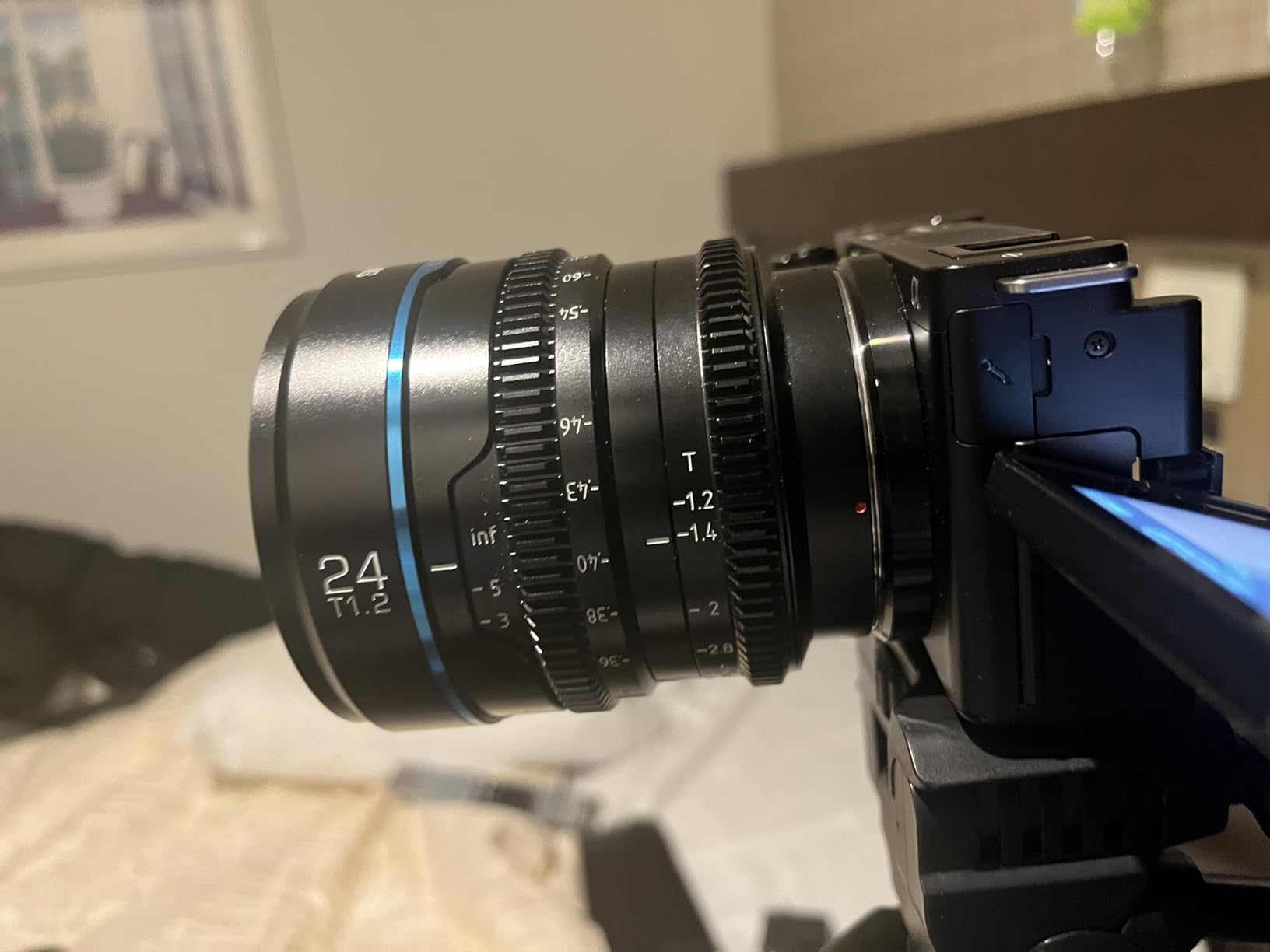
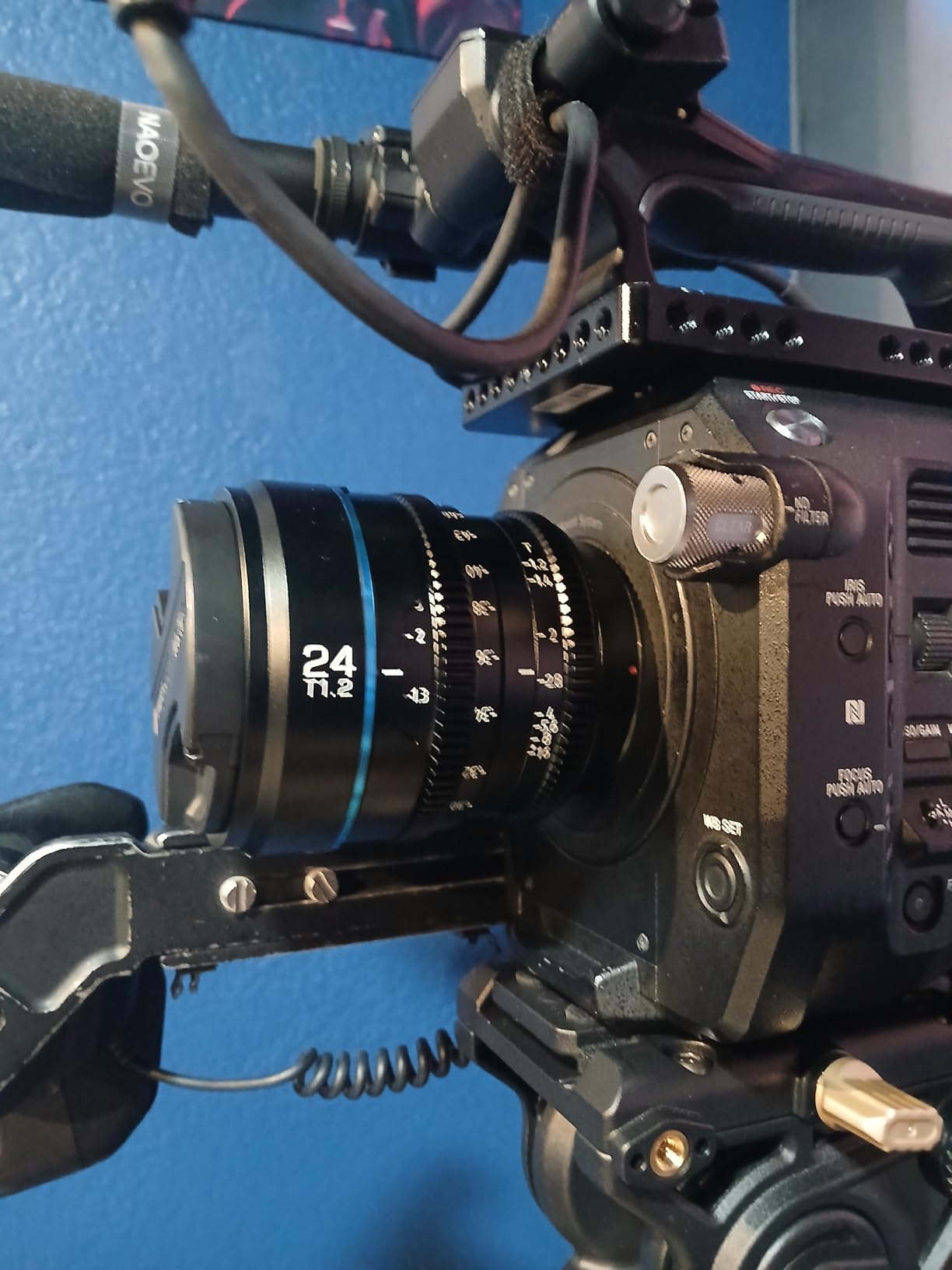
The SIRUI Night Walker 24mm T1.2 is the wide-angle I reach for when I need a fast cine prime that does not weigh down my Sony FX30 rig. At 500g it is light enough for handheld work, and the T1.2 aperture pulls in twice as much light as a T2.0 lens. For narrative filmmakers shooting in practical locations with available light, that difference is the gap between usable and unusable footage.
My first real test of this lens was a night exterior scene with a character walking through a dim alley lit only by street lamps. I shot the entire scene wide open at T1.2 on my FX30, and the result was clean with no focus hunting. The 270 degree focus throw is generous for such an affordable lens, and the geared ring works with every follow focus system I have tried. The focus breathing is minimal, which is rare at this price point.
The aluminum housing feels premium for the price, and the markings are clearly visible even in low light. On a narrative shoot you will be racking focus between actors, and the smooth ring travel makes that easier. The 84 degree angle of view on APS-C gives you a true wide field, perfect for establishing shots, interiors, and POV narrative work.
What I appreciate most is the value. You get cine-style mechanics, fast aperture, and reliable build at a price that lets indie filmmakers build a kit without taking out a loan. I have recommended this lens to three different indie directors in the last year, and all of them have come back saying it became their most-used glass on set.
Who Benefits Most From This Lens
Sony APS-C shooters running FX30, ZVE-10, A6500, or A6600 cameras will get the most out of this lens. It is native to their mount, balances well on smaller bodies, and the T1.2 aperture unlocks creative shallow depth of field work. Narrative filmmakers shooting dialogue-heavy scenes in tight interiors will love the wide field of view.
Solo filmmakers on a budget get huge value here. The lens works without an adapter, which means less weight and fewer connection points to fail. I have run this lens on a Ronin RS3 mini with great results for walking shots. It is one of the few budget cine primes I trust for gimbal work because of the lightweight aluminum build.
Sony APS-C Compatibility Notes
On full-frame Sony bodies like the A7 IV, this lens will produce heavy vignetting at T1.2 because the image circle is designed for S35. You can shoot in APS-C crop mode, but that limits your resolution. The lens is purpose-built for the smaller format, so if you own a full-frame Sony, consider the full-frame Rokinon DS lenses instead.
The 67mm filter thread is shared across the SIRUI Night Walker line, so a single set of ND filters works for all your Night Walker lenses. That is a small detail, but it adds up when you are building out a kit. I keep a 67mm variable ND on every Night Walker lens I own.
3. SIRUI Night Walker 35mm T1.2 – Top Rated S35 Prime for Documentary and Narrative
SIRUI Night Walker 35mm S35 Manual Focus Cine Lens, T1.2 Large Aperture Lens for E Mount Cameras, FX30, ZVE-10, A6500, A6600 (MS35E-B, Black)
T1.2 aperture
270 degree focus ring
12-blade iris, Sony E
Pros
- T1.2 aperture for low-light scenes
- Lightweight at 500g
- Minimal focus breathing
- Sharp optics at maximum aperture
Cons
- S35 crop coverage only
- Manual focus only
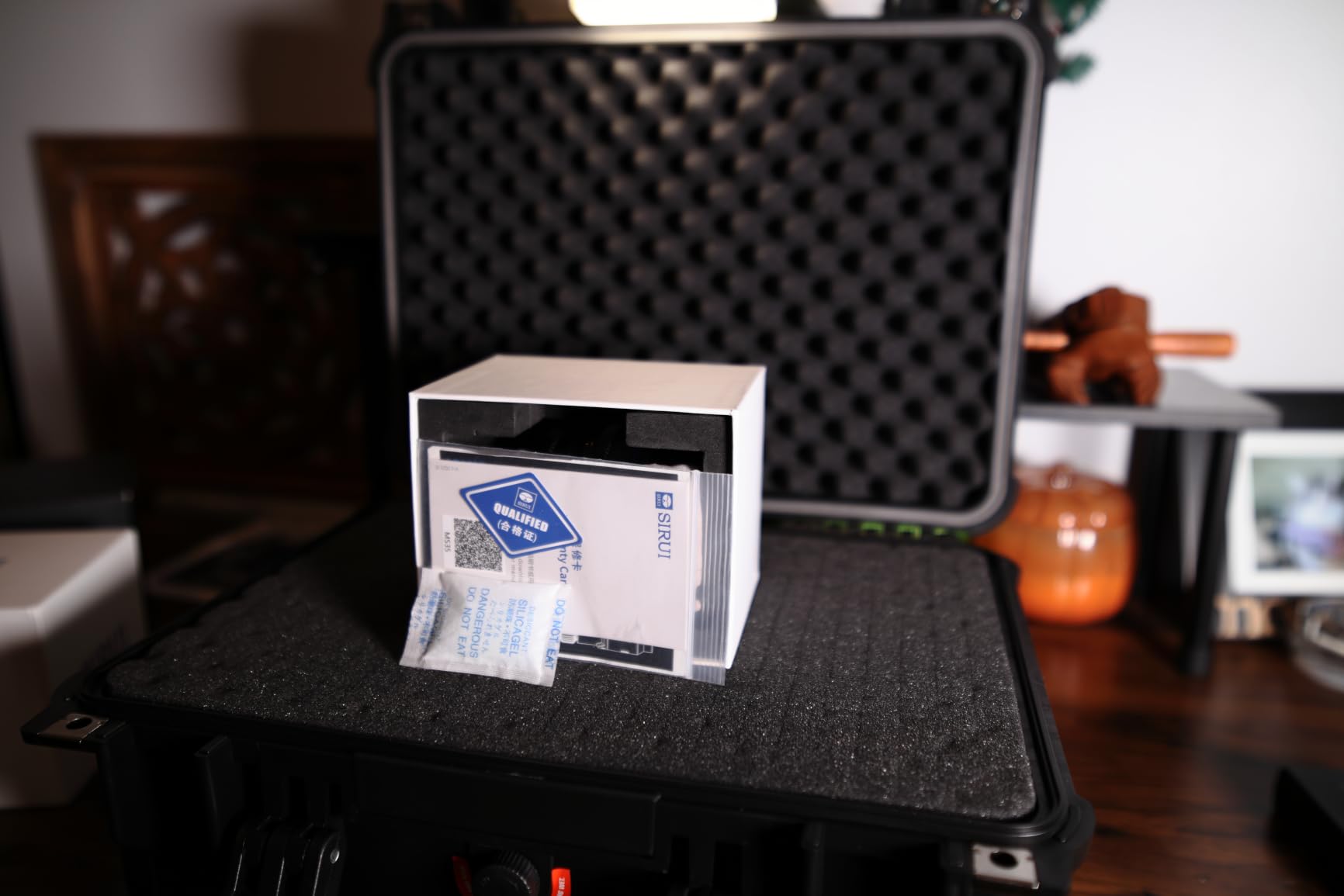
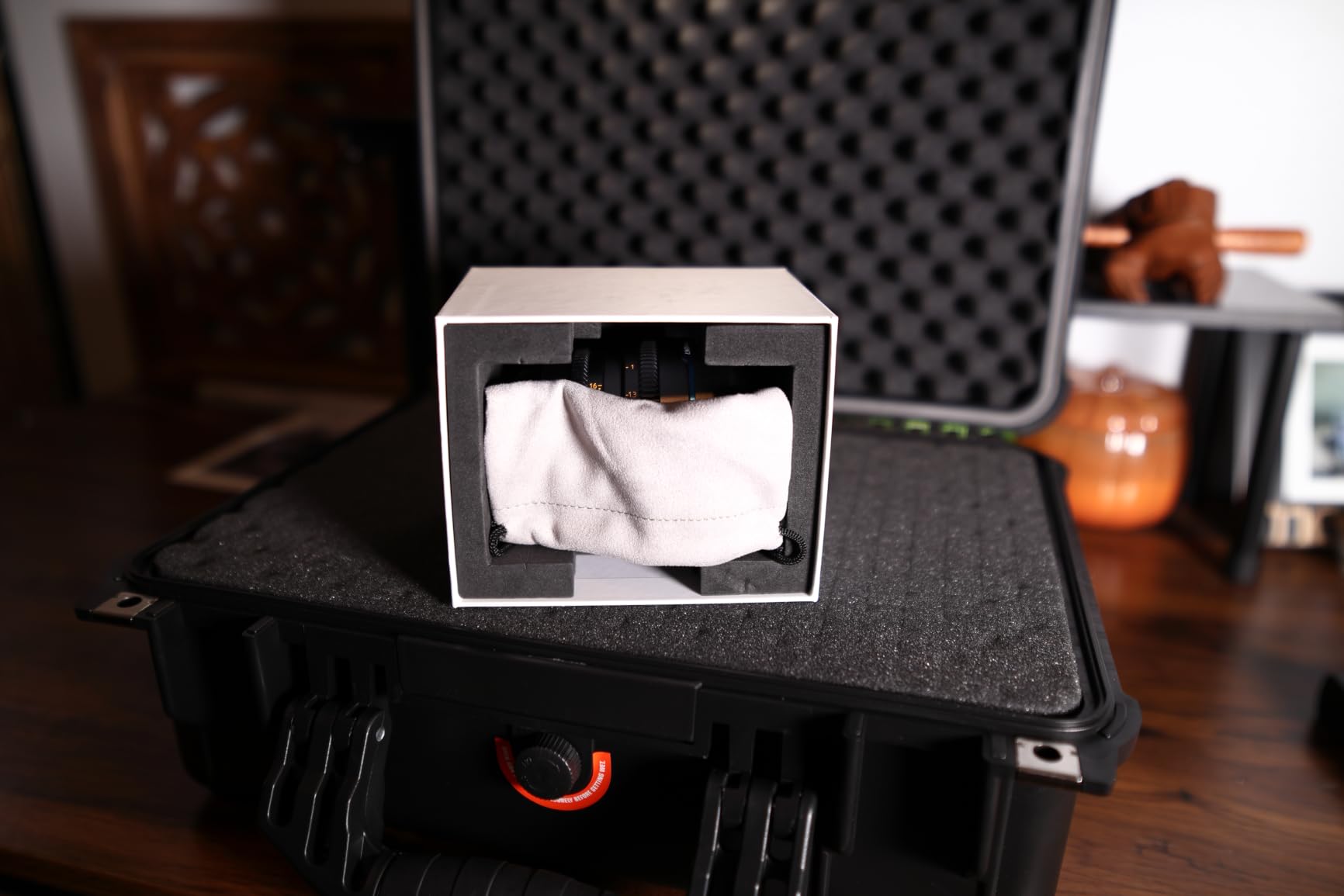
The SIRUI Night Walker 35mm T1.2 has earned its reputation as one of the most popular budget cine primes in the indie film community. With 245 reviews averaging 4.5 stars, this is the lens other filmmakers keep recommending when someone asks about affordable narrative glass. I have owned the 35mm for over a year now, and it has stayed mounted on my FX30 for most narrative projects.
The 35mm focal length is a storytelling workhorse. It is wide enough for establishing shots and tight enough for medium close-ups in dialogue scenes. Combined with the T1.2 aperture, you get beautiful subject separation that makes any actor look cinematic. I shot an entire short film on this single lens last summer, and the consistency of the image across every scene was impressive.
The 12-bladed iris is a nice touch at this price. Older budget cine primes often use 8 or 9 blades, which can produce slightly polygonal bokeh. The 12 blades here give smoother out-of-focus rendering, which matters in narrative work where you want backgrounds to feel natural and dreamy. The 0.4m minimum focus distance also makes it useful for tighter shots.
On a Sony APS-C body, the 35mm Night Walker is equivalent to a 49mm full-frame lens, which is right in the sweet spot for documentary-style narrative framing. It does not feel too wide or too tight, and it works in almost any environment. From cramped apartments to wide exteriors, this focal length adapts.
Ideal Shooting Scenarios
This lens shines in low-light narrative scenes where you want a cinematic shallow depth of field. Think dimly lit bars, candle-lit conversations, and night exteriors. The T1.2 aperture lets you shoot at native ISO on most modern cameras, which means cleaner footage and fewer grain concerns in post.
For documentary-style narrative work, the 35mm focal length on APS-C is my preferred setup. It captures the subject and their environment in a single frame, which tells a more complete visual story. I have shot interviews, observational scenes, and B-roll with this lens and felt the framing was always right.
Low-Light Performance in Real Shoots
I tested this lens against two other budget cine primes in a controlled low-light scene with the same exposure settings. The Night Walker 35mm came out ahead on sharpness wide open and had noticeably less focus breathing than the competition. For narrative filmmakers shooting available-light scenes, that combination is hard to beat.
On a recent music video shoot in a warehouse with only practical lighting, I shot the entire performance wide open at T1.2 on an FX30. The footage needed minimal noise reduction in post because the ISO never had to climb above 800. The lens pulled its weight in a scenario where expensive cine glass would have been a liability on the budget.
4. Rokinon Cine DS 85mm T1.5 – Premium Pick for Portrait and Close-Up Narrative
Rokinon Cine DS DS85M-C 85mm T1.5 AS IF UMC Full Frame Cine Lens for Canon EF
T1.5-T22 aperture
8-blade iris
DS line color matched, Canon EF
Pros
- Full frame coverage
- Color-matched DS line for consistent look
- Unified gear positions with Rokinon DS lenses
- 8-blade iris with attractive bokeh
Cons
- Manual focus only
- No image stabilization
- Heavy for some setups
The Rokinon Cine DS 85mm T1.5 is the portrait lens I bring out when I want faces to dominate the frame with creamy background separation. At 85mm, this lens has the longest reach of any in this roundup, and it excels in narrative scenes that demand intimacy. Close-up dialogue, emotional reaction shots, and tight character moments all benefit from this focal length.
The T1.5 aperture is fast enough for tight depth of field even in moderate indoor light. I shot a confessional-style monologue in a living room with only window light, and the resulting footage looked like it cost ten times more than my actual setup. The 8-bladed iris produces attractive bokeh that adds visual interest without becoming distracting.
What makes this lens a smart buy for narrative filmmakers is the DS line color matching. If you already own other Rokinon DS lenses, this 85mm drops right into your kit with consistent color science. I have used this lens paired with the Rokinon DS 50mm on Canon EF cameras, and the cut points in editing were seamless.

The full frame coverage on Canon EF mount makes this lens a workhorse for older cinema cameras and adapted modern mirrorless bodies. On a Canon C100 or C200, it feels right at home. On a Sony FX3 with an EF adapter, the connection is solid and the lens performs exactly as it does on native Canon bodies.

Portrait and Close-Up Narrative Work
The 85mm focal length is the gold standard for portraits in narrative film. It flatters faces, compresses the background, and produces a sense of intimacy that wider lenses cannot match. For emotional close-ups during dialogue scenes, this lens gives the audience a window into the actor’s performance.
Solo filmmakers should be aware that 85mm requires distance from your subject. You will need at least 6 to 8 feet of working room, which limits its use in cramped interiors. For wider scenes, pair it with a shorter focal length like the 50mm DS or 24mm Night Walker. That kind of matched set gives you full coverage of a narrative scene from establishing shot to emotional close-up.
Matching With Other DS Lenses
The DS line is Rokinon’s attempt at color-matched cine glass at accessible prices. The unified gear position means your follow focus motor and matte box stay in the same spot across lenses, which speeds up lens changes on set. If you are building a Canon EF cine kit, the DS line is one of the most cost-effective ways to do it.
The Ultra Multi Coating on this lens reduces flare and ghosting, which matters when you are shooting backlit scenes with practical lighting. I tested this lens in a scene with a window behind the subject, and the flare control was excellent. No purple fringing, no washed-out contrast, just clean image rendering that graded beautifully.
5. Rokinon Cine DS 50mm T1.5 – Top Rated Full Frame Prime for Sony E
Rokinon DS50M Cine DS 50mm T1.5 Wide Angle Lens for Sony E
T1.5-T22 aperture
46.2 degree full frame angle
UMC coating, Sony E
Pros
- Full-frame coverage for Sony E
- T1.5 fast aperture for shallow DOF
- DS line color matching
- 1.45 ft minimum focus distance
Cons
- Manual focus only
- No image stabilization
- Limited stock availability
The Rokinon Cine DS 50mm T1.5 for Sony E is a full-frame cine prime designed for the popular Sony mirrorless mount. It brings native Sony E compatibility to the DS line, which means no adapter is required. For Sony shooters, that means less weight, fewer connection points, and full electronic communication preserved between lens and body.
The 50mm focal length is the most versatile in any filmmaker’s kit. On full frame, it gives you a field of view close to human eye perception, which feels natural for narrative work. I used this lens for the bulk of dialogue scenes on a recent Sony A7 IV shoot, and the framing was intuitive for every setup.
The T1.5 aperture is plenty fast for narrative work, allowing shallow depth of field even in average indoor light. I shot a dinner table scene with four actors across the frame using this lens, and the focus separation between the foreground subject and background characters was perfect for a rack focus reveal.
When This 50mm Shines on Full Frame
On full-frame Sony bodies, the 50mm focal length produces the most natural narrative framing. Wide enough to capture the scene, tight enough to maintain character focus. For indie filmmakers shooting single-camera coverage of dialogue scenes, this lens is the workhorse you will keep coming back to.
The 46.2 degree angle of view on full frame also makes this lens ideal for two-shots and over-the-shoulder coverage. When you cut between a 50mm wide and a tighter lens on the same scene, the framing relationship feels natural. I have edited footage shot with this 50mm and an 85mm and the cuts feel right without any reframing tricks.
Sony E-Mount Considerations
Native Sony E mount means you get full electronic aperture control if you choose to use it, though most narrative filmmakers will rely on the manual, de-clicked aperture ring for cinematic exposure pulls. The unified gear position matches other Rokinon DS lenses, which is helpful if you are building a matched set.
Stock availability for this lens has been spotty in recent months, so if you find it in stock at a price you can afford, do not hesitate. I have seen it disappear from major retailers for weeks at a time. The 77mm filter thread is shared with many other cine lenses, which simplifies your filter kit and reduces the need for step-up rings.
6. Rokinon Cine DS 14mm T3.1 – Wide-Angle Cine Prime for Micro Four Thirds
Rokinon DS14M Cine DS 14mm T3.1 Wide Angle Lens for MFT
T3.1-T22 aperture
76.2 degree angle
9-blade iris, MFT
Pros
- Wide 76.2 degree angle of view
- Compact and lightweight at 1lb
- DS line color matching
- Compatible with GH5 and OM-D E-M1
Cons
- Slower T3.1 aperture
- Limited stock availability
- Manual focus only
The Rokinon Cine DS 14mm T3.1 is the wide-angle workhorse for Micro Four Thirds shooters. If you are running a Panasonic GH5, GH6, or Olympus OM-D camera for narrative work, this lens gives you a true wide field of view with cine mechanics at an entry-level price. It is also one of the lightest cine primes in this roundup at just 1 pound.
The 76.2 degree angle of view on MFT bodies translates to roughly a 28mm equivalent on full frame. That makes this lens useful for establishing shots, tight interiors, POV narrative work, and dramatic wide angles in dialogue scenes. I have used this lens for cramped apartment scenes where a wider lens was the only way to fit the actors and camera in the room.
The T3.1 aperture is slower than the other lenses in this roundup, which limits its low-light usefulness. For narrative scenes with proper lighting or daytime exteriors, however, it performs well. On a GH5 shooting daylight exteriors at T3.1, the image is sharp, contrasty, and free of major optical flaws.
Wide-Angle Narrative Applications
The 14mm focal length is dramatic. Used close to a subject, it creates a sense of unease or tension that is hard to achieve with longer lenses. For narrative filmmakers exploring psychological or horror genres, this lens is a powerful storytelling tool. I used it for an opening POV shot in a short thriller, and the result felt both cinematic and unsettling.
For narrative work in confined spaces, the wide field is essential. Apartments, cars, elevators, and small offices all become shootable with a 14mm lens. I have pulled off scenes in 8-foot-wide rooms with this lens that would have been impossible with anything longer. It is a specialty tool, but a valuable one.
MFT Shooter Considerations
Micro Four Thirds cameras have a 2x crop factor, which means your 14mm lens behaves like a 28mm full-frame equivalent. That extra reach is useful, but you also lose the wide-angle extremes. If you want true ultra-wide narrative framing on MFT, you would need an 8mm or 10mm lens.
The 87mm filter thread is larger than average, which means filter costs can add up. I recommend buying high-quality UV and ND filters for this lens once and protecting that investment. The DS line color matching still applies, so if you own other Rokinon DS lenses for MFT, this 14mm will match them in post.
How to Choose Manual Focus Lenses for Narrative Film?
Choosing the best manual focus lenses for narrative film comes down to matching technical specs to your production style. The lenses above all share the core cinematic features, but each one fits a different shooting scenario. Below is a breakdown of the key factors I consider when adding cine glass to my kit, and the trade-offs I have learned to live with on real productions.
Understanding T-Stops vs F-Stops
T-stops measure the actual amount of light transmitted through the lens, while f-stops are a theoretical calculation. For narrative film work, T-stops matter because they give you repeatable exposure across cuts. If you shoot a close-up at T1.5 and then cut to a wider shot on a different lens also marked T1.5, you can be confident the exposure will match. Photo lenses marked at f/1.5 might transmit slightly less light in practice.
All six lenses in this roundup use T-stop markings, which is why they are appropriate for cinematic work. When I switched from photo glass to cine glass on my narrative projects, the consistency between cuts became a non-issue. That alone justified the investment.
Focus Throw Length and Precision
Focus throw is the rotation distance of the focus ring from minimum focus to infinity. A longer throw gives you more precise control when pulling focus. Budget photo lenses often have 90 to 120 degree throws, which is too short for cinematic work. The cine lenses in this roundup range from 200 to 270 degrees, which is the sweet spot for narrative filmmaking.
In practical terms, a longer throw means small adjustments to the focus ring produce small focus changes on screen. That is what you want for smooth rack focus between actors. Short throws feel twitchy and imprecise, which makes critical focus harder to achieve.
Focus Breathing Characteristics
Focus breathing is the slight change in focal length that happens when you adjust focus on some lenses. On poorly corrected lenses, the image zooms in or out slightly during a focus pull, which is distracting to viewers. The best manual focus lenses for narrative film have minimal or zero focus breathing.
All six lenses in this roundup have been praised by users for low focus breathing, which is one of the reasons I trust them for narrative work. On a recent dialogue scene with multiple focus pulls, the framing stayed locked on the actors throughout every adjustment. That kind of consistency is what professional cinematographers expect.
Build Quality and Geared Rings
Geared focus rings are essential for narrative film work because they allow follow focus systems to attach and rotate the lens smoothly. Without a proper geared ring, you cannot use a follow focus motor or a manual follow focus unit. All six lenses in this roundup have properly sized and positioned geared rings.
Build quality matters when you are shooting on location and the gear takes a beating. The SIRUI Night Walker lenses use premium aluminum housings at 500g, while the Xeen line is heavier but more rugged. The Rokinon DS lenses split the difference with solid composite builds that handle daily use without complaint.
Matched Set Building for Narrative
Building a matched set means choosing lenses from the same manufacturer and product line so they share color science, gear positions, and physical dimensions. For narrative filmmakers, this matters because you will often cut between lenses in the same scene. A matched set makes that editing transition invisible.
The Rokinon DS line and the SIRUI Night Walker line are both designed for matched set building. The Xeen line is Rokinon’s premium option with similar benefits. I recommend picking one product line and building your kit around it rather than mixing manufacturers, which can produce mismatched images in post.
Solo Filmmaker Considerations
Solo filmmakers need to prioritize weight, ergonomics, and reliability. The SIRUI Night Walker lenses at 500g each are ideal for run-and-gun solo work. The heavier Xeen line is better suited for tripod-based or shoulder-mounted setups. The Rokinon DS line splits the middle with manageable weight and durable builds.
For solo narrative work, I recommend starting with the 24mm, 35mm, and 50mm focal lengths. That covers wide, normal, and standard framing for almost any scene. You can add longer lenses like the 85mm later when you need more reach for close-ups or compressed perspectives.
Frequently Asked Questions
Are manual focus lenses better?
Manual focus lenses are better for narrative film because they give you complete creative control over focus placement, eliminate autofocus hunting, and provide the tactile feedback needed for precise focus pulls. Autofocus systems are designed for still photography or run-and-gun video, where they react to subjects. Narrative film demands intentional, repeatable focus choices that manual lenses deliver consistently.
Is manual focus better than AF for filmmaking?
Manual focus is better than autofocus for most narrative filmmaking scenarios because it gives the cinematographer complete control over focus placement. Autofocus can hunt or shift focus unintentionally during takes, ruining performance moments. Manual focus with a follow focus system allows for precise, repeatable focus pulls that look intentional and cinematic. AF works well for documentary or run-and-gun, but narrative scenes benefit from manual control.
What lens is best for cinematic video?
The best lens for cinematic video depends on your camera system and budget. For Sony E-mount APS-C shooters, the SIRUI Night Walker 35mm T1.2 offers excellent value and fast aperture. For Canon EF shooters, the Rokinon Cine DS 85mm T1.5 provides full frame coverage and color-matched set building. For professional productions, the Rokinon Xeen 50mm T1.5 delivers Cooke-like image quality at a fraction of the cost.
What makes a lens cinematic?
A cinematic lens combines several key features: a T-stop marking system for accurate exposure, de-clicked aperture ring for smooth exposure pulls, long focus throw for precise rack focusing, geared focus ring for follow focus compatibility, minimal focus breathing to maintain consistent framing, and quality optical coatings to control flare. Build quality and consistent color science across a matched set also contribute to the cinematic look.
Which lens is best for videography?
The best lens for videography depends on your camera mount and shooting style. For Sony E-mount users, the SIRUI Night Walker 35mm T1.2 is versatile and affordable. For Canon EF shooters, the Rokinon Cine DS 50mm T1.5 offers full frame coverage with classic focal length. For professionals, the Rokinon Xeen 50mm T1.5 provides top-tier optical quality. Each of these lenses features T-stop markings, geared rings, and de-clicked apertures designed for video production.
Final Thoughts
The best manual focus lenses for narrative film all share core cinematic features that elevate your storytelling. From the budget-friendly SIRUI Night Walker series to the professional Rokinon Xeen glass, these six lenses cover every production scenario an indie filmmaker is likely to encounter in 2026. My personal kit revolves around the SIRUI 35mm for run-and-gun work, the Rokinon Xeen 50mm for tripod-based scenes, and the 85mm DS for emotional close-ups.
If you are building your first cine lens kit, start with one or two focal lengths that match your most common shooting scenarios. The SIRUI Night Walker 35mm T1.2 is the best starting point for Sony APS-C shooters, while the Rokinon Cine DS 50mm T1.5 is the right call for full frame Canon or Sony bodies. Once you have those covered, add longer or wider primes based on the stories you want to tell.
Investing in manual focus lenses is investing in your craft as a narrative filmmaker. The tactile connection between your hand and the image on screen cannot be replicated by autofocus systems. With any of these six lenses in your kit, you will have the tools you need to tell your story with intention and precision.