
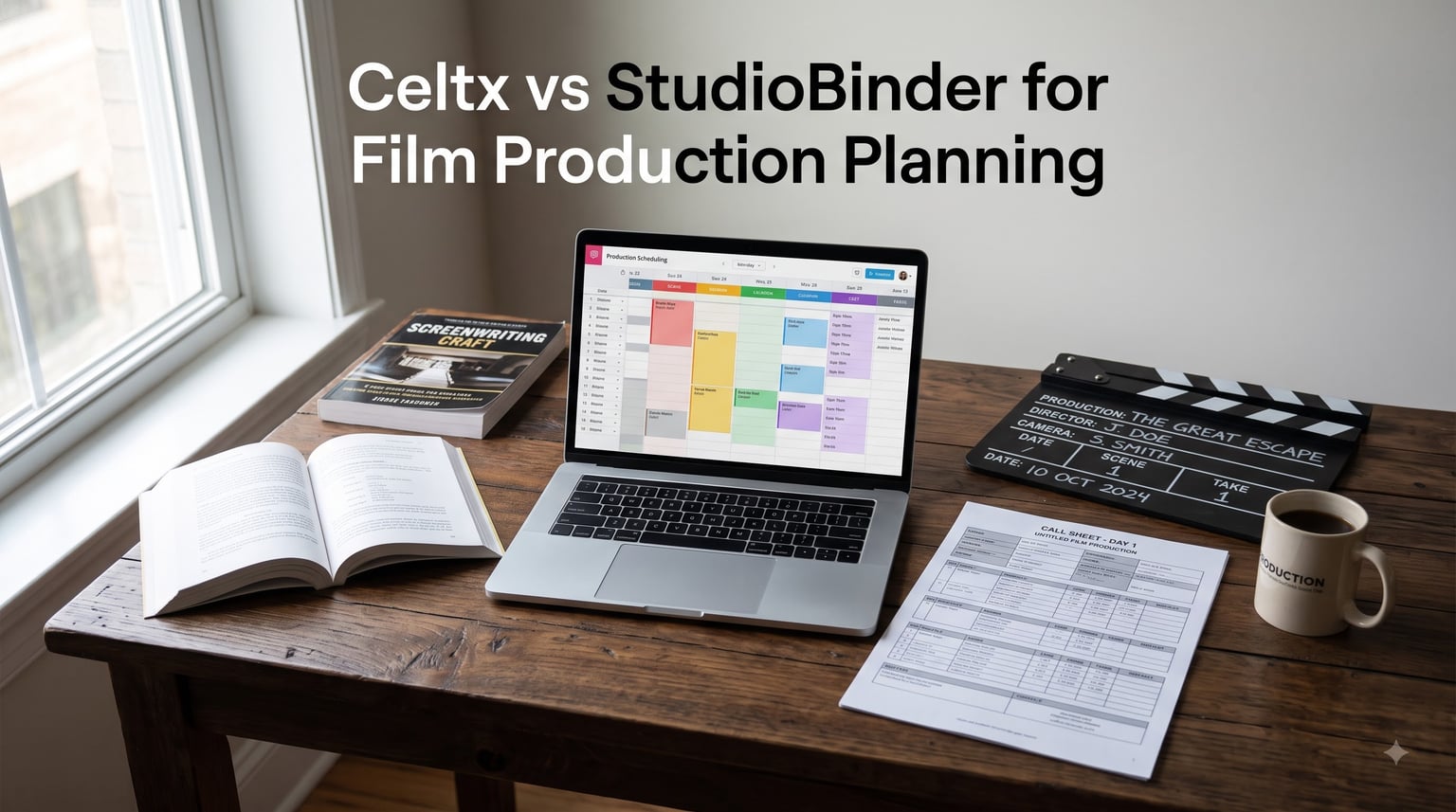
Every short film lives or dies in pre-production. That is why the Celtx vs StudioBinder for film production planning debate never settles: both tools promise to carry you from script to set, but they split the job very differently.
I have planned shorts on both platforms, and our team at Short Film Central keeps both subscriptions active because different projects demand different workflows. This guide packs in what we learned, plus what working filmmakers report in Reddit and Stage32 threads.
The short version: Celtx is the all-in-one pipeline where your script drives breakdowns, schedules, and line-item budgets automatically. StudioBinder is the logistics specialist — its breakdown-to-call-sheet chain is the best in this class, and professional AD teams lean on it for exactly that.
One warning before you compare feature lists. The biggest decision factor is not price or feature count — it is the call sheet. If your production sends daily call sheets to a crew, StudioBinder’s workflow is hard to beat. If your production needs budgeting tied to the script, Celtx is the only one of the two that does it.
Neither tool writes your script for you, and that matters more than any subscription. The software handles scheduling and communication; the craft still has to come from you. So alongside the head-to-head comparison, we review the two screenwriting books our team keeps within arm’s reach during every prep cycle.
Both platforms are cloud-based, so schedules and call sheets reach your crew on any device with a browser. We tested the desktop experience through two full prep cycles and the mobile browser view on set during a recent short.
Plenty of filmmakers we tracked use both tools, split by function — write and break down in one, schedule and distribute in the other. That is a valid answer too, and the buying guide below shows you exactly when it makes sense.
Here is the plan: a quick overview table up top, full reviews of both books with real reader feedback, a buying guide built around how productions actually fail, and direct answers to the questions filmmakers search most in October 2026.
Table of Contents
Film Production Planning in October 2026
Celtx wins for solo writer-directors and small teams who want script, schedule, and budget in one connected place. StudioBinder wins for teams that live and die by call sheets and crew communication. Everything else in this decision hangs off those two sentences.
| Product | Specs | Action |
|---|---|---|
 Screenwriter’s Bible, 7th Edition Screenwriter’s Bible, 7th Edition |
|
Check Latest Price |
 Scriptnotes by John August and Craig Mazin Scriptnotes by John August and Craig Mazin |
|
Check Latest Price |
Think of your stack in two layers. The craft layer is where the script gets written; the logistics layer is where the script becomes a schedule. Celtx and StudioBinder fight over the logistics layer, while the two books above cover the craft layer.
The books are not software substitutes. One teaches structure and industry-standard formatting from the ground up, and the other delivers working-screenwriter judgment drawn from more than 700 podcast episodes. Getting both layers right is what separates finished shorts from abandoned folders.
On the software side, both tools advertise free access with real limits. Celtx’s free tier has tightened repeatedly over the years, while StudioBinder’s free plan covers basics but caps projects quickly. Test the free tier of whichever tool matches your deciding document before paying for anything.
A quick word on ratings, since we lean on them throughout: both books hold a 4.8 out of 5 on Amazon, one across more than 1,500 reviews and the other across a smaller but enthusiastic base of readers. Those are strong numbers for reference books, which rarely score that high.
Now let us look at each book in detail, starting with the one that belongs on every first-time director’s desk.
1. The Screenwriter’s Bible, 7th Edition – The Craft Foundation
Screenwriter’s Bible, 7th Edition: A Complete Guide to Writing, Formatting, and Selling Your Script
462 pages
7th edition
Five-part structure
8.5 x 11 inch format
Formatting and marketing guides
Pros
- Comprehensive writing-to-selling guidance
- Workshop exercises and writing prompts
- Updated with current industry information
- Examples from successful and failed scripts
- Covers character development and dialogue
Cons
- Some readers may prefer a more academic approach
- Hefty desk-reference format at 2.5 pounds
I keep two copies of The Screenwriter’s Bible — one on my desk and one in my production bag. Across 462 pages, David Trottier walks you from first idea to a script you can actually sell, and the sequencing is what sold me. Nothing jumps ahead of itself.
I came to it backward, picking it up only after a festival reader flagged formatting problems in a draft I thought was clean. That feedback stung, and this book was the fix. Six months later the same script placed in two festivals.
The book breaks into five sections: a writing primer, scene writing, a workbook, a formatting guide, and a marketing plan. When I am stuck on a scene, I go straight to the workbook. When a formatting question comes up mid-draft in Celtx, the formatting guide settles it in minutes instead of a forum rabbit hole.

The formatting guide is the section I use most alongside production software. Celtx and StudioBinder both automate industry-standard formatting, but automation only helps if you know what the standard is. This book teaches the why behind the margins, sluglines, and transitions, so the software becomes a speed tool instead of a crutch.
The character development and dialogue chapters are stronger than I expected from a formatting-forward book. Trottier treats dialogue as a craft skill with drills rather than pure talent, and the drills transfer directly to table reads with your cast before shoot days.
The exercises and prompts earn their space too. Our team ran a weekend workshop using the writing prompts before drafting our last short, and two of those exercises survived all the way into the shooting script.
Selling guidance closes the loop. Most production planning articles stop at the schedule; this book carries through to querying and pitching, which matters when your short is a calling card for the next project.
It is not perfect. Some readers who want an academic, theory-heavy approach find it too practical, and at 2.5 pounds with an 8.5 by 11 inch page size, it is a desk reference rather than a commute read. Plan your shelf space accordingly.
Who Should Pick This Up
First-time directors get the most value here. New filmmakers weighing Celtx vs StudioBinder for film production planning should lock down formatting fundamentals before choosing software, because the tool decision gets easier once you know what a professional script looks like on the page.
Film students benefit just as much. Celtx is common in film school curricula thanks to educational pricing, and this book pairs naturally with classroom assignments and first shorts alike.
Skip it if you already have three produced features and a manager. At that point you know the format, and the marketing sections will read as review rather than revelation.
It also suits writers who work outside film. Several readers note the scene-writing and workbook sections transfer cleanly to plays and audio scripts, a nice bonus for multidisciplinary creators.
How It Works With Celtx and StudioBinder
Use it as the reference that sits beside your software. Draft in Celtx or your preferred editor, then check the formatting guide when something looks off. During prep, the marketing-plan section helps you package the script for backers before you build a single stripboard in StudioBinder.
Keep the formatting guide bookmarked during your first Celtx breakdowns. When you tag elements in the script, knowing the formatting logic helps you predict how scenes will strip onto the schedule.
Because this seventh edition was expanded and updated with current industry information, the standards it teaches match what both platforms output today. You will not spend months unlearning habits from an outdated printing.
Our verdict after two prep cycles: if you buy one book this year, make it this one. It is the cheapest insurance you can get against formatting mistakes that make a script look amateur before page one.
2. Scriptnotes by August and Mazin – Working Writer Judgment
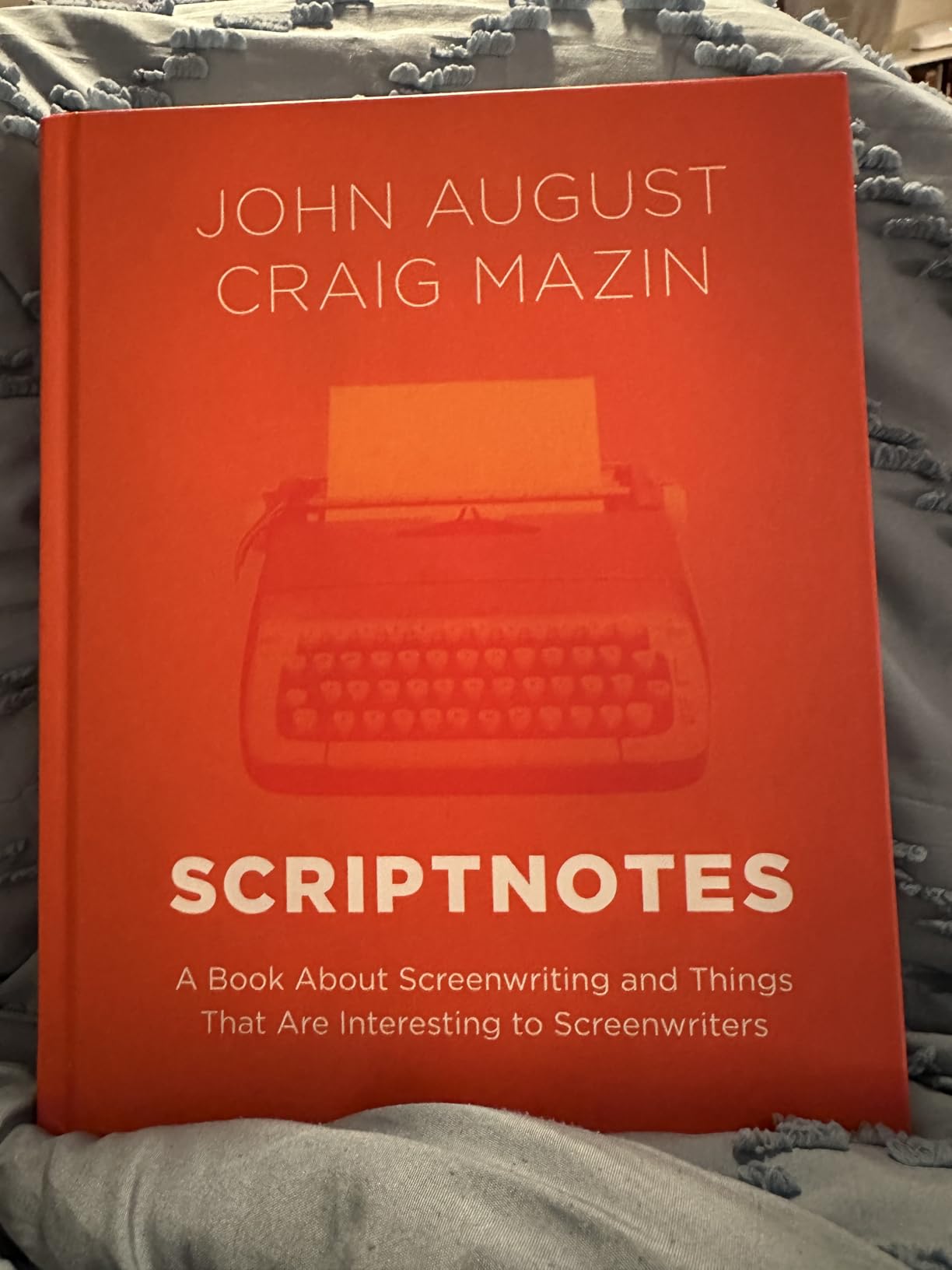
Scriptnotes: A Book About Screenwriting and Things That Are Interesting to Screenwriters
352 pages
Hardcover
700+ podcast transcripts
Thematic chapters
Hollywood craft insights
Pros
- Written by working Hollywood screenwriters
- Practical advice instead of academic theory
- Insights from Nolan and Gerwig and Rian Johnson
- Modular format for quick reference
- Entertaining and fun to read
Cons
- Structure lacks a unifying theory
- Reads like a collection rather than a linear guide
Where the Screenwriter’s Bible teaches structure, Scriptnotes teaches judgment. John August and Craig Mazin are working Hollywood screenwriters, and the book curates 352 pages from more than 700 episodes of their podcast. It reads like sitting in while two professionals argue about craft, because that is literally what it is.
What surprised me is how modular it is. Chapters are organized by theme, so when I needed perspective on rewriting during a tight prep window, I read that chapter in a single sitting and skipped everything else. It respects that working filmmakers do not have spare hours.
The tone is the differentiator. Where craft books can feel like homework, this one feels like mentorship. I have re-read the rewriting chapter three times, and it earns a re-read every single time.
It carries a 4.8 rating from a smaller pool of early readers, and the consensus matches mine: practical, funny, and free of rigid formula. The contributions from filmmakers like Christopher Nolan, Greta Gerwig, and Rian Johnson add range without turning the book into celebrity fluff.
The Die Hard breakdown is the standout for production-minded readers. Tracing how choices in a produced script ripple into what a crew actually shoots will change how you write scenes you cannot afford to film on a short’s budget.
For teams, this is the book I hand to co-writers before we open Celtx. It aligns everyone on story instincts first, so the breakdown and scheduling phase starts from a script that is actually worth scheduling.
The honest criticism from readers is fair: it can feel like a collection rather than a linear guide, and there is no single unifying theory. If you want a step-by-step curriculum, start with the Screenwriter’s Bible and come back to this once you have a draft.
Format and Reading Experience
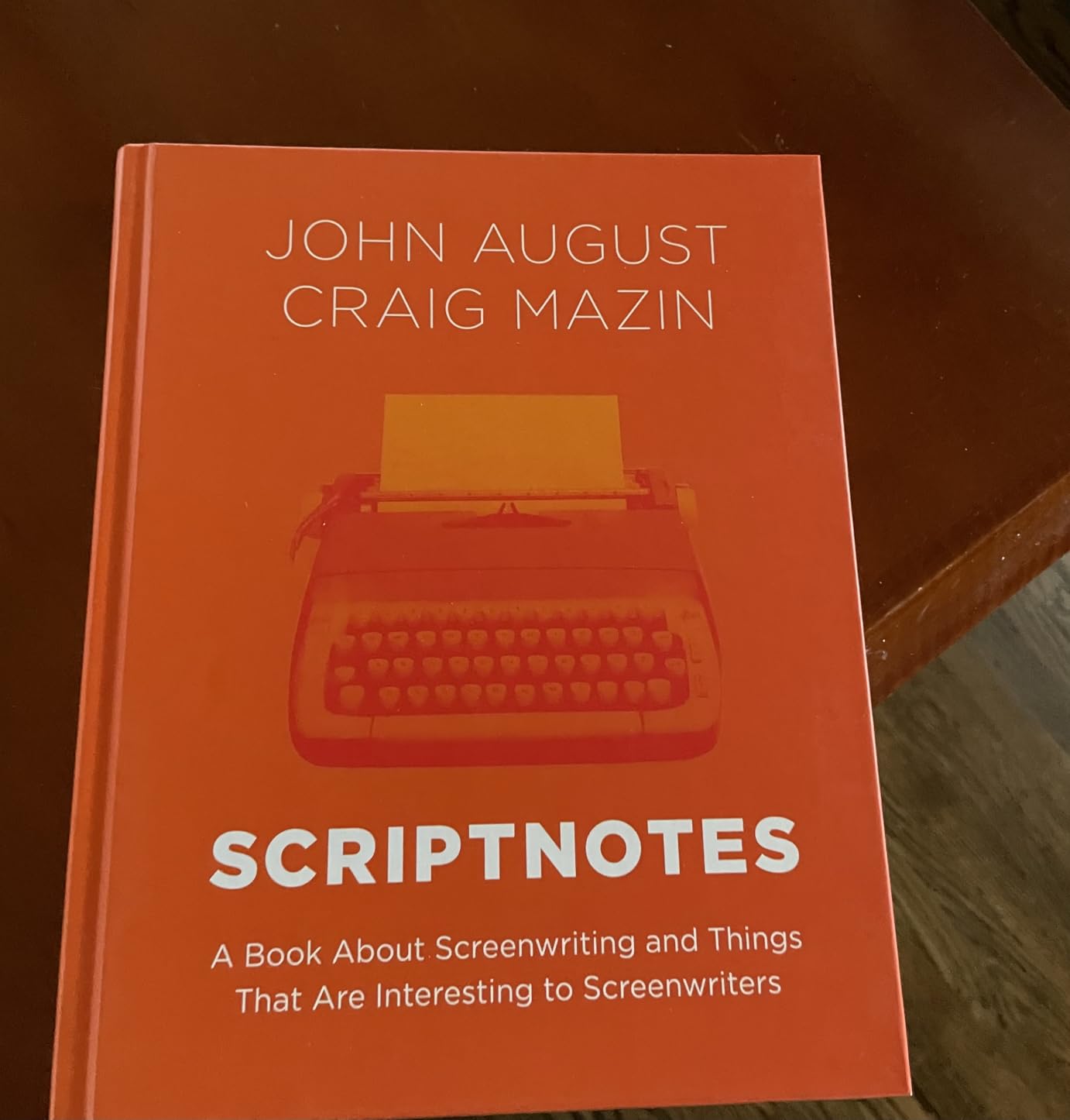
The hardcover build is solid, with quality paper and binding that survive being passed around a small crew. At 352 pages, it is a one-weekend read cover to cover or a dip-in reference if you go modular like I do.
It was published in December 2025, so the craft conversations reflect how writing rooms operate right now, not a decade ago. For a book about a living industry, that freshness counts.
Do not expect exercises. This is a reading book, not a workbook — pair it with the Bible’s workbook sections if you learn best by doing rather than reading.
How It Fits a Celtx or StudioBinder Workflow
Read it before you commit to a production calendar. The book pushes you to settle story decisions early, and every decision made before scheduling saves a re-breakdown in Celtx or a re-striped schedule in StudioBinder later.
It also explains why some writers keep a dedicated screenwriting app open beside StudioBinder. As Reddit users point out, StudioBinder is not really designed for writing screenplays — it formats and saves to PDF, but drafting happens better elsewhere.
If your short is dialogue-heavy, this is the one to read twice. August and Mazin spend real time on how conversations reveal character, which is the difference between a short that plays and one that just looks good.
The two books split the job cleanly: Bible for the format and the plan, Scriptnotes for the taste and the judgment. Together they cost less than a single month of most production software and outlast every subscription you will ever buy.
How to Choose: Celtx vs StudioBinder?
Pick StudioBinder if call sheets and crew logistics run your life. Pick Celtx if you want script, schedule, and budget in a single connected pipeline. Here is the framework our team runs through when a new project starts.
1. Start With the Document You Cannot Get Wrong
A call sheet is the daily notice telling every crew member where to be, when, and what scenes are shooting. A stripboard is the drag-and-drop schedule grid ordering your scenes across shoot days. A script breakdown is the tagging of every element — cast, props, locations — inside your screenplay.
If distributing accurate call sheets is your responsibility, StudioBinder is the stronger tool. Professional filmmakers and AD teams consistently rank it first for this exact job in the forum threads we reviewed.
Celtx covers call sheets too, but the experience is one module inside a bigger suite rather than the core of the product.
2. Script-to-Schedule Automation
Celtx builds its whole pitch on the script driving everything downstream. Tag elements once and the breakdown flows into scheduling without re-entering data. StudioBinder’s chain runs from breakdown to schedule to call sheet with strong collaboration tracking along the way.
One producer quote from our research sums up the friction: Celtx Studio feels slower than StudioBinder, and customizing breakdown details means clicking through a maze of separate windows. Automation saves re-typing, but it can cost you clicks.
3. Budgeting Requirements
This is the cleanest differentiator in the whole comparison. Celtx ships line-item budgeting tied to your breakdown; StudioBinder does not offer a budgeting module at all.
If your production needs script-informed budgets and you want them in one tool, the decision makes itself. If you already track money in a spreadsheet, the gap matters far less than it first appears.
4. Team Size and Onboarding
StudioBinder earns praise for collaboration tracking — who has opened a call sheet, who has confirmed. The trade-off reported by users is a learning curve for new team members.
Celtx supports real-time collaboration and is common in film schools, so student crews often already know it. If your team turns over between projects, prior familiarity matters more than any feature list.
5. Free Tiers and Real Costs
Both tools advertise free access, and both cap it. Celtx’s free tier has tightened repeatedly over the years, which long-time users bring up constantly. StudioBinder’s free plan works for testing the interface but limits projects fast.
Producers on Reddit report the same pattern: subscribe for the production window, then cancel after wrap. Three months of prep-to-wrap beats a forgotten annual renewal every time.
6. Mobile and On-Set Workflow
Both platforms are cloud-based and run in a browser, so call sheets and schedules reach phones without an app store download. Distribution works well on mobile for both.
Neither is a good writing environment on a phone. Draft on a laptop, distribute from wherever you are standing.
7. Planning a No-Budget Short
For a first short with no money behind it, keep fixed costs at zero. Run the free tier of whichever tool matches your deciding document, buy one craft book instead of a year of software, and subscribe only for the weeks you are actually in prep or production.
That approach also answers the most common beginner question we see: use Celtx if the script is the production, and use StudioBinder if the crew is the production. A five-person crew shooting over one weekend needs less software than the fear suggests.
The Honest Weaknesses on Both Sides
Celtx has drawn repeated complaints about compatibility and format issues at the end of production — problems that surface exactly when you can least afford them. Export early and check your PDFs before the final week.
StudioBinder’s weakness is the mirror image: it is a production management tool, not a screenwriting tool. Ask a writer to draft in it and they will bounce back to a dedicated editor within a day.
Frequently Asked Questions
Do professionals use StudioBinder?
Yes. Working producers, assistant directors, and production coordinators use StudioBinder for crew logistics, and forum discussions consistently rank it first for call sheet creation and distribution. It is strongest on productions with a crew to coordinate, though writers typically draft scripts in a dedicated screenwriting tool instead.
What are some good alternatives to StudioBinder?
The main alternatives are Celtx for an all-in-one script-to-budget pipeline, Assemble for production coordination, and a simple pairing of Final Draft or WriterDuet with spreadsheets when you only need writing plus basic scheduling. Pick based on the document that matters most to your production.
What are some good alternatives to Celtx?
StudioBinder is the strongest alternative when call sheets and scheduling are your priority. For pure screenwriting, Final Draft and WriterDuet are popular picks, and Assemble covers production coordination for teams that outgrow the Celtx module structure.
What is the best software for writing movie scripts?
For pure writing and industry-standard delivery, dedicated screenwriting tools like Final Draft and WriterDuet lead. Celtx is the best choice when the script must drive breakdowns, schedules, and budgets, since it connects writing directly to production planning. StudioBinder formats and exports to PDF but is not built as a primary writing environment.
Is Celtx or Final Draft better?
Final Draft is better for professional script delivery and format fidelity, which is why it remains the studio standard. Celtx is better when one subscription needs to cover writing, breakdowns, scheduling, and budgeting. Many filmmakers draft in one and plan in the other, or use Celtx alone on smaller projects.
Final Verdict: Celtx vs StudioBinder for Film Production Planning
There is no universal winner. Celtx is the better pick for writer-directors and small teams who want script, breakdowns, scheduling, and budgeting connected in one place. StudioBinder is the better pick the moment daily call sheets and crew confirmation drive your production.
Whichever way you go, the script comes first. Pair your software with the Screenwriter’s Bible for structure and formatting, and Scriptnotes for working-writer judgment — then plan your shoot with confidence in 2026.
Check current availability on both books above, subscribe to the tool that matches your deciding document, and get your short into production.